
by editor | Jul 17, 2014 | Place-based Education
Place-based Education:
Listening to the Language of the Land and the People
By Clifford E. Knapp,
Professor Emeritus, Northern Illinois University
 Introduction
The intersection of place and education has occupied much of my teaching even though this field has not always been called place-based education. I began my career in 1961 as a high school science teacher. When I took my students outside to plant and identify trees, build nature trails, and predict weather, I described what we did as outdoor education. In 1972 when I taught seventh grade science we took field trips to the local water and sewage treatment plant, a geology museum, and a forest to study tree management practices. I described this as environmental education. Before I retired from teaching in 2001 as a professor in the Teaching and Learning Department of Northern Illinois University, I took my graduate students to a local bookstore to learn about its role in the community, on a walk in the business district to study architectural styles, and to an arboretum to observe tree damage from pollution. Only then, did I describe this way of teaching as place-based education.
In all three of these examples, I used the place and people in the community as living textbooks to teach parts of the curriculum that were best learned in context through direct experiences. I did this because I believed in experiential education and knew these people and places were the best teachers. The places in these communities were strong factors in my choices of what and how to teach. I viewed the curriculum through a lens that magnified opportunities to involve my students in authentic and engaging interactions with a more expansive classroom. Place-based education is an old idea and at the same time it is a new term and movement that evolved from its predecessors. This modern approach to teaching incorporates the best of the best practices, as educators understand them today.
David Sobel (2004) a pioneer in the field, described the term as “the pedagogy of community, the reintegration of the individual into her homeground and the restoration of the essential links between a person and her place” (p. ii). The first time the term was used in the United States was in his book and on a cover designed by The Orion Society (1998). Over time, place/education approaches have sported different names. This idea of teaching about the local environment has been called nature study (Wilson, 1916), bioregional education (Traina & Darley-Hill, 1995), ecological education (Smith & Williams, 1999), environment as an integrating context for learning (EIC) (Lieberman & Hoody, 1998), a pedagogy of place (Hutchison, 2004), and community-based education (Smith & Sobel, 2010). More recent names include contextual teaching and learning (Sears, 2002), watershed education (Michael, 2003) and life-place education (Berg, 2004). Another emerging synonym is environment-based learning.
All of these terms describe programs demonstrating how local places contribute to curriculum and instruction in schools and other educational institutions. Sometimes other descriptors are used to explain why extending education into the community is simply a good teaching technique. For example, in an article appearing in the Harvard Educational Review in 1967 the authors labeled their plan for school reform “a proposal for education in community” (Newmann and Oliver, 1967, pp. 95-101). The school building was where teachers planned, set objectives, and taught basic literacy skills to students. They went into the community to visit factories, art studios, hospitals, libraries and other laboratories to generate learning. The third part of their proposal was the in-school seminar where local “experts” helped students reflect on and apply what they learned in the community laboratories. In that same year the National Council for the Social Studies (Collings, 1967) issued a publication titled, How To Utilize Community Resources. It was designed to help teachers learn from their communities. In 1970 the National Science Foundation funded a curriculum project titled, Environmental Studies for Urban Youth (ES). “The student determines and investigates whatever is of interest to him within the available learning environment, both inside and outside the classroom” (Romey, 1972, p. 322).
Naming or labeling a teaching method or philosophy may make the idea easier to communicate to others, although it sometimes creates confusion about what that term really means. Jonathan Sime cautions: “The concept of place is reaching the early stages of academic maturity. Undoubtedly, there are confusions in the way the concept is used at present” (In Hutchinson, 2004, p. 12). This article defines place-based education, pedagogy of place, and sense of place. It gives examples of different types of educational programs having common characteristics at their core and explains why place-based education is an important educational reform. To provide historical perspective, I describe the Progressive Education reform movement in the United States, Great Britain, and other countries about 100 years ago. Finally, I compare that movement with the place-based education movement of today. My hope is to provide useful information, but mostly I want to stimulate your curiosity by raising questions. Niels Bohr, atomic physicist, told his students, “Every sentence that I utter should be regarded by you not as an assertion but as a question” (In Klose, 2009, p. 768). My hope is that my words will help you connect to places through a greater understanding of their educational potential.
Looking Back at Place-based Learning
Long ago, before schools were invented to educate the young, children learned from their families and from others in their communities. If they wanted to learn a trade, they apprenticed and were taught by a skilled master. If they wanted to cook, sew, and clean, they gained these skills from their parents. Comenius (1592-1670), an educational reformer, wrote: “We should learn as much as possible, not from books, but from the great book of Nature, from heaven and earth, from oaks and beeches” (In Quick, 1890, p. 77). Rousseau (1712-1778), a Swiss/French philosopher, believed: “His [the ideal boy’s] ideas are confined, but clear; he knows nothing by rote, but a great deal by experience. If he reads less well than another child in our books, he reads better in the book of nature” (In Quick, 1890, p. 118). Pestalozzi (1746-1827), a teacher from Zurich Switzerland stated, “nature offers the succession of impressions to the child’s senses without any regular order” (In Quick, 1890, p. 184). Throughout the history of schooling many educational reformers advocated for direct experiences in the community as a way to improve how students learned important knowledge. Later, when schools were established, instruction became more separated from the community and less experiential and practical educators today continue to offer school reform proposals in hopes of finding better ways to teach and learn.
The Progressive Education Movement
Public education has long been a contested arena in societies around the world. People continue to hold different views about how to educate students and what is important for them to know. When people become discontented with how schooling is conducted, they suggest educational reform. In the United States, beginning as early as the 1870s (Pinar, Reynolds, Slattery, & Taubman, 1995), a new progressive movement challenged the way students were educated. Critics did not like the way meaningless routines, rote memory, long recitations, regimentation, and passive learning characterized traditional education. There is no agreement on the exact dates of the progressive reform movement in the United States, but most historians agree that it flourished from the 1890s to the 1930s (Hines, in Squire, 1972). The Progressive Education Association was founded in 1919 and disbanded in 1955. Progressive Education was not a unified movement. At least three types were identified: 1) “child-centered, or children’s interest and needs approach”, 2) “the creative values approach”, and 3) “the social-reconstructionist approach” (Hines in Squire, 1972, p. 118).
John Dewey was one of the leading proponents of the child-centered approach in the United States. He also was known outside the country through his books, articles, and lectures. He promoted experiential education: “Experience [outside the school] has its geographical aspect, its artistic and its literary, its scientific and its historical sides. All studies arise from aspects of the one earth and the one life lived upon it” (1915, p. 91). He also wrote, “The teacher should become intimately acquainted with the conditions of the local community, physical, historical, economic, occupational, etc., in order to utilize them as educational resources” (1938, p. 40). Dewey outlined some common principles found in progressive schools: 1) promoting expression and cultivation of individuality (as opposed to imposition from above), 2) nurturing freedom of activity (as opposed to external discipline), 3) learning mainly through experience (as opposed to texts and teachers), 4) acquiring meaningful skills (as opposed to drill), 5) using the learning opportunities of present life (as opposed to preparation for a remote future), and 6) adapting to a changing world (as opposed to static aims and materials) (Macdonald, in Squire, 1972, p. 2). Progressive educators viewed the curriculum as ecological and linked to the broader community. Therefore it included what happened there as well as in the school building.
Whenever theoretical principles of a movement are briefly outlined like this, opportunities for misinterpretations are likely. This was true in the case of Dewey’s message and in much of the Progressive Education movement. Advocates for this movement point out how Dewey and other progressive educators were misunderstood (Squire, 1972; Wang, 2007; Tanner, 1997; Lauderdale, 1981). Because many educators interpreted Progressive Education differently and they discovered that implementing the theory and practice took hard work, the movement eventually lost power in the mainstream and was replaced by more traditional and abstract ways – mostly by transmitting knowledge through lectures and the written word. Progressivism never died out completely; it moved outside in the form of outdoor and experiential education (Knapp, 1994). In some cases, it re-emerged in schools (especially some private and charter schools) and nature centers. Some educators continue to implement progressive educational methods because they recognize that their students respond well to them. Do you know teachers and schools that could be called progressive today?
A Crisis of Place?
Why is a pedagogy of place important for educators to understand and implement? Some believe that today’s youth, especially in Western societies, are missing important connections to their surroundings. Phillip Sheldrake (2001) refers to this problem as a crisis of place characterized by “a sense of rootlessness, dislocation or displacement” (p. 2). Bill McKibben (1993) called this alienation from nature, rapid globalization, and loss of skills needed for self-sufficiency “a moment of deep ignorance, when vital knowledge that humans have always possessed about who we are and where we live seems beyond our reach. An Unenlightenment. An age of missing information” (p. 9). Laurie Lane-Zucker (as cited in Sobel, 2004) calls for a “fundamental reimagining of the ethical, economic, political, and spiritual foundations upon which society is based, and . . . this process needs to occur within the context of a deep local knowledge of place” (pp. i-ii). In a study of primary school children’s knowledge of natural and non-natural objects in the United Kingdom, the researchers found that after age 8, children could recognize more Pokemon characters than common local wildlife (Senauer, p. 7). “Few American schoolchildren can name more than a few of the plants or birds in their own neighborhoods, yet studies have shown the average American child can identify over one thousand corporate logos” (Michael, 2003, p. xii). Another indicator of “missing information” from today’s student knowledge base is that a recent edition of the Oxford Junior dictionary omitted many words related to nature. The following words have disappeared from the pages: dandelion, stork, otter, magpie, beaver, doe, minnow, wren and porcupine. They have been removed to make room for new words such as blog, broadband, and chatroom (River of Words personal e-mail communication, 2009). If you believe that today’s youth are in crisis by lacking connections to their local community, you may want to implement a pedagogy of place in your schools. One response to this crisis of place was the formation of the Children & Nature Network in 2006. Co-founders Richard Louv, author of Last Child in the Woods, (2008) and Cheryl Charles, former director of two leading environmental curriculum supplements (Project Learning Tree and Project WILD), led the way. Now the network is a strong force in promoting nature activities to combat “nature-deficit disorder” in the United States and Canada. I have attended the group’s national gatherings and find great energy and enthusiasm there.
A Pedagogy of Place
David Orr (1992) gives four reasons to integrate place into the educational curriculum. First, the study of a place requires teaching through “direct observation, investigation, experimentation, and application of knowledge” (p. 128). Experiential learning capitalizes on the rich content found in specific places. Problem-based learning in the context of place investigations has been shown to engage students actively and increase their understanding of required concepts. “Second, the study of place is relevant to the problems of overspecialization, which has been called a terminal disease of contemporary civilization” (Orr, 1992, p. 129). In other words, place involves the study of many interrelated disciplines. Place-based education demonstrates how knowledge from various content areas is needed to understand place at an ecological level. This is how learning originally occurred before educators divided up knowledge into separate and often unrelated compartments. Third, the study of place gives rise to many significant projects that serves to improve policy and practice in communities. These activities leading to more sustainable community practices can promote policy change related to “food, energy, architecture, and waste” (Orr, 1992, p. 129). Fourth, some view the destruction of local community life as a “source of the instability, disintegration and restlessness which characterize the present epoch” (Orr, 1992, p. 130). The study of place can serve to reeducate people in the art of living well where they are. To be an inhabitant there means a person who dwells “in an intimate, organic, and mutually nurturing relationship with a place” (Orr, 1992, p. 130). Do you know students who have a close relationship to where they live? Implementing a pedagogy of place enables educators to plan the instructional programs that spring from within the contexts of local areas.
A Sense of Place
My earliest contact with the concept of a sense of place came in the early 1970s from the artist Alan Gussow speaking at a conference. He described a place as a piece of the whole environment that was claimed by feelings (1974). This made sense because I learned best when I felt attracted to the content and saw it as meaningful to my life. I can remember special places from my childhood – the sandy beaches at the Atlantic Ocean, school athletic fields, a children’s camp, and the lakes and streams where I fished. I had feelings of excitement, joy, satisfaction, and security there. These places shaped my sense of self and eventually led to my career as a place-based educator. I agree with Hug’s (1998) definition that a “sense of place is the meaning, attachment, and affinity (conscious or unconscious) that individuals or groups create for a particular geographic space through their lived experiences associated with that space” (p. 79). Albert Camus described it this way: “Sense of place is not just something that people know and feel, it is something people do” (In Basso, 1996, p. 143). In order to have a strong sense of place a person has to been actively engaged in those places doing something important. This “doing” needs to raise a person’s level of awareness to a point that changes a person’s view of the place. How has your personal identity been influenced by the places you’ve been?
The idea of a sense of place is difficult to quantify, just like a sense of joy, sense of community, or sense of wonder are. However, this does not mean that the concept is not important. My sense of place is strong if I experience many positive feelings somewhere and it is weak if I feel disconnected to that place. However, there is a downside to being closely attuned to a place. If you move away or that place is harmed or destroyed you might feel sad or angry. When I was a child, I walked to school on a familiar path through a vacant lot of trees. I came to love some of the plants growing there, especially a plant called skunk cabbage. When that land was sold and a house built there, I felt a deep sense of loss and sadness. My special plant and path were gone. Losing a special place happened to me again as an adult. I live along a tree-lined river in my town. For years, I walked there to find peace and relaxation. I even built a trail and invited the community to share nature with me. I had fallen in love with that place because of the good feelings I found there. When the park district bulldozed the trees, leveled the land, and placed stone riprap on the shore, I felt another sense of loss of landscape. Whenever I go there I know my sense of place is violated. Have you ever lost a special place that had claimed your feelings?
Place and the Disciplines of Study
Disciplinary content in the study of place extends beyond art and education. According to Philip Sheldrake (2001) “place has become a significant theme in a wide range of writing including philosophy, cultural history, anthropology, human geography, architectural theory and contemporary literature” (p. 2). To this list Hutchinson (2004) added psychology and urban planning. Because place-based education includes many disciplines, it is well suited to being incorporated into much of the school curriculum. Gregory Smith (2002) described five different thematic patterns or models of place-based education in American schools. The first model, Cultural Studies, focuses on collecting information about the people living in an area. Students can interview these people and then write about their lives. The Foxfire program, begun in Georgia in 1966 by a high school English teacher, is one example of this model (Hatton, 2005). Many of these interviews and photographs became part of the Foxfire book series published by a major New York publishing company.
The second model, Nature Studies, emphasizes investigations of local natural phenomena. These studies lead to conservation and restoration projects to improve the local environment. Whenever one or more teachers in a school plan to teach students about their ecological addresses as well as their home addresses, they create a more knowledgeable citizenry. One example of this model is River of Words in Moraga, California (Michael, 2003). One project of this non-profit organization is promoting an international poetry and art contest for youth each year.
The third model, Real-world Problem Solving, involves the identification of community problems and issues. These problems and issues result from the clash between culture and nature. The student projects include learning about biology, physics, psychology, mathematics, economics, politics, and other subjects. One example of this model is promoted by Harold Hungerford and his colleagues at Southern Illinois University (Hungerford, Litherland, Peyton, Ramsey, & Volk 1996). Designed for middle school students (ages 10-14), this program helps students learn the steps for dealing with controversial place-based topics in the region.
The fourth model, Internships and Entrepreneurial Opportunities, explores the economic options available to students. Students examine various vocational possibilities by shadowing employees in local businesses or by taking on service learning assignments. The fifth model, Induction into Community Processes, allows students to become more involved in the life of the community’s decision-making processes by learning how local government works. By partnering with those agencies responsible for the day-to-day operations of a community, students become more engaged and responsible citizens. Smith’s five models show that place-based curricular reform takes several different forms. He identified some common elements in all models: 1) surrounding phenomena are the foundation for developing the curriculum; 2) students become creators of knowledge more than consumers of knowledge created by others; 3) students’ questions and concerns play a central role in what is studied; 4) teachers act primarily as “brokers” for connecting students to learning possibilities in the community; 5) separation between the community and school is minimized; and 6) assessment is based on how student work contributes to the well-being and sustainability of the community.
Implementing Place-based Education
It may be useful to envision what might happen if teachers or entire school staffs decide to implement place-based education. What might that look like in the lives of students, teachers, and administrators? All of these projections are based on some empirical studies, anecdotal evidence and my experience, but clearly more research is needed. For more information about the benefits of place-based education, I recommend reading Andrew Kemp’s (2006) chapter, “Engaging the environment: A case for a place-based curriculum” (pp. 125-142). Another reference is fact sheet #2 available from the University of Colorado at Denver (www.cudenver.edu/cye). Smith and Sobel’s book, Place- and Community-based Education in Schools (2010) gives a powerful rational for implementing this approach in schools.
The most obvious outcome of a well-taught place-based curriculum is that students develop a strong sense of place for where they live. They feel rooted and connected there. They know the history of their place and discover where to find beauty as well as blight. They have a better sense of their personal identities because there is a positive relationship between knowing your place and knowing yourself. Students grasp how the community officials make decisions affecting their daily lives. They also know more about the critical issues facing the local government and may get involved in some of them. Students become aware of their own ecological ethic and want to take steps to maintain the community’s sustainability into the future. They demonstrate a reverence for life and a love of nature and are motivated to care for local ecosystems. They want to learn more about their place because they experience the joy and satisfaction of learning relevant concepts, skills, and values. They find many opportunities to apply the concepts, skills and values learned at school. Students improve as team members as more and more community projects are completed cooperatively. They are able to move between the school building and the rest of the community with greater ease and confidence.
Because of the students’ enthusiastic responses to learning, teachers look forward to going to school each day. Teachers notice that their classroom climate has improved as a result of a curriculum that engages students. Teachers realize that the students are retaining information learned in meaningful contexts and scores on certain tests and other indicators are slowly rising. Teachers look better in the eyes of their administrators and receive more acknowledgements. They realize that students are learning about their place through a variety of disciplines, including mathematics, science, history, government, language, art, music, and physical education. Teachers are able to teach their students about higher order executive functions (habits of mind) such as asking better questions, critically analyzing, problem solving, and evaluating their own thinking processes through lessons about place. They set textbooks aside in favor of learning through direct experiences and new information found in the community. They lecture less and let the places and the residents do more of the teaching. Their main role is to facilitate learning more than transmit knowledge. Teachers gain confidence in their ability to build challenging curriculum from the rich contexts in their community and surrounding region. They feel like creative and innovative educators and not mere technicians of a scripted curriculum.
If all of these transformations became visible in students and teachers, school administrators will be deeply satisfied. They will receive frequent praise from parents and other members of the community for running a successful school. They will boast to their fellow administrators about a school reform that works. The positive school climate will reflect a healthy place to be. Place-based education will have contributed to helping the school fulfill its critical role in the community.
Theologian and geologian, Thomas Berry (2006) wrote: “Two things are needed to guide our judgment and sustain our psychic energies for the challenges ahead: a certain alarm at what is happening at present and a fascination with the future available to us if only we respond creatively to the urgencies of the present” (p. 17). I hope that you share some of the alarm I feel about today’s youth becoming alienated from their local natural and cultural worlds and will respond to the urgencies of the present with plans to teach more about your local places.
References
Basso, K. H. (1996). Wisdom sits in places: Landscape and language among the Western Apache. Albuquerque, NM: University of New Mexico Press.
Berg, P. (2004). Learning to partner with a life-place. (Reprint first appearing in Ecuador Dispatch #1, June 12, 2004).
Berry, T. (2006) Evening thoughts: Reflecting on earth as sacred community. San Francisco, CA: Sierra Club Books.
Collings, M. R. (1967). How to utilize community resources. Washington, D.C.: National Council for the Social Studies. (How To Do It Series—No.13).
Dewey, J. (1915). The school and society (Rev. ed.). Chicago, IL: The University of Chicago Press.
Dewey, J. (1938). Experience & education. New York: Collier Books.
Gussow, A. (1974). A sense of place. New York: Seabury Press.
Hatton, S. D. (2005). Teaching by heart: The Foxfire interviews. New York: Teachers College Press.
Hines, V. A. (1972). Progressivism in practice. (Pp. 118-164). In J. R. Squire, (Ed.). A new look at progressive education. (Pp. 1-13). Washington, D.C.: Association for Supervision and Curriculum Development.
Hug, J. W. (1998). Learning and teaching for an ecological sense of place: Toward environmental/science education praxis. Unpublished doctoral dissertation, Pennsylvania State University, State College.
Hungerford, H. R., Litherland, R. A., Peyton, R. B., Ramsey, J. M., & Volk, T. (1996). Investigating and evaluating environmental issues and actions: Skill development program. Champaign, IL: Stipes Publishing.
Hutchison, D. (2004). A natural history of place in education. New York: Teachers College Press.
Kemp, A. T. (2006). Engaging the environment: A case for a place-based curriculum. In B. S. Stern (Ed.), Curriculum and teaching dialogue: Volume 8. (pp. 125-142). Charlotte, NC: Information Age Publishing.
Klose, R. (2009). Atoms vs. a three-legged woman. Phi Delta Kappan 90(10). Pp. 767-769.
Knapp, C. E. (1994). Progressivism never died—it just moved outside: What can experiential education learn from the past? The Journal of Experiential Education, 17(2), 8-12.
Lauderdale, W. B. (1981). Progressive education: Lessons from three schools. Bloomington, IN: Phi Delta Kappa Educational Foundation.
Lieberman, G. A., & Hoody, L. L. (1998). Closing the achievement gap: Using the environment as an integrating context for learning. San Diego, CA: State Education and Environmental Roundtable.
Louv, R. (2008). Last child in the woods: Saving our children from nature-deficit disorder. Chapel Hill, NC: Algonquin Books of Chapel Hill.
Mary Baldwin College. (n.d.). Taking natural teaching to a higher level. (Flier available at twillis@mbc.edu)
Macdonald, J. B. (1972) Introduction. In J. R. Squire, (Ed.). A new look at progressive education. Washington, D.C.: Association for Supervision and Curriculum Development.
McKibben, B. (1993). The age of missing information. New York: A Plume Book.
Michael, P. (Ed.). (2003). River of words: Images and poetry in praise of water. Berkeley, CA: Heyday Books.
Newmann, F. M., & Oliver, D. W. (1967). Education and community. Harvard Educational Review, 37(1), 61-106.
Orr, D. W. (1992). Ecological literacy: Education and the transition to a postmodern world. Albany, NY: State University of New York Press.
Pinar, W. F., Reynolds, W. M., Slattery, P., & Taubman, P. M. (1995). Understanding curriculum: An introduction to the study of historical and contemporary curriculum discourses. New York: Peter Lang.
Quick, R. H. (1890). Essays on educational reformers. New York: E. L. Kellogg & Company.
River of Words e-mail. info@riverofwords.org retrieved July 17, 2009.
Romey, W. D. (1972). Environmental studies (ES) Project Brings Openness to Biology Classrooms. The American Biology Teacher, 34(6): 322-328.
Sears, S. (2002). Contextual teaching and learning: A primer for effective instruction. Bloomington, IN: Phi Delta Kappa Educational Foundation.
Senauer, A. (2007). Children & Nature Network Research and Studies, Volume Two. Santa Fe, NM: Children & Nature Network. Retrieved September 6, 2009, from http://www.childrenandnature.org/research/volumes/C42/42
Sheldrake, P. (2001). Spaces for the sacred: Place, memory, and identity. Baltimore, MD: The Johns Hopkins University Press.
Smith, G. A., & Williams, D. R. (Eds.), (1999). Ecological education in action: On weaving education, culture, and the environment. Albany, NY: State University of New York Press.
Smith, G. A. & Sobel, D. (2010). Place- and community-based education in schools. New York: Routledge, Taylor & Francis Group.
Smith, G. A. (2002). Place-Based education: Learning to be where we are. Phi Delta Kappan, 83(8), 584-594.
Sobel, D. (2004). Place-based education: Connecting classrooms & communities. Great Barrington, MA: The Orion Society.
Squire, J. R. (Ed.). (1972). A new look at progressive education. Washington, D.C.: Association for Supervision and Curriculum Development.
Tanner, L. N. (1997). Dewey’s laboratory school: Lessons for today. New York: Teachers College Press.
The Orion Society (Eds.), 1998. Stories in the Land: A Place-Based Environmental Education Anthology. Great Barrington, MA: The Orion Society.
Traina, F., & Darley-Hill, S. (Eds.), (1995). Perspectives in bioregional education. Troy, OH: North American Association for Environmental Education.
Wang, J. C. (2007). John Dewey in China: To teach and to learn. Albany, NY: State University of New York Press.
Wilson, L. L. W. (1916). Nature study in elementary schools: A manual for teachers. New York: The Macmillan Company.
Cliff Knapp is a professor emeritus from Northern Illinois University. This means that he has time to attend conferences, teach workshops, carve wood, read books, travel and become a better husband, father, grandfather and great grandfather to his family. He can be contacted at cknapp@niu.edu
This article appeared in Pathways: The Ontario Journal of Outdoor Education. (Fall, 2012). Vol. 25, No. 1. Pp. 4-12

by editor | Jul 10, 2014 | Learning Theory
Are Economies the Only Things that Expand and Contract?
Do we need to inject more time for contemplation into our curricula?
by Jim Martin
CLEARING Associate Editor
Photo by Jim Martin
Concentration and contemplation. Expand and contract. Walk drive. Makes life varied, interesting, doable. In school, the intensity of work in the field or lab can make the follow-up work seem interminable. Slowing down to contemplate and write may seem, not a waste of time, but using time that needs to be spent preparing for the next test or lab or field trip. Some of us assume it can be done quickly, just make a table, graph the data in the table, and write a one-paragraph conclusion, then move on. But it’s contemplation that drives home the learnings. And makes life purposeful and meaningful. Even at the cellular level, it takes neurons time, hours to days to weeks or more, to lay down an effective memory. Even though the transmissions that set up the neuronal networks involved in that memory moved at velocities well over 100 meters per second. Contractions and expansions, working together to make the world meaningful.
Years ago, Dryas and I met a man who loved to restore old homes. Something he enjoyed working with, and which was a pleasant surprise for me, was the concept of expansion and contraction of space. For instance, two large spaces, two rooms, in our house were linked by a short, low, narrow passage. Moving from one room to another meant leaving a large space, contracting as you traversed a low, narrow space, and then expanding again into a large space. Traversing them was a small adventure. How do we recognize and use these large and small elements of our lives? Do we even allow them?
Even when life becomes unbearable – a bitter divorce, the death of one we’re close to – the emotional contraction is concentrated, intense, then opens to an expansion into a world we’re beginning to know and explore. The period before the event, if it was a life involved and invested in, was an expansion, the time we enter into understanding. It’s this concentrated period of exposing ourselves to new information, then moving to an extended period of contemplation that has the capacity to consolidate new learnings so they become elements we can easily bring to mind and to bear on new experiences. Even divorce and death.
Life today seems to emphasize contractions – tweets, texts, two people with lattes sit together talking to others on their cell phones – does it allow expansion, contemplation? As I write this, I look around my favorite coffee and crepe house and see people, many 20- and 30-somethings, talking and laughing, talking and thinking, reading; or eyes past the window, lost in thought. From time to time, a hand caresses a cell phone to life, an eye glances to see what’s there, then hand returns to thought, book, or friends. As people, we haven’t lost contemplation. Those who seem to be distracted are probably the same who have always found contemplation difficult. Of the hundred-plus people I’ve friended on Facebook, only a few send constant updates, and most of those, I know, spend quality time in contemplation.
And so it should be in school, but, paralleling school’s inability to adequately help us prepare for life in the real world, contractions tend to be the norm. Checking off standards seems to be our frenetic response to the need for doing a better job of teaching. Even though teaching less, but in more depth – expansion and contemplation – results in a better education. Test scores around the world tell us that our capacity to pass similar tests is well below that of the rest of the highly developed world. So we try to catch up by emphasizing test preparation in schools, and track our progress on tests of academic standards. We even invest heavily in preparing to take these tests. What we don’t emphasize is learning for understanding.
We don’t really understand something unless we’ve done it, thought about it, and done it again. And talked about it, and thought about it. Learning and memorizing facts in order to pass tests is effective when we are learning how to stop and go through a series of traffic lights, or to use a drill press effectively without injuring a finger. It doesn’t work as well for learning or modifying concepts for understanding. The networks of neurons for this kind of learning, learning for understanding, are much larger, and provide a broader base of information for understanding when we encounter something new. Students whose teachers engage this larger approach to teaching actually score better on standards tests than those where teachers focus significant amounts of time on preparing their students for these very tests. Let’s look at this.
Concentration and contemplation; what does this look like as an organizer for delivering curriculum? Let’s move from one large room to another via a narrow, arched passageway – contemplation, concentration, contemplation. One step further: Let’s follow the last contemplation with a sharp contraction.
Walking through the first room, observing and thinking about what’s there, we find people reading, discussing, working computers, writing. They’ve been presented with a question, “What about its local habitat influences where macroinvertebrates decide to spend their time?” The question is a short cut, devised by the students’ teacher to save time. The class has three days to develop a list of possibilities, discuss them, and find out how to observe them. They’ll do this in their work groups.
Even while they’re in this large room dedicated to contemplating the problem, some moments are busier than others, such as when they are deciding whether to add water temperature to the list, since the creek near the school has a generally predictable temperature. So, I might modify my metaphor to include large and small areas within the room; a room, nevertheless, where students know they have time to do the work.
What the teacher has done by phrasing the question in its particular way is to induce her students to employ higher level cognitive skills as a vehicle for learning. (And defining the limits of the playing field. An effectively devious method of setting boundaries.) Instead of starting by finding and memorizing facts, students begin by assessing and discriminating the macroinvertebrate habitat, which induces them to seek, acquire, and understand information, and apply what they find to answering the teacher’s prompt. This work takes time, involves research and what I call ‘negotiation of meaning’, where discourse begins to clarify meaning. While busy, students have time to think and digest information they have sought and found. Time to make sense of what they are learning. And to assure ownership of the learning.
They are starting by delineating and assessing a habitat with a mind toward developing a concept which includes macroinvertebrates and aspects of their habitat. Instead of being taught specifics about macroinvertebrates and stream habitats, then moving up the line, they start at a higher conceptual level, and the impetus for working at the lower levels comes from the students themselves by following up on the needs-to-know that emerge from their work. And they will spend their time learning the basics more effectively than if we teach to them from the front of the classroom. Not only that, but they will remember what they discover. That is what we’re after if we’re teachers.
Now, to a contraction. So they decide on temperature, water depth and velocity, characteristics of the bottom, and algae, as aspects of the local habitat which might influence where macroinvertebrates live. Now, they need intense concentration on how to observe and measure these. Then they put this into a design to answer the over-arching question, go out to the creek, and do the work. This is a straight-forward operation, much like what they usually experience in school. Except that it was derived almost entirely from their own minds. The things we’re charged with developing.
Next in the contraction is to do the work, followed by an expansion to process and interpret results. They’ll need to tabulate and analyze their results, then synthesize and interpret what emerges. After this, they will prepare to communicate their results. These processes will engage discussion and contemplation as they begin to comprehend what they have learned. By this time, they will be the owners of their learnings, and you will be tweaking things here and there to tie down the learnings which are your main curricular goals.
The final contraction? Go back to the site to follow up on questions that arose in reporting. Rarely done, but nails down the learnings. Products of their own minds.
 This is a regular feature by CLEARING “master teacher” Jim Martin that explores how environmental educators can help classroom teachers get away from the pressure to teach to the standardized tests,and how teachers can gain the confidence to go into the world outside of their classrooms for a substantial piece of their curricula. See the other installments here, or search Categories for “Jim Martin.”

by editor | Jun 24, 2014 | K-12 Classroom Resources

First graders at St. John the Baptist School observe the beautiful flowers that have developed from the seedlings they planted a year ago
Gardens Grow Minds: The School as Green Educator
by Mary Quattlebaum
“We have a garden! With flowers and butterflies!” The third graders beam as they describe their wildlife garden during my author visit to St. John the Baptist (SJB) School in Maryland.
I thought about their enthusiasm and the dedicated teachers and parent volunteer, Mary Phillips, I met that day as I researched and wrote Jo MacDonald Had a Garden. How best to convey a child’s joy in digging and planting while offering teachers and parents helpful information on starting and/or teaching with a school or backyard garden?
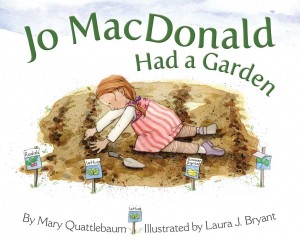 These days, schools, such as SJB, can be the venues best positioned for nurturing a child’s wonder in the natural world. I grew up with a dad who shared his curiosity about nature with his seven kids and umpteen grandkids and showed us how to garden. (He’s the model for Old MacDonald, Jo’s grandfather, in my book, which is an eco-friendly riff on the popular song “Old MacDonald Had a Farm.”)
But in today’s fast-paced, busy world and with diminishing green spaces, these “growing experiences” and “life lessons” may be missing from childhood.
Happily, SJB seems to be part of a national trend, with an increasing number of schools adding an “outdoor classroom” to the traditional learning environment. At the National Wildlife Federation (NWF), Senior Coordinator Nicole Rousmaniere, who manages school programs, shared recent statistics. More than 4200 schools have started schoolyard habitats that help sustain regional wildlife, she says, with an additional 300 to 400 being added yearly.
Rousmaniere emphasizes that commitment rather than size is the key to an effective “green education” from school gardens. Small can be powerful. Having children plant and care for native plants in containers or in a little patch beside a school can foster lessons in biology and stewardship. Indoor “green” activities pique youngsters’ interest in learning and doing even more. (Dawn has such activities online and in the back of all its children’s books, including Jo MacDonald Had a Garden.)
“Kids love a garden, but you’ve got to start them young,” says William Moss, a master gardener and horticultural educator. Advocating for school and small-space gardening, Moss writes the popular “Moss in the City” blog for the National Gardening Association, hosts HGTV’s “Dig In” and is a greening contributor to “The Early Show” on CBS.
Just about any subject can be taught through a garden, says Moss, including science, math, natural history, geography, nutrition, reading and writing.
A garden offers hands-on and experiential learning, says Phillips, the parent volunteer who helped SJB’s science teacher to create the school garden three years ago. Phillips has seen teachers use the garden to teach units on pollination, history, the food chain and the ozone. Her blog www.theabundantbackyard.com showcases student art inspired by the garden and by the art teacher’s lessons on Georgia O’Keefe’s flower paintings. An added bonus, says Phillips, is that the garden, in addition to enriching academic studies and creative expression, also stimulates the brain, enhances sensory awareness and gets kids outdoors for some exercise.
I thought of all these points so beautifully articulated by Moss, Phillips and Rousmaniere as I researched and wrote Jo MacDonald Had a Garden. My hope, along with illustrator Laura Bryant’s, was not only to playfully introduce youngsters to wiggling worms, fluttering birds and growing plants but to make it easy for teachers and parents to build on basic lessons.
School gardens can be the start of a learning experience that grows over a lifetime. As NWF’s Rousmaniere points out, just as schools teach the 3 R’s, so, too, they might provide a setting that connects children with and increases their knowledge about the natural world. One of the most important lessons to learn young is stewardship, says Rousmaniere, the idea that we are all caretakers of the earth and its wild inhabitants.
Resources for Starting and Learning from a School Garden
William Moss, horticultural educator www.wemoss.org
National Gardening Association www.kidsgardening.org
National Wildlife Federation www.nwf.org
Mary Phillips, school garden advocate www.theabundantbackyard.com
Mary Quattlebaum is the author of Jo MacDonald Had a Garden and numerous other children’s books. She and her family enjoy watching the birds, bugs and other wild creatures that visit their urban backyard habitat. www.maryquattlebaum.com


 As the United States seeks to meet the rising need for graduates with STEM (Science, Technology, Engineering and Math) degrees, First Green is filling the gap with its innovative program of using golf courses as learning labs. First Green coordinates outdoor STEM “learning labs” at golf courses that allow students to perform hands-on experiments and tests, all within the focus of their schools’ environmental science and/or environmental horticulture curricula. In these outdoor “labs” students test water quality, collect soil samples, identify plants, do math activities and work with local issues such as stream-bed or owl-nest restoration.
 A 501(c)(3) tax-exempt foundation, First Green was founded in 1997 and is based in Bellevue, Wash. Over 15,000 students have been on First Green field trips. Each field trip reaches an estimated 230 people with environmental and golf messages (due to students sharing with friends and families and teachers sharing with colleagues. First Green has replicated the program across Washington and into other states – Oregon, California, New Jersey, New York, Utah, Colorado, and just launched a program in Western Canada in May 2014.
 First Green was awarded a 2014 E3 Washington Green Apple Award for Business Excellence. Steve Kealy, Golf Course Superintendent and First Green Board member, accepted the award at a ceremony on June 26, 2014.


