
Natural Teachers: 10 Ways You Can Add Vitamin “N” to your Classroom & Beyond
NATURAL TEACHERS: 10 Ways You Can Add Vitamin “N” to your Classroom & Beyond.
from the Children and Nature Network website

NATURAL TEACHERS: 10 Ways You Can Add Vitamin “N” to your Classroom & Beyond.
from the Children and Nature Network website

By Pamela Jull, PhD
Applied Research Northwest
 t’s easy to get caught up in the excitement of planning the activities of an environmental education program. Programs are neat. They are often fun and innovative and they usually give participants a memorable, positive experience.
Sometimes in the thrill of innovation, the concrete goals of a program get lost. By planning your evaluation as you plan your program, you can better insure that you produce the results you intended when you came up with your great program idea.
An evaluator thinks of program planning this way:
• What are the specific skills and knowledge you intend your audience to acquire?
• How will you know if your audience has acquired the skills and knowledge you intended for them? What will it look like? What will they be able to do? What will they be thinking?
• What systematic information can you observe or collect to verify your belief that they have learned what you expected?
The best program design makes evaluation possible without it being an added burden to the program staff, and it provides useful information that the staff values in a timely way. Asking these questions early in the planning gives you the opportunity to embed the evaluation in the design. If this happens too late, the program agenda is often too firmly set and structured, and you may lose the flexibility to integrate good assessments into your program.
For example, perhaps you have a registration form for participants. That form could contain a few well-crafted questions that enable you to set a baseline or capture some information about your learners. Maybe as a result of planning, you will decide to add an initial reflection to show program staff their learners’ attitudes or understanding of the topic. Do you want to know if they used what they learned? Contacting people after their educational experience is not difficult if it’s planned for in advance, for example by collecting email addresses and priming participants to look for a follow up from your organization.
Perhaps one reason evaluation is sometimes stuffed to the margins is the fear factor. People often ask me “What if we find out our program is not working?” Failure is a depressing prospect, but my response is clear:
• Environmental education programs are designed by thoughtful highly motivated people. There is always success to be found in at many elements of the program
• Even negative findings nearly always produce a positive sense of efficacy among staff. It is really nice to know what’s working as well as what is not rather than guessing.
• Program staff almost immediately start puzzling through potential solutions, highly motivated to improve upon what they’ve accomplished.
The motivation to improve generates optimal program results. Staff might ask: Was there something unexpected about the group of learners that would account for the outcomes? Do the results point to an opportunity to make an easy adjustment, for example by giving a specific learning module more emphasis, or better clarifying an important concept? Reviewing program implementation is also helpful: Did something in the program delivery change from the plan due to some unforeseen constraint that may have removed an effective component?
Getting help is a good move. A good evaluator will help program managers think about their program as a system. Systems thinking can lead to a stronger sense of cause and effect, and a stronger program design. Solid evaluations are recognized by funding agencies as the hallmark of thoughtful program developers, and a great evaluation can set you up for more easily obtaining more program funding. The American Evaluation Association (www.eval.org) has a list of evaluators by region. Find someone close by who has an interest in your area.
Dr. Jull is a Cornell-trained sociologist and applied social scientist with more than 15 years experience in research and program evaluation. Her clients have included school districts, educational service districts, non-profits and local and state agencies engaged in environmental and K-16 education.

 by Shamin Graff
Lake Katherin Nature Center & Botanic Garden
Palos Heights, IL
 he sat quietly for several moments, watching and waiting. Suddenly, a streak of yellow flew by and then another. She quickly snapped a few photos on her phone as they flew off. Excitedly, she uploaded her photographs to iNaturalist, the first goldfinches that had been added to the biodiversity project she joined. She loved to see as all the new species being added by her and other citizen scientists like herself.
Across the United States, large institutions such as the Smithsonian National Museum of Natural History and the Field Museum of Natural History have developed spaces where visitors can watch scientists in action and ask questions about the work being done (Smithsonian Institution, 2013; The Field Museum, 2008). At the North Carolina Museum of Natural Sciences, an entire wing dedicated to the pursuit of science recently opened, which includes opportunities to engage visitors in citizen science (North Carolina Museum of Natural Sciences, 2012).
If your institution is anything like mine, creating a space for science and engaging visitors in citizen science programs may seem to be a greater project than time or financial resources can support. However, the resources put into a successful program can pay dividends over time for both the institution and its visitors. Knowing this, we dedicated a small space in our nature center to science and chose existing citizen science programs that could be tailored to meet the needs of our institution. The following is the evidence-based framework we created for doing so, based on extensive research that has been done in free-choice learning environments, including nature centers and museums.
The Case for Citizen Science
Citizen science is not a new idea, as participation in citizen science programs dates back to the 1700s in Europe where amateur bird enthusiasts recorded bird sightings (Dickinson, Zuckerberg & Bonter, 2010). Utilizing the Internet, today’s citizen science programs rely on crowdsourcing, or having large groups of people who each make a contribution, to collect data or classify previously-collected data. With many people sharing the work in this way, large data sets can be compiled that otherwise would not have been possible (Dickinson et al., 2010). These large data sets can not only be used to monitor a population or phenomenon, but also serve as a starting point for new questions to be researched (Bonter & Hochachka, 2009). For example, there is a project that asks participants to help transcribe old maritime records that can then be used to study climate change (www.zooniverse.org/project/oldweather) and several that ask people to help identify animals caught on camera traps. Both tasks require enormous amounts of man-hours and would be not feasible without the help of citizen scientists.
Besides the research benefits, participating in citizen science projects also have potential to increase scientific literacy. It can be difficult to assess, but research has shown that content knowledge can be gained through participation (Brossard, Lewenstein & Bonney, 2005). When participants are specifically instructed in science inquiry and the significance of the research being done, it may be possible to affect participants’ understanding and attitudes towards science in a positive way (Trumbull, Bonney & Grudens-Schuck, 2005; Jordan, Gray, Howe, Brooks & Ehrenfeld, 2011). Though more research is needed (Jordan et al., 2011), using citizen science to engage visitors over the long-term may also be a way to increase appreciation for nature and a caring attitude toward nature and biodiversity (Brewer, 2006), something we all strive for in environmental education.
 Creating a Space for Science
Although your institution may not have a wing to dedicate to science, there may be an area that can be used to introduce visitors to science, provide reference materials and perhaps even offer scientific equipment for visitors to use. For us, we needed a space that allowed visitors to overlook not only our site, but also our planned bird feeder installation and this guided our selection. As research in free-choice learning environments has shown, the physical attributes of a learning environment can affect visitor learning in both positive and negative ways. Visitors often feel more comfortable in smaller exhibit areas (Maxwell & Evans, 2002), so do not be discouraged by limited space. Although it is tempting to create an immersive environment where visitors can feel they have been transported to someplace else, this may actually overshadow any educational messaging (Pedretti & Soren, 2006). Instead, working to minimize distractions can increase visitor attention and potentially visitor learning (Maxwell & Evans, 2002). For us, that meant separating the area from the high-traffic by the entrance and shielding noise from the adjacent area for young children. Simply rearranging and strategically placing furniture created the ideal space for us. We also included a comfortable seating area to provide visitors a place to rest and that may encourage longer stay-times.
Choosing a Citizen Science Project
Choosing the citizen science project that fits the needs of your institution is important to the future success and support of the program. We chose projects with a local focus that visitors could participate in at our site in order to fit our institution’s mission. There are a wide variety of citizen science projects to consider. SciStarter (http://www.scistarter.com) provides a searchable database of citizen science projects around the world that may assist you in finding a suitable project.
Institutional resources should be considered when choosing a project. The time investment for some projects will be greater than others. Some projects require frequent reports, sometimes even daily. Still others have fees associated with participation, require specialized training, or use equipment that must be specially purchased.
It is also crucial to consider the target audience when choosing a project. Many projects will not easily lend themselves to being used with visitors. Some data collection may be too intensive for the visitor experience while others may have strict restrictions on reporting. In these instances, you may choose to participate as an institution and then share your contributions to the project with visitors. This could be expanded by offering visitors a similar activity to participate in, as we did with Project FeederWatch, a bird monitoring program through the Cornell Lab of Ornithology. Also, some projects may have data collection periods that may not coincide with times of highest attendance. For example, Project FeederWatch only runs from mid-November through early April each year (Bonter & Hochachka, 2009), when many nature centers in northern climates have a decline in attendance.
Developing Materials
When developing site-specific materials for your chosen citizen science project, you should consider including an explanation of scientific inquiry and the role visitors are taking by participating. This may help them develop a better understanding of how science research is conducted and the importance of citizen science (Trumbull et al., 2005). Research at science museums has shown that visitors often come away with a changed view of science, but it is one that sees science as a set of facts, not a collection of knowledge that is always evolving (Rennie & Williams, 2006). We can help science literacy by showing visitors that though some scientific knowledge has been rigorously validated, there is still much that is not fully understood, even after years of study. Without addressing these misconceptions directly, we may unknowingly undermine science literacy goals.
Our institution does not have naturalists or docents who are available to facilitate the citizen science area, a major hurdle for a project like this. To support self-directed learning and participation in citizen science projects, easy-to-follow materials are recommended (Banz, 2008), such as signage, brochures and worksheets. These self-guided activities can also provide visitors with a framework designed to help them conduct their own inquiries, allowing them to see firsthand the nature of science (Allen & Gutwill, 2009). Hopefully, this will also promote repeat visits to the area and enhance learning (Banz, 2008).
Program Assessment
While developing a citizen science program, program assessment should be discussed. Simply having visitors participate was our initial goal, and multiple iterations of materials and methods are still being used to reach that goal. However, research on the impact of citizen science is limited and contributions are needed in both data and research methods (Brossard et al., 2005). If resources allow, assessment of content knowledge, scientific inquiry, impact on stewardship and changes in conservation values are highly encouraged, and are in the planning stages for our project.
The Framework in Action
At Lake Katherine Nature Center & Botanic Gardens (LKNCBG) in suburban Chicago, Illinois, the first implementation of a citizen science program following this framework is underway. With only three full-time staff members, resources are limited and minimal funds were used for the project. However, as our mission seeks to “promote environmentally sustainable choices through education, outdoor experiences and scientific research,” it has been important goal for 2013 to begin to introduce citizen science to the 26,000 visitors that come through the nature center annually (LKNCBG, 2013).
The physical space for our citizen science center was formed using a 130 ft2 area inside our nature center. The area provides a small reference library, comfortable seating and views of our bird feeders. There is literature for each citizen science project located in the citizen science center, along with worksheets and identification guides. There is also a chalkboard for visitors to record and share their data.
Three citizen science projects were selected to help us reach our goal. As an institution, we are participating in Project FeederWatch (www.birds.cornell.edu/pfw/), a program that collects bird counts at feeders. For visitors, we are offering a paper-based activity similar to the actual data collection for the project. We have also started a project online at iNaturalist (www.inaturalist.org) that allows visitors to record observations of wildlife seen at our site in order to compile a biodiversity atlas. Finally, we have joined Project Budburst (www.budburst.org) as a Botanic Gardens Partner to encourage visitors to gather data about seasonal changes in ten target plant species onsite.
These specific projects were chosen mainly to help build visitors’ ecological knowledge. Research has suggested that as cultures become more affluent, this ecological knowledge is lost (Pilgrim, Cullen, Smith & Pretty, 2008). The projects we have chosen offer an opportunity for visitors to learn about species and their roles in local ecosystems, which we hope will help address this loss of knowledge. Also by increasing ecological knowledge, visitors may become more aware of their local environment and the issues it faces (Cooper, Dickinson, Phillips & Bonney, 2007), potentially leading to greater support for restoration and preservation of natural lands, including our own site.
Although it is a modest start, and interest from visitors is just beginning, we hope that citizen science will become an integral part of the visitor experience to LKNCBG and will inspire other environmental education institutions to develop similar programs. We expect that it will take time to build a culture of science at our institution and this is just one step in that process. In the future, we plan to evaluate our program through visitor surveys to not only improve our own programs, but also to share with the environmental education community.
Taking the First Step
A citizen science center may be a great way to further your institution’s mission and goals. Using this research-based framework as a guide, it is possible to create a place to engage visitors through citizen science, even when resources are limited. Through these programs, environmental education institutions can play a key role in increasing their visitors’ science literacy and ecological knowledge. With time, visitors may start taking a more active role in stewardship and provide greater support for local environmental causes. It all starts with taking the first step.
References
Allen, S. & Gutwill, J. P. (2009). Creating a program to deepen family inquiry at interactive science exhibits. Curator, 52, 289-306. doi: 10.1111/j.2151-6952.2009.tb00352.x
Banz, R. (2008). Self-directed learning: Implications for museums. The Journal of Museum Education, 33(1), 43-54.
Bonter, D. N. & Hochachka, W. M. (2009). A citizen science approach to ornithological research: Twenty years of watching backyard birds. In T. D. Rich, C. Arizmendi, E. Demarest, & C. Thompson (Eds.), Tundra to Tropics: Connecting Birds, Habitats and People (pp. 453-458). Proceedings of the 4th International Partners in Flight Conference, McAllen TX.
Brewer, C. (2006). Translating data into meaning: Education in conservation biology. Conservation Biology, 20, 689-691. doi: 10.1111/j.1523-1739.2006.00467.x
Brossard, D., Lewenstein, B., & Bonney, R. (2005). Scientific knowledge and attitude change: The impact of a citizen science project. International Journal of Science Education, 27, 1099-1121. doi:10.1080/09500690500069483
Cooper, C. B., Dickinson, J., Phillips, T. & Bonney, R. (2007). Citizen science as a tool for conservation in residential ecosystems. Ecology and Society, 12(2), 11.
Dickinson, J. L., Zuckerberg, B., & Bonter, D. N. (2010). Citizen science as an ecological research tool: Challenges and benefits. Annual Review of Ecology, Evolution, and Systematics, 41, 149-172. doi: 10.1146/annurev-ecolsys-102209-144636
Jordan, R. C., Gray, S. A., Howe, D. V., Brooks, W. R. & Ehrenfeld, J. G. (2011). Knowledge gain and behavioral change in citizen-science programs. Conservation Biology, 25, 1148-1154. doi: 10.1111/j.1523-1739.2011.01745.x
Lake Katherine Nature Center & Botanic Gardens. (2013). 2012 Annual Report.
Maxwell, L. E. & Evans, G. W. (2002). Museums as learning settings: The importance of the physical environment. The Journal of Museum Education, 27(1), 3-7.
North Carolina Museum of Natural Sciences (2012). New wing opens with 24-hour celebration Friday, April 20. Retrieved from http://naturalsciences.org/about-us/news/new-wing-opens-24-hour-celebration-friday-april-20
Pedretti, E. & Soren, B. J. (2006). Reconnecting to the natural world through an immersive environment. Canadian Journal of Science, Mathematics and Technology Education, 6(1), 83-96. Abstract retrieved from http://www.tandfonline.com
Pilgrim, S. E., Cullen, L. C., Smith, D. J. & Pretty, J. (2008). Ecological knowledge is lost in wealthier communities and countries. Environmental Science and Technology, 42, 1004-1009. doi: 10.1021/es070837v
Rennie, L. J. & Williams, G. F. (2006). Adults’ learning about science in free-choice settings. International Journal of Science Education, 28, 871-893. doi: 10.1080/09500690500435387
Smithsonian Institution. (2013). FossiLab. Retrieved from http://paleobiology.si.edu/FossiLab/index.html
The Field Museum. (2008). DNA Discovery Center. Retrieved from http://archive.fieldmuseum.org/dna/
Trumbull, D. J., Bonney, R. & Grudens-Schuck, N. (2005). Developing materials to promote inquiry: Lessons learned. Science Education, 89, 879-900. doi: 10.1002/sce.20081
Shamim Graff is a volunteer at the Lake Katherine Nature Center & Botanic Gardens in Palos Heights, Illinois.
By Jim Martin
CLEARING Associate Editor
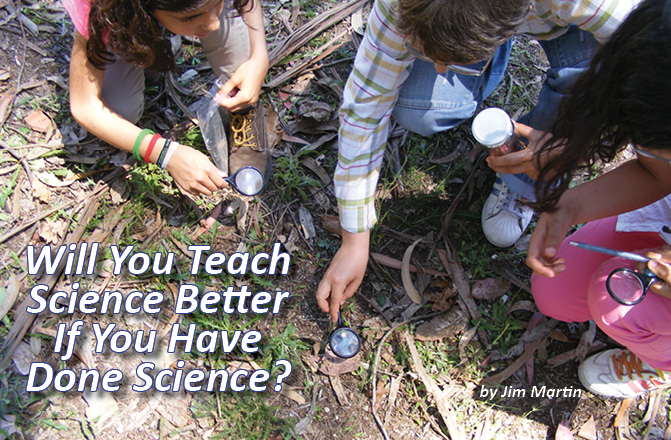
 hat if science teachers did science before they began teaching? Might a teaching model like this be possible to employ? Instructive to explore? There have been initiatives which followed up on this possibility. Their results were encouraging, but never replaced learning about science in publishers’ materials via college teacher education courses, which are simpler and less expensive to do when they are textbook-centered. The fruits of this choice have been a large fraction of K-12 graduates who haven’t achieved their potential.
What do students have to say about the way they are taught? Might some insights emerge from their comments? There is very little record of K-12 education from students’ own personal view point. Do they know whether their educations are worthwhile? A few people have looked into this, and have found that, when asked, students feel that classroom time is well spent when students treat the teacher with respect, behave the way their teachers want them to, stay busy and don’t waste time, learn a lot almost every day, and learn to correct their mistakes. Perhaps they have an intuitive understanding of an environment conducive to learning. The National Board for Professional Teaching Standards teacher certification program finds that students do well in school when their teachers are committed to them and their learning, know the subjects they teach and how to teach those subjects to students, are responsible for managing and monitoring student learning, think systematically about their practice, learn from experience, and are members of learning communities. Two complimentary views of what underlies effective education.
Taken together, these findings indicate that students know when they are taught well, and present the foundation of a clear plan for teacher pre- and in-service education. Had the K-12 graduates who didn’t achieve their potential applied questions such as stay busy and don’t waste time, learn a lot almost every day, and teachers know the subjects they teach and how to teach those subjects to students, to their teachers and curricula, and their assessments been considered in improving science teaching, might they have led to science courses which encouraged students to achieve their potential? Would they have led to pre-service science teachers actually doing science as part of their preparation for teaching science?
My experience tells me that doing science is important for science teachers. The need for science experience is a need that environmental educators have the capacity to respond to. The environments they work in abound with the kind of work pre- and in-service educators can do: mitigation, restoration, assessment, etc. They all contain the kernels of science inquiries to do. Working in collaboration with environmental educators, agency staff, and teacher education faculty and staff, pre- and in-service teachers could gain hands-on experience on the ground that they could get in no other way. My own experiences tell me that what emerges from this kind of collaborative work is science teachers involved and invested in the content that they teach, and empowered as teachers unencumbered by bureaucratic pressures outside their classroom doors; the experience necessary to change teachers’ views of science, a paradigm shift, that moves their locus of control for teaching science to within themselves, and away from the political winds that blow through schools. A key piece of the puzzle, this respite gives them a chance to develop effective science curricula.
What is it about doing science in environments outside the school that makes it so effective? I’d say that the reasons are many. An obvious one is that doing science in a familiar setting is less intimidating than doing it in a lab, which is much less familiar than, say, a quiet streambank. Another is that our brain learned to learn in the world outdoors. So learning science in a natural environment means learning in the brain’s inductive-constructivist way of learning. I’ve learned that, when teachers begin by doing science in a natural environment, they develop reasons to go into the lab, and labs become familiar places. What if we tried that? What would happen if environmental educators, agencies and organizations, and schools of education gathered together to explore the idea of a collaboration to provide pre- and in-service hands-on science education for teachers? There are all kinds of possibilities in collaborations like this.
If you’re a teacher, think back to your pre-service classes. Did you learn about a thing in class, then go out to experience it? How closely did what you experienced resemble the picture you had in your head back in the class? What if you had done the work first, then returned to the class to learn the underlying conceptual structure? Imagine a pair of pre-service teachers working together with an environmental educator, a restoration specialist from the City’s Bureau of Environmental Services, and a teacher with her students, to restore a reach of a stream flowing through a residential area near a school. Imagine further that the pre-service teachers are charged that day to identify and describe the characteristics of effective work groups. This in addition to doing the scheduled work of the morning.
The next day, back in the School of Education, all of the members of the class relate their experiences and report the characteristics of effective work groups that they had observed. Might discussion and negotiation of meaning elicit a clear concept of effective work groups, and posit connections between that and other elements of human learning? How might experiences like this influence these pre-service teachers when they do their one-year teaching internship? Would they affect the quality of their students’ educations when these interns begin full-time teaching? How would this look if a full-time teacher worked with the group from time-to-time as a mentor? If the full-time teacher would be the supervising teacher when the interns did their year in her classroom? This may never happen, but you can organize your own experiences to make this kind of experience one that you achieve yourself. All of the pieces of the puzzle are out there; they’re just not seen as elements of a functional whole. We have to learn to open our minds to recognize the relationships between what seem obviously disparate elements in a confusing world.
We’re not going to have this handed to us. But you can hand it to yourself. Find an environmental educator who is doing a restoration. Work with her. Then get your students on board. You’ll be outside your comfort zone. That’s okay. Keep your focus on what you want your students to learn, and make sure that part works. Look for workshops and institutes that provide valuable experience. In one summer institute, a teacher who had never ventured outside the classroom experienced her first encounter with the real world. By the end of the institute, she knew how to find a wetland, figure out its parameters, and design a project for her students. She had done science, and moved it into a perspective that removed its anxiety, made it eminently teachable. So she looked up an environmental educator she had met during the institute who suggested a wetland restoration project along a city-sponsored trail. The environmental educator agreed to help her plan, meet City bureau of environmental services staff, provide a training for her students, and point her toward a private granting organization which funded just this sort of project. She did the project, and continued on this path.
Let me step away from science for a moment and tell about plays my 7th graders performed when I first began teaching below college level. If I hadn’t done drama, I’d never have just hung two sheets from the ceiling light fixtures along the length of the room and said, “The side toward the windows is the audience, the side toward the blackboard is the stage. What shall we do?” My locus of control would have been too far away from me to even think of doing that. Luckily, I’d done plays for years. We picked a play, edited it, gave it. Then students, in groups, asked to write and do plays for the lower grades. And did them. I’d have been scared to death if I hadn’t acted, directed, constructed, written programs, made props, etc. I’d have simply followed a published play with directions. To the letter. And thought I was teaching drama. And I’d certainly not let them go off to the lower grades on their own. They’re seventh graders; get real.
Once you do science, it is not as intimidating as you first perceive it to be. Like me if I’d never done drama. Or, for all of us, the first time off the diving board, hitting a softball, etc. Now, you are focusing on particulars, so experience no unfocused anxieties about vague worries. We’re all good at that; once we focus on particulars, we begin to nail them down and work toward mastery. Get the start, so you know what you want to understand and do, then look around for resources like courses, workshops, knowledgeable people. Experience doing the work, then take control of your curriculum.
 This is a regular feature by CLEARING “master teacher” Jim Martin that explores how environmental educators can help classroom teachers get away from the pressure to teach to the standardized tests,and how teachers can gain the confidence to go into the world outside of their classrooms for a substantial piece of their curricula. See the other installments here, or search Categories for “Jim Martin.”

Strategies for Community-based Education: Developing Healthy Partnerships
by Pat Willis
Oregon State University 4-H Extension
 ommunity-based education is an approach to teaching and learning that connects learners to community and place. Educators who adopt this approach investigate local culture, natural features and resource issues, economic challenges and opportunities, and community governance. Students are often given the opportunity to participate in work that is valuable for the community, with community members having the opportunity to share their knowledge and expertise with students. When community-based education is well implemented, the boundary between schools and communities becomes permeable, and students and community members benefit from the partnerships created. This article will share ideas and strategies to help community-based program leaders develop long-lasting and productive partnerships for implementing rewarding and impactful programs.
Partnerships for effective community–based education
There is too much to do. So much that needs to be cared for, brought to the public’s attention, built, maintained, monitored, and observed. There is no shortage of need. There is however a chronic shortage of resources. There is never enough staff, enough money, or enough time. But with a change in thinking, a shift in how resources are allocated, combined with good planning, all partners in a community-based program benefit.
Why people and programs need healthy partnerships is often more complex than who needs partnerships. There are the pragmatic needs for staffing, transportation, supplies, information and services, but there is also a human need of working together that must be addressed. Healthy partnerships can help accomplish many objectives by providing the needed resources to do work that enriches our communities. This is often work that helps make us feel a part of something larger than ourselves. These accomplishments can connect us in unexpected ways, to each other, and to our community. A community-based program with healthy partnerships can become healing and empowering.
What is a partnership?
For many of us involved in the work of helping students be actively engaged in their community, partnership is a word that is trotted out like a new pet pony or waved like a flag, yet partnerships often fall far short of what is envisioned or desired. A partnership is not just a cash donation, a one-time guest speaker, or a guided field trip. It starts with a conversation and it is participatory. All parties must benefit from the partnership, and at its best, society at large should be enriched. Healthy partnerships are long-lasting, goal driven, and must be enjoyable.
Being prepared for partnerships
Perhaps the most critical skills we need to develop to create and maintain successful partnerships are being able to identify access points within the community. An access point can be as simple as a well asked question, a community need, or a community change. It may be born trying to solve a local problem or seeking information that doesn’t yet exist. An access point can be any project or place or set of societal or environmental conditions which allow or promote community engagement to meet a need.
As with any project and partnership, thoughtful planning is key. Plans are meant to be flexible, to be revised and to offer a road map to where you might go. Don’t let your plan control you, but use it as your guide. With a clear definition of goals it becomes much easier to see who you might need as a partner, what kinds of tools and equipment might be required, what kind of expertise will be needed, how much time the project might take to complete, and how much money may be needed. A well written plan or program proposal will serve you in many ways. It will save everyone time by clarifying the project outcomes. Doing your homework here will never be regretted.
Partnership Responsibilities
To make partnerships work for all sides in the relationship, we must assume specific responsibilities. These are two-way relationships and like all relationships they will require time and tending. To carry the metaphor further, like human relationships that span a range from a casual acquaintance to a full-out marriage, there will be different levels of commitment and richness with your various partners.
All your program partners will understand the need for reliability, dependability, and high quality work. No one wants to do a job over. Whatever your community based project is, i.e.: wetland restoration, planting of native species, developing a community oral history program, to food desert inventories, projects must be done well. There must be an understanding and commitment of the time and planning needed to the make a community-based project and partnership successful. Because partnerships are a two way street, there must be communication, trust, and dependability.
Where to look for partners:
Partnership potentials are everywhere. The community is full of resources to help meet potential financial needs, labor needs, and human needs. The local school, service club, scout group, small or large business to the resource agency, planning agency, parks department, nature center–all need partners. The key is being an active observer and listener. Get to know your potential partner; learn what needs or interests they have. Through the ever important use of skilled, open and honest two-way communication, partnerships will thrive.
Project Plan Outline
Another important part of beginning a program is the time spent early on in the planning phase. If you take the time to examine your hopes and limitations, to determine what your goals are and to commit those to paper, you will have come a very long way toward establishing something concrete to build the program on.
The proposal form (Figure 1) will help you to create a document you can use to approach school administrators, fellow staff members, and potential partners. It will help you clarify your group’s goals and priorities. Your proposal form, or “white paper” describes the vision and who should participate, the benefits of participation, and the benefits to the community. In addition, the project plan often contains language very useful in future grant proposals. Whether your project is simple or complex, you and your group will benefit from taking the time to ask yourselves the questions contained in the form.
Figure 1.
Project Plan
Project/Program Name/Title:
(The name of a project gives it a life—spending time on a catchy name is time well spent)
Community-based Program Lead Partner:
(This is usually your school/classroom, etc.)
Mission Statement:
(A mission statement should be 7-10 words in length and fit on t-shirt. This way everyone can remember it)
Program Impact
(What will be the impact of this program-what will be different after it is completed?)
Location(s):
Educational Goals and Objectives:
Brief Description of the Program:
(Describe how/what the project will benefit and why. What changes or improvements will be the end result?)
Figure 2.
Program Specifics
Current leadership or project manager:
Expected/desired partners:
Expected audience:
Your expected role:
Steps for meeting program goals and objectives:
Specific needs (ideas, information, equipment, funds, etc.):
Expected outcomes (be as specific as possible):
Program timeline:
Contact information:
Conclusion
Community-base programming can be a transformative experience for both young and older citizens. It literally does take a community to do this kind of work in the community, so partnerships will soon become the norm for your program verses the exception. Healthy partnerships also take time to build and nurture. The key to success is the ability to start small, take time, expect some failures, learn from the mistakes, celebrate the small successes, and be persistent. Give yourself and your partners plenty of pats on the back, and your program will take you to horizons you may never had considered possible
Pat Willis is a long-time environmental educator currently working for OSU Extension 4-H in the Portland, Oregon area. Pat’s previous incarnations include stints at the Oregon Museum of Science and Industry (OMSI) and the Jackson Bottom Wetlands in Hillsboro.