
by editor | Jan 2, 2014 | K-12 Classroom Resources
We need to provide opportunities for students to establish connections with the natural world, to be in awe of its power and beauty.
 t was February 2012 in northwestern Ontario. I was in teachers college and my outdoor, environmental education cohort was on a winter camping trip. Cold winds blew outside, but inside of our cabin it was cozy as my peers snuggled up under blankets, ready for story time. I was about to share with them Stuart McLean’s “Burd”, a short-story from the author’s Home from the Vinyl Café.
“Burd” tells the story of Dave, a second hand record store owner, who becomes a reluctant new birder when an unexpected visitor begins to frequent Dave’s backyard birdfeeder. The visitor is a summer tanager, completely off-course from its usual winter habitat of Mexico or Brazil. Dave comes to cherish the time he spends with his bird; waking up early to feed the bird, and coming home from work at lunch so that the bird does not go hungry. When, on an early May morning, Dave discovers that his bird has left, he is heartbroken and hopes she will return next winter.
“Burd”, in its simple way, speaks to the pain and gratification that can come with the beauty and wonder of the natural world. Can you recall a time when the natural world overwhelmed you? Have you ever felt in awe of the beauty of nature? Have you sat in salutation to the sun, or in quiet reverence to the river? Has nature left you speechless? When I posed these questions to my peers, in anticipation of reading “Burd”, they shared stories about thunder storms and the stars. Of canoe trips that they wished had never ended. One friend talked about that moment at night when you roll over in bed and catch a glimpse of the full moon outside your window. Magic moments, courtesy of our natural world.
But what about heartbreak? Nature provides those moments too. As educators of environmental literacy we can all surely reflect back on moments of loss, as something from the natural world was taken from us. It may have been as small as returning to your childhood home to find that the tall birch tree in your front yard had been cut down. Or it might be bigger – those lost fights against short-term gains and corporate interests that take away our rivers, our lakes, and our forests.
Does this sense of loss have a place in our classrooms? Indeed it is our students’ generation that is going to be handed the consequences of greed and inaction – rising sea levels, frequent and severe natural disasters, a complete disconnect from the natural world. If we continue down our current path, their losses will be far greater than anything we have experienced.
And yet, a feeling of loss necessitates that a connection has been established in the first place. In a world where children and adults alike are spending increasingly less time outdoors, these connections to the natural world are precious. For every story we have of loss, we each have a million more of those little moments of taking time for nature – time to be in awe, to slow down and find connection. If it weren’t for these moments, we wouldn’t be working as hard as we are to ensure a healthy and sustainable future for our children. The environmental movement wouldn’t exist. Dave’s summer tanager may not have survived an unplanned Canadian winter.
It is moments to build connection, awe, and wonder then that we must help create for our students. Moments that connect our students to the natural world, for not only is time in nature good for them, but they will then be good to the natural world. We can share our own experiences and the experiences of others, like Dave’s romance with a bird. But we must also provide opportunities for our students to have their own experiences – to establish connections with the natural world, to be in awe of its power and beauty. We know this already, it is why we seek out resources like CLEARING to inspire us to rely less on our four-walled classroom.
The most powerful story I can share, of my own experience creating space for awe, is from a most unlikely place: a suburban Grade 8 classroom. It was mid-December, the air was chilly, the sky was clear, and anticipation was building…snow would be coming soon. And sure enough it did, just as I started an afternoon lesson on local hunger issues. I didn’t notice the snow at first, but rather the sudden excitement on students’ faces as they began whispering and furtively pointing to the window. I looked outside and there it was – the first snow of the year! Big, beautiful snowflakes whipping around outside of the window.
I had two choices: as a student teacher I could maintain “classroom order”, aware that my teacher advisor was evaluating me, or I could allow space for awe. I chose the latter: “It’s snowing – look outside!” And then my students cheered. Suddenly, without any prompt from me, they ran to the window and cheered for snow. I cheered with them and also made a promise to myself: if I was ever lucky enough to be in front of a classroom again when snow fell for the first time outside, my class would bundle up, run outside, and lift our faces to the sky.
I made this promise because the first snow only happens once a year. Because nature has a way of spontaneously providing beautiful and powerful teaching moments, with no lesson plan required. And because these are the moments that students remember, and are the reason us educators do the work that we do.
Dave was heartbroken when his bird left. Not only had he lost a bird that he had come to care for, but he had also lost that very real connection to the natural world. In a world that is continually spinning faster and faster, Dave had found something small and vulnerable to focus on and to care for. He had been gifted with a reason to sit and watch nature – and to wonder. Why did this bird come to his backyard, of all places? How did it get there? Would it return? Dave did not know all of the answers and that was okay, because the answers were not what mattered. What mattered was that Dave knew how his bird looked in warm sunlight, and from what direction she flew in from the hedge to be fed. That is the beauty of “Burd” –it makes you want to go outside, sit by a bird feeder, and see what happens.
Let us make a promise to ourselves that as educators we will allow more time for awe. For wonder. For connection. That we will consider it a lesson well done if all our students do is sit by a bird feeder to see what happens.
Kim McCrory is a certified teacher and experienced outdoor educator from Ontario, but now calls Victoria, British Columbia home. Kim works for Sierra Club BC as the organization’s environmental educator, traveling the province to reconnect students with the wild products of our Temperate Rainforest.
Bibiliography
McLean, Stuart. 1998. Home from the Vinyl Café. Toronto, ON: Viking by Penguin Books Canada Ltd. P. 256. ISBN 0-14-027743-9.
by editor | Dec 10, 2013 | K-12 Classroom Resources, STEM
 1. Across the Spectrum: Resources for Environmental Educators
This downloadable collection of resources, perspectives, and examples will help nonformal environmental educators learn more about the field of EE, access resources, and gain skills to improve their practice and, over time, build a community of practitioners to advance the field. The document covers the foundations of EE, strategies, trends, and tools.
http://www.naaee.net/sites/default/files/publications/eebook/EEebook_download.pdf
 2. Christopher Columbus Awards
The Christopher Columbus Awards for Middle School Students is a community-based STEM program. Students work in teams of three to four, with an adult coach, to identify a problem in their community and apply the scientific method to create an innovative solution to that problem. The deadline for submission is February 3, 2014.
http://www.christophercolumbusawards.com/
 3. Green Living Project Student Film Project
Green Living Project’s Student Film Project is a filmmaking competition that encourages students, from middle school through college, to produce a short film telling a compelling story about a local or global sustainability-related project. The deadline for submission is January 17, 2014.
http://glpfilms.com/education/student-film-project/
 4. Education and the Environment
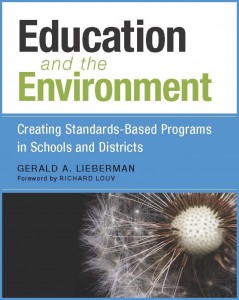
This newly published book by Gerald Lieberman (Harvard Education Press 2013) provides an innovative guide to creating and implementing effective environmental education that combines standards-based lessons in language arts, math, history, and science with community investigations and service learning projects. By connecting academic content with local investigatons, Lieberman shows how environmental study becomes an engaging, thought-provoking context for learning multiple subjects. Look for a full review soon in CLEARING.
http://hepg.org/hep/book/198/EducationAndTheEnvironment
 5. Climate Stewards Education Project – Online
NOAA’s Climate Stewards Education Project provides formal and informal educators working with elementary through university students with sustained professional development, collaborative tools, and support to build a climate-literate public that is actively engaged in climate stewardship. Participants are eligible for a variety of funding resources. Hurry – the deadline for application is December 13, 2013.
http://oceanservice.noaa.gov/education/climate-stewards/

by editor | Nov 4, 2013 | K-12 Classroom Resources
 by Jim Martin
CLEARING Associate Editor
 mbedded curricula. The curriculum that you can find just about anywhere you go: Fractions, transportation, velocity, acceleration, centrifugal force, metaphor, alliteration, poetry, drama, communities, transportation, and on. Topics we study in school, complete with real examples. Everywhere. We need to learn how to find it in natural places, and how to help our students use it in meaningful, empowering ways. Using it means we have to pay close attention to how we teach.
The way we teach directly affects the way we learn, and what we learn. Let me illustrate two poles of learning with a real-life example, two teaching methods that affect how and what students learn. This is a true story about two field trip station leaders, one who engages a centuries-old teaching paradigm, another who engages a paradigm based on the current state of knowledge about the neuropsychology of learning. One field trip leader stands ankle-deep in a stream, and tells eight students lined up on the bank about dissolved oxygen, its importance to life in the stream, and the range of dissolved oxygen concentrations which contribute to a healthy stream habitat. Then he measures the actual dissolved oxygen level where he stands, compares its value to the range for a healthy stream, and declares this stream healthy. After that, he moves on to do the same with turbidity.
 Another leader shows her eight students how to measure dissolved oxygen, and has them do two practice trials, one in each working group of four. Then, she has them combine to do a third test on their own. The students talk about the numbers they derive, and decide to calculate their average since all three are similar. The leader congratulates them on their careful work, and sends them to reference material on the stream bank to find out what their average dissolved concentration means in terms of stream health. Students scramble, pages fly, eyes and mouths communicate, and the group returns to announce that their average dissolved oxygen concentration is healthy. They attribute that in part to the riffle just upstream, and in part to the cool temperature of the water, phenomena which they learned about while reading. Based on their readings, they think that, in addition to the oxygenation of water by riffles, the cold water holds more oxygen than warmer water. Which group learned most? Best? Will recall what they learned next Spring? Will always see riffles as oxygenators when they view them in passing? Which station would you prefer if you were learning? Why? Teaching?
Think about the last word in the previous paragraph. We won’t all respond to it in the same way. When I first began to confront the realization that how I taught affected how and what my students learned, I eventually asked, “Am I an automaton who simply clerks what I receive, telling my students what I have learned, at least the part that was in the texts I used, and asking them to tell it back to me, or am I a professional educator who can build my own effective curricula?” I began to ask myself about the excitement of science, my own personal thoughts about it. And about the topics I was teaching; some were pertinent, others rather meaningless space fillers in a section that needed more lessons to make it seem complete. Could I transmit the joy of science to my students? The natural interest in science that we’re all born with? This posed a problem for me, something I found I needed to resolve, and slowly led to better teaching and more involved and invested students. Doing this, I learned two things: I have to be the person who decides what and how I teach; and I really have to understand how brains learn.
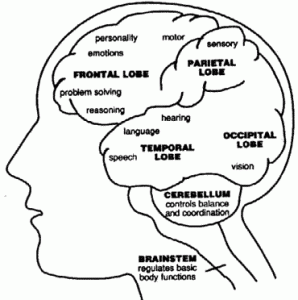 How does our brain learn? There is good evidence that we learn best when we begin new learnings by handling real objects in the real world. Do we really need to be physically involved in a learning to master it? Shouldn’t we simply be able to listen, write, and recall what is taught? Do we have to engage objects in the world to learn about them? I say that the answer to this is yes and no; there is a place for a didactic:deductive delivery, like that of the first station leader, and a place for a constructivist:inductive delivery, like that by the second leader. For instance, if the students in the first group had previously done inquiries in which they measured water quality and discussed the results of their inquiries, there would be no need to help them learn how to make the measurements, and the relationship of the station leader’s observations to a set of water quality standards would make good sense, and they could move on from there to new learnings. Once we have engaged content and concepts in the real world, we can enhance our learnings by reading, listening, and writing. And they can be extended in the real world via homework assignments that place students there. There is an appropriate time for reproducing knowledge and one for creating knowledge. Each way of teaching engages particular parts of the brain, and generates a particular kind of learning.
F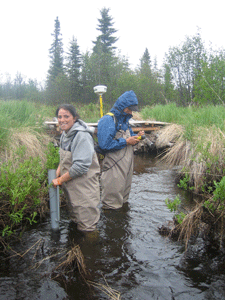 or instance, a teacher has his students identify trees along a riparian transect, and they use this information to assess that small piece of watershed. Students are shown how to start a transect at the water’s edge, and carry it, perpendicular to the stream, 100 meters up the stream bank. When they start at the water’s edge, they record this as Meter 0, and use a manual to name the trees within a 5-meter diameter and their trunk diameter and heights. Then, they move 10 meters up the transect, and record the same information within a 5-meter diameter centered on the tape measure’s 10-meter mark. They continue until they have assessed the trees in this way along the entire 100 meters, then use this information to determine the ranges of each tree species, and formulate questions based upon their distributions. When they return, they will carry out inquiries based on their questions. (They started by being told what to do, how to do it, and why. In the end, they were telling themselves what to do and how to do it because they were becoming capable of working on their own. Are they transitioning to the teaching model illustrated by the second field trip station leader?)
Back at school, they discuss their results and formulate questions they will attempt to answer the next time they are in the field. Here, they will engage the real world and try to make sense of it in terms of what they already know, and what they will find out. The next day, their teacher has them start a new unit, a street tree inventory in which they will count trees by species, height, diameter, and distance from the corner of the block they are on. So, now their transect is the block the trees are on; a transect determined by the block face and tree locations rather than 10-meter intervals on a tape measure. They’ll use this information to make inferences about CO2 absorption by leaves, but the teacher’s plan includes using the work to transition their math class into the study of ratio and proportion. He does this by establishing the protocols for measuring the distances of the trees from the corner. Students will measure their stride, then count steps as they walk from the corner to tree to tree. Before doing the work, each student carefully measures her or his stride to the nearest inch. When they make their measurements on the block, they’ll attempt to consistently walk with the same stride. They’ll use the ratio of one step to feet and inches to convert their steps walked on the block to feet and inches of its length. They make the calculation by multiplying feet and inches per step by the number of steps. In math, students will use the steps they used to convert their stride along the block to feet and inches by developing ratios and using them to make the distance calculations.
So, they start at the edge of a corner, pace to the center of the nearest tree, and record the number and fraction of a pace to get there. They continue this way to the end of the block. He’ll have them continue the work until they’re comfortable, then start the ratio and proportion unit in math. He’ll also assign them to do the same study on the block they live on, or one with trees if theirs has none. They’ll do this as a homework assignment. Now, he’s identified and used an example of embedded curricula in the real world. The curriculum is out there; we have to learn to find it.
Embedded curricula is effective curricula, probably because the student has to discover and exploit it, something our evolved brain is very good at. (I say, ‘brain,’ but I mean ‘central nervous system,’ the total set of nerve cells in the system that is coordinated by the brain.) If the brain is where we learn, then why not use it in designing the ways that we learn, both in school and on-site?
By the time the class goes out to implement the investigations engendered by their inquiry questions, they will be in charge of their learnings. The teacher has transitioned his delivery from didactic:deductive to constructivist:inductive. He started with an activity that he thought might generate students’ interest, then used that interest to engage them in self-directed learning that met his curricular objectives in science and mathematics.
Environmental educators can help teachers engage their students’ brains in effective ways. It doesn’t matter what the environmental educators offer, their sites contain embedded curricula, just waiting to be mined. They also know the classroom teachers who are serious about what they do. Put two of their heads together, and they can locate and describe curricula available on site. A team like this would be invaluable to Meredith. We have the power to bring them together, and might do that.
Here’s an anecdote to illustrate how curriculum discovered on site empowers students. Several years ago, some teachers in a middle school decided to exploit some man-made ponds and a ditched creek adjacent to the school to develop the curricula embedded there. They did this for most of the school year, then participated in the school’s Parent Science Night. That evening, the halls were filled with students who manned tables exhibiting science projects they had worked on. Parents and other adults wandered around, checking out what the students had done. The students whose projects were developed in the standard science classes used their texts and lab books to explain the experiments they were displaying. When asked a question, they inevitably read either from their books, or from notes they had written; often with a finger moving along the words. Students who worked on the ponds and creek spoke from what they knew, from what was in their heads. They answered questions, sometimes after quiet thought; always with confidence, with ownership of the learning and personal empowerment in their eyes. I’ve observed this often, but never in such fortuitous mixed company. We can learn for understanding and empowerment, but we have to do it using our brain’s evolutionary history to guide the ‘how’ of the learning.
 This is a regular feature by CLEARING “master teacher” Jim Martin that explores how environmental educators can help classroom teachers get away from the pressure to teach to the standardized tests,and how teachers can gain the confidence to go into the world outside of their classrooms for a substantial piece of their curricula. See the other installments here, or search Categories for “Jim Martin.”

by editor | Nov 4, 2013 | K-12 Classroom Resources, Marine/Aquatic Education

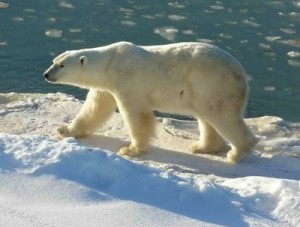
1. Climate Change: Connections and Solutions
Facing the Future offers this free two-week curriculum unit for middle school and high school which encourage students to think critically about climate change and collaborate to devise solutions. Students learn about climate change within a systems framework, examining interconnections among environmental, social, and economic issues.
https://www.facingthefuture.org/Curriculum/PreviewandBuyCurriculum/tabid/550/List/1/CategoryID/16/Level/a/Default.aspx#.UmbDNBCRh8k
2. Climate Change Teacher Resources
Windows to the Universe provides interlinked learning resources that support a variety of topics, including online content for browsing or to support an introductory online course on climate change, teacher professional development resources, classroom activities, and online interactives.
http://www.windows2universe.org/teacher_resources/climate.html

3. ClimateChange LIVE! – Resources and Online Webinars
The U.S. Forest Service and partners offer this website to bring climate learning to you through a series of webcasts, webinars, and online climate education resources. The materials include climate education resources and programs gathered from 17 federal agency and NGO partners. The National Wildlife Federation is hosting a series of six webinars in connection with the ClimateChange LIVE! materials; you may register for one or more webinars at a time.
http://climatechangelive.org/

4. Teaching Climate
Teaching Climate offers a searchable database of reviewed K-12 climate education resources. The resources have been reviewed by subject experts for scientific accuracy, pedagogical soundness, and usability. Topics include Climate Systems, Measuring & Modeling Climate, Human Responses to Climate, and more.
http://www.climate.gov/teaching

5. Citizen Science: Project FeederWatch
Those interested in citizen science can join the thousands of FeederWatchers across North America who count the birds at their feeders from November through early April. All participants receive the project’s annual summary publication and the Cornell Lab’s quarterly. New project participants receive a bird-identification poster, bird-feeding information, and instructional materials.
https://store.birds.cornell.edu/Project_FeederWatch_s/42.htm

6. CMOP: Studying Coastal Margins
The Center for Coastal Margin Observation & Prediction, an NSF Science and Technology Center partnership of Oregon Health & Science University, Oregon State University, University of Washington and others, focuses on coastal margins. The website offers a collection of activities and curricula that can help you use their data resources. Check out the materials on coastal hypoxia, vertical density gradients, drifters and currents, and more. Some of the materials are available in both English and Spanish.
http://www.stccmop.org/education/k12/teacher_resources/activityarchive
7. Urban EE Resources for High School Teachers
The LEAF Anthology of Urban Environmental Education is available online. The anthology is a collection of lessons and activities designed to help high school educators infuse urban environmental themes into their curriculum. Sections include Natural Cities, Human Cities, and Evolving Cities.
http://www.nature.org/about-us/careers/leaf/resources-for-teachers/leaf-anthology-of-urban-environmental-education.xml

by editor | Oct 24, 2013 | K-12 Classroom Resources
Honeybee Heroes: Carter Latendresse at Catlin Gabel School
 by Katie Boehnlein
 arter Latendresse is the sixth grade English teacher at Catlin Gabel School in Portland, OR. In addition to his classroom courses, which focus on fostering social responsibility in his students through ancient and contemporary literature, Carter is also the Garden Coordinator at the school. The Catlin Gabel Garden Club tends 2,000 square feet of organic gardens on its 60-acre campus, a 50-tree fruit orchard, and as you have probably guessed, honeybee hives. Catlin Gabel has earned itself a reputation in the Portland Metro area as a progressive institution that encourages all of its students, aged Pre-K to 12th grade, to think deeply and learn through experience. Carter embraces this philosophy, harvesting from and working in the school’s gardens as part of his English curriculum.
 Catlin Gabel also has a history of hosting honeybee hives on its campus, as a few teachers in the 1970s kept their hives on the school’s lush grounds, but the school hasn’t had a working hive run by staff and students in quite some time. Troubled by issues such as global agribusiness, monocropping, processed food, global warming, and desertification, Carter was motivated to install a beehive in the school’s orchard, which is located on the periphery of campus, away from the normal walking paths. He hoped that by having this hive on the campus, students could learn more about local food sources, biodiversity, and organic gardening first-hand. After receiving permission from both the facilities and grounds departments, who were immediate supporters, he recruited four fellow colleagues to take a beekeeping class in Hillsboro and a few weeks later, they set up the hive.
 Since then, the beekeeping activities on campus have received a very positive reception. All four school divisions have been involved in visiting the hive, from quiet Kindergardeners to boisterous fifth graders to sixth graders learning hands-on beekeeping skills with Carter. For most of these visits, Carter has set up an observational tent with four mesh walls. This allows an entire classroom to watch the goings-on in the hive without danger of being stung. Many teachers have also been involved in tending the hive, from elementary teachers to the middle school Chinese teacher to the school-wide food services director to the head of the grounds crew to high school science teachers. Many people on campus have seen the beehive as an opportunity to learn more about a very pressing topic and involve their students directly in a solution.
 The apiary project at Catlin Gabel School is only continuing to grow, aided by little opposition to the project and a great interest from students and staff on campus. According to Carter, “Once people hear that we know who is allergic to bee stings and that we have plans, fear melts away.” He would like to increase the school’s apiary to three hives next spring, following a strategy of organic beekeeping that allows one hive to be actively producing honey, one on the rise, and allows one to dwindle. Carter has been able to tie the hive into his classroom lessons on seeds, flowers, pollination, and organic local school garden food. In conjunction with these lessons, his classes are able to go out into the observational tent as well as try out their beekeeping skills wearing a veil and gloves. Of his students, Carter says, “They love the bees—it’s both an exciting and relaxing experience, especially for those with their hands on the hive.” Twice every seven days, Carter offers a Gardening and Beekeeping activity block in the middle school, which will allow ten students to be actively involved in the gardens and with the beehive.
Carter was recently selected by the National Association of Independent Schools (NAIS) to be part of the 2013-2014 Teachers of the Future program. He is one of 25 teachers nation-wide who “inspire academic excellence in students and serve as opinion leaders among their colleagues and peers,” hallmarks of high quality education for the 21st century. As part of this honor, Carter is creating a video about the beekeeping program at Catlin Gabel School, to share beekeeping tips with colleagues nationwide who are interested in keeping bees on campus. He is being aided by Portland beekeeper Brian Lacy, another one of our Honeybee Heroes, as well as his other fellow Catlin Gabel beekeepers. He is hoping that this video will educate fellow NAIS teachers about the importance of beekeeping and empower them to start their own apiaries. The video, which you can watch here, serves to feature the interdisciplinary learning program at Catlin Gabel School as well as guide teachers through a step-by-step process of starting an apiary on their campuses. Carter is an inspiring teacher who is truly helping his students better connect with the world around them. He encourages them to find solutions to their own problems, large and small, through both studying literature and by getting their hands dirty in a garden. Speaking to the Oregonian newspaper about his role as a teacher, he says, “What can we do as teachers is impart lessons to kids that allow them to have hope but while also confronting these huge problems. For every problem, we try to present a solution and we try to allow them to do it.”
Katie Boehnlein is a writer/intern for CLEARING magazine and teaching assistant at Catlin Gabel School in Portland, Oregon. She enjoys writing about the endless expressions of place-based education, inspired by so many creative teachers. Katie blogs about her own ecological and urban adventures at “In the Midst,” which can be found at kboehnlein.wordpress.com.


