by editor | Jan 16, 2013 | Environmental Literacy, Marine/Aquatic Education
Teachers discover authentic lessons in crayfish and caddis flies
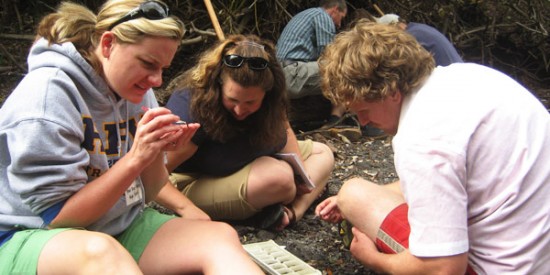
- What is that bug? Teachers Kathryn Davis from Hood River High School, Molly Charnes from the Academy of International Studies in Woodburn and Thomas McGregor from The Phoenix School in Roseburg work at identifying aquatic insects during a workshop in Philomath. (Photo: Lee Sherman)
By Lee Sherman
In Brief
The Issue
To provide environmental field experiences for their students, teachers need hands-on instruction in field research methods. Kari O’Connell and Susan Sahnow of Forestry Extension’s Oregon Natural Resource Education Program train high school teachers through Teachers as Researchers.
OSU Leadership
OSU trains science teachers through the Dept. of Science and Mathematics Education and provides opportunities for K-12 students through SMILE, 4-H, the Environmental Health Sciences Center and pre-college programs.
The dense grove of willow, ash, maple and alder looks like 100 percent nature’s doing. But in fact, the 3,000 towering trees shading the east bank of Marys River in Philomath grew from the vision and dedication of a science teacher and his students.
The riparian restoration that Jeff Mitchell and his biology students accomplished 10 years ago stands as a testament to the power of natural resources education and community collaboration.
“A whole generation has lost their connection to the land,” observes Mitchell, a longtime practitioner of environmental field studies at Philomath High School. “My generation were farmers and foresters. But with urbanization and electronics, people have lost track of the land and how it works. We need to restore that literacy in forestry, wetland biology and watershed dynamics.”
Now an OSU initiative is helping to re-forge those links. Oregon science teachers are getting hands-on lessons in environmental research through a two-year-old Extension program called Teachers as Researchers. This partnership between the university’s Oregon Natural Resource Education Program and the Andrews Forest Long-Term Ecological Research Program is helping educators guide their own students toward authentic, meaningful discoveries – and activism – within their local communities.
Watery Food Web
One late-September afternoon in the shade of Philomath’s student-planted trees, 15 high school teachers from Astoria to Roseburg scoop samples from the slippery riverbed with long-handled nets. Then, peering closely through handheld magnifiers, they compare their samples against photos and scientific illustrations on laminated field guides, trying to distinguish “shredders,” “collectors,” “grazers” and “scrapers” – aquatic invertebrates like caddis flies, crayfish, damselflies, pond snails – that live and feed in healthy Northwest streams. As each creature is identified with the expert input of research ecologist Sherri Johnson of the Pacific Northwest Research Station, it is sorted with its brethren into a white plastic ice-cube tray. The proportions of, say, aquatic worms to pouch snails to blackfly larvae are indicators of the river’s ecological balance.
Ultimately, Mitchell points out with a wry smile, the study of stream ecology is all about “who’s eating whom. The presence or absence of certain species of aquatic invertebrates can tell you a lot about past and present water quality of the stream.”
During the two-day workshop, the teachers also get skills instruction in classroom-based activities like graphing water-quality variables from chemicals and invasive species to organic pollutants and temperatures.
Inspired to Learn
The project’s ultimate goal, says OSU’s Kari O’Connell, is to get high school students out into the field to conduct their own investigations. Aquatic sampling at Marys River is one of three workshops teachers take during their year-long participation. They also learn about decomposition and carbon cycles at the H.J. Andrews Experimental Forest near Blue River and about fry and fingerlings at the Oregon Hatchery Research Center near Alsea.
“This project helps teachers engage their students in outdoor settings,” says O’Connell, who leads Teachers as Researchers. “Studies show that kids do better on achievement tests, behave better in class, get more excited about learning and feel more pride in their accomplishments when their lessons are tied to real-world environmental issues.”
The project is already having an impact in Oregon schools. During 2008, the project’s first year, nine of 13 workshop participants made quick use of their newfound skills by engaging their students in local watershed studies.
Oregon the Magnificent
Oregon’s storied landscapes — its mountains, rivers, oceans and rangelands — are prime, readymade environmental learning labs, notes Silicon Valley transplant Pete Tuana, superintendent of the Philomath School District.
“Oregon has a unique reputation as an outdoor state,” Tuana reminds the teachers before they head to the river with their sampling nets. “This environment is so magnificent. Yet today’s children get so busy playing videogames on the sofa, they don’t go outside and get dirty. Those kids are tomorrow’s stewards of the land. We’re not connecting the dots. We need a coherent, K-12 curriculum on natural resources.”
Oregon took a big step earlier this year when it became the first state to pass a “No Child Left Inside” act (House Bill 2544). Co-sponsored by Corvallis representative Sara Gelser, the legislation, part of a national movement to reconnect kids with the outdoors, created a state task force to develop guidelines, aligned with state science standards, for environmental literacy.
With its growing cadre of teacher researchers, OSU is in the vanguard of this urgent push toward authentic lessons in local landscapes.
“These inspiring teachers are preparing the future students of OSU,” says O’Connell, “and the future citizens of Oregon.”

by editor | Jan 7, 2013 | K-12 Classroom Resources

1. Presidential Innovation Award for Environmental Educators
The Presidential Innovation Award for Environmental Educators Program, a partnership between the CEQ and the EPA, recognizes outstanding K-12 teachers who employ innovative approaches to environmental education and use the environment as a context for learning for their students. Teachers from each EPA region will be selected to receive the award. The deadline for application is January 31, 2013.
http://www.epa.gov/education/teacheraward/
2. Siemens We Can Change the World Challenge
 The Siemens We Can Change the World Challenge is a national environmental sustainability competition for grades K–12. Students learn about science and conservation through project-based learning. The website offers tools to help integrate the challenge into their curriculum. The deadline for entry is March 5, 2013.
http://www.wecanchange.com/

3. edudemic
This website offers a platform dedicated to what’s next in learning by connecting technology, emerging trends, social media, and culture. The website focuses on social media applications, flexible learning frameworks, and more. While the website is packed, the article headlines offer a good summary of what you’ll find – often a numbered list such as The 18 Best Free Web Tools Chosen By You, or The 5 Biggest Ways Students Actually Want To Use Technology. Check out 10 STEM Apps To Teach About The Environment.
http://edudemic.com/
4. GLOBE Citizen Science Campaigns
 Two GLOBE Citizen Science Campaigns include GLOBE at Night, an international citizen-science campaign to raise public awareness of the impact of light pollution, and GLOBE Student Climate Research Campaign, which aims to engage students in measuring, investigating, and understanding the climate system in their local communities and around the world.
http://www.smdeponews.org/programs-events/globe-phenology-and-climate-project-through-june-30/
5. Mystery Class – Exploring Sunlight and the Seasons
 Teachers and students are invited to participate this winter and spring in Journey North’s Mystery Class project, January 28-May 10, 2013, in which students try to find ten secret classes hiding around the globe using the changing sunlight at each site as the clue.
http://www.learner.org/jnorth/mclass/fall2012/update120112.html
6. National EE Week
 The theme for National Environmental Education Week 2013, April 14-20, 2013, is Greening STEM: Taking Technology Outdoors. Register to take advantage of this year’s offerings and to learn more about the theme. Check out the suggested Top 10 Apps for Taking Tech Outside.
http://www.eeweek.org/
by editor | Jan 4, 2013 | Environmental Literacy, Questioning strategies, Schoolyard Classroom
Do It Yourself First: Leading Student-Directed Inquiry
by Jim Martin
CLEARING guest writer
 f you’ve never taken your elementary, middle, or secondary students out of the classroom to learn, and can’t find a helpful mentor or workshop, it’s okay to learn to use the real world to generate curricula and teach for understanding rather than to pass tests just by doing it. Just make a plan and stick to it, and you’ll be okay. Try a place on your school grounds first, then move to a place in the community when you’re comfy.
There is a simple way to do a student-directed inquiry outside your classroom, involving observations on invertebrates. You can use it to discover whether this kind of work is comfortable for you to do, and if it generates curricular content that satisfies your anxieties about meeting mandated standards and benchmarks. You can start it on your school grounds, or if you’re not comfortable with that, right in your classroom. The only caveat is that you have to let your students think and ask questions, and follow the parts of the project that capture their interest. That is, after you’ve first guided them (and yourself) through the process.
ALERT: You need to be a CLEARING subscriber to read the rest of this article.
(enter password then hit return button on your keyboard for best results)
[password]
The nice thing about the project we’ll be describing is that it begins with you facilitating a guided inquiry. It doesn’t matter what grade level you teach, the basic work applies to all of them. The vocabulary and complexity of conceptual content will vary with grade level and student experience, but the basics apply to all levels. The plan is this: We’ll make a small compost heap, then see what comes to live in it. Then we’ll have our students do the same. Simple, but loaded with potential.
First, do your own inservice, perhaps this summer. Start the compost in your own yard or somewhere on the school grounds as your source. Don’t place it where it will always be in direct sunlight, since it needs to stay moist. Put about 5-10 gallons worth of different kinds of plant material in it and turn it once a week with gloved (or ungloved) hands. Keep it moist, but not wet. It’s necessary to start outdoors to attract the invertebrates and microbes which will populate your students’ compost ‘piles.’ As you tend your compost heap, notice what is living there. (If you’ve already done this, I’ll bet you’ve gone to a book or the web about what you’ve found. That’s your brain doing what it’s designed to do.)
As you do your work, try out some learning activities. What is the temperature at the surface of the heap, and in its depths? How do you go about measuring the temperatures? Any glitches? Ask yourself how any temperature differences might have come to be. If it’s not directly explainable to you, who might you ask to find out? (This is a skill we all have to develop when we move out into the real world.) What mathematics activities can you use to make sense of the temperature data? What tells you more, the numbers themselves, or their graph, average, median, range? Would the data be different if the compost heap was larger or smaller? Let’s look at more of the things we can learn.
After your compost heap has been working awhile, you should be finding an increase in the numbers of invertebrates living there. If this isn’t the case, go to places where plant material is obviously decaying and bring samples back to your heap. Keep a record of how many species you find in your heap as you turn it, and how many of each you observe. This means you’ll have to be systematic about how you turn the heap. And about how you record the information you measure, count, and observe. You can pass these skills and understandings on to your students.
As you count species and their numbers, use that data to track species diversity in your compost heap. As a rule of thumb, the greater the species diversity, the healthier the system. Whether you work with kindergartners or high school seniors, you’ll need to know something about species diversity. You can google the term, find some sites which explain it in a way you can understand, and which detail some of the math used to make sense of the numbers. Here’s one you can use; a little esoteric at first glance, but ultimately doable; Simpson’s Index, D = Σ ni(ni-1)/ N(N-1), where D is Simpson’s Diversity Index, Σ stands for ‘the Sum of,’ ni is the number of organisms you counted in the ith species (so the number of organisms in the 3rd species you counted would be n3, and i goes from 1 to the total number of species you counted), and N is the total number of individuals counted among all species. This means that you take the sum of the numbers you get from multiplying the number you counted in each species times that number minus 1, then divide that sum by the total number of individuals you counted times that number minus 1.
Try it for 3 species: Species A, with 10 individuals; Species B, with 5 individuals; and Species C, with 20 individuals. The first ni set is 10(9), the second is 5(4), and the third 20(19), which totals to 490. There are 35 individuals all together, so the denominator is 35(34) = 890. Dividing 490 by 890 gives you about 0.56. What if the counts were 23, 51, and 36? Your numerator and denominator should be 4,316/11,990. If this is confusing, say so in a comment below, and I’ll get back to you with more details.
Sounds complicated, but by the time you’ve done three or four sets of species, you’ll get it down. Just be sure that you sum all the individual counts times themselves minus 1 before you divide by the total counted times the total counted minus 1. The answer to all this, D, gives you a number you can compare with other counts you or your students make. Remember, the reason you need to try this diversity calculation is to get an idea of one way that diversity is described. With your students, you can just use the total number of species present to stand for the same thing. This is the simplest math which can be used to estimate species diversity, the total number of species, a number students can use to compare the number of species in different compost heaps, and which may correlate with other measures of diversity.
There is a spectrum of ways to name diversity: number of species, species richness, species evenness, or a calculation like Simpson’s Index. None do a perfect job, since diversity is a dynamic with many aspects. For now, you can only choose one and use it consistently until you have good reason to use another statistic. We’ll take another look at this in the next blog.
Use your counts of living things to graph a population curve. Choose one species and plot it with time on the x-axis, and number of individuals on the y-axis. This is a population growth curve, and they are an indirect way of determining how an environment treats a particular species residing within it. In setting up your compost heap, you’ve created a new environment, and populations living within it should increase during the initial exploitation phase. Soon enough, those curves will change, raising nice inquiry questions.
Use the heap itself for learning. How big is it? Is it always that big? Bigness can be derived from measurements that students make. How tall is it? How wide? How long? How can you determine its volume? Do any of those numbers correlate with the range of temperatures in the different compost heaps? Species diversity? Population curves? Temperature range and diversity?
What about the biology of the organisms living in the heaps? If you’re up to it, you can take a piece of liver, blend it with a little water or electrolyte like pedialyte, then introduce a drop of this to a container with 250 ml or more of hydrogen peroxide (H2O2 ). Take the temperature of the hydrogen peroxide before adding the liver extract, then periodically during the next 20 minutes. As simple carbohydrates are metabolized to produce useable energy in the form of ATP in nearly all organisms from microbes to Homo sapiens, the extra oxygen atom in one of the intermediary products, hydrogen peroxide, is released leaving water (H2O), an oxygen atom (O), and the energy which held the oxygen atom in place. That energy isn’t re-used, and goes off as heat. Compare the results of this experiment with your data on population and temperature. Is there something to be learned? Might your students understand the basics of what they observed?
What can you find out about four of the species in your compost that explains how they are able to live there? The organisms you find are living in a dynamic relationship which keeps the entire community alive, an economy which cycles materials and moves energy in a productive way. Can you build some elements of a food web from the information you have? What else can you find out about the biology and ecology of compost heaps?
If you teach or use language arts, how can you use the compost heap and its components as metaphors to drive a piece of writing? A piece of art? Music? If you teach science, and have never used these arts and humanities deliveries, try one. You might be surprised at what you’ll learn. I certainly have been.
When you’ve studied your compost heap long enough to feel comfortable with it, have your students learn some thing about them. Use the piece you have the best handle on. The first time through the process with your students, you demonstrate each step. Let students ask questions or make observations as you feel comfortable. You can use your own compost, and demonstrate how to turn it to expose the invertebrates living there. (If you’re up to it, you can find out how to plate out microbes that will be living there, and find out what they do and who eats them.)
When you’re ready for your students to do theirs, have each group start compost heaps somewhere in the schoolgrounds, one 5 gallons in size for each group of four or five students. You can also have students bring in their own mulch, etc., or place boards on the ground at home then collect what’s living on and under them including any molds they find. You might suggest they place the animals in a jar of moist compost, keeping the lid slightly ajar for air, and simply bring the board in and set in in their compost heap. Once compost heaps are doing well (outside the building), you can make ‘sand traps’ by filling plastic bucket lids with a layer of sand and placing them next to a compost heap. Any small mammals or birds who are attracted to the compost will leave footprints in the sand. These don’t always work, but are pretty neat when they do. This will raise questions they can begin to answer.
[/password]
 This is the twenty third installment of “Teaching in the Environment,” a regular feature by CLEARING “master teacher” Jim Martin that explores how environmental educators can help classroom teachers get away from the pressure to teach to the standardized tests, and how teachers can gain the confidence to go into the world outside of their classrooms for a substantial piece of their curricula. See the other installments here, or search Categories for “Jim Martin.”
by editor | Dec 7, 2012 | Place-based Education
by Harmony Roll, Clearing Regional Advisory Panel
from Taiga Teacher
 |
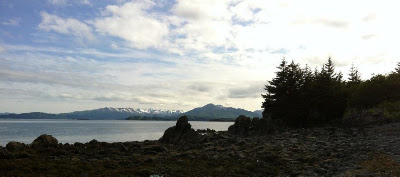
The turn around point on my regular running trail in Kodiak.
|
 hen I had my 3rd and 4th grade multi-age classroom in Fairbanks, I was in teacher paradise. I was in a Title 1 school, but was given a lot of freedom and autonomy to do what I felt best for my students. Part of that was an amazing administrator who knew I had a different situation teaching two grades, but also one who believed in multi-age and allowed me to make the decisions I needed to to make it truly work. I learned so much about my students having them for two years. I came to understand the breadth of the learning process. I also was challenged with creating new projects and approaches. You can not get in a rut when you teach multi-age like you can with a straight grade. Things have to be new and fresh each year because a large portion of your class you had the year before. One thing you can do is take a format that the kids know from one year and apply it to the next to allow them comfort and the ability to go deeper with their curiosity and study.
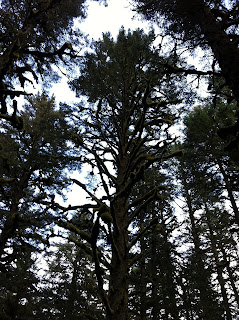 The first year I had my multi-age we did Moon Journals. The second year, the plant life cycle was part of our curriculum. We did Tree Journals. Students adopted a tree and observed it over the course of the school year. They drew about it, wrote about their observations, documented what they learned about trees and plants in general. One of my favorite things that came out of the year long study of trees was “Tree Movies.” We had great big beautiful windows in our classroom that looked out to the trees lining the Noyes Slough that ran by the school. When students noticed the trees dancing in the wind, or the alpenglow on the frost of the trees at sunrise (late morning in the winter in Fairbanks) they would ask me to shut off the lights and we would quietly watch the “Tree Movie.” A wonderful break in our busy routine and a communal experience of appreciation for the beauty of nature, remembering there was more to life than what remained inside the four walls of the classroom or the math problem in the workbook.
Studying one tree, one place or one trail is important. We live in a culture where conquering is so important. Even people who spend much of their lives outdoors like to have conquests in the form of Peak Bagging or seeing as much of the world as they can. This is important, but just as important is getting to know one place well. My husband thinks it’s funny that I like to run the same trail all the time. The only change is adding distance. I do this for many reasons… running the same course I know my body better and how much faster I can go, how much more I can push myself each time, but also I love noticing the weather patterns by seeing the sky from the same place over and over. I love seeing the same trail at different times of the day and noticing the subtle changes of the season from run to run. I enjoy walking the same trail and seeing things I totally missed when running by. I’ve known many places in my life by the trails I frequented. I mark milestones in my life by the way those trails looked as I traveled down them, processing the information from the day. One of the important things we owe our children is how to relate to spaces. Giving them the opportunity to get to know them intimately, deeply without pushing them to keep moving on. At the same time we need to let them find that space. Plopping them down and telling them to love a place won’t work. They need to choose the tree, trail, land, and….. decide when to move on… if they need to.
I think of a man I heard about once who climbs Mt. Monadnock in Southern New Hampshire every day for years. I wonder how much he understands about the world because he understands that one place. How much he has seen the landscape change and remain the same. Here’s an article from Yankee Magazine about him.
Much of the angst in my life has been leaving places I’ve come to know well and some of my greatest joys have been finding new ones.

 by Traci Price