by editor | Apr 18, 2012 | K-12 Classroom Resources
Go back to main page
How Do Other Animals Deal with Garbage? (3-5 Science)
Students will discover how ants and other animals deal with waste materials they themselves have created. Split the students into groups that will each build an ant house, which will contain white sand and 2 cm3 of sugar solution. The houses should either be placed in a dark area or covered by black construction paper because ants prefer darkness. Each group will then add several dozen ants to the ant house. The students should add small amounts of food and garbage to the houses, and then wait to see which of the materials are eaten. A discussion could follow to try and discover why the ants ate what they did, and what they did with the garbage.
— Kent Wilkinson, West Valley Junior High School, Yakima WA
Salmon Life Cycle (3-5 Science)
Take a large rope and tie several smaller ropes to it. The larger rope represents the Columbia River and the smaller ropes represent its tributaries.
You will also need several small containers (baby food jars) containing scented cotton balls. We have used a variety of scents including cinnamon, lemon, almond pepper and others you can find in your spice cupboard. Color code clothes pins to match two differently scented jars smelled in a specific order. A scented jar is placed at the mouth of a tributary and another placed at the specific spawning site along the tributary. Group the students in pairs. Blindfold one student to represent the salmon swimming up the Columbia River to spawn. The second student represents a biologst. The biologist picks up a clothes pin and a card. The clothes pin and the card are attached to the student representing the salmon. The biologist will allow the salmon to smell the two scents indicated by the colors on the clothes pin.The card will mark the salmon a male or female.
As the salmon travels up the Columbia River the biologist will open scented jars along the way. The salmon searches for its spawning site based on the two scents the biologist presented at the beginning of this activity. When the salmon reach their spawning site, have students check clothes pins to identify male and female surviving salmon. This is a great life cycle activity. It also reinforces the percentages of survival in a real way that students can experience themselves.
— Randy Davis, East Valley School District, Yakima WA
Is Trash Really for the Birds? (3-5 Science)
Students will be able to discover how birds are affected by positive and negative waste. In groups, the students dismantle bird nests using forceps while separating the materials into natural and man-made piles. The students can discuss how they believe the birds find those materials, and if they believe the man-made materials are harmful or beneficial to the birds.
— Kent Wilkinson, West Valley Junior High School, Yakima WA
Cultural Taboos (3-5 Social Studies)
First the teacher explains that taboos are considered things one should not do in a specific culture. Students should then identify taboos that exist in their own culture. Then the students break up into groups of about 4-5 and create their own culture and the taboos that would govern their behavior. Without revealing these taboos, let the groups interact and see how the “foreigners” perform the host group’s taboos. Follow the activity with a discussion of how the groups felt when the foreigners performed the taboos and what they could have done to remedy the situation.
— Ruth Rigby, LeHigh Senior High School, LeHigh Acres FL
Pen Pals (3-5 Language Arts)
Have the students develop a partner group at another school, possibly in another country. This bridges gaps for kids and helps widen perceptions of other cultures. To write to students speaking another language, a translator will be needed. The teacher or students can locate an interpreter by contacting the local consulate member of the community, or local college or university. Other ideas may include exchanging materials which represent the classes and their watershed such as photographs, cultural artifacts or a collage of classroom activities. Discuss how perceptions of the other culture has changed and what the similarities and differences are.
— from GREEN Cross Cultural Partners Activities Manual
Salmon Mobile (3-5 Fine Arts)
First, have students learn to identify the body parts of a salmon. Then, provide the students an opportunity to draw salmon using an overhead, opaque projector or free hand. They can make the salmon three dimensional by stapling two salmon together around the outer edge, leaving a small opening to stuff with paper scraps. After the salmon is stuffed, finish stapling it together. Attach a fishing line to the center of the salmon. Hang the salmon at different heights in the classroom to give the room the appearance of being in the middle of a school of salmon on their way to the spawning grounds.
Have students write about where their salmon has been and where it is going.
— Randy Davis, East Valley School District, Yakima WA
Go back to main page
by editor | Apr 18, 2012 | K-12 Classroom Resources
Go back to main page
What Does Acid Rain Do to Aquatic Animals? (6-8 Science)
Students will be able to discover the effects acid rain can have on aquatic wildlife. Set up two 10 gallon aquariums, each one with a variety of aquatic organisms (snails, caddisfly larva, damselfly larva, algae, etc.). Try to make the numbers and types of organisms similar. Test the pH in both aquariums and record the data.
Keeping one tank as the control, maintain the pH at a constant level by adding new and siphoning off old water if necessary. The second aquarium is the variable. Every two days siphon off some water and add a small amount of dilute sulfurous acid (take the pH down at a rate of 0.5 pH each week) to the second tank. Observe which animals live and die at what pH level each one died. Make a table of pH tolerance for each organism and discuss what happened within each separate aquarium.
— Kent Wilkinson, West Valley Junior High School, Yakima WA
Nature’s Scavenger Hunt (6-8 Science)
Students will be asked to take a close look at the components of the river/pond ecosystem in detail. They will be able to locate and identify clues that help describe the overall ecosystem.
Break the class into small groups, each group receiving a pencil, notebook, field guides, a hand lens, and binoculars. Have one person record the answers and observations in a notebook. Stay on the tril, and don’t collect the items. The following is a scavenger hunt list with things to find, identify, or describe:
Identify or describe: two kinds of birds, three kinds of plants, two types of habitat, two types of leaves or needles from the tree, three colors you see.
Find: signs that animals are in the area, two signs that people have been there, something rough, something smooth, something that changes, something that stays the same, three non-living parts of the ecosystem, an example of Lichen, an example of fungus, something soft and spongy, something tall, a seed.
Describe: three different smells, two different sounds.
Locate: some bird nesting material.
Spend about 20 minutes on the hunt, and then discuss the discoveries. What was easy or difficult to find? Why? Have a discussion on ecosystems and how everything you found is part of an ecosystem.
— Lee Hunsperger, Pace Alternative School, Wapato WA
Clean a Stream (6-8 Social Studies)
After making preparatory arrangements, take the students to a stream where they can collect the litter in the stream (have students use gloves). Keep a tally of the trash collected, and then discuss the results with the students. Ask them what they would do if they saw someone throwing litter into the stream. Chances are, they would do something about it!
— Kent Wilkinson, West Valley Junior High School, Yakima WA
Shape a Watershed (6-8 Fine Arts/Science)
Describe a watershed to your students. Remind them that just as a toolshed has walls, a floor and a roof, so too does a watershed. Compare the parts of a toolshed to those of a watershed. Its walls are the sides of valleys and mountains, its floor bottomlands with streams, rivers, lakes, and its roof a ceiling of clouds.
Each student will create their own watershed. Crmple up a sheet of paper into a loose wad. Uncrumple the paper, leaving it about half bunched up.
Tape the edges of it onto a base sheet of paper, creating a miniature landscape.
Using water-soluable blue markers, gently shade the top of the ridges and divides. Have students guess where streams, rivers and lakes will form by tracing them in with a dark, fine-point marker.
Have students create rain by misting their paper watersheds with a spray bottle. Have them oserve where the water flows as the marker colors run “downslope.”
Did they correctly guess where streams, rivers and lakes would be? Where might they find wetlands on their models?
— Activity from “The Living River: An Educators Guide to the Nisqually River Basin”
Go back to main page
by editor | Apr 18, 2012 | K-12 Classroom Resources
Go back to main page
Mapping a Watershed (9-12 Science)
Locate a local stream or river on a map, making sure that your map includes the entire watershed. Select a spot on the map as far downstream as possible for your starting point. Next, locate the upstream ends of all channels that flow into your river above that point. Trace the section of your watershed onto paper (lor draw directly on the map), drawing all of the branches or tributaries of your stream or river. Draw the other significant natural features, and major land uses (industry, agriculture, residential neighborhoods). Discuss some of the following questions with the class: Where does the water in your watershed come from? Are the streams and rivers in the watershed present year round? What are some of the major land uses? How do these uses effect the river?
— from Investigating Streams and Rivers (GREEN)
Stepping Into Others’ Shoes (9-12 Science)
Present two sides of a current environmental issue to the class. Have the students write one letter stating their personal opinions about the issue and why they feel that way. Then have them write a second letter from another perspective. Discuss what students learned and insights that were gained.
— GREEN Cross Cultural Partners Activity Manual
Piecing Together Your Watershed (9-12 Science)
Laminate a copy of your watershed map, then cut into jigsaw puzzle-like pieces The number of pieces will be determined by the number of student learning groups formed by students working in groups of two or three. Give each group of students one piece of the map puzzle and a large piece of butcher paper with colored pencils and markers. Have the students reproduce/enlarge their section of the basin map (each 6″ of the puzzle should be enlarged to 1′ on the butcher paper). Have the students include all features (roads, towns, tributaries, railroads, etc.) Have each student present their enlargement to the entire class, describing its location and features. Have the other students try and locate the section being talked about on the basin map. Challenge them to identify it by using the map’s marginal coordinates.
Using tape, assemble the new large scale map. Have students create a key for their map featuring symbols and scale. Hang it on a wall in the school with a project banner hanging over the map to identify the class that worked on the project.
— Activity from “The Living River: An Educator’s Guide to the Nisqually River Basin.”
Regulatory Agencies (9-12 Social Studies)
The students should in groups choose a regulatory agency to investigate. Through library research, determine the laws, standards, enforcement, and penalties for which water resource agencies are responsible. Obtain the address and phone number of a regulatory agency’s nearest office and the name of someone to contact concerning its water resources work.
Have the students take the role of the lawmakers and write five regulations to protect water quality or public health and safety associated with water resources. Have the group discuss some of the following questions: What are the names and responsibilities of the international, national, regional and local agencies with primary resource responsibilities? Why are regulations necessary? What measures other than regulations may be used to maintain the health and safety of water resources? What are some difficulties encountered by water resources staff in creating and enforcing regulations?
Have the students make an appointment with agency staff members to present questions or observations. Invite the agency representative to come to the class to address the questions.
— Adapted from Aspen Global Change GREEN Cross Culturall Partners Activity Manual
Selecting an Issue to Address (9-12 Social Studies)
After investigating a local waterway, have the class brainstorm a list of problems that affect the stream. The students pick one problem to act upon based on a list of selection criteria they generate. Students then deelop a prrecise statement of the problem they have selected. Then, together a decision should be made about what action could be taken to solve the problem after brainstorming a list of options. After a successful outcome is decided upon, the students begin to take action.
— Investigating Rivers and Streams, GREEN
My Life’s Journey (9-12 Language Arts)
Thinking and writing about your life using the river as a metaphor.
To reinforce the elements of river formation and drainage, students in Language Arts class compare their own life’s journey (from birth to present) to that of a river. Students will have already learned about a river’s physical features from their science class and know the terminology associated with it.
On a poster, have the students draw a river with illustrations or photos depicting each element of the river (origin, oxbow, rapids, waterfalls, confluence, dam, calm deep pools, eddy, riffle, mouth). In addition to the illustration or photo of the physical feature, have the students describe how the element of the river relates to their life. Along with the poster, the students should write a narrative describing each element of their personal journey. Emphasize that the students delve into their lives only as deeply as they feel comfortable.
— Debra Nickerson, Yelm Community Schools, Yelm WA
Observation (9-12 Language Arts)
The students should first read “Walking” by Linda Hogan to put them in an observation mind-frame, and then they should closely observe an object in nature: a leaf, an insect, a tree, a cloud. Describe the object in detailed notes in a journal, emphasizing the description with imagery trying to appeal to all of the senses. What feelings or emotions does the object evoke in the student? Is the object part of a larger whole? Does the description cause the student to think about the other parts or aspets of nature? Have the students write a well-developed, thoughtful paragraph describing the item they chose.
— Lisa Hornyak, North Mason High School, Belfair WA
Collage (9-12 Language Arts/Fine Arts)
The students should read “Drama on a Wooden Fence” by Mary Leister and choose at least three specific scenes from the story. In small groups, the students can draw, or cut and paste from a magazine, three scenes onto paper. The resulting collage should give the page number, the specific text from the story near the copied scene, and the names of your group members.
— Lisa Hornyak, North Mason High School, Belfair WA
Go back to main page
by editor | Apr 17, 2012 | K-12 Classroom Resources
Researchers conducted phone interviews with 2000 adults in the US urban areas about their childhood nature experiences and current environmental attitudes and behavior. Interview questions, for example, addressed “wild” nature experience in childhood (hiking, camping and hunting) and “domesticated” nature experiences (picking flowers, caring for plants and planting trees). Structural equation modeling was used to test relationships between variables. Researchers conclude that “while involvement with “wild” and “domesticated” natural environments both play a role, participation with “wild” nature before age 11 is a particularly potent pathway toward shaping both environmental attitudes and behaviors in adulthood. When children become truly engaged with the natural world at a young age, the experience is likely to stay with them in a powerful way – shaping their subsequent environmental path.”
SOURCE: Wells, N. M., & Lekies, K. S. (2006). Nature and the life course: pathways from childhood nature experiences to adult environmentalism. Children, youth and environments, 16(1), 1-24.
by editor | Apr 16, 2012 | K-12 Classroom Resources
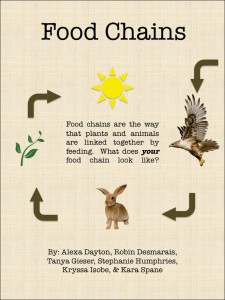
Check out the creative and insightful work of students in Pauline Sameshima’s T&L 390 class at Washington State University. (Click on the image to see their individual reviews of K-12 teaching resources).
