by editor | Apr 16, 2012 | Questioning strategies
“Lessons for Teaching in the Environment and Community” is a regular series that explores how teachers can gain the confidence to go into the world outside of their classrooms for a substantial piece of their curricula.
Part 18: Starting at the Top
Stand the hierarchy of cognitive functions on its head
by Jim Martin, CLEARING guest writer
 Learning to exploit the community and environment for your curriculum can be a confusing process. It can be less confusing if you apply the Learning Curve to the structural concepts we’ve been discussing – dimensions of inquiry, student-centered inquiry, effective work groups, etc. – because learning is a process, a developmental process. For instance, when you first start to develop effective work groups, both you and your students are learning them. Once learned, you’ll find that you have to keep in mind that you’ve got it down so well that it is easy to assume a new batch of students has too. To you, because you assimilated the concept, it seems more like common sense than learned content. The word, developmental, is an important one to remember. Lots of us don’t. We teach as if they already knew.
‘Structural concepts’ is a term that is useful to keep in mind. They help you stay on track in your teaching. I’m sure that, like me, you’ve found yourself in a favorite unit, straying away from the plan because where you’re going is such fun. If we keep those structural pieces in mind, we can attach the curricula we’re delivering to them. Some sheetrock here, a window there, and the deck in just this place.
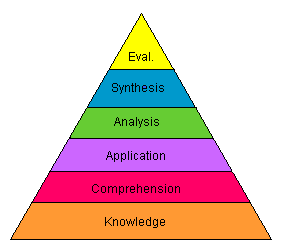
One structural concept is Bloom’s hierarchy of cognitive function, which contains several levels, named and then described: Knowledge – observation and recall of information; Comprehension – understanding information; Application – use information, use methods, concepts, theories in new situations; Analysis – seeing patterns, organization of parts, recognition of hidden meanings, identification of components; Synthesis – use old ideas to create new ones, generalize from given facts, relate knowledge from several areas, predict, draw conclusions; and Evaluation – compare and discriminate between ideas, assess value of theories, presentations, make choices based on reasoned argument, verify value of evidence, recognize subjectivity.
You might have noticed as you move through the hierarchy, there are more and more descriptors. A clear indicator that more and more of the learner’s brain is involved at each successive level. And, the learnings are more meaningful. Many published materials contain words in question stems like, ‘What,’ ‘How,’ and ‘Why,’ in an apparent attempt to stimulate thinking at the various levels in the hierarchy. In fact, I once attended a workshop where the presentor suggested starting multiple choice question stems with words like these to induce critical thinking. Words in question stems don’t do the work of thinking at the various levels; what students do, does. Starting at higher cognitive levels and inquiry dimensions is doable, and a way to stimulate involvement and investment in new learnings. It’s worth learning how to do.
Much of what education does in the US attempts to move students up the hierarchy, perhaps with the idea that when students have all the facts memorized, they’ll be able to evaluate what they’ve learned. But, most curricula ends at the Application level, or if it does reach true Analysis and Synthesis, it is delivered in a didactic modality. We know the words, but don’t incorporate them into our lives because we haven’t done them.
Here’s an interesting way to engage your own learning curve: start, once you’re comfortable with the concept of dimensions of inquiry, at the top right of the cube (See the diagram in Effective Work Groups: When you know them, they will change your world), reserving the lower left corner for training on instruments, etc. This top-down learning is effective, as students begin in a context, and work their way down the cognitive function hierarchy as they develop needs to know.
For instance, you can use temperature and dissolved oxygen in a stream and a lateral channel to start in the upper right, at least to the Correlational segment of the Experimental dimension. Lead students to the stream and ask them to see where water is. They’ll notice the main channel of the stream, but may take a while to notice a lateral channel. Then ask them where they think temperature and dissolved oxygen are more suitable for juvenile salmon. You move to the lower left corner of the diagram by showing them how to measure temperature and dissolved oxygen. Then they will move themselves almost immediately toward the upper right corner as they explore your question. This is how humans learn.
In the activity described above, you have moved from Application to Evaluation. Instead of starting with Knowledge, moving to Comprehension, then to Application, students start at the Evaluation level of the cognitive hierarchy, then migrate through its levels as they pursue their inquiry. Should you observe them carefully, you’d find they were using pieces of each level as they solve the problem they started out with. They don’t have to move in lock step, in one direction, up the hierarchy. They simply integrate the functions of the hierarchy into their repertoire.
Let’s explore a template that may help you reverse the sequence contained in the hierarchy, and so doing, leads to learning for understanding. The template is called the Learning Cycle, another structural concept, and it starts somewhere near the Unstructured and Inquiry dimensions of Inquiry. Instead of learning all about something before they go into the lab, community, or environment to explore it, students explore first, experiencing the content at a higher cognitive level. Let’s use the temperature and dissolved oxygen activity to demonstrate this.
The concept of the learning cycle has evolved over several decades, has generated a large body of data to support its efficacy, and is generally described as having 3-5 phases. I’ll paraphrase five phases here, and describe what students would do in each. The cycle can be used in any discipline; in our case let’s relate it to the stream and lateral channels activity described above. What the students and teacher did fall into the five phases in the order they were done.
- Engage: in which a student engaging in an activity becomes interested in a topic. Students exploring stream channels, main and lateral, become engaged with the content.
- Explore: in which the student to constructs incipient knowledge in the topic through questioning and observation facilitated, but not directed, by the teacher. When students, facilitated by the teacher, pull experiences together to formulate an inquiry question, they begin to construct knowledge and incipient concepts about the content. (This takes time.)
- Explain: in which students explain what they have discovered, and engage in a discussion of the topic to consolidate their understandings. When students assess their questions and design their investigation, they negotiate the meaning of their new understandings, testing their understanding of them as their plan evolves.
- Extend: in which students apply what they have learned and elaborate these new skills and understandings. As they collect data and analyze it, students are applying what they have learned about measuring temperature and dissolved oxygen in parts of the main and lateral channels they have chosen. As they work, they are elaborating their incipient understandings about temperature and dissolved oxygen in response to readings from the two microenvironments, and are observing and categorizing more details of the two channels. Doing this, they begin to develop incipient conceptual schemata about main and lateral channels They also encounter problems in knowing just where to sample, and are learning new information about how temperature and dissolved oxygen change in the two microenvironments.
- Evaluate (may now be evolving to ‘Create’): in which the teacher and students assess their knowledge, skills, and understandings. Students present their findings to the class. This forces them to assess the coherence and validity of their new learnings. When students interpret their data and ask if it answers their question, they are ground-truthing and clarifying their understandings. As they communicate their findings to the rest of the class, they are observing and correcting themselves, as is the teacher, within a collegial context. (If you’ve never done this, you’ve missed a very powerful experience. Find a teacher who does this and visit when students are communicating findings.
During the trajectory of the stream and lateral channel study, the ownership of the work migrated from the teacher to the student. The teacher must get them into contact with the content, then follow up on their initial findings to assist them to develop a clear inquiry question. After this, they carry most of the load, and you can scope and zoom to learn more about how this kind of learning works. Remind yourself if you forget, a brain is an autonomous learning machine. It starts in the real world, where it evolved, then moves to the abstract, to conceptual learnings. Back at school, those brains will peruse the books to fill in information they need to know. They learn.
Next time, we’ll take a trip from the end of an inquiry to its inception. Working backwards is a good way to nail down understandings.
 This is the eighteenth installment of “Teaching in the Environment,” a new, regular feature by CLEARING “master teacher” Jim Martin that explores how environmental educators can help classroom teachers get away from the pressure to teach to the standardized tests, and how teachers can gain the confidence to go into the world outside of their classrooms for a substantial piece of their curricula. See the other installments here, or search Categories for “Jim Martin.”

by editor | Apr 11, 2012 | K-12 Classroom Resources
Reviewed by Seth Webb

 hile perusing my local library’s children’s section, I found a wonderful collection of playful poems, insightful science and glorious artwork. In Ubiquitous: Celebrating Nature’s Survivors, written by Joyce Sidman and illustrated by Beckie Prange, the reader is treated to an engrossing portfolio of fourteen success stories from the timeline of life.
I was spellbound just opening the book to the endpapers. What greeted me was an impressionistic illustration of the history of life on Earth. Using 46 meters of cotton string and the brilliant colors of the rainbow, Prange recreates and elaborates upon the Long Black Line. Rather than stretching down a long hall, or across a field, this timeline bends and swirls to fit within a much smaller space. Interestingly, the effect is as profound, held in our very hands.
With each page I was drawn deeper, continuously fascinated by the discoveries I was making – new knowledge about organisms, some of whom I thought I knew quite well.
But that’s part of the magic, right? To allow for and celebrate the known becoming new and strange again.
I greatly appreciated how Sidman and Prange chose, for some of their examples, species that are more often maligned than revered. How refreshing to see a positive and inquisitive voice brought to grasses, crows, dandelions and coyotes. In an age where the pursuit of ease and cleanliness seems to be paramount for many adults, to find in this book organisms often given a bad reputation for being irritating or troublesome was especially gratifying.
As with contemporary compendiums on topics of nature and survival, this book too also brings to light some of the present dangers that threaten the species highlighted within. Sidman’s text, however, is well balanced – allowing for the notation of real threats without resorting lambasting humans outright – for nothing is quite that simple.
The final line offers both the hope and challenge that humans bear:
“Our cooperative nature leads to acts of great kindness and compassion, while our competitiveness – combined with a tendency to crowd out other species – makes us one of the most destructive species on earth.”
I invite you to add Ubiquitous to your classroom collection. It will enchant readers of any age, and provide for the possibility of great discussions on our place and role in it all.
Enjoy!
Ubiquitous: Celebrating Nature’s Survivors (ISBN: 978-0-618-71719-4)
 — Seth D. Webb is the Instructional Leader for the Upper Elementary Department at Free Horizon Montessori, a charter public school in Golden, Colorado. Prior to working in the classroom, Seth taught outdoor experiential education in Colorado, Utah, Arizona and Wyoming with many institutions, including: Earlham College’s Wilderness Program, Grand Canyon Field Institute, and the National Outdoor Leadership School. Read more at his blog, Finding Our Center – Reaching Out.
by editor | Apr 10, 2012 | K-12 Classroom Resources
Lohr and Pearson-Mims have conducted a nationwide phone survey of 2004 adults in cities about their childhood experiences related to nature, and current action and attitudes towards trees. Researchers concluded that, “Growing up next to natural elements such as flower beds, visiting parks, taking environmental classes, and gardening during childhood were associated with stronger adult attitudes and more actions. Growing up next to urban elements, such as large buildings, had a small, but opposite, influence. (…) These results indicate that horticultural programs for children raised in urban surroundings with few or no plants can be effective in fostering an appreciation for gardening in adults.”
SOURCE: Lohr, V. I., & Pearson-Mims, C. H. (2005). Children’s active and passive interactions with plants influence their attitude and actions toward trees and gardening as adults. HortTechnology, 15(3), 472-476.
by editor | Apr 10, 2012 | Questioning strategies, Schoolyard Classroom
“Lessons for Teaching in the Environment and Community” is a regular series that explores how teachers can gain the confidence to go into the world outside of their classrooms for a substantial piece of their curricula.
Part 17: Discovery of Students as Persons
Students, engaged, empower teachers; a first step toward Community and Environment Based Learning
by Jim Martin, CLEARING guest writer
 The discovery and appreciation of effective student work groups often emerges from involving students in community-based learning. Probably because the work, based in and on the real world, is authentic, and entrains central nervous system processes which are already in place. This is an important developmental learning milestone, and can be exploited to move yourself toward community-based learning as an integrated view of how to teach.
As teachers make this discovery about work groups, they may exhibit a growing desire to nurture and exploit this new view of school and students. This is one of the paradigm shifts which leads to effective use of the curriculum embedded in the community. The student, as empowered person or citizen, affects the nature of a teacher’s view of his or her role in the classroom, school, field, and community.
Teachers who build their curricula around the community and environment often directly alter their students’ attitudes toward their educations. The perceptive observer will notice this in the way students become involved and invested in their educations, and empowered as persons. From time to time, I’ve heard teachers notice particular students working in the lab make an observation like, “Is that Bethany organizing her group? She doesn’t do that in my class.”
This change in students’ attitudes and work is noticeable, and most teachers who observe it are impressed, and with support, eventually changed by what they see. Students’ empowerment influences and empowers their teachers. Certainly, I was one of those teachers. I’d like to describe three teachers’ involvement in community and environment based learning, and the effect their students had on them. Each teacher is a composite of more than one teacher, but the teachers in each description approached the work of teaching in similar ways, and had about the same experience.
The first is a veteran middle school math teacher who used his authority to maintain control in the classroom, sent misbehaving students into the empty hallway, delivered his curriculum via lecture and practice, and was marginally successful in delivering content. One day he decided to try a regional watershed program where students and their teachers made observations on environmental parameters in watersheds. During the first field trip, he mainly walked around as a spectator, which many teachers do in these situations. Later, we talked about possible follow-up activities, and I suggested making three-dimensional topographic models of their station from thick poster board. This would give him an opportunity to observe work groups; hopefully one or more would be effective.
The next day, he asked me to start the project, and said he would butt in whenever he felt comfortable. Once the students started working, he expressed surprise at the work, communication, and management skills various students exhibited. He had never noticed his students were all different! He took over right away, used his own personal knowledge, skills, and understandings to run the class, and over the next two years moved from being a top-down, didactic, authoritarian teller of content to a comfortable, student-centered facilitator of effective work groups. That was a gift from his students, whose personal empowerment so impressed him. And one of his gifts to them was a dramatic increase in the scores of the bottom 25th percentile.
(In many of my blogs, I refer to the ‘bottom 25th percentile.’ I do this because, if you can raise the achievement of that particular group in a classroom of students, then the achievement of all students in the class will improve along with them.)
The second is a middle school language arts teacher who was relatively new to teaching, and who involved her students in the community and environment. One day, she decided she’d like to have her class develop a watershed model in a courtyard at the school. She organized the class into groups who learned how the fountain in the courtyard worked, and modified its flow so it resembled a stream. Others learned about rocks in streams, native plants in streams and on stream banks, etc. These students were already empowered by their teacher’s competence as a motivator and facilitator, so they continued to be involved and invested in their educations, and their success in this new project reinforced the teacher to continue to be involved in community and environment based learning.
(My last project with her was a tutor-assisted reading program in which college students volunteered to tutor groups of 4-5 students, and significantly improved the reading levels of her bottom 25th percentile. Authentic education involving effective work groups pays off in any discipline and academic level.)
The third is a veteran middle school social studies teacher who did little planning for her classes, didn’t maintain a structure in her classroom that was conducive to learning, and didn’t develop effective work groups. As part of our project we would come to her school to mentor her on field work. One time we took her class out to learn to find and map elements of watersheds. Once we were on the school grounds with the students, she left to rest in the faculty room. Over a period of two years, she never became involved in activities the students engaged in the school. But she did stay with them when they manned information booths about their projects at informational open houses at study sites in the community. She became comfortable on field trips, participated in some of the work her students were doing, and encouraged some of them to do good work. The students who grew in the projects she started did so mainly on their own; the opportunity was all they required. Her bottom 25th percentile didn’t improve.
This teacher had, over several years by the time our project finished, entered and traveled along the acquisition phase of the learning curve. In some areas, she moved into transition to the proficiency phase. Should she ever move some distance up that phase, the work might involve and invest her in her teaching. She is bright, but not empowered by her work or by her students. The fact that she did move some way into the learning curve tells me she represents a first approximation of a fully empowered teacher. If I were her mentor, I’d use that information to set the next approximation and move her toward it.
There’s a good lesson here. If we are to get our students to the point where they empower us, we have to be intimately involved in what we do. Seems obvious, but not to everyone. The third teacher was interested in the community and environment, but never became intimately involved with the work. Because the work is almost always authentic, that alone helps us to become very involved in it. That, plus our commitment to our profession, teaching.
 This is the seventeenth installment of “Teaching in the Environment,” a new, regular feature by CLEARING “master teacher” Jim Martin that explores how environmental educators can help classroom teachers get away from the pressure to teach to the standardized tests, and how teachers can gain the confidence to go into the world outside of their classrooms for a substantial piece of their curricula. See the other installments here, or search Categories for “Jim Martin.”

by editor | Apr 4, 2012 | Questioning strategies
“Lessons for Teaching in the Environment and Community” is a regular series that explores how teachers can gain the confidence to go into the world outside of their classrooms for a substantial piece of their curricula.
Part 16: Effective Work Groups
When you know them, they will change your world
by Jim Martin, CLEARING guest writer
 e left the last blog with a note about effective work groups. I asserted a continuum of work groups from one in which each student is answering questions without talking with other students in the group, to one in which students carried on a continuous negotiation of meaning and organization of work assignments until the job was finished.
Let’s return for a moment to the Dimensions of Inquiry to visualize scenarios in which the quality of student interactions experiences a developmental change from isolated work to effective cooperative work. Look at Figure 1, which is a depiction of the three Inquiry dimensions arrayed in a three-dimensional graph whose axes are connected to form a cube. The dimensions range from Verification to Inquiry on the X-axis, Structured to Unstructured on the Y, and Description to Experiment on the Z. Each black dot inside the cube represents an activity performed by a student or group of students. Taken together as pictured, they represent a trajectory from rote didactic to interactive constructivist learning, a plan for where a course or unit should begin and end.
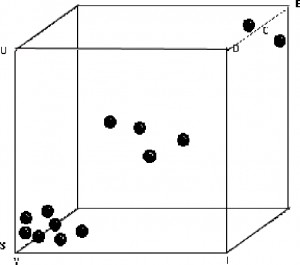
Figure 1. Three-Dimensional array of the Dimensions of Inquiry. Starting at the upper left, and moving around to the right, U = Unstructured, S = Structured; V = Verification, I = Inquiry; and D = Descriptive, C = Correlation, and E = Experiment.
You can see that some activities are structured, and clustered around the Verification and Description sides of the X and Z axes. These would be teacher-centered, and didactic, and hopefully activities in which students were learning to use equipment, read technical manuals, or work like that. But, try to imagine an activity in that lower left cluster in which students were trying to determine where juvenile salmon might congregate based on measured water quality parameters. It is possible to imagine this scenario, but the picture I see is one of a very neurotic teacher controlling every aspect of the students’ thoughts and actions. Certainly not conducive to critical thinking, one of the products which should emerge from science education. Unfortunately, it usually doesn’t emerge, and we all need to learn to rectify this situation.
The most effective way I know to do it is to move my students through that cube so, instead of doing lots of ineffective small activities, such as those publishers seem to favor, they spend most of their time on a few complex activities that entrain and encourage critical thinking, involvement and investment in their education, and empowerment as persons. These outcomes are as important, at the very least, as is touching ever so briefly, mandated science benchmarks. (I had a very small part in developing science benchmarks. So, I should talk. I don’t wish to belittle benchmarks; they make wonderful organizers, but have morphed into swords, held over teachers’ heads. Unfortunate.)
Effective work groups facilitate this movement toward students who routinely use critical thinking to navigate the curricula they are assimilating. Developing effective work groups is an ongoing process in which you move from Teller of Facts to Facilitator of Minds. Students working together in groups is a dynamic phenomenon, one which can be frustrating or invigorating, depending on how you approach the process. Like raising children, you have to learn to live with a balance between freedom of decision and action, and respect for boundaries. And, like parents, you accomplish this by creating structures within which your students move.
One thing that helps is to start the school year off with students working on an interesting problem in dyads. The problem should be one in which students make some things interact, and the interaction produces interesting results. (Our primate heritage: We’re easily drawn to novelties! Piaget called them discrepant events.) For instance, they can add an indicator dye to several liquids you’ve collected, and observe for a color change. (If you’ve practiced beforehand, you’ll almost always find one thing which doesn’t produce the color change you expected. Fun. And, discrepant.)
As they work, you can make suggestions that help them work well together, but don’t tell them any answers. Their brains have to do that. Having them report their results to the class helps them to learn some valuable lessons about working together. (If you include things in this activity which will act as openers to segue into your first unit, you’ll be able to see right away the power of assimilation to involve students in their learnings.)
I start with dyads because they minimize problems of acting out, refusing to help, etc. Once students are working well in dyads, then you can merge dyads to form tetrads, groups of four, to work on larger problems. Occasionally move the memberships around. (I learned a nice trick at a workshop; Make up a blank ‘day timer’ page, with the hours from 9:00 to, say 6:00, and an underline after each hour. Have students move around, signing up students they know and don’t know. Then, when you change group memberships, ask them to get together, say, with their 4 O’clocks to form dyads. This keeps the ownership ball in their court, and also gets students to know one another the first or second day of class.)
We’re going down this road toward effective work groups for a reason. There’s a dynamic that is generated within groups of students who have experiences in working together effectively which will raise the capacity of all of your students to become very effective learners. You’ll see this emerge as you work. The person who first described this dynamic was Lev Vygotsky, a Russian psychologist, who developed the concept of a Zone of Proximal Development, which he hypothesized as a place where all students could learn a particular concept, but don’t because most students haven’t developed the capacity to identify key elements of the concept that bring everything together. Practically all students understand the components of the concept, but haven’t developed the skills to identify the key elements and bring them to bear on solving the problem.
When they work in groups, students, in a real sense, share their minds, their brains. And they are very good at recognizing and exploiting cues from the environment. As either a bright student in their group, or you, the teacher, elucidates a key integrating component, most of the students will see it. Eventually, continuing to work in this mental negotiating environment, all, or nearly all of your students will have assimilated the skill of identifying key elements, and will be working at a higher level of cognitive function. This is how you raise the performance of your bottom 25th percentile. The secret is to begin with groups who learn to negotiate meaning together, and who work well in small or large groups. That sets the stage. The hardest part for you, once you begin to notice student dynamics in groups, is having the patience to move at a pace which allows your students to develop these capacities. I always felt frustrated when I would consider that I had to wait three or four months until we did the activity which I knew would bring everything together.
If you’ve already developed effective work groups, this is probably old hat. If not, try a small piece with dyads, and observe their interactions very carefully. What are they doing and saying that moves them forward? What inhibits them? Later, work with them by starting with strengths you observed. We don’t always recognize our strengths, and begin to favor them when they’re recognized. And, we resist change when our weak areas are brought up. So, build on strengths, then ask yourself and your students how to use these strengths to shore up the weak areas. You’ll all learn valuable lessons about group dynamics from this. You know by now that you are modeling adult behavior and attitudes in your classroom. You don’t have to tell them much. What you do is like planting seeds. You may not see the plant that eventually grows, but you can rest assured that you will enhance students’ lives by modeling how to be an effective member of a group.
 This is the sixteenth installment of “Teaching in the Environment,” a new, regular feature by CLEARING “master teacher” Jim Martin that explores how environmental educators can help classroom teachers get away from the pressure to teach to the standardized tests, and how teachers can gain the confidence to go into the world outside of their classrooms for a substantial piece of their curricula. See the other installments here, or search Categories for “Jim Martin.”


