by editor | Feb 25, 2012 | Environmental Literacy
“Lessons for Teaching in the Environment and Community” is a regular series that explores how teachers can gain the confidence to go into the world outside of their classrooms for a substantial piece of their curricula.
Part 12: Flirting with Danger
What happens when things seem to go wrong
 by Jim Martin, CLEARING guest writer
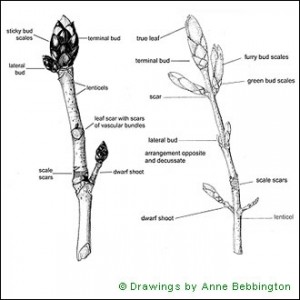
 n the last blog, I – and hopefully you – went out to snap off a twig from a cherry tree. I did that, except that the closest I have to a cherry tree is a prune tree, then began to examine it. Since I don’t have a lab now, I did the dissection with my tiny swiss army knife. The blade is a little over an inch long, and reasonably sharp after nearly 14 years of use. Here’s what I found.
The twig was dry and hard. When I cut it from the tree, I first cut off a piece about a foot long, then made another cut to create a six inch section of twig. I used the knife to slice a line around the circumference of the section about half an inch from one end. Then I cut lines perpendicular to the circumference line, about a quarter inch apart, around the section. After that, I used the edge of the blade to peel up sections of bark, one at a time.
Danger #1: When you look at illustrations of twigs and their parts, each section is shown intact, colored to set it apart from others, and often thicker than you find in the real thing. So, being mentally forewarned, I wasn’t discouraged when what I saw wasn’t what bark and cambium look like in the drawings in the book. The outside of the bark was easy to discern, but any cambium adhering to the inside was a little harder to decipher. After a section of bark was lifted, there was a relatively dark, thin layer which looked like it had been buttered on with a table knife. It wasn’t soft, but when I scraped it off, it was definitely different from the wood beneath. (more…)

by editor | Feb 24, 2012 | Questioning strategies, Schoolyard Classroom
“Lessons for Teaching in the Environment and Community” is a regular series that explores how teachers can gain the confidence to go into the world outside of their classrooms for a substantial piece of their curricula.
Part 11: Assimilation Continued
by Jim Martin, CLEARING guest writer
 e’ve been talking about assimilation, where we start in the real world, integrate new learnings into old concepts, then use this auspicious beginning to move into the abstract. It’s like building a boat that lets you explore an uncharted ocean. It helped our hunter-gatherer ancestors to navigate changing environments. It is still embedded within the brain that was selected for by the consequences of its activities.
And it served us well until our environments became brick, steel, asphalt, and concrete. Now, instead of learning about the world in the world, we learn in rooms. Not that that’s a bad idea. It helps us to focus and concentrate our thinking. But, because it’s generally only an extended exercise in developing short term memory, twelve or thirteen years of it doesn’t leave a student well equipped for the environment he or she will inhabit. (more…)

by editor | Feb 12, 2012 | Schoolyard Classroom

 n a quiet, residential, inner southeast Portland, Oregon street, a little elementary school is breaking new ground for the farm-to-school and school garden movement.
At Abernethy Elementary, students enjoy freshly cooked breakfasts and lunches prepared on site by a trained chef. The meals are often prepared with local and seasonl ingredients, some of which are harvested from the school’s Garden of Wonders. The garden itself is entirely planted, tended and harvested by the students, who use it throughout their school day as a “learning laboratory.”
Read their story…

by editor | Feb 1, 2012 | Environmental Literacy, Questioning strategies
“Lessons for Teaching in the Environment and Community” is a regular series that explores how teachers can gain the confidence to go into the world outside of their classrooms for a substantial piece of their curricula.
Part 10: Assimilation
When the world outside becomes the world inside
by Jim Martin, CLEARING guest writer

 tarting in the world outside our skin, our personal tegumental boundary, I have claimed, is the best way to learn. By ‘learn,’ I mean integrate new material into old understandings so that they become a part of you. Part of you because they begin their synaptic lives with you by adding protein to the synapses they innervate, piles of stones along a new path, so they can find their way again. Becoming protein within you, they are you, a part of yourself that will travel with you wherever you go.
An enchanting thought, that, one that all teachers could give to their students in every class they teach. Learning for understanding, carried through each person’s life. I would think that thought would drive education, but it doesn’t. Even so, I’d like to talk about it for a bit.
ALERT: You need to be a CLEARING subscriber to read the rest of this article. (See box in right sidebar)
(enter password then hit return on your keyboard for best results)
[password]
What happens when we engage some concrete piece of the world outside our bodies with the intent to learn? Or, at least the teacher expects us to learn. Let’s say we’re on a streambank, collecting, identifying, and counting the macroinvertebrates (macros) we have netted in the stream. You empty the net into a tub of stream water, then use a pipet to suck one particular macro from the milieu, place it into one of the depressions of an ice cube tray, and use your macro identification book to attach a name to it. These activities are all coordinated by your brain, the organ system which will do the learning and, hopefully, the eventual remembering.
While you are hovering over the basin, pipet in hand, your parietal lobes begin to pay attention to what is happening where the skin of your hand ends, and the rest of the world begins. That’s one of their jobs. Another thing they do is to alert other parts of your brain about what you are doing. The Gnostic area (in the parietal lobes) integrates sensory interpretations with memories from most of the brain to formulate a common thought and devise a single response to the incoming information. Cells in your parietal lobes are stimulated and in turn stimulate neurons connected to parts of the midbrain associated with attention, instinctive and procedural skills, and episodic (past experience) memory. Other neurons are stimulated in the frontal lobes, where working memory is organized and where stored memories advise and guide current behaviors, in the temporal lobes with their stores of general knowledge memories, and in the hippocampus, which has the capacity to turn experiences into long-term memories.
So, what does this mean? When we use our hands to net macros, use a pipet to transfer a particular one to an ice cube tray depression, then grab a book and try to identify it, the parietal lobes turn on our wonderful autonomous learning machine. It automatically focuses us on the subject of our actions, brings all relevant knowledge and concepts to bear on it, and sets up a working memory room for us to work in until we’re ready to incorporate the gist of this new experience into knowledge, concepts, and skills already stored in our brain.
As the Learning Machine continues its work, it does so by firing impulses across synapses, connections between nerve cells involved in this activity we’re involved in. A neat thing about cells is that they build more parts when one is used. So, each of the nerve cells which fire during this learning add to the size of a synapse each time it is used. This increases to the probability of firing when stimulated again. Later, when one of these neurons is stimulated, others will more than likely be stimulated too, and you’ll remember significant pieces of the objects and related concepts that you worked with originally; in this case, a visual image of the macro, its name, and relevant facts you discovered about it. If you build from hands-on activities, in May or June you can remind students what they did in October, and they’ll bring the concepts and relevant facts out spontaneously. That’s because the knowledge and concepts are in the brain proteins that are part of them.
And to make this even simpler: What I’ve described is the process of assimilation, starting with concrete objects to develop new understandings which are incorporated, integrated, into previously held concepts and thus more likely to be remembered. This idea has been around a long time, a part of the psychology of learning, but is not used by most educators. Instead, we ask students to place new learnings in working memory until they have passed the test. Once the job is finished, working memory flushes itself out. Then we wonder why they can’t remember enough to pass the SAT.
Once you’ve started in the real world with concrete objects, then you can milk this opportunity by tying these learnings to new material the class learns from books, and other standard sources. If you’re clever, you’ll find that you can stretch this a long way. Start with concrete experiences, move to the abstract. This is one of the reasons that community and environment based education works so well. It is based on the way the human brain works. Since the brain is the organ of learning, we ought to know something about how it works.
When you take your students into the community and natural areas, plan your curriculum with assimilation in mind. Talk with the people you work with in these places. They can help you find what you need to get started, the curricular starting places that are embedded in the places where they work. While your students are working, observe them for evidence of the pieces of assimilation. You’ll find that, once you get a handle on it, your teaching will begin to move in an interesting direction.
[/password]
 This is the tenth installment of “Teaching in the Environment,” a new, regular feature by CLEARING “master teacher” Jim Martin that explores how environmental educators can help classroom teachers get away from the pressure to teach to the standardized tests, and how teachers can gain the confidence to go into the world outside of their classrooms for a substantial piece of their curricula. See the other installments here.

by editor | Jan 22, 2012 | Questioning strategies
“Lessons for Teaching in the Environment and Community” is a regular series that explores how teachers can gain the confidence to go into the world outside of their classrooms for a substantial piece of their curricula.
Part 9: Digging Through the Brambles
by Jim Martin, CLEARING guest writer
 t last writing, I’d decided to explore a place outside for the curricular content which was embedded in it. I planned to do a natural science inquiry, and decided to also look for social studies and creative writing curricula units there based on an area near a dog walk. The area is fenced off from the dog walk, and has entrances to several animal runs along its edge. At its outer edge, this undisturbed area ends at a sharp precipice on the edge of a working quarry. Now, my job is to turn this place into a lesson that will release and exploit the curricula embedded within it.
I’ve decided to start each discipline the same way, a casual exploration and discussion of the animal runs. The discussions will direct the students into each of the three disciplines. First, though, an operational definition of what I’m calling animal runs. If you walk on a path that has tall grasses, shrubs, or other plants parallel to it, every now and then you’ll notice small, oval or round openings in the wall of vegetation. They vary in size from awfully small to large enough for a cat to crouch through. If you look beyond the entrance, and can see, this is probably a run. Exploring further, you can find signs of particular places animals go, but this takes patience and skill to locate in many runs. In others, the paths are clear to the eye.
So, I’ll assume that some runs will only be observed as entrances, with no particular destination other than safety. Others may reveal some indication they travel to a destination. And, in the best of all possible situations, one will have a clearly defined path. When I see one of these, I’m thrilled. (If you are observing in a place where large mammals, deer-size, live, then the runs are true paths that you, yourself, can use to move from one place to another. And learn a lot about the animals who made them.)
So, here’s how I’ll build my curriculum for each discipline. I’ll start with science, since that’s what I know best. Since I want this inquiry to focus on transportation, after the casual observation, I’ll call up the observations reported on runs, and ask what students think animals use these runs for, and use this to get ideas out for consideration, and then to suggest students organize into groups to word a science inquiry question and design an investigation.
Science standards I’ll focus on are: (Central Focus) Design a scientific investigation to answer questions or hypotheses. (Most ‘hypotheses’ sections in publishers’ materials ask the student to formulate an hypothesis about something she has never experienced. Hypotheses are formulated after many question-driven inquiries suggest them. I think we’re best to work with questions. They perform effective work.) (Supplemental Focus) I’ll also see that their experiences partially support the standards: Analyze data, while being mindful of observer and sample bias; Acquire information from print and not-print sources, including the Internet; and Describe cause and effect relationships in biological and physical systems. I could also include the standard, Collect sufficient data to investigate a question, clarify information and support analysis, but think there will be lots of uncertainties in their data.
So, I’ll have them do the casual observation on the runs detailing any evidence of animals or animal movement they find, develop a clean inquiry question, design their investigation to answer the specifics in their question, collect and analyze data, then interpret their data and communicate their inferences to the rest of the class in a symposium. There may be next steps that emerge from the reporting, and we’ll have to decide what to do about them at that time. Given the importance of their work to their understanding and comprehension of science and science inquiry, extra time, and perhaps an extra field trip, may be worth it.
Creative writing standards I’ll focus on are: (Central Focus) Write a narrative piece that establishes character, a situation, plot, point of view, setting, and conflict using a range of strategies to create dialogue, tension, and/or suspense. (Supplemental Focus) I’ll also see that their experiences partially support the standards: Engage the reader by establishing context, creating a persona, and developing audience interest; Include sensory details, personal thoughts, and feelings in developing topic or plot and character; Write sentences that flow and vary in length; and Revise writing to improve clarity and effectiveness by adding relevant details, changing or rearranging text, as suggested by others.
After the casual observation, we’ll report our findings and brainstorm the possibilities embedded in them for story plots or elements. My expectation is that, because they started with concrete referents, their stories will emerge easily, with significant detail. For this unit, I want each student to write a story, so I’ll group them for all the other work but the writing of the story. They’ll first share their thoughts in group, then write a synopsis of the story as they see it. Then, in groups, they will sell their synopses to the rest of the group, receive feedback, and use this to assess any changes they feel they’d like to make to the story. As they work on their stories, I’ll ask which of the Central Focus elements they would like advice on, and I’ll do a lecture/discussion on that piece. In groups, students will share progress made, ask for feedback, etc. The stories have a 3,000 word limit, and do not have to be finished all the way to the end. (At the end of the unit, if several stories aren’t finished, then I’ll arrange time for students who would like, to finish their writing.) When all stories are complete, we’ll share them, either as readings or as written documents.
Social Studies standards I’ll focus on are: (Central Focus) Understand how human modification of the physical environment in a place affects both that place and other places. (Supplemental Focus) I’ll also see that their experiences partially support the standards: Understand how changes in a physical environment affect human activity; and Understand fundamental geography vocabulary such as concepts of distance, latitude, longitude, interdependence, accessibility, and connections.
After the casual observation, we’ll take a tour around the humane society neighborhood, and through the quarry to see what ‘runs’ we find there. Then, I’ll divide the class into three large groups who will focus on human modifications to the environment at the site which affect that place and other places. One group will focus on the animal runs, another on the quarry, and the third on the streets and roads around the humane society. We’ll use communication and transportation as topics which will coordinate the three groups’ work. At the end, we’ll build a communication and transportation map of the area which will hold relevant information for each use.
You’ll notice that my description of the social studies unit is the briefest of the three units. Think of that fact as an analog or metaphor for what our teaching is like when we’re asked to teach content we’re not prepared for. We don’t have enough synaptic connections among neurons in our brain to raise up words that provide detailed descriptions of our thoughts. And we subsequently don’t pass many understandings on to our students. The best way I know to build these synaptic pathways is to start in the real world, engage real things with our bodies and senses, and connect them to concepts and understandings already housed in our brain. Perhaps we should talk more about this.
[/password]
 This is the ninth installment of “Teaching in the Environment,” a new, regular feature by CLEARING “master teacher” Jim Martin that explores how environmental educators can help classroom teachers get away from the pressure to teach to the standardized tests, and how teachers can gain the confidence to go into the world outside of their classrooms for a substantial piece of their curricula. See the other installments here.

 by Jim Martin, CLEARING guest writer


