by editor | Jan 13, 2012 | Questioning strategies, Schoolyard Classroom
“Lessons for Teaching in the Environment and Community” is a regular series that explores how teachers can gain the confidence to go into the world outside of their classrooms for a substantial piece of their curricula.
Part 8: Where is Curriculum?
by Jim Martin, CLEARING guest writer
 We’ve been talking about our ‘Locus of Control,’ the place where the authority for what we do lies. That authority can be outside ourselves, or within. What determines where we find it? Nothing more than experience.
By experience, I mean having done something in a way that lets me understand it once and for all. Most teacher inservices introduce us to new learnings, then let us go, as if we had mastered it. Many field trips do the same; we go out, experience something neat and invigorating, then return to our classroom not understanding it well enough to incorporate into our curriculum. I think we might do well to revisit environmental education, and its partner, K-12 education.
Before environmental education was a household word, most people abused the environments they inhabited and traveled through. There were lots of reasons for this, and someday we might visit some of them. The first environmental education project I remember was Lady Bird Johnson’s campaign to reduce highway litter, which was an atrocious problem. She opened our eyes, and we soon began to generalize the concept and become more aware of what was happening in our forests, plains, wetlands, and waterways.
Environmental education brought this to our attention, and we learned. Today, a large fraction of the population recycles, and votes for environmental legislation. I think it might be time for environmental education to begin an exploration of its place in the average U.S. K-12 school system. It has a lot to bring with it, and our students’ educations might better prepare them for the world they inhabit. Let’s look at some pieces of such a possible future merger.
We’re already moving in that direction. Many teachers, and some schools, have been using the natural world, and its embedded curricula to drive their deliveries. With great success. Some schools organize their entire curriculum around the environment and community. In other schools, individual teachers have built their curricula around the world outside the classroom. They all use environmental educators and local experts and organizations to partner in their works. Both environmental educators and teachers had to modify their practices to make it work, but all seem to have benefited from the adaptation.
Here is what each brings to the table. Environmental educators bring natural environments with their plant and animal populations, a great place to begin learning for understanding via assimilation. They bring an intimate intuitive knowledge of the curriculum embedded in the places where they work. And so far, all those I have known are quite willing to work with teachers to develop projects and programs which meet their needs. They also often have equipment and resources that school classrooms don’t.
Teachers bring students who are, at the very least, happy to be out of the classroom, and are willing to work while they are on site. Teachers have intimate knowledge of the strengths their students bring to the work, and are great behavior managers of students who are working on their own. Those who have been doing this work for awhile carry with them the certain knowledge that their students grow in this work, and most important for their job security, score very well on standard tests.
The interface piece which holds this together for both groups is the embedded curricula residing in the sites the environmental educators work in. Classroom curricula and real world sites; a dynamite combination. I can give you an example from a project a bright first-year teacher did. Her class was working on a restoration project in a ‘natural’ urban park. One day, she had her students stand on a high spot where they could see all of the trees on site. They counted the number of each species present, and she then showed them how to convert these numbers into fractions, and the fractions to percents. Suddenly her students could see what 13% and 48% looked like. And, when they and a class which didn’t work on the project took the tests on percents, all of the ones who worked on the project passed; far fewer in the other class did.
We’ve all been to school, and many of us have gone to college. We know something about each of the major disciplines taught in our K-12 schools. Here’s what we can do with this knowledge we’ve carried with us all these years. We can find a natural place, or a place in our community, and begin to get to know the curriculum embedded in it.
When you think of it, everything we learn in school is about the world outside the classroom. Those disciplines originated somewhere, and that somewhere is in the world we’ve inhabited. Pick three disciplines, one that you know intimately, and two you know, but not well enough to teach from scratch. Go into that place you’ve chosen, and find examples of each discipline you picked. When you’ve done that, think of how you would teach it.
Here are the disciplines I’ve chosen: Biology, creative writing, and social studies. I’ve listed them in the order that I’m familiar with them. For instance, one part of me has been a biologist since 1963; another part likes to write, but has never taken a course in creative writing; and, the third part appreciates history, but doesn’t know what a social studies curriculum contains other than history.
So, I’m going to go out right now and find the place where I’ll find my disciplines embedded in. I’ll search for the learnings, and when I find them, I’ll think of how I could get a classroom of students to locate and exploit them. I feel comfy about biology, okay about creative writing because I appreciate the power of metaphor (Which I don’t use often enough!), and am feeling pretty shaky about social studies. If you know about learning levels, I’m at my Instructional Level. The learning load isn’t at my Frustration Level (where I’d just give up), nor is it all at my Mastery Level (where I’d be bored to death).
. . . Two days later . . . .
Okay, the place is the area just off the dog walk at the Southwest Washington Humane Society in Vancouver, WA. A few yards from the dog walk, there is a chain link fence at the edge of the shelter property, and on the other side brush and brambles cover several yards before reaching the precipitous edge of a quarry. Not really a natural area, except that humans don’t tend it. Nor is it a developed urban area. But, it resides in the world outside the classroom, so fits my criteria. I’m going to check it out, and report back on the biology, creative writing, and social studies curriculum I found embedded in it. See if you can’t do the same so you’ll have some concrete referents to refer to as we continue this exploration.
.
 This is the eighth installment of “Teaching in the Environment,” a new, regular feature by CLEARING “master teacher” Jim Martin that explores how environmental educators can help classroom teachers get away from the pressure to teach to the standardized tests, and how teachers can gain the confidence to go into the world outside of their classrooms for a substantial piece of their curricula. See the other installments here.
by editor | Jan 9, 2012 | K-12 Classroom Resources
Understanding Electricity Through Photovoltaics from green levine on Vimeo.
More Than a Metaphor
Solar energy in the classroom
by Jessica Levine
Eckstein Middle School
Seattle, Washington
As a student of David Orr at Oberlin College I helped design the Adam Joseph Lewis Center (AJLC) for Environmental Studies. The building was designed to generate more energy than it consumed– a phenomenal concept for a building. It turned out it was also a pioneering concept for education.
Taking my Oberlin education into my own educational practice has been easy. I teach the science of sustainability in a year-long physical science curriculum for 6th graders at Eckstein Middle School in Seattle. So, recently, I considered some of the same questions we had set out to explore for the AJLC. Was it possible to generate energy from solar—even in Seattle? Could I maintain a system as a demonstration, for students, families, and community, of what is possible with renewable energy? Could I go off the grid in a large urban public middle school? (more…)

by editor | Jan 7, 2012 | K-12 Classroom Resources
 Rick Johnson has served as executive director of the Idaho Conservation League for 16 years. ICL is Idaho’s leading voice for conservation.
Interview by Chris Gertschen
CG: Is there one particular event or series of events that led you to a profession in conservation?
RJ: Yes, if you focus on the profession part. I got into conservation as a volunteer for a lot of reasons wrapped around love of Idaho’s outdoors and a sense I could contribute, but I got into the profession because of a single event. (more…)

by editor | Dec 31, 2011 | Environmental Literacy, Questioning strategies
“Lessons for Teaching in the Environment and Community” is a regular series that explores how teachers can gain the confidence to go into the world outside of their classrooms for a substantial piece of their curricula.
Part 7: From Hand to Mind
Concrete experiences generate learning for understanding
by Jim Martin, CLEARING guest writer
 ver the past few blogs, we’ve walked through a science inquiry done in a natural area. First, we noticed something there, then asked a question about it, and used the question to develop an investigation. We did the investigation, collecting data that we hoped would answer our question.
We’ve analyzed and interpreted our data, and now we need to communicate it. Most science standards and benchmarks overlook this piece of science inquiry, but scientists don’t. This is the place where you really nail down what you’ve learned. Something we often don’t do in American education
Communicating findings is an important piece of science inquiry. Preparing for this phase gives you a chance to look back on what you’ve done; where you started, what you did, how that affected your thinking, what new questions emerged from your work. A check to see if you understand, and, hopefully, appreciate what you’ve done. You know what one part of the world is, and what it does. I’m sure you’ll never pass that place, or one like it, and not think about what’s there and what it’s doing.
A good way to start the communication process is to make a poster with four sections. The first section states your question and provides background information about it, and why you want to find out. The second section lists the steps you took to answer your question. It should be clear enough that another person could follow your directions. (I used to have my students swap directions, try to follow them, and make recommendations for edits, point out pieces that were particularly well done, etc. What emerged was interesting for all of us.) The third section contains the record and analysis of your observations. The fourth section is a statement of your findings (your interpretation based on analysis of the data) and any next steps you would like to take.
When you’ve done this, and if you’re feeling particularly brave, post it where your students and/or colleagues can see it. Get them interested. You’ll find that they are curious about what you’ve done. Some of them may wish to do an inquiry themselves. How would you respond to that? You might find yourself working with a colleague to do a similar inquiry, or integrate yours into an interdisciplinary project.
If you’ve been following this inquiry, you know that it isn’t easy to find time and determination to actually go out yourself and attempt to do this work. We all have important things to do, are pressed for time, and don’t have a clear idea how to incorporate new work into an already full schedule. These are all understandable reasons for not trying this way of doing science inquiry. But they’re not effective reasons. One of the causes of the current dilemmas in education is that we rely on publishers’ curricula and mandates from the bureaucracy of education to organize our teaching, our delivery of one of the most important developmental pieces of each of our students’ lives, their education.
When you engage a science inquiry on your own, something most teachers have never done, you gain a perspective you can only achieve in this way. You can’t learn about it; you have to learn it by doing it. You put something into your head that no one can take away; that changes your view of science as something that is cluttered with disparate facts and processes that you have to somehow teach, and your students have to try to memorize long enough to pass the test on. You begin to see clearly that science isn’t just an extremely large compendium of facts and concepts, science made, but also an invigorating, exciting way to learn, science in the making. If you actually do an inquiry, you’ll know first-hand that it drives you into the books to find information – the seemingly disparate facts that we try, and largely fail to teach our students. You control whether you take the steps to gain this view of teaching. There is very little in your environment compelling you to do it.
So, what has this long exercise been about? Using the world outside your classroom to involve and invest your students in their educations, to develop their capacity for assimilating new learnings into conceptual schemata which are already there in their brains.
The important piece in the inquiry we’re working on is first going into the community to do work, then returning to the classroom after the outdoor work to follow up. It’s easy to let the second piece go, especially if you’ve never done work in the community with your students. Your students use these real-world experiences to establish concrete referents in the community; following up in the classroom allows them to use these referents to develop coherent symbolic concepts, that are part of the curriculum you deliver. There is a continuum from the community to the classroom, just like a road connects the country with the city, making a continuum of travel, and experience, from one to the other and back again.
Many teachers who venture out into the real world miss that opportunity. They allow the environmental educators they work with do the work, then return to the classroom and pick up on section 18.b.3 in their textbook. You can always tell environmental educators what your students are doing, and what you would like to do, and they’ll nearly always be able to work with you. The idea behind environmental education is to instill knowledge about environments into people’s world views. Doing inquiry in environments guarantees that new learnings will be assimilated, become part of the person, along with her concomitant views. As long as you follow up on them in the classroom.
This is a win-win situation. Most environmental educators rely on people (read school buses) to come to their sites, and most teachers rely on effective student learners to bolster their records for the number of students passing standards tests. Here’s the connection: If you turn your field trips into student-driven inquiry activities, then their brains, which are built to learn best in the real world, will begin the job of preparing them to pass tests.
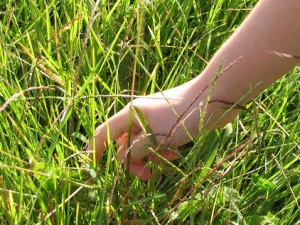
When human beings use their hands, their brains become very active. Especially when they use their hands to learn something new. The parietal lobes keep track of where we end and the rest of the world begins. This place is our skin. When we see and touch things in the real world, outside our skin, and know we’re there to learn, the parietal notifies other parts of the brain that are involved in this new learning. Concepts and knowledge already in memory are opened up, storage is set up for the new learnings, and these activities generate ‘needs to know.’ The needs to know drive them into the books and internet. That’s power.
Reflect on your experience if you did the casual observation in a natural area; do you recall your mind opening up? Recognizing what living things were there? What their names were? What information you already knew about them? Did you want to find out more? This is all set up for you when you start learnings in the real world. Then you use your teacherly skills to use this auspicious beginning to engage your students in real learning that will stay with them for a long, long time. Because it will become assimilated into concepts and understandings which are already there, in their brains. You can’t ask for better.
When students engage in self-directed inquiry in natural places, they become involved and invested in the work. Especially those students who aren’t seen as being ‘academic.’ Becoming invested in the work – a natural function of the brain in the real world – students want to know about what they are experiencing. This leads them to search for clarifying and amplifying information on their own. In the end, they learn for understanding, not just so they can pass tests. And they do pass the tests, especially those in the bottom 25th percentile.
Teachers whose students do this know it’s true. For the rest of us, it takes courage to free ourselves enough to give it a try, to start something like this, but we can do it. Start in your own school yard. Who lives there? Simple question; it can be answered at many levels. You’ll find that the main difference in grade-level approaches to answering this question are just in the vocabulary, complexity of sentences and paragraphs used, and the nature of details contained within the concepts. The main facts elicited will be very similar. Take ten minutes to ask this question in your school yard. Hard to squeeze in ten extra minutes, but worth the effort.
[/password]
 This is the seventh installment of “Teaching in the Environment,” a new, regular feature by CLEARING “master teacher” Jim Martin that explores how environmental educators can help classroom teachers get away from the pressure to teach to the standardized tests, and how teachers can gain the confidence to go into the world outside of their classrooms for a substantial piece of their curricula. See the other installments here.

 We’ve been talking about our ‘Locus of Control,’ the place where the authority for what we do lies. That authority can be outside ourselves, or within. What determines where we find it? Nothing more than experience.
 This is the eighth installment of “Teaching in the Environment,” a new, regular feature by CLEARING “master teacher” Jim Martin that explores how environmental educators can help classroom teachers get away from the pressure to teach to the standardized tests, and how teachers can gain the confidence to go into the world outside of their classrooms for a substantial piece of their curricula. See the other installments here.