by editor | Oct 21, 2011 | Forest Education, K-12 Classroom Resources
by Derek Jones
We erect dams assuming they are eternal, as if they’ll never topple over or be dismantled or fill with sediment or lose their financial rationale. Yet all dams will die. . . They’ll be reminders of an ancient time when humans believed they could vanquish nature, and found themselves vanquished instead.
— Jacques Leslie, from “Deep Water, the Epic Struggle over Dams, Displaced People, and the Environment”
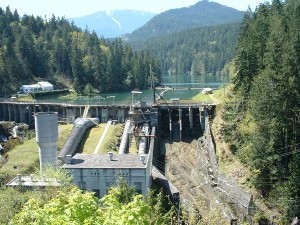
WHAT WOULD YOU SAY if I asked if you knew that the nation’s second largest ecological restoration project was happening right now only a 2 ½ hour drive from Seattle? Would you be able to name the project? If given a map of the Puget Sound Region, would you be able to point out where the Elwha River is? How many of your students could do the same? The removal of two dams on the Elwha River provides students with a fascinating case study that contains elements of a wide swath of topics covered in, and out of, the classroom; engineering, social studies, ecology, mathematics, history, and geology among others. It is up to educators to make sure that such an enormous and complex project with such far-reaching implications does not go by without being appropriately utilized as a teaching tool. (more…)

by editor | Oct 21, 2011 | Interviews with Educators & Leaders
 Interview by Chris Gertschen
Wendy Francis, Program Director, has been involved with Y2Y (Yellowstone to Yukon) since its inception. She chaired the board from 2003-2005 and was interim Executive Director in 2002-2003. Educated in law and biology, Wendy previously held positions as Director of Conservation and Science at Ontario Nature, Interim Executive Director at the Canadian Parks and Wilderness Society, and Conservation Director for CPAWS Calgary-Banff. More…
CG: What brought you to conservation?
WF: I grew up in the 1960s, when playing outside was not only the norm, it was mandatory! We were simply not allowed to play inside on a nice day. I knew all the semi-wild places in my neighborhood, and loved to climb their trees and explore their wetlands. As a family, we often camped on weekends and holidays. Later, we rented cottages in northern Ontario and experienced the great freedom of being able to wander the forests for weeks on end. My Dad, who grew up on the prairies, was an avid naturalist and hunter and often pointed out different trees and animals to us. I believe I inherited my love of nature from him. (more…)
by editor | Oct 17, 2011 | Outdoor education and Outdoor School
 Courtesy of recmanagement.com
By Kelli Anderson
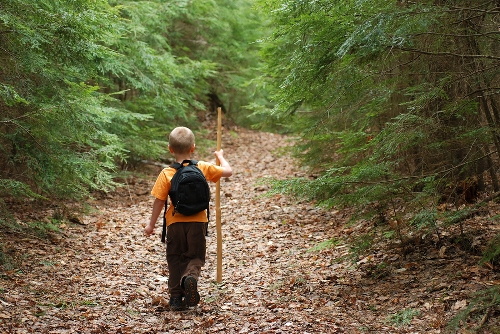
Five years ago, with the addition of new management at Tamarak Nature Center in Maplewood, Minn., programming for children and their families began to take the road less traveled. It began, in effect, to go off trail.
“When Marcie, our new acting outdoor education supervisor, came on board, she asked a question,” said Jody Yungers, director of park services and recreation in Ramsey County, Minn. “If we really wanted our kids to connect with nature, why did we have signs posted that basically were saying don’t touch, don’t engage or really appreciate the outdoors? Marcie started the ball rolling and really worked with us to start the whole notion of asking the important question of how do we connect families with nature.”
An answer followed shortly afterward. One afternoon, while observing the reluctance of young mothers with children to venture beyond the interior of the nature center, Oltman began to realize that the mothers’ unfamiliarity and discomfort with the outdoors might be to blame. Her idea for a solution turned out to be wildly successful. It was also counterintuitive. (more…)

by editor | Oct 13, 2011 | Indigenous Peoples & Traditional Ecological Knowledge, Marine/Aquatic Education
 by Sarah E. Smith
from A Newsletter of the Salish Coastal Gathering
An innovative education program is introducing Squamish First Nation kids and their non-Native classmates to the richness of plant and animal life along the waterways of their lush corner of Coast Salish territory in British Columbia.
Last school year, 500 children in 24 classes from kindergarten to seventh grade learned about the life adventures of salmon, the magic of traditional medicinal plants and the duties of humans as stewards of the land and water.
The Squamish Rivers and Estuary Education program, a partnership between local schools, an environmental nonprofit and Squamish First Nation, provides a curriculum that incorporates the ancient aboriginal culture of the area. The program began in 2006 with eight classes from three schools participating. (more…)
by editor | Oct 7, 2011 | Environmental Literacy, Outdoor education and Outdoor School, Questioning strategies, Schoolyard Classroom
 ne of my favorite nature quotations comes from the Japanese conservationist Tanaka Shozu who said, “The question of rivers is not a question of rivers, but of the human heart.”
I wanted to touch the hearts of my middle school students with the beauty of nature as well as inspire them to take care of the local environment. I found the perfect spot for a nature experience less than an hour away from our school campus in the Sierra Nevada. (more…)

