
by editor | Nov 30, 2010 | K-12 Classroom Resources, Marine/Aquatic Education, Place-based Education

Exploring Place-based Education Programs in the Pacific Northwest
by Becs Boyd
On the southwest coast of Oregon a small town called Charleston is tucked against a busy dockside lined with fishing and tourist boats. The Oregon Institute of Marine Biology has its base here, in a campus of attractive traditional buildings covered in sun-bleached wooden shakes. I’m here to see OIMB’s amazing track record for bringing the local marine environment to life for local children.
For the past six years a National Science Foundation grant has meant that nine OIMB graduate students a year have been teaching marine biology two days a week in twelve local schools to Grades K-6 (ages 6 to 12), reaching around 3500 students. The result? – a generation of schools and teachers with an excellent knowledge of the sea life at their doorstep, what it looks like, how it works, and the issues and challenges it faces. On the way they learn to think like scientists and are familiar with microscopes, hypotheses, moon phases and zoea. The curriculum framework is cleverly arranged by habitat, with Grade 1 studying rocky shores, Grade 2 sandy shores, Grade 3 estuaries, Grade 4 kelp forests, Grade 5 the open ocean and Grade 6 drawing all they have learned together with the study of islands. (more…)
by editor | Nov 30, 2010 | Forest Education
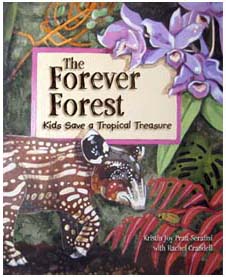
Kids Save a Tropical Treasure
By Kristin Joy Pratt-Serafini with Rachel Crandell
Published by Dawn Publications
Reviewed by Emily Baker LeRoux
As a home schooling mother of two, I have to admit I like books. I mean REALLY like books. They seem to multiply in our house and I like to think of it as literary decoration. It works for us though; I find both kids sprawled in various rooms throughout the day with a pile of books next to them.
I first stumbled across The Forever Forest while browsing at the library on the never-ending search for books for my six-year-old animal-loving kid. Upon first glance, I thought this was just another book on the animals that live in the rainforest but I knew he’d love it so I checked it out. It turned out to be so much more. (more…)

by editor | Nov 22, 2010 | K-12 Classroom Resources
 What do you think?
As a former environmental educator, I think it is very important that we as educators separate advocacy from education. At the Environmental Education Association of WA’s first conferences in the early 1990s we discussed the distinction a lot. Working at North Cascades Institute and now at another nonprofit, we always have to make the distinction between education and advocacy for the content our EE programs.
EE programs that we all work with have an environmental impact and environmental initiatives are often controversial because people hold very different opinions based on different values. Those values come from different life experiences in family, community, cultural groups, training and education, political power, history of property ownership, etc.
Controversy is inherent in a free democratic society and the discussion of controversial issues is essential to decision making in a free society. More than a discussion of controversial issues is needed.
Citizens need to understand the environmental issues and problems facing their community and of the options available in addressing them. THIS IS Education.
Advocacy is an important activity, and advocacy programs must provide individuals with opportunities to identify, investigate, and participate in the resolution of environmental issues and problems on their land and in their community. But in dealing with these issues through true environmental education, the atmosphere should be as neutral and objective as possible. Environmental educators must be familiar with all sides of issues, bringing all sides into educational programs, and must stand firm for each advocate’s right to be heard and express opinions based firmly on objective information.
This is an interesting topic and I would welcome a continuing dialogue among the EE community—on the distinction between EE and Advocacy! Thanks for everyone’s thoughts on this!
Wendy Scherrer, Executive Director
Nooksack Salmon Enhancement Association (NSEA)
Bellingham, WA

by editor | Nov 22, 2010 | K-12 Classroom Resources

Preparing students with 21st century skills
Reviewed by Ella Inglebret and CHiXapkaid (D. Michael Pavel)
The salmon serves as an indicator species reflecting the overall health of the natural environment in the Pacific Northwest. For Native American tribal members, the salmon has played a central role in sustaining communities both historically and in contemporary daily life. Based on the importance of the salmon to all people living in this region, tribal leaders, environmental organizations, government agencies, and educators formed a partnership to create curriculum resources that bring awareness to the status of the salmon population as it interconnects with the broader ecological system. The outgrowth of these efforts is the Shadow of the Salmon curriculum, designed to prepare eighth- grade students with 21st century critical thinking, problem solving, and communication skills as they address environmental issues. (more…)
by editor | Nov 9, 2010 | Learning Theory
by Maurice Holt
In her celebrated The Classic Italian Cookbook, Marcella Hazan wrote: “What people do with food is an act that reveals how they construe the world.” At the time — 30 years ago — it was a sentiment that needed a word of explanation; the Japanese meal respects aesthetics, the French cuisine respects subtlety, Italian food respects its ingredients.
We now take what we eat much more seriously, and it is timely to ask: What does a school lunch of reheated burger and chips have to say about how we construe the world? For that matter, what does it say about how we construe the nature and purpose of education?
Pausing to ponder the nature and consequences of a burger bar in the center of Rome was how a major eating revolution began. Carlo Petrini, a prominent Italian journalist, was walking past a newly-opened McDonald’s franchise when he stopped and said: If this is fast food, why not have slow food? In much the same way, I was thinking about the standards-based school curriculum, with its emphasis on regurgitated gobbets of knowledge, when I recognized the analogy with fast food. What we have created, with our tests and targets, is the fast school, driven by standardized products. So why not devise a slow school, driven by an emphasis on how ideas are conceptualized, just as slow food is driven by how the innate qualities of ingredients can be realized? (more…)


