
by editor | Dec 27, 2010 | Learning Theory

The Arboretum Trust
Do you know Meet a Tree? The exercise where you blindfold one kid and their buddy leads them to a tree. Then, after the blindfolded is removed, the child goes and finds their tree. Yawn.
Don’t get me wrong, I’ve seen kids enjoy this. I believe they do get some value out of it. I also believe that many outdoor educators abuse this like they do all other stock and file-card activities. It’s something for kids to do. It’s in the nearly official Environmental Educator’s Game Guide.
I’m an animal tracker. I teach it to both kids and adults. I use all my facilities and gut instincts to follow bears, cougars and bobcats across epic landscapes. I deftly understand the reasoning behind sensory based curriculum. It’s great that these kinesthetic activities begin to receive more and more credibility in a world of water quality testing and DBH. Unfortunately any game or activity can also be a crutch for educators. (more…)

by editor | Dec 24, 2010 | Conservation & Sustainability, Environmental Literacy
Big Ideas from the field of Environmental Education and their Relationship to Sustainability Education
— or —
What’s love got to do with it?
.
.
 By Donald J. Burgess and Tracy Johannessen
Introduction
 common raven suddenly begins to call from Cornwall Park. I rush to the front porch trying to see what the commotion is all about. Two adult ravens are flapping high over the green canopy, croaking vigorously. Like vigilant Block Watch captains protecting the integrity of a neighborhood, ravens exhibit exceptional observational prowess coupled with intense fidelity to family and place. I scan the forest with binoculars and notice three raven fledglings perched in a scraggly birch tree at the edge of the forest. Scanning higher, I finally detect a distant bald eagle circling over the urban park where the ravens have nested for a decade. Ravens recognize an opportunistic predator like a bald eagle as a “threat to the neighborhood” and they act decisively to protect their home. The raven’s objection is clearly articulated through their vocalizations and aerial antics and the bald eagle soon circles out of sight.
Why is it that when human observers experience an ecological threat and speak out in alarm (warning against drilling oil 5000 feet below the ocean surface or climate change) that our most heartfelt appeals remain ineffective? Is it an inability to understand the true threat to our children? If we truly perceived the ability of humanity to survive as linked to the ecological integrity of our surroundings, would the human response to these cries of alarm be different? What roles do love and caring play? (more…)
by editor | Dec 15, 2010 | At-risk Youth, K-12 Classroom Resources, Place-based Education, Service learning
Exploring Place-based Education Programs in the Pacific Northwest
by Becs Boyd
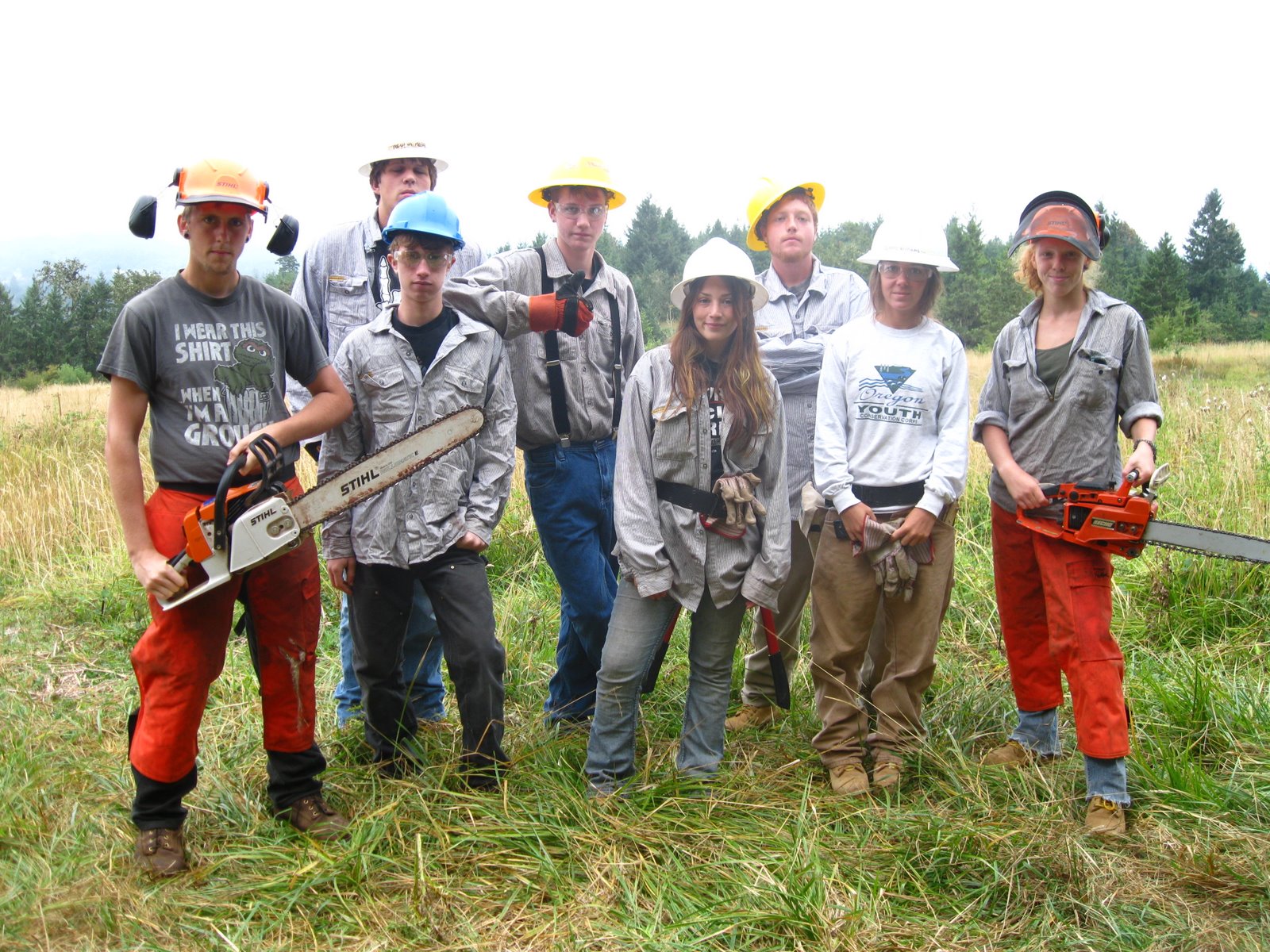
A visit to Kennedy High School in Cottage Grove, Oregon on 18 November, turns out to be one of the most uplifting days I have spent in a school, perhaps ever.
Formally known as AL Kennedy Alternative High School, the school was founded in 1998 by a forestry teacher who wanted to help students aged 15 to 18 who were struggling in mainstream education. By 2008, when current principal Tom Horn took over, the school was sinking under an attendance rate sometimes as low as 23%, serious drug problems and alarming drop out rates. Now, little more than two years on, Tom’s vision, and the perceptive and caring approach to the students which shines through the principal and his team of committed and talented staff, have completely transformed the culture of the school. Attendance rates are around 90% and the drop out rate has fallen dramatically, while test results show an upward trend. The school serves a maximum of 75 students, but there are 190 further students waiting for a place.
(more…)
by editor | Dec 9, 2010 | Climate Change & Energy, Conservation & Sustainability, Outstanding Programs in EE
The Cool School Challenge engages schools from all across the country in strategies to reduce CO2 emissions
 by Katie Fleming, Rhonda Hunter & Kimberly Cline
Extreme weather events, rising sea levels, melting glaciers – oh my! While climate change is an overwhelming issue, there is certainly hope, especially in the collective power of individual actions to reduce greenhouse gas emissions. That’s the underlying principle of the Cool School Challenge, an innovative climate education program that motivates students, teachers and school districts to reduce carbon dioxide (CO2) emissions school-wide. At the heart of the program is the philosophy that big changes start with small steps – and taken together, simple individual actions create a world of difference. Cumulatively, we CAN reduce our carbon footprint and it’s already happening! (more…)
by editor | Dec 5, 2010 | Place-based Education
Exploring Place-based Education Programs in the Pacific Northwest
by Becs Boyd
On 8th May I meet Ed Armstrong, grant writer for Tillamook School District, outside Tillamook High School in north-west Oregon. I’m here to find out about the amazing work Ed and others have been doing in connecting the six schools in the Tillamook School District with their community and with School Districts State-wide.
Ed’s background is as a biology teacher at Tillamook HS from 1995-2000 when the school was one of 25 national Annenburg Schools for science. He returned after a break in 2004 to become grant writer for the entire School District, and, using this wider influence and the $6m of grants he has secured, has been at the centre of a small revolution in science teaching in Tillamook which has been internationally recognised. (more…)


