by editor | Jan 19, 2013 | Environmental Literacy, Place-based Education
The Urban-Rural Exchange Bridges Oregon’s Greatest Divide
By Judy Scott
From Oregon’s Agricultural Progress
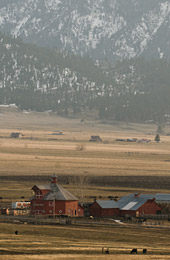
Wallowa County in northeast Oregon was the destination for one of this year’s four exchanges. The young guests from the city arrived in the thick of calving season, a dynamic leap into ranch life. Photo by Lynn Ketchum.
 ix lanes of Portland traffic filled the rear-view mirror as the van headed east on I-84. On the left, the Columbia flowed through its gorge below giant windmills scattered like toys, turning with the breezes. After a few hours, sagebrush took the place of Douglas-fir and fern.
The riders from Portland’s Sunnyside Environmental School had reason to be nervous as they watched the familiar give way to the unknown. And it wasn’t just the landscape that would change.
The 15 middle-school students were already immersed in a life-broadening experience: the 4-H Urban-Rural Exchange program, sponsored by Oregon State University Extension Service. For five years, host families from Grant, Klamath, and Wallowa counties have opened their homes and lives (sometimes nervously) to city kids. In turn, Multnomah County families introduce rural students to life in Portland.
Wallowa County in northeast Oregon was the destination for one of this year’s four exchanges. The young guests from the city arrived in the thick of calving season, a dynamic leap into ranch life.

The Portland students (above) weren’t sure what to expect when they arrived in Wallowa County to stay with rancher Charley Phillips and his wife Ramona. Soon, the students were pitching in to help with all the chores, including branding calves at the Birkmaier ranch (below). Photos by Lynn Ketchum.
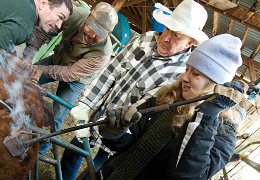
Deep in the Wallowa Mountains, hosts Tom and Kelly Birkmaier and a crew of friends rounded up 65 calves for branding. While unhappy mother cows bawled in the distance, the job was to brand, inoculate, and ear-tag the calves as quickly as possible while muscling them securely into a metal chute.
This was no spectator sport for Portland middle-schoolers Zoe O’Toole and Birch Clark. Although reticent at first (“I’m not really sure how I feel about branding,” Zoe had confided earlier), the girls gamely took turns with both the branding iron and the syringe.
Down in the valley at another host home, a cow notched up her tail, and three other city students learned what that meant: the cow was ready to give birth. Lanie Novick and her middle-school colleagues watched in awe as the calf dropped from its mother’s womb while Lanie documented the event on her cell phone. Ramona and Charley Phillips, who hosted the girls at their ranch near Joseph, were impressed with the students’ enthusiasm and unending questions as they collected eggs each morning and tossed baled hay from the back of a truck to a “sea of cows.”
Calving season knows no time clock. After midnight, the girls bumped along with the Phillipses in their pickup truck, scanning the range with spotlights in search of cows with newborns. The girls learned that if they spotted cows bawling and bunched up around their calves, there might be predators such as cougars or wolves stalking nearby.
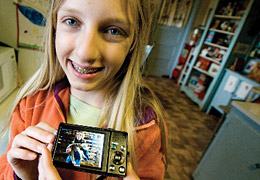
Seventh grader Lanie Novick (above) displays a memorable snapshot of her Sunnyside classmate Julia Glancy holding a newborn lamb. The learning experience includes classroom time at the Imnaha School (below), where five local students make up the total K-8 enrollment. Photos by Lynn Ketchum.
Part of each exchange includes spending a day at the host school. Portland students Morgaen Schall and Joseph Unfred swelled enrollment of the one-room schoolhouse in Imnaha by 40 percent on the day they went to class with the school’s five local students.
Morgaen and Joseph both love working with horses in Portland but prefer being “in the middle of nowhere.” Their stay was not romantic—mending fences seldom is—but they enjoyed the outdoor work, and to show their appreciation, the two boys made a special Sunday breakfast for their hosts, Cynthia and Dan Warnock and their three sons.
More than half of the urban-rural exchange students have kept in touch with their host families. Sometimes during the summer they cross back over the cultural divide to reunite with their hosts and to share the experience with their parents. The exchange expands when parents get involved. Thirty families in Portland now buy beef directly from a host rancher as part of a new beef cooperative, an idea that grew from the young people’s exchange.

Back on the ranch (above), feeding time is fun for students and cows. In Portland, students used mass transit to navigate the city (below). Photos by Lynn Ketchum.

“The basic mission of 4-H is education for youth,” said Jed Smith, a 4-H faculty member at the Extension office in Klamath Falls. “But 4-H also involves parents in Extension education. When you get young people in the conversation, you’ve got a good start towards better understanding between remote rural Oregon and the rest of the state.” Smith wants his urban visitors to experience first-hand the life of rural ranchers and farmers. “They see that ranch families are good with animal husbandry, they’re responsible stewards of the land, but they face different challenges than urban families,” he said.
One of those challenges is the reintroduction of wolves, which sparked the creation of the urban-rural exchange. In 2005, after Sunnyside students completed a class project on how westward U.S. settlement affected wildlife, the students gave testimony at a state Fish and Wildlife Commission hearing in favor of reintroducing wolves. The urban students didn’t expect that their opinions would spark controversy in rural Oregon, where ranchers bemoaned that city dwellers didn’t understand rural life. To foster better understanding across the state, OSU 4-H and Sunnyside joined forces to create the first Urban-Rural Exchange in 2006.
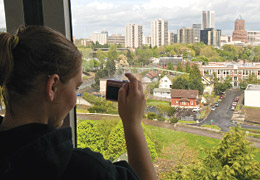
Students from Klamath County get a tram’s-eye-view of Portland (above) while Hot Lips pizza shows off their spin cycle (below). Photos by Lynn Ketchum.
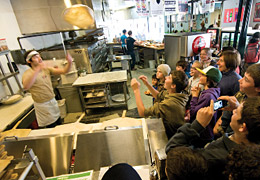
Everyone involved that first year, from both sides of the Cascades, ventured into unfamiliar territory. At least one rancher would have pulled out at the last minute if the city kids were not already on their way. However, at the end of five days of sharing chores and meals together, both students and families described the exchange as one of the best experiences of their lives.
Each year, some of the city students come home thinking that farming and ranching would be professions they’d like to pursue. “We want them to learn about the care of natural resources from a rural perspective,” said Maureen Hosty, the OSU 4-H Extension faculty member who coordinates the exchange. “Sometimes they take it to a personal level. They want to live there.”
Fewer rural students visiting Portland express a strong desire to relocate to the city. Perhaps city living is an acquired taste. Dylan Denton and Trevor Wentz, both from Wallowa County, enjoyed their day exploring mass transit and gliding over the skyline by tram. But considering that a square mile in Portland is home to 3,939 people, and in Wallowa County, it’s home to 2, they had to conclude, “There are too many people!” Nevertheless, according to their host family mom, Dylan and Trevor readily took to “a crash course” in riding bicycles in city traffic, even while pedaling in cowboy boots.
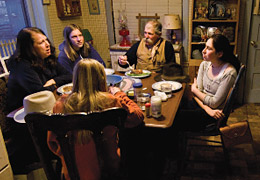
The bustle of city life contrasts with the quiet of dinner time after a long day’s work on the ranch. Photo by Lynn Ketchum.
Portland hosts helped their rural visitors understand sustainable urban living. They climbed to the top of city buildings to see rooftop landscapes that temper winter stormwater and summer heat. They visited the city’s massive recycling system. And they walked through one of Portland’s 20 farmers markets, where they ran into a potato vendor from faraway Wallowa County.
More city kids have made the exchange than their rural counterparts, and Hosty encourages more students from rural Oregon to visit Portland. “We want to build a strong bridge of understanding that goes both ways,” she said. The bustle of city life contrasts with the quiet of dinner time after a long day’s work on the ranch.
“We have a lot more in common than we realize,” Hosty said. “But if we don’t spend some time walking in each other’s shoes, then misunderstandings will continue to divide our state.” The 4-H Urban-Rural Exchange can make a difference. “Kids are leading the way and are willing to spend some time to learn. And the real learning happens in family homes at the dinner table.”
by editor | Jan 16, 2013 | Environmental Literacy, Marine/Aquatic Education
Teachers discover authentic lessons in crayfish and caddis flies
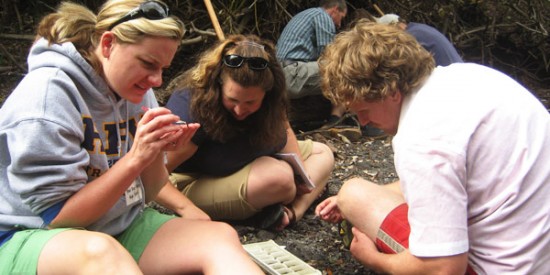
- What is that bug? Teachers Kathryn Davis from Hood River High School, Molly Charnes from the Academy of International Studies in Woodburn and Thomas McGregor from The Phoenix School in Roseburg work at identifying aquatic insects during a workshop in Philomath. (Photo: Lee Sherman)
By Lee Sherman
In Brief
The Issue
To provide environmental field experiences for their students, teachers need hands-on instruction in field research methods. Kari O’Connell and Susan Sahnow of Forestry Extension’s Oregon Natural Resource Education Program train high school teachers through Teachers as Researchers.
OSU Leadership
OSU trains science teachers through the Dept. of Science and Mathematics Education and provides opportunities for K-12 students through SMILE, 4-H, the Environmental Health Sciences Center and pre-college programs.
The dense grove of willow, ash, maple and alder looks like 100 percent nature’s doing. But in fact, the 3,000 towering trees shading the east bank of Marys River in Philomath grew from the vision and dedication of a science teacher and his students.
The riparian restoration that Jeff Mitchell and his biology students accomplished 10 years ago stands as a testament to the power of natural resources education and community collaboration.
“A whole generation has lost their connection to the land,” observes Mitchell, a longtime practitioner of environmental field studies at Philomath High School. “My generation were farmers and foresters. But with urbanization and electronics, people have lost track of the land and how it works. We need to restore that literacy in forestry, wetland biology and watershed dynamics.”
Now an OSU initiative is helping to re-forge those links. Oregon science teachers are getting hands-on lessons in environmental research through a two-year-old Extension program called Teachers as Researchers. This partnership between the university’s Oregon Natural Resource Education Program and the Andrews Forest Long-Term Ecological Research Program is helping educators guide their own students toward authentic, meaningful discoveries – and activism – within their local communities.
Watery Food Web
One late-September afternoon in the shade of Philomath’s student-planted trees, 15 high school teachers from Astoria to Roseburg scoop samples from the slippery riverbed with long-handled nets. Then, peering closely through handheld magnifiers, they compare their samples against photos and scientific illustrations on laminated field guides, trying to distinguish “shredders,” “collectors,” “grazers” and “scrapers” – aquatic invertebrates like caddis flies, crayfish, damselflies, pond snails – that live and feed in healthy Northwest streams. As each creature is identified with the expert input of research ecologist Sherri Johnson of the Pacific Northwest Research Station, it is sorted with its brethren into a white plastic ice-cube tray. The proportions of, say, aquatic worms to pouch snails to blackfly larvae are indicators of the river’s ecological balance.
Ultimately, Mitchell points out with a wry smile, the study of stream ecology is all about “who’s eating whom. The presence or absence of certain species of aquatic invertebrates can tell you a lot about past and present water quality of the stream.”
During the two-day workshop, the teachers also get skills instruction in classroom-based activities like graphing water-quality variables from chemicals and invasive species to organic pollutants and temperatures.
Inspired to Learn
The project’s ultimate goal, says OSU’s Kari O’Connell, is to get high school students out into the field to conduct their own investigations. Aquatic sampling at Marys River is one of three workshops teachers take during their year-long participation. They also learn about decomposition and carbon cycles at the H.J. Andrews Experimental Forest near Blue River and about fry and fingerlings at the Oregon Hatchery Research Center near Alsea.
“This project helps teachers engage their students in outdoor settings,” says O’Connell, who leads Teachers as Researchers. “Studies show that kids do better on achievement tests, behave better in class, get more excited about learning and feel more pride in their accomplishments when their lessons are tied to real-world environmental issues.”
The project is already having an impact in Oregon schools. During 2008, the project’s first year, nine of 13 workshop participants made quick use of their newfound skills by engaging their students in local watershed studies.
Oregon the Magnificent
Oregon’s storied landscapes — its mountains, rivers, oceans and rangelands — are prime, readymade environmental learning labs, notes Silicon Valley transplant Pete Tuana, superintendent of the Philomath School District.
“Oregon has a unique reputation as an outdoor state,” Tuana reminds the teachers before they head to the river with their sampling nets. “This environment is so magnificent. Yet today’s children get so busy playing videogames on the sofa, they don’t go outside and get dirty. Those kids are tomorrow’s stewards of the land. We’re not connecting the dots. We need a coherent, K-12 curriculum on natural resources.”
Oregon took a big step earlier this year when it became the first state to pass a “No Child Left Inside” act (House Bill 2544). Co-sponsored by Corvallis representative Sara Gelser, the legislation, part of a national movement to reconnect kids with the outdoors, created a state task force to develop guidelines, aligned with state science standards, for environmental literacy.
With its growing cadre of teacher researchers, OSU is in the vanguard of this urgent push toward authentic lessons in local landscapes.
“These inspiring teachers are preparing the future students of OSU,” says O’Connell, “and the future citizens of Oregon.”
by editor | Jan 14, 2013 | Environmental Literacy, K-12 Classroom Resources
Oregon Environmental Literacy Plan: Building a Network
 by Traci Price
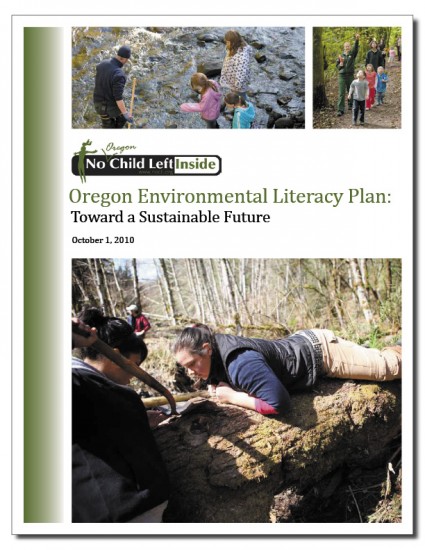
In 2009, the Oregon Legislature passed the No Oregon Child Left Inside (NOCLI) Act that established an eleven-member task force charged with developing The Oregon Environmental Literacy Plan: Toward a Sustainable Future[1](OELP). The OELP, accepted by the Oregon Legislature in 2010, articulates a vision for education in Oregon where every student experiences a continuum of place-based, outdoor learning opportunities and becomes a lifelong steward of his or her environment and community, prepared to address challenges with sound decisions for our future.
The OELP’s five learning strands have been comprehensively aligned with Oregon Academic Standards and Essential Skills. You can find a crosswalk of this alignment work on the Oregon Department of Education’s website: http://www.ode.state.or.us/search/page/?id=2886. Consider using the OELP crosswalk for your own programs to help get teachers outside! (more…)
by editor | Jan 4, 2013 | Environmental Literacy, Questioning strategies, Schoolyard Classroom
Do It Yourself First: Leading Student-Directed Inquiry
by Jim Martin
CLEARING guest writer
 f you’ve never taken your elementary, middle, or secondary students out of the classroom to learn, and can’t find a helpful mentor or workshop, it’s okay to learn to use the real world to generate curricula and teach for understanding rather than to pass tests just by doing it. Just make a plan and stick to it, and you’ll be okay. Try a place on your school grounds first, then move to a place in the community when you’re comfy.
There is a simple way to do a student-directed inquiry outside your classroom, involving observations on invertebrates. You can use it to discover whether this kind of work is comfortable for you to do, and if it generates curricular content that satisfies your anxieties about meeting mandated standards and benchmarks. You can start it on your school grounds, or if you’re not comfortable with that, right in your classroom. The only caveat is that you have to let your students think and ask questions, and follow the parts of the project that capture their interest. That is, after you’ve first guided them (and yourself) through the process.
ALERT: You need to be a CLEARING subscriber to read the rest of this article.
(enter password then hit return button on your keyboard for best results)
[password]
The nice thing about the project we’ll be describing is that it begins with you facilitating a guided inquiry. It doesn’t matter what grade level you teach, the basic work applies to all of them. The vocabulary and complexity of conceptual content will vary with grade level and student experience, but the basics apply to all levels. The plan is this: We’ll make a small compost heap, then see what comes to live in it. Then we’ll have our students do the same. Simple, but loaded with potential.
First, do your own inservice, perhaps this summer. Start the compost in your own yard or somewhere on the school grounds as your source. Don’t place it where it will always be in direct sunlight, since it needs to stay moist. Put about 5-10 gallons worth of different kinds of plant material in it and turn it once a week with gloved (or ungloved) hands. Keep it moist, but not wet. It’s necessary to start outdoors to attract the invertebrates and microbes which will populate your students’ compost ‘piles.’ As you tend your compost heap, notice what is living there. (If you’ve already done this, I’ll bet you’ve gone to a book or the web about what you’ve found. That’s your brain doing what it’s designed to do.)
As you do your work, try out some learning activities. What is the temperature at the surface of the heap, and in its depths? How do you go about measuring the temperatures? Any glitches? Ask yourself how any temperature differences might have come to be. If it’s not directly explainable to you, who might you ask to find out? (This is a skill we all have to develop when we move out into the real world.) What mathematics activities can you use to make sense of the temperature data? What tells you more, the numbers themselves, or their graph, average, median, range? Would the data be different if the compost heap was larger or smaller? Let’s look at more of the things we can learn.
After your compost heap has been working awhile, you should be finding an increase in the numbers of invertebrates living there. If this isn’t the case, go to places where plant material is obviously decaying and bring samples back to your heap. Keep a record of how many species you find in your heap as you turn it, and how many of each you observe. This means you’ll have to be systematic about how you turn the heap. And about how you record the information you measure, count, and observe. You can pass these skills and understandings on to your students.
As you count species and their numbers, use that data to track species diversity in your compost heap. As a rule of thumb, the greater the species diversity, the healthier the system. Whether you work with kindergartners or high school seniors, you’ll need to know something about species diversity. You can google the term, find some sites which explain it in a way you can understand, and which detail some of the math used to make sense of the numbers. Here’s one you can use; a little esoteric at first glance, but ultimately doable; Simpson’s Index, D = Σ ni(ni-1)/ N(N-1), where D is Simpson’s Diversity Index, Σ stands for ‘the Sum of,’ ni is the number of organisms you counted in the ith species (so the number of organisms in the 3rd species you counted would be n3, and i goes from 1 to the total number of species you counted), and N is the total number of individuals counted among all species. This means that you take the sum of the numbers you get from multiplying the number you counted in each species times that number minus 1, then divide that sum by the total number of individuals you counted times that number minus 1.
Try it for 3 species: Species A, with 10 individuals; Species B, with 5 individuals; and Species C, with 20 individuals. The first ni set is 10(9), the second is 5(4), and the third 20(19), which totals to 490. There are 35 individuals all together, so the denominator is 35(34) = 890. Dividing 490 by 890 gives you about 0.56. What if the counts were 23, 51, and 36? Your numerator and denominator should be 4,316/11,990. If this is confusing, say so in a comment below, and I’ll get back to you with more details.
Sounds complicated, but by the time you’ve done three or four sets of species, you’ll get it down. Just be sure that you sum all the individual counts times themselves minus 1 before you divide by the total counted times the total counted minus 1. The answer to all this, D, gives you a number you can compare with other counts you or your students make. Remember, the reason you need to try this diversity calculation is to get an idea of one way that diversity is described. With your students, you can just use the total number of species present to stand for the same thing. This is the simplest math which can be used to estimate species diversity, the total number of species, a number students can use to compare the number of species in different compost heaps, and which may correlate with other measures of diversity.
There is a spectrum of ways to name diversity: number of species, species richness, species evenness, or a calculation like Simpson’s Index. None do a perfect job, since diversity is a dynamic with many aspects. For now, you can only choose one and use it consistently until you have good reason to use another statistic. We’ll take another look at this in the next blog.
Use your counts of living things to graph a population curve. Choose one species and plot it with time on the x-axis, and number of individuals on the y-axis. This is a population growth curve, and they are an indirect way of determining how an environment treats a particular species residing within it. In setting up your compost heap, you’ve created a new environment, and populations living within it should increase during the initial exploitation phase. Soon enough, those curves will change, raising nice inquiry questions.
Use the heap itself for learning. How big is it? Is it always that big? Bigness can be derived from measurements that students make. How tall is it? How wide? How long? How can you determine its volume? Do any of those numbers correlate with the range of temperatures in the different compost heaps? Species diversity? Population curves? Temperature range and diversity?
What about the biology of the organisms living in the heaps? If you’re up to it, you can take a piece of liver, blend it with a little water or electrolyte like pedialyte, then introduce a drop of this to a container with 250 ml or more of hydrogen peroxide (H2O2 ). Take the temperature of the hydrogen peroxide before adding the liver extract, then periodically during the next 20 minutes. As simple carbohydrates are metabolized to produce useable energy in the form of ATP in nearly all organisms from microbes to Homo sapiens, the extra oxygen atom in one of the intermediary products, hydrogen peroxide, is released leaving water (H2O), an oxygen atom (O), and the energy which held the oxygen atom in place. That energy isn’t re-used, and goes off as heat. Compare the results of this experiment with your data on population and temperature. Is there something to be learned? Might your students understand the basics of what they observed?
What can you find out about four of the species in your compost that explains how they are able to live there? The organisms you find are living in a dynamic relationship which keeps the entire community alive, an economy which cycles materials and moves energy in a productive way. Can you build some elements of a food web from the information you have? What else can you find out about the biology and ecology of compost heaps?
If you teach or use language arts, how can you use the compost heap and its components as metaphors to drive a piece of writing? A piece of art? Music? If you teach science, and have never used these arts and humanities deliveries, try one. You might be surprised at what you’ll learn. I certainly have been.
When you’ve studied your compost heap long enough to feel comfortable with it, have your students learn some thing about them. Use the piece you have the best handle on. The first time through the process with your students, you demonstrate each step. Let students ask questions or make observations as you feel comfortable. You can use your own compost, and demonstrate how to turn it to expose the invertebrates living there. (If you’re up to it, you can find out how to plate out microbes that will be living there, and find out what they do and who eats them.)
When you’re ready for your students to do theirs, have each group start compost heaps somewhere in the schoolgrounds, one 5 gallons in size for each group of four or five students. You can also have students bring in their own mulch, etc., or place boards on the ground at home then collect what’s living on and under them including any molds they find. You might suggest they place the animals in a jar of moist compost, keeping the lid slightly ajar for air, and simply bring the board in and set in in their compost heap. Once compost heaps are doing well (outside the building), you can make ‘sand traps’ by filling plastic bucket lids with a layer of sand and placing them next to a compost heap. Any small mammals or birds who are attracted to the compost will leave footprints in the sand. These don’t always work, but are pretty neat when they do. This will raise questions they can begin to answer.
[/password]
 This is the twenty third installment of “Teaching in the Environment,” a regular feature by CLEARING “master teacher” Jim Martin that explores how environmental educators can help classroom teachers get away from the pressure to teach to the standardized tests, and how teachers can gain the confidence to go into the world outside of their classrooms for a substantial piece of their curricula. See the other installments here, or search Categories for “Jim Martin.”
by editor | Nov 10, 2012 | Environmental Literacy, Questioning strategies
by Sally Hodson, Ed.D.
author of Granny’s Clan, published by Dawn Publications
See Part 1 of this series.
.
 Part 2: Asking Questions
 ow do we prepare young people for the 21st century challenge of caring for our planet so that it can sustain future generations of plants, animals and humans? In short, how do we educate our kids to be eco-literate?
To be literate in the language of our planet, we need to understand how life on Earth functions and how we interact with it. And we need tools to help our heads to think, our hearts to feel, and our hands to act. (more…)

by editor | Oct 16, 2012 | Environmental Literacy
by Sally Hodson, Ed.D.
author of Granny’s Clan, published by Dawn Publications
.
Part 1: Thinking in Webs
.
 lanet Earth is home whether you’re a plant, an animal or a human. Our Earth is the only place in the universe we know for sure that can support life. So how do we prepare young people for the 21st century challenge of caring for our planet so that it can sustain future generations of plants, animals and humans? In short, how do we educate our kids to be eco-literate? (more…)
