
by editor | Oct 14, 2012 | Environmental Literacy, Place-based Education
 urious about place-based education? Check out this free place-based education (PBE) video series, produced by University Outreach at the University of Michigan-Flint. The series was made possible through a $20,000 grant by the Saginaw Bay Watershed Initiative Network and support from the Great Lakes Stewardship Initiative. Several of the videos feature Oregon’s own Jon Yoder, past-president of the Environmental Education Association of Oregon (EEAO), one of the founders of the Straub Environmental Learning Center in Salem, and science program coordinator for the Salem-Keizer School District.
See the entire series at http://www.umflint.edu/outreach/programs/pbe-videos.page?

by editor | May 29, 2012 | Environmental Literacy
Click on the image to read the article.
by editor | May 2, 2012 | Environmental Literacy, Forest Education, K-12 Classroom Resources
 Teachers and school administrators now can access Oregon Forest Resources Institute’s The Oregon Forest Literacy Program, a K-12 Conceptual Guide to Teaching and Learning about Oregon Forests. The new program provides a framework for educating Oregon’s K-12 students about forests.
Developed by a diverse and collaborative statewide group, the effort resulted in a plan with three components: a conceptual framework; a K-12 scope and sequence; and connections to service-learning projects developed by teachers.
The conceptual framework identifies important forest concepts, the scope and sequence is a blueprint for when to teach the concepts, and the service-learning projects provide an instructional strategy for how to teach the concepts. The Oregon Forest Literacy Program, in essence, provides guidance on the “what,” “when” and “how” of forestry education.
The guide was made possible in part through a “Learn and Serve for Sustainability” grant from the Oregon Department of Education, jointly awarded to the Tillamook School District and OFRI. The Oregon Forest Literacy Program is available at Oregonforests.org, along with tools that correlate the forest-literacy concepts to Oregon’s science and social science standards, as well as to OFRI’s other educational materials.
Norie Dimeo-Ediger
Director of K-12 Education Programdimeo-ediger@ofri.org

by editor | Mar 21, 2012 | Environmental Literacy, Place-based Education

Along the Oregon coast, community partners are teaming up with the school district to encourage use of the ocean as a context for learning
.
by Rachel Bayor, School Liaison Partnership Coordinator
 hy do kids need to know about the ocean? It may take a moment to reflect on why the ocean is important to every person on this earth whether you live on the beach or in Nebraska. For one, the ocean’s influence on weather and climate is an integral part of understanding global climate change. In addition, the ocean makes earth habitable as most of the oxygen in the atmosphere comes from photosynthetic organisms in the ocean. These and other details about the ocean are important to understanding our global system and how the system is changing.
Why do kids that live on the Oregon Coast need to know about the ocean? This one may not be as much a puzzler. Residents of the coast must prepare for coastal hazards such as tsunamis, sea level rise and storm surges. In order to make informed decisions, they must also understand the natural resources of fish, shellfish, timber and even waves that directly impact local economy and jobs. (more…)

by editor | Feb 28, 2012 | Environmental Literacy
A Classroom Without Walls
Deepening Children’s Connection with Nature
by Seth Webb
Free Horizon Montessori School

 e each have an incredible gift: the ability to engage children with the world – indeed, the universe – that surrounds them and, of which, they are an integral part.
Working with children, our job is one of setting the kindling for the wonderful sparks of curiosity and deep interest to spring forth. While there may be a linear progression of lesson delivery in our albums, we don’t always teach that way, nor do we make overt and obvious the connections between the seemingly disparate ideas and materials across the curriculum that we share.
We wait for the “ah-has.” It is up to the students, alone or collectively, to do the work of the synapses – to make those links, to leap the gaps between ideas towards a holistic understanding of everything around and within them.
There is a way of knowing that comes from being genuinely part of what you are attempting to understand. That is, an authentic knowledge rooted in sensorial experiences that tickle and surprise. Through slowing down and taking our time, looking at the familiar from different perspectives, we can deeply explore the wild spaces around us. So it can be with the natural world outside the classroom. (more…)
by editor | Feb 25, 2012 | Environmental Literacy
“Lessons for Teaching in the Environment and Community” is a regular series that explores how teachers can gain the confidence to go into the world outside of their classrooms for a substantial piece of their curricula.
Part 12: Flirting with Danger
What happens when things seem to go wrong
 by Jim Martin, CLEARING guest writer
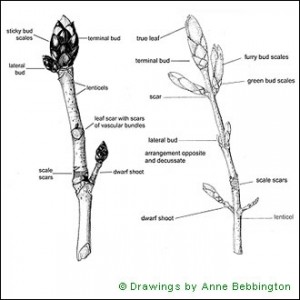
 n the last blog, I – and hopefully you – went out to snap off a twig from a cherry tree. I did that, except that the closest I have to a cherry tree is a prune tree, then began to examine it. Since I don’t have a lab now, I did the dissection with my tiny swiss army knife. The blade is a little over an inch long, and reasonably sharp after nearly 14 years of use. Here’s what I found.
The twig was dry and hard. When I cut it from the tree, I first cut off a piece about a foot long, then made another cut to create a six inch section of twig. I used the knife to slice a line around the circumference of the section about half an inch from one end. Then I cut lines perpendicular to the circumference line, about a quarter inch apart, around the section. After that, I used the edge of the blade to peel up sections of bark, one at a time.
Danger #1: When you look at illustrations of twigs and their parts, each section is shown intact, colored to set it apart from others, and often thicker than you find in the real thing. So, being mentally forewarned, I wasn’t discouraged when what I saw wasn’t what bark and cambium look like in the drawings in the book. The outside of the bark was easy to discern, but any cambium adhering to the inside was a little harder to decipher. After a section of bark was lifted, there was a relatively dark, thin layer which looked like it had been buttered on with a table knife. It wasn’t soft, but when I scraped it off, it was definitely different from the wood beneath. (more…)


