by editor | Oct 7, 2011 | Environmental Literacy, Outdoor education and Outdoor School, Questioning strategies, Schoolyard Classroom
 ne of my favorite nature quotations comes from the Japanese conservationist Tanaka Shozu who said, “The question of rivers is not a question of rivers, but of the human heart.”
I wanted to touch the hearts of my middle school students with the beauty of nature as well as inspire them to take care of the local environment. I found the perfect spot for a nature experience less than an hour away from our school campus in the Sierra Nevada. (more…)

by editor | May 19, 2011 | Environmental Literacy, Outdoor education and Outdoor School
By Saul Weisberg
Executive Director
North Cascades Institute
(reprinted from The Best of CLEARING)
I love knowing the names of things. It makes them familiar, like old friends. I also love to look at patterns in nature. Veins on the back of a vine maple leaf. The yellow and black scales on the wing of a two-tailed tiger swallowtail. The striations in a piece of greenschist. The patterns of nature show us the details of life where the wonder lies.
The landscape is made up of details, too. The ways things fit together — the interactions of living and non-living things — tell a story. In order to make sense of larger patterns, in order to recognize them in the first place, you have to know the details. You have to be able to look at the pieces and pick them apart, understand what this thing is, why this lives here and not there, why things work the way they do, and what has changed over time.
The distrust and ignorance of science that is prevalent in society has made inroads in environmental education as well. It is not unusual to see eager and competent educators with master’s degrees in EE who have no knowledge of natural science, and who are unable to identify common birds and plants. These educators tend to focus on two things: the experience of teaching in the outdoors and the big picture — important processes and concepts. But somewhere between the experience and the process we lose touch with the thing itself — the organism and its world. (more…)
by editor | Apr 7, 2011 | Environmental Literacy, Marine/Aquatic Education, Place-based Education
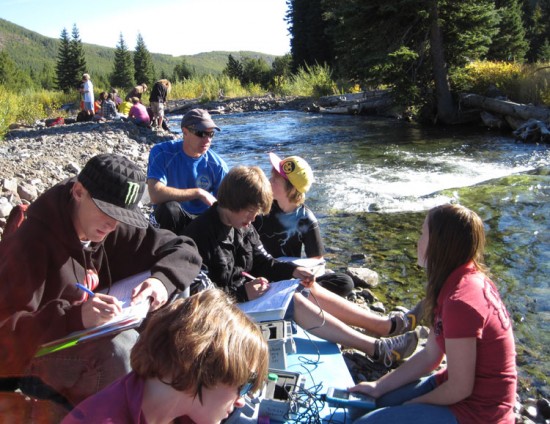
 Rather than viewing technology as an enemy of environmental literacy, technology-based learning can help cultivate an environmental sensibility by serving as a “bridge” to the outdoors.
By Ryan Johnson
When I was ten years old, I was absolutely obsessed with the original Nintendo Entertainment System. My cousins had one, my best friend had one, it seemed like everyone I knew had a Nintendo. I would have done just about anything to have one as well, but my parents refused, despite my continuous complaints and numerous solicitations.
I thought I was the most neglected ten-year-old child in the world, while my parents, patiently suffering my pleas, would remind me that the Beartooth, Big Horn, and Pryor Mountains, the McCullough Peaks, and Shoshone River were just beyond my doorstep. These natural features were, in fact, truly magnificent and unavoidable constituents of the landscape, dominating every view with snow-capped peaks, granite cliff faces, rainbow-colored bluffs, and crystal clear riffles, containing everything from wild horses to Grizzly Bears to rattlesnakes. Now, perhaps needless to say, I prize every single second I am able to gaze upon the mountains and deserts of northern Wyoming, and I cherish every memory of running through alpine forests and mountain biking through tumbling sage brush. But a conscious acknowledgement of my privilege of being born into such natural wonder eluded me, and as a result I still found modern, escapist forms of entertainment media seductive. Even in a place completely dominated by mountains, peaks, rivers, valleys, prairie, and high desert, I still found a way to explore MTV far more often than Heart Mountain. (more…)
by editor | Feb 8, 2011 | Environmental Literacy
By Eric Shawn
 The interdisciplinary study of food has emerged as a theme in sustainability education at Catlin Gabel School, an independent, co-educational school with 725 students in preschool through 12th grade in Portland, Oregon. The focus on food—a necessity for human life, and a subject of much recent thinking worldwide in terms of sustainability—touches many disciplines across the school and touches our learners from age 4 to 18. (more…)

by editor | Dec 24, 2010 | Conservation & Sustainability, Environmental Literacy
Big Ideas from the field of Environmental Education and their Relationship to Sustainability Education
— or —
What’s love got to do with it?
.
.
 By Donald J. Burgess and Tracy Johannessen
Introduction
 common raven suddenly begins to call from Cornwall Park. I rush to the front porch trying to see what the commotion is all about. Two adult ravens are flapping high over the green canopy, croaking vigorously. Like vigilant Block Watch captains protecting the integrity of a neighborhood, ravens exhibit exceptional observational prowess coupled with intense fidelity to family and place. I scan the forest with binoculars and notice three raven fledglings perched in a scraggly birch tree at the edge of the forest. Scanning higher, I finally detect a distant bald eagle circling over the urban park where the ravens have nested for a decade. Ravens recognize an opportunistic predator like a bald eagle as a “threat to the neighborhood” and they act decisively to protect their home. The raven’s objection is clearly articulated through their vocalizations and aerial antics and the bald eagle soon circles out of sight.
Why is it that when human observers experience an ecological threat and speak out in alarm (warning against drilling oil 5000 feet below the ocean surface or climate change) that our most heartfelt appeals remain ineffective? Is it an inability to understand the true threat to our children? If we truly perceived the ability of humanity to survive as linked to the ecological integrity of our surroundings, would the human response to these cries of alarm be different? What roles do love and caring play? (more…)
by editor | Oct 8, 2010 | Environmental Literacy, K-12 Classroom Resources
from Callister, Jamogochian, Lemos, Weddle, & Yoder (2010) – Community-based Education: Model Programs. Northwest Center for Sustainable Resources.
http://www.ncsr.org/materials/index.html
This top-ten list of advice from Jon Yoder may be of assistance for teachers just beginning to integrate environmental literacy into their classroom:
- Start small and find other teachers interested in doing a community project. Support and collaboration are critical for success as you begin this work.
- Don’t let issues such as transportation and funding stand in your way. Be creative and persistent and employ the resources of your community.
- Getting to know community partners is a must, so be prepared to make calls and meet with potential partners. They are often more than willing to work with you and may have resources you can use.
- Make sure that your class does not become a work crew. The work you do should be the work of your partner. This is not a field trip or guest presentation, but joining the authentic work of your partner.
- Be organized and plan ahead. You can never foresee all possibilities, but being organized helps you become more successful with students and partners.
- Promote the program. It is not about you but about the students and their capacity to serve as a resource for their community
- Involve students in the selection of their work and in designing their products. This may be the first time they have some control over their learning. It can be empowering for them.
- As your work expands, think of ways that the program can sustain itself when you are no longer there.
- Do not worry about having to know the content or being in charge of direct instruction. You will become a facilitator and instruction comes from the community partner and the curriculum resources you organize. One of the great joys of this approach is that you often get to learn along with your students. Sometimes they can even teach you. The teacher is no longer the “sage on the stage,” but instead is the “guide on the side.”
- Remember it is about community! The work students do needs to have a context to it. They should come out of their study with a clear understanding of what their community is, how it can function, and possible roles for them to participate. Do not forget that this approach also fosters community building within the classroom and students become reconnected to themselves and to each other.


