
by editor | Feb 1, 2012 | Environmental Literacy, Questioning strategies
“Lessons for Teaching in the Environment and Community” is a regular series that explores how teachers can gain the confidence to go into the world outside of their classrooms for a substantial piece of their curricula.
Part 10: Assimilation
When the world outside becomes the world inside
by Jim Martin, CLEARING guest writer

 tarting in the world outside our skin, our personal tegumental boundary, I have claimed, is the best way to learn. By ‘learn,’ I mean integrate new material into old understandings so that they become a part of you. Part of you because they begin their synaptic lives with you by adding protein to the synapses they innervate, piles of stones along a new path, so they can find their way again. Becoming protein within you, they are you, a part of yourself that will travel with you wherever you go.
An enchanting thought, that, one that all teachers could give to their students in every class they teach. Learning for understanding, carried through each person’s life. I would think that thought would drive education, but it doesn’t. Even so, I’d like to talk about it for a bit.
ALERT: You need to be a CLEARING subscriber to read the rest of this article. (See box in right sidebar)
(enter password then hit return on your keyboard for best results)
[password]
What happens when we engage some concrete piece of the world outside our bodies with the intent to learn? Or, at least the teacher expects us to learn. Let’s say we’re on a streambank, collecting, identifying, and counting the macroinvertebrates (macros) we have netted in the stream. You empty the net into a tub of stream water, then use a pipet to suck one particular macro from the milieu, place it into one of the depressions of an ice cube tray, and use your macro identification book to attach a name to it. These activities are all coordinated by your brain, the organ system which will do the learning and, hopefully, the eventual remembering.
While you are hovering over the basin, pipet in hand, your parietal lobes begin to pay attention to what is happening where the skin of your hand ends, and the rest of the world begins. That’s one of their jobs. Another thing they do is to alert other parts of your brain about what you are doing. The Gnostic area (in the parietal lobes) integrates sensory interpretations with memories from most of the brain to formulate a common thought and devise a single response to the incoming information. Cells in your parietal lobes are stimulated and in turn stimulate neurons connected to parts of the midbrain associated with attention, instinctive and procedural skills, and episodic (past experience) memory. Other neurons are stimulated in the frontal lobes, where working memory is organized and where stored memories advise and guide current behaviors, in the temporal lobes with their stores of general knowledge memories, and in the hippocampus, which has the capacity to turn experiences into long-term memories.
So, what does this mean? When we use our hands to net macros, use a pipet to transfer a particular one to an ice cube tray depression, then grab a book and try to identify it, the parietal lobes turn on our wonderful autonomous learning machine. It automatically focuses us on the subject of our actions, brings all relevant knowledge and concepts to bear on it, and sets up a working memory room for us to work in until we’re ready to incorporate the gist of this new experience into knowledge, concepts, and skills already stored in our brain.
As the Learning Machine continues its work, it does so by firing impulses across synapses, connections between nerve cells involved in this activity we’re involved in. A neat thing about cells is that they build more parts when one is used. So, each of the nerve cells which fire during this learning add to the size of a synapse each time it is used. This increases to the probability of firing when stimulated again. Later, when one of these neurons is stimulated, others will more than likely be stimulated too, and you’ll remember significant pieces of the objects and related concepts that you worked with originally; in this case, a visual image of the macro, its name, and relevant facts you discovered about it. If you build from hands-on activities, in May or June you can remind students what they did in October, and they’ll bring the concepts and relevant facts out spontaneously. That’s because the knowledge and concepts are in the brain proteins that are part of them.
And to make this even simpler: What I’ve described is the process of assimilation, starting with concrete objects to develop new understandings which are incorporated, integrated, into previously held concepts and thus more likely to be remembered. This idea has been around a long time, a part of the psychology of learning, but is not used by most educators. Instead, we ask students to place new learnings in working memory until they have passed the test. Once the job is finished, working memory flushes itself out. Then we wonder why they can’t remember enough to pass the SAT.
Once you’ve started in the real world with concrete objects, then you can milk this opportunity by tying these learnings to new material the class learns from books, and other standard sources. If you’re clever, you’ll find that you can stretch this a long way. Start with concrete experiences, move to the abstract. This is one of the reasons that community and environment based education works so well. It is based on the way the human brain works. Since the brain is the organ of learning, we ought to know something about how it works.
When you take your students into the community and natural areas, plan your curriculum with assimilation in mind. Talk with the people you work with in these places. They can help you find what you need to get started, the curricular starting places that are embedded in the places where they work. While your students are working, observe them for evidence of the pieces of assimilation. You’ll find that, once you get a handle on it, your teaching will begin to move in an interesting direction.
[/password]
 This is the tenth installment of “Teaching in the Environment,” a new, regular feature by CLEARING “master teacher” Jim Martin that explores how environmental educators can help classroom teachers get away from the pressure to teach to the standardized tests, and how teachers can gain the confidence to go into the world outside of their classrooms for a substantial piece of their curricula. See the other installments here.

by editor | Dec 31, 2011 | Environmental Literacy, Questioning strategies
“Lessons for Teaching in the Environment and Community” is a regular series that explores how teachers can gain the confidence to go into the world outside of their classrooms for a substantial piece of their curricula.
Part 7: From Hand to Mind
Concrete experiences generate learning for understanding
by Jim Martin, CLEARING guest writer
 ver the past few blogs, we’ve walked through a science inquiry done in a natural area. First, we noticed something there, then asked a question about it, and used the question to develop an investigation. We did the investigation, collecting data that we hoped would answer our question.
We’ve analyzed and interpreted our data, and now we need to communicate it. Most science standards and benchmarks overlook this piece of science inquiry, but scientists don’t. This is the place where you really nail down what you’ve learned. Something we often don’t do in American education
Communicating findings is an important piece of science inquiry. Preparing for this phase gives you a chance to look back on what you’ve done; where you started, what you did, how that affected your thinking, what new questions emerged from your work. A check to see if you understand, and, hopefully, appreciate what you’ve done. You know what one part of the world is, and what it does. I’m sure you’ll never pass that place, or one like it, and not think about what’s there and what it’s doing.
A good way to start the communication process is to make a poster with four sections. The first section states your question and provides background information about it, and why you want to find out. The second section lists the steps you took to answer your question. It should be clear enough that another person could follow your directions. (I used to have my students swap directions, try to follow them, and make recommendations for edits, point out pieces that were particularly well done, etc. What emerged was interesting for all of us.) The third section contains the record and analysis of your observations. The fourth section is a statement of your findings (your interpretation based on analysis of the data) and any next steps you would like to take.
When you’ve done this, and if you’re feeling particularly brave, post it where your students and/or colleagues can see it. Get them interested. You’ll find that they are curious about what you’ve done. Some of them may wish to do an inquiry themselves. How would you respond to that? You might find yourself working with a colleague to do a similar inquiry, or integrate yours into an interdisciplinary project.
If you’ve been following this inquiry, you know that it isn’t easy to find time and determination to actually go out yourself and attempt to do this work. We all have important things to do, are pressed for time, and don’t have a clear idea how to incorporate new work into an already full schedule. These are all understandable reasons for not trying this way of doing science inquiry. But they’re not effective reasons. One of the causes of the current dilemmas in education is that we rely on publishers’ curricula and mandates from the bureaucracy of education to organize our teaching, our delivery of one of the most important developmental pieces of each of our students’ lives, their education.
When you engage a science inquiry on your own, something most teachers have never done, you gain a perspective you can only achieve in this way. You can’t learn about it; you have to learn it by doing it. You put something into your head that no one can take away; that changes your view of science as something that is cluttered with disparate facts and processes that you have to somehow teach, and your students have to try to memorize long enough to pass the test on. You begin to see clearly that science isn’t just an extremely large compendium of facts and concepts, science made, but also an invigorating, exciting way to learn, science in the making. If you actually do an inquiry, you’ll know first-hand that it drives you into the books to find information – the seemingly disparate facts that we try, and largely fail to teach our students. You control whether you take the steps to gain this view of teaching. There is very little in your environment compelling you to do it.
So, what has this long exercise been about? Using the world outside your classroom to involve and invest your students in their educations, to develop their capacity for assimilating new learnings into conceptual schemata which are already there in their brains.
The important piece in the inquiry we’re working on is first going into the community to do work, then returning to the classroom after the outdoor work to follow up. It’s easy to let the second piece go, especially if you’ve never done work in the community with your students. Your students use these real-world experiences to establish concrete referents in the community; following up in the classroom allows them to use these referents to develop coherent symbolic concepts, that are part of the curriculum you deliver. There is a continuum from the community to the classroom, just like a road connects the country with the city, making a continuum of travel, and experience, from one to the other and back again.
Many teachers who venture out into the real world miss that opportunity. They allow the environmental educators they work with do the work, then return to the classroom and pick up on section 18.b.3 in their textbook. You can always tell environmental educators what your students are doing, and what you would like to do, and they’ll nearly always be able to work with you. The idea behind environmental education is to instill knowledge about environments into people’s world views. Doing inquiry in environments guarantees that new learnings will be assimilated, become part of the person, along with her concomitant views. As long as you follow up on them in the classroom.
This is a win-win situation. Most environmental educators rely on people (read school buses) to come to their sites, and most teachers rely on effective student learners to bolster their records for the number of students passing standards tests. Here’s the connection: If you turn your field trips into student-driven inquiry activities, then their brains, which are built to learn best in the real world, will begin the job of preparing them to pass tests.
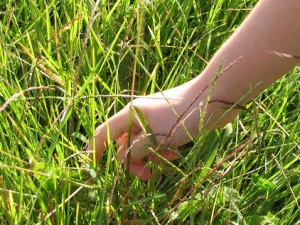
When human beings use their hands, their brains become very active. Especially when they use their hands to learn something new. The parietal lobes keep track of where we end and the rest of the world begins. This place is our skin. When we see and touch things in the real world, outside our skin, and know we’re there to learn, the parietal notifies other parts of the brain that are involved in this new learning. Concepts and knowledge already in memory are opened up, storage is set up for the new learnings, and these activities generate ‘needs to know.’ The needs to know drive them into the books and internet. That’s power.
Reflect on your experience if you did the casual observation in a natural area; do you recall your mind opening up? Recognizing what living things were there? What their names were? What information you already knew about them? Did you want to find out more? This is all set up for you when you start learnings in the real world. Then you use your teacherly skills to use this auspicious beginning to engage your students in real learning that will stay with them for a long, long time. Because it will become assimilated into concepts and understandings which are already there, in their brains. You can’t ask for better.
When students engage in self-directed inquiry in natural places, they become involved and invested in the work. Especially those students who aren’t seen as being ‘academic.’ Becoming invested in the work – a natural function of the brain in the real world – students want to know about what they are experiencing. This leads them to search for clarifying and amplifying information on their own. In the end, they learn for understanding, not just so they can pass tests. And they do pass the tests, especially those in the bottom 25th percentile.
Teachers whose students do this know it’s true. For the rest of us, it takes courage to free ourselves enough to give it a try, to start something like this, but we can do it. Start in your own school yard. Who lives there? Simple question; it can be answered at many levels. You’ll find that the main difference in grade-level approaches to answering this question are just in the vocabulary, complexity of sentences and paragraphs used, and the nature of details contained within the concepts. The main facts elicited will be very similar. Take ten minutes to ask this question in your school yard. Hard to squeeze in ten extra minutes, but worth the effort.
[/password]
 This is the seventh installment of “Teaching in the Environment,” a new, regular feature by CLEARING “master teacher” Jim Martin that explores how environmental educators can help classroom teachers get away from the pressure to teach to the standardized tests, and how teachers can gain the confidence to go into the world outside of their classrooms for a substantial piece of their curricula. See the other installments here.
by editor | Dec 13, 2011 | Environmental Literacy, Schoolyard Classroom
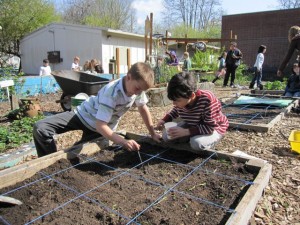
 On a quiet, residential, inner southeast Portland, Oregon street, a little elementary school is breaking new ground for the farm-to-school and school garden movement.
At Abernethy Elementary, students enjoy freshly cooked breakfasts and lunches prepared on site by a trained chef. The meals are often prepared with local and seasonal ingredients, some of which are harvested from the school’s Garden of Wonders. The garden itself is entirely planted, tended and harvested by the students, who use it throughout their school day as a “learning laboratory. “ (more…)

by editor | Nov 23, 2011 | Environmental Literacy, Place-based Education, Schoolyard Classroom
“Lessons for Teaching in the Environment and Community” is a regular series that explores how teachers can gain the confidence to go into the world outside of their classrooms for a substantial piece of their curricula.
Part 4: Inquiry
An Introduction to the World of Discovery….
by Jim Martin, CLEARING guest writer
“We carry with us the wonders we seek without us. There is all
Africa and her prodigies in us; we are that bold and adventurous
part of Nature, which he that studies widely learns in a compendium
what others labor at in a divided piece and endless volume.”
– Sir Thomas Browne
Religio Medici
We are, indeed, the wonders that we seek. To discover them, we must look deep within ourselves, to that part which can reach out to the world and comprehend it. Then release ourselves to know.
 Odd, that we must release what’s within us to know what is outside. Traveling within is a process, best taken a step at a time. Enough steps taken, and your teaching will change.
The change flows from a tack in perspective, a paradigm shift, if you will, that presents you with a new, very functional and accessible view of teaching: what it ought to be, what it can be. But, like discovering your inner self, you don’t get there by hearing about it; you have to make the journey yourself.
Start by going into the world. Reflect on the difference between how it looks and how school looks and how textbooks, handouts, and applications look. When you engage that change in perspective, school, textbooks, handouts, and applications will look like the real world, the extension of the world beyond the classroom that they ought to be.
If you spent some time in a place like those I described in my last blog, you may have had a moment when you wanted to know something; the name of a plant, what that stuff encrusting the branches of a tree was, etc. These ‘Needs to Know’ emerged from engagement with a place, and may have influenced your view of this place as classroom – your new perspective. They are the vehicle which makes publishers’ materials, and your classroom, relevant and useful extensions of the real world. The world outside drives you into the books and into learning.
How often do we give our students concepts to memorize, and then tear our hair out when they can’t think their way through them? Science is touted to be the subject which teaches critical thinking. Do we enable it to do that, or do we eschew this role of our discipline? Going into the Real world for curriculum gets you and your students into the larger community and environment where they can reach out, touch what they find, and incorporate it into what is already there in their brains. I call going into the world outside the classroom “Community and Environment Based Education,” CEBE for short.
If you’ve never experienced it, the thought of teaching a CEBE curriculum can be intimidating. We all experience a sense of uneasiness when we try something new. Taking simple, positive steps is how we overcome inertia in the face of what we perceive as difficult. You’ll find that doubt dissolves as soon as you engage a familiar content. If you made a casual observation, you probably noticed this.
How do you gain the confidence it takes to enjoy teaching CEBE learning? First, learn what it is. CEBE learning is an inquiry process that produces facts, but it is not the facts themselves. Inquiry, itself, is not a book of facts; it is a cognitive-kinesthetic process, a way of knowing, a way of organizing your thoughts and actions. Here are four basic pieces of the process: 1) ask a question in your environment or community, 2) decide how you might answer it, 3) follow through on this decision, and 4) compare the results of following through with the question that you asked. This is manageable, and, with a little support, you’ll find that you can do it. Let’s work our way through this, one step at a time. We have time.
We can’t ask a question until we know something about the topic of our inquiry. This is one of the critical problems with publishers’ inquiries. They start with a question or hypothesis about something you’ve never experienced. To ask a question, you have to know something about the thing you’re questioning. We don’t start right out with our magnifying glasses and a Burning Question. To begin, we’ll just go out and get a feel for how Inquiry works. A good place to start is to engage in finding something out. This is one of the most difficult pieces of inquiry, because it is tenuous, and where you go is up to you. You’ll be a little uncomfortable for awhile. Assume that you’ll find something of interest and develop a good inquiry. As you work, you’ll occasionally feel uncertain, and want to be advised by some authority. Be assured that this is your inquiry, and you have the capacity to make decisions about what to do.
Start with something to find out. Go to a place that interests you and walk through it. Let yourself relax in this place. Don’t focus on any particular thing, but let parts of the place come to you as you walk. They will, if you let them. For example, let’s say you notice plants seem to act as habitat for animals. Now you have something to think about. Look closely. Write notes about what you notice. Comment on anything that you find of interest. Spend at least 20 minutes doing this as you walk around. It may become quite involved. If it does, have faith that you can sort it out.
Keep track of how you feel about this, especially your sense of autonomy. Whenever we do something, we have a thing I call our ‘Locus of Control’ that goes with the doing. Bend your arm at a right angle and close your fist. Move your fist away from your body, keeping your elbow against your ribs and your lower arm parallel to the ground. If you’re comfortable with what you’re doing, and the authority for that comes from you, move your fist as close to the center of your abdomen, next to the spine, as your skin and muscles will allow. This indicates a locus of control which resides within a person; where the person is the authority for her thoughts and actions.
If you’re following directions, but aren’t comfortable enough to act on your own decisions about the work, move your fist into the air before you; move it to a distance which seems to reflect your comfort with being the authority for the work you are doing. Make sure you understand this idea of a locus of control. It’s importnt to move your locus of control from outside yourself to inside you. We’ll revisit the concept from time to time.
Later, look over your notes. What did you notice that was interesting to you? Were there any patterns? Anything unusual? Describe that, and what about it caught your interest. Of the things you described, which would you like to know more about? Later, you will use this to focus your inquiry question. Jot down any questions your observations, thoughts, or notes raised. Then think of how you might use this piece to start a lesson in the classroom, lab, schoolyard, neighborhood, some topic you will cover in the next two weeks.
Next, we’ll work on asking a clear, succinct inquiry question. This is a tough job, but not as personally difficult as going to a place and finding something to question. If you have children of your own, how might they grow with this kind of experience? Your students?
 This is the fourth installment of “Teaching in the Environment,” a new, regular feature by CLEARING “master teacher” Jim Martin that will explore how environmental educators can help classroom teachers get away from the pressure to teach to the standardized tests, and how teachers can gain the confidence to go into the world outside of their classrooms for a substantial piece of their curricula. See the other installments here.
by editor | Nov 21, 2011 | Environmental Literacy
 by Val McKern
Kettle Falls Elementary School believes that by engaging kids in authentic work, attitudes can change toward both work and community. As a second grader, Todd started the year with little interest in school, had a difficult time focusing on discussions and avoided work whenever possible.
His teacher sought ways to help him stay focused but he continued to struggle. In January, the second graders began seeking the answer to the question “What does it take for wood ducks to survive in the Colville River ecosystem and how can we help?”
Todd was initially intrigued by the fieldwork to the Colville River and became an exemplary student while studying the ecosystem.
As Todd became more engaged in determining how humans impact the ecosystem in both positive and negative ways, he became more focused. Soon it was Todd leading the discussions during the science talks and sharing how to improve the Colville River ecosystem for wood ducks. He became adamant about protecting the ecosystem, encouraging students to “leave no trace”. When reading difficult texts, Todd was engaged and even asked to move to a quiet place to study before participating in group protocols.
Each success for Todd led to a new success. When writing his final product, a wood duck narrative based on fact, Todd continuously sought excellence through revisions, even asking to stay in during recess to perfect his writing. His pursuit of excellence transferred to artwork and handwriting, where high quality became Todd’s goal. His work was selected to send to the Cornell Ornithology Lab newsletter.
When the opportunity came to present their findings at the Ducks Unlimited Banquet on a Saturday evening, Todd completed his application letter promptly. Once selected, he practiced during recesses to perfect his presentation.
Todd’s enthusiasm for helping wood ducks survive was clear as he shared the trail camera photos of nine wood duck drakes that were near the nesting box that Todd had built and the actual eggshells from two different duck species that had used the nesting box during the spring.
Todd’s knowledge and love of wood ducks made his plea to support ecosystems moving and they were able to raise substantial funds for Ducks Unlimited by auctioning student artwork and nesting boxes.
By engaging our students in real work, Kettle Falls Elementary School students learn they can make a difference in their community while pursuing academic excellence.
Submitted by Val McKern, Principal
Kettle Falls Elementary School

by editor | Nov 21, 2011 | Environmental Literacy
 by Bob Carlson
CREST is an environmental education center operated by the West Linn-Wilsonville School District which is located just south of Portland, Oregon. One of the key CREST programs is the CREST Farm . The farm is located on surplus district property. Currently, a half-acre of land is producing vegetables for school cafeterias and other uses. Last summer, middle school and high school interns learned how to grow, maintain, and sell vegetables from a farm stand on site. Next summer, the students will operate a 20 family CSA in addition to running the farm stand.
The farm is also used as a field trip destination for K-12 students year round. Each season approximately 600 students visit the farm. Learning activities are tailored to the needs of individual teachers or teams of teachers. Many of the trips emphasize wellness and the benefits of eating fresh healthy fruits and vegetables. Other field trips focus on sustainable agricultural practices that help conserve resources and promote a healthy ecosystem. Lessons include biodynamic farming practices such as maintenance of soil health, natural pest management, crop rotation and wise use of water. Students participate in hands on activities including: planting, thinning, pruning, composting, amending soil, and harvesting.
All of the farm lessons promote ecological literacy by helping kids understand their connection to food and how the production of food can affect ecosystems. They gain an understanding of the delicate balance of ecosystems and the interconnected web of living things.
One of the goals of the farm is to give students a chance to make a difference in their community and the world by participating in service learning. Some students participate in projects that provide food to local food banks and support sustainable agriculture projects in other communities and other countries.
A number of CREST staff help run the farm and create meaningful educational experiences for students. A professional farmer lives on-site and provides technical expertise, a part-time grant-funded educator runs field trips and the internship program, and an AmeriCorps member recruits community volunteers and establishes systems for distributing the food to school cafeterias. She is also offering tasting programs to schools to promote increased consumption of vegetables and fruits.
Submitted by Bob Carlson, CREST Director
Phone: (503) 673-7349
Fax: (503) 570-2969
11265 WIlsonville Rd.
Wilsonville Or. 97070


 This is the tenth installment of “Teaching in the Environment,” a new, regular feature by CLEARING “master teacher” Jim Martin that explores how environmental educators can help classroom teachers get away from the pressure to teach to the standardized tests, and how teachers can gain the confidence to go into the world outside of their classrooms for a substantial piece of their curricula. See the other installments here.


