
by editor | Feb 24, 2010 | Marine/Aquatic Education, Place-based Education
Connecting Students and Salmon in Their Watershed
How rearing salmon in an elementary classroom can foster powerful teaching and learning in the content areas, environmental awareness, and good stewardship of the Earth
By Daniel S. King, PhD
My transition in January of last year to a new position teaching science, math, and technology to 5th graders at STARBASE ATLANTIS on Navy Base Kitsap has caused me to reflect on my 11 years as an elementary school teacher.
There is no doubt that my work as a public school teacher was rewarding in countless ways; however, the most profound, meaningful, and enjoyable experience for me during my years as an elementary school teacher was participating in a Salmon in the Classroom Project. Likewise, I believe the project has had a positive and enduring impact on the hundreds of students that participated along with me.
For 10 years my students and I raised salmon in the classroom and then released them into Clear Creek in Silverdale, Washington which is located on the Kitsap Peninsula.
 As an elementary school teacher I had taught every level from kindergarten through 6th grade. My experience teaching at each of these grade levels enabled me to become familiar with the broad K-6 curriculum as well as the developmental continuum of K-6 learners. One of the most important things I learned from my wide-ranging teaching experience is that a vast majority of children at every elementary grade level are passionate about protecting animals and animal habitats in the world in which they live. Furthermore, Iíve learned that through real-world inquiry-based learning activities even the least motivated students become exceptionally engaged in the learning process. It is true that over the course of 10 years I took over 900 children in kindergarten through 6th grade on salmon release field trips without experiencing any serious behavior issues! Clearly, outdoor education provides opportunities for powerful teaching and learning events for all types of learners. Indeed, the outdoors provides a positive context for learning in a way that cannot be duplicated within the confines of a classroom.
Salmon in the Classroom
Each January, shortly after my students returned from winter break, they would arrive at school one morning surprised to see a new addition to the classroom–a specially designed salmon tank set up and ready to receive salmon eggs. Within a few days of discovering the salmon tank, a volunteer from the Kitsap Kiwanis Club would arrive unannounced with a small burlap bag full of salmon eggs. He would then dump about 200 pinkish pearl-like Chum Salmon eggs into the egg tray in front of an audience of curious on-lookers. Once all the eggs were deposited the students looked closely and discovered that the eggs were translucent and that you could see the eyes of the tiny fish inside them. “These are eyed-eggs and soon to hatch,” the Kiwanis volunteer would explain. So began the process of discovery and learning about the salmon life cycle.
 For the week or so after the salmon eggs arrived, eager learners would flock to the tank each day to marvel and wonder at the sight of salmon fry hatching. The eggs bounced and jiggled until finally the alevin (also know as sac fry) emerged complete with their fatty bulge (a yolk sac for nourishment) in their abdomens. The alevin would then wriggle and squeeze through the wire mesh of the egg tray and swim downward into the rocks and gravel where they remained hidden for approximately six weeks. “Where did they all go?” the students would wonder upon discovering no more eggs on the egg tray and no baby salmon to be seen anywhere in the tank. “What do you suppose happened to them?” I would respond.
 Day after day the children would peer curiously into the window of the tank. At first, the tank would be frequented by almost every student in the class. Then, over the ensuing weeks with no activity to be seen, curiosity would begin to wane and the tank would be visited by fewer and fewer students. Approximately six weeks later, usually when a student strayed to the tank on a trip to the water fountain or pencil sharpener, the class would become startled by the cry, “I saw one! I saw a baby salmon!” With this, the entire class would race to the tank to have a look. Sure enough, several salmon fry would be swimming about the tank. Indeed, as their fatty deposits diminish, the fry “button up” and emerge from their rocky hiding places in search of food. “It’s time to begin feeding our fish,” I would say. It was also time to begin the next phase of discovery and learning.
Using Children’s Inquiry as a Catalyst for Learning
Children of all ages are naturally curious about ambiguous and novel phenomena and experiences. Teachers can take advantage of children’s curiosity and wonder to foster inquiry-based learning events. Learning fueled by inquiry is powerful and engaging. Inquiry sparks motivation, desire, and purpose for learning because children naturally seek to make meaning of ambiguous and novel information. Things in nature, particularly live animals, seem to appeal to most children fostering in them a desire to use their keen observation skills. This is what makes the salmon in the classroom project such a powerful catalyst for teaching and learning new concepts and skills. Through the salmon in the classroom project using a variety of cooperative and exploratory learning activities I was able to teach students in grades K-6 core concepts in both science and social studies and integrate lesson in language arts, math, and visual arts thereby creating a multi-disciplinary salmon education curriculum.
For example, in the process of raising the salmon fry, students learned not only about the salmon life cycle, but that all animals (including humans) have a life cycle. One way this was accomplished was by having students cut out pictures from kid-friendly magazines of people in various stages of life (infant, toddler, child, pre-teen, teen-ager, young adult, and so on) for use in making their own human life-cycle posters. In the process, students were able to compare and contrast the salmon life cycle and the human life cycle. (more…)
by editor | Feb 22, 2010 | Marine/Aquatic Education
Beach Hoppers: Inquiry-based learning while having fun!
Field trips are exciting. Field trips incorporating inquiry-based learning and live animals are even better.
by Stephanie Schroeder
This second grade unit focuses on beach hoppers, tiny amphipods found on most sandy beaches. The first three lessons focus on learning beach hopper characteristics in the classroom and teaching students how to do scientific fieldwork. Once the students are beach hopper experts, they take a field trip to the sandy beach to conduct experiments on beach hoppers.
Background
On the west coast, there are primarily 2 species of beach hoppers, Orchestoidea californiana and O. corniculata. The animals reach lengths of 28 (1.1 inches) and 25 mm (.98 inches), respectively. Beach hoppers can be found along the mid tide line where the sand is neither too dry nor too wet. Typically, they can be found on both sheltered and exposed beaches, near washed up algae. It is best to go in search of them prior to the field trip. Look for small holes and start digging or look under algae in the wrack line. (Refer to the Beach Hopper Biology websites listed in the Resources section.)
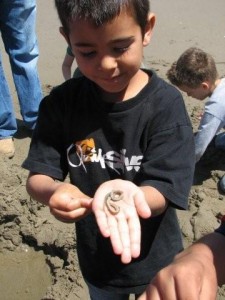
A second grader finds a worm. (photo by Trish Mace)
Introductory Lessons
Lesson 1-Intro to beach hoppers-KWHL chart
Goal-how to ask good science based questions while learning about beach hoppers
Key concepts-Good science based questions help us learn information and sharing information is a good way to learn.
Show a picture of a beach hopper and describes where they live and sets up a chart, labeled ‘Beach Hoppers’ with four columns-what we know, what we want to know, how we can learn, and what we learned. Students are asked to provide their thoughts and ideas on the first three questions. If time permits, the instructor can label the picture of a beach hopper and go through its anatomy (antenna, eye, head, thorax, abodomen, walking legs, cheli) and discuss how the parts of the animal are used. (A beach hopper picture with anatomical labels can be found on the OIMB GK12 webpage, under Beach Hopper Unit Summary, see Resources section.)
Lesson 2-Can you jump as far as a beach hopper?
Goal-measuring and introduction to proportions by comparing how far beach hoppers and humans can jump (Relative to body size, beach hoppers can jump much further than humans.)
Key concepts-accurate measuring and proportions
This lesson incorporates live animals and math. First ask students if they think they can jump farther than a beach hopper. Divide the students into two groups. Each group measures both how far they and a beach hopper can jump. Measure the heights of students in group one. Lay a tape measure on the ground and record how far each student can jump. In group two, students put a beach hopper in their hand and measure its length with a ruler. To determine how far a beach hopper can jump, place a target with circles indicating 3, 6, 9 and 12 inches from the center on the ground. Each student puts their beach hopper in the middle and observes how far it jumps. Switch roles for groups and repeat. Introduce the concept of relative body size proportion, explaining how a beach hopper can jump much farther than a human. Determine how much farther a beach hopper jumps, compared to its body length, than humans can. (A worksheet can be found on the OIMB GK12 webpage, under Beach Hopper Unit Summary, see Resources section.)

Lesson 3-Wrap up and review, field trip preparation
Goal-prepare the students for the field trip and plan and discuss the field trip experiments
Key concepts-appropriate field trip behavior, how to ask a good question and conduct experiments
Lead the students in a discussion to decide and list good field trip rules and what the class needs to bring to the beach. Revisit the KWHL chart and have the students reflect on what they have learned about beach hoppers, what more they want to know and how, when they go to the beach, they could discover some answers. Lead a discussion on what the students will do on the field trip based on their responses. Guide them towards the three experiments planned for the field. The first determines where (high, mid and low) in the tidal zones beach hoppers live. The second examines what substrate beach hoppers prefer to live near. The final experiment looks at if beach hoppers hop in a specific direction when released.
Field Trip
Reconnaissance work will be needed to determine the best beach for the field trip. Factors include location, ability to easily locate beach hoppers, safety of the beach, human activity, and how much beach is exposed during low tide. Although an extreme low tide is usually not required, the tide must be low enough to expose the area of digging for the duration of the field trip.
Supplies
Shovels, buckets, sieves (a kitchen colander with small holes will work), clipboards, Rite in the Rain paper, pencils (Field trip data sheets can be found on the OIMB GK12 webpage, see Resources section.)
Divide the students into groups of no more then 10 students with at least one group leader and 2 helpers. Each group should have 3 shovels, 3 buckets, 1 sieve and 1 clipboard. Designate one student to be the recorder for each experiment and switch recorders for each experiment. Allow 30-40 minutes for each experiment.
Once the students arrive at the beach, hold a review session with the entire group to remind them of their 3 experiments and review beach etiquette (treat animals with respect, refill any holes dug, etc).
Experiment 1-Where do beach hoppers live?
The expected answer-they live at the mid tide line where it is not too dry and not too wet. Beach hoppers are poor swimmers and cannot live low on the shore where there is too much water, but will dry out if they are too high on the shore due to the sun. (Give students a hint that they should dig near holes). (See field journal sheet 1 on OIMB GK12 webpage in Resources section)
Have students predict where and why they think they will find the most beach hoppers. Start digging at the high tide line and have students count how many they find and record their data. After 10 minutes, have the students move to the mid tide line and repeat their search. After 10 minutes, repeat at the low tide line. Have them make observations about the size and color of the organisms.
Experiment 2-What do beach hoppers like to live near?
The expected answer-they prefer seaweed as that is what they eat. It also provides refuge from the sun and predators. (See field journal sheet 2 on OIMB GK12 webpage see Resources section)
Keep the students in the same groups and work in the mid intertidal where there are the most beach hoppers. Ask the students to list possible habitats-seaweed, rock, driftwood, and just sand. Start digging and have the students keep tally of how many beach hoppers they find near each spot. Have the students capture and place beach hoppers in a bucket containing some damp seaweed for the next experiment.

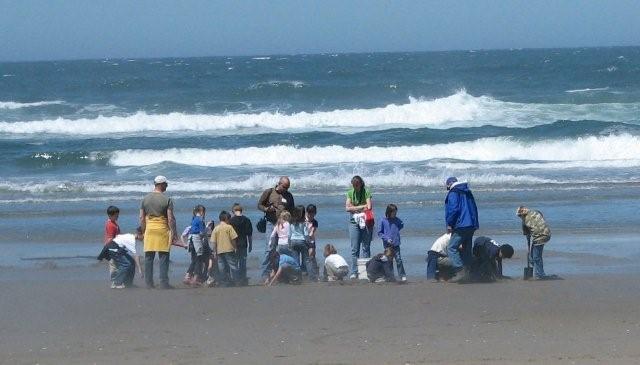
Hillcrest Elementary second graders on an inquiry-based field trip at Bastendorff Beach, Oregon. (Trish Mace)
Experiment 3-What direction will a beach hopper hop?
The expected answer-beach hoppers orient themselves according to the slope of the beach, jumping landward. This prevents them from moving downward on the shore where they would get into deeper water where it would be harder for them to swim. (See field journal sheet 3 on OIMB GK12 webpage in Resources section)
The students will hopefully have collected 20-30 beach hoppers. Lead a discussion on how the beach hoppers should be released (head towards the water, head towards the land, etc.) Students release equal numbers of beach hoppers at the high, mid, and low zones and observe the beach hoppers’ behaviors. Assign students the task of releasing one beach hopper at time and have them observe the direction they hop. One student will record the direction the beach hopper moved, writing if the beach hopper stayed there or continued moving.
If time remains, students can practice sieving sand and looking for other animals, seeing what lives where.
Post lessons
Many lessons, from a variety of disciplines can be created based on the field trip.
Examples:
Graphing-have the students graph the distribution of beach hoppers per zone (low, mid and high tide lines)
Day in the Life of a Beach Hopper-each student will write and illustrate a story depicting how a beach hopper would spend a day
Zonation poster-students can work in groups or individually to draw a poster showing what they found in different zones of the beach.
Credits
Jan Ward, Alix Laferriere, Merry Lojkovic, Kara Davidson, Ashley Binter, Ben Grupe
Resources
Beach Hopper Biology Websites
http://www.wallawalla.edu/academics/departments/biology/rosario/inverts/Arthropoda/Crustacea/Malacostraca/Eumalacostraca/Peracarida/Amphipoda/Gammaridea/Talitridae/Megalorchestia_californiana.html
http://www.answers.com/topic/beach-hopper
OIMB GK12 Beach Hopper Unit Summary
http://www.uoregon.edu/~oimb/Academics/GK12/field inquiries/beach%20hopper%20field%20inquiry.pdf
OIMB GK12 Field Trip Data Sheets
http://www.uoregon.edu/~oimb/Academics/GK12/field%20inquiries/Hopper%20Field%20Journal.pdf

by editor | Jan 2, 2010 | K-12 Classroom Resources, Marine/Aquatic Education

What causes ocean currents? What impact do they have on Earth’s environment? How have they influenced human history?
This teaching guide for grades 5-8 provides 7 activities for students to explore the causes and impacts of ocean tides and gain an understanding of the influences of wind, temperature, salinity and density on ocean movement.
Students are given the opportunity to explore such real-world situations as the 1990 Nike shoe spill, the raft Kon Tiki, and other oceanic voyages in history.
From Great Explorations in Math and Science (GEMS). ISBN 0-924886-44-7. $21.00. Order online at www.lhsgems.org.
by editor | Apr 16, 2009 | Marine/Aquatic Education
Engaging students in the marine sciences
by Susie Vanderburg

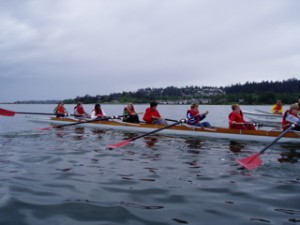
enny Ross, a N.A.M.E. teacher at Strawberry Vale Elementary in Victoria, BC, shared with us a creative and challenging way to engage students in the marine sciences. When Lenny was a middle school teacher, he developed a partnership with The Rowing Center, a waterfront business on the Strait of Juan de Fuca. The Rowing
Center staff and Lenny created a unique opportunity for local 6th and 7th graders by offering a teacher workshop along with a one-day field trip to explore marine ecology and learn the art of rowing. The workshop’s resources included Gloria Snively’s curriculum guide, “Salish Sea: A Handbook for Educators.” The workshop provided a springboard for teachers to develop and teach units in marine science, preparing students for the field trip.
(more…)

