
by editor | Jul 5, 2011 | Outdoor education and Outdoor School, Place-based Education
 By Joseph Cornell
Profound moments with nature foster a true and vital understanding of our place in the world. I remember an experience I had as a five-year-old boy that awakened in me a life-long fascination for marshes, birds, and for a life lived wild and free.
I was playing outside on a cold, foggy morning when I suddenly heard a startling chorus of “whouks” coming toward me through the air. I peered intently at the thick fog, hoping for at least a glimpse of the geese. Seconds passed; the tempo of their cries increased. They were going to fly directly overhead! I could hear their wings slapping just yards above me. All of a sudden, bursting through a gap in the fog, came a large flock of pearl-white snow geese. It seemed as if the sky had given birth to them. For five or six wonderful seconds their sleek and graceful forms were visible, then they merged once again into the fog. Seeing the snow geese thrilled me deeply, and ever since then I have wanted to immerse myself in nature. (more…)

by editor | Jun 7, 2011 | Outdoor education and Outdoor School
The Social Studies of Spirituality
By Kasey Christian
IslandWood
(photo from silouanthompson.net)
Where are the boundaries between Social Studies, Science, and Spiritual beliefs? Where do these distinct practices intersect? How does a teacher model equal respect for each?
As professional educators, how do we teach about intrinsically interdisciplinary (and sensitive) topics such as the basic foundations of life and death? Both alternative and popular cultures have explored the intimate intersection between natural sciences and spirituality since the earliest discoveries of humankind. Through exploration of cultural customs and beliefs, a similarly fascinating intersection can be found between social studies and spirituality . As an outdoor educator in a formal, non-traditional setting, much of the curriculum I teach is based on the cultural history of the land. As I respectfully acknowledge both the facts and beliefs of particular cultures, I am repeatedly challenged to articulate the similarities and differences between social studies, science, and spiritual beliefs. In my desire to regard each subject area with equal respect and value, I am currently grappling with this dynamic, mysterious and sometimes perplexing crossroads between disciplines.
(more…)

by editor | May 31, 2011 | Outdoor education and Outdoor School, Questioning strategies
For the questioning mind, learning never concludes because it is an endless journey with an infinite number of destinations…
by Chris Helander
Head Instructor
Coyote’s Path Wilderness School
(reprinted from The Best of CLEARING)
There are many people who say our current model for learning is ineffectual. Parents and educators are asking “how do you reach young people who seem apathetic and unmotivated to learn?” In old cultures before schools, books, and grades, people learned by being mentored. Using stories, ceremony, games, and survival skills everyone and everything was a teacher. In the modern model of education, learning is force fed, sitting in chairs, listening to an adult spouting out information to be memorized. Modern children learning this way are trained to get their knowledge by memorization of someone else’s knowledge. They do not learn how to develop the questioning mind or follow their hearts to learn from their own experiences.
Read the rest of this article…

by editor | May 19, 2011 | Environmental Literacy, Outdoor education and Outdoor School
By Saul Weisberg
Executive Director
North Cascades Institute
(reprinted from The Best of CLEARING)
I love knowing the names of things. It makes them familiar, like old friends. I also love to look at patterns in nature. Veins on the back of a vine maple leaf. The yellow and black scales on the wing of a two-tailed tiger swallowtail. The striations in a piece of greenschist. The patterns of nature show us the details of life where the wonder lies.
The landscape is made up of details, too. The ways things fit together — the interactions of living and non-living things — tell a story. In order to make sense of larger patterns, in order to recognize them in the first place, you have to know the details. You have to be able to look at the pieces and pick them apart, understand what this thing is, why this lives here and not there, why things work the way they do, and what has changed over time.
The distrust and ignorance of science that is prevalent in society has made inroads in environmental education as well. It is not unusual to see eager and competent educators with master’s degrees in EE who have no knowledge of natural science, and who are unable to identify common birds and plants. These educators tend to focus on two things: the experience of teaching in the outdoors and the big picture — important processes and concepts. But somewhere between the experience and the process we lose touch with the thing itself — the organism and its world. (more…)
by editor | May 12, 2011 | Outdoor education and Outdoor School
 by Tony Deis
TrackersPDX
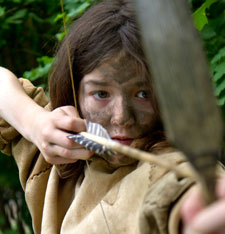
Remember when Outdoor Education was chopping wood, ghost stories, building log cabins, lighting fires and fishing? Nowadays it’s playing nature games, parroting sanitized and co-opted indigenous lore, taking water quality samples and sitting in a sit spot like you’re eating your vegetables.
We’ve devolved from great acts that require great competency to monkeying what kids do when they play without us. Heck, the same goes for a lot of “Outdoor Recreation” programs that work with adults. The educator follows their school’s philosophy like a zombie.
In my 20 years as an outdoor educator I’ve heard plenty of folks say, “It’s our job to get to kids to play again.” While that’s partially true, its also important to remember, we are the guides on [a] true hero’s journey. We are the adults that show kids what’s possible. Equally missing to spontaneous play is your mother and father taking you fishing. Or the old school scout master showing you how to throw a hatchet.
“Child centered education” can often excuse ourselves from training in real outdoor skills and lore. If you yourself dare a compelling and extraordinary life, that will show through in what you share with kids. Adventure will be second nature. No curriculum, visible or invisible, required.
Remember, all models are wrong and some are useful. All methodologies of outdoor education (including and especially Trackers) are also thoroughly incorrect yet serve a purpose. It’s up to you to make those methods real by being real yourself.
A great outdoor educator is not solely someone who has trained to be so. A great outdoor educator is she or he who has chosen to live an epic life out of doors.
http://trackerspdx.com/blog/posts/2011/05/12/outdoor_ed_is_boring
by editor | Jan 15, 2011 | Outdoor education and Outdoor School, Place-based Education
by Lindsay Letitia Huettman
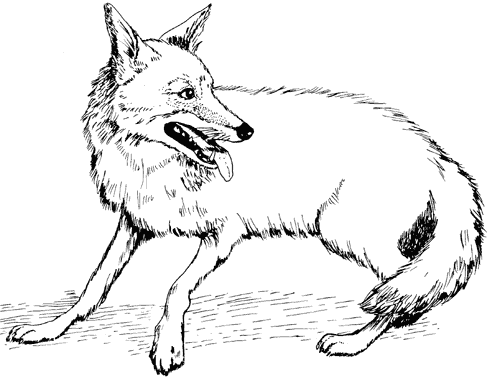
I am out in the foggy, wet Pacific Northwest winter with my 10-12 year-old homeschoolers’ program, heading to an amazing place we call Elk Meadows. As we cross the meadow, we stop for a word of thanksgiving about the day and send the kids to their Sit Spots. The instructors also head out into the landscape, finding a place to rest and watch the morning wake under the goliath presence of Mount Si. Life is revealed to all our senses in this temporary silence. As a mentor, it helps to model to my genuine excitement at the small birds in the willow thicket while enduring the cold, damp earth that I rest upon. This is a great time for instructors; a sacred time to breathe and connect to the elements, earth and its creatures. It is also the time I invite Coyote to come out and do his secret, stealthy duty as the ultimate mentor. During this peaceful space, Coyote brings me glimpses of the internal workings of my beloved students.
If any of the students were looking my way, they would see my attention on the meadow; my head turning to interpret bird calls. Perhaps they see my chest moving up and down, taking large gulps of the mist rolling off the Snoqualmie River, and observe my eyes scanning the horizon, searching for elk on the forest edges. What they wouldn’t see is a part of my awareness is also listening to Coyote. (more…)

 By Joseph Cornell
