
by editor | Jul 31, 2010 | Outdoor education and Outdoor School
by Megan McGinty
North Cascades Institute
Last year we began a service-learning summer program for high school students focusing on climate change. The Climate Challenge program consisted of a summer residency in the North Cascades followed by a service project in which elementary-school students were taught by the returning high-school students back in their home communities that fall. We planned a challenging field itinerary for the summer portion – studying glaciers, interviewing scientists and exploring hydrological systems. The student team made both geographic and intellectual discoveries and practiced presentation skills in order to bring their stories to their hometowns. We anticipated that they would struggle to master new skills, become proficient communicators, and hoped that they would become passionate teachers.
ALERT: You need to be a CLEARING subscriber to read the rest of this article.
(enter password then hit return button on your keyboard for best results)
[password]
What we did not anticipate was the strength of the reaction from the adult audiences that the students encountered. The first clue was a rant posted online in response to an article in the local newspaper that briefly mentioned the then-pending program. (From the reference to “enviro-nazi youth,” I can only assume the comment was made by an adult.) Other reactions were far more favorable. People consistently commented upon how inspiring the students were, mentioning the word ‘hope’ again and again. The rangers and resource mangers that showed the students their daily work thanked us for the opportunity to interact with the students. The most striking meeting happened over dinner at our environmental learning center one evening when the students gave a brief impromptu presentation as a way to introduce themselves to a group of adults attending a naturalist class. When the students sat down, a woman across the room stood up and turned towards them. “I want to thank you all. We have done such a poor job of taking care of the Earth and now my generation has left you such a mess. I am so grateful to you and want you to know you are our only hope.” By this time, tears were running down her face, the dining hall was still and a few other adults also had red eyes. As she sat down, I looked over at the students, who were gape-mouthed. I had been nervous about them confronting the enormity of the task before them and wondered if the woman’s address would discourage them.
Over the course of the rest of the program, the students referred to that night as the point when they began to take the program more seriously, realizing that people were relying on them in earnest to address climate change. At times the amount and intensity of the expectations being put forth seemed a bit overwhelming and unrealistic for the students. As staff, we were often asked how to teach kids about climate change without getting depressed or depressing them.
 Amid all this, the students never struck me as burdened. Yet neither did they seem uninformed. If anything, they were saturated with information and were quick and adept at adopting new ideas and applying scientific concepts. Flux seems to be a natural state of affairs for them.
The youth who are growing up now, with climate change as a primary concern, are facing a far different threat than any confronted by previous generations. Since the founding of the United States of America, people have faced civil war, wars in Europe, unrest over race, wars in Asia and the possibility of annihilation by nuclear war. While variations of all these threats still exist (and may always be present to some extent), they are all generated by humans.
In these cases we are both the victims and the agents. Meeting these challenges is a matter of appealing to the humanity that lies within the enemy, an enemy that is biologically identical to us and therefore subject to all the great strengths and debilitating weaknesses that we ourselves are capable of. Hope is rooted in our vision of ourselves not just as a nation or race, but as a species.
The problem with casting climate change as a foe is that we can barely define it or its effects in concrete terms. At best it is a poorly understood process, driven by forces that we struggle to comprehend, let alone grasp well enough to manipulate. We may know enough about the gross concepts behind the carbon cycle, meteorology and hydrology to understand that our climate is changing, but these topics become exceedingly challenging and intricate when combined with the physics of aerosols and clouds, quantum mechanics and paleoclimatology. In addition, climate change occurs on a scale far greater than most of us can easily fathom. We know what tens of thousands of years is, but how many of us can honestly say we have an actual operating sense of even a hundred years? In terms of both the mechanisms involved and magnitude of change, climate change is a great unknown. The level of uncertainty posed by climate change is far greater than that posed by war.
This is probably where the generational hinge folds. Students today see climate change as a static fact, a reality that looms in the form of species loss, desertification, and wars about water. They consider themselves optimistic yet realistic. They expect to see changes in the climate, but they also expect to adapt, to develop technologies for a different planet and to live under laws that strictly regulate the use of resources. They anticipate losing habitats, biodiversity, and undeveloped landscapes. I’ve asked students what they think the difference between older people’s views of climate change are compared to theirs. Upon hearing their answers, it occurs to me that the fear surrounding climate change is ours, not theirs. Climate change is a great unknown, but this is true of so many other factors in these students’ lives- whether they will go to college, fall in love, have children, what career they will choose, whether they will encounter fortune, illness or wealth. To them, the issues resulting from climate change are among a host of many other big questions. These students still embrace uncertainty, and right now, that fact is to their advantage.
This past fall, the same students that addressed the group in the dining hall were presenting their views on youth, climate change and involvement before a panel of federal officials. One young woman stood up and related a pivotal moment that occurred for her during the summer. As she spoke about standing on top of a mountain and realizing that the land as far as she in every direction was public land, her voice cracked and tears ran down her face. She took a deep breath and continued. “I realized that this land was my responsibility and that I want to do everything I can to protect it into the future.” While some of us may see a reason for despair, there are others who hear a call to arms.
When these students learn about pressing issues, their response is a desire to inform others about it. They intend to catalyze the change they believe their communities need. One student said “It’s easier for us because people who grew up earlier kept seeing things get better and all we’ve seen is things go downhill.” They consider themselves naïve, but are looking forward to making and seeing change. They realize that not all the changes will be good, just as they realize that they will not be successful in all they undertake. They also understand that climate change has winners and losers, but they see no reason why they, and we, can’t adjust.
 Perhaps as these students age, and go on to both succeed and fail at the challenges that occur in the course of their life journeys they will become jaded, tired and lose hope. Their expectations don’t seem as high as those of students 10 or 20 years ago, but they also seem to be more accepting of the situation. I am confident that as they go out into world they will find some assumptions that they are working under to be far more challenging than they imagined, but also suspect that their lack of pre-set notions about what should be will serve them well as they innovate and adapt their way onward.
[/password]
by editor | Jul 7, 2010 | Outdoor education and Outdoor School, Questioning strategies
by Jude Curtain
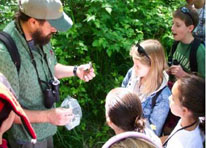
The sun was shining. There was just a hint of fall in the September air. Twenty three fourth graders were hunched over their white dishpans, excitedly sorting through their samples of forest litter. So began a series of lessons designed to guide students in generating questions, creating investigations, and ultimately finding answers.
Lesson #1: Noticing Details
My experience has been that children need training to be good observers. My first lesson engaged students in examining a container of forest litter, sorting all the things they discovered in their samples, and recording each item in their science journals.
Lesson #2: Open vs. Closed Questions
We defined closed questions as those that had a simple “yes” or “no” answer. Open questions were those that required an explanatory answer. Examples of both types of questions were generated first by me, then by the students in a class discussion. (more…)
by editor | Jul 6, 2010 | Outdoor education and Outdoor School
by Rob Sandelin
 My primary goal as an educator at the Environmental Science School is to create connections between students and nature. I do this because I believe once students have a deep connection to nature, they become advocates, often for the rest of their life. We have lots of time and experiences with nature as part of our program.
An example. We spent several trips a few years ago along a certain creek watching, counting and learning about salmon. We watched a female dig a redd (her nest) and the whole cycle. Every time we went back the kids looked for red girl, as they had named her. During one rainy day the kids noticed a pipe dumping gunky water into OUR stream onto OUR fish. They were outraged. We followed the pipe back and discovered it was a street drain, full of crud and oil from cars off the road. I did not tell them how to feel or act, they did that on their own, based on their connection to that place. After school they ALL met and cleaned up that whole street, then, unknown to me, a bunch of them went to an evening political debate between a couple of candidates for mayor. They stood up in a room full of adults, and demanded to know what the candidates were going to do about the street drains in our town which dump oil and gunk onto OUR salmon stream. They were articulate, bright and passionate advocates.
As far as I am concerned, this is why I teach.
Rob Sandelin is a naturalist and environmental educator who has since childhood spent much of his life observing and studying nature in the mountains of the Northwest. He has served as a park naturalist at Yosemite National Park, Olympic National Park, and Denali National Park. Currently he teaches field skills to student naturalists at the Environmental Education School of the Sky Valley Education Center in Monroe, Washington. He is the author of This Week in the Woods, a series of natural history essays; the Cohousing Resource Guide; and the Intentional Communities Resource Pages website. He lives with family and friends in the Sharingwood Cohousing Community in Snohomish County.
by editor | May 4, 2010 | Outdoor education and Outdoor School, Schoolyard Classroom
 by Julie Lancaster
Last year, I left the OE world that I love so much and went back to school to get my teaching credential/MA Education. I felt that loving education as much as I do, it would be extremely beneficial to study it! Finding myself headed toward student teaching in the classroom, I kept reaffirming my commitment to OE, and vowed that I would reenter that world once I was finished with my program.
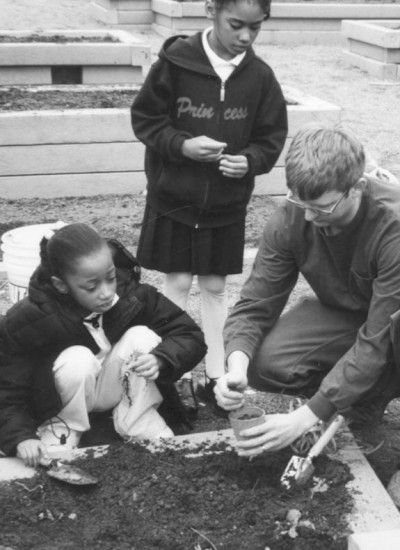
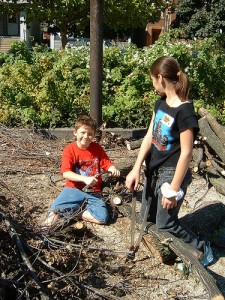
Well, I survived learning and teaching in a traditional classroom setting, and I still have a love of teaching and learning outdoors (of course). After finishing my program this past July, I jumped into a new direction that bridged OE and the school system. I have become the Special Programs Director at an elementary school, where as one of my primary jobs is creating and teaching K-6 in a school garden (AKA Life Lab or Garden Classroom). It is absolutely wonderful. (more…)

by editor | Apr 14, 2010 | Interviews with Educators & Leaders, Outdoor education and Outdoor School

This interview is the first in a series that will be a regular feature in Clearing. Check back each month for a new interview with a leading environmental educator in the Pacific Northwest.
Saul Weisberg is executive director and co-founder of North Cascades Institute. He is an ecologist, naturalist and writer who has explored the mountains and rivers of the Pacific Northwest for more than 30 years. Saul worked throughout the Northwest as a field biologist, fire lookout, commercial fisherman and National Park Service climbing ranger before starting the Institute in 1986. He authored From the Mountains to the Sea, North Cascades: The Story behind the Scenery, Teaching for Wilderness, and Living with Mountains. Saul serves on the board of directors of the Association of Nature Center Administrators, the Natural History Network, and the Environmental Education Association of Washington. He is adjunct faculty at Huxley College of the Environment at Western Washington University. Saul lives near the shores of the Salish Sea in Bellingham, Washington with his wife and daughters.
Clearing talked to Saul on April 12, 2010:
You were the co-founder of the North Cascades Institute in 1986 and have been its executive director ever since. What changes have you seen in the field of environmental education over the years? (more…)
by editor | Mar 10, 2010 | Outdoor education and Outdoor School, Schoolyard Classroom
A Teacher’s Guide to Using the Schoolgrounds for Environmental Studies
Review courtesy of Fletcher Brown, University of Montana
Author unknown
Environmental education for children growing up in urban areas is often limited to a single trip to a forest preserve or state park. The hidden message behind such field trips is that the environment must be sought, and that their local community is not a part of a greater ecology. Helen Ross Russell believes that environmental education can be taught in all locales, including the hard-topped schoolyards common in urban areas. Ten-Minute Field Trips provides opportunities for students to learn about the natural processes occurring all around them, to develop a concern about the misuse of this planet, and foster a willingness and ability to initiate and support positive action on the basis of this knowledge.
The book begins with a short chapter making a strong case for schoolyard field trips — they are available to all schools; are conducive to repeated trips throughout a day, week, or school year; can easily and spontaneously be integrated into a daily lesson, even in a tightly structured teaching environment; and can be the springboard for a greater depth of inquiry by students. Before launching into field-trip ideas, there is a short chapter emphasizing the importance of fostering curiosity in learners of all ages. Russell believes that:
If schools are going to have a meaningful role in today’s world, they
must be more than dispensers of information and places to read; they
must keep alive the natural spark of curiosity, they must nurture the
ability to think, they must permit a child to grow.
The remainder of Ten-Minute Field Trips is filled with ideas for providing students opportunities to do the above. The activities are divided up under the headings of “Plants,” “Animals,” “Interdependence of Living Things,” “Physical Science,” “Earth Science,” and “Ecology.” Each section is divided into several subsections. For example, “Animals” is broken into Vertebrate Animals, Birds, Animal Tracks, Insects and Other Arthropods, and Earthworms. Each section and subsection provides background for the teacher about the general subject, classroom activities that may be taught in conjunction with the field trips, suggestions for teacher preparation, and field trip possibilities. The field trip ideas are intentionally fairly vague, so as to be relevant to a wide variety of age groups, skill levels, and school environments. For example, one of the Earth Science field trips suggests observing nearby waterways, including gutters of city streets. In this field trip, students are asked to observe the difference in the load carried by rapidly flowing water compared to slowly moving water; to find waterfalls, deltas, canyons, or outwash plains; to build a dam and observe the change in water flow and siltation. Students in urban or rural schoolyards, from kindergarten through high school, could engage in this activity, focusing on anything from an aesthetic appreciation of water systems to the physics of water dynamics.
Although originally published in 1973, Ten-Minute Field Trips is as relevant today as it was thirty years ago. It is full of great ideas for teachers who may not think that their teaching environment is conducive to hands-on environmental education, as well as for those who do. With stories and obvious excitement for the topic, Russell creates both a useful manual and an interesting read. Although written in the context of schools, most of the activities could be integrated into day and residential camp programs, nature centers, or family experiences. As Russell points out, Ten-Minute Field Trips is not a complete teaching guide, it merely “suggests possibilities which the teacher can select and adapt as a starting point.” Whether teaching in a hard-topped city school, or wild and green summer camp, this book can be a valuable resource for educators of all subjects who want to infuse their curricula with experiential activities that bring the local environment home.

 Amid all this, the students never struck me as burdened. Yet neither did they seem uninformed. If anything, they were saturated with information and were quick and adept at adopting new ideas and applying scientific concepts. Flux seems to be a natural state of affairs for them.
 Perhaps as these students age, and go on to both succeed and fail at the challenges that occur in the course of their life journeys they will become jaded, tired and lose hope. Their expectations don’t seem as high as those of students 10 or 20 years ago, but they also seem to be more accepting of the situation. I am confident that as they go out into world they will find some assumptions that they are working under to be far more challenging than they imagined, but also suspect that their lack of pre-set notions about what should be will serve them well as they innovate and adapt their way onward.

