
by editor | Feb 24, 2012 | Questioning strategies, Schoolyard Classroom
“Lessons for Teaching in the Environment and Community” is a regular series that explores how teachers can gain the confidence to go into the world outside of their classrooms for a substantial piece of their curricula.
Part 11: Assimilation Continued
by Jim Martin, CLEARING guest writer
 e’ve been talking about assimilation, where we start in the real world, integrate new learnings into old concepts, then use this auspicious beginning to move into the abstract. It’s like building a boat that lets you explore an uncharted ocean. It helped our hunter-gatherer ancestors to navigate changing environments. It is still embedded within the brain that was selected for by the consequences of its activities.
And it served us well until our environments became brick, steel, asphalt, and concrete. Now, instead of learning about the world in the world, we learn in rooms. Not that that’s a bad idea. It helps us to focus and concentrate our thinking. But, because it’s generally only an extended exercise in developing short term memory, twelve or thirteen years of it doesn’t leave a student well equipped for the environment he or she will inhabit. (more…)

by editor | Feb 12, 2012 | Schoolyard Classroom

 n a quiet, residential, inner southeast Portland, Oregon street, a little elementary school is breaking new ground for the farm-to-school and school garden movement.
At Abernethy Elementary, students enjoy freshly cooked breakfasts and lunches prepared on site by a trained chef. The meals are often prepared with local and seasonl ingredients, some of which are harvested from the school’s Garden of Wonders. The garden itself is entirely planted, tended and harvested by the students, who use it throughout their school day as a “learning laboratory.”
Read their story…

by editor | Jan 13, 2012 | Questioning strategies, Schoolyard Classroom
“Lessons for Teaching in the Environment and Community” is a regular series that explores how teachers can gain the confidence to go into the world outside of their classrooms for a substantial piece of their curricula.
Part 8: Where is Curriculum?
by Jim Martin, CLEARING guest writer
 We’ve been talking about our ‘Locus of Control,’ the place where the authority for what we do lies. That authority can be outside ourselves, or within. What determines where we find it? Nothing more than experience.
By experience, I mean having done something in a way that lets me understand it once and for all. Most teacher inservices introduce us to new learnings, then let us go, as if we had mastered it. Many field trips do the same; we go out, experience something neat and invigorating, then return to our classroom not understanding it well enough to incorporate into our curriculum. I think we might do well to revisit environmental education, and its partner, K-12 education.
Before environmental education was a household word, most people abused the environments they inhabited and traveled through. There were lots of reasons for this, and someday we might visit some of them. The first environmental education project I remember was Lady Bird Johnson’s campaign to reduce highway litter, which was an atrocious problem. She opened our eyes, and we soon began to generalize the concept and become more aware of what was happening in our forests, plains, wetlands, and waterways.
Environmental education brought this to our attention, and we learned. Today, a large fraction of the population recycles, and votes for environmental legislation. I think it might be time for environmental education to begin an exploration of its place in the average U.S. K-12 school system. It has a lot to bring with it, and our students’ educations might better prepare them for the world they inhabit. Let’s look at some pieces of such a possible future merger.
We’re already moving in that direction. Many teachers, and some schools, have been using the natural world, and its embedded curricula to drive their deliveries. With great success. Some schools organize their entire curriculum around the environment and community. In other schools, individual teachers have built their curricula around the world outside the classroom. They all use environmental educators and local experts and organizations to partner in their works. Both environmental educators and teachers had to modify their practices to make it work, but all seem to have benefited from the adaptation.
Here is what each brings to the table. Environmental educators bring natural environments with their plant and animal populations, a great place to begin learning for understanding via assimilation. They bring an intimate intuitive knowledge of the curriculum embedded in the places where they work. And so far, all those I have known are quite willing to work with teachers to develop projects and programs which meet their needs. They also often have equipment and resources that school classrooms don’t.
Teachers bring students who are, at the very least, happy to be out of the classroom, and are willing to work while they are on site. Teachers have intimate knowledge of the strengths their students bring to the work, and are great behavior managers of students who are working on their own. Those who have been doing this work for awhile carry with them the certain knowledge that their students grow in this work, and most important for their job security, score very well on standard tests.
The interface piece which holds this together for both groups is the embedded curricula residing in the sites the environmental educators work in. Classroom curricula and real world sites; a dynamite combination. I can give you an example from a project a bright first-year teacher did. Her class was working on a restoration project in a ‘natural’ urban park. One day, she had her students stand on a high spot where they could see all of the trees on site. They counted the number of each species present, and she then showed them how to convert these numbers into fractions, and the fractions to percents. Suddenly her students could see what 13% and 48% looked like. And, when they and a class which didn’t work on the project took the tests on percents, all of the ones who worked on the project passed; far fewer in the other class did.
We’ve all been to school, and many of us have gone to college. We know something about each of the major disciplines taught in our K-12 schools. Here’s what we can do with this knowledge we’ve carried with us all these years. We can find a natural place, or a place in our community, and begin to get to know the curriculum embedded in it.
When you think of it, everything we learn in school is about the world outside the classroom. Those disciplines originated somewhere, and that somewhere is in the world we’ve inhabited. Pick three disciplines, one that you know intimately, and two you know, but not well enough to teach from scratch. Go into that place you’ve chosen, and find examples of each discipline you picked. When you’ve done that, think of how you would teach it.
Here are the disciplines I’ve chosen: Biology, creative writing, and social studies. I’ve listed them in the order that I’m familiar with them. For instance, one part of me has been a biologist since 1963; another part likes to write, but has never taken a course in creative writing; and, the third part appreciates history, but doesn’t know what a social studies curriculum contains other than history.
So, I’m going to go out right now and find the place where I’ll find my disciplines embedded in. I’ll search for the learnings, and when I find them, I’ll think of how I could get a classroom of students to locate and exploit them. I feel comfy about biology, okay about creative writing because I appreciate the power of metaphor (Which I don’t use often enough!), and am feeling pretty shaky about social studies. If you know about learning levels, I’m at my Instructional Level. The learning load isn’t at my Frustration Level (where I’d just give up), nor is it all at my Mastery Level (where I’d be bored to death).
. . . Two days later . . . .
Okay, the place is the area just off the dog walk at the Southwest Washington Humane Society in Vancouver, WA. A few yards from the dog walk, there is a chain link fence at the edge of the shelter property, and on the other side brush and brambles cover several yards before reaching the precipitous edge of a quarry. Not really a natural area, except that humans don’t tend it. Nor is it a developed urban area. But, it resides in the world outside the classroom, so fits my criteria. I’m going to check it out, and report back on the biology, creative writing, and social studies curriculum I found embedded in it. See if you can’t do the same so you’ll have some concrete referents to refer to as we continue this exploration.
.
 This is the eighth installment of “Teaching in the Environment,” a new, regular feature by CLEARING “master teacher” Jim Martin that explores how environmental educators can help classroom teachers get away from the pressure to teach to the standardized tests, and how teachers can gain the confidence to go into the world outside of their classrooms for a substantial piece of their curricula. See the other installments here.
by editor | Dec 30, 2011 | Schoolyard Classroom
by Harmony Roll, Taiga Teacher
 ou don’t need to be an environmental educator, you don’t have to stray from traditional norms, or be on the cutting edge to incorporate place-based education into your daily practice as a teacher. The goal is to create connections, connections to what the learners already know about the world around them. Activate their prior knowledge. (more…)

by editor | Dec 21, 2011 | Place-based Education, Questioning strategies, Schoolyard Classroom
“Lessons for Teaching in the Environment and Community” is a regular series that explores how teachers can gain the confidence to go into the world outside of their classrooms for a substantial piece of their curricula.
Part 6: The Easy Part
by Jim Martin, CLEARING guest writer

 e’ve been exploring science inquiry, starting with doing a casual observation in a natural area. In the last blog, I found an inquiry question. What did it tell me to do? I discovered how straightforward the Investigative Design is when it is built upon a clean inquiry question. The inquiry question I finally chose was, Where in trees do Fox Sparrows spend most time? That tells me what to do. Here are the steps it will take me to answer it.
1. Go to the place where I will do my study.
2. Observe for Fox Sparrows. I might do a continuous observation, or break it into 15-minute intervals. I opt for intervals so that, in case the data are inconsistent in their aggregate, they may be influenced by external events that I might notice on site. This provides more information than simple overall totals. (At this point, I may decide to add a section in my data sheets for comments.)
3. Write down the numbers of Fox Sparrows in the trees, and my estimate of how far above ground they are.
4. When the observations are completed, analyze and interpret the collected data.
5. Then, refer the interpretation back to the question. Did I answer it?
Let’s look at your question. If you wrote a clear one, it will tell you what to do. Think of what it’s telling you, and write it out in steps. Make sure that the plan, as written, is practical and details procedures which can be followed by another person. Be sure that the information gathered by your procedures will provide an answer to your question.
Tell yourself how your plan answers the question. Tie parts of the plan to particular parts of your question. Then think of other classroom things this work might be tied to: What information do the main parts of your plan bring to the answer? How would you use this piece to develop critical thinking? Technical writing? Formulating operational definitions? How might you use this as a writing assignment? To address the misconception that scientists’ endeavors are clean and straightforward from the get-go? (Your students need to learn how scientists really do their work. They should be able to look at a set of canned directions and tell you why they’re written as they are. While scientists may master most of the pieces of investigative designs, there is always some level at which they continue to struggle. That’s one of the things that keeps them in the game.)
Now for the easy part. Collect a good set of data by following the plan that you described. Record any glitches you encounter, and any modifications to the plan that you had to make. Keep clear records. Note anything that was not anticipated by your plan. This may become useful later.
Here’s what I found. I had to add ‘the ground’ to the list of places in trees where I might find Fox Sparrows. In fact, they spent all of the time I observed them foraging on the ground. This raised lots of questions in my mind. If I was teaching, and this was my class making the observations and raising the questions, I’d have to decide if it was possible, given my schedule, to let them follow up on some of the questions they generated. I have no standard answer to this dilemma other than to do what seems best for the students’ development at the time. I think I’ll take this topic up in a later blog. It has lots of repercussions on how you teach, and how students learn and become empowered.
Once you’ve collected the data, you can begin to organize it so that it makes sense to you. Use this experience to mentally organize the ways you will record your data in the future. For instance, did the way you organized your data record beforehand have to be modified? How? Why? Did your protocols anticipate what you would experience on site? This is an important learning experience that helps you develop the concepts and skills which underlie science inquiry. Pass these learnings on to your students.
Then illustrate the data in a way which clarifies it. This can be a graph, a diagram, an illustration. As you do this, you may experience some twinges of uncertainty: Am I using the correct method of illustration and analysis; does the data clearly demonstrate what I thought it would; is my data significant? This is a topic we’ll return to from time to time. We all pass lots of math classes, but rarely have to use mathematical analysis in real world situations. The more comfortable you are with it, the more comfortable your students will be.
The data generated by my Fox Sparrow observations pose a few problems. For one thing, they all fit into one category – birds on the ground. I suppose I could make a bar graph, with ‘ground,’ ‘lower branches,’ and ‘upper branches’ on the X-axis, and ‘Number of Birds’ on the Y. It would certainly drive home the point, so I might do it.
However, doing this forces me to think about how I responded to the fact that no birds were in the trees. I realize now that they didn’t stray far from the trees and shrubs where I was working. None strayed into a meadow nearby, or toward the lake shore. I know now that I should have divided the ground habitat in some sort of representative sections, and counted birds in them. I’d probably have found something interesting. This is a piece of science inquiry we need to look at again later – what is the place of negative results in science inquiry? They are important, so we’ll come back to them in a later blog.
Now to interpret our data. What does it mean in terms of your question? This is the place in the inquiry where you decide if your investigation has provided an answer to your question. Work and think carefully. Include a visual representation of the data. If your data doesn’t answer your question, what does it say? If what it says isn’t clear, then does it raise other questions? Can you use inquiry to answer them? I certainly can do that with my results.
Summarize in a few words what the data says to you in terms of your question. Make this a clear statement with an opening sentence, and two or three supporting sentences. Then state any further questions that your inquiry raised and posit any next steps. Do this as if you would follow up on your findings and investigation, even though you may not have time. The thought processes engaged are worth it.
Good inquiry questions tend to raise other good questions as they are answered. This is like a bank account with interest. My own summary is, ‘Fox Sparrows spent all of their time foraging on the ground. They stayed within several yards of the shrubs and trees at the edge of a meadow adjacent to the shore of a lake. Their apparent foraging habit means I need to make observations over the period dawn-to-dusk to determine whether and where they perch in trees.
We’ve finished the active inquiry part of the work. This also completes the more or less didactic nature of the blog thus far. We’ll become more conversational, and perhaps more thoughtful. I’d like to hear from you, your thoughts on the things I’m writing about, on the place of environments and classroom science, or other topics you’d like to address.
Next time, we’ll communicate our findings, something most science standards and benchmarks leave out, but without which science would stagnate. In the meanwhile, work with your data and summarize it. I’ve noticed that the process of inquiry involves both convergent and divergent thinking. If you don’t know about these categories of thought, google them. They are important conceptual organizers you can use to organize and deliver your curricula.
This is the sixth installment of “Teaching in the Environment,” a new, regular feature by CLEARING “master teacher” Jim Martin that explores how environmental educators can help classroom teachers get away from the pressure to teach to the standardized tests, and how teachers can gain the confidence to go into the world outside of their classrooms for a substantial piece of their curricula. See the other installments here.
by editor | Dec 13, 2011 | Environmental Literacy, Schoolyard Classroom
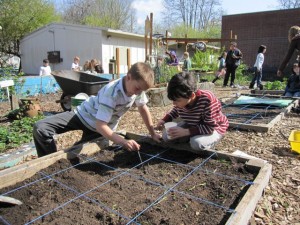
 On a quiet, residential, inner southeast Portland, Oregon street, a little elementary school is breaking new ground for the farm-to-school and school garden movement.
At Abernethy Elementary, students enjoy freshly cooked breakfasts and lunches prepared on site by a trained chef. The meals are often prepared with local and seasonal ingredients, some of which are harvested from the school’s Garden of Wonders. The garden itself is entirely planted, tended and harvested by the students, who use it throughout their school day as a “learning laboratory. “ (more…)


