by editor | Oct 20, 2016 | Outdoor education and Outdoor School

“Mr. D., that was the best science class I’ve ever had!”
The trials and successes of a classroom without walls
By Greg Derbyshire
 he above feedback, made by a grade 8 student, is one of many similar comments made to me by students and parents who recognize and appreciate the opportunities provided by outdoor experiential education. That’s why I took students outdoors when I was a classroom teacher. Not for the accolades or ego stroking, but for the knowledge that I reached many students in a way that can’t be done inside the walls of a classroom. Few of us need to be informed of screen-time statistics when it comes to our modern society. A growing body of research is supporting what many of us know inherently, and the long-term impacts of the loss of exposure to the natural world are mounting. We now know that connecting with the natural world benefits many aspects of our being. Physical, social, spiritual, and mental health improve when we spend more time outdoors. Bullying decreases, ADHD symptoms are reduced, and social and cultural barriers diminish. For many of us, we know that we have an obligation as teachers to expose our students to the outdoors; it may be the only opportunity many of them get.
Herding Cats
The last class of my indoor teaching career was one of the nicest groups of grade 7 and 8s I’d had the pleasure of working with. They were energetic, creative, and enthusiastic. They weren’t, however, good listeners. During the first couple of weeks of September, I tried to help them develop better listening skills.
The usual strategies didn’t work; being late for gym class bothered them, but didn’t change their attentiveness.
With some trepidation then, I prepared them for a study of our schoolyard and the adjacent vacant land. The grade 7’s would investigate biodiversity for the Interactions in the Environment science unit and the grade 8’s would review the above, plus collect plant and water specimens for investigation with microscopes for the Cells unit.
Prior to going outdoors, we reviewed the expectations. Each small group would carry a clipboard, worksheets, scrap paper, pencils, measuring tapes or metre sticks and numerous zip-lock bags for collecting samples. Members of each group were to stay together and work together, solving problems on their own if possible.
I knew this class might be a bit challenging in an outdoor setting because of the struggles we’d had with listening skills in the classroom. But it was much worse than expected. Groups split up, metre sticks were used as swords, pencils got lost, and worksheets didn’t get filled out properly. And, that was just in the schoolyard! With thirty years as a classroom teacher under my belt, and with considerable experience at outdoor education centres, leadership centres and summer camps over the previous thirty-five years, I had no idea a group could be so frustrating. Despite the schoolyard behaviour, we moved to the adjacent vacant land and continued our study. When we finished our work and lined up at the school door to go back inside, I shared with them my dismay at their blatant disrespect for their peers, for me, and for the learning opportunity, which they had just spoiled. I told them that I had never had such a challenging group in all my years teaching outdoors, and that my experience that day was much like trying to herd cats. They knew Iwas upset, so they followed my instructions to return to class, sit down,open their reading books and remain silent.
I sat down at my desk to plan my lecture on respect and listening skills. After fifteen minutes, I asked for their attention.
Instead of my lecture though, I instinctively asked them to share what was good and what wasn’t so good about their outdoor learning experience. A few students offered the correct observations about poor listening skills and a general lack of following instructions. A couple of students suggested that the hands-on learning was a lot of fun. Then, the comment I’ll never forget: “Mr. D. – that was the best science class I’ve ever had!”
I paused. It was obvious that many other students felt the same. “Why then,” I asked, “were you so out of control out there?” It took some time, but some students shared that they seldom, if ever, went outdoors for anything but recess and gym class. They just couldn’t control themselves with the perceived freedom; it was too much like recess, despite having clipboards and worksheets in hand.
Even with this frustrating outing, the learning that followed was substantial. We spent many quality hours preparing plants for pressing, identifying species, mapping study plots with species variety, comparing schoolyard plots with vacant land plots, preparing slides for looking at samples through microscopes, identifying microscopic invertebrates, and preparing reports for presentation. Just one afternoon of outdoor learning provided plenty of extended learning opportunities in the classroom, and set up anticipation for future forays into outdoor experiential education.
In fact, the outdoors became our classroom without walls. Students began to ask if we could go outside to learn. We did. Over the course of the year, we left the classroom for language, math, history, geography, science, physical and health education, and the arts. The outdoors became a natural place to learn. And they became better learners as a result.
Benefits, Barriers, Basics and Beyond
As suggested above, there are dozens of benefits to outdoor experiential education. Students get more exercise, they socialize more, co-operate more and learn more.
They are exposed to new venues for learning where staff can share their expertise. Some students, who might find desk learning a bit of a struggle, shine in the outdoors; they often take leadership roles in groups – something they would not normally do inside. In my experience, students become motivated to work well together so that they don’t lose their outdoor learning opportunities.
The different venues open up different ways of learning. Most will know of Howard Gardner’s theory of multiple intelligences, (Frames of Mind: The Theory of Multiple Intelligences,1993).
There are now nine recognized intelligences: logical-mathematical, spatial, linguistic, bodily-kinaesthetic, musical, interpersonal, intrapersonal, naturalistic and existential. I am convinced that outdoor experiential education can support and enhance all nine intelligences.
Recently in education, differentiated instructionhas been touted as the way to reach more of our students. Take them outside, then! Some will thrive. Some will be challenged. All should benefit in their own ways.
There are, however, a few barriers to taking classes out regularly. A single permission form for a year of local outdoor excursions may not be allowed at some schools. On the other hand, many schools and boards are moving toward being “paperless,” so trip-specific permission forms could easily be completed electronically. Depending on administration, specific school and classroom compositions, the availability of volunteers may be a barrier. None are typically needed if you are staying on school property, and possibly if you are going “next door.” Other outdoor resources within walking distances would require volunteers. Individual schools and boards will have their specific requirements.
As is suggested by my “herding cats”experience, individual class dynamics will impact on the quantity and quality of outdoor experiences. Teachers must recognize the uniqueness of each class and the individuals within it, and plan accordingly. The reality is, some classes may not be able to get out as often as others. Regardless, the benefits of outdoor excursions will be palpable.Whether you’re a novice outdoor educator who needs support, or the experienced teacher who can provide that support, there are a few basics to keep in mind. The list below is a starting point. Adjust it as you see fit for each activity to suit your specific needs. The more experience you get at this, the easier it is.
- Get to know your local resources, (schoolyard, woodlots, vacant land, urban studies opportunities, talented parents or other adults in the community who might be able to help you with specific aspects of outdoor learning).
- Get to know your board and school policies and procedures for outdoor excursions; complete any required paperwork. Perhaps a generic permission form for occasional excursions close to school would suffice for those outdoor teaching opportunities that present themselves throughout the year.
- Arrange for volunteers, if needed.
- Know your students; what are their strengths and limitations?
- Plan the activity for your chosen curriculum area and topic, and gather materials and supplies.
- Carry out that plan; take those kids outside!
- Debrief the students to find out what they liked and didn’t like, and what they understood and didn’t understand. This feedback will prove very useful for future outings.
- Do follow-up activities to solidify learning.
Beyond the basics, here are some ideas for developing a network of outdoor educators within your school and district.
- Consult with colleagues to learn the basics.
- Share your ideas and experiences at regular meetings.
- Create outdoor activity resource documents specific to your schoolyard and local resources, (saved on your school’s server, of course). All teachers can contribute to it.
- Combine classes for some of your excursions. This is one way to team up experienced and inexperienced teachers, and more appropriate student groupings may be easier to arrange.
- Be an advocate for outdoor experiential education whenever you can.
So, why bother?
From my years of experience in the outdoor education and recreation sectors, I’ve seen what a difference going outdoors can make. Beyond all the wonderful benefits stated in research, there’s something that happens to children when they spend time outdoors. Their eyes soften. They begin to see the world in a different way. They’re more centred and at peace. They discover a part of themselves they didn’t previously know. What more could you want for your students?The bottom line is, if you don’t make the small effort to take your kids outside, who will?
Greg Derbyshire is a recently retired classroom teacher with the Grand Erie District School Board in Ontario, Canada. His many and varied outdoor interests and pursuits continue to occupy much of his time. More recently, his interest in promoting the benefits of outdoor experiential education has inspired the creation of a new venture, It All Comes Naturally.
This article first appeared in Stepping Into Nature, a publication of The Back to Nature Network, a multisectoral coalition oforganizations and agencies working to connect children and families with nature. The Network was established with the support of the Ontario Trillium Foundation through a collaborative partnership between Royal Botanical Gardens, Parks and Recreation Ontario and Ontario Nature.

by editor | Feb 17, 2016 | Place-based Education
Wenatchee School District’s Case Study of Science Field Experiences
by Susan Ballinger and Karen Rutherford
his year (2005) in the shrub-steppe eco-region of rural Eastern Washington, over 3600 elementary students, teachers, and adult volunteers will spend a wonderful day of adventure and learning outdoors, at a science field experience. Kindergarteners pound leaf chlorophyll into fabric, 1st graders capture insects amidst blooming wildflowers, 2nd graders use iodine to measure sugar content in ripening apples, 3rd graders wade in icy waters looking for aquatic insects, 4th graders build paper dams, and 5th graders climb a 1000-ft mountain, rewarded with an expansive view their valley home below.
All science field experiences take place within a 20-mile radius of city elementary schools. Each experience is co-sponsored by local organizations. In the Wenatchee School District, a field experience differs significantly from a just-for-fun “field trip.” This place-based field experience is a relevant, multidisciplinary day of adventure and learning in a local outdoor setting. There are two distinct parts to a field experience, both tied to local natural resources:
1. In-class curriculum integrating science and social studies concepts
2. On-site field curriculum, applying classroom concepts with hands-on activities.
Here is our story of how weíve worked from the inside of our school district to make significant connections with the natural and cultural landscape of our collective home.
(Table 1).
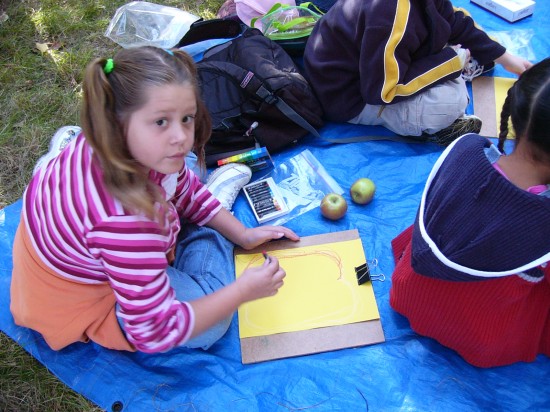
As field teachers, we try to fight the desire to verbally import knowledge and instead allow students time and space to discover using their senses.
BACKGROUND
The Wenatchee School District (WSD) is located along the Columbia River in the state’s geographic center with a rural metropolitan population of 50,000.
Over 7,000 students are served at seven elementary schools, three middle schools, an alternative high school, and a 4A high school. Our K-5th student population is 55% Hispanic with 55% Free/Reduced lunch poverty levels.
Six years ago, the Wenatchee School district embraced a vision to connect classroom science curriculum to the local landscape of our watershed and cultural community. At that time, our assistant superintendent, Dr. Jeanine Butler, wanted our district to comply with our state’s (unfunded) mandate to provide environmental education, K-12. A wonderful model existed in the Leavenworth Salmonfest, serving all 3rd grade students in our region. This outdoor festival co-sponsored by the U.S. Fish and Wildlife Service and the U.S.D.A. Forest Service included teacher training for classroom pre-work lessons. Student come to Salmonfest with foundational knowledge and participates in hands-on activities at the festival. Initially, only schools that had strong parent support organizations could afford to pay for school bus transportation to Salmonfest. Dr. Butler recognized the need for equity and strategically budgeted bus transportation money for all schools into the science curriculum. This budget decision significantly addresses the issue of environmental justice. In our district, we see a high correlation between poverty and ethnicity in student populations, which is reflected in our low scores on state standardized testing. Among our 7 elementary schools, a wide disparity between overall ethnic and poverty levels is found between buildings. Schools with high poverty rates have fewer resources available to provide student trips. With a district-level initiative, all students, regardless of income or ethnicity, have this opportunity and an even-playing field for learning. For science field experiences, district-budgeted bus transportation money has been the key to serving all schools.
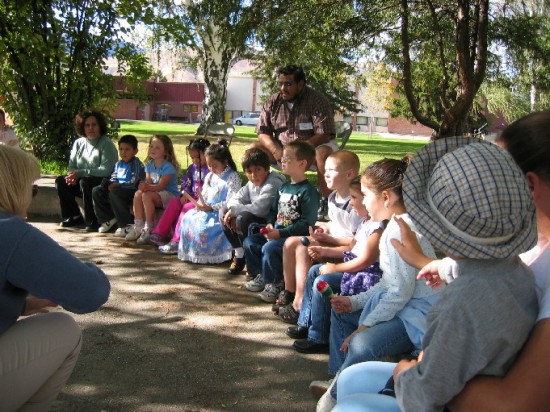
The community college arboretum is the location for the kindergartner Wenatchee Tree Walk and college students work as volunteer teachers.
CREATIVE FUNDING and SUPPORTIVE PARTNERS
Community partners provide the key help needed to launch a science field experience. For example, the USDA Forest Service spearheaded a successful grant-writing effort that enabled the purchase of supplies and development of the 5th grade field experience curriculum. Our 4th grade field experience found significant funding support at our local Public Utility District for 25 classroom kits, valued at $400 each. They are our hosts for our annual watershed-based River of Power experience at Rocky Reach hydroelectric dam. Our community college arboretum is the location for our kindergartener Wenatchee Tree Walk and college students work as volunteer teachers. Our local museum provided relevant local history resources and staffing for many grade level experiences. Members of local non-profit conservation organizations volunteer each year as field teachers. Our local Arbor Day Committee purchased non-fiction tree books for 25 classroom kits. As part of their coursework, Central Washington University pre-service teachers lead groups of 5th graders each May. This broad base of community support has institutionalized field experiences in both the school district and the partner organization.
The key to effective use of community agencies and organizations has been the use of a school district coordinator. The coordinator initiates the contacts, ensures good communication, and follows through with strategically worded thank you letters sent to organization leaders and local newspaper letters-to-the-editor.
Most of our community partners have organizational education goals and our district curriculum structure allows them to concentrate their efforts annually. For example, instead of responding to year-round requests from individual teachers to give tours or be guest speakers, local research scientists from Washington State University know that every September, they will teach stations as part of the Awesome Apple Adventures, serving every 2nd grade student in our town in a concentrated manner.
IN-CLASS CURRICULUM- A FOUNDATION FOR THE FIELD
Teacher today are under great time pressures. Increased testing requirements means even less class time is available for extra activities or field trips. By using a district science field experience coordinator, classroom teachers can focus solely on teaching. The district coordinator designs, and produces an in-class curriculum. With this, we provide a classroom kit filled with all the materials needed to teach the classroom field experience lessons, from videos to local maps, books, and supplies. For example, our second teachers receive an art kit with craft supplies necessary to make anatomically correct insects. This pre-work art lesson prepares students to learn in the field where they use beating trays to find aphids and moths living in apple trees. Another example is our linkage of local cultural history to watershed concepts when our fourth graders view a vintage 1950s film documenting the building of Rocky Reach Dam, prior to their visit.
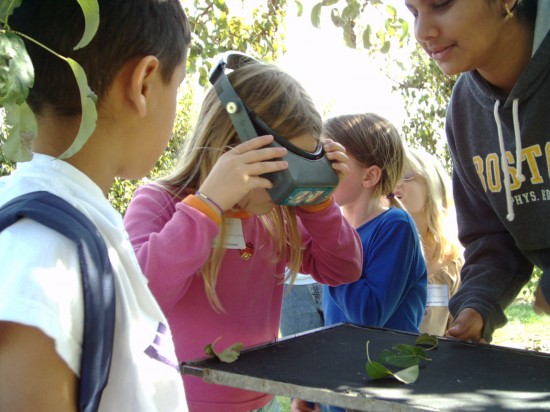
A pre-work art lesson prepares students to learn in the field where they use beating trays to find aphids and moths living in apple trees.
Seven years ago, we adopted a national FOSS curriculum for K-5th grades. This broad-based national curriculum needed a local focus to become relevant, interesting, and meaningful to our teachers. Teachers have no time to research local connections and then integrate this into the adopted curriculum. For example, our fifth grade teachers were struggling to teach the FOSS landform kit topographic map lessons, using a Mt. Shasta map, and many found the stream tables to be baffling. Most had never heard of Mt. Shasta and had never worked with a topographic map themselves. Many teachers are new to our region and had limited knowledge of the local environment and landforms. Teachers simply didn’t realize that our region was a topographic wonderland. Views of Mt. Rainer, catastrophic Ice Age floods, and the Columbia River Watershed were literally within a short bus ride of every classroom. As curriculum designers, we realized we had to start with adult-level learning as a key part of our trainings, giving foundational knowledge to our teachers. At the training, our teachers heard a respected local geologist lecture about our valley’s remarkable erosional features. Suddenly, stream tables are seen not as sandboxes, but as working models of the Columbia River that bisects our town. The FOSS curriculum suddenly had connections to the local environments, so teachers saw the connection between science and experience.
Classroom teachers, librarians, and music specialists spend one month preparing students using science lessons, integrated with reading, writing, art, music, and social studies. Our 4th and 5th grade curriculums include a student reader containing local artist biographies, memoirs, interpretive sign texts, song lyrics, poems, legends, radio plays, and newspaper articles. Classroom teachers have the option to teach non-fiction reading lessons using original source material directly linked to the science lessons. After the experience, students reflect on their experiences and new knowledge by drawing, composing poetry, producing a play, and or by writing essays as culminating classroom projects.

Local research scientists from Washington State University teach stations as part of the Awesome Apple Adventures.
SCIENCE FIELD EXPERIENCE — THE DAY!
Coordinators, not teachers, set up the logistics of the experience, so teachers can instead focus on preparing their students to learn in the field. Coordinators write and prepare hands-on field station curriculum, schedule the buses, recruit station teachers, and devise class rotation schedules. The coordinators take care of the nuts-and-bolts of putting on a big event: making sure everyone can get to where need to be, drink, eat, use the bathroom, and stay safe. They make sure that schedules are fastened to clipboards, binder clips secure watercolor paper to lap easels, port-a-potties and hand-sanitizer are strategically placed, small digital clocks attached to clipboards, large water jugs are ready to refill water bottles, and first aid kits are on hand to handle skinned knees.
FIELD CURRICULUM-BUILDING ON CLASSROOM LEARNING
One of the most fun and creative parts of developing a science field experience is designing the outdoor learning stations. We aim to select activities that extend classroom learning, are best done outside, are too messy for the classroom, and that require special equipment. We assemble an array of visual aids and needed tools into a station kit that is delivered to the field location, ready to go. We often enlist the expertise of a scientist to help with the content of a field lesson. For example, several local wildlife biologists helped develop 5th grade stations called “Mule Deer/ Marmot.” and “Coyote/Cougar.” We use pelts, scat, prints, skulls, and photographs to compare and contrast the life history of these two sets of native mammal species.
We strive to offer an art or music station at each field experience. Art teachers develop the watercolor painting or pastel drawing lessons so that every student produces a masterpiece in the field that is later delivered to their classroom. Our music teachers have enthusiastically created music stations, teaching science content through finger-plays, songs, dances, and games. We provide classroom teachers with a music CD (recorded in-house) so students can start to learn the songs before coming to the field experience.
Each station lesson presentation is written as a “script” so that a non-scientist volunteer or paid teacher can successfully present the material with minimal preparation time. If a skilled professional is available as a station volunteer, we encourage them to modify and extend the lesson to best match their expertise. These scripts are modified and improved each year, using input from the field teachers.

Teachers simply didn’t realize that the region was a topographic wonderland. Views of Mt. Rainier, catastrophic Ice Age floods, and the Columbia River Watershed were literally within a short bus ride of every classroom.
FIELD EXPERIENCE LOGISTICS
A critical element for success of a field experience is detailed event planning. Logistically, field experiences differ significantly in length, type of location, and structure. We try to match amount of time spent in the field with the developmental abilities of students. Kindergarten students spend only 2 hours on site, eliminating the need for eating, having lots of extra water available, and frequent bathroom stops within this time window. In contrast, our 5th graders spend 5-1/2 hours on site, hiking a steep trail, covering a roundtrip distance of three miles. We provide port-a-potties at 3 strategic points, lots of water, and schedule a 1/2 hour seated lunch break. While students rest at lunch, music teachers lead a camp song sing-a-long.
In-District partnerships are another key to our success. The most essential partnership has been between the two co-coordinators for field experiences. Both of us bring a different suite of skills to the tasks of curriculum and event design, event implementation, and last-minute problem-solving. It takes two coordinators to pull off each event, dealing with the last minute crisis that always arises. We do have stories to tell! Maybe you’d like to hear about the time a sudden gust of high winds blew over a port-a-pottie, with a child inside!
In designing the activities and the flow of the day in the field, we’ve borrowed what we call the “Disneyland principles.” To ensure that science learning can happen in the field:
1. Participants leave, wanting to come back because they didn’t get to do everything;
2. Music is embedded in the event;
3. Adequate food and drink are ensured;
4. A wide variety of offered activities; and
5. Something to take home to remember the experience.
What may look like a marketing plan, in reality has ensured a quality science learning experience for all ages of participants. It ensures a good flow of the day that taps into all the senses. We strive to create a scheduled day that runs smoothly with a balance of activities at a pace that isn’t rushed. At all of our experiences, student groups attend some, but not all learning stations. Many of students are dual-language learners so field learning activities involve touch, smell, and creation of art, singing, and movement. We strive to minimize talk and maximize doing. As field teachers, we try to fight the desire to verbally impart knowledge and instead allow students time and space to discover using their senses. Simply being in an unfamiliar outdoor environment is very new to our mostly urban, poor children. We try to select field locations in public spaces so children can potentially return with their families.
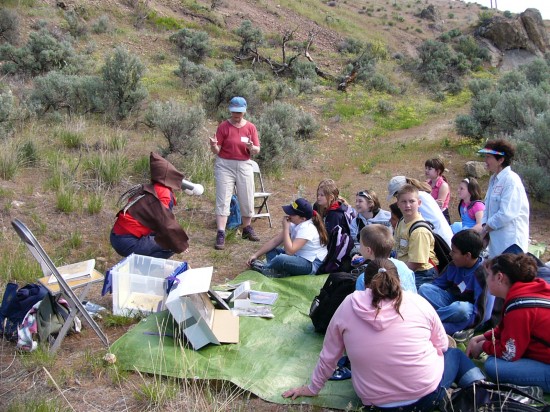
We’ve discovered that field eperiences have woven a web-like interdependency between non-classroom employees and our classroom teachers in our school district.
SUMMARY:
We’ve discovered that field experience have woven a web-like interdependency between non-classroom employees and our classroom teachers in our school district. School nurses, warehouse managers, delivery truck drivers, building secretaries, food service workers and district office administrators all provide logistic support. We’ve also built partnerships with a corps of district substitute teachers who are hardy souls, willing to teach outdoors in all types of weather. We depend upon hired station teachers who can modify and adjust their teaching when high winds spread materials far and wide, a massive bloody nose erupts, or when a rambunctious high school helper decides to capture a bull snake. Community volunteers, many of whom are retired, and will likely vote in the next school bond levy, have positive, one-on-one contact with students and are introduced to the diversity of our student population. Many of our volunteers return year after year. We often need to provide special transportation for senior citizens and some teachers in order to get them to their teaching locations. We strongly encourage pregnant teachers to take advantage of our transportation offers!
Creating a sustainable field experience program is important to us. Often, outdoor education programs depend upon the charisma and energy of a few key people and once these people move on, the program dies. By fully integrating our field experiences into classroom curriculum, they have become part of the schoolís culture. Students and teachers alike look forward to their annual adventure in the field. District funding ensures that staff are dedicated to refurbishing kits and implementing six yearly experiences.
An important key to our success is that we’ve taken the FOSS and STC national general science curriculums and made them place-based for both social studies and science. Integration has helped our teachers see the “why” of teaching science because it is locally relevant and fun. We’ve brought science “home.”
Author Biographies
Karen Rutherford is the K-8th Science Resource Coordinator for Wenatchee School District. Over the past 6 years, Karen has implemented and maintained over 270 FOSS and STC kits. Karen has a strong background in Marketing and Business to compliment her passion for science education.
Susan Reynolds Ballinger has a M.S. Education and M.A. Biology and works as a consultant to Wenatchee School District as the Science Field Experience Coordinator. Susan’s former pursuits include middle school science teaching, biology field work, and a variety of natural history interpretation projects.
For Science Field Experiences, Karen and Susan have worked together for over five years on grant-writing, curriculum development, kit assembly, and event coordination.

by editor | Jan 19, 2016 | Environmental Literacy, Learning Theory
by David A. Greenwood, Lakehead University, Canada
As part of the 2009 North American Association of Environmental Education Research Symposium, this article addresses the cultural and theoretical frameworks that we bring to environmental education, the web of ideas and experiences that define the scope and purpose of the work in its geopolitical context. Originally delivered as a keynote address at the symposium, the paper highlights two necessarily related conversations within environmental education: the first concerns the problem of empire, including its roots in imperialism and colonialism, as well contemporary problems of globalization; the second concerns the problem of nature, including the need to develop intimate connections with the non-human on a planet that everywhere bares the mark of human alteration. Nature and empire are two poles on a continuum that shape the cultural and ecological contexts of life and learning. The author argues for the need to hold empire and nature not in opposition, but in paradox. Holding the tension of paradox complicates simplistic binaries, and can contribute to a stance that appreciates the relationships between seeming polarities in the intersectional work of social and ecological change.
For starters, I want to welcome all travelers to the Columbia River watershed. Here we are. I live some 300 miles east on the Idaho border, and the Palouse River that flows full of agricultural silt and erosion through my rural town mixes here with Portland’s urban confluences on its way to the Pacific Ocean. The mouth of the Columbia is an impressive roar of waves, marine life and history, commerce, and even today, shipwreck. Historian Richard White (1995) called the great Columbia River “the organic machine”: upriver the once wild Columbia and its many tributaries are now a mechanized and politicized system of dammed, slack-water reservoirs. The organic machine, indeed.
The tension of paradox surrounds us, and it surrounds the field of environmental education: local-global; urban-rural; environment-culture; masculine- feminine; native-settler; public-private; land-property; commons-enclosure; human-more-than-human; inhabitant-refugee; social justice-ecojustice; schooling- learning; domination-resistance; me-you; us-them; nature-empire.
My thesis is a simple claim around a single paradox: environmental education of any stripe can deepen its theory and practice by purposefully embracing the tensions between nature and empire. Nature and empire are two poles on a continuum that shape the cultural and ecological contexts of life and learning.
In the tradition of 19th century natural history, imagine an object lesson. I hold in my hands two related objects: the flight feather of a barn owl, and a wallet full of plastic and paper money. Inquiry: How do these objects and what they represent implicate me and shape our work? Nature and empire, the flight feather of an owl and the wallet of a white man, generate a paradox, a paradox that we need to hold, and balance.
 We need to embrace paradox because we nature-lovers and no-child-left-insiders must also face up to the eco- and genocidal politics of empire, politics we’re all complicit with everyday in our cosmopolitan superprivilege. We need to embrace paradox because as heady academics and well-meaning activists, we can easily forget the gift of our own embodied and earthy existence. This feather is perfect. No matter how scientifically rigorous, politically informed, or culturally responsive, environmental education is barren if it does not include re-enchantment with the wide world of creation, encounters with the others, and gratitude for the gift of life.
Nature, empire, and paradox.
Nature. Remember, when you walked miles into the mountains until the rant of your mind receded. The sounds around you returned. Birds, insects, movement in the cover. The air, warm and cool of sun and shade. You started to blend, quiet self diminished and enlarged by a place full of others, and though walking through, you felt belonging. Until later you startled a cougar, you had thought this impossible, your shared shock while everything stopped, her ears twitching, brown eyes locked on your next move, your heart jumping on your chest, predator, prey, you watched each other’s bodies trembling. Remember, how against reason you wanted to run, how you caught your breath and she suddenly returned easily to the ninebark. The day shimmered, your relief, you had finally come back to your senses.
Encounter, enchantment, gratitude.
Empire. Like globalization, empire describes the political economy of the planet: the new imperialism, colonization, development, free trade. Empire—a system of domination and resistance, a bio-political power that is exercised, internalized, and shaped by networks of human cultures worldwide. A system of authority and control enacted by all of us, motivated by habit, addiction, desire, necessity, dreams of a better life, fantasies of endless economic growth—all increasing the throughput of natural and human capital. Empire creates and destroys under the flashing lights of a “postindustrial” age. Empire—your I-Phone, my laptop, the G-20—ecological and social impacts concealed, denied, ignored, and masked as ecological nostalgia or market opportunities. The subject of empire is the commodity; the object is the consumer. All of us are its soldiers.
Domination, critique, resistance
Context: It’s a beautiful world, life is short, and I want to live. I want to feel the wind rushing around me. I want to walk on the land I love, every day. I want to garden with my children and watch them taste the fruits. I want friends. I want to drink starlight in the mountains and howl at the moon. I want the experience of being alive, to feel my sensuous and spiritual relation to flesh, water, rock, fire, wind, species, shooting stars. I want to keep my privileges and increase them. I want to travel to Europe with my family. I want to see my daughters in London or Paris.
Context: Planet Earth 2009, population and industrial explosions, perpetual war, mass extinctions, billions of us striving for better and more, the unthinkable suffering of others. Such beauty and possibility for wonder, connection, pleasure—and—as Barry Lopez (2001) wrote in his great essay “The Naturalist”: “To read the newspapers today, to merely answer the phone, is to know the world is in flames” (¶ 24). Earth abides; meanwhile, no one knows the full extent of the mess we’re making of habitats, species, biosphere, ecosystems, neighborhoods, cultures, selves, others, relationships. No one knows the full extent of “this entire extractive culture [of empire] that has been deforesting, defishing, dewatering, desoiling, despoiling, destroying since its beginnings” (Jensen, 2009, ¶ 10). No one knows the full scale of the problem of empire, its spiral of unintended consequences, and the degree of our own complicity: the way we are part of the problem we fail to understand, the way we fail to understand our part in it. Some say we are on the brink of industrial apocalypse. Others remember: we’ve been here about 500 years.
Anyone paying any attention can see that the mounting data describe an awesome mess of impacts, but fitting the fragments together is complicated. How many parts per million CO2? How many African American men in prison?
Rare is the space in which related impacts are acknowledged along with their more complex cultural causes. But increasingly, impacts are experiential, and therefore transformative. During my first week of classes this fall, a graduate student showed us a collage of photographs she made from her travels with Philippine Exchange: a dichotomous landscape of incredible beauty, destruction from mining, factories like prisons, and desperate poverty: people barely surviving, naked children playing on mountains and rivers of waste. Slumdog without millionaire; millionaire far removed. “It humbled me,” she said, and our privileged space of learning grew quiet. Breathe it in now.
I believe that appropriate responses to the facts surrounding nature and empire—what we know and don’t know, what we feel and don’t feel—are anger, fear, grief, and humility. Avoiding such emotions can lead to projections that may contribute to problems we deny or arrogantly claim to understand. We might learn to be with, rather than run from, the natural sense of despair that the field of environmental education sometimes schools us to avoid. If we are the least connected to others, we are part of a great suffering. Inquiry: Can we hold the paradox between suffering and hope, the dichotomous landscape of wretchedness and magnificence? “The test of a first-rate intelligence,” F. Scott Fitzgerald (1936/2008) wrote, “is the ability to hold two opposing ideas in mind at the same time and still retain the ability to function. One should, for example, be able to see that things are hopeless yet be determined to make them otherwise” (¶ 2).
Paradox. Along with grief, anger, and a rational fear of catastrophe, there is also a sense of urgency and responsibility, an embodied and shared knowing that we must do what we can, and now. From “Hieroglyphic Stairway,” by Drew Dellinger (2006, p.47):
it’s 3:23 in the morning and I’m awake because my great great grandchildren won’t let me sleep
my great great grandchildren ask me in dreams
what did you do while the planet was plundered? what did you do when the earth was unraveling?
surely you did something when the seasons started failing?
as the mammals, reptiles, birds were all dying?
did you fill the streets with protest when democracy was stolen?
what did you do once you knew?
(See the poet perform the entire poem at http://www.youtube.com/ watch?v=XW63UUthwSg)
W. S. Merwin said of poetry, “Any work of art makes one very simple demand on anyone who genuinely wants to get in touch with it. And that is to stop. You’ve got to stop what you’re doing, what you’re thinking, and what you’re expecting and just be there . . . however long it takes” (Merwin in Moyers, 1995, p. 2). Like the other time I seek out on the land, poetry engenders another cultural way of knowing. It is a dissident minority tradition within my own colonized and colonizing culture. Stopping for poetry is an antidote to the morning news, to the incessant political posturing, to the super-sure academic argument, to the voice of reason that governs research methods and reports findings with caution and restraint. Poetry revives me, helps me to recover my wilder self, my possibilities, my empathy, in a domesticating competitive culture that makes me feel loss and lost. Poetry does not argue for the truth, it burns with it. “What did you do once you knew?” (Dellinger, 2006, p.47).
At 82, W. S. Merwin has won two Pulitzer prizes for poetry including this year’s prize; he is also an environmental and peace activist. What Merwin says of poetry is a fruitful beginning for any field of inquiry shaped in part by empire: we’ve got to stop what we’re doing, what we’re thinking, and what we’re expecting. Is it possible to let down our guard and just be here, together?
To deepen a felt experience of paradox between nature and empire, I want to read two poems by Mary Oliver, another great American poet of nature. The poems I’ll read are from her recent volume, Red Bird (2008); the titles are “The Teachers” and “Of the Empire.” These two poems reflect a tension in environ- mental education: between a focus on nature and human relationship with the more-than-human world, and a focus on empire and the political structures that shape people, place, and planet. My argument, again, is simple: environmental education research must hold together the tension between nature and empire or risk its own irrelevance while empire grows and nature recedes.
Mary Oliver is one of the best nature poets ever. She has taught millions to stop and wake up to their own terrestrial embodiment. In “The Summer Day” Oliver (1992) confesses:
I don’t know exactly what a prayer is. I do know how to pay attention, how to fall down into the grass, how to kneel down in the grass, how to be idle and blessed, how to stroll through the fields. (p.94)
Oliver ends this poem by asking of everyone alive, “What will you do with your one wild and precious life?” (p. 94). Her poem “The Teachers” (2008, p.27) is typical of her meditations on slowing and stopping to pay attention to the others and what our relationship to others might signify.
The Teachers
Owl in the black morning, mockingbird in the burning
slants of the sunny afternoon declare so simply
to the world everything I have tried but still
haven’t been able to put into words,
so I do not go far from that school
with its star-bright or blue ceiling,
and I listen to those teachers, and others too—
the wind in the trees and the water waves—
for they are what lead me from the dryness of self
where I labor with the mind-steps of language—
lonely, as we all are in the singular,
I listen hard to the exuberances
of the mockingbird and the owl, the waves and the wind.
And then, like peace after perfect speech, such stillness.
The teachers, the others, make me more human. The more-than-human world—as David Abram, Paul Shepard, Annie Dillard, Henry Thoreau, Rachel Carson, Jay Griffiths, Derrick Jensen, and all my friends remind me— the more-than-human-world is sacred, biological diversity makes human life possible, it makes my life, your life, potentially, beautiful. The logic of empire is destroying this world, leaving behind what David Quammen (1998) called “a planet of weeds.”
Who are the teachers, what are their names, and what, if we learn to listen, might we hear the land and the water telling us? Robert Michael Pyle (2008) wrote, “[Environmental] education, no matter how topographically or culturally informed, cannot fully or even substantially succeed without reinstating the pursuit of natural history as an everyday act” (p. 156). It’s only good manners, Pyle says, to get to know our neighbors. “What we know, we may choose to care for. What we fail to recognize, we certainly won’t” (Pyle, 2001, p. 18). Nature study, from this perspective, must also include the study of what we fail to recognize, the study of what dominates our attention and stunts our ability to perceive nature. It must, in other words, include the study of empire.
Environmental education requires an expansive conceptual and experiential framework connecting local and global realities; it requires ecological attention and political edge, to make it relevant to our place and time. It also requires what Phillip Payne and Brian Wattchow (2009) call “slow pedagogy,” deep experience that helps us open and become responsive to the voices of the teachers:
Owl in the black morning, mockingbird in the burning
slants of the sunny afternoon…
…I do not go far from that school…
(Oliver, 2008, p.27)
How far gone are we now, here, today, from the teachers? Returning to the teachers, slowing to open to the more-than-human others, to the experience of habitat and biological diversity, to the interactions between land and people— this is the heart and soul of environmental education. What impedes our ability to perceive these teachings?
Aldo Leopold (1949-1968) said it over a half century ago: “our educational and economic system is headed away from, rather than toward, an intense consciousness of land” (p. 223). Today, it is even possible to observe that some environmental education research is headed away from, rather than towards, intense consciousness of land, consciousness that can only develop through direct experience of sufficient frequency, duration, curiosity, and reverence, so that we may learn to listen and to love. The environmental education field has become culturally responsive, politically astute, and psychologically smart—mainly in response to empire. But we still need the teachers. What they teach us is irreplaceable, and endangered, unless we stop, look, and listen for a long time.
Before sharing Oliver’s (2008) poem, “Of the Empire,” I want to make a few paradoxical claims about the field of environmental education.
First, environmental education researchers and practitioners ought to guard against the lure of professionalization and the pressures of specialization that surround all fields of inquiry. There is a danger inherent in specialization that narrows our potential community and that distances us from the teachers. In many ways I believe, as Peter Martin wrote in 1996, that “having become institutionalized, environmental education is a lost cause and should be phased out as soon as possible” (p. 51). This obviously does not mean that I don’t support environmental education; rather, I observe that the development of environmental education as a profession can dull its political edge, and can school it far away from the teachers. What is more, as Foucault (1977) showed us, professions tend to normalize behaviour, marginalize outsiders, and disqualify dissent; they can make us docile and unresponsive to nature or empire.
In a provocative lecture titled “Professionals and Amateurs,” Edward Said (1994) noted:
 Specialization means losing sight of the raw effort of constructing either art or knowledge; as a result you cannot view knowledge and art as choices and decisions, commitments and alignments, but only in terms of impersonal theories or methodologies. . . . In the end as a fully specialized . . . intellectual you become tame and accepting of whatever the so-called leaders in the field will allow. Specialization also kills your sense of excitement and discovery, both of which are irreducibly present in the intellectual’s make-up. In the final analysis, giving up to specialization is, I have always felt, laziness, so you end up doing what others tell you, because that is your specialty after all. (p. 77)
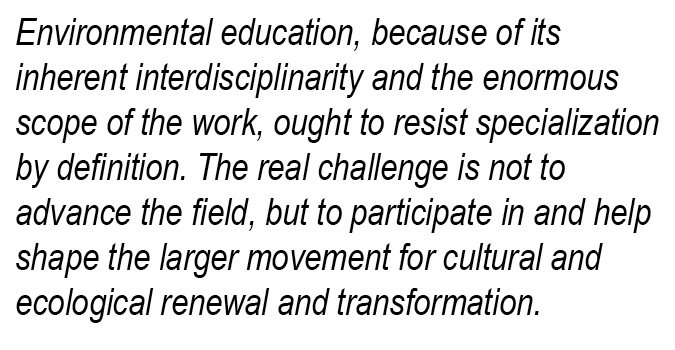
Environmental education, because of its inherent interdisciplinarity and the enormous scope of the work, ought to resist specialization by definition. The real challenge is not to advance the field, but to participate in and help shape the larger movement for cultural and ecological renewal and transformation. As Paul Hawken (2007) tells it in his book Blessed Unrest, the larger movement is huge. It is made up of diverse networks of organizations and individuals working for peace, social justice, ecological sustainability, and Indigenous and civil rights. Each of these related ideals is threatened by the same empire. Political and conceptual power capable of resisting and shaping empire can be found in the intersectionality of the larger movement. This power is also found in the arts, the soul of all social movements.
Mary Oliver’s (2008) “Of the Empire”:
We will be known as the culture that feared death and adored power, that tried to vanquish insecurity for the few and cared little for the penury of the many. We will be known as a culture that taught and rewarded the amassing of things, that spoke little if at all about the quality of life for people (other people), for dogs, for rivers. All the world, in our eyes, they will say, was a commodity. And they will say that this structure was held together politically, which it was, and they will say also that our politics was no more than an apparatus to accommodate the feelings of the heart, and that the heart, in those days, was small, and hard, and full of meanness. (p.46)
Let’s face it: environmental education is a pedagogical David to the Goliath of empire with its schools, bombs, patriarchy, and shopping opportunities everywhere. The way the U.S. national budget is prioritized is symptomatic: trillions for horrific wars; nothing for the environment within the Department of Education. Even if the United State’s No Child Left Inside Act of 2009 eventually passes, and the environment is finally noted by the Department of Education 40 years after Earth Day, it and its budget will be subsumed under No Child Left Behind, which is the climax of neoliberal education reform aligned with the politics of empire. This is not conspiracy theory or even critical theory, but the explicit expression of educational purpose from policymakers and leaders from local, state, and federal levels. No Child Left Inside is a remarkable example of grass-roots political activism in support of environmental education. May we please open a window and listen to the teachers? But obviously, the thrust of formal education in the industrial/capitalist state is aligned with the politics of empire.
 Today in wartime, these politics constantly promote the expectation of “economic recovery,” and the recovery of “consumer confidence.” We might wonder what it means. Consumer confidence? Recovery back to what? The prevailing fiction of limitless growth, that logical impossibility that Edward Abby called “the ideology of the cancer cell”? Recovery back to what? An unjust colonial order? An economically exploitative and ecologically destructive culture of hyper-consumption, speculation, and debt? Today in wartime, few educators, environmental or otherwise, are questioning the profoundly pedagogical impact of empire: economic growth for the class economy, military adventurism for false security, and the erosion and commodification of the cultural and ecological commons. The most insidious effect of empire, however, may be that it functions to conceal from thought the very idea that any of this is problematic. These are the politics from which no child is left behind, and to which environmental education research must attend.
Memory and Reinhabitation
A writer and lover of beauty, my grandmother suffered from Alzheimer’s the last decade of her long life. She was the matriarch of a large family, a first generation immigrant who loved America, and the American flag, for the real opportunities it represented for freedom from poverty and oppression that my ancestors fled in Eastern Europe. I remember the last time I saw her before she was placed into full-time care. I took her for a short canoe ride on a lake in northern Wisconsin. She crawled into the bow seat; I paddled from the stern. I had never paddled so intentionally, every stroke deliberate and smooth. Once out on the water, she leaned over the gunwale and let her hand dip below the glassy surface. “Soft,” she said, “it’s so soft.”
The last time I saw her before the funeral was at the nursing home in Milwaukee. The attendant who wheeled her into the common room told her, “Your grandson is here to visit with you, Liz,” and then she parked the wheelchair next to me and left us alone. I was scared. Would she know me? Was it a good day or a bad day? So, I started talking about the weather, the season, what was going on. I said: “Nonny, guess what. I moved to the country.” Instantly, as if from far away, she came back: “Smart,” she said, “smart.”
Then she must have remembered I was a teacher. She loved education, read all the time, left school after eighth grade. “You’re teaching,” she said, half statement, half question. I answered, “Yes, I’m a professor now.” Unimpressed, she asked me what I was teaching, and glibly I told her, “Well, I’m trying to help tear down the system.” Her eyes got real squinty then, and they widened and cleared as she looked up at me with the firm authority of elderhood, “You mean build it up!” She was insistent, and that was the end of that.
Most days my grandmother didn’t know her own name, her children or grandchildren’s faces, the season, the current president (she often spoke of Lincoln), or how long ago her husband had passed (it had been 30 years). But at the mere mention of tearing something down, the response from my grandmother was immediate. “Sonny,” she said, “you need to build it up.”
Today I honor my grandmother’s wisdom. She came of age during the Depression. She stretched a meager budget for food for seven children. “Sonny,” she said, “you need to build it up.”
Building things up and tearing things down—this apparent dichotomy presents another opportunity to hold and balance paradox. I’ve described nature and empire as two poles of a paradox that reflect the expansive landscape of environmental education, the linked cultural and ecological contexts of our work. I want to offer another paradox that holds together the big aims of environmental education, and that also points to pathways for pedagogy and curriculum. The paradox is between decolonization and reinhabitation, between tearing things down, and building things up.
 I propose considering “decolonization” and “reinhabitation” as twin goals for education in a culture of empire. It should be said that these goals parallel other aims of educational research and practice; naming them is an effort to make inclusive space for those interested in environment and culture, nature, and empire. Like other synonymous terms, decolonization signals a strong critique of cultural practices and their underlying assumptions. The significance of decolonization as a theoretical category is that its usage specifically problematizes the colonization of people and land, both as historical practice and as the political progenitor of today’s empire. Of course critique alone is insufficient theory for environmental education research, and thus the pairing of decolonization with the vision of reinhabitation. It is the tension of paradox between decolonization and reinhabitation that gives both terms their conceptual range. Though for the sake of theory-building the two terms are called out as distinct, reinhabitation and decolonization are two dimensions of the same task. Renewal often requires that something is undone. In California, Van Jones expressed this clearly with his program, “Green Jobs, Not Jails.” Nature, empire, paradox.
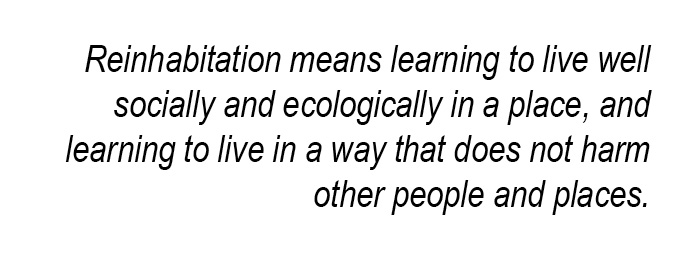
Decolonization involves learning to recognize disruption and injury in person-place relationships, and learning to address their causes. Because colonization refers also to the colonization of the mind and body, it involves the practice of unlearning and undoing. Reinhabitation involves maintaining, restoring, and creating ways of living that are more in tune with the ecological limits of a place, practices that are less dependent on a globalized consumer culture that values profits and conveniences more than people and places. Reinhabitation means learning to live well socially and ecologically in a place, and learning to live in a way that does not harm other people and places (Gruenewald, 2003).1 These are big aims, but there is more. Reinhabitation also implies taking a new stance toward one’s own becoming. We reinhabit the self whenever we seek our own renewal, when we stop to listen to the teachers, or when we acknowledge the heartbeat of empire in our own bodies:
they will say also that our politics was no more than an apparatus to accommodate the feelings of the heart, and that the heart, in those days, was small, and hard, and full of meanness. (Oliver, 2008, p.46)
Because decolonization emphasizes human relationship to land, Indigenous perspectives on inhabitation are vital, as are the perspectives of other displaced and minoritized groups. Acknowledging Indigenous inhabitation is not only to recognize place-based relations to nature, but also to remember the long story of colonization, resistance, and the rights of sovereignty. Indigenous cultures are not the only cultures that have histories that need to be remembered; many minority traditions tell sacred stories of land, displacement, and struggle. Even mainstream white America incubates movements for resistance and change. The voices of poets, artists, activists, and others working for peace, social justice, Indigenous and civil rights, and for environmental justice and ecological sustainability—these voices are a worldwide movement standing up to empire. Whatever success this unnamed movement will have building things up and will depend not merely on critique and vision, not merely on developing communities of congruence and resistance. Perhaps building things up will depend mainly on changes in consciousness that open the heart, reinhabitations that slow us down so that we can recognize the intersectionality of our interests, how each of us is implicated in the other.
Listen to the teachers, confront empire. I want to build now toward naming a course of action for the field. While we might celebrate No Child Left Inside and the growth of green, decolonization means that we dig deeper: that we acknowledge genocide, racism, and patriarchy, past and present; that we acknowledge the class and caste systems that our contented consumption supports; and that we face up to our militarized culture of violence, repression, and war. Decolonization and reinhabitation mean untangling the roots of empire and building something up, a process that begins with ourselves, reaches outward, and never ends. Every act is important and not without consequence; collectively all of our actions create all of our contexts. Our numbers are many.
Our numbers, in fact, and our impacts, are extreme. Chris Jordan is a photographer who creates images that communicate the otherwise ineffable scale of our culture of mass consumption (see all the following images at http://www.chrisjordon.com). What is indistinguishable from a distance is revealed on closer scrutiny. “Gyre” (2009) depicts 2.4 million pieces of plastic, equal to the estimated number of pounds of plastic pollution that enter the world’s oceans every hour. All of the plastic in this image was collected from the Pacific Ocean. “Shark Teeth” (2009) depicts 270,000 fossilized shark teeth, equal to the estimated number of sharks of all species killed around the world every day for their fins. Jordan’s art also magnifies the social and psychological impacts of empire: “Ben Franklin” (2007) depicts 125,000 one-hundred dollar bills ($12.5 million), the amount our government spent every hour on the war in Iraq during 2007; “Constitution” (2008) depicts 83,000 Abu Ghraib prisoner photographs, equal to the number of people who have been arrested and held at US-run detention facilities with no trial or other due process of law, during the Bush Administration’s war on terror; “Barbie Dolls” (2008) depicts 32,000 Barbies, equal to the number of elective breast augmentation surgeries performed monthly in the US in 2006. The commodification of life under empire reeks of plastic, petroleum, patriarchy.
Paradoxically, the demand for Jordan’s work is high: people are drawn to the terrible truth of his poetry. Of all of Jordan’s (2009) work, his “E. Pluribus Unum,” or “the many become one,” best represents to me future directions for environmental educational research. From a distance, this image reminds me of the stories of the land told in tree rings. Complexity and beauty are revealed in proximity. This large scale mandala (the indoor wall hanging measures 45 by 45 feet) depicts the names of one million organizations around the world that are devoted to peace, environmental stewardship, social justice, and the continuation of diverse and indigenous cultures. The actual number of such organizations is unknown, but Paul Hawken’s (2007) “Blessed Unrest” project estimates the number at somewhere between one and two million, and growing. If the lines in this piece were straightened out, they would make an unbroken line of names, in a ten point font, twenty seven miles long.
 What I’m suggesting is that if part of the work of environmental education is to decolonize and reinhabit empire, then we must better recognize the intersectionality of our interests with the interests of others, even or especially those whose ecological consciousness may be diminished by the ravages of empire. Green jobs, not jails. Environmental educators who can hold the paradox between nature and empire can expand the landscape of the field while enhancing the reach and impact of environmental education. In all intersectional social movements there are opportunities to acknowledge and resist the power of empire, to remember and reinhabit colonized land and colonized places, to remember their stories, and to listen for the wisdom of the teachers. We need an intersectional approach because our work is already braided in its resistance to and reconfiguration of empire, and moreover, to discount the struggles of others is to cut ourselves off from the principle of interrelationship; and to discount the struggle of others is to enact the logic of empire.
The intersectional movement that environmental education needs has been gathering: social ecology, environmental justice, ecofeminsim, ecojustice, eco-pedagogy, ecopsychology, critical geography, Indigenous ways of knowing, place-based education, peace education, humane education, sustainability education, disability studies, transformative education, Transition Towns, Wendell Berry, Jane Goodall, the Earth Charter. The shared theme of intersectional movements is their responsiveness to both nature and empire. Their movement energy is the vanguard of educational theory and practice.
The politics of empire do not change unless they are resisted by growing social movements: locally, nationally, globally. Democrats in Washington are obviously not enough. President Obama is not enough. Even if he wanted a strong climate agreement, for example, or to remove the salmon killing dams on the Snake River, or to provide affordable universal health care, or to end war–he can’t get it done, because his work is governed by the logic of empire.
History shows us that through partnership, solidarity, and persistence, social groups grow wiser and stronger in their ability to transform this logic, and to reinhabit our colonized places and lives. In the age of empire, the field of environmental education can itself become a kind of E. Pluribus Unum that invites and creates intersectional theory and action.
But—as important as it is to politicize our work and to ally the field with kindred social movements, we must remember the teachers. We need to learn how to stop, slow, and invoke their sacred presences. We need to learn how to privilege the teachers—other species, their languages, “owl in the black morning”—as full partners in E. Pluribus Unum. Nature, habitat, ecosystem, species, climate—this is not a political group; it is the context that makes all politics possible. There is a power greater than political power, and a strength greater than intellectual muscle. We know it as the experience of being alive, and being connected to others. The challenge is to hold this power and develop this strength as we participate in the larger struggle for peace, social justice, Indigenous and civil rights, and ecological well being.
Because a culture of perpetual war undermines the growth of any environmental ethic, I want to close with a poem by Judyth Hill (2002, p.4) called “Wage Peace.”
“Wage Peace”
Wage peace with your breath. Breathe in firemen and rubble,
breathe out whole buildings and flocks of red wing blackbirds.
Breathe in terrorists and breathe out sleeping children and freshly mown fields.
Breathe in confusion and breathe out maple trees. Breathe in the fallen and breathe out lifelong friendships intact.
Wage peace with your listening: hearing sirens, pray loud. Remember your tools: flower seeds, clothespins, clean rivers.
Make soup. Play music, learn the words for “thank you” in three languages.
Learn to knit, and make a hat. Think of chaos as dancing raspberries,
imagine grief as the outbreath of beauty or the gesture of fish.
Swim for the other side. Wage peace.
Never has the world seemed so fresh and precious. Have a cup of tea and rejoice.
Act as if armistice has already arrived. Celebrate today.
Notes
Participation in the money economy makes it difficult to know how one’s consumption is impacting other people and places. The point is that to practice reinhabiting place, one must become more aware of how one’s actions have impacts “all over the place” now and in the future—and—one must begin to act ethically on that knowledge.
Acknowledgements
This paper was the concluding plenary address at the North American Association of Environmental Education (NAAEE) Annual Conference Research Symposium in Portland, Oregon, USA, October, 2009.
Excerpt from “hieroglyphic stairway” by Drew Dellinger. Copyright © 2006 by Drew Dellinger. Used by permission of the poet. www.drewdellinger.org
Excerpt from “The Summer Day” by Mary Oliver. Copyright © 1992 by Mary Oliver. Used by permission of the poet.
“The Teachers” and “Of the Empire” by Mary Oliver. Copyright © 2008 by Mary Oliver. Used by permission of the poet.
“Wage Peace” by Judyth Hill. Copyright © 2002 by Judyth Hill. Used by permission of the poet.
David A. Greenwood is Associate Professor and Canada Research Chair in Environmental Education in the Faculty of Education of Lakehead University in Thunder Bay, Canada. His teaching, research, and community work revolve around place-based, environmental and sustainability education. Widely published in these areas, David recently guest edited with Marcia McKenzie Volume 14 of the Canadian Journal of Environmental Education (2009), and is editor with Greg Smith of the book Place-Based Education in the Global Age (Routledge, 2008). Contact: greenwooddavida@gmail.com
References
Dellinger. D. (2006, Summer). hieroglyphic stairway. YES!, 38, 47.
Fitzgerald, F. S. (1936/2008). The crack up. Esquire. Retrieved from http://www.esquire.com/features/the-crack-up Foucault, M. (1977). Discipline and punish: The birth of the prison. New York: Vintage Books.
Gruenewald, D. (2003). The best of both worlds: A critical pedagogy of place. Educational Researcher, 32(4), 3-12.
Hawken, P. (2007). Blessed unrest. New York: Viking. Hill, J. (2002). Wage peace. In M. Adams (Ed.), Singing this great body back together:
In remembrance of September 11, 2002 (p. 4). Columbine Hills, CO: Baculite Publishing.
Jensen, D. (2009, May/June). The world at gunpoint. Orion. Retrieved from http://www.orionmagazine.org/index.php/articles/article/4697/
Leopold, A. (1949/1968). A Sand County almanac. Oxford, United Kingdom: Oxford University Press.
Lopez, B. (2001, Autumn). The naturalist. Orion. Retrieved from http://www.orionmagazine.org/index.php/articles/article/91/
Martin, P. (1996). A WWF view of education and the role of NGOs. In J. Huckle and S. Sterling,(Eds.), Education for sustainability (pp. 40-54). London: Earthscan.
Moyers, B. (1995). The language of life: A festival of poets. New York: Doubleday. Oliver, M. (1992). New and selected poems. Boston: Beacon Press.
Oliver, M. (2008). Red bird. Boston: Beacon Press.
Payne, P. & Wattchow, B. (2009). Phenomenological deconstruction, slow pedagogy, and the corporeal turn in wild environmental/outdoor education. Canadian Journal of Environmental Education, 14, 15-32.
Pyle, R. (2001). The rise and fall of natural history: How a science grew that eclipsed direct experience. Orion, 20(4), 16-23.
Pyle, R. M. (2008). No child left inside: Nature study as a radical act. In D. Gruenewald & G. Smith, (Eds.), Place-based education in the global age: Local diversity (pp.155-172). New York: Routledge.
Quammen, D. (1998). A planet of weeds. Harper’s Magazine, October, 57-69. Said, E. (1994). Representations of the intellectual. New York: Pantheon Books.
White, R. (1995). The organic machine: The remaking of the Columbia River. New York: Hill and Wang.


 f I could imagine the best possible classroom in the world, it would be one in which each student is empowered to look out into the world, see something which catches her attention, then know what to do to find out about it. Students engaged, involved, invested, and empowered in their world. My mind’s eye expresses this dream as one of a salmon fry darting quickly into a thick growth of periphyton on a fist-sized cobble, as Maria’s eye turns up and the corner of her mouth sets its sails toward a smile. That, not checking off a cell in a table, is the moment of learning that we teach for. That tells us that all is going to work out; we’ll accomplish this unit, and be ready for the next; empowered to accomplish whatever comes down the road.
 This is a regular feature by CLEARING “master teacher” Jim Martin that explores how environmental educators can help classroom teachers get away from the pressure to teach to the standardized tests, and how teachers can gain the confidence to go into the world outside of their classrooms for a substantial piece of their curricula. See the other installments here, or search Categories for “Jim Martin.”