
by editor | Aug 13, 2018 | K-12 Classroom Resources, Place-based Education
Enlivening Students
by Gregory A. Smith
Review of Sarah Anderson’s, Bringing School to Life: Place-Based Education across the Curriculum (Lanham, Massachusetts: Rowman & Littlefield, 2017)
 or the past two decades, books and articles written by place- and community-based advocates have been largely focused on defining and justifying an alternative approach to teaching and learning grounded in local knowledge and issues with the aim of inducting children into a sense of community participation and responsibility. This literature was largely exhortatory rather than prescriptive. It did not often provide interested teachers with detailed guidelines about how to move from a broad vision to the challenge of creating and enacting curriculum and instruction not limited by either textbooks or even classrooms. These advocates asked teachers to be courageous and take risks, trusting in their capacity to experiment and learn from their failures and successes. And many teachers across the United States and elsewhere became early adopters of this approach, willing to embrace those challenges and risks. As place- and community-based education enters its third decade, however, something more is needed to make its implementation appealing and understandable to a broader group of educators. Sarah Anderson’s Bringing School to Life: Place-Based Education across the Curriculum (2017) provides exactly the kind of guidance required to accomplish this end.
Anderson is a former student of David Sobel, one of the early advocates of this approach. For the past dozen years she has embraced what she learned while studying with him first as a middle-school teacher and now as the fieldwork coordinator at the Cottonwood School of Civics and Science in Portland, Oregon. Anderson’s work is especially powerful because of her concern about citizenship education and democratic practice. Place-based educators often focus primarily on providing students with immersive experiences in nature without necessarily engaging them in the cultural understandings, conflicts, problem-solving, and negotiation that accompany life in civil society. This is not to diminish the importance of those immersive experiences—which can be central to the development of a strong environmental ethic—but in themselves not enough to give young people the confidence or savvy required to become engaged community actors. Anderson’s work exemplifies how this can happen and how schools and communities can truly “get better together.”1
Her volume provides multiple examples of lessons and units she or the teachers she works with have developed and taught. Chapters describe ways that students can use maps to learn about their place, contribute to its human and environmental health through community science, learn directly about local history, partner with nearby agencies and organizations, explore the way different subject areas can be integrated to deepen knowledge and understanding, and develop a sense of connection with and empathy for one another and people beyond the school. The three chapters about mapping, citizen science, and local history provide detailed descriptions of units interested but uncertain teachers could profit from as they begin to incorporate local possibilities into their own work with students; they will be the focus of the remainder of this review.
Maps offer not only a good way to introduce children to their own place but to think about “What is where, why there, why care?”2 They naturally lead students to observe, collect data, and make inferences. At the Cottonwood School maps are integrated into the learning experiences of children at all grade levels. Early in the school year as a welcoming activity, everyone is invited to create and share personal maps of things special to them in their bedroom, home, neighborhood, or someplace away from home. Kindergarteners through second graders then create maps of their classroom and playground, sometimes using blocks and unix cubes to illustrate a space. Third graders map the school focusing on specific features such as sound. Fourth through sixth graders create maps to scale of neighborhood features such as parks and then compare and contrast in writing the data presented in their maps. Sixth graders map nearby features of their own choosing. They walk through the South Waterfront neighborhood and record the location of things like K9 restrooms (fire hydrants), bike racks, and food carts. They then create a formal illustrated map with compass roses and borders (and sometimes sea serpents in the Willamette River) to represent what they have found. Seventh and eighth graders go further afield and focus on the city and state. Given a map of the city’s boundaries and different districts, they identify major bodies of water, traffic routes, and one personally significant place in each district. This leads into a more extensive exercise in which they choose one data set to map. Possibilities include population, temperature levels during a heat wave, city parks, or the location of Starbucks coffee shops. They are encouraged to think about who has access to which resources by comparing demographic maps that focus on race and ethnicity. Maps offer a way to synthesize disparate but related information as well as integrate a variety of subject matter.
The school’s incorporation of community science offers similar opportunities to link lessons to students’ lives and create learning experiences that allow for observation, analysis, and curricular integration. Community science involves identifying local phenomena or issues worthy of study and action and linking these topics to the Next Generation Science Standards. One year, seventh- and eighth-graders identified the problem of animal waste in the neighborhood as an issue they wanted to explore and investigate. As they ventured beyond the school for a variety of learning activities, they found nearby sidewalks both hazardous and smelly. They decided to do something about it. Their teacher divided the class into teams who performed different tasks: one counted all of the pet waste in a six-block radius, another researched the environmental toxins found in dog poop, a third team investigated Portland laws regarding the regulation of pet waste, and a fourth researched similar laws in other cities. Once students had all of this information in hand, they analyzed what they had found and brainstormed possible solutions. They then wrote letters to public officials recommending that the city provide more public education about this problem and enact bigger fines for people who violated laws already on the books. Their letters resulted in a meeting with officials in city hall, and their ideas were incorporated into a “petiquette” campaign that the city had already begun planning. Extended units like these offers students a chance to systematically explore a topic, do so in ways that allow them to see its relevance to their own lives, and then make a contribution to the broader community. Such experiences match the call by framers of the NGSS to apply scientific concepts and practices to real life circumstances.
One of Anderson’s talents lies in her capacity to find ways to make the study of history local, as well. The third grade curriculum, for example, includes a focus on Native Americans. As part of that study, students visited the Oregon Historical Society, Portland State University’s Department of Archeology, and a traditional Chinook longhouse at Ridgefield, a National Wildlife Refuge in Washington State less than an hour from the city. Returning to the school, they transformed their classroom into a longhouse with a “fire pit” in the middle of the room. They also participated in PSU’s Archeology Roadshow where after having learned about the characteristics of meaningful exhibits at the Oregon Museum of Science Industry, they created a longhouse model and became the only K-12 students to share their work at an event otherwise populated with much older presenters. The opportunity to be involved with people beyond the school at PSU or City Hall demonstrates to children that they are as much citizens as anyone else in their community, lending them both a level of confidence and a sense of responsibility too absent in the education of this country’s future adults.
Learning experiences like these are deeply engaging for students. Furthermore, they demonstrate to community members the capacity of children to make genuine contributions to their common life. Anderson’s book offers a useful and inspiring roadmap for other educators interested in realizing this vision of place-based education themselves.
NOTES:
1 Tagline for the Rural School and Community Trust, an organization that grew out of the Annenberg Rural Challenge, the first national effort in the 1990s aimed at disseminating the possibilities of place-based education.
2 In Brian Baskerville’s 2013 article, “Becoming Geographers: An Interview about Geography with Geographer Dr. Charles Gritzner (http://geography.about.com/od/historyofgeographty/fl/Becoming-Geographers.htm).
____________________________________________________________________________
 Gregory Smith is a professor emeritus of the Graduate School of Education and Counseling at Lewis & Clark College in Portland, Oregon. He has written numerous articles and books about environmental and place- and community-based education. He is a fellow of the National Education Policy Center at UC-Boulder, a member of the education advisory committee of the Teton Science Schools, and a board member of the Cottonwood School of Civics and Science.

by editor | Mar 19, 2018 | IslandWood, Learning Theory
The Compassionate Educator:
Empathy and Environmental Education
Tom Stonehocker
 common challenge in environmental education is working with students who feel disconnected from their environment. This disconnection not only impedes a student’s ability to understand how natural systems function, it also affects how they value the natural world. This is caused not necessarily from lack of education, but the lack of focus on types of learning that build social-emotional skills in students.
Environmental work is inherently about responding to the needs of a changing planet. Environmental education must also continually focus on responding to the needs of our students so that they can grow to do the same for others. The study of nature is the study of relationships, and we would be wise to include ourselves in that definition, and perhaps even more importantly, those around us.
Author and educator Joseph Cornell shares that, “Our enjoyment and appreciation of life depends on our ability to sense feelings of other creatures, escaping our self-definitions to taste the joy of self-forgetful empathy with others” (Cornell, 1998, p.33). If young people are not well practiced in putting themselves into perspectives outside of their normal selves, how can they be expected to understand and care for the natural world?
Through my own reflections and experience as a field instructor at Islandwood, “a school in the woods”, located in Washington state, I have witnessed the value of being able to take on other perspectives. By adopting new points of view, we are better able to make informed and meaningful connections with ourselves, with others, and with our environment. As educators, the opportunites we provide our students largely do not come from the knowledge we can impart, rather our ability to engage students in experiences that speak to where they are coming from in life. To teach in this way, we must be willing to step out of our own experience from time to time and into the experiences of others in our community. Fortunately, with practice and thoughtful action, empathy can be used to increase the impact of our teaching.
Beyond Egocentrism
In Coyote’s Guide to Connecting with Nature, the authors describe a progression toward empathy that begins as students learn to recognize and express their own needs. “Over time and with your encouragement, they will go beyond asserting their needs into taking responsibility for them and being proactive about them” (Young, Haas, and McGown, 2010, p. 268). This growing sense of responsibility might be observed in simple acts, like noticing a student plan ahead by bringing warm and dry clothing. It might be a student who articulates that they are uncomfortable with a certain aspect of an activity and opens a conversation to plan an alternative.
Young, et al. go on to describe how this behavior often expands into a greater awareness of others and tending to their needs as well (2010). I have witnessed this progression in my students as I see them begin to speak up for each other. Students also feel more comfortable affirming the positive attributes that their peers bring to the group, and begin to feel a sense of comradery and pride with group identity.
“This same tending sensibility will also show itself as care for the natural world -and especially one’s own native romping grounds” (Young, et al., 2010, p. 268). In watching how self-care can grow into caring for others, it’s easy to imagine this expanding beyond just people and encompassing the environment as well. Developing a sense of place begins when a person starts to have deeper familiarity with their surroundings, and ultimately begins to feel at home where they are. Feeling a sense belonging is a true testament to the number and quality of the relationships built.
Helping Students to Cultivate Empathy
An important way to help a group of students begin to see from perspectives other than their own is by helping each individual realize the interconnectedness present within a community. One way to encourage this sense of interpersonal connection is by engaging them in team-building challenges. Of course there are millions of activities that achieve this—I’ve seen wonders happen when I challenge group of ten students to transport themselves 25 feet across an expanse of “shark-infested hot lava” using only four foam seat-pads as stepping stones. They become invested in a successful outcome for the group and along the way, they discover the role that each person plays and how they can more carefully and effectively communicate with one another.
These types of play-based collaborations have helped groups of students with intense trust and interpersonal challenges to become significantly more community-minded and thoughtful of each other’s needs. Sometimes, we must recognize that there is more work than can be achieved in our time together with students, but we must not let that stop us from trying.
One of my favorite activities to facilitate with students to dive even deeper into empathy is to engage them in storytelling from the perspective of a non-human element of the natural world. Students get to create their own narrative, which could be a short story, poem, or comic about any living or nonliving component found in our place.
One memorable story came from a student who, after having trouble coming up with ideas for his story, eventually wrote a beautiful piece about a plant he had learned about earlier in the day, the Evergreen Huckleberry:
One time there was [an] Evergreen Huckleberry. People and animals came every second to take the berry. A bird comes and make a house out of you, but the evergreen huckleberry can’t do nothing. So every time it grows [berries], people or animals take it. The tree was mad…because they were eating its berry. It [wanted] revenge and a 10-year-old kid came and said, ‘Stop, we were not hurting you, we were only [taking] berries because it taste good and we take out the seeds and grow another tree. No big deal.’”
Another student wrote from the perspective of a Salal plant that lives through the challenges of each season and ultimately feels unwanted by the other members of the forest community. She wrote,
“A small blueberry tree [looked] at me and said, ‘Salal you are great just like you are. You don’t need to be bigger and we need you. We need you, like you have very [delicious] and sweet [berries] and animals need you. Look, the [deer] needs you for your [berries].’ Salal said ‘Cool, I’m special.’”
In both of these stories, students are demonstrating their understanding of ecological relationships but also have some compelling themes of personal struggle. Both stories have moments when the main character is feeling underappreciated until another member of the community shows them they are valued. People of all ages struggle with self-confidence or feeling like an outsider. These stories illustrate how students can identify threads of connection across boundaries. This helps them develop new interpretations of environmental relationships andf also interpersonal relationships.
Another strength of perspective storytelling is that it helps students to view the natural world through a creative lens, and allows them to do so on their own terms and in their preferred medium. The perspective storytelling activity I shared with my students involved writing, but perspective storytelling can be done with singing, rapping, dancing, acting, or any other interpretation. By giving them flexibility in how they complete the activity, students will be more successful in reaching the goals of connecting with place and practicing empathy.
Showing Students We Care
Environmental and outdoor education inherently provides experiences that are new and often uncomfortable for students. Some students have spent very little time outdoors, some are away from their families for the first time, and some are working with people they don’t know very well. It is a vulnerable time for many, and often students’ interpersonal and intrapersonal challenges are placed secondary to content. The best way we can teach empathy is by practicing it ourselves.
I frequently encounter students with anxiety from being away from home. It is incredibly difficult for a student to experience the wonders of nature when they are in tears and sick to their stomach from being anxious. I approach these students by thinking about where I was at 10 years old. I remember being at outdoor school being unable to sleep, staying up at night crying, and feeling so alone in my discomfort. By stepping into the shoes of my 10-year-old self, I am better able to help students feel like they are being heard and help them persist through their challenges. I acknowledge the difficulty and pain, but remind them of the ways in which I’ve watched them succeed during our time together.
Being empathetic toward students also helps us as educators be more responsive to diverse groups of students. Something as seemingly straightforward as writing in a nature journal may cause great stress for an English Language Learner or a student with different learning abilities. It’s important for us to assess how we are connecting with our students, because it ultimately affects how they will be able to connect with the natural world
Many educators feel constrained when their curricula is focused on meeting state and national achievement standards. Some may not realize that NGSS (Next Generation Science Standards) was designed to improve the equity of science education and serve diverse populations and learners (Quinn, 2015). At its core, NGSS help students explore concepts that are applicable across many different scales and subjects.
It is precisely this adaptability to a broad range of learners that demonstrates how integral empathy is in science teaching. An important tenet of NGSS is to create an environment where students feel at home and are “welcomed as full members, and invited to share their ideas and participate fully” (Quinn, 2015, p. 16). Reaching this place of comfort will happen after learning to be appropriately responsive to the needs of the students. Getting there could be as simple as providing opportunities for movement within lessons, inviting them to incorporate personal or family stories as part of the activity, or by keeping the focus on experience rather than outcome.
Making content more relevant to student lives can help concepts feel less abstract and more tangible. Kathy Liu Sun (2017) suggests incorporating guests to share their perspective and speak from experience. Hearing from voices that students can identify with helps add personal meaning and relevance. When learning is rooted in the experiences of real people and real places, students will recognize the authenticity and be more able to make connections back to themselves, their families, and their communities.
Being There
In her 2012 novel, Wonder, R.J. Palacio writes, “It’s not enough to be friendly. You have to be a friend” (p. 312). I interpret this to mean that we can treat others with kindness, but it means little if we are not working towards creating a meaningful relationship. In environmental education, we must prioritize relationship-building if we are to truly show that we care for future generations and the planet. By being present and attentive to student needs, we can help them cultivate a rich and meaningful connection to nature. By helping create these relationships, we are helping to create a future where people are fully invested in and advocate for the wellbeing of their natural and human communities.
Tom Stonehocker is a naturalist, graduate student, and field instructor who works with 4th & 5th-grade students at Islandwood, an outdoor school on Bainbridge Island, Washington.
References:
Cornell, Joseph. (1998) Sharing Nature With Children. Nevada City, CA: DAWN Publications
Palacio, R. J. (2012). Wonder. New York: Knopf
Quinn, Helen. (2015) Science and Engineering Practices for Equity. In NGSS for All (pp.7-18). Arlington, VA: NSTA
Sun, Kathy Liu. (2017) The Importance of Cultivating Empathy in STEM Education. In Science Scope. April/May. Pp. 6-8.
Young, J., Haas, E., and McGown, E. (2010) Coyote’s Guide to Connecting with Nature. Shelton, WA: OWLink Media.

by editor | Feb 27, 2018 | Indigenous Peoples & Traditional Ecological Knowledge

Tribal teachers set out to help design an integrated curriculum around the canoes of Pacific Northwest Native American tribes.
Article by Suzie Boss
Click here to view article in PDF format: Canoe Curriculum PDF

by editor | Nov 22, 2016 | Learning Theory
Understanding Ecosystems is a Real Need:
Will we help today’s kids learn what they ought to know about ecosystems?
by Jim Martin
CLEARING Writer and Contributor
 ids in school today, and their children, need to understand ecosystems, and their own place within them. And teachers need to possess the capacity to ensure this can be accomplished. A recent study published in Science, (Vol. 351, Issue 6274, 12 February 2016, pp. 664-665) indicates that US teachers are not adequately prepared to teach about global warming in any detail; nor, for many, with confidence that it is even happening, or is caused by human activities. And, how many know with confidence how local ecosystems will respond to global warming? This is, I submit, knowledge and understanding that our students need. As important as technical and engineering knowledge and understanding, which receives far more attention in our society than ecosystems.
 This is a poor state of affairs. Ecosystems aren’t simple; nor is global warming. How many teachers, or citizens for that matter, know that the Earth’s current orbital position and ‘wobble’ about its axis indicate that we should be in a long cooling, not a warming, period? How many know the length of these periods during Earth’s journey around the Sun? Or their effect on ecosystems; ecosystems which support all life on Earth. Not to mention the human population explosion, which is the driver of much of this warming process. How many teachers spend quality time each year on these topics? How many feel free to do so? They need help. And help is what we can offer them.
How can our teachers bring themselves up to date on the complexities and importance of global warming? What resources do they have available? If you were to check the New Generation Science Standards (NGSS) web site, you might be surprised. I just checked the Oregon Department of Education’s web site, and found nothing in the teacher resources section that could be used to support student learnings about ecosystems, global warming, or the human population explosion. The NGSS web site has the same paucity of resources for teachers, although they do note that some resources will be forthcoming. NGSS and the National Science Teachers Association web sites offer resources like worksheets and ties to the standards for the content the worksheets cover, but there is nothing I can find that offers teachers without strong backgrounds in science an opportunity for in-service training which will prepare them to teach ecosystems so that they are understandable. The same is true for the in-service support teachers need to attain the conceptual understandings which underlie competent teaching. We, the people who teach, or have taught, in our classrooms are the ones who will have to do this work. We need to start.
I submit that this state of affairs means the NGSS (and CCSS) need to become more expressive; to become useful, descriptive, aids that teachers can rely on to support their efforts in teaching a complex environmental curriculum. We can’t ask the federal or state education organizations to do this, but we can do it ourselves. Taking it one step at a time. Environmental educators know their sites and the science and math involved in understanding them. They may not currently discover and use the curricula which is embedded within their sites. This is where those teachers who, together, have this experience can help. Environmental educators and teachers, working together to exploit curricula which is embedded in natural environments. To learn about ecosystems. What if a few teachers and environmental educators got together to talk about how they could work together to use a study of ecosystems as a vehicle to drive curriculum in other content areas? A conversation in which they cover broad topics students would need to work with in order to learn about ecosystems, coupled with conversation about particulars of other content areas that could be integrated into the study of ecosystems.
 For instance, while studying a forest ecosystem, students at any grade level could count the number of each species of tree they find. Then, depending on their math capacity, they could draw a representative of each of the tree species, with the size of each kind based on its population count. They can add the numbers counted to get the total trees counted. They could subtract the number of the first species from the total; then the second, and on to the last. What is left? They can develop fractions and do the division built into a fraction’s structure, to calculate the decimal fraction which says the same thing. They could multiply each divided fraction by one hundred to calculate the percent that kind of tree is of the whole. They could use the counted numbers of trees, their total and the number of each species, in an equation to calculate species diversity. That’s just a smattering of the math curricula embedded in one activity in a natural area. And the concomitant standards embedded there along with them. How do teachers take these pieces of math to a larger mosaic which enables students to attain the conceptual understandings which prepare them to deal with global warming and ecosystems? What can you imagine for all of the other content areas taught in your schools? What we teach is in and of the real world, that place outside the classroom. Can we use it to learn?
Would you be interested in engaging a substantive conversation about how environmental educators and teachers can work together to do a better job of teaching mandated curricula while building students’ knowledge and understandings of ecosystems? If you’d like to contribute to a conversation on this theme, you might write an article for Clearing, write a comment in the space below, start a conversation where you are, or decide to try this yourself. If teachers know environmental educators, or environmental educators know teachers, you can present the concept at environmental education and teacher annual conferences. For myself, I’ll continue to write on this theme. And contact my regional environmental and teacher organizations to suggest it. We all need to do something. The kids need that.
Jim and Dryas Martin 604 E. 28th St. Vancouver, WA 98663 berrywd@teleport.com home.teleport.com/~berrywd/index.htm
 This is a regular feature by CLEARING “master teacher” Jim Martin that explores how environmental educators can help classroom teachers get away from the pressure to teach to the standardized tests, and how teachers can gain the confidence to go into the world outside of their classrooms for a substantial piece of their curricula. See the other installments here, or search Categories for “Jim Martin.”

by editor | Feb 22, 2016 | Outdoor education and Outdoor School
From Chattermarks
The Transformative Power of Wilderness Education
A graduate student finds an understanding of the effect of wilderness on the development of young people’s sense of self-worth
by Rory Crowley
 n July 7th, 2001 I lie huddled in my sleeping bag, shivering as I survey the cloud of water vapor that floats above my head. It’s 2:00 am and sleep is distant; I realize that I am unprepared for my first solo backpack. I’ve brought a waif of a summer sleeping bag into the high-country, and as snow covers my lonely two-man tent and the ground steals away the heat, I shiver. The Nalgene bottle under my knees is cold; I pull it out, undo the top and gulp the cool water. I open the tent door and pour the rest of the water into my camp stove. I am boiling water for the fourth time tonight; I watch the blue flame in anticipation. I need a warm water bottle under my knees to keep the night bearable.
“What am I doing here?” I say to myself, echoing what I’ve been thinking all night. I have come to Cathedral Provincial Park to test myself but I have also come in search of wildness, to find something that a city cannot supply. I just don’t know what I seek.
The simplicity of wilderness travel attracted me to strap on the hiking boots for that solo and embark on a career in environmental education. Carrying everything I need to survive a week, and leaving behind the overabundance of technology and distraction. Wilderness travel requires simplicity because of the load limits of the human body. Furthermore, wilderness travel resigns the distractions of the modern world to the subconscious. Gary Snyder eloquently warns people who seek the wild that
“Wilderness can be a ferocious teacher, rapidly stripping down the inexperienced or the careless. It is easy to make a mistake that will bring one to an extremity. Practically speaking, appropriate boldness, good humor, gratitude, unstinting work and play, and lots of walking brings us close to the actually existing world and its wholeness.” (Snyder 1990, 23).
During my first solo I was searching for my self-definition as an adult. Self-definition — ”defining, or interpreting ourselves to others, so that people in our social environment have a clearer understanding of who we are”— is a constant evaluation to see if our actions reflect our values (Williams et al. 1989, 170). I wanted to exhibit the “Mountain Man” persona as a symbol of my personal values. But there is also a cultural aspect; this self-image is desirable because the natural wonders of the wilderness are symbols spiritually and aesthetically unique to my Euro American culture. I came to Cathedral Provincial Park with a very anthropogenic goal. Unfortunately, like me at twenty-one, many “weekend warriors” do not go beyond the personal benefits of wilderness — views, peaks, the workout — disregarding their interconnections to the natural world. Learning is facilitated in wilderness when “the learning is necessary to solve basic problems of comfort and even survival” (Miles, 1987, 7). However, wilderness education needs to be sure to go “beyond the simple act of holding classes in the great outdoors” and embrace the experience and personal growth possibilities (Grumbine, 1999, 125).
www.evergreenescapes.com
Much of my summer (2004) was spent in the backcountry in North Cascades National Park. I was at the halfway point of a graduate program jointly administered by Huxley College of the Environment at Western Washington University and North Cascades Institute. The Master’s of environmental education is centered on place-based education, leadership and non-profit administration gave me the opportunity to teach in the backcountry while fulfilling course requirements.
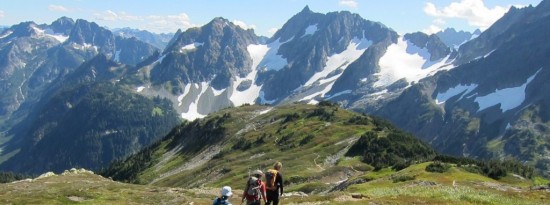
During a 6-night canoe camp, my co-leader and I took a group of participants, aged 14-16, up a difficult hike to the top of Desolation Peak and a fire lookout. Rob, the oldest and most experienced participant who had attended two previous camps, set out to try and summit Desolation, a peak that his earlier instructors had never attempted with their groups. After ten minutes of strenuous hiking Rob sat down for a drink of water. Gasping he said, “I am never hiking that fast again, it sucked.” At this point I thought to myself, “okay, I guess we won’t make it to the top, but we’ll make a day hike out of it.” I was wrong. As the group quickly started leaving Rob behind, I sent Rob’s best friend in the camp, Stan, back to hike with him. Stan talked Rob all the way to the top, reaching the lookout just thirty minutes after the rest of the group. The weary hikers were greeted by a fire raging in the distance, the lookout making her daily observations, a helicopter flying through the smoke, and the ghost of past lookouts.
 About a month after the trip I received an e-mail from Rob’s father. Rob was doing really great in alternative school this year, especially in English class. Our lessons during the hike had centered on Jack Kerouac, who spent the summer of 1956 as Desolations Peak’s fire lookout. Our lessons, combined with the accomplishment of reaching the summit had convinced Rob to read both Desolation Angels and Dharma Bums. Most importantly, he had started writing. Although Rob said he hated hiking at the time, I am happy to hear that after some reflection he has incorporated some positives from the day into his daily life.
Rob was receptive to coming to the wilderness and striving towards self-improvement. His actions exemplified this commitment. The wilderness of Ross Lake differs from Rob’s daily hectic life in urban America. Contrast and attunement during time in the wilderness humbled and empowered Rob.
With increased visitation to wilderness areas as population grows, stress on our protected areas increases. As a result, programs that do not depend on the pristine wilderness should take place elsewhere. But if the program depends on the healing and restorative powers of wilderness the activity will be inferior elsewhere. In my opinion, Rob likely would not have received the same personal benefits if the canoe camp was on a local lake and the hike was on a less significant peak near his home.
During the summer of 2004 I also began to explore what it means to be a mentor and a facilitator. I tried to make the experiences I led as valuable as possible, exposing youth to wilderness’s restorative capabilities, while modeling positive behavior in the backcountry. Although a recent resident of the North Cascades, I have further sought to exhibit the qualities Barry Lopez suggests in his essay “American Geographies,”
It resides with men and women more or less sworn to a place, who abide there, who have a feel for the soil and history, for the turn of the leaves and night sounds. Often they are glad to take the outlanders in tow… they are nearly flawless in the respect for these places they love. Their knowledge is intimate rather than encyclopedic, human but not necessarily scholarly, it rings with concrete detail of experience. (Lopez, 1998, 132-133).
It was in this vein that I set out on successive hikes up Sourdough Mountain with participants from the Washington Conservation Corps.
“What are you doing Cait?” I yelled as I looked back to see Cait walking backwards down the trail. Cait, a member of the Washington Conservation Corps, was close to finishing a long day-hike to Sourdough Mountain lookout which included a talk with Northwest poet and fire lookout Tim McNulty.
“It feels like needles are poking into my toes! Like a thousand needles!” she shouted over her shoulder as she limped down the trail to catch up with the waiting group. “My stupid boots are cutting into my toes. Walking backwards makes it feel better.”
“What’s wrong? Do you want me to check for blisters?” I probed. We were still at least an hour from the trailhead.
“No, let’s just get down,” she said, tears swelling in her red eyes. “How long until we get down?”
“Ah… thirty-forty minutes…if you walk facing forward” I fibbed. We continued down the trail from Sourdough, one of the steepest and hardest hikes in North Cascades National Park, but also one of the most rewarding. From the fire lookout you can see six different river drainages; Ross, Ruby, Thunder, Stetattle, Big Beaver and the lower Skagit. We had an amazing day in the high country: blue skies, mountain flowers, views, poetry and writing advice. An hour and a half later we reached the vehicles and Cait immediately stripped off her dust-covered boots. Her toes were red, raw and inflamed but with no noticeable blisters. Her boots must really be terrible. Now in sandals, Cait soothed her toes in the cool river before we got into the trucks to go back to camp. Her feet will be fine tomorrow.
Back at camp I noticed that Cait was not at dinner. After climbing over 5,000 feet in five miles I expected everyone to be devouring their food. I tracked her down walking back from a payphone, her eyes red and swollen. She had phoned her boyfriend because she could not wait to tell her partner about her amazing day; so amazing she could not wait another minute to share it with him. As an aspiring writer, Cait met one of her idols and it has had a profound impact on her. It was at that point that I realized I had facilitated a day that Cait would remember for a long time. Cait’s amazing day can be summarized as experiential wilderness education.
Cait saw the hike up Sourdough was a once in a lifetime opportunity. Author Tim McNulty was in the lookout crafting his work. While at the lookout she observed his everyday tasks of a lookout. Cait understood the purpose of a writer spending time in seclusion and wilderness. Tim gave her advice of different techniques to make her writing better.
Since our hike Cait has had the opportunity to independently write and apply what she had learned. In a chance meeting she indicated her writing had never been better and that the advise from Sourdough was very helpful.
Cait and Rob exemplify the amazing metaphoric benefits to wilderness education. They have been able to apply the positives from the wilderness to their everyday lives. My time as wilderness educator has also been metaphoric for me as a leader. I knew wilderness could impact someone in a positive way, but I needed to actually witness a transformative experience to fully believe in the benefits of wilderness education.
Learning and teaching during my time working with North Cascades Institute causes me to reflect on my time huddled in my cold sleeping bag in the Wilderness of Cathedral Provincial Park. I was grasping for a connection to nature. The myth of the “Mountain Man” brought me to the wilderness, but the effect has been something deeper. For me wilderness has become a metaphor of a deeper connection to the land, a source of inspiration and, most importantly, a positive influence on me as a member of society, a citizen and a resident of the earth.
References
Grumbine, E.R., “Going to Basho’s Pine” ISLE, 6(2), 1990.
Krumpe, E.E., “Managing Wilderness for Education and Development.” Preparing to Manage Wilderness in the 21st Century, U.S. Forest Service, 1990.
Lopez, B.H., “The American Geographies” Barry Lopez: About This Life, Toronto: Random House, 1998.
Miles, J.C., “Wilderness as a Learning Place.” The Journal of Environmental Education, 18(2), 1986-1987.
Miles, J.C., “Wilderness as Healing Place.” The Journal of Experiential Education, 10(3), 1987.
Snyder, G., “The Etiquette of Freedom.” The Practice of the Wild, San Francisco: North point Press, 1990
Spray, R.H. & Weingert, P.D., “The Wilderness Environment: Training Wilderness Managers.” Wilderness Benchmark 1988, U,S, Forest Service, 1989.
Williams, D.R. et. al., “The Role of Wilderness in Human Development.” Wilderness Benchmark 1988, U.S. Forest Service, 1989.
Rory Crowley was a Graduate Student with Huxley College of the Environment at Western Washington University and the North Cascades Institute. Funding was provided by the Skagit Environment Endowment Fund who support conservation, stewardship and education in an around the Washington and British Columbia’s Skagit Watershed.


