by editor | May 4, 2013 | Learning Theory
Teaching how to involve and invest students in their education and empower them as persons isn’t a passive set of knowledge, skills, and understandings. Rather, it is an active, dynamic process, not as easy to teach, at least within the current education paradigm.
by Jim Martin
CLEARING Associate Editor
 hat is school? Everyone has a picture of what it is, and the majority will probably include kids sitting in desks, learning, taking tests, and doing homework. The things I just expect students to do – listen to the teacher, take good notes, ask questions, complete homework, memorize material for tests, pass tests with good scores – are part of teaching and learning, but not all of it; not the most important part. The most important part is our students’ involvement and investment in their education, and empowerment in their lives; these are what school actually is. This part of school isn’t taught in pre-service courses, even though it’s the source of developing their responsibility for learning, and determines the quality of what graduates at the end of high school. Students’ responsibility for directing their education is the part we don’t learn about because, I believe, the publishers’ pre-packaged products make it too easy to skip this vital part of learning for understanding. Teaching how to involve and invest students in their education and empower them as persons isn’t a passive set of knowledge, skills, and understandings. Rather, it is an active, dynamic process, not as easy to teach, at least within the current education paradigm. (more…)
by editor | Apr 18, 2013 | K-12 Classroom Resources
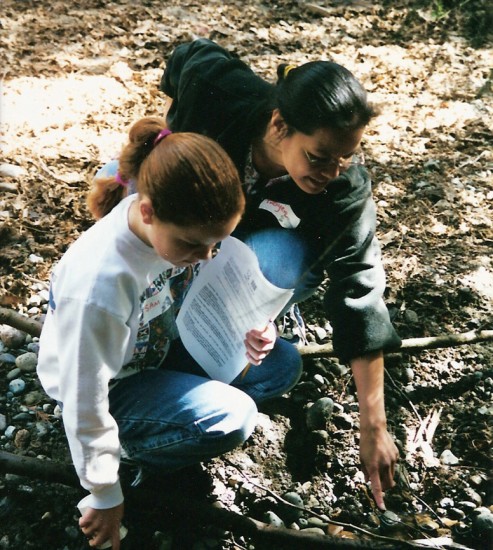
The following activities were submitted by K-12 teachers from around the Pacific Northwest who have participated in watershed education programs in their classrooms. The majority of these teachers were involved in the following coordinated watershed education programs: the Yakima Basin Environmental Education Program, the Bainridge Island Watershed Watch Program, the Nisqually River Education Project, the Budd/Deschutes Project GREEN, and the Lower Hood Canal Watershed Education Network. Each activity lists the teacher’s name and school. Activities were compiled by Karen Clark.
Grades K-2:
Science and Math: Butterfly Math
Social Studies: My Personal Symbol
Language Arts: Pond Journal
Fine Art: Wetland Animal Hats
Grades 3-5
Science: How Do Other Animals Deal with Garbage?
Science: Salmon Life Cycle
Science: Is Trash Really for the Birds?
Social Studies: Cultural Taboos
Language Arts: Pen Pals
Fine Arts: Salmon Mobile
Grades 6-8
Science: What Does Acid Rain Do to Aquatic Animals?
Science: Nature’s Scavenger Hunt
Social Studies: Clean a Stream
Fine Arts/Science: Shape a Watershed
Grades 9-12
Science: Mapping a Watershed
Science: Stepping Into Others’ Shoes
Science: Piecing Together Your Watershed
Social Studies: Regulatory Agencies
Social Studies: Selecting an Issue to Address
Language Arts: My Life’s Journey
Language Arts: Observation
Language Arts/Fine Arts: Collage
by editor | Apr 11, 2013 | Environmental Literacy, Forest Education, Learning Theory, Outdoor education and Outdoor School

…at Starker Forests
Helping students climb the ladder to responsible citizenship
by Dick Powell
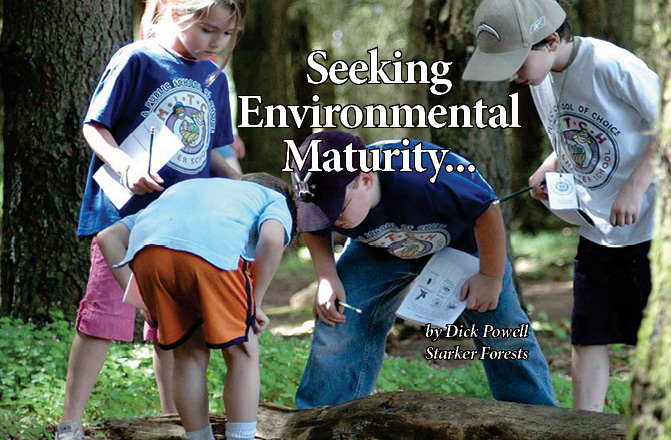
This past summer I attended the World Forestry Center’s International Educator’s Institute (IEI). As an environmental educator without any formal pedagogical or interpretive training, I found this week-long workshop enlightening and very worthwhile.
The part of IEI that I found most useful was called the “Pedagogic Steps in Environmental Maturity.” It validated what we’ve been doing.
Read the article here. (From the 2012 CLEARING Compendium).

by editor | Mar 29, 2013 | Environmental Literacy

- Photo credit: Sarah Sullivan, Abernethy School, Portland
by Jim Martin
Clearing Associate Editor
 he last time we met, students had planted seeds in parts of a garden plot they chose. So, where do they go now? They’ve made their decisions about where to plant each of their seeds. As the seeds sprout and grow, are there opportunities for them to engage in self-directed inquiries? Can they ask questions, like, “What would happen if ___?” followed by a perturbation they choose to introduce. Some possibilities that come to mind are things like sun flecks (the moving patches of sunlight in forested areas), watering schedules, companion plants, fertilizers and vitamins, pruning, hours of sunlight (photoperiod). What effect do these perturbations have on plants’ optimal growth? Kids have great imaginations, and I’m sure some of their perturbations would be more interesting than those I’ve mentioned. Doing this kind of work suggests that we are seriously entering the Experimental dimension of science inquiry. This is where you lose a little control over what students think and do, but not over how they go about their work. (more…)

by editor | Mar 4, 2013 | Environmental Literacy
When you make the finding yourself – even if you’re the last person on Earth to see the light – you’ll never forget it.
-Carl Sagan
by Jim Martin
Science Educator and
CLEARING guest writer
 oing out into the world beyond the classroom for science and other curricula can be confusing. I clearly remember the first time I took students out to make observations. In the classroom, we had lined up all the conifers together, deciduous species together, and animals in neat little boxes. It all made sense to me. Little did I know! When we went into the real world, there was no sense of order my students could perceive. I saw that my first job was to help organize what seemed to be disorder. We did a transect, and the observations they made along its length brought the underlying order in any ecosystem within reach. And the difference between the ecology in the publishers’ materials and in an actual ecosystem opened my eyes to why we need to begin our science studies with actual hands-on inquiry, both as a pragmatic necessity, and as being a closer fit to how our brain learns for understanding, than the lessons and activities in the published materials I was using. It’s also the way scientists work; inquire of nature to answer a question, communicate findings, and inquire some more.
Let’s look at a project in a schoolyard. A teacher began one with a garden plot, and had her students plant seeds in a plot on the school grounds. During the year, they would make observations on changes they observed. She had a friend who works for the county environmental services agency, talked with her, and they jointly decided to complement the garden plot with a study of a restoration site where the teacher and her students would determine where to plant, plant, monitor, and compare.
(more…)
