by editor | Sep 15, 2025 | Adventure Learning, Conservation & Sustainability, Critical Thinking, Data Collection, Environmental Literacy, Experiential Learning, Forest Education, Homeschool, Inquiry, Outdoor education and Outdoor School, Place-based Education, Questioning strategies, STEM, Teaching Science
A Natural Fit: Homeschooling and the Establishment of a Research Forest
by Jess Lambright
For those open to an alternative educational path, a classroom with no walls or desks but instead trees, meadows, and streams, offers abundant opportunities for scientific exploration. My journey in outdoor education started by home-educating my own children, but soon expanded to include other students and families. Although making everyday a field day comes with certain challenges—such as very wet, cold winter days—it has also shown me how adaptable young people are, and how many spontaneous and fascinating learning opportunities present themselves when you commit to regular immersion in the natural world.
I have come to appreciate the vast range of possibilities in which students can acquire knowledge. While some homeschooling families follow packaged curriculum closely and monitor carefully to make sure their children meet state standards each year, others chose a less structured approach called unschooling, rooted in a deep trust for kids’ natural tendency and ability to learn. This philosophy can free a motivated young person to dive deeply into an ocean of learning powered by autonomy, inspiration, and infinite possibilities.
Connecting to place and stewardship of land
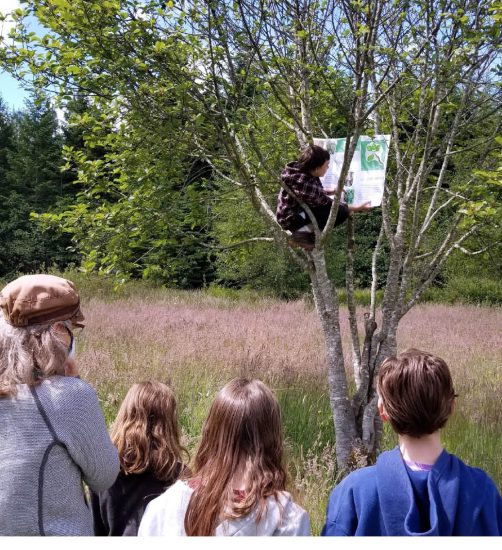
A multi-disciplinary unit study called My Tree and Me, where each student was connected with a specific tree which they measured (diameter, height, age) conducted secondary research about the species, wrote poetry, and created art with materials from the tree. One student decided to give his final poster presentation from the branches of the Cascara tree he had spent so many hours with.
The first outdoor program I hosted involved an established group of kids spending an entire day outdoors, once per week, for over four years. Week after week and year after year we returned to the same 40-acre woods from the first days of fall through the start of summer. It was common for our group to wander through the forest, without a destination or agenda, letting our innate curiosity lead the way. Wandering freely, with open eyes, allowed us to get in touch with what excited us and created opportunities for true discovery (Young et al., 2010, 56).
It filled me with satisfaction to watch the deep connection to place that developed over time in each of us. Monuments and landmarks, like a circle of giant old moss-covered stumps towards the southwest corner of the forest, acquired names and memories and provided comfort and familiarity when they were encountered. We would experience the wet meadow as a place that requires rubber boots to traverse in the wet months, a beautiful explosion of white flowers and soft grasses that dance in the wind in the summer, and a sea of delicate purple camas flowers in the spring. One year we returned to the same sit spots week after week, recording changes in our journals as spring brought all the growing things to life.
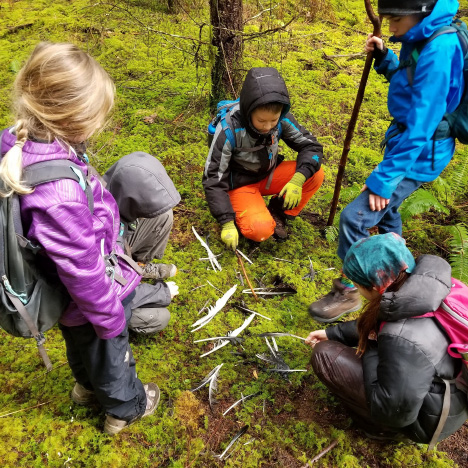
Students pause to examine a pile of feathers they discovered while exploring the woods on a rainy day. The group came up with a series of questions about what happened and brainstormed ideas about how they could investigate further to potentially find answers.
Spending time on a particular piece of land, through the seasons and years, inevitably leads to a sense of kinship and creates an urge to protect and enhance the natural environment. It’s been rewarding to teach students about which plants are non-native and potentially harmful to the local ecosystem, then see them step up as guardians of the land. When we wander through the woods, sometimes they spot a pocket of invasives and if we’re lucky enough to be carrying long-handled loppers, the team of weed warriors can quickly level a patch of Himalayan blackberry. In addition to studying and exploring, offering students an opportunity to actively participate in land management elevates their sense of purpose and deepens their connection to the natural world.
Full Family Learning
Homeschooling naturally leads to multiple ages and families all learning together. In the early days of our homeschool outdoor program the adults often observed activities and supported logistics. But over time it became clear that we truly were a mixed-age group of learners and explorers. Treating everyone as learners equally can have the effect of empowering young people. Sometimes kids master skills quickly. teaching what they’ve learned to adults. And sometimes the best exchange comes not from experts, who have a deep and longstanding understanding of a concept- but those who have recently experienced the gift of insight.
Mixed age learning is a mutually beneficial relationship fostering growth in multiple ways. Adults sometimes shelter in the security of topics they already understand and avoid venturing into areas less familiar. Conducting scientific inquiry in nature is ideal for having a high ceiling and a low floor: everyone knows something, and no one knows everything! Cultivating a growth mindset, by creating an atmosphere where mistakes are celebrated as learning opportunities, and where having a question is as valuable as having an answer (Boaler, 2015, 11), pairs beautifully with immersive study in nature.
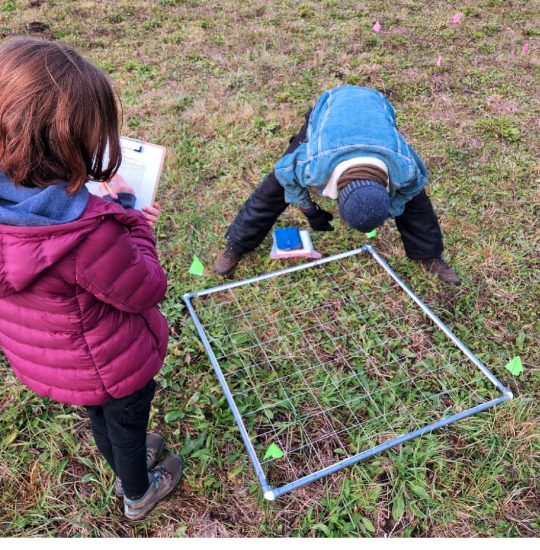
A team of researchers determine the percent meadow knapweed present in a one-meter plot square by examining each of 100 smaller squares for the plant of interest.
Authentic Curriculum
Each day that I meet a group of students in the natural world, I come prepared with a plan for that day. Sometimes my plans are elaborate and detailed, and sometimes they are less specific and open to input from my fellow adventurers. But without exception I am mentally prepared and openly delighted to be upstaged by the unexpected. Whether it is locating a dead porcupine after noticing an unusual smell, being suddenly pelted by large hail, being startled by the arrival of the cacophonous noise of a murder of crows, or being circled by two deer so distracted in their mating dance that they fail to notice us; being fully present for nature’s dramas is my top priority.
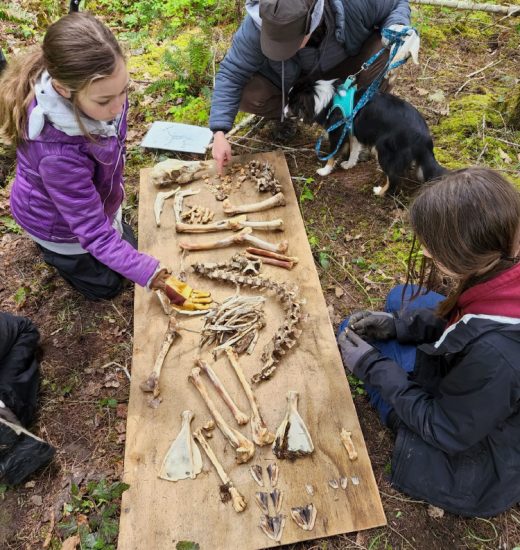
After waiting over a year for the soft tissue to decompose, students collect and sort bones from a deer that died of natural causes near the Bear Creek Wilderness.
One day, just as the families were arriving at the Bear Creek Wilderness, a truck with two wildlife professionals pulled up to examine a deer laying in the horse pasture adjacent to our meadow. Curious, we gathered to ask questions about what might have happened. When they offered to let us keep the recently deceased animal, we gladly accepted- and spent the day dragging it across the meadow into the woods, securing it with paracord, and setting up our two trail cameras to watch what would happen.
Each week we checked on the deer, and everyone brave enough to venture near got to experience first-hand what decomposition looks and smells like. The camera footage revealed a series of fascinating dramas involving a bobcat, opossums, neighborhood dogs, and finally turkey vultures. A year and half later we carefully collected the bones and spent hours sorting and reconstructing a full deer skeleton. Finally, we tried our hands at making bone tools. In my experience, the best learning opportunities are not planned or expected. But when we build regular rhythms and practices, it is possible to “lay the groundwork for the outbreak of authentic curriculum” (Sobel, 2008, 81).
Cultivating scientific inquiry

Students work to match specific leaves to nature journal pages. Each student found a leaf while wandering through the woods, then recorded details of that leaf in their nature journals using words, pictures and numbers. The leaves were collected, then each student selected a new leaf and found the corresponding journal page.
Getting to know a place, including its seasonal changes, provides a useful perspective when it comes to asking research questions. An invaluable tool to record and remember discoveries, questions and observations is the field notebook, or nature journal. Developing the habit of collecting data with pencil and paper while exploring the natural world takes ongoing dedication, is deeply personal, and will certainly evolve through the years if one continues the practice (Canfield, 2011, 187-200). Nature journaling techniques that involve close examination of specimens in order to draw them, often reveal details that would have been overlooked with a quick glace or photograph. Indeed, to truly get to know a specific plant species it is hard to imagine an activity more educational than carefully drawing each of its parts.
Foundational to scientific inquiry is the research question, or asking questions within the realm of science. There are plenty of valid and interesting questions that one might ask while pondering the wonders of nature, and it’s important not to shut down inquiry when a question like, “Does it make this tree happy when I climb it?” arise. If limited to knowledge bound by science, one may miss rich worlds of philosophy, spirituality, intuition, and other ways of knowing. Still, once we are ready plot our scientific course it’s useful to remind students that questions should be measurable (Laws & Lygren, 2020, 90-93).

At the start of a student-led wildlife study, one researcher, who had taken time to carefully read the manual and test out the equipment, teaches the other students how to label their memory cards and set up their trail cameras. This project was made possible by a generous grant from the Diack Ecology Education Program.
Research Methods
When guiding young people into the world of field research it is helpful to start with basic techniques and big picture, cross-cutting concepts. Keeping track of important details in a field notebook and not forgetting to record obvious but key information like the date and location takes practice before it becomes routine. Collecting data can be time consuming, but sometimes trying to interpret sloppily recorded field notes can lead to tedious and frustrating hours at home. Finding a doable and interesting research question, taking into account confounding factors, and dealing with the disappointment if all the hard work to apply different treatments on an invasive plant all result in similar outcomes, requires a certain level of maturity and commitment.
Digging into a full-fledged research project requires determination, perseverance, and time, but it is possible to introduce students to the exciting and fun parts without getting bogged down by details. I recently taught a research methods class to elementary and middle school students with the goal of having hands-on experience with sophisticated research equipment without requiring data analysis or report writing.
We practiced collecting samples, and at first, we recorded in our field notebooks all the important metadata. Inspired by collection and observation, but limited in time, we then simplified the process to maintain interest and focus. For the rest of our forest walk we collected whatever samples caught our eyes- and mentioned what we would record if we were doing a research project- but kept it fun and quick so we still had time to investigate them at the end with magnification. Keeping data collection fun and exciting for younger students makes for a useful introduction to scientific inquiry and sets them up for conducting their own research in the future.
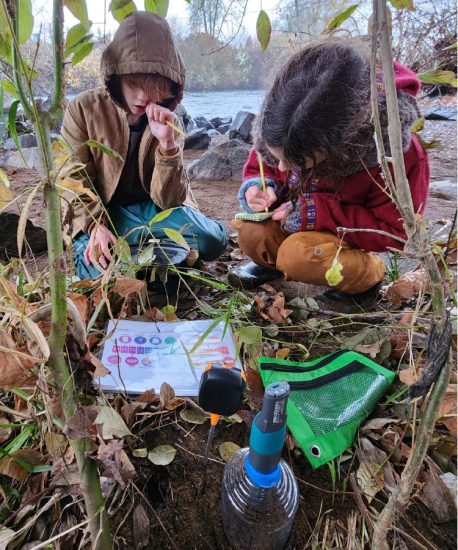
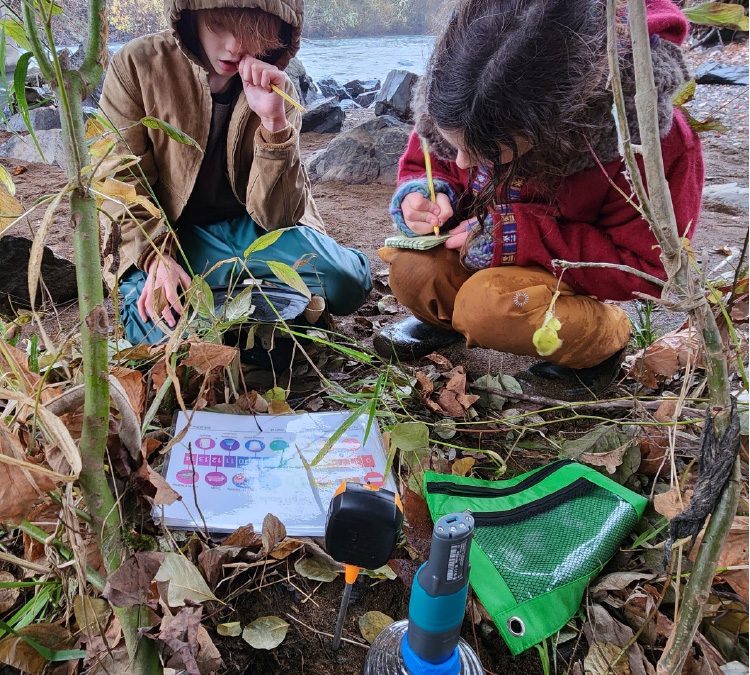
Students collect carbon dioxide and pH data from a patch of earth using equipment funded by the Diack Ecology Education Program during a research methods class with Wild Alive Outside.
Student-Led Research
In my experience, homeschoolers have a low tolerance for contrived activities, busywork and doing things for a grade. Any activity, assignment or project needs to be authentically meaningful. While it may be hard to force them to fill out a worksheet recording what we just discussed, they often thrive with open-ended activities and projects they can direct. It’s important to provide the appropriate scaffolding, and offer examples, but I have been impressed by how quickly and enthusiastically students construct their own research projects. As a mentor, I sometimes struggle with finding balance between requiring them to do something ‘right’ and encouraging critical thinking along with a safe place to fail, each of which are valuable learning experiences. Allowing students to take ownership in the learning process enhances the development of scientific thinking.
Once, a student created an elaborate plan to attract birds for his trail camera research project involving dead trees, peanut butter, and bird seed. There was tangible disappointment when the resulting images revealed many more rodents than birds, but it led to a new series of questions as well as an understanding about wildlife activity in that area. Field science is almost always iterative in nature, with new questions emerging from initial data and, ideally, the opportunity to inquire further and collect more data. With guidance and partnership students integrate information while maintaining natural curiosity.
Expanded Educational Support
Last year our outdoor program, Wild Alive Outside, received its first infusion of grant-funded scientific equipment. The Diack Ecology Education Program financed a set a trail cameras for our students to study wildlife activity at the Bear Creek Wilderness. Access to high-quality equipment has been a game changer for our little research group. Students felt empowered to design their own experiments by having full control over one of the trail cameras and two high-capacity memory cards. In addition to learning what wildlife passed through the area of the forest or meadow they selected, they gained experience with organizing and analyzing digital data. For some, it was their first exposure to spreadsheets, and others had to push their edges to patiently examine each of hundreds of photos. After months of data collection and conducting secondary research on one of the many wildlife species they discovered, they created posters to present their findings.
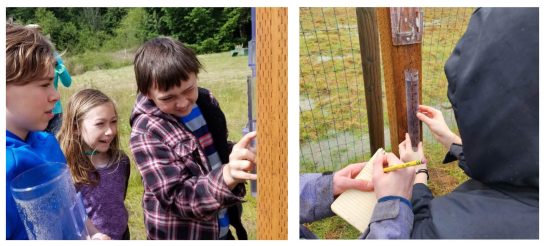
Students carefully measure the water in the rain gauge to determine rainfall over the previous week. Data is later reported to the CoCoRaHS website as part of a nationwide citizen science initiative.
For several years now, each day on the land begins with checking the rain gauge. Because we only visit once per week, we often have several inches of rain to carefully measure and record in the notebook. This simple ritual wakes up scientific thinking: “remember to look straight on before taking a reading,” connects us to what’s been happening while we were away: “no wonder there’s standing water in the meadow,” and gives us access to site-specific long-term data. At the end of the water year, shortly after the start of autumn, we can look back at the data we’ve collected, compare it to previous years, and make predictions for when the rains might come that fall. Additionally, we report our data through a sophisticated citizen science program called CoCoRaHS – Community Collaborative Rain, Hail & Snow Network with thousands of other citizen scientists across the country. I have found students take data collection quite seriously when they know they are part of a larger community of scientists, all doing their best to produce accurate results.
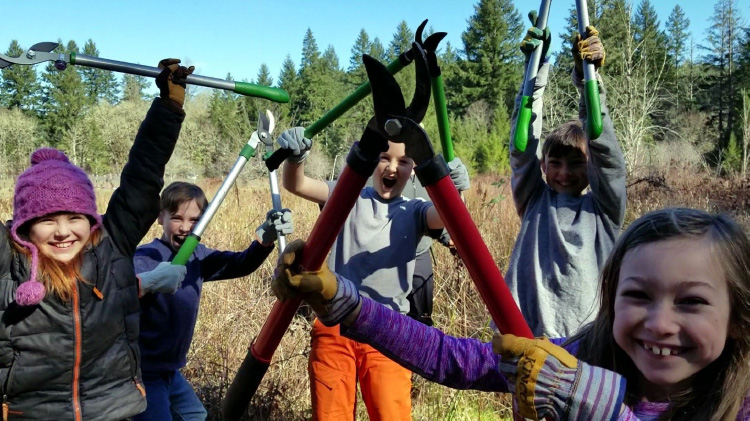
After tackling a large patch of invasive blackberry bushes, the Weed Warriors celebrate their contribution to protecting the wet meadow in the Bear Creek Wilderness.
The Bear Creek Wilderness and Student Research Forest
My program design is to plant the seeds for creating a student research forest where young people will have ongoing opportunities to learn scientific methods of field research and contribute to an ever-increasing body of knowledge through their own efforts. Just as the H.J. Andrews Experimental Forest welcomes graduate students and long-term ecological researchers and has amassed a wealth of knowledge and data about that site, we aim to support young emerging scientists with open minds and creative ideas to connect with place, nature, and make meaningful contributions to science within a community of knowledge seekers. Participants gain foundational skills together as they engage with the land, utilize scientific tools, grow as learners, and share knowledge with each other.
References
Boaler, J. (2015). Mathematical Mindsets: Unleashing Students’ Potential Through Creative Math, Inspiring Messages and Innovative Teaching. Wiley.
Canfield, M. R. (Ed.). (2011). Field Notes on Science and Nature. Harvard University Press.
CoCoRaHS – Community Collaborative Rain, Hail & Snow Network. Retrieved January 18, 2024, from https://www.cocorahs.org/
Diack Ecology Retrieved January 26, 2024, from https://www.diackecology.org/
H.J. Andrews Experimental Forest. Retrieved January 26, 2024, from https://andrewsforest.oregonstate.edu/
Laws, J. M., & Lygren, E. (2020). How to Teach Nature Journaling: Curiosity, Wonder, Attention. Heyday.
Sobel, D. (2008). Childhood and Nature: Design Principles for Educators. Stenhouse Publishers.

In 2019, Jess Lambright started a nature school for homeschool families where once per week kids and parents spend all day outside learning wilderness skills, exploring, developing naturalist knowledge, conducting field studies, and connecting with nature, themselves, and each other. She founded Wild Alive Outside in the summer of 2023 with the goal of getting more youth outdoors to discover wonder and inspiration in the natural world through science, outdoor skills, and wilderness connection.
by editor | Mar 30, 2012 | K-12 Classroom Resources
Interview by Chris Gertschen
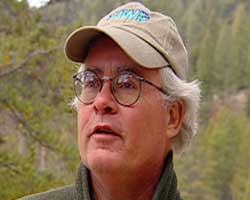
 Jon Marvel is the founder and executive director of the Western Watersheds Project.
Mission
The mission of Western Watersheds Project is to protect and restore western watersheds and wildlife through education, public policy initiatives and litigation.
Western Watersheds Project is a non-profit conservation group founded in 1993 with 1400 members and with field offices in Idaho, Montana, Utah, Wyoming, Arizona and California. WWP is headquartered at the Greenfire Preserve in Clayton, Idaho. The group works to influence and improve public lands management in 8 western states with a primary focus on the negative impacts of livestock grazing on 250,000,000 acres of western public lands. WWP has an annual budget in 2009 of $1,000,000.
WWP works in partnership with the Oregon Natural Desert Association in Oregon, WildEarth Guardians in New Mexico, the Center for Biological Diversity in Arizona; and the Larch Company in Ashland, Oregon. With these groups WWP co-founded the National Public Lands Grazing Campaign that supports federal legislation for a generous and voluntary federal grazing permit buyout program to compensate ranchers and restore public lands. Congressman Raul Grijalva of Arizona sponsors that legislation.
WWP’s long-term partner in our efforts to bring the Bureau of Land Management and the Forest Service into compliance with national environmental laws is the non-profit environmental law firm Advocates For The West in Boise, Idaho.
CG: Were there particular moments, events or series of events that led you to conservation?
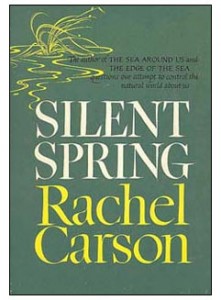 JM: I would first mention Rachel Carson’s “Silent Spring” which I read in 1963 when I was 16. Her writing about manmade chemical use was especially informing for me because I was attending a boarding school in Massachusetts where, in an effort to prevent the spread of Dutch elm disease, the spraying of DDT was routine and widespread. I realized from reading Rachel Carson that the probable reason the robins on the campus were dying and acting oddly was because of DDT.
In high school I also was first introduced by my mother to Aldo Leopold’s, a “Sand County Almanac” which had an equivalent effect on me as Silent Spring. My mother also was a strong influence on my thinking. She had been a member of a statewide planning commission in Delaware that recommended in the late 1950s against the development of an oil tanker port in wetlands along the Delaware River, something I took to heart. She also introduced me to the writing of Louis Bromfield and his organic farming efforts at Malabar Farm in Ohio.
In 1966 I was attending the University of Chicago and became an activist in the anti-war movement, co-founding a draft resistance group. That activism informed my understanding of human induced environmental catastrophes when I learned about the aerial spraying of Agent Orange to defoliate the southeast Asian jungle to simplify warfighting. The dangerous and negative ecological and health impacts of Agent Orange were just beginning to be understood then, and I learned that there was an interrelationship between the military-industrial complex’s assault on people and on the earth. Later I began to refer to this relationship as the “culture of death.”
 In late 1968 a friend introduced me to the first Whole Earth Catalog and I was completely bowled over by what I read. The focus on natural fibers, natural food, alternative communities and open discussion about the use of mind-expanding naturally available substances was transformational. I could hardly believe such a wonderful publication existed. I immediately subscribed and became a long-term reader of the WEC and it’s following publications, Place Magazine, the Co-Evolution Quarterly and the Whole Earth Review. The writing in the WEC also informed and intrigued me about alternative building techniques including passive solar houses and simpler, less consumptive life styles.
When we moved to Idaho in late 1969 one of the efforts we made was to grow as much of our food as possible without chemical herbicides or pesticides, so we had a garden every year even though where we lived near Stanley was not a good climate for most vegetables. To combat the cold climate and short growing season I tried mini greenhouses and early indoors seedling starts, but learned that a warmer climate was needed for a modest level of organic food production for a small family.
In the winter of 1970-71 we lived for a few winter months overlooking the Hudson River in Sneden’s Landing in Rockland County, New York where I read Robert Boyle’s very saddening book, “The Hudson River”. Reading Bob Boyles descriptions of the decline and degradation of a great river and all its life forms convinced me like no other book of the need for conservation of all natural systems.
These are some of the experiences that helped inform my thinking about the need for a conservation ethic in all human activities.
CG: The Western Watersheds Project has grown into a strong organization with considerable impact on conservation in the West. What are some of your greatest successes?
JM: While there have been many successes for Western Watersheds Project (WWP) over the last 18 years, there are some that stand out.
On one day in April of 1999 Idaho Watersheds Project (the name was changed to Western Watersheds Project in early 2001 to reflect a broader geographic area of work) won an unprecedented victory at the Idaho Supreme Court when the Court awarded IWP with three separate victories on the same day all by unanimous decisions.
Those victories changed forever how the State of Idaho administers its 1,900,000 acres of Public School Endowment lands that are leased for livestock grazing. The Court overturned an Idaho Constitutional Amendment passed by the voters of Idaho in November 1998 that would have removed the requirement that School Endowment Lands be disposed of only at public auction. The Court also overturned a statute passed solely to block IWP from competing at auction for expiring grazing leases. The Court also overturned the award of grazing leases to the low bidder in another case. These three precedential court orders have changed the face of Idaho State Lands management and ripples from those three court decisions continue to be felt in related areas of law like Idaho State cabin site leases and the fees charged for leasing state property as well as in other states.
In 2005 Western Watersheds Project won an unprecedented victory in federal District Court closing over 800,000 acres of public lands in southern Idaho to livestock grazing. (see: http://www.westernwatersheds.org/news-media/online-messenger/wwp-wins-major-federal-court-victory-ordering-immediate-removal-cattle-o
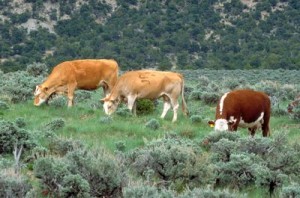 This win changed the whole perception of public lands ranching from the idea of ranching on public lands as a property right to just another federally permitted use subject to compliance with the law.
In 2006 WWP won a remarkable court order (see: http://www.westernwatersheds.org/news-media/online-messenger/federal-judge-halts-bush-grazing-regulations-affecting-160000000-acres-p ) overturning the Bush administration’s rewritten grazing regulations for the Bureau of Land management. This decision was upheld at the 9th Circuit Court of Appeals and in 2011 a final appeal of this decision was denied a hearing by the U.S. Supreme Court. This is the first time rancher-friendly regulations have ever been blocked by the Courts of the United States.
In June 2010, WWP reached an unprecedented and innovative settlement (see: http://www.westernwatersheds.org/news-media/online-messenger/western-watersheds-project-and-ruby-pipeline-llc-establish-multi-million ) with Ruby Pipeline LLC and El Paso Corporation that created a new non-profit, the Sagebrush Habitat Conservation Fund. The Sagebrush Fund which will be managed jointly by WWP and Ruby, will be funded over ten years by $15,000,000 to be donated to the Fund over that time by Ruby Pipeline LLC for the main purpose of acquiring voluntarily offered federal grazing permits in order to have them retired by the Forest Service and the BLM.
This agreement created a new way to resolve public land disputes with ranchers by enabling a generous voluntary buy-out capability that will serve as a model for conflict resolution on western public lands
CG: To set so many precedents in land management law is an impressive feat. Will WWP continue to rely on lawsuits in the future or do you foresee a time when other conservation methods might be employed more often? What other directions would you like to see WWP pursue?
JM: Litigation is a tool to catalyze change in public policy. By itself litigation cannot achieve needed changes, but it is an excellent tool for pressuring the status-quo management of public lands. It is significantly more effective than petitions, letter writing campaigns or public events unless those have thousands of people participating as in the Occupy Wall Street movement and the recent White House demonstrations against the proposed Keystone XL oil pipeline from Canada to Texas.
As part of our strategic efforts and planning and in addition to administrative actions and litigation, Western Watersheds Project also supports generous voluntary programs to initiate and enable change in the management of public lands.
The first example of this side of WWP’s work is the Sagebrush Habitat Conservation Fund created in June 2010 by Western Watersheds Project in partnership with Ruby Pipeline LLC. Ruby is a subsidiary of the El Paso Corp., a major gas and oil pipeline company headquartered in Houston, Texas.
The Sagebrush Fund will have $15,000,000 available over ten years for the acquisition of voluntarily offered federal livestock grazing permits by ranchers. These purchases will take place in locations like Owyhee County, Idaho where Resource Management Plans or federal legislation exists that directs that waived grazing permits be permanently retired. The Sagebrush Fund will enable the jump-starting of related efforts to provide for a voluntary process to permanently retire federal grazing permits across the west.
The second example is the Rural Economic Vitalization Act (REVA; HR-3432) introduced into Congress in November 2011 by Congressman Adam Smith of Washington State with several co-sponsors. This legislation when enacted into law will authorize up to 100 federal grazing permits per year be retired if voluntarily waived to the permitting agency usually the Forest Service or the Bureau of Land Management. This legislation is a generous and voluntary way to resolve conflicts over the damaging impacts of federally authorized public land livestock grazing in the western United States. Western Watersheds Project staff worked closely with Congressman Smith’s staff on the creation of this legislation.
Western Watersheds Project’s efforts provide a well-rounded strategy with both a carrot and a stick in order to challenge the status-quo and help voluntarily resolve what some describe as intractable conflicts over land use.
CG: It seems that one sticking point with ranchers is that they can’t support their lives and families without the use of public land grazing allotments. Does WWP have some ideas on how ranching families can afford to stay on the land without using the allotments they’ve come to depend on? The old “Cows not Condos” argument is hard to dispute when we here in the west love our open spaces so much.
The issue you raise about ranch families is more complex than your question would suggest.
For example, most public land grazing permits (over 60% of them) are not permitted to family ranchers at all. That majority of permits is held by permittees who do not receive the majority of their income from ranching. In other words they are hobby ranchers who mostly live somewhere other than on the ranch i.e. absentee owners.
A good example of this non-family ranching is the largest grazing permittee on public lands in Nevada, Barrick Gold Corporation. Barrick is one of the largest gold mining companies in the world and operates a number of large open pit gold mines in Nevada. As part of their gold mining business Barrick bought up several tens of thousands of acres of large ranches in order to acquire their water rights for use in gold mining. Barrick continues to graze livestock on the public lands associated with those ranches as a part of their public relations plan.
The largest public land ranching operation in the United States is the Simplot Corporation of Boise, Idaho. Simplot has grazing permits to over 2,000,000 acres of public land in three states and can hardly be characterized as a family ranch operation dependent on public lands for their business.
Similarly the largest cattle ranching operation on public lands in central Idaho (the Mountain Springs Ranch north of Mackay in Custer County) is owned by Mary Hewlett Jaffe who is the daughter of William Hewlett, the co-founder of the Hewlett-Packard Corporation. Mrs. Jaffe lives in Portland, Oregon and visits her ranch in Idaho once or twice a year. She is not dependent on her ranch for survival.
Right here in Blaine County the largest public land permittee is Lava Lake Land and Livestock a domestic sheep ranch that has public land grazing permits to 750,000 acres of public land in Idaho. The owners, Brian and Kathleen Bean, live in San Francisco where he is an investment banker.
Finally one statistic is compelling in this regard: 10% of all public lands ranchers control over 75% of all grazing use on public lands. This concentration of control reflects the fact that public lands ranching is primarily a corporate or rich person’s activity.
If we are to consider ranching as a right on public lands, perhaps I might be more concerned about the plight of small ranchers who hold public land grazing permits, but the reality is that fewer and fewer small family ranches exist every year, and grazing permits are not rights but permits that do not carry a guarantee of use for anyone.
The Cows versus Condos argument is also specious because a very large majority of all ranches in the west have little or no pressure for subdivision in to small or even medium size lots. The pressure for subdivision exists in specialized places in the west with scenic qualities, rivers and streams or proximity to resort areas with amenities that attract development like Aspen, Jackson, Steamboat Springs, the Gallatin Valley and Sun Valley. There is little or no subdivision risk in rural Owyhee County, Idaho or south of Burley, Idaho to give two examples.
In places where subdivision is a real concern, county land use policies and zoning can reduce the risk of inappropriate subdivision remarkably. Blaine County recently increased the minimum rural lot size to 40 acres in much of the County. In Washoe County, Nevada the most rural parts of that county have a minimum lot size of 90 acres. In areas with critical landscapes needing protection, public funds can be used, and often are used, to buy the land at risk and keep it from being developed. Conservation easements are also a good way to prevent subdivision.
Simply keeping ranchers in business fails all tests of preventing development and subdivision of private lands in the west. Keeping ranchers ranching only owrks as long as individual ranchers decide to continue to ranch. Often factors beyond their control intervene to force of influence private land sales including death, divorce, family squabbles, sickness, drought, insects, livestock disease and a miriad of other events that can and do occur that cause ranchers to sell their land.
The final reality is that ranching has not prevented the high level of subdivision we experience in desirable parts of the west. Public land ranchers can make more money by selling their land in those locations, and they have done so in large numbers notwithstanding the heavily subsidized nature of public land grazing permits that enable them to be ranchers in the first place.
I have attached an excellent article by George Wuerthner that further explains the false premises behind the Cows v. Condos argument.
One final thing I suggest it is important to remember is that “open space” is not necessarily healthy wildlife habitat or a healthy ecosystem. Farming and ranching simplifies landscapes in ways that eliminates or greatly reduces biodiversity, so it is a good idea to ask ourselves if simply keeping land in “open space” actually benefits other values than just the landowner.
CG: Thank you so much for helping me to better understand this issue. I wish that all conservationists (and western ranchers) had the opportunity to consider the valid points that I believe you and George make. That’s why I got involved in these interviews: there is a great need for more communication – and education across the board about ecological issues and conservation. Most conservation organizations conduct a certain amount of outreach but I wonder if there isn’t a way to better collaborate in supporting conservation education efforts. Do you see a place for education in conservation?
JM: Of course, education at all levels is an essential part of conservation efforts!
I have spent many days over the last twenty years speaking to college and high school classes in Hailey, Boise, Twin Falls, Pocatello, at the University of Idaho in Moscow, at Bard College in New York State and to Whitman College students through their terrific Semester in the West program ( http://semesterinthewest.org/ ). All of these educational efforts are important, but the fact is that a very small percentage of the students attending will follow up in any way. This is not surprising since student priorities are rarely focused on conservation issues at all.
One of the most challenging aspects of all citizens’ understanding of conservation issues is what they believe and accept as received wisdom. Many Americans receive their understanding of conservation issues as word-of-mouth from family, friends and especially from popular culture media like films, television, social media and the internet. Those sources vary greatly in having even simple factual information and may not fully inform anyone. Another problem conservation educators face is that many ideas about the natural world are derived more from folkloric beliefs than from factual understanding.
A good example of this conservation education gap and the power of folklore can be found simply by asking a random sample of westerners whether sage brush is a non-native species or not. My experience suggests that at least half of all adults in western states believe sage brush is a non-native plant and therefore even more worthless than it is routinely perceived to be. I have good friends who grew up in Idaho who believe sage brush is a non-native species and that tumbleweeds are native (tumbleweed, as you know, is a non-native exotic annual plant from the Ural Mountains in Siberia also known as Russian thistle). Perhaps many people are still informed by that well-recognized ballad of the west “Tumbling Tumbleweeds” as performed by Roy Rogers and the Sons of the Pioneers: http://www.youtube.com/watch?v=_UiSMyyj-Ac .
Another very difficult reality facing all educators on natural resources conservation issues is the power of mythology. There are many myths that inform American society. They are of varying strengths, but any educator embarking on an effort to inform and update societal myths is in for a hard time. The realm of myths is a non-rational world where facts are not welcome unless they can be massaged into fitting the mythological context. Two excellent example of myths we face in our work are the cowboy myth and various myths about wolves.
The cowboy myth has to do with an imagined cowboy with an imagined state-of-mind: a straight talking, riding-for-the-brand, right-thinking, respectful-to-the-little-ladies, don’t cross that line keeper-of-his-word in a charming and colorful costume who will save us from city-slickers and card-cheats with a six gun or a quick and righteous punch to the jaw ! Unfortunately this mythological person never existed in the first place, and while he seems to be fading away, his myth continues to inform public policy as if it were meaningful.
The mythology of wolves that informs most wolf-haters is based on atavistic ideas from many millennia of human existence but again that have little basis in fact. As we know, wolves are sociable creatures forming large family groups very similar to many human families. While they are apex predators, they are not dangerous to humans except in the rarest of circumstances, yet opponents of wolves repeatedly make public statements based on an unshakeable belief that it is only a matter of time before children waiting at school bus stops will be dragged off and eaten by the wolves.
Education can change society as the 50 year shift away from accepting tobacco smoking of any kind shows and education will always be an important part of conservation work. We do need to keep in mind that it is a slow and uncertain process that may or may not succeed. In the meantime, we can pursue parallel and possibly more powerful ways to influence public policy while never abandoning educational outreach.
CG: So I am coming to see the importance of taking people from ecological knowledge to activism. Environmental education is thought to promote the ecological knowledge but I think activism only comes with passion for nature. Any ideas on how we might help to inspire that passion?
JM: This is a very good question, and I don’t think I have a good answer for you.
All the people I know who have chosen to actively work for change in public lands management to better protect wildlife and wild lands do so because they love the outdoors and wildlife and because they have had specific experiences in the outdoors that have shown them the good and bad outcomes of human intervention in the environment.
I don’t really know why some people become more active than others, but I think everyone’s personal situation in life informs those sort of decisions. For most people their family and their job come first and political activism is pretty far down their to-do lists !
CG: Yes, the lives of young people are so wrapped up in the need to keep body and soul together. But in thinking about new audiences for conservation and EE, I am seeing a vast supply of folks who are retiring and are looking to become more actively involved in conservation than just sending in that yearly check. (I am one of those!) I dream about a new network of volunteers who are active in teaching and learning about the land and its critters. Environmental education, at least in Idaho, is focusing on K-12 but in my dreams, I think there is so much more that EE or CE (conservation education) could be doing on the community and regional level.
What does your most hopeful view of the future of conservation look like?
JM: I think my answer depends on what I am feeling any particular day. Some days I think that there is a chance that we humans will start acting as if our relationship with life on earth is important and merits our full attention; other days I think we will get what we deserve, an almost uninhabitable planet with the loss of most living species.
Still I am, generally speaking, an optimist and I think that people are capable of changing their attitudes and ways of thinking. Having individuals assisting in bringing about those changes in lots of important ways is essential to achieving needed cultural change and educational outreach is one of those important ways.
I am hopeful that in the next few years there will be a new understanding of the importance of our environment and all living things, unfortunately, I also believe that it is only hard lessons leanred from shocking experiences that brings about change and then only for limited time frames. The 2011 Japanese earthquake and tsunami is a good example of shock therapy in regard to nuclear power and its perils, but even now one year later we see that the impact of that experience on most people is fading. Our American culture is capricious and ephemeral in its attention span and pays more attention to the mental and physical state of George Clooney and Lindsay Lohan than whether we will still have fish in the ocean and water in our rivers, so making any shift in our cultural obsession with celebrity is a very very big challenge.
I remain hopeful, but I sometimes think that my hopefulness may be just as delusional as someone basing their clothing choices on what they see on American Idol !
# # # #
Chris Gertschen is the founder and former director of the Sawtooth Science Institute. She is conducting a series of talks with the leaders of conservation in the west to get their perspectives on the relationship between conservation and environmental education. Read her introduction here.


