by editor | May 26, 2015 | Outdoor education and Outdoor School
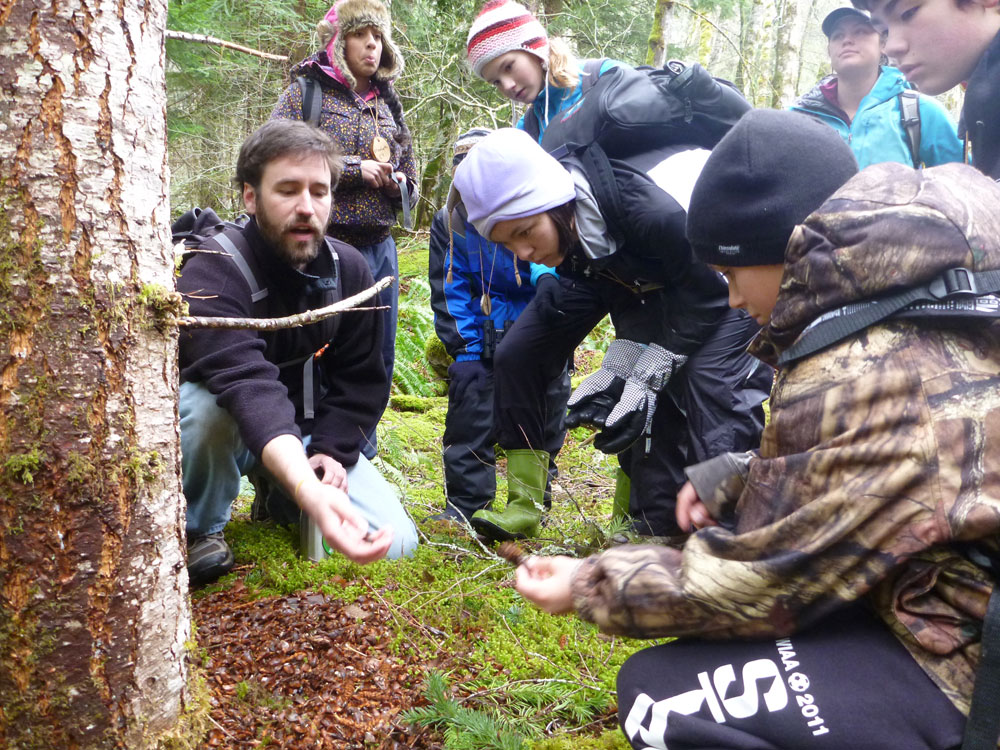
 Tips for bringing students into the field: Strategies for success
By Joshua Klaus
Director of Academic Programs, Ecology Project International (EPI)
 aking students into the field can provide an endless array of occasions to learn new skills, see theoretical concepts enacted, make connections, and learn about the world around us. Given the endless places that offer valuable learning opportunities, it must just be a matter of heading out the door for students to have impactful educational experience, right?
Though it would be nice if it were that easy, there are a few key strategies that will allow any educator (novice or veteran) to make the most of their time – before, during, and after their field experience.
Educators will have a higher likelihood of success if they keep the following things in mind:
• Go outside! The natural world offers limitless educational opportunities. Given the amount of time students spend in front of computers, screens, and isolated from weather, plants, and animals, exposure to the natural world is a fantastic way to engage students’ bodies and minds.
• Real-world projects: Involving students in applied research, service-learning, and conservation or community-related projects will give them a sense of connection to something larger than themselves.
• Find good partners: Working with established land managers, non-profit organizations, or government agencies can help provide additional resources, information, expertise, and motivation.
• Incentivize good work: Offer students school credit, lab hours, or community service credits if they meet or exceed your expectations while in the field.
• Have fun! Focusing on specific learning outcomes is a good idea, but balancing learning with fun, exploration, and freedom will increase the likelihood that students will have a positive, meaningful experience.
Preparation:
As the old adage instructs, failing to adequately plan and prepare often means planning for failure. Preparing students for a field experience is of paramount importance and should include setting clear expectations about goals and behavior, in addition to providing students with the tools, background, vocabulary, and knowledge necessary for success and high-quality outcomes. Advance preparation might include proper gear and equipment, safety protocols, practicing field methodology in advance, and providing a theme or integrating context for learning. At the very least, prior to heading into the field students should be given a structured opportunity to determine what they already know about a particular place or activity in addition to the chance to articulate what questions they have and what they’d like to learn. This could be as simple as asking students to draw a picture, make a list, or tell a partner what they know about a concept. Additionally, individuals could make a K-W-L chart, and the entire group could share the information in the ‘W’ column.
Adequate advanced preparation will help students stay comfortable, safe, and well-fed! By engaging students in managing risks they might encounter in the field – whether hiking on a trail or crossing a busy street – they’ll have a better understanding of the potential dangers they’ll encounter as well as the rationale for making appropriate decisions that will help keep them safe. When students understand why they should do something (instead of just being told they should) they’ll cultivate a deeper sense of ownership and personal responsibility.
Collaboration/ maximizing resources
Many organizations, government agencies, and companies are more than willing to host a group of visiting students. Call the local fisherman to take a tour of his boat, approach the university about a tour of the wet lab, or ask a conservation group to give an on-site presentation to your class about their restoration projects. Experts often love to talk about what they do and are happy to share their knowledge with students. When teaching in Oakland, CA one teacher took his physics class to a boat yard a couple blocks away and a crusty sailor taught them about mechanical advantage and pulley systems used for dry docking and offloading cargo. When the Pixar Studio in nearby Emeryville was under construction, his students crawled around the open foundation with a bunch of engineers who were delighted to tell them all about how they designed the building to withstand a 9.0 earthquake. Think creatively about what you consider a ‘field’ experience, and likely you’ll discover a long list of wonderful opportunities right within your community.
The wheel already exists
Talk to your local conservation group, nature center, government agency, or tourist outfitter about what you would like to do and ask if they can help. Many of these groups have some kind of educational mandate associated with their work, and if you can help them achieve their goals by involving your students in their work, they will likely be accommodating.
Go for it!
For beginning teachers, it’s a great idea to keep things simple until you establish a track record of success with your students and within your community. Start with small, accessible field experiences before making too large a commitment. That being said, despite the importance of preparation (as described above), don’t over-think your first field experiences. Once you’ve covered your bases and the basics, it really can be as simple as heading out the door. The world awaits, so don’t worry – once you get there, your students will thank you.

by editor | Nov 20, 2014 | Outdoor education and Outdoor School
In Support of Outdoor School
By Merrill Watrous
“I not only learned about ghost shrimp and how to catch them, I did catch them. I not only learned what a chitin was and where it lived, I went out to where it was and petted it. Almost everything (at Outdoor School) was one step ahead of regular school. With the songs around the campfire there were just as many emotional parts as there were educational parts. I feel like I left a better person, more aware of the environment.” (Nick, age 11)
Petting an animal, singing around a campfire, and learning how to care for the environment — the value of these activities is not easily assessed according to current standards and benchmarks. I can provide no statistical evidence with this article to prove that the students who spent a week with me at Outdoor School scored higher on later standardized tests the next year than their peers did. However, research does indicate that integrating the curriculum around topics in environmental education is a powerful way to teach. The arguments I will present here in support of continuing to fund outdoor education are largely anecdotal, based in part on the words of children like Nick who were themselves changed by the experience.
How did Nick become a better person through Outdoor School? It is important to determine this for he was not alone in feeling transformed by it. To prepare for Outdoor School, we first read and wrote about the natural world. In public French immersion schools in both Canada and the United States, teachers often share students but not curriculum. Outdoor School brought me closer to my teaching partner because we became engaged with the same curriculum as well as with the same students. It brought my students closer to one another because they ate, slept, worked, and played in close proximity twenty-four hours a day. It brought teachers and parents closer to one another because we met often to organize transportation and materials before leaving. It transformed us all because, through the Outdoor School experience, we came together as a more cohesive community.
Loving the Science
Like Nick, Matthew loved Outdoor School and when he wrote to me about it later, he couldn’t help but enumerate all that he had learned.
“I learned about biodiversity, the amount of compressed oxygen in salt and fresh water, the inhabitants of the tide pools, the secrets of the estuary, the names of plants like salal and fruiticas lichen, and about mixed, diurnal, and semidiurnal tides.”
Matthew enjoyed the company of his classmates and the beauty of his surroundings but what made the week work for Matt was the science. Classroom science kits may have helped him to understand some of the basic principles of science back at “regular school,” but no lab could compare with the estuary as a learning environment.

Character Education
One child who was less sure than Matt that he liked Outdoor School wrote about his character growing in spite of himself. Children, like adults, realize that sometimes we learn the most from experiences that challenge us. We spend a substantial amount of money in schools today in the United States on programs devoted to preventing violence through “character education.” If Outdoor School for my students was a place where they felt themselves becoming better people, a place where they felt themselves growing as human beings, perhaps this is one place we need to invest time and money.
We all took with us to Outdoor School for the week only what we needed to stay warm and relatively clean. Each child wrapped his or her belongings in black plastic garbage bags to keep it all dry as we took the barge across the estuary to the camp site. As simple as these bags were to pack, they were heavy to carry, and right away the strongest children began to help the weaker ones as we hiked up and down the dunes on our way from the landing dock to the cabins. After awhile, we got to know our cabin-mates from different schools and a few of our neighbors shared with us the fact that a store in their small rural Oregon community had chosen to make a gift to the class of garbage bags to take to Outdoor School. “Free garbage bags- what kind of gift is that?” I watched my students thinking, students who had never before in their lives had to consider where the money comes from to purchase such necessities as garbage bags. I was humbled myself when later on that first night another teacher shared with me how hard she’d worked to find enough warm and water-resistant coats for her students to wear to Outdoor School. (Every one of my children arrived at school regularly with a warm coat on a cold day.) At various times during that Outdoor School week, the children and I were humbled and inspired not only by the beauty and majesty of the wilderness around us but by the courage and determination of our bunkmates.
Learning to Conserve
Without television or video games to distract us, we shared time, materials, and our food with one another. Child after child wrote about the “great food!” at Camp Westwind. (The menu featured such gourmet kid fare as chicken nuggets, mac and cheese, and PB and J sandwiches.) At mealtimes, we passed bowls of food and pitchers of milk from child to child, bowls and pitchers that could be refilled as needed. What was left at the end of the meal on the plates of the children and their teachers, however, had to be thrown on the compost pile after it was weighed, measured, and recorded: every day and at every meal. As the week went on and campers began to realize how much they’d been wasting, food waste was reduced by 90%. I watched children serve themselves applesauce an eighth of a cup at a time, gauging their hunger carefully before putting anything extra on their plates. Students not only learned to conserve food, they also learned to be responsible for their own possessions. At the end of each meal, we sang together, and staff members who had combed the beach and the woods for “lost” personal items earlier offered these items in song for reclamation. It was all done with a sense of humor, but it helped us to learn to be more responsible stewards of our possessions.
Funding Outdoor Education
When deciding whether to fund Outdoor School experiences in the future, we need to think about what we value as teachers and parents. Do we value teaching science in an integrated fashion so that we can maximize the number of students we engage? Do we value teaching students to be environmentally conscious in a way that will stick with them? Do we value teacher-to-student and student-to-student relationship building? If as teachers these are among our core values, then we need to see Outdoor School as something worth fighting for in the face of budget cuts.
Tokens and Rewards
I found Outdoor School to be a nourishing experience personally; I took away from it at least as much as it took from me. I remember buying quickly and thoughtlessly the day before we left a little packet of camping-themed stickers. I handed them over to the Outdoor School Principal at Camp Westwind on our first night so that all of the children participating in camp could “enjoy” them equally as journal decorations. She received them graciously from me and returned them just as graciously, unused, to me at the conclusion of camp. The anti-consumerist message of the camp staff was both consistent and heartening; there was no place within it for something as useless as stickers.
Individual efforts and team efforts were recognized from time to time at camp — not with stickers but with a song or with a “gift-loan” of a feather or a rock of unusual beauty to admire. The children learned to replace these feathers and rocks in the spots where they had first been found after admiring them. We spent hours creating sand sculptures in teams and then reduced them all to “sand rubble” in order to leave the beach as we had found it in its pristine condition before leaving camp. Returning the beach to its natural state was fun and it was exercise. We were moving all the time at Camp Westwind, and most of the children reveled in well-earned feelings of physical fatigue at the end of the day. They even complained pridefully about the hardships of camp.
Alex wrote,
“The cold hard beds, the early hours, and the long, tiring hikes. These are the reasons I liked Outdoor School. The early hours let you hear the birds chirping in the morning. At the end of the long hikes there was always a beautiful view. And the beds . . . well, there was nothing so great about the beds.”
There’s nothing so great about fundraising for activities like Outdoor School when public funds dry up, either, but it would not be easy to set a price on what my students learned at Camp Westwind. As Alex put it, the view at the end of the day IS spectacular. I’ll never forget it, or the children who shared its beauty with me.
Merrill Watrous taught Foundations of Education seminars and supervised teaching practicum students through the Cooperative Education Department at Lane Community College. Prior to that, she taught graduate level courses in writing for Pacific University and fifth grade at a language immersion school. She has also taught grades K, 1, 3, and 4 and middle school writers. She is the author of one book on the teaching of writing and art and numerous articles for such magazines as Learning, Instructor, Mailbox, California and Oregon English, Writing Teacher, Techniques, The Magazine of American History and others. She can be reached at Watrousm@lanecc.edu.

by editor | Nov 20, 2014 | K-12 Classroom Resources, Outdoor education and Outdoor School

Early literacy skills can be developed and enhanced through journaling and data collection. Even the youngest learners can feel successful.
Effective Education: Turning the Classroom Inside Out
By Indira Dutt
 s a child at school I remember sitting in a stuffy portable looking out the window to the field and houses beyond. I felt constrained: my seat was attached to the desk, the classroom was just barely big enough to fit all of us, the windows were small, and the air was stale. I also remember the playground outside. I played hide and seek in the small stand of trees beside the field; I helped friends pile up the leaves in the fall and we all jumped in; I imagined an extraordinary museum of found objects–we made displays of the natural oddities that intrigued us and told stories about each treasure.
The two sides of the portable wall felt inexorably different and though I did well in school I was often wrangy in the classroom, wanting a little more of the freedom I felt when I was outside. Funny then that I should chose a career that keeps bringing me back into classrooms.
As a teacher I notice that, when the outside and inside feel completely separate, there is a problem. My teaching needs to be both connected and applicable to the everyday lives of my students and they need to feel free enough to be creative and capacious in their thinking so they can meaningfully participate in their education.
The literal and metaphorical notions of the outdoors are vital for me and so I work to soften the edge between inside and out.
One way I can do this is by creating and embellishing meaningful indoor–outdoor relationships. Connections between indoor spaces and outdoor areas are important “so that the outdoors becomes a natural extension of indoor learning” (Nair, Fielding & Lackney, 2009, p.111). This area of school design is sometimes overlooked or minimized by architects and educators, and this negatively influences students’ relationships to the natural world (Taylor, Aldrich & Vlastos, 1988).
Indoor–outdoor interfaces facilitate indoor–outdoor relationships. These interfaces are points, areas or surfaces that serve as a juncture between the inside and outside of a building. They include features that provide connection to the outdoors such as windows, skylights, natural building materials, aquariums, plants, interior living walls and porches. Even multimedia devices connected to the outside world via the Internet can bridge the gap between interior and exterior.
In 2009 I conducted a qualitative study that explored how intermediate students’ experience of the natural world was mediated by the design of their school building. My study site was the Bowen Island Community School (BICS) located on Bowen Island, a 20-minute commute by ferry from West Vancouver. The school was built on public land, parceled out of west coast rainforest. There are numerous large cedars and Douglas firs surrounding the property. I worked with grade six and seven students at BICS and collected data from two focus groups, semi-structured interviews, photographs and field notes.
One of the major findings of this study was that a school occupant’s experience of being inside their school building extends beyond the physical boundaries of the structure. When I asked students about their experience inside the school, they repeatedly spoke about the school grounds.
From a child’s perspective the whole school site as well as the school’s immediate A school occupant’s experience ofbeing inside their school building extends beyond the physical boundaries of the structure surroundings is a substantive part of their school experience. As well as being drawn to the outside, students expressed the significance of their sense of freedom, joy and beauty. Despite a focus on the fixed structure of the school building and school grounds, the student interviews were saturated with instances in which students reflected that indoor–outdoor connections deepened their freedom of movement, solitude, expression and imagination as well as the freedom to take mini-breaks from work. At BICS these instances of freedom were always associated with their connection to the exterior of the building. Students also recounted joy and places of beauty as critical in their learning.
I believe that my experience as a child varies little from students today. It is no surprise to any of us who have spent time in the classroom with children (of any age) that students’ attention is often drawn away from the topic or task at hand. I think that as teachers we get caught up in expending energy on refocusing, directingand corralling our students into the confines of the classroom, when instead we could find ways to capitalize on students’ desire to move outside. At times this movement is literal, but students’ imaginations can and do take them out in a figurative sense as well.
At BICS, teachers work with the imaginative drive and thirst for freedom that children have. The teachers at BICS incorporate the indoor–outdoor interfaces into the teaching process; they use the view from their classroom windows to highlight relevant elements of curriculum and they bring the children out into the hallway to stand or sit under the skylight and talk about the clouds outside. There is an active engagement with the outdoors from within the structure of the school.
While BICS is situated in what some might consider an idyllic teaching environment, certain aspects of the BICS students’ experience can be generalized to any location, rural or urban. If we can acknowledge the importance of freedom in the life of our students we can start to embrace and incorporate the interfaces to which we have access instead of thinking of classroom windows as distractions and covering them up using blinds or construction paper.
 As a part of my research, I asked 55 grade six and seven students to draw an ideal school building, one that they thought would foster their connection with the natural world. I asked them to label important features they included. The most dominant features of these drawings were plants and animals. During my study I found that students expressed great joy witnessing the complete life cycle of plants. At BICS students could see the garden from their large classroom window. One student exclaimed, “It’s fun to watch everything [in the garden] because you go in the beginning of the year and there are little sprouts and then you go later and there are big shoots and stuff.” At a more urban school in Toronto each class grows a different kind of seed (grade one grows peppers while grade two grows tomatoes) and later in the spring they transplant their seedlings into the garden. In both these examples students develop relationships with food they eat in addition to having an indoor–outdoor connection.
When resources permit, adding indoor–outdoor interfaces by creating a “living things zone” (Nair, Fielding & Lackney, 2009) can delight students and inspire observation and investigation. I noticed students would consistently gather around a seaquarium in the foyer at BICS and watch the sea creatures inside. One student exclaimed with joy, “You don’t see a seaquarium everyday. It’s my favourite. Sea cucumbers, yeah, they spit out their guts for protection.” Students used their excitement about sea creatures and ability to watch them for long periods of time to write daily observations and creative stories in their journals.
Living things zones can include elements such as plants, sprouts, a window farm, living walls, an aquarium and small animals. In some Waldorf classes, one daily routine (first and last thing of day) consists of each child retrieving their potted plant from a table top, bringing it to their desk for the day and then putting their plant back on the tabletop at the end of the day, watering it when need be. Each child sees their plant change over time, while having something small for which they are responsible, and they always have a living thing close at hand. Even this very small and relatively easy version of a living thing zone has a profound effect on students.
If we take a broader view of nature, and humans’ place within it, we might even conceive that the very busy urban street below a school window has natural lessons waiting to be learned. Rich conversations result when we explore what is happening beyond the walls of the classroom regardless of where our school is situated.
With our students’ best interests in mind we can utilize existing indoor–outdoor interfaces to enhance curriculum. While I feel a particular affinity for green spaces and places where dirt and water and clean air are easily accessed, in reality many schools occupy sites with precious little green or naturalized space. We can find ways to incorporate the nature outside, be it the trees or the bustle of humanity on city streets, in our classrooms to create an expanded sense of freedom and joy in our students.
References
Nair, P., Fielding, R. & Lackney, J. (2009). The language of school design: Design patterns for 21st century schools. Rev. ed. Minneapolis, MI: DesignShare.
Taylor, A., Aldrich, R.A. & Vlastos, G. (1988). Architecture can teach … and the lessons are rather fundamental. In Context, 18(Winter), 31–38.
Wilson, E.O. (1993). Biophilia and the conservation ethic. In S.R. Kellert and E.O. Wilson (Eds.), The biophilia hypothesis (31–41). Washington, DC: Island Press.
Indira Dutt is a graduate of the Center for Cross-Faculty (Architecture and Education) Inquiry in Education at University of British Columbia. She is currently participating in a Participatory Design Process at Cassandra Public School and working at Outward Bound, Evergreen Brickworks. This article was originally published in Pathways: The Ontario Journal of Outdoor Education 2010 23(2).
by editor | Jan 26, 2014 | Outdoor education and Outdoor School
Race, Class, Climate Change and Outdoor Education
By Jay Roberts
A recent post on climate change and race (http://tinyurl.com/b6fzp7) brings up an issue that really needs to be on the forefront of outdoor and environmental education moving forward. It is becoming increasingly clear that climate change will become the defining issue of our times. Just as with civil rights in the 1960’s, this will require sustained and imaginative work on the part of our education system (both formal and informal).
Recent surveys show that the percentage of citizens claiming that the “science is mixed” on human caused climate change is on the rise. Worse, even among those who believe it to be a human-caused problem, there is a high percentage who don’t feel that it is an immediate threat (http://tinyurl.com/cc6uuo). Clearly, we have not just technological and scientific work to do, we have educational work to do. I call this the importance of both “outer” work (the work of technical problem solving that comes from policy changes, technological advances, scientific research, and economic modeling for example) and “inner work” (the work of education, of faith-based institutions, community organizing, etc.). (more…)

by editor | Oct 2, 2013 | Environmental Literacy, Outdoor education and Outdoor School
Fueling the Fire: North Cascade Institute’s Path for Youth

by Mollie Behn
 t is no secret that today’s youth are increasingly disconnected from nature. As a result, youth are less aware of issues and threats facing the environment and how to address them. We need to develop active and motivated citizens who are capable of implementing solutions to the challenges. These abilities derive from understanding the threats, consequences, and solutions to environmental problems, as well as feeling empowered to make necessary changes. The young people of today offer us a glimpse into a promising future, especially if we prepare them for the challenges and triumphs they will experience. Sadly, youth’s disconnect from the natural world can leave them feeling less inclined to be actively engaged citizens and stewards. North Cascades Institute is confronting this situation through the Path for Youth initiative, a suite of programs and a shared vision with public lands agencies and community partners to engage elementary to graduate level students through education, conservation and stewardship…
Read the entire story at https://clearingmagazine.org/NCIPathforYouth.pdf or at
https://clearingmagazine.org/NCI-FuelingTheFire.html (pictures have captions)