
by editor | Apr 14, 2010 | Interviews with Educators & Leaders, Outdoor education and Outdoor School

This interview is the first in a series that will be a regular feature in Clearing. Check back each month for a new interview with a leading environmental educator in the Pacific Northwest.
Saul Weisberg is executive director and co-founder of North Cascades Institute. He is an ecologist, naturalist and writer who has explored the mountains and rivers of the Pacific Northwest for more than 30 years. Saul worked throughout the Northwest as a field biologist, fire lookout, commercial fisherman and National Park Service climbing ranger before starting the Institute in 1986. He authored From the Mountains to the Sea, North Cascades: The Story behind the Scenery, Teaching for Wilderness, and Living with Mountains. Saul serves on the board of directors of the Association of Nature Center Administrators, the Natural History Network, and the Environmental Education Association of Washington. He is adjunct faculty at Huxley College of the Environment at Western Washington University. Saul lives near the shores of the Salish Sea in Bellingham, Washington with his wife and daughters.
Clearing talked to Saul on April 12, 2010:
You were the co-founder of the North Cascades Institute in 1986 and have been its executive director ever since. What changes have you seen in the field of environmental education over the years? (more…)
by editor | Mar 10, 2010 | Outdoor education and Outdoor School, Schoolyard Classroom
A Teacher’s Guide to Using the Schoolgrounds for Environmental Studies
Review courtesy of Fletcher Brown, University of Montana
Author unknown
Environmental education for children growing up in urban areas is often limited to a single trip to a forest preserve or state park. The hidden message behind such field trips is that the environment must be sought, and that their local community is not a part of a greater ecology. Helen Ross Russell believes that environmental education can be taught in all locales, including the hard-topped schoolyards common in urban areas. Ten-Minute Field Trips provides opportunities for students to learn about the natural processes occurring all around them, to develop a concern about the misuse of this planet, and foster a willingness and ability to initiate and support positive action on the basis of this knowledge.
The book begins with a short chapter making a strong case for schoolyard field trips — they are available to all schools; are conducive to repeated trips throughout a day, week, or school year; can easily and spontaneously be integrated into a daily lesson, even in a tightly structured teaching environment; and can be the springboard for a greater depth of inquiry by students. Before launching into field-trip ideas, there is a short chapter emphasizing the importance of fostering curiosity in learners of all ages. Russell believes that:
If schools are going to have a meaningful role in today’s world, they
must be more than dispensers of information and places to read; they
must keep alive the natural spark of curiosity, they must nurture the
ability to think, they must permit a child to grow.
The remainder of Ten-Minute Field Trips is filled with ideas for providing students opportunities to do the above. The activities are divided up under the headings of “Plants,” “Animals,” “Interdependence of Living Things,” “Physical Science,” “Earth Science,” and “Ecology.” Each section is divided into several subsections. For example, “Animals” is broken into Vertebrate Animals, Birds, Animal Tracks, Insects and Other Arthropods, and Earthworms. Each section and subsection provides background for the teacher about the general subject, classroom activities that may be taught in conjunction with the field trips, suggestions for teacher preparation, and field trip possibilities. The field trip ideas are intentionally fairly vague, so as to be relevant to a wide variety of age groups, skill levels, and school environments. For example, one of the Earth Science field trips suggests observing nearby waterways, including gutters of city streets. In this field trip, students are asked to observe the difference in the load carried by rapidly flowing water compared to slowly moving water; to find waterfalls, deltas, canyons, or outwash plains; to build a dam and observe the change in water flow and siltation. Students in urban or rural schoolyards, from kindergarten through high school, could engage in this activity, focusing on anything from an aesthetic appreciation of water systems to the physics of water dynamics.
Although originally published in 1973, Ten-Minute Field Trips is as relevant today as it was thirty years ago. It is full of great ideas for teachers who may not think that their teaching environment is conducive to hands-on environmental education, as well as for those who do. With stories and obvious excitement for the topic, Russell creates both a useful manual and an interesting read. Although written in the context of schools, most of the activities could be integrated into day and residential camp programs, nature centers, or family experiences. As Russell points out, Ten-Minute Field Trips is not a complete teaching guide, it merely “suggests possibilities which the teacher can select and adapt as a starting point.” Whether teaching in a hard-topped city school, or wild and green summer camp, this book can be a valuable resource for educators of all subjects who want to infuse their curricula with experiential activities that bring the local environment home.
by editor | Mar 2, 2010 | K-12 Classroom Resources
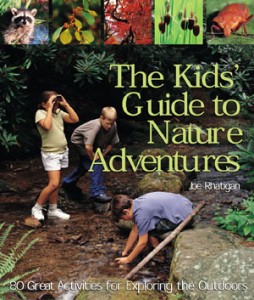
80 Great Activities for Exploring the Outdoors
Whether their outdoor adventures include camping, hiking, or just exploring the backyard, kids will have a memorable experience with this cheerfully illustrated “nature guide” in their backpack. It’s filled with super projects and games. The fun begins at home with instructions for making such necessities as a sleeping bag and first aid kit, and continues at the campsite with ghost stories and a sing-along. Take a closer look at wildlife by learning animal calls, setting up a bird restaurant, or constructing an earthworm apartment. Try one of the 10 special hikes; maybe the one where you go on the prowl for owls. Most important, see how to leave everything as you found it, and how to bring nature back home in the form of a journal, sketchbook, audiotape, or photographs. With 80 cool outdoors activities to choose from, children won’t want to come back inside!
—from Taproot, A Publication of The Coalition for Education in the Outdoors.
ISBN 1579903738 from Lark Books, 2003, 28 pgs, $17.95 ($27.95 Canada)
by editor | Feb 25, 2010 | Outdoor education and Outdoor School, Place-based Education
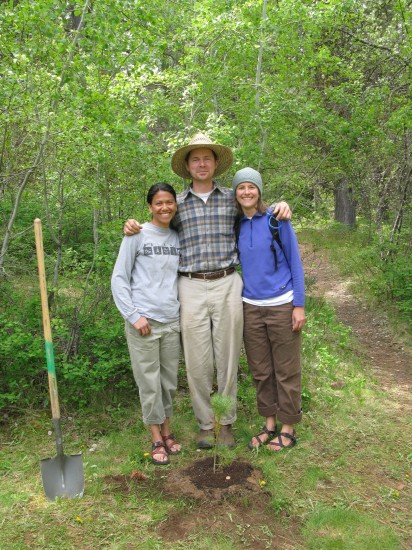
Anne Marie Untalan, Michael Becker, and Ashley Sprouse, developers of the HRMS Outdoor Classroom Project.
CLEARING: What have been the most difficult issues in getting this project started?
Michael Becker: One of the Permaculture Design Method principles is to start small, and I highly advocate for starting with small projects that you can have initial success with. Trying to get space is often a hurdle, and if you can show that you have managed a small space efficiently and generated student interest and outcomes you’re more likely to be able to expand. It’s important to have a sense of where you’d like to go in the future but be focused on what you can do today. (more…)

by editor | Feb 25, 2010 | Outdoor education and Outdoor School, Place-based Education, Schoolyard Classroom
 Hood River Middle School Outdoor Classroom Project
The Outdoor Classroom Project is a work in progress where students are the researchers, engineers, designers, architects, builders, and users of a multidisciplinary, multi-sensory learning experience.
What you see when you approach the schoolgrounds at Hood River Middle School is nothing short of remarkable. From solar panels on the roof to a working greenhouse in the back, Hood River Middle School exhibits the markings of a unique and visionary school of the future.
As more and more schools around the country are beginning to organize their curriculum to include concepts of ecology, community, and sustainability, some programs, through innovation, vision and determination, move forward in meshing those concepts into a cohesive, integrated and successful program and serve as a model for others to follow. The Hood River Middle School Outdoor Classroom Project has become an exemplary program that began small and grew to encompass an ecological framework that gives students a unique blend of science, technology and permaculture that connects them to real world issues within their community.
Since 1998, science teacher Michael Becker has guided a program that offers students a higher level of connectivity between school and community. Using a hands-on approach to solving real-life problems, students at HRMS accelerate through the basic skills and concepts outlined in the Oregon Academic Benchmarks. The Outdoor Classroom Project is a work in progress where students are the researchers, engineers, designers, architects, builders, and users of a multidisciplinary, multi-sensory learning experience. The Outdoor Classroom Project connects students to key concepts in sustainability through a field based, experience-driven curriculum. Key themes of the project include Diversity, Water, Food, Energy, and Waste.
The Outdoor Classroom Project is divided into three separate strands. (more…)


