by editor | Feb 22, 2010 | Marine/Aquatic Education
Beach Hoppers: Inquiry-based learning while having fun!
Field trips are exciting. Field trips incorporating inquiry-based learning and live animals are even better.
by Stephanie Schroeder
This second grade unit focuses on beach hoppers, tiny amphipods found on most sandy beaches. The first three lessons focus on learning beach hopper characteristics in the classroom and teaching students how to do scientific fieldwork. Once the students are beach hopper experts, they take a field trip to the sandy beach to conduct experiments on beach hoppers.
Background
On the west coast, there are primarily 2 species of beach hoppers, Orchestoidea californiana and O. corniculata. The animals reach lengths of 28 (1.1 inches) and 25 mm (.98 inches), respectively. Beach hoppers can be found along the mid tide line where the sand is neither too dry nor too wet. Typically, they can be found on both sheltered and exposed beaches, near washed up algae. It is best to go in search of them prior to the field trip. Look for small holes and start digging or look under algae in the wrack line. (Refer to the Beach Hopper Biology websites listed in the Resources section.)
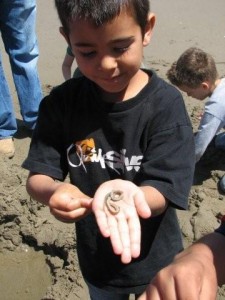
A second grader finds a worm. (photo by Trish Mace)
Introductory Lessons
Lesson 1-Intro to beach hoppers-KWHL chart
Goal-how to ask good science based questions while learning about beach hoppers
Key concepts-Good science based questions help us learn information and sharing information is a good way to learn.
Show a picture of a beach hopper and describes where they live and sets up a chart, labeled ‘Beach Hoppers’ with four columns-what we know, what we want to know, how we can learn, and what we learned. Students are asked to provide their thoughts and ideas on the first three questions. If time permits, the instructor can label the picture of a beach hopper and go through its anatomy (antenna, eye, head, thorax, abodomen, walking legs, cheli) and discuss how the parts of the animal are used. (A beach hopper picture with anatomical labels can be found on the OIMB GK12 webpage, under Beach Hopper Unit Summary, see Resources section.)
Lesson 2-Can you jump as far as a beach hopper?
Goal-measuring and introduction to proportions by comparing how far beach hoppers and humans can jump (Relative to body size, beach hoppers can jump much further than humans.)
Key concepts-accurate measuring and proportions
This lesson incorporates live animals and math. First ask students if they think they can jump farther than a beach hopper. Divide the students into two groups. Each group measures both how far they and a beach hopper can jump. Measure the heights of students in group one. Lay a tape measure on the ground and record how far each student can jump. In group two, students put a beach hopper in their hand and measure its length with a ruler. To determine how far a beach hopper can jump, place a target with circles indicating 3, 6, 9 and 12 inches from the center on the ground. Each student puts their beach hopper in the middle and observes how far it jumps. Switch roles for groups and repeat. Introduce the concept of relative body size proportion, explaining how a beach hopper can jump much farther than a human. Determine how much farther a beach hopper jumps, compared to its body length, than humans can. (A worksheet can be found on the OIMB GK12 webpage, under Beach Hopper Unit Summary, see Resources section.)

Lesson 3-Wrap up and review, field trip preparation
Goal-prepare the students for the field trip and plan and discuss the field trip experiments
Key concepts-appropriate field trip behavior, how to ask a good question and conduct experiments
Lead the students in a discussion to decide and list good field trip rules and what the class needs to bring to the beach. Revisit the KWHL chart and have the students reflect on what they have learned about beach hoppers, what more they want to know and how, when they go to the beach, they could discover some answers. Lead a discussion on what the students will do on the field trip based on their responses. Guide them towards the three experiments planned for the field. The first determines where (high, mid and low) in the tidal zones beach hoppers live. The second examines what substrate beach hoppers prefer to live near. The final experiment looks at if beach hoppers hop in a specific direction when released.
Field Trip
Reconnaissance work will be needed to determine the best beach for the field trip. Factors include location, ability to easily locate beach hoppers, safety of the beach, human activity, and how much beach is exposed during low tide. Although an extreme low tide is usually not required, the tide must be low enough to expose the area of digging for the duration of the field trip.
Supplies
Shovels, buckets, sieves (a kitchen colander with small holes will work), clipboards, Rite in the Rain paper, pencils (Field trip data sheets can be found on the OIMB GK12 webpage, see Resources section.)
Divide the students into groups of no more then 10 students with at least one group leader and 2 helpers. Each group should have 3 shovels, 3 buckets, 1 sieve and 1 clipboard. Designate one student to be the recorder for each experiment and switch recorders for each experiment. Allow 30-40 minutes for each experiment.
Once the students arrive at the beach, hold a review session with the entire group to remind them of their 3 experiments and review beach etiquette (treat animals with respect, refill any holes dug, etc).
Experiment 1-Where do beach hoppers live?
The expected answer-they live at the mid tide line where it is not too dry and not too wet. Beach hoppers are poor swimmers and cannot live low on the shore where there is too much water, but will dry out if they are too high on the shore due to the sun. (Give students a hint that they should dig near holes). (See field journal sheet 1 on OIMB GK12 webpage in Resources section)
Have students predict where and why they think they will find the most beach hoppers. Start digging at the high tide line and have students count how many they find and record their data. After 10 minutes, have the students move to the mid tide line and repeat their search. After 10 minutes, repeat at the low tide line. Have them make observations about the size and color of the organisms.
Experiment 2-What do beach hoppers like to live near?
The expected answer-they prefer seaweed as that is what they eat. It also provides refuge from the sun and predators. (See field journal sheet 2 on OIMB GK12 webpage see Resources section)
Keep the students in the same groups and work in the mid intertidal where there are the most beach hoppers. Ask the students to list possible habitats-seaweed, rock, driftwood, and just sand. Start digging and have the students keep tally of how many beach hoppers they find near each spot. Have the students capture and place beach hoppers in a bucket containing some damp seaweed for the next experiment.

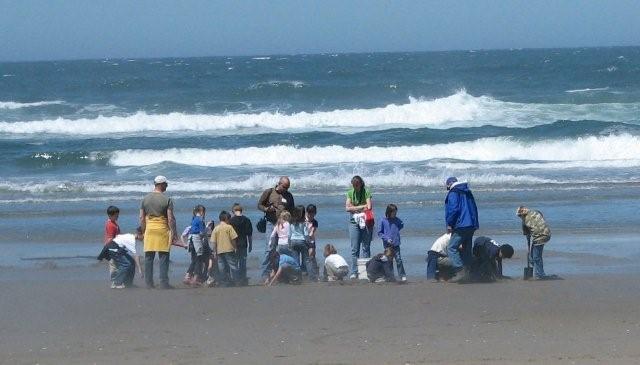
Hillcrest Elementary second graders on an inquiry-based field trip at Bastendorff Beach, Oregon. (Trish Mace)
Experiment 3-What direction will a beach hopper hop?
The expected answer-beach hoppers orient themselves according to the slope of the beach, jumping landward. This prevents them from moving downward on the shore where they would get into deeper water where it would be harder for them to swim. (See field journal sheet 3 on OIMB GK12 webpage in Resources section)
The students will hopefully have collected 20-30 beach hoppers. Lead a discussion on how the beach hoppers should be released (head towards the water, head towards the land, etc.) Students release equal numbers of beach hoppers at the high, mid, and low zones and observe the beach hoppers’ behaviors. Assign students the task of releasing one beach hopper at time and have them observe the direction they hop. One student will record the direction the beach hopper moved, writing if the beach hopper stayed there or continued moving.
If time remains, students can practice sieving sand and looking for other animals, seeing what lives where.
Post lessons
Many lessons, from a variety of disciplines can be created based on the field trip.
Examples:
Graphing-have the students graph the distribution of beach hoppers per zone (low, mid and high tide lines)
Day in the Life of a Beach Hopper-each student will write and illustrate a story depicting how a beach hopper would spend a day
Zonation poster-students can work in groups or individually to draw a poster showing what they found in different zones of the beach.
Credits
Jan Ward, Alix Laferriere, Merry Lojkovic, Kara Davidson, Ashley Binter, Ben Grupe
Resources
Beach Hopper Biology Websites
http://www.wallawalla.edu/academics/departments/biology/rosario/inverts/Arthropoda/Crustacea/Malacostraca/Eumalacostraca/Peracarida/Amphipoda/Gammaridea/Talitridae/Megalorchestia_californiana.html
http://www.answers.com/topic/beach-hopper
OIMB GK12 Beach Hopper Unit Summary
http://www.uoregon.edu/~oimb/Academics/GK12/field inquiries/beach%20hopper%20field%20inquiry.pdf
OIMB GK12 Field Trip Data Sheets
http://www.uoregon.edu/~oimb/Academics/GK12/field%20inquiries/Hopper%20Field%20Journal.pdf

by editor | Feb 19, 2009 | Outdoor education and Outdoor School, Schoolyard Classroom

by Lyanda Haupt
Seattle Audubon Society
Birds are everywhere. Their lives hold myriad ecological lessons, some obvious, some subtle. No matter where we live, or where we teach, there are birds to be found. They may not be wondrous, rare, or exotic. They may be an uninspired mix of starlings and pigeons. But they ARE birds, living definitively avian lives, and as such, they are the perfect subjects for schoolyard studies of bird behavior, flight, social habits, feeding preferences, and much more.
We’ve all seen hot-shot birders, calling out the name of every bird that flies by. It’s easy for teachers to feel intimidated, and believe that since they don’t have that level of competence, or perhaps don’t know the names of any birds at all, that they are not qualified to teach students about birds. The truth is, all you need is a schoolyard with a pigeon or a crow in it, to begin studying birds with some depth. The secrets of birds lie not in their names, but in their lives. Observation is the best, and most direct pathway to learning about our avian neighbors. Explore birds holistically, and learn their names as you go.
The study of birds can complement any environmentally minded program. Avian observation increases understanding of adaptations, species, biodiversity, and food webs. Schoolyard observations can lend depth to concepts such as native versus non-native species, and biodiversity. Watching birds can even complement studies in paleontology, since many prominent geologists now believe that birds are living dinosaurs! With guidance, students can gain competence in data collection and field identification. Perhaps the most enriching aspect of schoolyard birding is that it increases students’ awareness of the natural world as it surrounds them day to day. When they journey to a natural place, they will be awakened to the presence of birds, and ready to see more.
Birdwatching with Kids
The most important thing on a bird walk with young people is to have an enjoyable time that increases their interest in birds and the natural world. You don’t have to be seriously and silently slinking around, stalking birds every second. It’s probably best to go on a bird watching walk – a fun hike punctuated by times that everyone stops to look for birds.
Being in the outdoors, working with binoculars, field guides, and searching for birds is a lot to do. You don’t have to overload the time with planned activities. Here are some simple suggestions that can be incorporated into your walk. These are foundational ideas that can form the basis of a bird walk for any age group or experience level.
Enter a Place Quietly. Groups of people have to be particularly aware of the noise they make. Try to plan your bird walk before a recess, or well after one, so the birds have time to recover from frolicking youth. The less talking on a bird trip the better. If you enter a place quietly and respectfully, the birds will grace you with rare glimpses into their lives.
Starting Off. Sometimes a group of students will be pretty hyped up at the beginning. Try to start with an activity that gets students quieted down and focused on their surroundings. With eyes closed, have students listen for birds around them. Give them some time – four or five full minutes. Have them open their eyes, and still sitting in one place, quietly notice any signs of birdlife around them, without trying to identify or analyze any of it.
Experiment with Birding Methods. What works best? Some birders walk around and just see what they see. Some birders see a bird from afar, and then quietly sneak up on it until they have a good view. Some birders sit quietly in one place that looks promising and wait for the birds to come near. Have students experiment with these methods, and see what they think works best. Do some birding strategies work better for some species of birds than others?
Use Real Names. Young people are ABLE and WILLING to learn the real names for birds, other animals, and plants. Look at how well some five year olds can rattle off the long scientific names for dinosaurs! Use complete real names for the species of birds that you know, and encourage students to do the same. If the name of a species is difficult, repeat it together several times.
“Pishing.” This is a secret technique that birders use to get birds to come out of the bushes and show themselves. Make a sort of spitty pishing sound – “PISHHH-PISHHH-PISHHH.” Many birds are curious about this sound, and will come out to investigate. If you sit very still and don’t talk (other than to PISH) some birds may come startlingly close. Very fun!
Field Notes. Keeping a field notebook is probably the best thing anyone can do to learn to appreciate birds in the field. It’s a place to record individual observations, sketches, strange things that birds do, new species, and literally anything that occurs during the day that may help a student to remember a bird walk, and the birdlife experienced. It’s a place to ask questions and seek answers from the birds themselves. By putting pencil to paper in the field notebook, observations become crystallized, and experience becomes focused. Field Notes can include a record of the day – weather, time, other observers, etc., a list of species seen and their behaviors, vocalizations, habitats, sketches and descriptions, anything that makes the experience memorable.
Expect UFOs. Even expert birders encounter unidentifiable flying bird-objects. Let the kids know that not all birds can be identified by everyone, and that’s O.K. It’s part of the mystery that keeps bird watching fun.
A Note About Attracting Birds to School Grounds.
There are many great resources that can assist you in choosing native plants and feeders to create an avian sanctuary on school grounds. With work, you can attract new species to an urban area. Just make sure to use feeders specific to the kinds of birds you want to attract, and take steps to minimize use by non-natives. Don’t let worries over the long-term existence of your feeding station stop you. Contrary to popular belief, it IS okay to feed birds for awhile, and then to stop. Birds use feeders because it’s easy, not because they have to. When your feeders are removed, the birds will go back to natural sources for food.
Birds are everywhere! One great thing about watching birds is that you can pretty much always find one. Crows, pigeons, and starlings are all good examples of “birdness” that are readily available. They are walking around vocalizing and exhibiting interesting behaviors all day long. Even if you can’t swing a major field trip or uncover an exciting avian rarity, you can take advantage of the birdlife that’s around you everyday, and engage birds as a powerful educational tool.
Resources at the Seattle Audubon Society
Seattle Audubon offers an educational kit called “Birds in the Field.” Ten field bags contain binoculars, field guides, bird calls, and field notebooks for each student to keep. A leader’s pack contains all of the above, plus flash cards and the booklet “Sharing Birds With Students,” to help you get started with field guides, binoculars, identification, taking walks and field trips, using field notes, etc.
We also have two other kits to complement bird studies. “Symphony of the Birds” is an audio-visual introduction to avian vocalizations. “Feathers, Fossils, Flight” is a hands-on introduction to the adaptations that birds have for flight. It includes a reproduction of the first fossil bird Archaeopteryx, as well as many wings, bones, feathers, and more”
Kits are available to rent for one week at a time, or a Seattle Audubon naturalist can visit your site to present a program. Contact Lyanda Haupt, Seattle Audubon Education Coordinator at (206)523-0722, lyandah@seattleaudubon.org
Schoolyard Birds
Here is a short introduction to the species that you are likely to encounter in an urban or suburban schoolyard. With a little practice and observation, the various species can come alive in their uniqueness. Many of the common schoolyard birds are non-native birds that thrive in disturbed habitats. While it may make them less interesting ecologically, many of these birds exhibit fascinating behaviors, and are quite intelligent. They are still great tools for learning about birds in general.
Eurasian Starling Many people call starlings “blackbirds,” because they are about the size of a blackbird, and they are certainly black. Actually, they are not closely related. The starling can be separated from the locally common Red-winged blackbird by its yellow bill, and spangled plumage. In the summer, the starling looks like it is covered with iridescent jewels, as bright flecks of gold mingle with its black feathers. People are often mistakenly convinced that a bird they have seen up close could not possibly be a starling, because their bird was so pretty! Winter starlings are more drab, and the first-year birds are all brown, with a black beak and legs.
Starlings were introduced to the U.S. in the late 1800’s, and have proved to be an ecological disaster. They compete with native birds for nest sites and food, and are implicated in the decline of many sensitive native species. Even so, starlings are extremely intelligent and interesting. They are one of the best bird mimics in the country, imitating the calls of gulls, killdeer, cats, honking horns, and whatever else strikes their fancy. Listen for their long, fanciful whistles, and complex vocalizations. Starlings can learn to talk as well as mynah birds and parrots.
Rock Dove Calling the pigeon by its “real” common name, the Rock Dove, makes it sound a little more interesting. Like the starling, the Rock Dove is not native to our area. Rock Doves were introduced from their native homes in Europe, North Africa, and India. Most of the birds that we see in the schoolyard are passerines, or perching birds. The Rock Dove is not – its feet are adapted for roosting, rather than grasping tightly onto branches. Pigeons are unique in that both males and females produce a milk-like substance in their digestive system to feed their young. The baby doves plunge their bills down the parents’ throat and suck out the milk. The typical gray and purple pigeon resembles the extinct Passenger Pigeon. The numerous hybrids among city pigeons produce some intriguing color combinations – genetics in action!
House Sparrow Yup. Another introduced bird. And this one isn’t even properly named! Taxonomically, the House Sparrow is not a sparrow at all, but an Old World Finch. Find it at the very end of your field guide, rather than in the sparrow section. These are the small, brown birds that jump around under your feet at outdoor cafes, awaiting the crumbs of your bagel. They also chirp about the shrubbery of schoolyards, and nest noisily beneath the eves. The males have a gray cap and black throat. Females are a drab gray-brown, with a light brown eye stripe. House Sparrows have a beak made for seed-eating. Watch them forage on the ground for bits of plant material.
American Crow The amazing black bird with the raucous “CAW CAW CAW!” The crow is one of the most intelligent birds out there. They are known to use tools, problem-solve, mourn the loss of family members, and PLAY. Crows are scavengers that will eat just about anything, but they prefer meat. Even though they are so large, crows are passerines, or “songbirds,” just like robins and chickadees.
Steller’s Jay The Steller’s Jay is in the crow family – closely related to the larger American Crow. If you have trees around your schoolyard, you may attract this brilliant blue bird with the unwieldy black crest. Like crows, Steller’s Jays are quite intelligent, and will think up all kinds of mischievous way to win more food than all the other birds. They will even sit at feeders and imitate the call of a Red-tailed Hawk to scare smaller birds away. Jays can cause problems for other birds, attacking and eating their eggs and nestlings.
Black-capped Chickadee This is another bird that requires some cover – at least small trees or shrubs. These tiny gray and white birds with black masks are a birdwatcher’s treasure. They are common, but constantly delightful, gleaning insects, caterpillars, and seeds from the branches. The chickadee repeats its own name in its call – a nasal “chickadee-dee-dee.”


