by editor | Jun 12, 2014 | Place-based Education
10 Questions to Ask When Developing Place-based Learning Experiences

by Gregory Smith, Professor of Education, Lewis & Clark College
 he March 19, 2014 Oregonian included an article about two math teachers at Benson High School in Portland who have created a course they call Tech Geometry that requires students to apply their emerging mathematical understandings to projects that have social value. They combine work in the classroom with work in a spacious auto shop where they use what they’ve learned about triangles, the Pythagorean theorem, or trigonometric functions to design and construct a 120-foot structure for the otherwise homeless residents of Portland’s Dignity Village or a playhouse for Escuela-Viva, a nearby bilingual preschool.
The class is an example of place- and community-based education. This approach to teaching and learning involves finding ways to give young people a chance to use their emerging academic knowledge and skills to make positive contributions to their community. The result is almost always engaged students, energized teachers, and enthusiastic community members. Learning becomes meaningful as the boundaries between classroom and the world beyond are reduced, students understand the value of what they’re learning, and tax-paying citizens come to see public school as an institution that gives back as well as takes.
Developing lessons or units that incorporate these possibilities can serve as an important motivation for student learning. Even with today’s emphasis on instruction driven by standards and tests, teachers in school districts around the United States and other countries are finding ways to integrate opportunities for applied learning outside the classroom into their work with students. Teachers successful in moving in this direction start small with projects that easily connect to curriculum requirements and have a strong likelihood of success. To guide their efforts, they often consider the following questions:
1. What local topics, issues, or projects are likely to be meaningful for students and give them an opportunity to participate in learning activities that others will value?
2. What aspects of the required curriculum are related to this issue or project? List specific subtopics that students might explore, including those related to other subject areas.
3. What four or five overarching questions might guide your students’ study?
4. What specific learning standards would this topic or project enable you to address?
5. How will you assess student learning? List possible strategies, including some culminating projects. Discuss how you will scaffold the learning that students need.
6. What community partners might you bring into the classroom to help teach this unit or to support activities outside of school?
7. What field studies, monitoring, or other inquiry activities might students become involved with in their neighborhood, community, or region?
8. What community needs might students address as part of this unit or project? What service learning opportunities does it afford? How might you publicize the contributions that students make?
9. How might students become involved in community governance activities related to this project? How could they participate in data gathering, reporting, or other forms of public participation, such as organizing meetings or planning community events?
10. What creative possibilities in the fields of art, music, dance, film, or theater relate to this project? What about vocational opportunities or internships?
More than anything, implementing place- and community-based education requires a shift of perspective and the willingness to see learning opportunities in something other than textbooks, computer programs, or laboratory experiments whose end results are already known. By approaching the world beyond the school as a text filled with potential resources and needs, teachers can bring to their students the kinds of learning experiences that once lay at the heart of cultural transmission in earlier human societies, experiences that gave young people the chance to develop valued competencies and to perceive themselves as people able to contribute to the well-being of their community. When this happens, learning becomes not a chore but a means for realizing one’s identity and ability to make a positive difference in the lives of others.
Gregory Smith is a Professor Emeritus of Education at Lewis & Clark College in Portland, Oregon. Contact him at gasmith@lclark.edu
This article originally appeared in TOST, the journal of the Oregon Science Teachers Association, June 2014.
Addendum:
Place-Based Education Northwest was formed following a suggestion from a participant at a two-day workshop about this educational approach in November, 2005. Its primary purpose has been to serve as a meeting place for people interested in making room for local knowledge and learning experiences in regional schools. The organization now meets twice-yearly in early December and May at Lewis & Clark College in Portland, Oregon. These gatherings have provided an opportunity for local educators who have adopted place-based approaches to share what they are doing with others. Meetings have also served as the springboard for the beginning of local workshops and Institutes about place-based education as well as presentations at regional conferences.
For more information about this network, go to the PBENW Blog at: http://placebasededucationnw.blogspot.com/p/history.html
by editor | May 15, 2014 | Place-based Education
Successful educational projects that focus on the community share key characteristics.
by James Lewicki
During the last several years, I have worked with dozens of elementary, middle, and high schools that value place-based learning enough to shift curriculum priorities to seeing that students, as well as studying about the community in the classroom, learn in the field with community elders and experts. Privileged to see what works across the country, I have coached students and teachers to create productive place-based projects. Over time, I have seen again and again how a handful of characteristics always frame good work.
In trying to distill these essential features into a mnemonic device, I came up with eight characteristics. The first letters of each word form the acronym MEASURES. (Considering that a worthy placed-based project measures academic achievement and personal success, this is a highly appropriate term.) Where I see great place-based work, I find these characteristics active and alive; where I see the place-based vision embraced, but the reality struggling, it is always because two, three, or maybe more of the characteristics are lacking.
Read the rest of this article here.
James Lewicki is a national director for EdVisions who works with schools across America that embrace project-based learning, as well as a National Rural Faculty member of the Rural School and Community Trust.

by editor | Jun 7, 2013 | Place-based Education, Schoolyard Classroom
Stepping into the Real World – What happens when you open the door
by Jim Martin,
CLEARING Associate Editor
Let’s explore what science and environmental education could look like if we were to use the real world as if it were an authentic source of curriculum, and a place to start our work. The place we’ll explore is a suburban school yard. There is a small creek at the edge of the school property. Its west side has a tall fence at its edge; beyond is an apartment complex. On the school side, the bank faces a playing field. There are trees and shrubs along both sides of the bank. Closer inspection reveals that the stream has two riffles along its length, a glide or run above the first riffle, between the two riffles, and beyond a pool at the end of the second riffle. Riffles are places in a stream where the water splashes and turns white. Glides or runs are places where the water moves quickly, but doesn’t splash. Pools are places where the water moves slowly, and has a relatively smooth surface. (more…)
by editor | Jan 19, 2013 | Environmental Literacy, Place-based Education
The Urban-Rural Exchange Bridges Oregon’s Greatest Divide
By Judy Scott
From Oregon’s Agricultural Progress
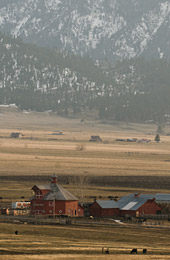
Wallowa County in northeast Oregon was the destination for one of this year’s four exchanges. The young guests from the city arrived in the thick of calving season, a dynamic leap into ranch life. Photo by Lynn Ketchum.
 ix lanes of Portland traffic filled the rear-view mirror as the van headed east on I-84. On the left, the Columbia flowed through its gorge below giant windmills scattered like toys, turning with the breezes. After a few hours, sagebrush took the place of Douglas-fir and fern.
The riders from Portland’s Sunnyside Environmental School had reason to be nervous as they watched the familiar give way to the unknown. And it wasn’t just the landscape that would change.
The 15 middle-school students were already immersed in a life-broadening experience: the 4-H Urban-Rural Exchange program, sponsored by Oregon State University Extension Service. For five years, host families from Grant, Klamath, and Wallowa counties have opened their homes and lives (sometimes nervously) to city kids. In turn, Multnomah County families introduce rural students to life in Portland.
Wallowa County in northeast Oregon was the destination for one of this year’s four exchanges. The young guests from the city arrived in the thick of calving season, a dynamic leap into ranch life.

The Portland students (above) weren’t sure what to expect when they arrived in Wallowa County to stay with rancher Charley Phillips and his wife Ramona. Soon, the students were pitching in to help with all the chores, including branding calves at the Birkmaier ranch (below). Photos by Lynn Ketchum.
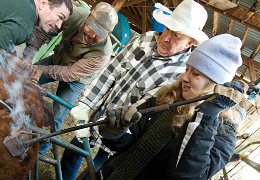
Deep in the Wallowa Mountains, hosts Tom and Kelly Birkmaier and a crew of friends rounded up 65 calves for branding. While unhappy mother cows bawled in the distance, the job was to brand, inoculate, and ear-tag the calves as quickly as possible while muscling them securely into a metal chute.
This was no spectator sport for Portland middle-schoolers Zoe O’Toole and Birch Clark. Although reticent at first (“I’m not really sure how I feel about branding,” Zoe had confided earlier), the girls gamely took turns with both the branding iron and the syringe.
Down in the valley at another host home, a cow notched up her tail, and three other city students learned what that meant: the cow was ready to give birth. Lanie Novick and her middle-school colleagues watched in awe as the calf dropped from its mother’s womb while Lanie documented the event on her cell phone. Ramona and Charley Phillips, who hosted the girls at their ranch near Joseph, were impressed with the students’ enthusiasm and unending questions as they collected eggs each morning and tossed baled hay from the back of a truck to a “sea of cows.”
Calving season knows no time clock. After midnight, the girls bumped along with the Phillipses in their pickup truck, scanning the range with spotlights in search of cows with newborns. The girls learned that if they spotted cows bawling and bunched up around their calves, there might be predators such as cougars or wolves stalking nearby.
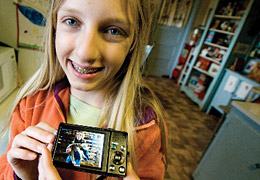
Seventh grader Lanie Novick (above) displays a memorable snapshot of her Sunnyside classmate Julia Glancy holding a newborn lamb. The learning experience includes classroom time at the Imnaha School (below), where five local students make up the total K-8 enrollment. Photos by Lynn Ketchum.
Part of each exchange includes spending a day at the host school. Portland students Morgaen Schall and Joseph Unfred swelled enrollment of the one-room schoolhouse in Imnaha by 40 percent on the day they went to class with the school’s five local students.
Morgaen and Joseph both love working with horses in Portland but prefer being “in the middle of nowhere.” Their stay was not romantic—mending fences seldom is—but they enjoyed the outdoor work, and to show their appreciation, the two boys made a special Sunday breakfast for their hosts, Cynthia and Dan Warnock and their three sons.
More than half of the urban-rural exchange students have kept in touch with their host families. Sometimes during the summer they cross back over the cultural divide to reunite with their hosts and to share the experience with their parents. The exchange expands when parents get involved. Thirty families in Portland now buy beef directly from a host rancher as part of a new beef cooperative, an idea that grew from the young people’s exchange.

Back on the ranch (above), feeding time is fun for students and cows. In Portland, students used mass transit to navigate the city (below). Photos by Lynn Ketchum.

“The basic mission of 4-H is education for youth,” said Jed Smith, a 4-H faculty member at the Extension office in Klamath Falls. “But 4-H also involves parents in Extension education. When you get young people in the conversation, you’ve got a good start towards better understanding between remote rural Oregon and the rest of the state.” Smith wants his urban visitors to experience first-hand the life of rural ranchers and farmers. “They see that ranch families are good with animal husbandry, they’re responsible stewards of the land, but they face different challenges than urban families,” he said.
One of those challenges is the reintroduction of wolves, which sparked the creation of the urban-rural exchange. In 2005, after Sunnyside students completed a class project on how westward U.S. settlement affected wildlife, the students gave testimony at a state Fish and Wildlife Commission hearing in favor of reintroducing wolves. The urban students didn’t expect that their opinions would spark controversy in rural Oregon, where ranchers bemoaned that city dwellers didn’t understand rural life. To foster better understanding across the state, OSU 4-H and Sunnyside joined forces to create the first Urban-Rural Exchange in 2006.
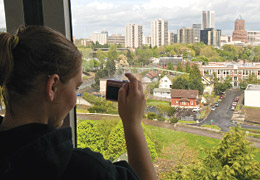
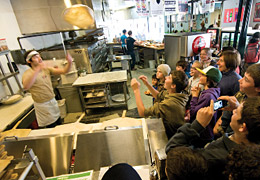
Students from Klamath County get a tram’s-eye-view of Portland (above) while Hot Lips pizza shows off their spin cycle (below). Photos by Lynn Ketchum.
Everyone involved that first year, from both sides of the Cascades, ventured into unfamiliar territory. At least one rancher would have pulled out at the last minute if the city kids were not already on their way. However, at the end of five days of sharing chores and meals together, both students and families described the exchange as one of the best experiences of their lives.
Each year, some of the city students come home thinking that farming and ranching would be professions they’d like to pursue. “We want them to learn about the care of natural resources from a rural perspective,” said Maureen Hosty, the OSU 4-H Extension faculty member who coordinates the exchange. “Sometimes they take it to a personal level. They want to live there.”
Fewer rural students visiting Portland express a strong desire to relocate to the city. Perhaps city living is an acquired taste. Dylan Denton and Trevor Wentz, both from Wallowa County, enjoyed their day exploring mass transit and gliding over the skyline by tram. But considering that a square mile in Portland is home to 3,939 people, and in Wallowa County, it’s home to 2, they had to conclude, “There are too many people!” Nevertheless, according to their host family mom, Dylan and Trevor readily took to “a crash course” in riding bicycles in city traffic, even while pedaling in cowboy boots.
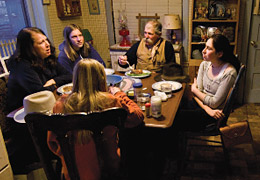
The bustle of city life contrasts with the quiet of dinner time after a long day’s work on the ranch. Photo by Lynn Ketchum.
Portland hosts helped their rural visitors understand sustainable urban living. They climbed to the top of city buildings to see rooftop landscapes that temper winter stormwater and summer heat. They visited the city’s massive recycling system. And they walked through one of Portland’s 20 farmers markets, where they ran into a potato vendor from faraway Wallowa County.
More city kids have made the exchange than their rural counterparts, and Hosty encourages more students from rural Oregon to visit Portland. “We want to build a strong bridge of understanding that goes both ways,” she said. The bustle of city life contrasts with the quiet of dinner time after a long day’s work on the ranch.
“We have a lot more in common than we realize,” Hosty said. “But if we don’t spend some time walking in each other’s shoes, then misunderstandings will continue to divide our state.” The 4-H Urban-Rural Exchange can make a difference. “Kids are leading the way and are willing to spend some time to learn. And the real learning happens in family homes at the dinner table.”
by editor | Dec 7, 2012 | Place-based Education
by Harmony Roll, Clearing Regional Advisory Panel
from Taiga Teacher
 |
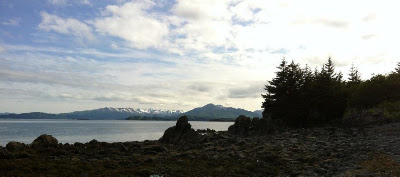
The turn around point on my regular running trail in Kodiak.
|
 hen I had my 3rd and 4th grade multi-age classroom in Fairbanks, I was in teacher paradise. I was in a Title 1 school, but was given a lot of freedom and autonomy to do what I felt best for my students. Part of that was an amazing administrator who knew I had a different situation teaching two grades, but also one who believed in multi-age and allowed me to make the decisions I needed to to make it truly work. I learned so much about my students having them for two years. I came to understand the breadth of the learning process. I also was challenged with creating new projects and approaches. You can not get in a rut when you teach multi-age like you can with a straight grade. Things have to be new and fresh each year because a large portion of your class you had the year before. One thing you can do is take a format that the kids know from one year and apply it to the next to allow them comfort and the ability to go deeper with their curiosity and study.
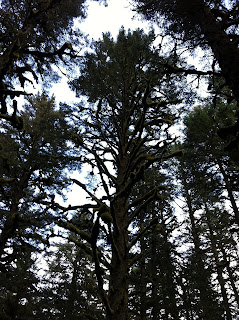 The first year I had my multi-age we did Moon Journals. The second year, the plant life cycle was part of our curriculum. We did Tree Journals. Students adopted a tree and observed it over the course of the school year. They drew about it, wrote about their observations, documented what they learned about trees and plants in general. One of my favorite things that came out of the year long study of trees was “Tree Movies.” We had great big beautiful windows in our classroom that looked out to the trees lining the Noyes Slough that ran by the school. When students noticed the trees dancing in the wind, or the alpenglow on the frost of the trees at sunrise (late morning in the winter in Fairbanks) they would ask me to shut off the lights and we would quietly watch the “Tree Movie.” A wonderful break in our busy routine and a communal experience of appreciation for the beauty of nature, remembering there was more to life than what remained inside the four walls of the classroom or the math problem in the workbook.
Studying one tree, one place or one trail is important. We live in a culture where conquering is so important. Even people who spend much of their lives outdoors like to have conquests in the form of Peak Bagging or seeing as much of the world as they can. This is important, but just as important is getting to know one place well. My husband thinks it’s funny that I like to run the same trail all the time. The only change is adding distance. I do this for many reasons… running the same course I know my body better and how much faster I can go, how much more I can push myself each time, but also I love noticing the weather patterns by seeing the sky from the same place over and over. I love seeing the same trail at different times of the day and noticing the subtle changes of the season from run to run. I enjoy walking the same trail and seeing things I totally missed when running by. I’ve known many places in my life by the trails I frequented. I mark milestones in my life by the way those trails looked as I traveled down them, processing the information from the day. One of the important things we owe our children is how to relate to spaces. Giving them the opportunity to get to know them intimately, deeply without pushing them to keep moving on. At the same time we need to let them find that space. Plopping them down and telling them to love a place won’t work. They need to choose the tree, trail, land, and….. decide when to move on… if they need to.
I think of a man I heard about once who climbs Mt. Monadnock in Southern New Hampshire every day for years. I wonder how much he understands about the world because he understands that one place. How much he has seen the landscape change and remain the same. Here’s an article from Yankee Magazine about him.
Much of the angst in my life has been leaving places I’ve come to know well and some of my greatest joys have been finding new ones.