
by editor | Mar 2, 2011 | Place-based Education
 The following is part of an on-line discussion between Greg Smith, Associate Professor at Lewis and Clark College in Portland, and David Greenwood, Associate Professor at Lakehead University in Thunder Bay, Ontario Canada.
Dear David,
I’ve been puzzling over an issue to raise with you for another blog entry, and I’ve found myself coming back to the impact that hierarchies of knowledge and skill have on the use of learning opportunities encountered in local communities and places. I recall this issue coming up with a friend in Madison, Wisconsin, more than a decade ago when his daughter was junior at the city’s most academically competitive high school—probably the same one you went to. She was interested in enrolling in a “chemistry in the community” course that would have allowed her to experience a more hands-on and problem-solving approach to science education. Her counselor discouraged her from doing so on the grounds that the kinds of colleges she was interested in attending would see this as a deficit. Jim, a biology professor committed to learning in the field, disagreed and wrote to academics at around a dozen colleges similar to those his daughter hoped to apply to and asked whether they agreed with the counselor. None did. His daughter enrolled in the course and ended up going to Earlham. Most students and parents, however, seem unlikely to challenge the counselor’s advice because of the way it represents common understandings about prestigious (theoretical and text-based) knowledge and less prestigious (applied and practical) knowledge. This seems like a fundamental issue we’ve got to address if we hope more educators begin to incorporate lived experience into the forms of instruction they share with students. (more…)

by editor | Jan 15, 2011 | Outdoor education and Outdoor School, Place-based Education
by Lindsay Letitia Huettman
I am out in the foggy, wet Pacific Northwest winter with my 10-12 year-old homeschoolers’ program, heading to an amazing place we call Elk Meadows. As we cross the meadow, we stop for a word of thanksgiving about the day and send the kids to their Sit Spots. The instructors also head out into the landscape, finding a place to rest and watch the morning wake under the goliath presence of Mount Si. Life is revealed to all our senses in this temporary silence. As a mentor, it helps to model to my genuine excitement at the small birds in the willow thicket while enduring the cold, damp earth that I rest upon. This is a great time for instructors; a sacred time to breathe and connect to the elements, earth and its creatures. It is also the time I invite Coyote to come out and do his secret, stealthy duty as the ultimate mentor. During this peaceful space, Coyote brings me glimpses of the internal workings of my beloved students.
If any of the students were looking my way, they would see my attention on the meadow; my head turning to interpret bird calls. Perhaps they see my chest moving up and down, taking large gulps of the mist rolling off the Snoqualmie River, and observe my eyes scanning the horizon, searching for elk on the forest edges. What they wouldn’t see is a part of my awareness is also listening to Coyote. (more…)
by editor | Dec 15, 2010 | At-risk Youth, K-12 Classroom Resources, Place-based Education, Service learning
Exploring Place-based Education Programs in the Pacific Northwest
by Becs Boyd
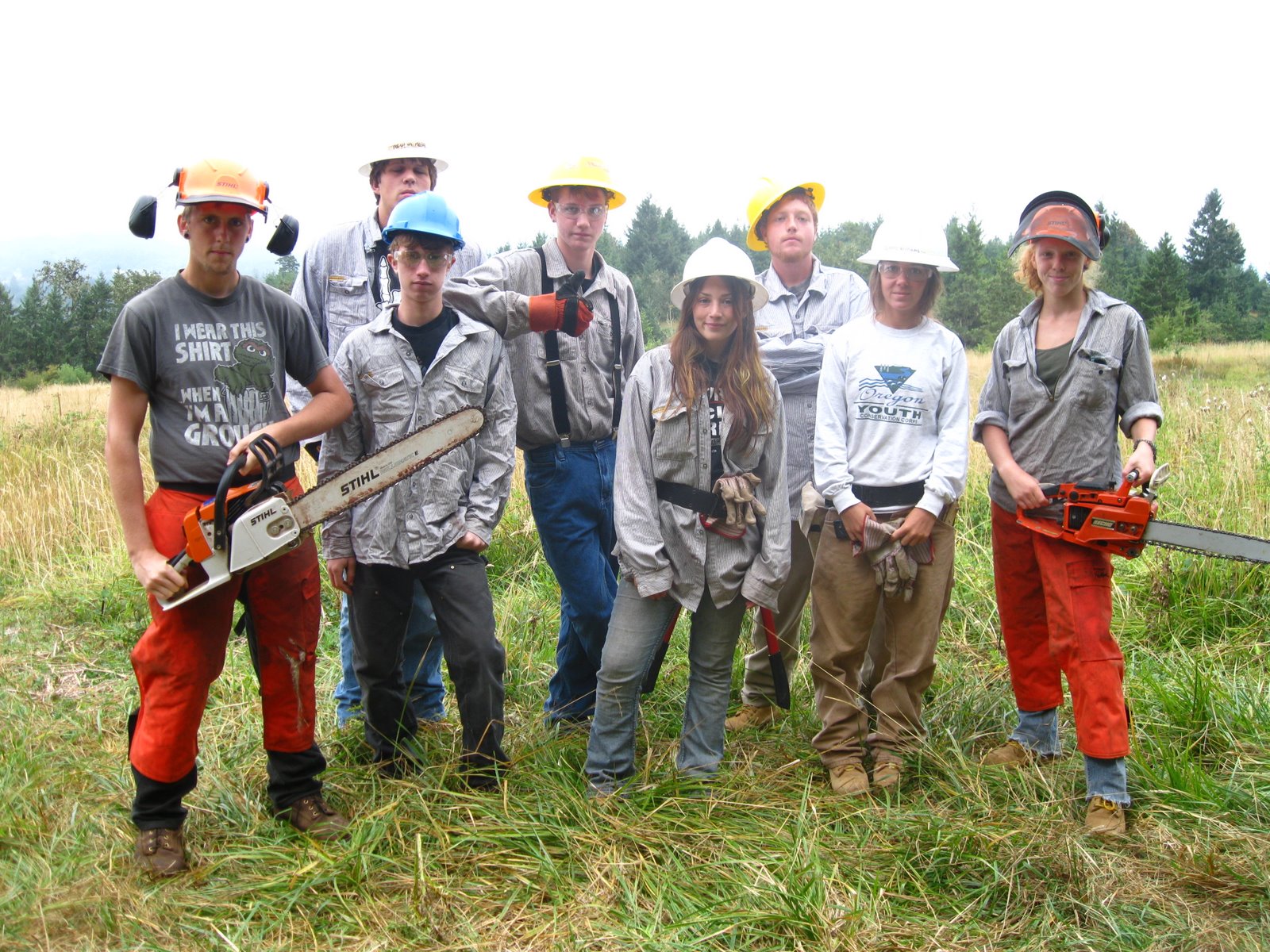
A visit to Kennedy High School in Cottage Grove, Oregon on 18 November, turns out to be one of the most uplifting days I have spent in a school, perhaps ever.
Formally known as AL Kennedy Alternative High School, the school was founded in 1998 by a forestry teacher who wanted to help students aged 15 to 18 who were struggling in mainstream education. By 2008, when current principal Tom Horn took over, the school was sinking under an attendance rate sometimes as low as 23%, serious drug problems and alarming drop out rates. Now, little more than two years on, Tom’s vision, and the perceptive and caring approach to the students which shines through the principal and his team of committed and talented staff, have completely transformed the culture of the school. Attendance rates are around 90% and the drop out rate has fallen dramatically, while test results show an upward trend. The school serves a maximum of 75 students, but there are 190 further students waiting for a place.
(more…)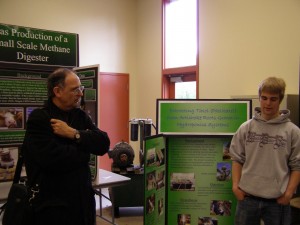
by editor | Dec 5, 2010 | Place-based Education
Exploring Place-based Education Programs in the Pacific Northwest
by Becs Boyd
On 8th May I meet Ed Armstrong, grant writer for Tillamook School District, outside Tillamook High School in north-west Oregon. I’m here to find out about the amazing work Ed and others have been doing in connecting the six schools in the Tillamook School District with their community and with School Districts State-wide.
Ed’s background is as a biology teacher at Tillamook HS from 1995-2000 when the school was one of 25 national Annenburg Schools for science. He returned after a break in 2004 to become grant writer for the entire School District, and, using this wider influence and the $6m of grants he has secured, has been at the centre of a small revolution in science teaching in Tillamook which has been internationally recognised. (more…)
by editor | Oct 19, 2010 | K-12 Classroom Resources, Place-based Education
Part two of an on-going discussion
The following is part 2 of an on-going discussion on place-based education topics between Gregory Smith of Lewis and Clark College and David Greenwood of Lakehead University in Thunder Bay, Ontario (formerly of Washington State University). You are invited to participate in this discussion and can add your comments through the reply box at the bottom of the post. Read part 1 here.
Dear David,
When you wrote your 2003 article about a critical place-based education, you rightly criticized those of us who had been writing about this approach for being under-theorized. Jan Nespor and others have continued that criticism. I’m becoming increasingly aware of the consequences of not anchoring place-based education in a more explicit critique of industrial civilization. In some respects, place-based education can mean almost anything people want it to—much like the term sustainability. Once ideas gain some currency, they take on a life of their own.
I’m seeing this happen with the way school gardens are becoming synonymous with place-based education. There is nothing wrong with the creation of school gardens—in fact, helping young people learn how to grow their own food and develop more of an affinity with agricultural practices seems essential. Wendell Berry would applaud such efforts. But school gardens, (more…)

