
by editor | Feb 25, 2010 | Outdoor education and Outdoor School, Place-based Education, Schoolyard Classroom
 Hood River Middle School Outdoor Classroom Project
The Outdoor Classroom Project is a work in progress where students are the researchers, engineers, designers, architects, builders, and users of a multidisciplinary, multi-sensory learning experience.
What you see when you approach the schoolgrounds at Hood River Middle School is nothing short of remarkable. From solar panels on the roof to a working greenhouse in the back, Hood River Middle School exhibits the markings of a unique and visionary school of the future.
As more and more schools around the country are beginning to organize their curriculum to include concepts of ecology, community, and sustainability, some programs, through innovation, vision and determination, move forward in meshing those concepts into a cohesive, integrated and successful program and serve as a model for others to follow. The Hood River Middle School Outdoor Classroom Project has become an exemplary program that began small and grew to encompass an ecological framework that gives students a unique blend of science, technology and permaculture that connects them to real world issues within their community.
Since 1998, science teacher Michael Becker has guided a program that offers students a higher level of connectivity between school and community. Using a hands-on approach to solving real-life problems, students at HRMS accelerate through the basic skills and concepts outlined in the Oregon Academic Benchmarks. The Outdoor Classroom Project is a work in progress where students are the researchers, engineers, designers, architects, builders, and users of a multidisciplinary, multi-sensory learning experience. The Outdoor Classroom Project connects students to key concepts in sustainability through a field based, experience-driven curriculum. Key themes of the project include Diversity, Water, Food, Energy, and Waste.
The Outdoor Classroom Project is divided into three separate strands. (more…)
by editor | Feb 22, 2010 | Marine/Aquatic Education
Beach Hoppers: Inquiry-based learning while having fun!
Field trips are exciting. Field trips incorporating inquiry-based learning and live animals are even better.
by Stephanie Schroeder
This second grade unit focuses on beach hoppers, tiny amphipods found on most sandy beaches. The first three lessons focus on learning beach hopper characteristics in the classroom and teaching students how to do scientific fieldwork. Once the students are beach hopper experts, they take a field trip to the sandy beach to conduct experiments on beach hoppers.
Background
On the west coast, there are primarily 2 species of beach hoppers, Orchestoidea californiana and O. corniculata. The animals reach lengths of 28 (1.1 inches) and 25 mm (.98 inches), respectively. Beach hoppers can be found along the mid tide line where the sand is neither too dry nor too wet. Typically, they can be found on both sheltered and exposed beaches, near washed up algae. It is best to go in search of them prior to the field trip. Look for small holes and start digging or look under algae in the wrack line. (Refer to the Beach Hopper Biology websites listed in the Resources section.)
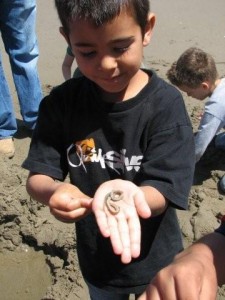
A second grader finds a worm. (photo by Trish Mace)
Introductory Lessons
Lesson 1-Intro to beach hoppers-KWHL chart
Goal-how to ask good science based questions while learning about beach hoppers
Key concepts-Good science based questions help us learn information and sharing information is a good way to learn.
Show a picture of a beach hopper and describes where they live and sets up a chart, labeled ‘Beach Hoppers’ with four columns-what we know, what we want to know, how we can learn, and what we learned. Students are asked to provide their thoughts and ideas on the first three questions. If time permits, the instructor can label the picture of a beach hopper and go through its anatomy (antenna, eye, head, thorax, abodomen, walking legs, cheli) and discuss how the parts of the animal are used. (A beach hopper picture with anatomical labels can be found on the OIMB GK12 webpage, under Beach Hopper Unit Summary, see Resources section.)
Lesson 2-Can you jump as far as a beach hopper?
Goal-measuring and introduction to proportions by comparing how far beach hoppers and humans can jump (Relative to body size, beach hoppers can jump much further than humans.)
Key concepts-accurate measuring and proportions
This lesson incorporates live animals and math. First ask students if they think they can jump farther than a beach hopper. Divide the students into two groups. Each group measures both how far they and a beach hopper can jump. Measure the heights of students in group one. Lay a tape measure on the ground and record how far each student can jump. In group two, students put a beach hopper in their hand and measure its length with a ruler. To determine how far a beach hopper can jump, place a target with circles indicating 3, 6, 9 and 12 inches from the center on the ground. Each student puts their beach hopper in the middle and observes how far it jumps. Switch roles for groups and repeat. Introduce the concept of relative body size proportion, explaining how a beach hopper can jump much farther than a human. Determine how much farther a beach hopper jumps, compared to its body length, than humans can. (A worksheet can be found on the OIMB GK12 webpage, under Beach Hopper Unit Summary, see Resources section.)

Lesson 3-Wrap up and review, field trip preparation
Goal-prepare the students for the field trip and plan and discuss the field trip experiments
Key concepts-appropriate field trip behavior, how to ask a good question and conduct experiments
Lead the students in a discussion to decide and list good field trip rules and what the class needs to bring to the beach. Revisit the KWHL chart and have the students reflect on what they have learned about beach hoppers, what more they want to know and how, when they go to the beach, they could discover some answers. Lead a discussion on what the students will do on the field trip based on their responses. Guide them towards the three experiments planned for the field. The first determines where (high, mid and low) in the tidal zones beach hoppers live. The second examines what substrate beach hoppers prefer to live near. The final experiment looks at if beach hoppers hop in a specific direction when released.
Field Trip
Reconnaissance work will be needed to determine the best beach for the field trip. Factors include location, ability to easily locate beach hoppers, safety of the beach, human activity, and how much beach is exposed during low tide. Although an extreme low tide is usually not required, the tide must be low enough to expose the area of digging for the duration of the field trip.
Supplies
Shovels, buckets, sieves (a kitchen colander with small holes will work), clipboards, Rite in the Rain paper, pencils (Field trip data sheets can be found on the OIMB GK12 webpage, see Resources section.)
Divide the students into groups of no more then 10 students with at least one group leader and 2 helpers. Each group should have 3 shovels, 3 buckets, 1 sieve and 1 clipboard. Designate one student to be the recorder for each experiment and switch recorders for each experiment. Allow 30-40 minutes for each experiment.
Once the students arrive at the beach, hold a review session with the entire group to remind them of their 3 experiments and review beach etiquette (treat animals with respect, refill any holes dug, etc).
Experiment 1-Where do beach hoppers live?
The expected answer-they live at the mid tide line where it is not too dry and not too wet. Beach hoppers are poor swimmers and cannot live low on the shore where there is too much water, but will dry out if they are too high on the shore due to the sun. (Give students a hint that they should dig near holes). (See field journal sheet 1 on OIMB GK12 webpage in Resources section)
Have students predict where and why they think they will find the most beach hoppers. Start digging at the high tide line and have students count how many they find and record their data. After 10 minutes, have the students move to the mid tide line and repeat their search. After 10 minutes, repeat at the low tide line. Have them make observations about the size and color of the organisms.
Experiment 2-What do beach hoppers like to live near?
The expected answer-they prefer seaweed as that is what they eat. It also provides refuge from the sun and predators. (See field journal sheet 2 on OIMB GK12 webpage see Resources section)
Keep the students in the same groups and work in the mid intertidal where there are the most beach hoppers. Ask the students to list possible habitats-seaweed, rock, driftwood, and just sand. Start digging and have the students keep tally of how many beach hoppers they find near each spot. Have the students capture and place beach hoppers in a bucket containing some damp seaweed for the next experiment.

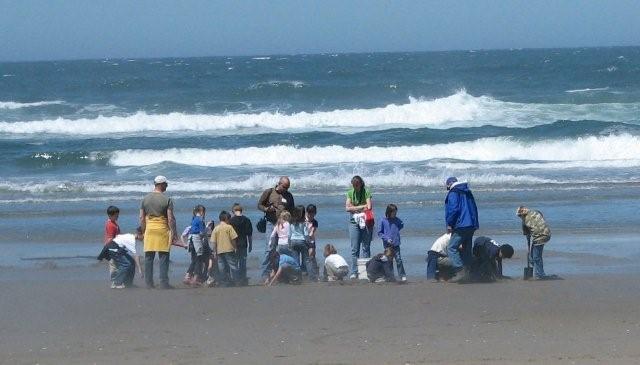
Hillcrest Elementary second graders on an inquiry-based field trip at Bastendorff Beach, Oregon. (Trish Mace)
Experiment 3-What direction will a beach hopper hop?
The expected answer-beach hoppers orient themselves according to the slope of the beach, jumping landward. This prevents them from moving downward on the shore where they would get into deeper water where it would be harder for them to swim. (See field journal sheet 3 on OIMB GK12 webpage in Resources section)
The students will hopefully have collected 20-30 beach hoppers. Lead a discussion on how the beach hoppers should be released (head towards the water, head towards the land, etc.) Students release equal numbers of beach hoppers at the high, mid, and low zones and observe the beach hoppers’ behaviors. Assign students the task of releasing one beach hopper at time and have them observe the direction they hop. One student will record the direction the beach hopper moved, writing if the beach hopper stayed there or continued moving.
If time remains, students can practice sieving sand and looking for other animals, seeing what lives where.
Post lessons
Many lessons, from a variety of disciplines can be created based on the field trip.
Examples:
Graphing-have the students graph the distribution of beach hoppers per zone (low, mid and high tide lines)
Day in the Life of a Beach Hopper-each student will write and illustrate a story depicting how a beach hopper would spend a day
Zonation poster-students can work in groups or individually to draw a poster showing what they found in different zones of the beach.
Credits
Jan Ward, Alix Laferriere, Merry Lojkovic, Kara Davidson, Ashley Binter, Ben Grupe
Resources
Beach Hopper Biology Websites
http://www.wallawalla.edu/academics/departments/biology/rosario/inverts/Arthropoda/Crustacea/Malacostraca/Eumalacostraca/Peracarida/Amphipoda/Gammaridea/Talitridae/Megalorchestia_californiana.html
http://www.answers.com/topic/beach-hopper
OIMB GK12 Beach Hopper Unit Summary
http://www.uoregon.edu/~oimb/Academics/GK12/field inquiries/beach%20hopper%20field%20inquiry.pdf
OIMB GK12 Field Trip Data Sheets
http://www.uoregon.edu/~oimb/Academics/GK12/field%20inquiries/Hopper%20Field%20Journal.pdf

by editor | Jan 2, 2010 | K-12 Classroom Resources, Marine/Aquatic Education

What causes ocean currents? What impact do they have on Earth’s environment? How have they influenced human history?
This teaching guide for grades 5-8 provides 7 activities for students to explore the causes and impacts of ocean tides and gain an understanding of the influences of wind, temperature, salinity and density on ocean movement.
Students are given the opportunity to explore such real-world situations as the 1990 Nike shoe spill, the raft Kon Tiki, and other oceanic voyages in history.
From Great Explorations in Math and Science (GEMS). ISBN 0-924886-44-7. $21.00. Order online at www.lhsgems.org.
by editor | Jun 12, 2009 | Gardening, Farming, Food, & Permaculture
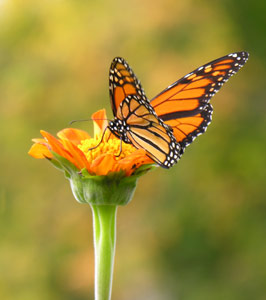
 Many people think only of allergies when they hear the word pollen. But pollination — the transfer of pollen grains to fertilize the seed-producing ovaries of flowers — is an essential part of a healthy ecosystem. Pollinators play a significant role in the production of over 150 food crops in the United States — among them apples, alfalfa, almonds, blueberries, cranberries, kiwis, melons, pears, plums, and squash.
Bees, both managed honey bees and native bees, are the primary pollinators. However, more than 100,000 invertebrate species, including bees, moths, butterflies, beetles, and flies, serve as pollinators — as well as 1,035 species of vertebrates, including birds, mammals, and reptiles. In the United States, the annual benefit of managed honey bees to consumers is estimated at $14.6 billion. The services provided by native pollinators further contribute to the productivity of crops as well as to the survival and reproduction of many native plants.
However, long-term population trends for some North American pollinators are “demonstrably downward,” says a new report from the National Research Council1.
Observable decreases in wild populations of bees, butterflies, and moths are of great concern to producers of fruits, vegetables, nuts, alfalfa, and flowers. These crops depend on wild and domestic pollinators. Growers in California, Florida, Arizona, Utah, Washington, and Hawaii are especially concerned. More important is the disturbing notion of an imbalance in the natural ecosystem and biodiversity on which all food production depends. Habitat loss for pollinators by human activity poses an immediate and frequently irreversible threat. Other factors responsible for population decreases include invasive plant species, broad-spectrum pesticide use, disease, and weather.
For the most part, the general public is unaware of the decrease in pollinator populations and the implications this has for agricultural production. The Nature’s Partners: Pollinators, Plants, and You curriculum is designed to educate young people about
- pollinators and the important role they play in providing many of the foods we eat and the plant fiber used in our clothing and household goods, and
- ways they can help pollinators survive and flourish by protecting and creating pollinator-friendly habitat.
The Nature’s Partners curriculum is just one step toward increasing the public’s awareness and sense of responsibility that are essential to a successful conservation program for pollinators.
Go to curriculum


