by editor | May 29, 2012 | Learning Theory, Questioning strategies, Schoolyard Classroom
“Lessons for Teaching in the Environment and Community” is a regular series that explores how teachers can gain the confidence to go into the world outside of their classrooms for a substantial piece of their curricula.
Part 21: Where Brains Learn
Some cognitive particulars about learning in the real world
 by Jim Martin, CLEARING guest writer
 he crack, a river, flows from the upper left corner of the wall, spreads into branching riverlets as it nears the window. That sentence was written in metaphor. The next sentence has no metaphor, but carries the same information: There was a crack in the wall which branched as it neared the window. Which will you remember? Which brings recallable pictures to your mind? This is like engaging in science inquiry in the real world. Compared to reading about the results of science inquiry in the real world. Each gives a visual clue, but which will come most easily to mind?
This is like science made vs. science in the making. The place of Assimilation is learning for understanding. When you engage your students in the real world, it acts like a metaphor, clarifies concepts and rectifies them with experience.
When you use the conceptual structures which underlie learning, they act as metaphors to clarify what you and your students are doing and learning. These structures are like the mirrors in a kaleidoscope which always generate the underlying structure of the image you see, and the pieces, ordered by that structure, are what you respond to. Can I add a little more to this?
We’ve been examining the conceptual structures that underlie learning, and how concrete experience in the real world encourages our brains to engage those structures. They reside in the architecture and processes of the brain. A picture of how they work to build understanding began to clarify itself to me during my teaching years. The brain is the organ of learning, and its structure and function does facilitate learning, especially when the delivery of the learnings recognizes how the brain works. Just as knowing the structure of color facilitates painting with water colors. When you dip the brush and apply it to paper, you know and anticipate what will happen. The underlying structure determines, to a large extent, what emerges.
Many of us carry an image of the human mind as an entity disembodied from our brain, an ethereal thing that goes where we go, and does our thinking for us. And no wonder. We can’t see the brain work, even in our classrooms. It doesn’t move the way muscles do, and it makes no sound. The best we can do is to know what the work of the parts of the brain are, and look for evidence of what they do in the things our students do and think.
Take Assimilation. The concept of Assimilation has varied descriptions, depending on who’s doing the describing. They generally carry this piece: What the learner personally experiences in the world about is incorporated into the world within our mind or brain. Its strength lies in the interaction between our brain and objects in the world outside ourselves. These are concrete interactions, and they work perfectly with the way our brain is organized to learn. Our brain learned to learn in the real world, where engaging concrete objects led to the kinds of abstractions that emerged as spear throwers and paintings on rocks, sticks, and cave walls. That is what makes metaphor such a powerful writing and rhetorical vehicle. It clarifies a subject with visual, tactile, olfactory, aural, and taste details that engage our senses, and make complexities open to understanding. A brain which developed in a concrete world is able to soar. Marvelous!
I often mention concrete vs. abstract referents. You can do the following as an experiment if you teach the same thing to two classes. When we are presented with new material in an abstract form, like a paragraph of information, we can put it into long term memory by using the information several times. Think of the end-of-section questions, where students answer questions by reviewing what they have read about particulars. Like Procedural Memory, which helps us carry out actions, it may stay with us, but different but related pieces won’t be stored as one concept. When we actually engage concrete referents, a thermometer in a stream, we engage Declarative or Distributed Memory, episodes and facts that can be brought to mind consciously, where new learnings are incorporated into concepts already residing in the brain. Let’s look at some of the parts of the brain involved in these processes.
When a student holds a thermometer in her hand and immerses it into the cold waters of a glacier-fed stream, her eyes send visual information about this to the visual processing areas in the Occipital Lobe of her brain, at the very back of her head. The Parietal Lobe, between the Occipital Lobe and the middle of her head, processes the feeling and temperature of the water on her hand. It also keeps track of where her person ends and the rest of the world begins, then gathers the visual, tactile, and coolness information, and passes it to other parts of the brain which carry memories of all these things.
You can get a sense for how this functions when you sit down to enjoy your favorite beverage, say a latte. (Now, you have to tell yourself that you’re here to learn. That sets things up in your brain.) As your fingers move toward the cup’s handle, you become very aware of the shape of the handle just outside your skin, and the round shape of the cup. You may have brief perceptions of other cups, perhaps a favorite that is still in the dishwasher. You can see the foamy latte part of the beverage near the top of the cup, and anticipate its flavor. Certainly you’ll be aware of its texture, fine bubbles, color, pieces that your tongue loves to discover. And the coffee itself. You’ll know what kind it is, where it was grown, color, anticipated taste, texture, and the bouquet it always leaves in your mouth after you’ve sipped it. You may even be aware of the brands of the latte and coffee, and other facts of these ingredients of the beverage. You may have brief recollections of other places you’ve had this particular blend, who was there, and what you were doing.
These things happen very quickly, but they are perceptions perceived. Each piece of information came from specific parts of your brain, and these were processed together in your prefrontal cortex, at the front of you head, as what is currently called Working Memory. The prefrontal cortex is also the place where you engage critical thinking. Nice.
So, by doing something when you’ve told yourself that you’re doing it to learn, you suddenly have all of the things you’ll need to help you learn brought together in the part of the brain that can do the learning. Why shouldn’t we use the structure and function of the brain to enhance the delivery of our curricula? Let’s take this idea back to the young woman immersing her thermometer into the waters of a stream.
As she picks up the thermometer, positions it in her hand so she can see its graduations, she becomes very aware of its shape, its use, her expectations for what it will tell her, the particular reason she is picking it up, the memories she already has about streams, and thermometers, and, because she’s here to learn about salmon, some thoughts about how salmon like the temperature of their water.
She is on the first hour of a one week unit on watersheds, so doesn’t know a great deal about water temperature, salmon, and watersheds. None the less, what memories she does have of these things come together with all the rest in working memory, ready to learn.
So, she measures the temperature of the water, and it’s twelve degrees celcius. Her working memory doesn’t know where to fit this in, what I call a Need to Know. So she looks for the reference book that is part of the contents of the box she helped carry down to the streambank. Finding it, she looks for information about salmon and temperature, and finds they prefer waters with a range of temperatures between 4.4 and 14.0C. Then her prefrontal cortex, the site of critical thinking, begins to use the information she has gleaned and memories stored, to engage the prefrontal cortex’s functions of perseverance, self-monitoring and supervision, problem solving, orchestration of thoughts and actions in accordance with internal goals, compare and contrast, working toward a defined goal, expectation based on actions, extract and reconstruct sequences of meaning from ongoing experience.
That’s a long list, a partial one, of the functions of this site of human learning that current US curricula generally overlooks. Contrast this with the teacher telling students about salmon and water temperature, the student reading in the text about it then answering questions in the back of the chapter about these things. Compare and contrast (using your prefrontal cortex!) this with the rich texture of meaning in the young woman with the thermometer.
Next time we’ll look some more at this underlying structure of learning.
 This is the twentyfirst installment of “Teaching in the Environment,” a regular feature by CLEARING “master teacher” Jim Martin that explores how environmental educators can help classroom teachers get away from the pressure to teach to the standardized tests, and how teachers can gain the confidence to go into the world outside of their classrooms for a substantial piece of their curricula. See the other installments here, or search Categories for “Jim Martin.”

by editor | May 15, 2012 | Outdoor education and Outdoor School, Schoolyard Classroom
“Lessons for Teaching in the Environment and Community” is a regular series that explores how teachers can gain the confidence to go into the world outside of their classrooms for a substantial piece of their curricula.
Part 20: Beginning at the Beginning
.
 by Jim Martin, CLEARING guest writer
 n the last blog, we looked at planning an inquiry unit from the perspective of a student display, isolating the parts of the display and tracing them backwards. Now, let’s start at the beginning, and look at the inquiry unit as a scope and sequence. Until you’re comfortable taking your students out into the real world, it’s easy to forget some of the details in this kind of work until you’re on site, or waiting by the school for a bus you haven’t ordered. It happens!
It’s difficult, in the blog’s format, to construct a scope and sequence using a long timeline, so we’ll do it as a narrative. You might practice laying the parts out on a timeline, at least mentally, as the visual feedback often suggests things to do that you won’t notice as you read a narrative.
Our reed distribution inquiry began with the Casual Observation. At least, as written. However, just getting to the site means you’ve ordered a bus and substitute, have talked with your students about safety, given specific directions about clothing and lunches, sent permission slips home for parents to sign and return, looked for equipment students might need, prepared student logs so they can record their experiences, done a preliminary site visit yourself, and prepared the substitute’s lessons.
On a time line, these would line up on the left under a heading, “Casual Observation.” They would be on the left side of this column. On the right of that column, you would list the things students will do. For instance, they will need to know something about the site they will visit, and, in general, what they will be doing there. You’ll need to organize reference materials the class will need when they return, and decide which references you will carry to the site. All before you board the bus. So your timeline would begin at least a month before you’re on that bus, headed toward your site.
The actual observation won’t take up much space on the timeline. You ought to give your students a tour of the site. Then have them follow prompts you give them, or just follow their own noses. At first, this will depend on your comfort level. Eventually, it will depend on your recognition of the potential embedded in a student’s ownership of the work and learnings.
Where we go from here depends upon your schedule. If you’re here for the day, then your students can move through all the pieces of the unit. If you are planning for two briefer field trips, then the timeline will look different, but most of the components should be the same. Because this is a linear unit, with each piece completed before moving to the next, the parts of the scope and sequence will be similar, but the days won’t.
When students have completed their casual observation, you might have them share what they noticed. As students work, some may go to the references for information, others may not have thought of this, or are waiting. As you move around the site, some may ask for advice. Be careful not to tell them what they can find out themselves. A sentence that almost always works for me is, “Good question; how can you find out?” The number and kinds of questions students raise are mostly a function of their locus of control. Okay, let’s move to the Develop an Inquiry Question phase.
Before starting this phase, you should have samples of good and not so good inquiry questions for students to critique. Do you have them do this before, or after they have written two or three tentative questions? Again, this depends on your comfort level and teaching style. Because Assimilation is one of the main conceptual structures that underlie the organization and delivery of my curriculum, I like to have students write first, so they have concrete referents to use when we discuss the characteristics of good inquiry questions.
The process is simple, but takes time. Basically, students write and critique inquiry questions using the examples you provide until they have one or two they are comfortable with. Then, they assess these questions and develop a final inquiry question. You might introduce the concept of operational definitions if appropriate, and naming protocols, which are sort of operational definitions. (Use naming protocols for plants or animals whose names they are unsure of. Mine was, “Give it a name and use it until you have good reason to change it.” This seemed to work; relieves anxiety and reduces confusion.)
If you’re doing two field trips, you’ll want to check permission slips, equipment, bus, and sub. So, under Develop an Inquiry Question, you would just have something like Develop an Inquiry Question on the right, and Prepare Sample Questions and Assessment Criteria on the left, and if you’re doing two trips, check permission slips, etc., on the left. (You might have noticed that all of the items we’ve been adding fall into two groups, logistics and pedagogy. This could be a way to further clarify your scope and sequence.)
After students have developed their inquiry question, they need to Design an Investigation. This is always pretty straightforward; their question tells them what to do to answer it. The other items in this column might be safety reminders, prep the analytical math they’ll need to process their collected data, practice using tables to organize observations, and practice on any equipment they plan to take into the field. They are important, not so much to the design of their investigation as to the next item, Collect Data. However, this is the time, before they leave the school, to do this. Of course, you can move it to Collect Data. I like the idea of prepping these things as students are designing their investigations because they have an opportunity to integrate these concepts into their planning at a time when it makes sense to them.
The Collect Data column is short, unless you include the logistical pieces in it, like take the bus, arrive at site, go to stations, collect data, pull the work together, return to bus. Students ought to iterate safety rules before you release them into the site. After that, students do the work and return to school. By this time, they ought to be the well-oiled machine.
Back at school, they Analyze and Interpret their data. Now that they have concrete referents about data, this is a good time to review what they learned about tables and analytical math. Since student groups will move through this phase at different paces, show them what you want to include (but not be limited to) in their reports and displays, if they are making them. As questions arise, this is where you do targeted mini-lectures. Most classes will welcome a demonstration of the analysis of a hypothetical set of data, both the mathematical and graphical analyses and interpretations. If you’re weak in this area, and lots of us are, this can be a good learning experience for you.
After students have analyzed and interpreted their data, they prepare to Communicate it, the last heading in the scope and sequence. They should at least make a presentation to the class, complete with a poster. You’ve already briefed them on what to include in their display, and this is a good time to reiterate it. After all reporting is done, you ought to consider having the class summarize the meaning of all of the findings. You’ll find, over the years, that you’ll learn as much about teaching as they learn about environments.
This description of attempting to use a scope and sequence has generated a great deal of detail. More detail than you’d want on a simple timeline. You can take lumps of these details, give each lump a name that makes sense to you, and just name the lump. It will help build a better scope and sequence. Somewhere below these briefer descriptors you can jot down the details. (I’ve used spreadsheets to do this, since you can go as far to the right, and down, as you want.)
It may be time, while we’re engaging underlying structures, to examine their significance. Next time, we’ll do this, and discuss some of the reasons structure is significant.
 This is the twentieth installment of “Teaching in the Environment,” a new, regular feature by CLEARING “master teacher” Jim Martin that explores how environmental educators can help classroom teachers get away from the pressure to teach to the standardized tests, and how teachers can gain the confidence to go into the world outside of their classrooms for a substantial piece of their curricula. See the other installments here, or search Categories for “Jim Martin.”

by editor | Mar 11, 2011 | Questioning strategies, Schoolyard Classroom
“All anyone really needs is a coal bin and a friend.”
 By Jim Martin
A storm of children, shouts, swirling bodies, and dust swept me out of the yard. Up the street, neighborhood kids whirled around some coal bins between two wartime shipyard houses. I can see and hear them now, the kids, a bicycle, the coal bins, the houses and trees behind them, the noise. Propelled toward them by their intense energy, I became madly aware that they were riding a bicycle. I wanted to ride too. This was 1947; kids didn’t have bikes during the war, and few had them now, two years after the armistice.
Nor were there such things as training wheels. Getting onto a 26-inch bike with a running start was so intimidating that I had shrunk from attempting it. But this day was different. Kids were riding the bike by balancing themselves between two coal bins which were set about three feet apart, making a narrow chute. They would put the bike in the chute, climb onto a coal bin, lower themselves onto the pedals, scoot out to the edge of the bin, push off, and ride! This, I saw so clearly, I could do.
I ran up the street and begged for a turn, mounted, scooted out, pushed off and rode in a large circle in the driveway, lost my balance, fell sideways, caught myself and the bike before we both fell to the ground, stood up and wheeled it to the next kid in line. I had done it! You could, too, with a little help from a coal bin and encouragement from your friends.
The coal bin gave me just that bit of support and encouragement that I had lacked. With it, riding a 26-inch bicycle became something I could do. And I did.
ALERT: You need to be a CLEARING subscriber to read the rest of this article.
(enter password then hit return button on your keyboard for best results)
[password]
The thought of teaching science can be as intimidating for many teachers as the thought of riding a bike was for me. We all experience a sense of uneasiness when we try something new. This is how we overcome inertia in the face of what we perceive as difficult. I call these hesitations in the face of something new “twinges of doubt.” When I first began teaching, I had a twinge of doubt that I’d understand the biological concepts I’d learned well enough to teach them. Doubt dissolved as soon as I engaged a familiar content; but the fact that the twinge was experienced is significant. If, having a strong background and interest in biology, I felt it, what must an elementary teacher, with little or no background or experience feel? Science has so much content, so many facts. How can we possibly master the subject well enough to teach it? Well, we don’t need to master science in order to teach it. What we need is to experience how science works. Knowing how science works, believe it or not, makes teaching science doable, it builds a sense of self confidence, a sense that this bicycle is not a formidable adversary; it can be ridden, it is fun to do. How do you gain the confidence it takes to enjoy teaching science? First, climb the coal bin; learn what science is. Science isn’t books of facts; it is a cognitive kinesthetic process, a way of knowing, a way of organizing our thoughts and action. Science as process produces facts, but it is not the facts themselves. Here are four basic pieces of process science that you can try today: 1) ask a question, 2) decide how to answer it, 3) follow through on this decision, and 4) compare the results of following through with the question you asked. This is manageable, and, with a little support, you can do it. Here’s how:
1. Find the coal bin (a question). Take a first step; ask a question answerable by an observation. No one will see you or know that you are taking a personal risk. Our environment is more familiar to us, so let’s try it first. Go outside and try one of these:
Pigeons – where do they spend most of their time? How do they spend their time?
Ants – where do they go? Do they all travel in the same direction? Do the same thing?
Squirrels – how close can you get to them before they run away? (Notice that you can answer these question just by looking, which is making an observation). Pick one of these simple questions, choose one of your own, or substitute the subjects of your observations for, say, pill bugs, potato bugs, spider webs, weeds, and so forth, then continue reading.
2. Scoot out to the edge of your question. First, make a guess about what you will find out. If you are looking at ants, make a guess about where their main door is, or in which direction the majority of those near the door are traveling. Decide what you will look for. For instance, the number of ants who enter and leave the door. Rite this down. We don’t write enough. Humans clarify their thoughts by writing, acting, or drawing them. Our written expressions become records of the thoughts we all too easily forget. This is important; you must articulate your simple plan of action. Science is a wonderful vehicle for delivering critical thinking. Critical thinking happens best when we write out our thoughts. It is a formal commitment of our thoughts to paper. Now, put this article down and go out, follow your directions, and observe for ten minutes. Write down what you see, one minute at a time. Just ten minutes. Easy
3. Push off (follow up on your question). Go back to the classroom and put the results of your ten-minute observation on the board. Do this as a visual: a picture, a graph, a diagram, etc. Mak it into a representation of what you saw, and which makes sense to you. Ask yourself how to put the results up so they tell you whether you’ve answered your question. Discuss these results with yourself, or call in a friend or colleague. Better yet, discuss your results with a student. Did your observations answer your question? What did they tell you about the animals you observed? What did you learn about the process of observation itself? Did you find it necessary to change your observational plan? Did you find you had to change what you meant by, say, moving in a particular direction? Think about this and thin about the phrase, “science as process.”
4. And Ride. What questions or ideas does the information on the board raise? How about your observations; did they raise any questions or ideas? Pick one of these to follow up. Write it down. Decide how to organize your observations, then go out again. (This time, you might invite your students. Dangerously close to curriculum now.) Make your observations, post and review your results, discuss their implications, raise questions. If your review the list in the previous sentence, you will notice that the words in the list name processes. Do you recognize any pattern in how these processes are applied? Can you add any to the list? Notice that, in seeking an answer to a question, you end up asking more questions. You’ve been paid compound interest on a small investment in critical thinking! What an investment opportunity for your students!
Nail down what you’ve learned so far. Describe to yourself what you can do now that you couldn’t do before. Describe what you know about the subject of your observations. Did you acquire new facts? (These are the facts of your science curriculum. These facts your students should, and will, remember because they make sense.) Describe how your experiences and understanding might fit into an integrated curriculum. Write these descriptions out. If you have done this with your class, then you can look back and recognize that you’ve generated a piece of your own curriculum. Go to the standards and see if you have addressed any of them. Did you address any in Mathematics? Social Studies? Language? Art? Music? Share your experiences by submitting an article to Clearing. Make a presentation of your experiences at the next science teachers conference. Nentor another teacher. Celebrate. You’ve begun a process which has no end.
This article is reprinted from Issue 96 of Clearing Magazine, and is also found in The Best of Clearing, Volume V.
—Jim Martin has retired from a long career as a science educator in which he taught at every grade level from elementary through college, and as a teacher trainer for the Center for Science Education at Portland State University. He also served as president of the Environmental Education Association of Oregon.
[/password]
by editor | Jul 29, 2010 | Marine/Aquatic Education, Place-based Education
The Colquitz Watershed Stewardship Education Project
By Pam Murray
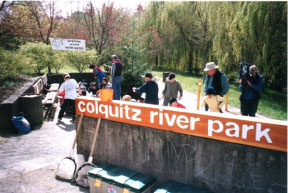
A school class at Colquitz River Park in Victoria, BC
Along the Cowichan River, surrounded by the smell of cottonwood resin, an elementary school student discovers that dragonfly larvae look like aliens. In a quiet wetland, a middle school teacher marvels as a guest expert shows his class how to fold cat-tails into duck shaped toys and send them downstream with wishes. In a municipal office, a bureaucrat considers a community proposal, initiated by an elementary school class, to create a new park.
Since 1994, the Colquitz Watershed Stewardship Education Project (CWSEP) has been bringing students, teachers, and the community together to experience educational turning points like those above. Headed by teacher Lenny Ross, the award winning project has successfully instilled an environmental ethic in students of all ages and their teachers by connecting them to the watersheds in which they live.
Flowing through two school districts near Victoria, B.C., Colquitz Creek is an urban salmon-bearing stream affected by development, runoff, encroachment and other negative impacts from the increasing population density within its watershed. The care of watersheds like the Colquitz is often championed by local naturalists and activists who feel a sense of stewardship towards their local environment and community. Creeks are much longer lived than people, and so it is crucial to pass on this ethic to young people who can continue to act as stewards of natural places in the future. Fostering this ethic, however, is difficult through textbook-based classroom learning. Depressing environmental stories of polluted rivers and decreasing salmon returns may actually turn students off of learning about their environment (Sobel, 1996). How then, did this project manage to instill a strong environmental ethic and sense of stewardship in the students and teachers who participated in it?
Inspired by a growing number of environmental education programs, including the Streamkeepers program and Project Wild, which were becoming available in British Columbia during the early 1990’s, Lenny Ross developed the CWSEP during a summer at the Wetlands Institute in the U.S. Over the years, the program has branched out and changed course, but throughout all of these changes, the essential goal has remained the same. “Students learn”, according to Ross, “to appreciate their environment, understand scientific concepts of watershed ecology and take action to help the watershed, and thus become responsible citizens of their community.”
A watershed, as defined by ecologists, is an area which drains into a common body of water, such as a river or stream. As well, the term can be used to describe a turning point in a process. The point at which a course of events is irrevocably altered may be described as a ‘watershed moment’. The CWSEP began with such an event, in which political and school district boundaries were set aside in favor of a new method of defining borders – the watershed of Colquitz Creek. Ten schools were identified within those boundaries, and at each school an environmentally minded teacher agreed to participate. Grant proposals were prepared and submitted with successful results due to the clear focus, goals, and objectives of the program. The project was on its way with a budget to work with.
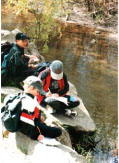
Students take time to reflect along Colquitz Creek.
Over the years, a variety of methods have been utilized to engage students in learning about their watershed. As well, changing focus slightly each year has kept the CWSEP fresh for the growing number of teachers who implement the program in their classroom year after year. In the 1999 – 2000 school year, classes went on watershed tours of Colquitz Creek while teachers used curriculum materials developed around music and literature. The following year, teachers received a curriculum package focusing on fish biology and their classes traveled to the watershed of the Cowichan River to compare it to the Colquitz. Other years have tied into community events such as Rivers Day or Science and Technology Week. This flexible focus has also helped the project make use of available funding which may require that specific themes are addressed. The essential components of the program, however, have remained the same each year and are as follows:
• Development of curriculum resources and provision of in-service training for participating teachers
• Implementation of curriculum materials and resources in the classrooms of participating teachers
• Field trips, during which classes participate in field studies and environmental assessments, often assisted by high school students who have received special training.
• Students then work on class projects and stewardship activities such as planting native plants or cleaning up streams
• All participants are involved in a community celebration during which they help educate members of the public and are recognized for their accomplishments.
Together, these components make up a project that has catalyzed ‘watershed moments’ for students and teachers alike.
Teachers try out an activity during the “Project Wet” workshop.
Teachers as Students
An integral part of the CWSEP’s success has been providing curriculum resources, in-service workshops, and the knowledge of local ‘experts’ to teachers involved in the program. Many of the teachers who have taken part in the CWSEP do not have science backgrounds. Lenny Ross’ own professional background was originally in special education. The opportunity for professional development motivates teachers by giving them the resources they need to tackle topics like stream ecology and bird identification. Through the years, these resources have variously included lessons in fish biology, contributions from local government agencies such as park departments and water districts, guest speakers from the local natural history society, a partnership with musician Holly Arntzen to create classroom activities which use songs celebrating watersheds, and a guide using a literature-based approach to investigating freshwater ecosystems.

Teachers received Stream Team vests after completing training.
According to Lenny Ross, teachers are also attracted to the program because “As research out of the U.S. shows, if you integrate education around an environmental theme,
children’s test scores across all aspects of the curriculum go up because the learning is relevant and meaningful to their world. Such socially responsible education affects more than just grades. Student behaviour improves as children see that their work is valued in the community, and teacher enthusiasm goes up because they know this type of education is effective and it feels worthwhile when they see they are having a positive effect on the community as well.(Lieberman & Hoody, 2000) As one teacher said, “It makes for a really strong personal connect and that’s how you make a change.”
The program also benefits from the sense of community which develops between the teachers as they take on new challenges at workshops or eat meals together while planning the year’s activities. In 2001, the project partnered with the Freshwater Eco-Centre and Vancouver Island Trout Hatchery in Duncan, B.C. to assist in adapting activities for a “Fish Ways” manual, which provided teachers with activities for exploring the biology and ecology of fish with their classes. At the in-service in Lenny Ross’ school, teachers sat in groups for a hands-on lesson in fish anatomy and ecology facilitated by a naturalist from the Freshwater Eco-Centre. This included watching a fish dissection, counting rings on fish scales, and discovering that they could tell, even with paper bags on their heads, that the skin of a flounder, embedded with star-shaped scales, feels like sandpaper.

A Stream Team student shows a turbidity wedge to younger students.
Students as Teachers
The Colquitz Watershed Stewardship Education Project has involved teachers and students from Grade 1 to Grade 12. In general, any class that has expressed interest in the program has been allowed to participate. As a result, it has been necessary to develop relevant and challenging components of the program to suit students of various ages. When high-school students became involved, the project partnered with Streamkeepers, a college-level course provided through the Department of Fisheries and Oceans Canada, to train them in the skills needed to assess stream quality. Students were provided with sophisticated equipment which enabled them to determine the pH, oxygen content, and temperature of streams, as well as with training in many aspects of stream stewardship. This group of students, through the vision of middle school teacher Angus Stewart, evolved into the “Stream Team” and began helping with field trips for younger students.
 In the 1999/2000 school year, participating classes spent a day touring the entire watershed of Colquitz Creek, from its headwaters at Beaver Lake, through their community, to where the creek meets the ocean. By visiting three different stations along the creek and taking short hikes, the classes experienced the watershed first hand and began to see how it conncts their community. Students examined water quality, sampled and identified stream invertebrates, and completed reflective activities to record their impressions of the experience.
Throughout the tour, high school Stream Team students acted as teachers. Set up at stations along the route, the Stream Team students helped with activities for three or four classes a day, each day throughout the week. Given the opportunity to teach the younger students, on an ongoing and repetitive basis, the Stream Team participants quickly became adept at sharing their knowledge and acted as role models for the younger participants.

Students student stream invertebrates in a “mini pond.”
Students as Scientists
As much as the CWSEP has positively affected the teachers and students involved, it has also had tangible successes in improving the quality of the Colquitz watershed. Early in the program’s history a group of high school students from Spectrum Community School became involved with the project. Using their Streamkeepers equipment provided by the CSWEP, they recorded water quality data from the creek and used this data to plot graphs.
By doing so, they discovered that an area known as Quick’s Bottom, just downstream from the headwaters at Beaver Lake, had an elevated water temperature and low oxygen levels which would be deadly for salmonids. As it happened, many schools in the area were also involved in a “Salmonids in the Classroom” program where they were provided with equipment to rear salmon fry in their classes. These fry were then released into appropriate streams, including Colquitz Creek. The favored location for salmon releases in the Colquitz Watershed was just upstream of the warm, low oxygen area discovered by the students – an area that they renamed “Quick Death Bottom”.
After this discovery, it was decided that a new location for salmon releases should be found. A nearby park was located, safely downstream from the “Quick Death” area, where earlier habitat enhancement projects had already created excellent conditions for salmon fry. Classroom-reared salmon fry began to be released into this new location, greatly improving their chances of survival.
Students in the Community
After field trips are completed each year, students participate in class projects which apply their knowledge of environmental stewardship. Stream cleanups, plantings, and recycling projects have all taken place. Salmon have been raised in classrooms, invasive plants have been removed, and storm drains have been marked. Classes have done research projects to create posters and help educate their community about their shared watershed.
At Strawberry Vale School, where Lenny Ross teaches, mapping activities took place. In becoming more aware of their watershed, students and teachers noticed an open natural area near their school, owned by the Municipality of Saanich. Students helped work on a community proposal that resulted in this land being designated as a park, which the students named “Strawberry Knoll.”

Holly Arntzen leads students in a song and dance during an end of year festival.
As well, the program has involved community festivals. Displays have been erected in a local mall to highlight student’s work, and celebration concerts featuring local musician Holly Arntzen – who has also contributed to curriculum resources – have brought together participants to finish the year. In 2001, students came together from four school districts to Fort Rodd Hill National Historic Site near Victoria to highlight what they had learned in an ecology fair called the Salish Sea Festival.
Watershed Moments for Schools
The CWSEP has had lasting effects not only on students, teachers, parents, and community members, but on entire schools. In the case of Strawberry Vale School, the elementary school where Lenny Ross teaches, the project has been partly responsible for inspiring a new school design.
Located in a semi-rural area within the Colquitz Watershed, Strawberry Vale was intimately involved with the CWSEP from its very beginning. Not only Lenny Ross, but almost every teacher in the school, was involved with the project each year. When, during the project, the opportunity to build a new school arose, the teachers’ interest in environmental education helped to shape the new school. Landscape architect Moura Quayle interviewed the teachers to determine what kind of school they wanted, and discovered that Strawberry Vale was the perfect school to pilot projects with an environmental focus, reflecting the natural features of the semi-rural area in which it was located.
The new school and its grounds incorporated many features to allow children to learn, play, and interact with the natural world. The school is designed without eaves troughs. Instead, water pours off the roof in a waterfall-like fashion, past windows where students can observe the water cycle in action. The water then goes into a ground drainage system and eventually runs into a swale which empties into a newly created seasonal pond on the school’s property. Drains in the parking lot also lead into the pond, and have been painted with yellow storm drain marking fish to indicate that they lead to fish habitat. Between the school and the pond is a native plant garden approximately 100m long by 20m wide. This garden was created over many years with the participation of students who helped fundraise and create interpretive signage, as well as teachers, the parent association, district grounds and facilities staff, and other school staff. Ongoing planting and mulching days that take place at the school engage everyone, including the school custodian who has come to accept mud and leaves being tracked through the halls as a minor inconvenience when compared to the exciting and important learning that is taking place.
Students at the school who have been involved in the creation of their garden and ponds have developed a stewardship ethic that they readily apply to the greater community. When they discovered that a neighboring grove of Garry Oak trees was suffering from misuse and neglect, the students and staff took action to remove invasive ivy and add leaf mulch to the soil. These wild places near their school also provide opportunities for study. The pond and garden are regularly used for lessons about habitat requirements, aboriginal uses of plants, and more. Local experts have come to the garden to teach the students about traditional uses of plants and to make wild teas. Heavy snows this past year revealed dozens of birds searching for seeds and shelter amongst the shrubs. Red- winged blackbirds and marsh wrens have nested amongst cattails growing in the pond, and mink and great blue herons have been seen on the school grounds as well. Over the years, students have been able to learn about pond succession as the pond gradually filled in, and recently they raised funds to dig the pond out and start over so that future classes can continue to enjoy and learn from it.
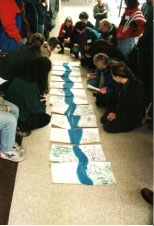
Some years, the students and staff of Strawberry Vale shared their watershed moments with others when the CWSEP end of year festival was hosted in part at their school. Participants from four other schools were able to rotate through various activities in different classrooms including storytelling and watershed models. Class projects were displayed in the hallways, a watershed drawn on the floor flowed towards the gymnasium, and students led tours of their school garden and pond, explaining how their school fits into the watershed of Colquitz Creek.
Aside from opportunities to practice stewardship and to study, the garden, swale, and pond also provide the students at Strawberry Vale the very important opportunity for unstructured play. “You can walk down the trail at recess”, says Lenny Ross, “and think there’s nobody in the garden, but as soon as the bell goes, kids pop out everywhere. They are down at their own level, in the thicket, and if you join them and ask what they are doing they go on forever about the rooms and shelves and castles they have created.” This kind of unstructured play has been shown to contribute to children’s creativity and problem solving abilities, and also to be instrumental in fostering the environmental ethic that the CWSEP strives to create (Louv, 2005).
Assessment
Because of the longevity of the program, which began in 1994, teachers involved have been able to see students who participated in the program in elementary school grow up. They have observed these students carrying a sense of stewardship and an environmental
ethic with them into university and beyond. The ponds, gardens, and lasting dedication to environmental programs at Strawberry Vale school are one legacy of the project.

Lenny Ross (left) and Nikki Wright of SeaChange Marine Conservation Society celebrate the program’s success.
Through a partnership with the SeaChange Marine Conservation Society, the watershed tours continue as part of the Living Watershed Program. The high- school Stream Teams still work to take care of their local watersheds. Today, a middle-school oriented program called EcoRowing, which also involves yearly themes, extensive networking amongst teachers, and the knowledge of local experts, continues to provide more “hands on, feet wet” learning for teachers and students alike.
So why does this program work? According to Dr. Gloria Snively, University of Victoria environmental and marine education professor:
A major factor is the outstanding leadership of Lenny Ross who is a master environmental education teacher. Lenny is an extremely knowledgeable environmentalist and a visionary elementary school teacher without an ego. By demonstrating a strong environmental ethic and warmly welcoming all teachers and resource persons who want to participate, Lenny himself contributes significantly to the program’s success. (Personal communication, March, 2007).
Aside from this leadership, some identifiable “watershed moments” from the program are likely major factors:
a) The program was created in a focused manner. Having clearly stated goals and objectives made it easy to ‘sell’ the program when applying for grants and other funding, as well as asking for the participation of community partners. By 2001 the program had 29 community partners including parks systems, government agencies, local non-profits, two universities, the local natural history society, artists, and musicians.
b) Resources and in-service workshops were conducted for participating teachers that provided them with the knowledge, resources, and confidence necessary to prepare units on watershed ecology to teach in their classroom. Many of the resources were not necessarily science based. Musician Holly Arntzen recorded a CD of environmentally themed music and worked with Lenny Ross to create a teacher’s guide to use the CD in their classroom, and materials using a literature- based approach were also used.
c) Students came to field trips prepared. All the classes who took part in watershed tours or other activities had completed a watershed unit in their classroom beforehand, which meant they were primed for the hands-on experiences of closely observing the creek.
d) Stewardship projects were involved – being able to clean up litter, plant shrubs, or even create a new park gave participants a taste of success and the feeling of truly making a difference in their community.
e) Finally, the students’ efforts were recognized. Community celebrations and eco- fairs that showcased the students work meant students accomplishments could be shared with the larger community, giving them a true sense of contribution.

A student project illustrates a healthy watershed.
Finally, an unspoken strength of this program is perhaps simply the amount of time students are given to have direct contact with nature – a factor that has been shown to directly affect students’ performance (Louv, 2005). The success of this program has garnered it recognition at both the provincial and national level.
Experiencing success with their stewardship projects, feeling a sense of pride as they educate their community, and spending time in nature all help to foster an environmental ethic in the students who participate. Most significantly, however, the students have experienced critical moments that have allowed them to see themselves as an integral part of their watershed. Having made this connection through the CWSEP, they cannot help but care for the environment in which they live.
References:
Lieberman, G. & Hoody, L. (2000). California student assessment project: The effects of environment-based education on student achievement. San Diego, California, State Education and Environment Roundtable.
Louv, R. (2005). Last child in the woods: Saving our children from nature-deficit disorder. Chapel Hill, North Carolina: Algonquin Books.
Snively, G. (2007). (Personal communication, University of Victoria professor, March 28, 2007).
Sobel, D. (1996). Beyond ecophobia, Great Barrington, Maryland: The Orion Society.
About the Author:
 Pam Murray is a writer and park naturalist from Victoria, B.C., who currently lives in the Bowker Creek watershed. In 2001, as a naturalist at the Freshwater Eco-Centre in Duncan, B.C., she participated in the CWSEP by helping to deliver the “Fish Ways” in-service workshop. Over the years, Pam heard many positive comments about the CWSEP, mostly from other naturalists who told her how much fun it was to help out with Lenny’s program. This paper could not have been written without the generosity and patience of Lenny Ross, who also provided all of the photos and illustrations.
[/password]
by editor | May 24, 2010 | Marine/Aquatic Education
by Bill Hanshumaker
Hatfield Marine Science Center
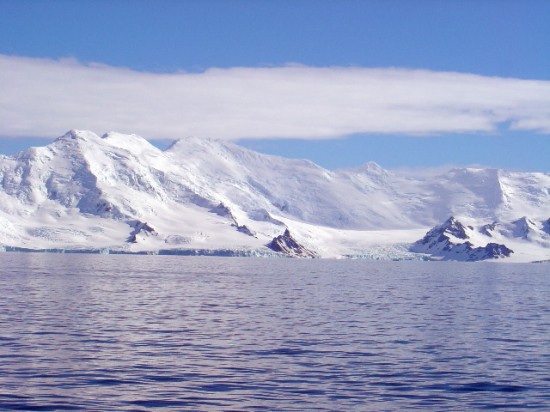
The Southern Ocean surrounds Antarctica and serves as a conduit between the Atlantic, Pacific and Indian oceans. Yet because of severe climatic conditions, much of this ocean basin remains unexplored. Polar regions play key roles in the global environment and one goal of our project is to document linkages between changes to the Antarctic ice sheet and the volcano-tectonic seafloor processes in the region. To meet the challenge for continuous monitoring in this extreme environment, researchers from the Hatfield Marine Science Center utilized the Russian icebreaker Yuzhmorgeologiya to deploy an array of Autonomous Underwater Hydrophones (AUH). This new ocean-sensor technology uses cold-water capable, deep-ocean hydrophones to record sounds generated by moving ice sheets, undersea earthquakes and volcanoes; even vocalizations from large baleen whales. When the AUH array is recovered in 2006, sounds that it has captured will enable accurate monitoring of global climate change, as well as identifying previously unknown volcanically active regions on the polar seafloor. (more…)


