by editor | Aug 12, 2018 | Learning Theory
Know and Do What We Teach: How many times are we assigned to teach a subject we know little about?
by Jim Martin
CLEARING Special Contributor
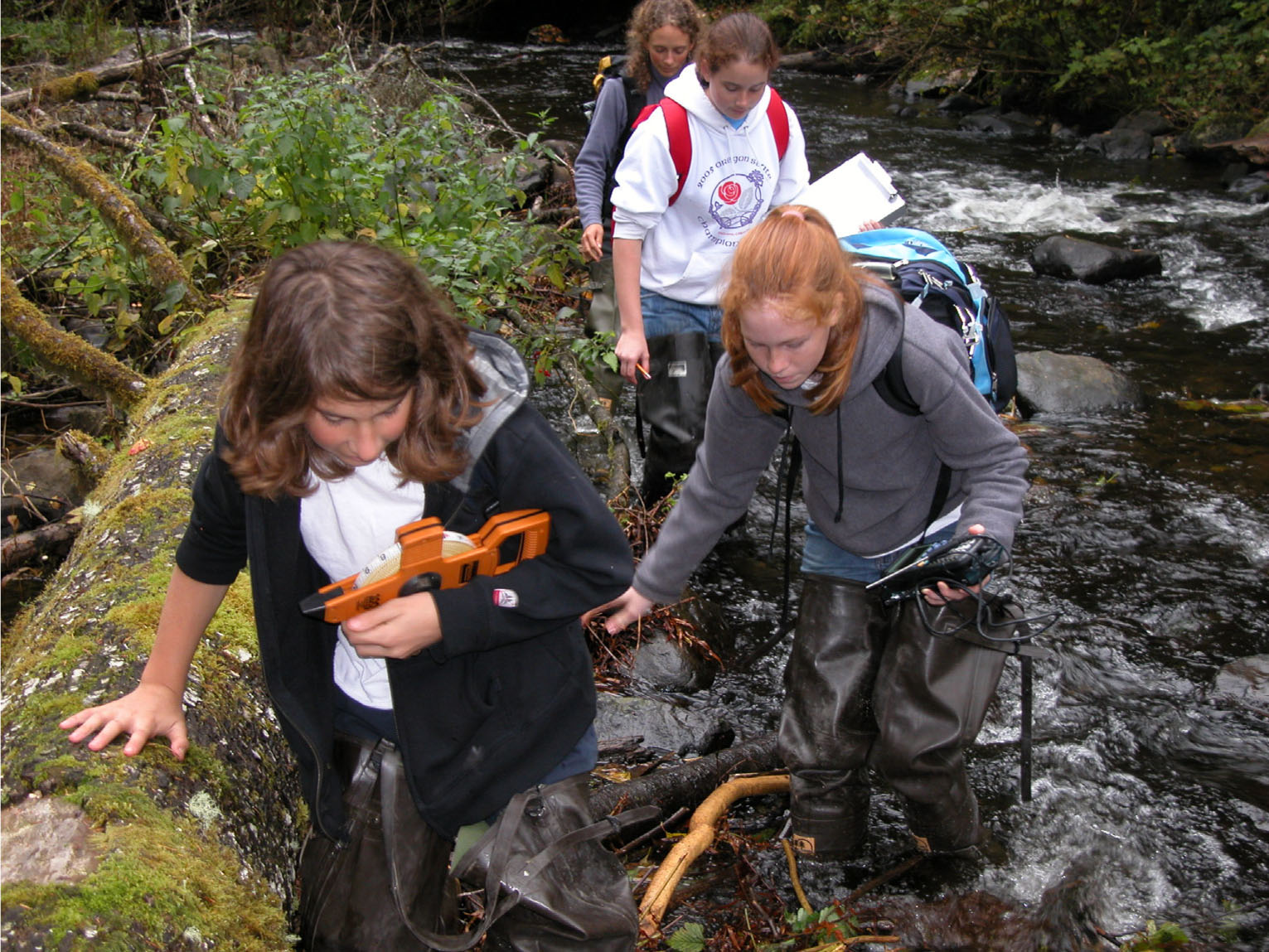
 t a riparian ecology training for teachers a few years ago, I met two who epitomize a perennial problem in education in America. One of the teachers was in her third year of teaching, said she had no background in science, was never trained for teaching it, but was assigned to teach all of the 6th grade science in her middle school. The other was a teacher who had been a fisheries biologist for several years, and was now teaching high school science. Two teachers, each of whom is assumed will deliver equally effective, student-empowering curricula in their schools. Who are assumed to be teaching at the same level of experience and expertise. How do we rationalize this? How do we deal with it?
Many teachers who lack confidence in teaching the content they are assigned forces them to simply use and parrot the instructions in teachers’ editions of their assigned curricular materials. If we are simply in the schools to prepare our students for the standards tests they will take, adhering to the status quo may be able to make the attempt; although, to date, this effort has produced no nation-wide positive result. But, if we are in schools to involve and invest our students in authentic and challenging concept-based curriculum, and to deliver our curricula in a way which empowers them as persons, then we all need to comprehend the concepts we teach at a level which makes us comfortable in determining our own ways to deliver our curricula. The only way to do that is to know and do what we teach.
As long as we are able to build a learning environment which involves and invests our students in their learnings and empowers them as persons, their brains will do the work. While there are many reasons posited for the poor performance of US students compared with their global peers, assumptions about student capacity based on demographics ought not to matter, not be a reason for poor performance; the brain is an autonomous learning machine. If we allow it.
Why should I want more than a good set of published curricular materials?
All teachers of empowered students that I’ve observed have a content background strong enough to allow them to design their own curricular deliveries. And their students, regardless of demographics, respond to this in a positive, participating way. I’ve also observed teachers with little or no background in the curricular content and/or grade level they are assigned to teach become exceptional teachers when they receive competent mentoring in their classrooms while they are teaching. Just as with their students, these teachers’ brains became autonomous learning machines when they were allowed to. Our expectations re teachers’ preparation for the content they are assigned to teach is a strong indicator that many of us do not allow that. They are assigned to teach what they are assigned to teach. Beyond that, most receive precious little support in the way of developing professional competence in their assigned content area.
Would we accept a world in which only about half of automobile mechanics have training to repair the motors they work on? Where half of dentists have the training to perform a root canal on their root canal patients? How about only half of surgeons with training for the surgeries they perform? Only half of lawyers with training for the cases they proceed with in the court? Half the baristas with no training for the coffees they produce in the coffee shops where they work? We have, and assume, the right to people who have had effective training for the work they perform. Except for teachers. It’s almost as if there is an assumption that teachers can “just do it.” In fact, I’ve heard this claim. More than once.
So, why are we so complacent about having teachers in classrooms who may be only marginally trained in the content they deliver? Jaime Escalante taught calculus to students at Garfield High School in Los Angeles, where 85 percent of the students were eligible for free or reduced-fee meals, and faculty morale was low (Scientific American, Aug 2011, p. 14: Stand and Deliver). His unpopular, to some, attitude toward his students’ brains’ capacity for learning was displayed in a banner in his classroom which declared, “Calculus does not have to be made easy – It is easy already”. In spite of opposition from the school administration and some faculty to his teaching, more of his students took the AP calculus exam than at all but three other public schools in the nation. Two thirds of his students passed the exam. He possessed a background in calculus which allowed him to develop and execute a very clear demonstration that the brain is an autonomous learning machine when we allow it. And proved it.
In a recent article, Climate confusion among U.S. teachers: Teachers’ knowledge and values can hinder climate education, published in the 12 February 2016 issue of Science magazine, the authors report that fewer than 25% of teachers have the training they need to teach the basics of global warming. This, in spite of the fact that climate change may be the most important challenge that today’s students and their children will face. Why aren’t schools allowed to provide the training their teachers need to become more effective teachers of climate change in their classrooms? A large fraction of the business world does just that. Especially when there is a demonstrated authentic need for it.
What do I need in addition to good curricular materials to better prepare my students for their future?
A suggestion: I submit that we need to work together to develop an effective method to ensure that teachers have access to the training and support they need to teach inquiry-based science in their classrooms. Every day. We don’t think of students as the people who will set our nation’s place among the other nations in the world, but they are. We need more than a small fraction of K-12 students who excel in school. My experience tells me that nearly all students have the capacity to either excel, or do very well in school. Dysfunctional families can certainly hold their children back, and schools have very little influence over what happens at home. But, they ought to have influence over what happens at school. That’s where their power lies.
Schools, can, and do, produce environments in which all of their students can excel, or at the least, do very well. For instance, one school I’ve known for a long time does just that. The Jane Goodall Environmental Middle School (JGEMS), a public charter school in Salem, OR, does that consistently every year. Entering students are selected via a lottery which covers Salem’s demographic spectrum. While the faculty don’t focus on the standards, each year 100% of their students pass the standards exams, 90% or more at the two highest levels. Oddly enough, all of their teachers have strong backgrounds in the content they teach.
In many of these cases, teachers have engaged in summer workshops and institutes which deliver hands-on experience in doing science inquiries they have conceived, designed, and executed in natural environments, and using those experiences to develop in-depth content knowledge of the subject of their inquiries. This is a context in which regional environmental educators and experienced teachers can collaborate to plan and execute workshops and institutes which can provide the training and support to produce classrooms which are facilitated by teachers who are experienced in science inquiry and have deep knowledge of the content they teach. And which deliver students who are involved and invested in their educations; and empowered as persons. A strong content and process background gives teachers the confidence it takes to deliver a student-centered, active-learning based curriculum. Something we all need to learn to do. Well.
How can you help?
 This is a regular feature by CLEARING “master teacher” Jim Martin that explores how environmental educators can help classroom teachers get away from the pressure to teach to the standardized tests, and how teachers can gain the confidence to go into the world outside of their classrooms for a substantial piece of their curricula. See the other installments here, or search Categories for “Jim Martin.”

by editor | Jun 21, 2017 | Climate Change & Energy
Climate Change Education: A Student’s Perspective
by Eliot Brody
At my recent high school graduation, I found myself reflecting on the 12 years I spent in Oregon’s largest school district, Portland Public Schools. While I sat through the speeches in my oversized, wrinkly gown, I thought about all that I had learned in those 12 years. And all that I hadn’t.
As I sifted through the many topics that had been covered in my schooling, my thoughts lingered on the conspicuous absence of climate change education—I had known nothing about the greenhouse effect until a guest speaker came into my science class in eighth grade. As a few members of Franklin High School’s graduating class crossed the stage wearing their beaded “wood-cookie” necklaces, my mind conjured vivid images of the place they got those keepsakes; a week in sixth grade that we all spent learning environmental science in the woods near Mt. Hood. Again, though, my nostalgia turned negative as I recalled that we were the last group of students to have the full six-day Outdoor School experience; the following year, Multnomah Education Service District shortened the program to three days. My reflections left me with the conviction that the school system as I knew it could not be counted on to teach climate science.
Reversing the consequences of climate change grows increasingly difficult each day. With this is in mind, we must find ways to teach our youngest students about climate change as early as possible, because they will be the ones most affected by it.
Big Ideas in a Shrunken School
Two months before graduation officially concluded my Portland Public Schools journey, I paid a special visit to the place where it all began, Glencoe Elementary School. I walked through what felt like shrunken hallways in the familiar building, dodging elementary schoolers as they hurried back to class from lunch. Only seven years before, I had been in their position, but I was there now to be their guest teacher. I was accompanied by a classmate and friend, Mabel Miller, and together we had prepared an hour-long presentation on climate change for the school’s fourth graders.
 Glencoe has four fourth grade classes, each with around 30 students. Miller and I planned to teach lessons in two of the classes that day, before presenting to the other two classes the following day. As we prepared our Google Slides presentation in our first class, there was an audible hubbub among the fourth graders about the two unfamiliar teenagers standing awkwardly at the front of their classroom. One brave student even called out to us, “Who are you?” Before we could say anything, Ms. Clark, the teacher, hushed her class and reminded them who we were by pointing to the day’s schedule on a chalkboard. Scrawled in white chalk was, “Franklin High School visitors,” next to, “12:00 p.m.”
I glanced out at the large group of antsy nine and ten year-olds, then over at Miller. Her face displayed my own worries: how will we keep the attention of these kids? I silently thanked her for preparing an interactive, climate change-themed activity to do with the students when they got restless. Ms. Clark turned to us with a smile and informed us that we could start whenever we were ready. I leaned over to turn on the projector, and we introduced ourselves and began.
First, we gauged the fourth graders’ prior knowledge on the subject. We asked what the phrase “climate change” made the students think about and how it made them feel. We got a variety of responses, from “it makes me sad” to detailed accounts of the polar ice caps melting. Then, we showed slides explaining:
- The distinction between “climate” and “weather,” and how climate change is different from seasonal fluctuations in temperature and weather.
- The atmosphere, how it can vary in size, and what that means for average temperatures on the Earth. We displayed a series of diagrams showing atmospheres of varying sizes, and how much heat could escape in each scenario. We also used plenty of analogies:
- “It’s like your blanket at night. You don’t want one that’s too heavy, or else you’ll be too hot.”
- “It’s like sitting in a hot car in the summer. The windows let the warmth from the sunlight in, and then that heat gets trapped in the car.”
- Fossil fuels and how humans use them.
- Greenhouse gases and how they cause the greenhouse effect. We specifically highlighted and explained carbon dioxide, methane, and water vapor.
- The many effects of climate change. We made the tougher ideas as relatable for the students as possible, including talking about what coral bleaching means for the livelihood of the aquatic characters in the popular Disney movies Finding Nemo and Finding Dory.
- Small and big things that the students could do to fight climate change.
As soon as we got into the material, it was apparent that the kids were interested—far more interested than we had anticipated. We had expected our presentation to take the first 40 minutes, leaving 20 minutes for the activity, but the students’ many questions and comments stretched our slideshow to take up the whole hour. Instead of being bored or disinterested, the students wanted to learn more about each detail and share their own stories and experiences. We received a chorus of genuine-sounding “thank you’s” from the students as we left.
In the next class, our presentation ran even more smoothly. I was consistently surprised by how much the students wanted to participate and ask questions, and again we finished the presentation without having to use the activity to fill time or focus the students. At the end, a number of students came up to personally thank us, and one girl gave me a bookmark emblazoned with the words, “save the earth.”
The classes we presented to the following day were just as welcoming and curious. The experience we had gained from the previous day gave us more confidence as we taught. By the end of the second day, we had given a crash course on climate change’s underlying science and effects to well over 100 students. More importantly, we had showed what they could individually do to help. It had only taken four hours of our time, and the teachers had happily extended their rooms, students, and class time to our cause. The four teachers, all of whom had been around when Miller and I attended Glencoe, even gave us a thank-you card.
Education, the Best Form of Activism
So, how did Miller and I end up back in our elementary school two months before graduation?
At Franklin, we had both taken a class called Environmental Justice and Sustainability. The format of the elective was to have each student work on year-long projects related to sustainability. The class was only two years old, having been started in the 2015-16 school year, but it had already made big strides and inspired the adoption of a similar class by the same name at another PPS school, Lincoln High School. Miller, as president of Franklin’s Earth Club, had used the class to increase the club’s size and presence in the school community (this year, over 60 students were in the club). Students had also created and run a bottles-and-cans recycling system and started a vegetable garden, among other endeavors. The class had even been able to improve Franklin’s resource conservation strategies enough for the school to earn recognition as a Merit-Level Oregon Green School.
My project was to coordinate outreach from our “green team” to other nearby communities, including the rest of the PPS high schools. Earlier in the year, I had focused on high school outreach by helping form a coalition of students called High School Environmental Leadership Project (HELP). HELP brings together high school students every other week to work on environmental activism and make each PPS high school more sustainable. One long-term HELP goal is to write a city ordinance that would bind Portland lawmakers to reducing emissions. The project is called YouCAN (Youth Climate Action Now) and is based on a model that has been used in four other Oregon cities: Eugene, Bend, Corvallis, and Ashland. One tactic that was used in Eugene was to have students testify in front of the city council in favor of adopting the ordinance. YouCAN organizers in Eugene described the importance of having youth of all ages testify, so HELP decided that elementary school outreach would be an important step in furthering this goal. At the end of our elementary school presentation, we told students that one of the big ways they could contribute to the cause is by attending a HELP summer camp or even testifying in front of city council at some point. Many students seemed interested in this, and we told the teachers that we would keep them posted as the project developed. HELP’s climate justice action camp will be held on August 24th and 25th this summer for rising third graders, fourth graders, and fifth graders.
Miller and I had a number of reasons for teaching at Glencoe. It furthered our work with HELP and allowed us to reach out as Franklin green team members to elementary school students in the Franklin neighborhood. Most importantly, though, it allowed us to teach about climate change to the generation that will be most affected by it. It is extremely important that students are taught at a young age to trust the scientists on this issue and not the corporate propaganda.
Get High Schoolers Teaching Climate Science
After the successful lessons at Glencoe, I wanted to continue to teach elementary schoolers about climate change. I emailed a 4th grade teacher at Atkinson Elementary, another school in the Franklin neighborhood. The teacher, Amy Nunn, seemed enthusiastic about the lessons, and about a week after the Glencoe lessons, Miller and I headed into Atkinson to teach Nunn’s class. The experience was slightly different, as I hadn’t gone to school at Atkinson. Even so, I felt more comfortable teaching this time. For the first time, Miller and I were able to fit the climate change activity into the presentation. For the activity, we gave the students “before and after” pictures of glaciers. Half of the pictures dated back to the early 20th century, and half were modern pictures of the same glaciers. They looked very different, which made the matching process difficult for the students, and also showed them the effects of climate change.
Once again, it felt wonderful to be able to teach younger students about such an important topic. Nunn also saw another benefit to the lessons. “In fourth grade, students learn and practice the speaking skills needed to effectively convey a message to an audience,” she said. “Having high school students model exemplary speaking skills provided the younger students with a real life example of how to effectively educate an audience.”
PPS and other school systems have shown that they don’t see climate education as a priority. I wish that I could have been taught much earlier about the causes and effects of climate change; I could have started my activism at a younger age if that had been the case. Sometimes, though, you have to make your own solution to problems like these. There are few roadblocks preventing high schoolers from emailing their elementary school teachers and asking to borrow some class time to teach about climate change.
Nunn added, “As a professional educator, I would gladly welcome back future high school students to share their scientific understanding of how the local decisions we make directly impact our Earth at a global level and how we can live more responsibly to prevent further, negative changes to the Earth’s climate.”
Eliot Brody is a recent graduate of Franklin High School in Portland, Oregon. He has been accepted to continue his studies in climate change education at Occidental College in Los Angeles. We hope that Eliot will be willing to contribute future articles as he learns more about climate change education.

by editor | May 16, 2017 | Learning Theory
 Why would a practicing teacher need a Mentor?
Is the idea of mentoring teachers an unnecessary element in our Schools?
by Jim Martin
If you were to trace your ancestry 25,000 years or further, you’d find that your forebears read no books about the natural environment. Nor did they answer multiple choice test questions about it. They lived in it, and learned in it. The environment is where they developed the capacity for critical thinking that we carry with us today.
We try very hard to continue to teach critical thinking in our classrooms, but all you have to do is look around, and you have to conclude that classrooms don’t teach critical thinking very well, if at all. However, walk into a classroom in which the curriculum is built upon experiences in the real world, and you will see critical thinking, critical writing, involvement and investment in learning, commitment to growth, and active environmental stewardship. You’ll also encounter enthusiastic, empowered people. Environmental education is demonstrably an effective vehicle for learning for understanding in all subjects, and is the crucible for the evolutionary development of our central nervous system, “the brain,” which we use every day to learn. We learn best in the real world; the learnings we acquire express themselves in personal growth, improved education, and a commitment to stewardship.
Studies on teachers who decide to take their students into the real world reflect what I’ve heard from other people who train teachers or are teachers who have taken their students outside the classroom. Even my own experiences teaching classes in fifth-grade through college, and helping teachers learn to do that too, all say, in one way or another, that it takes three to five years for a teacher to move from not having taken students outside the classroom, to being comfortable using the world outside to deliver curricular content. (That’s a long sentence; I’ll follow with a short one.) It works. Takes time and patience, but it does work.
Might mentors assist teachers to develop their capacity to use the environment for teaching and learning?
Hopefully, many of us know that our students, and their children, will have to understand ecosystems and climate change if they are to cope with the brunt of the effects of climate change. That means we have to teach these subjects in our schools. The studies I can find of how well-equipped we are to meet this real need say that fewer than half of us have the college-level background and understandings we should possess to teach the environmental science to meet this need effectively. We really must take some first steps in filling this vacuum as a professional responsibility.
In previous blogs we’ve looked at an outline of how to approach the training that teachers need to enable their students to approach global warming effectively. Another component of an effective response to the problem is a mentoring program to help more teachers through these three to five years it takes to become proficient in using active learning outside the classroom to teach ecosystem science. Mentoring is a model that business and industry use routinely, but which is relatively rare in schools. Just now, we are the only ones who can begin to build capacity for this developmental model in our schools.
Over the years, I’ve worked with teachers making their first forays with students into the world outside the classroom. For a large fraction of them, their main concern on this first trip is the head count going onto the bus, and the head count getting on the bus for the return trip. This concern of theirs about not losing a student highlights a pertinent piece of the act of moving outside the classroom to generate curriculum – how we, the teachers, feel when we step outside the familiar safety of our classroom.
What can mentors actually do for teachers?
Those feelings, anxieties, tend to carry through that first day. Another common teacher concern at the site during a first field trip is about student behaviors as they work and move through the site’s stations. When we are anxious, our brain’s response is to seek safety instead of attending to the learnings on site and developing conceptual schemata that will help us do a better job of teaching. On that first day, teachers should have the support it takes to enjoy the field trip, and be sorting through it to re-think what will follow once they are back in the classroom. Mentors can fill that need, helping teachers grow as they experience active learning in the world about. This can involve and invest them in the work, and empower them as teachers. A mentor is another human to walk the road with. Then, the work, not concern about what might happen, will carry the day.
For teachers on a first trip where their students are actively involved in learning on-site, a mentor is an ideal person to point out the content the site contains, and how to fill in areas the teacher is weak in. They also would have the knowledge, skills, and experience to recommend particular things the teacher can do to help their students discover that content embedded in the environment. At the same time, a good mentor would also be able to make suggestions about supervision and management skills that the teacher may not be aware of. It takes time, years, to become comfortable and proficient at using the real world to enhance student learnings.
The payoffs of making mentors a part of classroom and environmental education are worth the investment it takes to get them there. One powerful tool in making this happen is attracting seasoned mentors to help teachers navigate this part of the education world. Both environmental educators and teachers. We need to build this capacity into teacher training now.
There are teachers in most school districts who do take their students outside the classroom, either on the school grounds, the neighborhood, or a natural area. Many of these teachers who take their students out of the classroom for part of their curricula have, in the past, been willing to help other teachers who think they would like to try it, but are understandably unwilling to risk it alone. They constitute a component of an ideal mentor pool. Adding environmental educators, a critical component in the pool, should double its effectiveness. We’ll take this up in the next blog. Meanwhile, if you have an interest in this topic, leave a comment below.
This is a regular feature by CLEARING “master teacher” Jim Martin that explores how environmental educators can help classroom teachers get away from the pressure to teach to the standardized tests, and how teachers can gain the confidence to go into the world outside of their classrooms for a substantial piece of their curricula. See the other installments here, or search Categories for “Jim Martin.”

by editor | May 24, 2016 | Learning Standards, Learning Theory, Schoolyard Classroom
Use the Real World to Integrate Your Curriculum
In today’s test-driven schools, there’s little room for including the world outside the classroom in the curriculum, even though school is supposed to be based on the real world. And prepare us for it.
by Jim Martin
CLEARING Associate Editor
 his year I watched good classroom programs which involved and invested students in the learning they were doing come to a halt for several weeks so they could prepare for the standards tests. This, during what is the best teaching time of the school year: January through March, when there are very few breaks in the schedule, and teachers can concentrate on the delivery of curricula. Somehow, we have to wake up, get back to our senses, and use this time for learning.
That said, students do need to go out into the world to learn. Let’s look at two possibilities, the first in a stream, the other in a school yard. We’ll do the stream first, since it is the kind of place we ought to be going to. Then the school yard, since it is often the only alternative we have.
There are many places where students can find a streambank to explore. Or a wooded area; an open meadow; some place where they can see and count the organisms who live there. Then learn about them. These are wonderful places for students to engage new content via Active Learning. There is one, a small stream, near where I live. Here’s a list of some of those who live there: Salmon fry (very small, recently hatched, eat copepods); Copepods (eat algae and organic debris); Amphipods (eat organic debris, algae); Mayflies (eat algae, organic debris); Caddisflies (eat organic debris, algae, mayflies); Organic debris (this is dead and decomposing organisms on the streambed); and Algae (plants found on the streambed and submerged rocks). This list of organisms and information about them is abbreviated, mostly out of necessity; this is a blog, not a book!
Why Employ Active Learning?
Active learning is the best way for humans to learn. It entails having a learner-generated reason to find out something, and access to the resources which will help them find out. Finding plants and animals in a riparian area always stimulates students, and easily leads to conceptual learnings. Providing their teacher is comfortable with this way to learn. This is because noticing something in the world outside your body that catches your interest can, if you’re allowed to follow up on noticing, engage your prefrontal cortex and the machinery it employs in critical thinking. That builds brains. We need to do it.
Let’s say you find a stream near your school which has been restored, and supports a small salmon population. Your class can make a round trip to it in 20 minutes, which leaves time to make observations each time they visit. When they make a visit, they’ll group to study macroinvertebrates on the bottom of the stream, algae on the stream bottom and rocks, and animals living in the water column who will fit into a small net. Next, they’ll organize themselves to learn to identify the organisms they’ve found, and find out what the animals eat. This is an opening to several NGSS standards: Let’s look at four, one each from K-3, 4-5, 6-8, and 9-12. (I haven’t started this yet, but it should be doable. It’s all LS.) So, while they’re gathering data to build a food web, they can also be embarking on an integrated curriculum about diversity, thermal tolerance, diet, a John Steinbeck novel; whatever is coming up.
For K-3, look at K-LS1-1: From Molecules to Organisms: Structures and Processes, in which students use observations to describe patterns of what plants and animals (including humans) need to survive. In this case, building the food web helps students answer the question of what do living things need to survive. That might also lead to learning how some organisms not having enough to eat might affect their food web.
For 4-5, try 5-LS2-1: Ecosystems: Interactions, Energy, and Dynamics, in which students develop a model to describe the movement of matter among plants, animals, decomposers, and the environment. In this case, when one species becomes scarce in its ecosystem, then is lost, this affects the movement of matter in its food web. In doing this, it also affects species diversity. This might lead to learning more about diversity, how we determine it, and what it provides for the species in a food web.
For 6-8, try MS-LS2-4: Ecosystems: Interactions, Energy, and Dynamics, in which students construct an argument supported by empirical evidence that changes to physical or biological components of an ecosystem affect populations. This might lead to learning more about how their food web reflects ecosystems, and some of the biotic interactions which affect them. Middle school students might also use their food webs to approach another NGSS standard, MS-LS2-5: Ecosystems: Interactions, Energy, and Dynamics, in which students evaluate competing design solutions for maintaining biodiversity and ecosystem services. Again, they learn how to assess biodiversity, and apply those learnings to their food web.
For 9-12, try HS-LS2-6: Ecosystems: Interactions, Energy, and Dynamics, in which students evaluate the claims, evidence, and reasoning that the complex interactions in ecosystems maintain relatively consistent numbers and types of organisms in stable conditions, but changing conditions may result in a new ecosystem. For instance, they can use their food web to learn about thermal tolerance, and how it might cause the loss of one or more species in their food web. Then they might even search the literature for current evidence that, as species move from one ecosystem to another due to the stressors involved in global warming, they are replaced by other species, more tolerant of the changed thermal regime.
Can you engage active learning?
All of these can be enhanced with lab and field activities. This is in addition to the learning each group of students engages. Because they’re learning about particulars they have engaged in a stream, these learnings will become part of a readily accessible conceptual schematum, rather than a smorgasbord of disconnected facts.
Pick one of these which doesn’t seem overpowering, look it up on the NGSS web site, and try it out. Read what the NGSS says about it, then think of what you understand of food webs, and see how you can put the two together. When you’ve done that, then see what area of science you will soon be teaching, and see how you can use the NGSS description plus what you know of your food web, to integrate all into a workable unit to teach.
While the NGSS documents don’t often refer to food webs, there are some references to them at the elementary, middle, and high school levels. You can just do a search for ‘food web’ to find them. I’ve used the labels and titles, and the descriptions from the NGSS site in this writing. But I’m uncomfortable with the bureaucratic way they describe a very vivacious, dynamic, interesting system. A food web is one place where much science can be effectively addressed. Then, instead of learning facts about systems, students develop conceptual schemata which tie many areas of science together in meaningful concepts, ideas of how the world works.
We’ll use the organisms I found at the stream near my home for the next step; and that is to build a food web for this riparian area. As in all studies like this, the data collected will apply to just my reach, not the whole stream. To be more confident that my sample represents the stream, I’d have to sample more reaches. This collected information can then be used to construct food webs for that extended reach of the stream. Here’s one for the stream near where I live. (I had to look in side channels and slow waters near the stream’s edge to find the fry. Then, lacking time to complete the sampling, I looked up their diets on the web. I used this information to construct the food web in Figure 1.)

Figure 1. A Riparian Food Web. Elements of the food web are organized by trophic level.
While I’ve named each organism just once, I’ve grouped larvae, both young and mature, in one place, even though they might show up within more than one trophic level if I have considered all of the stages in their lives. And for some, there are more than one species gathered under a name. Considering all species and their life stages would make a more complex, but more informative food web if done with more attention to these details. You can take this as far as your students can comprehend or stand. Complexity increases comprehension up to a point. Beyond that, learners are on overload, and their work isn’t effective. This information/concept overload point is different for each student. You can overcome these differences in capacity by parceling out the work according to each student’s capacity and instructional level. And interest!
You’ll find that active learning is evident in the negotiations within groups as they sort out the pieces of their food webs. As they learn more details about the organisms, their conceptual understandings grow exponentially. And their food webs become more complex, and more meaningful.
Now, we’ll go to a school yard to build a food web. It may not be a riparian area, but it is an area we can study nonetheless. (When I taught inmate students in the college program at the Oregon State Penitentiary, they were able to discover and report data on food webs found in the prison’s exercise yard, an ecosystem where there were no trees, shrubs, or streams. We, too, can do this, without going to prison.) Natural areas are the best to study, but as a workable alternative, you can do an effective study in your own school yard. For lots of us, this is a more workable alternative than field trips to a stream or forest. Take a look. What can you find? Jot down their names, or make names up. (As you learn their actual names, update your food web. This tactic works well with students.) Make an initial food web from your observations, then amplify this with information students research. (Food webs are easier to assess in fall and spring, when the organisms are there in greatest number. However, as compost piles remain warm in their interior, you can probably assess them any time. Be sure to cover them back up!)
Here is one I made up as an example. It’s based on what you might find in a compost pile in a corner of the school yard. If you’ve ever rummaged a compost pile, you’ll know that this is a much simpler food web than you’d find in most compost.
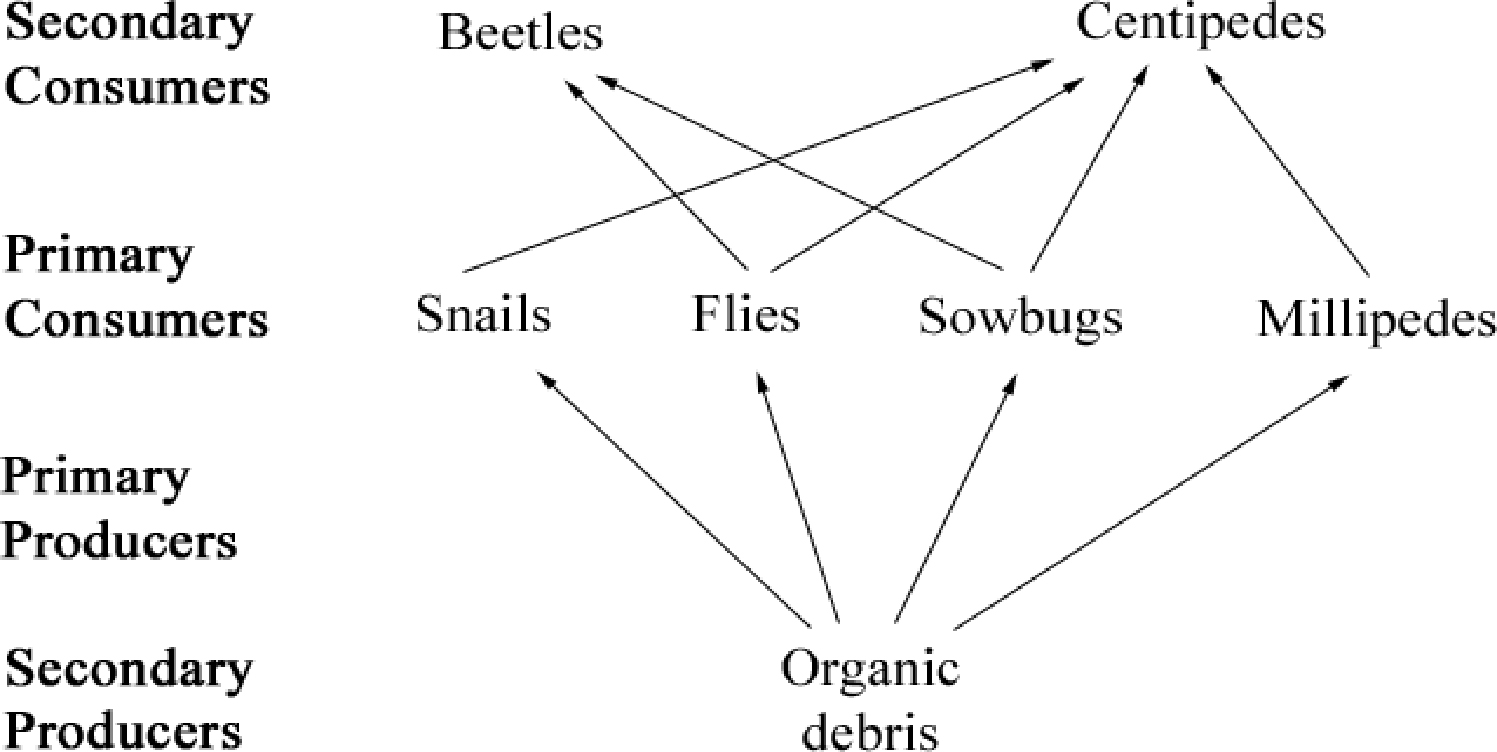
Figure 2. A Schoolyard Food Web.
Food webs, by themselves, provide a visible platform for thinking about organisms and their ecosystems in a dynamic, conceptual way. Both species diversity and thermal tolerance can be effectively introduced via a food web. Thermal tolerance can affect diversity as species move from an ecosystem where temperatures have gone from within their thermal tolerance range to one which offers a better thermal regime. Diversity can attenuate the effects of thermal tolerance limits by reducing the effects of losing a food web species. The more diverse the population, the better the chance that other species will utilize the food sources that the departing species exploited. And might be exploited by the same consumer which consumed the species which departed. Like the visible, dynamic structure of a drawn food web, these two biological phenomena effectors of ecosystem stability live in a dynamic relationship with one another.
So, what will they do with their food webs? In the next two blogs, let’s look at diversity first, then thermal tolerance. Both will provide valuable insights into the effects of global warming on living things; which is something our students need to become experts in.
This is a regular feature by CLEARING “master teacher” Jim Martin that explores how environmental educators can help classroom teachers get away from the pressure to teach to the standardized tests, and how teachers can gain the confidence to go into the world outside of their classrooms for a substantial piece of their curricula. See the other installments here, or search Categories for “Jim Martin.”

by editor | Feb 22, 2016 | Learning Standards
Active Learning:
Is this something our pre-service education equips us for?
 ’m interested in the Resource section on the New Generation Science Standards (NGSS) web site (http://www.nextgenscience.org/resources). At the very end of the materials, there is a link to the Vision Framework table (http://www.nextgenscience.org/sites/ngss/files/15-041_Achieve_ScienceChartNewVision.pdf) which indicates where science education has been, and where it is expected to go: From teacher-centered/didactic to student-centered/constructivist, along with an emphasis on active learning. My experience and perennial hopes tell me that this is what should happen. In the long run, it will produce a better-educated electorate.
 One thing I don’t see is how this change will be effected. There is little evidence of funding to facilitate this movement from teacher-centered to student-centered deliveries, especially when so many science teachers haven’t made the move. And for good reason: a large fraction of teachers don’t have the college-level preparation this change entails. And, historically, this has been the case since I started tracking it in the early 1970s. There is some talk of states taking up this responsibility, but not many states seem willing to spend more on education. As in most education initiatives, it will be up to the teachers to bring themselves up to speed.
That said, my hope is to be able to take a science activity and walk it up the NGSS from K-12. This started with a simple food web, which we’ll continue to use with questions it raises to stray into other areas of the Life Sciences standards. I’ll try to use examples which can be applied at any grade level. I have no certainty that I can do that, but I’ll try. Several possibilities for assisting teachers to make the transition to effective use of the NGSS in their classrooms are briefly described in the NGSS Resources section, such as the effort the Delaware and Rhode Island (http://www.nextgenscience.org/sites/ngss/files/DE-RI%20Collaborating%20for%20NGSS%20Alignment%20June%202015.pdf) collaborative effort to build effective ways to deliver the NGSS. Most efforts are still in the works, or pending work. The Delaware and Rhode Island effort’s final statement is instructive: “This work takes time: Participants’ knowledge of the NGSS, the rubric, and what makes for good feedback and suggestions for improvement grew over time, especially through the process of sharing their work with other members of their state team and across state teams.” Progress, but definitely not a final product.
 Many Classroom Sample Task plans described in the NGSS Resources section are “coming soon.” In one which is here now, Where Did the Water Go?: Watershed Study – Middle School Sample Classroom Task, the Introduction to the sample task describes what could become a student-centered activity, but the description of how to teach the lessons is largely teacher-centered. Overall, it doesn’t represent a student-directed inquiry, and provides little effective advice for teachers who are employing active learning for the first time. I suspect it will be up to individual teachers to reorganize the NGSS Resources offerings to make them student-centered inquiries. I’m concerned about this because teachers are under the gun to deliver on the NGSS, but are receiving precious little assistance to do so. And so we must train ourselves.
Let’s look at the wording in K-LS-1. Its performance expectation reads, “Use observations to describe patterns of what plants and animals (including humans) need to survive.” This is further clarified: “Clarification Statement: Examples of patterns could include that animals need to take in food but plants do not; the different kinds of food needed by different types of animals; the requirement of plants to have light; and, that all living things need water.” Then, elements from the Framework for K-12 Science Education are listed: “Analyzing and Interpreting Data – Analyzing data in K–2 builds on prior experiences and progresses to collecting, recording, and sharing observations. Use observations (firsthand or from media) to describe patterns in the natural world in order to answer scientific questions. Connections to Nature of Science: Scientific Knowledge is Based on Empirical Evidence – Scientists look for patterns and order when making observations about the world. LS1.C: Organization for Matter and Energy Flow in Organisms: All animals need food in order to live and grow. They obtain their food from plants or from other animals. Plants need water and light to live and grow. Patterns: Patterns in the natural and human designed world can be observed and used as evidence.” Lots of jargon, but it does contain useful information. We can draw on these elements to integrate what we observe in the real world with the semantic world of the NGSS. If we succeed, our students will be learning for conceptual understanding rather than to connect particular standardized test question stems with memorized, but not conceptualized, facts. We need to be able to do this.
We started to use a food chain to begin to address this standard. If we were to use the delivery modalities described in the first row of the Vision of the Framework table at the end of the NGSS Resources web page we would have two choices. One is teacher-centered, “Rote memorization of facts and terminology.” The other is student-centered, “Facts and terminology learned as needed while developing explanations and designing solutions supported by evidence-based arguments and reasoning.” That’s a rather densely concept-populated sentence; a sentence with a top-heavy concept load. (Concept Load is one of the things we all need to be careful about when we’re speaking or writing. It’s certainly a common problem for me.) In spite of that, it does open the door to teachers who allow their students to develop their own questions from time-to-time, and to develop investigations to answer them, collect and analyze data, interpret their findings, and communicate them. (You’ll notice my problem with concept load in that sentence.) In the process, students’ own questions and investigations force them into the books and the web to find needed information. Because they’re not going after it to answer a test question, it will be stored in conceptual memory, where it can be brought out to use when needed. That kind of work fits what the NGSS states it wants students to do. That opens the door to real, competent learning. We need that.
Your best way to master this new way of teaching is to take one piece and work on a way to deliver it via active learning. We’ll give that a first shot here. If we were to deliver the personal food chain activity described in the previous blog with a teacher-centered activity, we would provide students with the names of the plants, and where to place them on paper. Then we’d have the students write their own names above the plants and animals they ate, and draw arrows from each plant or animal to the student’s name. (We might ask them to write the animal names above the plant names and below their own names.) We’d then tell them they’d constructed a food chain, and begin to explain the arrows’ meaning. Whatever else we wanted them to know would be delivered in a similar way. Very little conceptual understandings would connect all of this information in a meaningful way or pattern.
“Pattern” is the operative word here. When we discover patterns, our brain’s Seeking system is activated, and the prefrontal cortex organizes itself to place all of these learnings within a connected conceptual schematum, which draws on information stored in various parts of the brain. The conceptual memory then ‘makes sense.’ Contrast this with memories created during teacher-centered activities, where memories are stored, but with precious few connections; little chance of developing into conceptual memories.
Now, to the right side of the Vision of the Framework table. Each of us teaches differently. I’ll describe this constructivist, active learning activity as I might do it. Think about it in your own way. That’s important. The differences may raise useful questions. Here we go. First, I assigned the homework task, “Tomorrow, write down all of the things you eat for breakfast. We’ll use this to look at one of the ways you’re connected to the world.” This will raise questions in some students’ minds. When a few of those articulate their questions, I’ll phrase in some way my standard response, “What do you think?” If the discussion seems fruitful, we’ll just see where it goes. If not, we’ll continue with what follows.
When they come in with their information the following day, I’ll ask them to work in partnerships to figure out a way to picture a relationship between the things they eat and themselves. After, we’ll report back what we find, discuss what we see and think, and then each group will build a picture to illustrate how they understand the relationship between the organisms they eat and themselves based on what they’ve taken away from the reporting session. That is as long as a fruitful discussion the day before didn’t lead to a better way to do this. Note: I’m talking about kindergarten or, K-1, since that is the level the standard quoted above is directed toward. But this activity does work at all levels with a little tweaking. The idea here is to prepare students’ minds for the learning about food webs that they will embark upon; and, to begin working on the NGSS LS1-1 standard.
We’ll post their pictures, then if I think it’s helpful, I’ll show them the way I did mine. Hopefully, I won’t have to. Since these are young children, I’ll simply say this is the way I thought of to do it. Then I’ll ask if their pictures provide any information about what plants and animals need to survive. This conversation can go many ways. My job will be to see that we learn that we all, even plants, need to eat. (Note: The NGSS K-LS-2 states that plants don’t need to take in food. I disagree with this assertion. Plants take in nutrients from the soil; that’s one of the reasons we compost and fertilize. Plant roots aren’t there just to absorb water and stabilize the plant. Roots work on their own and with microbes and fungi to bring nutrients in the soil into their own bodies. That’s taking in food, which the NGSS standard says plants do not. Oh, well.)
It is more difficult to write a set of standard directions for an activity delivered via active learning than via teacher-centered learning. Active learning allows so much room for minds to explore that it seems to have no direct path to the end. It actually doesn’t work that way, but you have to engage it yourself to discover that. There are little or no standard terminology or conceptual referents that we can use to describe active learning as there are for teacher-centered learning. Perhaps because it’s a relatively new function for most educators. Not for our brain. It learns best when it is seeking a pattern and/or answer to an interesting question. Helped us survive the Pleistocene. Somewhere along the way, school lost the capacity to use this powerful tool. We’re beginning to rediscover it.
In the next blog, we’ll look at the food chains the class produced, then see how we can use them to connect to other curricular areas.
This is a regular feature by CLEARING “master teacher” Jim Martin that explores how environmental educators can help classroom teachers get away from the pressure to teach to the standardized tests, and how teachers can gain the confidence to go into the world outside of their classrooms for a substantial piece of their curricula. See the other installments here, or search Categories for “Jim Martin.”

 This is a regular feature by CLEARING “master teacher” Jim Martin that explores how environmental educators can help classroom teachers get away from the pressure to teach to the standardized tests, and how teachers can gain the confidence to go into the world outside of their classrooms for a substantial piece of their curricula. See the other installments here, or search Categories for “Jim Martin.”