by editor | Dec 14, 2015 | Learning Standards, Learning Theory
Why kids need ecology now!
Teachers, as well as science majors and graduate students, need to understand the process of science. And they need to be able to argue it, discuss it, suggest novel perspectives, give and respond to criticism. Does our inservice education deliver this to us? Especially critiques of current practice? The Vision of the Framework for K-12 Science Education Vision table and, some of the descriptions of the New Generation Science Standards indicate that all science teachers will need to understand both the process of science and the process of student-centered science education.
by Jim Martin
CLEARING Magazine Associate Editor
 lobal warming; hot topic, little consensus. What if students were learning the ecology and environmental science they needed to understand the nature of global warming: its history during the tenure of life on Earth, the similarities and differences between this episode we’re experiencing now and others, the nature of food webs and their connections to the concept of species diversity, the connections between temperature and habitat? What would be the effect of this work on students? They are young citizens, and will be among the adults, as will their own children, faced with the results of our generation’s effect on global climate. How much curricular time do we devote to these topics? Are we allowed to? They’re definitely good science; but, are they currently culturally correct education?
Do these topics conform to our expectations of curricula meeting New Generation Science Standards (NGSS)? The NGSS have addressed a relatively small part of their standards to ecology. Students in schools today, and their children, need to know ecology at a level which makes it, especially at the conceptual level, clear and comprehensible; fits the understandings we need to cope successfully with the effects of global warming. They’ll be dealing directly with these effects in their lives. Will they understand and use what they know of, say, food webs and the effects of global warming? Concepts like thermal tolerance? Species replacement? The concept and applications of niche? What can we do to help? Knowledge of environments and their biota are important components of our response to global warming. We do a better job of responding to issues when we understand their pieces.
While the NGSS call for active learning in their delivery, there is no advice in the Resources Section at the NGSS web site (http://www.nextgenscience.org/resources) that assists teachers to employ active learning and learning for understanding in the classroom. They do provide brief descriptions of active learning, but provide no examples. Nor do they provide inservice instruction that will prepare teachers to engage students in active learning and acquire the requisite curricular understandings they will need to do the job well. We need to attend to this.
At the end of the NGSS Resources section[1], there is a table at the end of the NGSS Resources section which describes changes in the way science will be taught when it is aligned with the standards; how science was once taught, and how it will be taught as the NGSS is implemented. The transition moves learning from teacher-centered delivery to active, student-centered, constructivist, self-directed inquiry on the part of students, their preferred delivery modality. My experience teaching, and working with teachers, tells me that this transition is difficult, and needs time and support to do effectively. Done by confident teachers, it is always effective, involves and invests students in their learnings, and empowers them as persons. The didactic, teacher-centered modality is effective when you’re teaching how to use a dissolved oxygen probe, but for most learning, the constructivist, student-centered, active learning modality works best.
I’d like to spend some blogs describing how this transition in delivery modalities might work at the various grade levels. To facilitate this, I’d like to discuss a paradigm which is easily assimilated by humans of all ages, and which helps some of the more esoteric ecology standards make down-to-earth sense: food webs. (Note: Food Webs are also called Food Cycles. Both Food Webs and Food Cycles are composed of Food Chains, which show the chain of animals which eat a particular Producer. I favor Food Web because it infers a complex of interactions, which are the means for maintaining ecosystems.)
We’ll start with students’ (and your) own food chain. I decided to do this to illustrate the process of constructing a food web. After that, we’ll do a food web on a school ground or neighborhood for our initial food web, and amplify it as we move up the LS2 grade levels from K to 12. While we’re working, we’ll use the Vision of the Framework table to see how active learning works, and what we can do to facilitate it. I suppose that this means that there will be many blogs to follow.
Here’s how I constructed my own food chain (Since I’m the only consumer eating what I eat, a food chain will have to act as my food web!): I wrote down what I ate for each meal for a day, then looked up on all package and can labels any ingredients which were included in the prepared foods I ate. They were all derived from plants, so I placed all of the plant species’ names on the bottom row of the diagram, (Figure 1), and the things which eat them above that row. Next, I drew lines from each plant species to what eats it. (Some draw lines from the eaters to what they eat. Either type of placement does the job.) In this case, that was always me. I’ve added salmon and mackerel to my food chain, even though they don’t eat the plants I’ve listed. I did this because I eat those fish too. If I wasn’t on a vegan diet for my health, the list of one label’s ingredients would make my food chain too cumbersome to draw. As it is, the ‘web’ looks like a mess.

Figure 1. My Personal Food Chain. First Pass.
If you have started your own food web, and got this far, you might entertain the same feeling. Why do you think this, my personal food web, seems so confusing? Unnatural? Perhaps because it is. In the first place, it is a food chain, not a food web. If I were to trace each ingredient to the place where it lived, there would be very few which lived near where I do. Is this true of all organisms living in ecosystems on Earth? Do you know how to find out? Do you know enough about ecosystems to make informed opinions and decisions about our response to global warming? Should our children’s educations provide them with this capacity?
What else do I eat? Some of the food sources listed, prepared or simply harvested, contained microbes, insects, etc., either whole or in part within them. That’s just how food happens. How do I account for them? Another fact about my food chain: The mackerel and salmon I eat are part of other food webs. Do I show them? While they are consumed by me in my own food chain, I affect theirs. Migratory animals’ food webs do this as they move from one ecosystem to another, but I stay where I am. (They become transient parts of those food webs. I’m a permanent part of mine. But mackerel never swim past my house!) These questions suggest to me that my food chain needs attention. (Exploring this might present a nice activity for students of any age.) If we are to survive the effects of over-population and global warming, I think a first thing to understand is that we are members of an ecosystem, and need to be contained within it. At least, as much as is possible. Constructing a food chain is the first step in this process.
So, what will I do? I’ll cut down my producers (plants) to those which grew here. I’ll pretend all of the salmon are from here, but eliminate the mackerel. What does it look like now? (See Figure 2) You may see that this is complex. What I’ve written so far may not seem like exploring what students need to know about species diversity and the connections between temperature and habitat. I think that exploring those two topics will work best if we can envision their effects on food webs. We’ll go through this a step at a time as I do mine, and expand to a food web in a riparian area. (Is this what I will do?)

Figure 2. My Personal Food Chain. Second Pass.
I could show what Salmon eat, and that would make this a more realistic food web; more informative by placing me within an ecosystem. And I could add the herbivores who also eat the oats in my food chain. (Rest of paragraph needs work.) But, it wouldn’t be Mine! Instead, I would begin to become part of a food web based on the ecosystem I live within. Hmm . . . . Closer, perhaps, to where I should be? A further step: I can add other animals which eat the producers I do, and animals that eat them. I could even show the organisms which decompose them, and those who redistribute our parts when we die or lose them. A more realistic food web, and one which would make me a better-informed citizen when I am engaging or reading about our efforts to compensate for the effects of global warming. Just what today’s students need.
[1] (http://www.nextgenscience.org/sites/ngss/files/15-041_Achieve_ScienceChartNewVision.pdf)
 This is a regular feature by CLEARING “master teacher” Jim Martin that explores how environmental educators can help classroom teachers get away from the pressure to teach to the standardized tests, and how teachers can gain the confidence to go into the world outside of their classrooms for a substantial piece of their curricula. See the other installments here, or search Categories for “Jim Martin.”

by editor | Oct 25, 2015 | Learning Theory, STEM
schoolship.blogspot.com
Arts and Humanities in the Sciences? Is that incongruous, or what?
By Jim Martin
Have you ever ‘felt’ the weather as cloud formations began to change? I love to watch Mares’ Tails form; multiple long extensions of a cumulus cloud that race out ahead, then turn up and curl back. They signal a change in the weather; an eye-catching choreography in the sky; a dance students could perform to learn about weather. I started teaching biology to college students in 1970, and had no thoughts about using the arts and humanities in my delivery. I was open to them; my childhood and youth were infused with them. But I saw no way to employ them because it seemed to me that they were an adjunct, a vehicle I would have to tack onto an already overloaded syllabus.
Then, a few years later, concerned about the quality of my general biology (Bio 101) students’ understandings, and wondering what they were learning during their K-12 years, I accepted an opportunity to teach a 7th grade self-contained classroom. Before the first day of school, I decided not to use the school’s language arts texts and workbooks. They were utterly boring; pages to go through so you could answer a few tedious questions. So, I organized my own curriculum. In one part, the delivery vehicle was drama. We stretched sheets across the length of the classroom, and began to write and perform scripts.
I used these scripts, and their repetitious deliveries to teach topics like DNA and protein synthesis, natural selection, and more. While doing that, I discovered that certain pieces of the science were learned well with this method, so this integrated way of teaching started to become a vehicle I used to teach multi-disciplinary units in language, performance arts, and science.
This is beginning to sound ominous! Don’t despair. I did these things because I was comfortable with them. For one thing, I was teaching both language arts and science to this class. Since we were in the same classroom all day, it was an easy thing to do. I can tell you this: If you can find the courage to try to use one piece of the arts and humanities in one science activity, you might discover the strength of this method in helping students understand the concepts they are studying. And, developing critical thinking and executive functions you might not have noticed they carry with them.
Be patient. Let me finish this reminiscence, and we’ll get to the pragmatic details of how you might try one small activity; and assess it. Not long after, I found myself learning what I could of the human brain; how it learns, how it expresses these learnings. This set me on a journey I still travel. An interesting viewpoint on that journey was one where I could see the parts of the brain, and their connections (critical piece there) that were used to conceive a visualization of a piece of art, then execute its expression in the finished piece itself. Contrary to what I’d always assumed, that art and science used different parts of the brain for their work, both used nearly the same parts and their connections. No wonder my tentative attempts to teach art and science together seemed to work! While we isolate and jurisdict the disciplines, the brain does not.
It’s challenging to meet science standards and benchmarks by using the arts and humanities as vehicles for teaching to these standards. The main reason teachers who do this continue the practice is that students’ learnings stay with them. After they take the test, they don’t forget what they have learned. The Seeking System, as described by Jaak Panksepp, is a coordinated effort between the limbic system and the cortex which can lead to conceptual learnings, encourages conceptual learning by engaging learners in an active learning inquiry which builds on students’ curiosity. It’s this state of expectant curiosity which keeps students on-task, seeking an answer, finding out. Like observing paramecia flitting about among algae on a microscope slide. What are they? What are they doing? Where are they going? Curiosity a fair wind which drives their sails, students will devour the books and internet for information they seek.
While this state is initiated in the limbic, a part of the brain which does little thinking, it engages, via prompts from the limbic to the prefrontal cortex (pfc), which processes students’ thoughts, engages critical thinking, brings to working memory in the pfc other relevant information, and performs the executive functions which keep learners on task, following their plan. Learnings there then move back to the cortical regions brought on line, where they become connected; long-term memories, which can be called out via any of the neural circuits brought to the pfc to deal with this new experience.
Let’s look at an activity which incorporates the arts and humanities to drive a science unit in weather. Teachers have used dance to help their students learn the meteorological processes that cause phenomena like Mares’ Tails. You can do the observation any time in the year, then recall it when your class does meteorology. Or, start the dance when you make the observation, and finish in the appropriate unit. When students observe Mares’ Tails, then build a dance around what they have observed, they follow an interesting trail into meteorology to discover the processes involved in producing Mares’ Tails. And, even better, their connection to subsequent weather. Then, students and the teacher can use this newly learned information to better inform the choreography they are constructing.
As they observe and find out about Mares’ Tails, the fact that they are also observing for the clouds’ dynamics will engage the Seeking System in many students; the quest to find out. Engaging the idea of dance and Mares’ Tails will pique the curiosity of others. And, a very nice coincidence, both alert the prefrontal cortex and initiate the critical thinking and executive direction capacities of the brain as they build an abundance of routes to relevant memory, which your students use to move effortlessly through the landmarks delimited in Bloom’s Taxonomy.
While relatively simple, the teaching and learning in an activity like this is challenging for teachers. It is definitely not part of most of our pre-service and in-service professional educations. We all want to teach well, and to understand what and how we are teaching. If, like most Americans, the arts and humanities aren’t an integral part of our teachers’ developmental experience, incorporating them into our teaching is uncomfortable at best. In spite of this, in time, this sort of integrated teaching will have wider acceptance, but just now it seems like an adjunct to most education. I say this: The education establishment in America is woefully unfamiliar with the brain and its processes in learning, and its relationship with the rest of the body currently being described in the area of embodied cognition; the close coupling of processes in the brain and processes in the rest of the body. We need to have the courage to begin to explore this lucrative, brain-based teaching modality. The brain is the organ of learning.
By actively participating in the process of using dance to begin to learn about Mares’ Tails, both teacher and students incorporate the learning in long-term conceptual schemata they will carry with them. This is because the conceptual information they have learned is available via multiple neural pathways; much better than being accessed only by reading a question stem. Both the dance and the science inquiry follow similar trails through the brain. This is in contrast to the effect of relying on what Panksepp terms the limbic’s Fear System; the anxiety of some degree which is associated with learning science facts in order to pass a test. In this case, the information is stored by itself, un-connected to other relevant conceptual information stored elsewhere, and with no connection to the real-world memories produced during active learning. If students are to carry what they learn into their lives, they need to learn it in authentic ways. Seeking’s learnings are remembered; Fear’s are forgotten after the test. This means that the teacher has to be committed to this learning modality. And, committed to taking on only that which she is comfortable with. Should you want to try, but are unsure, you can contact a dance teacher to help, or a colleague who has taken dance. Lots of them around. You could even check a dance studio. Most people who work in the arts and humanities are open to help.
Here is a breakdown of planning steps a hypothetical teacher might take in preparing to deliver the Mares’ Tails meteorology/dance section of a unit on weather. As you read each step, ask yourself if you could do it now. You might surprise yourself.
1) Observe Mares’ Tails; either a serendipitous observation, or consult a meteorologist to find out when to expect them. Difficult until you’ve positively identified one; fun and easy after that. Students can do this as homework, or as a whole class if Mares’ Tails occur during a class. (You may have noticed that weather doesn’t program itself to coordinate with school schedules. Or their needs.)
2) During the observation, have students note any dynamics in the clouds. This is a good time to suggest the idea of clouds dancing.
3) If their interest is piqued, raise the idea of a Mares’ Tail dance; otherwise wait.
4) First approximation of the dance. Note questions which arise within groups.
5) Ask the class what more can they find out about Mares’ Tails. Give them time to find out.
6) Incorporate this information into the choreography. Name the dance’s sections from meterological learnings. (Note: I was feeling creative, in Seeking mode, by this time, and that’s when my pen wrote, “. . . (n)ame the dance’s sections from meteorological learnings.” Words and a visualization just popped up. Evidence my prefrontal cortex was coming on line. One of the things Seeking does.)
7) Perform the dance for an audience, and explain the meteorology; perhaps by dance section.
8) Two assessments or tests: Yours, based on their work; and a standard test from your publisher or the web. Compare results.
9) Assess the project: you, your students, their audience.
10) Write an article for Clearing and send it in!
This is a regular feature by CLEARING “master teacher” Jim Martin that explores how environmental educators can help classroom teachers get away from the pressure to teach to the standardized tests, and how teachers can gain the confidence to go into the world outside of their classrooms for a substantial piece of their curricula. See the other installments here, or search Categories for “Jim Martin.”

by editor | Sep 17, 2015 | Questioning strategies
 What’s the Difference…
…between a single performer and an energetic band? Can students teach themselves?
by Jim Martin
CLEARING Master Teacher
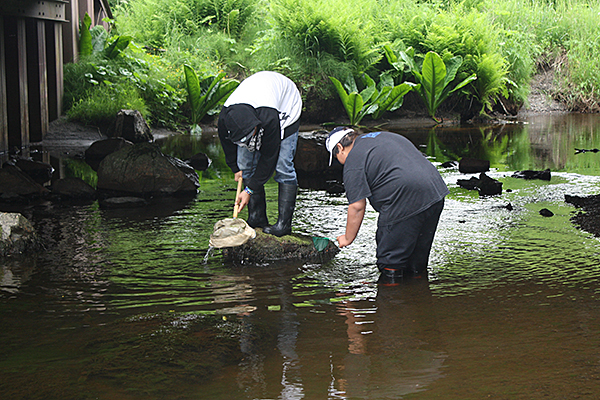
 n an earlier set of blogs, we followed a middle school class whose science teacher had started them on a project to study a creek that flows at the edge of the school ground. The last time we saw them, groups were analyzing and interpreting the data and observations they collected on their first major field trip to the creek, and preparing a report to the class. The blog focused in on the group doing macros, macroinvertebrate insect larvae, worms, etc., who live on the streambed; aquatic invertebrates large enough to distinguish with the unaided (except for glasses) eye.
They eventually organized themselves into three groups, one to cover the process of collecting the macros, one to describe how they identified and counted them, and a third to find out how to use their macro findings to estimate the health of the creek. Sounds like they’re on a learning curve, moving from Acquisition to Proficiency. They would need some feedback, both from withn the group and from their teacher. She gave each group one more task, to find out what they could about effective student work groups.
The macro group prepared the presentation they would make to the class. Each of their groups prepared their part, then they gave their presentations within the group, and used this experience to tweak them into a final, effective presentation. Their presentation included the interpretation they made based on their collected data that the creek’s current health was Fair, tending toward Good.
They used the rest of their prep time to begin a search for information on effective student work groups. During their web search, they were surprised there was so little there about middle school work groups, since they are finding their work invigorating, and feel they are learning a lot. Some of the sites they visited were confusing, some targeted high schools, but most described college work groups. Among those things related to effective work groups they found and were interested in were those which described the work, maintenance, and blocking roles individuals play within work groups, and those which described how groups can make their work visible while they’re processing by using whiteboards, posters, etc. They saw how these aids would help clarify concepts as they were learning. They decided to report on these two findings, roles group members play and making the work visible so that it is easier to discuss and process.
Of the two group characteristics they decided to report on, the idea that individuals play roles in a group, and these roles affect the work of the group were the most interesting to them, and a bit of a revelation. They were especially intrigued by one of the Blocking roles, which interfere with a group’s capacity to complete its work. The one they found most interesting was the Avoidance Behaver role. Each of them had engaged this role when they were madly fighting for the D-net while first collecting macros. (By joisting to control the D-net and collecting tray, they were avoiding the work in the way in which they behaved. They had employed Avoidance Behaviors; each of them, as they joisted, was an Avoidance Behaver.) They still laughed at the fun they had been having, but also felt the odd juxtaposition of this role with the Work and Maintenance roles they also played to move the work along, clarify the processes they used and identifications they made, keeping communication lines open, and sending out consensus queries about what they thought they were finding out.
They were encouraged that most of the roles they assumed were positive ones which lead to a successful project. As they talked, they also came to consensus that this was a finding of their work as important as their findings indicating that the health of the stream was Fair, tending toward Good. A revelation for them, and would become one for their teacher.
This group has made good progress on their new learning curves, macroinvertebrates and group roles. One curve is facilitating their conceptual understanding of macros; the other curve is empowering them to understand the dynamics of an effective work group. They entered these learning curves because (1) their teacher set them up in the first place, and (2) the Acquisition phase included finding out about macros. And, perhaps inadvertently, their, and their teacher’s discovery of the importance of developing effective work groups. Because the students were first finding macros, then learning about them, they started their work seeking information and patterns which would help them know who was living on the bottom of the creek. They didn’t consciously couch their investigation in these terms, but this is what they were experiencing.
The experience of seeing if they could actually capture macros, and the fun involved in collecting and seeing them stimulated the limbic’s Seeking system in their brains, which added dopamine to the neural soup that facilitates human efforts to make work interesting. These feelings and felt interests, in turn, drove them to the books and the web to follow up on the needs to know generated by their inquiries. Under their own power. First, the excitement of learning how best to capture macros, then residual interest carried them to the manuals to begin to identify who was there. ‘Finding Out’ is a powerful student (and human) motivator, one we stamp out as students move through the grades we teach. Perhaps because many of us don’t understand the content we teach well enough to allow our students to have their own thoughts about it. (Parenthetical comment on the 50%)
We could learn to use this motivator to engage conceptual learnings in ways that involve and invest our students in their learnings, and empower them as persons. There is a big difference between memorizing for a test and trying to find out the same information. The difference between a single performer and an energetic band. One way that difference expresses itself is in our standing in global scales of learning, where we are consistently near the bottom, rarely in the upper half. Our current model of school is memorizing for tests. How well does that work? We need to rediscover this active, group-centered, collaborative way of being human, and exploit it in our classrooms and outdoor sites. Telling students what is before them doesn’t stimulate long-term conceptual memory; helping them find out does. I’d like to say, “Freeing them to find out,” but for many teachers those words, especially the first one, might be intimidating to hear.
Building effective work groups takes time and patience. Fortunately, it goes quicker if the process takes place while the groups are pursuing an inquiry. Engaging in this kind of work develops needs for just the sort of group processes which make inquiries successful. While she may not have consciously planned it, dividing the class into groups, each with its own part of the creek to study, set the stage with students who were ready to learn about effective work groups. They weren’t consciously aware that they were ready, but their needs to do the work did the job for them.
(I’m interested in Jaak Panksepp’s work at Washington State University on the brain’s limbic system’s Seeking System. It’s important to learning for understanding because this is one of the few instances in which engaging the relatively primitive Limbic System leads to effective activity in the cortex, where critical thinking happens. When educators speak of the brain and learning in the same sentence, eyes in just about any audience tend to either roll or glaze over. Even though the brain is our organ of learning, teachers and administrators tend to think of learning and publishers’ products as the only bundle that matters. No room for neuronal bundles. Connecting. In effective ways. Evolved bottom up, and may work best that way.)
First, by sending students to find out, the emotions of the Seeking system move them to the cortex and critical thinking. Then we organize the learners’ environment so the information they (their cortices) need to know is readily available. And we can watch as our students learn for understanding. My experience was this: First engage students in their inquiries, then see how much of the reading I would have assigned or lectured on that they get into on their own. My observations on learners over the years told me that any movement away from total inertia on the part of the student indicates a determined effort to learn even if it’s a small move, say 10% of the way to mastery. Perusing the research on the brain eventually clarified that particular parts of the brain, when they were working, elicited the learning behaviors I observed, and clarified students’ involvement and investment in the learning, and empowerment as persons, and prepared them to form effective work groups.
So, the teacher and her class were learning that one thing which will enhance student performance is to learn how to get group members to interact. You can facilitate this by ensuring that students’ work calls for the communication skills it takes to develop consensual decisions about complex topics. The teacher whose students we just followed did this by asking each group to research information about effective student work groups. They do the work, she gleans the information. Win-win. A further step would be deciding how to include minority opinions in final reports. Simple to do; you just announce that you allow it. In my experience, this helps students achieve ownership of their learnings. A surprise for me was that sometimes students presenting a minority report saw something other groups presented from a new perspective, that of observer, not of learner. Whether that altered their interpretation of findings wasn’t as important as the fact that they were developing the capacity to hear another view and think about it. And validate the right to hold it. And, holders of the majority opinion often did review their thoughts.
The macro group is moving through its own learning curve. Does their progress look like a learning curve? Where did they start? Where are they now? How does the learning curve differ for an individual student vs. an effective work group? I picture this difference as one between a single, good performer, and an energetic band; the interactions between group members, while they’re working, can make a routine school activity become an exciting experience, a performance to be remembered. If you’re a teacher, listen to that last word.
This is a regular feature by CLEARING “master teacher” Jim Martin that explores how environmental educators can help classroom teachers get away from the pressure to teach to the standardized tests, and how teachers can gain the confidence to go into the world outside of their classrooms for a substantial piece of their curricula. See the other installments here, or search Categories for “Jim Martin.”
by editor | May 26, 2015 | Questioning strategies, Teaching Science
Can I become a science inquiry facilitator? . . . If I’ve never been one?
by Jim Martin
What do I need to be competent in, comfortable with, being a facilitator instead of a top-down teacher? I think a first thing is the recognition that people can learn on their own; that they don’t need to hear me say every single thing that I want them to know. To be free to allow that, facilitators have to be comfortable with their understandings of the content they are delivering. And, they need to be comfortable developing effective work groups. Actually, I can think of a bazillion things, but these three are, so I currently believe, essential to making the transition.
If the Common Core State Standards (CCSS) and New Generation Science Standards (NGSS) are going to become more than simply another swing of the pendulum that arcs through the schools with predictive regularity, then teachers need to rally to support and develop those pieces of these initiatives which are directly targeted at the deficiencies in our teaching. Deficiencies which have landed us in a mediocre position in the educational statistics describing achievement on the globe. We’re the only ones who can do it.
Both the CCSS and NGSS initiatives profess to be based on a constructivist, active learning model of teaching and learning. This, to me, is wonderful news. Our brain is admirably organized to learn by actively constructing conceptual schemata, conceptual learnings. It does this best by asking questions of the real world. This means that teachers aren’t , of necessity, people who put learning into other people’s brains; rather, they are people who can organize their teaching environments to draw out the learning potential which resides in their students’ brains. They facilitate those brains to enter a conceptual space, engage and discuss what is there, and find out as much as they can about it. Like the little robotic vacuum cleaners, when, once their switch is turned on, clean up all the dust and litter in the room. All by themselves, with no one directing them. Once you turn on a brain, it doesn’t turn off. Unless it loses its freedom to work.
I’ve observed this dichotomy of teaching practices as long as I have taught, and been a student. Didactic, teacher-centered practices, and constructivist, student-centered practices: Is it a matter of personality, or of comfort with the content and methods being used to teach it? That makes a teacher prefer one or another? I’ve had (and observed) teachers who told me what to learn and how to learn it, then tested me on the results. Twice, in high school, I had teachers who threw out an idea, then sat back as I tried to find out more about it. I remember what I learned by finding out 60 years later. And the excitement of the learning. I carry no specific memories of learnings from the rest, except for things which personally interested me, like diagramming sentences. Which, odd it may seem, I loved to do.
The didactic teacher I had from fifth through eighth grades was the kind who told me what to learn and how to learn it all the way to the last days of eighth grade. Then, she started us on the way to pre-algebra by saying, “You don’t have to learn this. Just see if you can follow the argument.” Then, she wrote on the board the first algebraic expression I’d ever seen, a + 2 = 6. I looked at that for awhile and thought, “Wow! You can use letters to stand for anything! You could learn about anything with that!” A mind, at last free to explore.
For that brief moment, my stern, demanding teacher had become a facilitator. All by herself. That was 1952. Had her stern and demanding exterior reflected a lack of comfort with the content she was teaching and the methods used to deliver it; or, was her exterior reflecting the personality within? I can’t answer that question, but the obvious interest and enthusiasm she brought to the introduction to equations suggest she may not have actually been a stern and demanding person. It seems almost, from hindsight, relief to be free to teach as she thought she ought that I observed those very few days at the end of eighth grade. Today, more teachers have experienced being facilitators, but many have not. What would you need to become one? How can you find out?
At this point, I should leave you to find out; but, I’ll barge ahead with my own ideas, just as any didactic teacher would. Hoping all along that you’ll adopt a constructivist approach to the subject. That said, let’s start with my offering of three things a person who is a facilitator must have encountered and successfully engaged.
The first is probably the most difficult for a teacher to entertain – recognizing that people can learn on their own. When I first experienced this, I was in my first year teaching below college, in a 7th grade self-contained classroom. I didn’t know it at the time, but I had begun employing a constructivist teaching paradigm. It was hard, exciting work, yet I always felt the anxiety-producing peer pressure from colleagues whose view of school was students sitting in rows doing quiet seat work. Luckily, I had a very supportive principal, who encouraged what I was doing. And I applied what I had so far learned from raising my own children, that they do best when they are following up on choices they have made, which I had offered them, and which were within the limits I knew were workable.
So, what did I learn about using constructivist vehicles for delivering 7th grade curricula? About whether and how students can learn on their own? One, that this worked. At least, for me. They had two and a half hours each morning for language arts. During that tiem, they scheduled and worked on open-ended (but contained) writing and reading assignments. We also used speech and drama to engage active learning. (I didn’t know that’s what it is called; I simply knew it worked.) For instance, while working in groups to write and deliver one-act plays to elementary classes, they also learned the current language arts curriculum I had to deliver. Students became involved and invested in their work, and I noticed they also seemed empowered as persons. These were outcomes of the work; I wanted to know how this involvement and investment in their educations came to be. And that started my lengthy, often-interrupted journey into the human brain. A long stretch for me, with my background in intertidal marine invertebrate communities!
How would a constructivist science-inquiry delivery look in an actual classroom in two very different activities? The first is a microscope activity, where students observe for the stages of mitosis in plant cells. The second is a field activity, where students observe the effects of streamside vegetation on the temperature and dissolved oxygen content of the water adjacent to it.
When you employ a constructivist paradigm to organize the delivery of your curriculum, the students’ job is to construct the concepts you hope they’ll acquire by examining the pieces of the concept they are acquiring. Instead of you telling them the concept, they learn its essential parts by engaging them, and then use these parts to tell themselves the concept. A different way to teach; but effective. The first few attempts call for courage and confidence on the part of the teacher. And, in time, the patience to take the time to allow the learning to happen.
How does this play out? In the mitosis activity, you might start by projecting a slide of plant tissue containing cells whose chromosomes have been stained; the usual root cells most of us have observed. You have students pair up to do two things: Locate as many chromosomal configurations as they can and draw them. Or, if you know your students well, ask them to find out if there is any underlying order in the mish-mash of chromosomal configurations they see. This done, they are to organize their drawings in the order they think they occur during the progress of cell division. If you’re truly brave, you might ask them to find and draw other cellular evidence to support your placements. That done, they can present their findings, then go to the books and internet to find what other scientists have found about cell division. They will learn as much, or more, than you would have taught them. And moved further on the road to becoming life-long learners; explorers of the world they live in.
In the streamside activity, you ask each group to take a reach along the stream, then find out the effect of the vegetation on temperature and dissolved oxygen in the water along that reach. Nearly all students can do this. You can provide gentle hints about overhanging vegetation if necessary. The hard part of this work for you is locating a stream which has enough overhanging vegetation for the number of groups in your class. When they’ve collected the data, they find out what they can about temperature and dissolved oxygen, and relate that to what they observed. Next, they prepare presentations about their work, what their data tell them, and what next steps would be if they have discussed them in their groups. (Note that these are things the students and teacher do. To know what they think, we need to go into the brain.)
Eventually, with a constructivist approach to conceptual learnings, coupled with a didactic approach to things like safely lighting a bunsen burner or using a dissolved oxygen probe, I became convinced that this consistently led to solid learning. So, I slowly began to learn about the brain we carry with us, and the ways that it learns. What I found reinforced what I observed; validated it as a teaching paradigm based on real evidence. I had observed evidence over the years that students seeking answers to their own questions involved and invested them in their work; but that was just me, making observations and inferences. As I learned more about how the brain processes input from the world outside the body, I discovered that what I observed was real. Students get better and better at this. Probably quicker than you do. This relates to students as autonomous learners. Autonomous because they are pointing their needs to know, and following up on them.
The other two things a facilitator must engage, comfort with understandings of content, and comfort with developing effective work groups, are our responsibilities. Here is how I approached them. First, I recognized that they are, indeed, our responsibilities. Just as it was my responsibility to take college and graduate courses to fill the gaps in my understandings when I taught in college. Goes with the job. We’re teaching professionals, and that places the onus on us to do what is necessary to become comfortable with the content we teach. The only way to do that is to learn the content. We can take courses in it, work out an internship with someone who does the work, or teach ourselves. It’s an unfortunate fact of American education that we’ll be asked more than once in our careers to teach content we’re either marginally prepared to teach, or know next to nothing about. It will take all of us, working together, to resolve that.
When I finally decided to teach in K-12 schools, I knew nothing about teaching reading. I’d taken literature courses in college, but could only recall that we read, then discussed, then wrote papers. Not much help. I’d noticed in the few teacher education courses I’d taken that the most informative were the special education courses, so I enrolled in a course in corrective reading. It was taught by Colin Dunkeld, and delivered within a constructivist paradigm. (This was in the early 1970s!) I became comfortable enough to make my own decisions about teaching language arts. The corrective reading course was very hard and time-consuming work, but had a great payoff – confidence in content and comfort in delivery. That, and my life-long love of words helped me build a useful / effective / profitable / worthwhile7th grade language arts curriculum.
When you decided to do the mitosis and streamside vegetation activities, you marshallled together your understandings about those topics. You’d observed slides of dividing onion root-tip cells in a genetics course you took in college, and felt familiar enough with the process and observations that you would probably only have to review and practice to come up to speed in the mitosis activity. You’d also taken two botany courses because you’ve always loved plants, so felt you could understand the vegetation part of the overhanging vegetation activity. Temperature and dissolved oxygen in streams is new to you, so you decide to ask around about finding help. You contact the school district science specialist who recommends a field trip program which focuses on the riparian (streams and their banks) which includes water temperature and dissolved oxygen in its offerings. As a real bonus, the program includes measuring the effect of streamside vegetation on temperature and dissolved oxygen near the stream bank, and a field trip for you and your students. Offerings like the one described are fairly common! You do have to ask.
If your circumstances are different for your preparation to teach these two activities, how would you approach them? Leave your thoughts as a comment for others who will, you can be sure, be interested. Or, leave a question for me to answer!
Aside from knowing and teaching the learner inside each student who enters your door, your becoming comfortable with content and its delivery is something you cannot bypass. Its effect on your students is profound. Think of yourself as being assigned to perform as a heart surgeon, even though you’d never done it. Would you be satisfied knowing that, while you did have experience in knee surgery, you had none in heart surgery? Like surgeons, we directly affect the quality of our students’ lives, and must be certain we are delivering the best education possible. We can’t do that if we’re uncertain about our content understandings and delivery methodologies. Knowing is our responsibility.
If you know the learner who lives within your students, and are comfortable with the content you teach, then you’re ready to become comfortable developing and using what I call Effective Work Groups. These are small groups of students who know how to work together to accomplish tasks, and who can coalesce into larger groups to carry out projects. Humans are social beings, and can learn to work together effectively. Let’s look at the two examples of constructivist approaches to learning as they would appear from within an effective work group, or team. First, make the groups, then have each group discuss the work and decide how to organize it. After each session, they will discuss how it went, decide on any modifications, and then continue. When the work is completed, and it’s time to move on to more curriculum, they in their groups, then as a class, nail down what they know about effective work groups. (Be sure to call them that, and that they know this is a goal. Toward the end of the year, have them develop a description of effective work groups.)
Now, here is what one group has decided to do. Mitosis: Identify chromosomes; find different examples of chromosomes; each person will use a microscope because they all need to develop this skill; sort chromosomes out; declare the steps in mitosis; research what other scientists have found out about chromosomes; develop and critique their report; report to the class; assess their work. Communication is important here; one of the keys to becoming effective. You have them assess the role of communication in the effectiveness of their work after they have found and identified chromosomes, sorted them into a process, and have prepared their report to the class. They decide they’ll each observe their own slide, and will show others what they find and what they think it means. They assign tasks when they present. Streamside vegetation: They divide into temperature and dissolved oxygen teams; each team learns how to do the observation, then teaches the other group; then they divide the reach. After they arrive on site, they decide to assign a group of Mappers to map the vegetation. The group works on communication when they discuss data’s meaning, and divide jobs when they look up other scientists’ work on web and in books. You ask them to assess their roles in their group, and the outcome of their working together.
Active learning within a constructivist paradigm is effective, even at the college level. Many teachers engage it, but far from enough. It takes confidence in your students’ capacity for autonomous learning, and confidence in your capacity to do and facilitate this kind of work. And patience; lots of it. If you don’t believe students of almost any age can engage this paradigm, find a class of young students which uses it and observe them at work. When they are born, children possess wonderful potential. The environments they develop in determine, to a large extent, whether they will generate the capacity to achieve their potential. If their environment believes they cannot, more than likely they won’t. If their environment recognizes the learner within, they more than likely will. And feel this is normal.
This is a regular feature by CLEARING “master teacher” Jim Martin that explores how environmental educators can help classroom teachers get away from the pressure to teach to the standardized tests,and how teachers can gain the confidence to go into the world outside of their classrooms for a substantial piece of their curricula. See the other installments here, or search Categories for “Jim Martin.”

by editor | Feb 23, 2015 | Environmental Literacy, Indigenous Peoples & Traditional Ecological Knowledge, Marine/Aquatic Education, Place-based Education, STEM
It Takes a Community to Raise a Scientist:
A Case for Community-Inspired Research and Science Education in an Alaskan Native Community
By Nievita Bueno Watts and Wendy F. Smythe
The quote, “lt takes a village to raise a child,” is attributed to African tradition and carries over to Alaskan Native communities as well (Hall, 2000). Without the support of their community and outside resources, Alaska Native children have a difficult time entering the world of science. Yet increasing the awareness of science, as a tool to help a tribal community monitor and maintain the health of their environment, introduces conflicts and misconceptions in context of traditional cultural practices. Rural communities depend upon traditional food harvested from the environment such as fish, wild game, roots, and berries. In many Native Alaskan villages the health of the environment equals the health of the people (Garza, 2001) . Integrating science with culture in pre-college education is a challenge that requires sensitivity and persistence.
 The Center for Coastal Margin Observation and Prediction (CMOP) is a multi-institutional, National Science Foundation (NSF) Science and Technology Center that takes an interdisciplinary approach to studying the region where the Columbia River empties into the Pacific Ocean. Two of CMOP’s focus areas are biogeochemical changes affecting the health of the coastal margin ecosystem, and socio-economic changes that might affect the lives of people who harvest and consume fish and shellfish.
The Columbia River waters touch the lives and livelihoods of many people, among them a large number of Pacific Northwest lndian tribes. These people depend on the natural and economic resources provided by the Columbia River. Native peoples from California through Alaska also depend on resources from their local rivers, and, currently, many tribes are developing-a workforce trained with scientific skills to manage their own natural resources in a way that is consistent with their traditional way of life. The relationship between Traditional Knowledge (TK) and practices, which are informed by centuries of observation, experimentation and carefully preserved oral records, and Western Science, which is deeply rooted in the philosophies and institutions of Europe, is often an uneasy one.
National progress is being made to open pathways for individuals from Native communities to Western Science higher education programs and back to the communities, where tribal members are empowered to evaluate and monitor the health of their environment. CMOP is part of this national movement. CMOP science is developing tools and techniques to observe and predict changes in the river to ocean system. CMOP education, an essential element of CMOB supports American lndian/Alaska Native students in pursuing academic and career pathways focusing on coastal margin sciences (Creen et al., 2013). One of CMOP’s initiatives is the CMOP- School Collaboratories (CSC) program.
CMOP-SCHOOL COLLABORATORIES
The CMOP-school Collaboratories (CSC) program is based on the idea that Science, Technology, Engineering, and Mathematics (STEM) pathway development requires an intensive and sustained effort to build relationships among science educators, students, school personnel, and the tribal community. The over-arching goal is to broaden participation in STEM disciplines. CMOP educators developed the CSC model that includes integration strategies for a community, development of appropriate lessons and field experiences and student action projects that connect local and traditional knowledge with science. Educational experiences are place- based, multi-disciplinary and culturally relevant. The objective is to open students’ minds to the reality of the need for scientists with many different world views and skill sets working together to address our planet’s pressing problems in a holistic manner. CMOP seeks to encourage these students to be part of that solution using both Traditional Knowledge and STEM disciplines.
The program encourages STEM education and promotes college preparatory awareness. This CSC program has three unique characteristics: it introduces coastal margin science as a relevant and viable field of employment; it integrates STEM learning with Traditional Knowledge; and, it invites family and community members to share science experiences. The example presented in this article describes a four-year program implemented in a small village in Southeast Alaska, 200 miles from the capital city of Juneau.
Figure 1: Students, scientists, a cultural expert. and a teacher with scientific equipment used to collect data from the river.
ALASKA NATIVE VILLAGE CASE STUDY
 Wendy Smythe, a CMOP doctoral candidate and principal investigator for an NSF Enhancing Diversity in the Geosciences (OEDC) award, is an Alaska Native Haida. As she advanced in her own education, she wanted to share what she had learned with the youth of her tribal community, striving to do so with the blessing of the tribal Elders, and in a way that respected the Traditional Knowledge of the Elders. Dr Bueno Watts is a mentor and expert on broadening participation. She acts in an advisory capacity on this project.
The village school consists of l5 staff members and 50 K-l2 students, with the school experiencing high administration turnover rates. ln the first two years of the program we recruited non-native graduate students to participate in the CSC program. This effort provided them experience working in Native communities. ln the last two years we recruited Native American undergraduate interns to teach lessons, assist with field activities and provide students with the opportunity to become familiar with Native scientists [Figure 1]. lnterns formed part of the science team.
STEPS TO GAIN ENTREE TO A VILLAGE
The community must support the concept to integrate science education with traditional practices. Even for this Alaska Native (Smythe), the process of building consensus from the tribe and gaining approval from the Elders and school district for the program was a lengthy one. The first step required letters of support from school district and tribal leaders. The difference in geographical locations proved difficult until Smythe was able to secure an advocate in the tribe who spoke for her at tribal meetings. Face-to-face communications were more successful than distance communications. Persistence proved to be the key to achieving success at getting the consensus of community leaders and school officials’ support. This was the top lesson of l0 learned from this project (Table l).
Traveling to the school to set up the program is no small feat and requires extensive coordination of transportation and supplies. A typical trip requires a day-long plane ride, overnight stay in a nearby town to prepare and gather supplies, a three-hour ferry ride, acquisition of a rental truck and a one-hour drive. Accommodations must be made to board with community members.
The development of appropriate lessons for the curriculum engaged discussions with tribal Elders and community Ieaders on an individual basis. Elders agreed to provide videoed interviews and were given honoraria as a thank you for their participation. Smythe asked the Elders what scientists could do to help the community, what stories can be used, where students and educators could work in the community to avoid intruding on sacred sites, and what information should not be made public. Once Elders agreed to provide interviews and share stories, other community members began to speak about their lives and concerns. This included influence of boarding schools, Iife as it was in the past, and changes they would like to see within the community. This was a significant breakthrough.
Table l . Lessons Learned: ten things to consider when developing a science program with Native communities
1. Persistence is key.
2. Face to-face communication is vital and Lakes time.
3. A community advocate with influence and respect in the community is critical.
4. Consult with the Elders first. They have their finger on the pulse of the community and are the center “of the communication network. Nothing happens without their approval. Find out what it is okay to talk about and where your boundaries are and abide by them. lnclude funds for honorariums in your proposal. Elders’ time and knowledge is valuable and they should be compensated as experts.
5. Partner with individuals or groups, such as the Department of Natural Resources.
6. Find a relevant topic. Be flexible with your curriculum choice. It must reflect the needs and interests of the community and the abilities of the teacher you are working with.
7 . Be prepared, bring supplies with you. Ship items in advance if going to a remote location
8. Have the ability to provide individual instruction for students who need it to prepare projects and practice giving presentations.
9. lnvolve the community. Hold events in a community center to encourage everyone to attend.
10. View your involvement as a long-term investment in a committed community relationship.
 ln addition to the Elders, support was needed from a natural resources representative who functioned as a liaison between our group and the community members. This person’s role is found in most villages and could be the head of the Department of Natural Resources or a similar tribal agency that oversees fish, wildlife, and natural resources. This person provides a critical link between the natural environment and the community. The next step is to go in the field with the natural resources representative, science teachers, EIders, and interested students to identify a meaningful focus for the community. lnitially we focused the project with a scientist’s view of teaching microbiology and geology of mineral deposition in a river ecosystem. However, the team found community interest low and no enthusiasm for this project.
Upon our return to the village, the team and CMOP educators found the focus, almost by accident. We were intrigued by “boil water” notices posted both at the home in which we were staying and on the drinking fountains at the school: The students were all talking about water, as were the Elders. It was clear that the community cared about their water quality. The resulting community-inspired research educational plan was based on using aquatic invertebrate bioindicators as predictors of water quality (Adams, Vaughan & Hoffman Black, 2003). This student project combined science with community needs (Bueno Watts, 2011).
CURRICULUM LESSONS
The first classroom lessons addressed water cycle and watershed concepts (Wolftree, 2OO4), which were followed by a field lesson on aquatic invertebrates. Students sampled different locations in an effort to determine biodiversity and quantity of macroinvertebrates. While students were sitting at the river’s edge, the site was described in the students’ Alaska Native tongue by a cultural expert, and then an English translation was provided. This introduced the combination of culture and language into the science lesson.
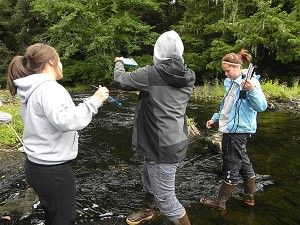 Figure 2: Students use data loggers to collect data on temperature, pH, and location.
The village water supply comes from a river that runs through the heart of the community. Thus, this river was our primary field site from which students collected water for chemical sampling and aquatic invertebrates using D-loop nets. Physical and chemical parameters of the river were collected using Vernier LabQuest hand-held data loggers. Students recorded data on turbidity, flow rate, temperature, pH, and pinpointed locations using CPS coordinates (Figure 2].
 Aquatic invertebrate samples were sorted, classified, counted, recorded, and examined through stereoscopes back in the classroom. Water chemistry was determined by kits that measured concentrations of alkalinity, dissolved oxygen, iron, nitrate/nitrite, dissolved carbon dioxide, and phosphate.
Microbiology assessments were conducted in an effort to detect fecal coliform (using m_FC Agar plates). Students tested water from an estuary, river, drinking fountain, and toilet. Results from estuarine waters showed a high number of fecal coliform, indicating that a more thorough investigation was warranted While fecal coliform are non-disease causing microorganisms, they originate in the intestinal tract, the same place as disease causing bacteria, and so their presence is a bioindicator of the presence of human or animal wastes (Figure 3).
 Students learned that the “dirty water” they observed in the river was actually the result of a natural process of acidic muskeg fluids dissolving iron minerals in the bedrock, no health danger. The real health threat was in the estuarine shellfish waters. Students shared all of their results with their families, after which community members began to approach the CMOP science team with questions about the quality of their drinking water. The community was relieved to find that the combined results of aquatic invertebrate counts and water chemistry indicated that the water flowing through their town was healthy. However they were concerned about the potential contamination as indicated by fecal coliform counts in the local estuary where shellfish were traditionally harvested.
ln the second year, a curriculum on oceanography developed by another STC, the Center for Microbial Oceanography: Research and Education (C-MORE) was introduced (Bruno, Wiener, Kimura & Kimura, 2011). Oceanography lessons focused on water density as a function of salinity and temperature, ocean currents, phytoplankton, and ocean acidification, all areas of research at CMOP. Additional lessons used local shipworms, a burrowing mollusk known to the community, as a marine bioindicator (CMOP Education, 2013). Students continued to conduct bioassessments of local rivers and coastal marine waters.
 Figure 3: Students sort and count aquatic invertebrates as a bioindicator of river health.
Students used teleconferencing technology to participate in scanning electron microscope (SEM) session with a scientist in Oregon who had their samples of aquatic invertebrates. Students showcased their experiments during parent day. Five students (l0%) had parents and/or siblings who attended the event.
SHARING KNOWLEDGE
As a reward for participation in the science program, two students were chosen to attend the American lndian Science and Engineering Society (AISES) 2009 conference in Oregon. Travel expenses were shared between the school, CSC program, and the tribe. ln the following three years an additional ten students attended the AISES conference and presented seven science research posters in New Mexico. Minnesota and Alaska. ln 2012, one student won 3rd place for her shipworm poster presentation (Figure 5). These conference presentations enabled some students to take their first trip out of Alaska.
ln May 20ll the first Science Symposium for grades K-12 allowed students to share their science projects with parents, Elders, and tribal community members. Both students and teachers were prepared on how to do a science fair project. Work with students had to be accomplished on a one-on-one basis, and members of the team were paired with students to assist with completing projects and polishing presentations. Students were not accustomed to speaking publicly, so this practice was a critical step.
The event was held at the local community center, which encouraged Elders and other community members to attend.
Elders requested a public education opportunity to teach the community about watersheds and the effects of logging. Our team incorporated this request into the science symposium. Students led this project by constructing a 5D model of the watershed for display. People could simulate rainfall, see how land use affects runoff and make runoff to river estuary connections. Scientists conducted hands-on demonstrations related to shipworms, local geology, ocean acidification and deepsea research. Language and culture booths were also included. During the symposium, a video of one of the interviews we had conducted with an Elder was shown as a memorial to his passing. The symposium was considered a huge success and was attended by 35 students and 50 community members.
 COMMUNITY RESPONSE
The CSC program garnered results that could not have been predicted at the outset. For example, the tribe requested our input when deciding which students should attend a tribal leadership conference and summer camp. Three student interns participated in a collaborative project with the tribe to conduct bio-assessment studies of local rivers and a key sockeye breeding lake. lnterns operated a remotely operated underwater vehicle (ROV) for data collection, resulting in video documentation of the salmon habitat. ln addition to the bio-assessment, the interns conducted interviews with Elders about the rivers in the monitoring project. The results of this study were used to stop logging around sockeye spawning habitat and to ban the harvest of shellfish from contaminated parts of the estuary. Now the tribe is monitoring rivers on its own. ln the near future CMOP plans to install a sensor that can be monitored remotely, and to train people to read and interpret the data.
CONCLUSION
Community-inspired research often produces a ripple effect of unforeseen results. ln this case, inclusion of Elders in the design and implementation of the project produced large scale buy-in from community members at all age levels. Consequently, in a village where traditionally students did not think about education beyond high school, we have had two students attend college, two students attend trade school, five students receive scholarships, and eight Native interns conducting science or science education in the community. And, given the low numbers of Alaska Natives pursuing careers in science, we find those numbers to be remarkable.
REFERENCES
Adams, J., Vaughan, M., & Hoffman Black, S. (200i). Stream Bugs as Biomonitors: A Guide to Pacific Northwest Macroinvertebrate Monitoring and Identification. The Xerces Society. Available from: http://www.xerces.org/identification-guides/#
Bruno, B. C., Wiener, C., Kimura, A., & Kimura, R. (2011). Ocean FEST: Families exploring science together. Journal of Geoscience Education, 59, 132.1.
Bueno Watts, N. (20,1 1). Broadening the participation of Native Americans in Earth Science. (Doctoral dissertation).
Retrieved from Pro-Quest. UMI Number: 3466860. URL http ://repository.asu.edu/items / 9 438
Center for Coastal Margin Observation & Prediction. QO13). Shipworm lesson URL http://www.stccmop”org/ education/k1 2/geoscience/shipworms
Carza, D. (200.l). Alaska Natives assessing the health of their environment. lnt J Circumpolar Health. 6O@):a79-g6.
Creen, V., Bueno Watts, N., Wegner, K., Thompson, M., Johnson, A., Peterson, T., & Baptista, A. (201i). Coastal Margin Science and Education in the Era of Collaboratories. Current: The Journal of Marine Education. 28(3).
Hall, M. (2000). Facilitating a Natural Way: The Native American Approach to Education. Creating o Community of Learners: Using the Teacher os Facilitator Model. National Dropout Prevention Center. URL http://www. n iylp.org/articles/Facilitating-a-Natural-Way.pdf
Wolftree, lnc. (200a). Ecology Field Cuide: A Cuide to Wolftree’s Watershed Science Education Program, 5th Edition. Beavercreek, OR: Wolftree, lnc. URL http://www. beoutside.org/PUBLICATIONS/EFCEnglish.pdf
ADDITIONAL RESOURCES
The educational resources of CMOP are available on their website : U R L http ://www. stccm o p. o rg / education / kl 2
ACKNOWLEDGMENTS
CMOP is funded by NSF through cooperative agreement OCE- 0424602. Smythe was also supported by NSF grant CEO-I034611. We would like to thank Dr. Margo Haygood, Carolyn Sheehan, and Meghan Betcher for their assistance and guidance with the shipworm project. We would like to thank the Elders and HCA for their guidance, advice and encouragement throughout this program
Nievita Bueno Watts, Pn.D. is a geologist, science educator, and Director of Academic programs at the NSF Science and Technology Center for Coastal Margin Observation & Prediction (CMOP). She conducts research on broadening the participation of underrepresented minorities in the sciences and serves on the Board of Directors of the Geoscience Alliance, a national organization dedicated to building pathways for Native American participation in the Earth Sciences.
Wendy F. Smythe is an Alaska Native from the Haida tribe and a Ph.D. candidate at the NSF Science and Technology Center for Coastal Margin Observation & Prediction. She runs a geoscience education program within her tribal community in Southeast Alaska focused on the incorporation of Traditional Knowledge into STEM disciplines.

 lobal warming; hot topic, little consensus. What if students were learning the ecology and environmental science they needed to understand the nature of global warming: its history during the tenure of life on Earth, the similarities and differences between this episode we’re experiencing now and others, the nature of food webs and their connections to the concept of species diversity, the connections between temperature and habitat? What would be the effect of this work on students? They are young citizens, and will be among the adults, as will their own children, faced with the results of our generation’s effect on global climate. How much curricular time do we devote to these topics? Are we allowed to? They’re definitely good science; but, are they currently culturally correct education?
 This is a regular feature by CLEARING “master teacher” Jim Martin that explores how environmental educators can help classroom teachers get away from the pressure to teach to the standardized tests, and how teachers can gain the confidence to go into the world outside of their classrooms for a substantial piece of their curricula. See the other installments here, or search Categories for “Jim Martin.”