by editor | Mar 2, 2024 | Environmental Literacy, Place-based Education, Schoolyard Classroom, Teaching Science
by Erin Banks Rusby. Reprinted from the Idaho Press
 n the summer of 2023, a group of high school students and adults converged over their shared interest in science and dragonflies.
Known as the Finding Dragons program, the effort aimed to provide hands-on, publishable research experience to high school students and adults, while answering some key questions about the health and history of dragonfly species — offering clues into how they have weathered stress in the past, and how they might be affected by climate change.
Their findings so far have been published in the International Journal of Odontology, with the students listed as co-authors, and a second currently under review for publication.
Jisong Ryu, a junior at Timberline High School, is interested in working in the environmental science and public policy field. Participating in the dragonfly research offered an opportunity to practice some of those research skills, and in the process, build friendships and fortitude in the face of challenging times.
“I think those efforts of understanding the problem more gives me hope and less worry about how things will be,” Ryu said.
 The Charisma of Dragonflies
Insects are one of the first animals kids notice, drawn in by their seemingly alien features, said Dick Jordan, a retired science teacher who taught for 40 years at Timberline High School.
Jordan is also the founder of Life Outdoors, a nonprofit whose programs focus on connection with the outdoors and learning about conservation.
In 2021, a former student of Jordan’s, Ethan Tolman, reached out about helping Jordan survey dragonfly species in the Boise River watershed. Tolman, now a Ph.D. student at the City University of New York, wanted to look at the abundance of different dragonfly species along the Boise River.
Kristin Gnojewski, Boise Parks and Recreation’s community volunteer specialist, had trained community volunteers on dragonfly identification for a community monitoring program, and a volunteer read about the Finding Dragons program in the newspaper, asking if their group could participate. Soon, both students and community science volunteers were banding together to participate in the Finding Dragons program.
Tolman, Jordan, and Gnojewski said dragonflies make a great study subject for understanding the urban environment because they are easily recognizable and charismatic. They are not difficult to find in the Treasure Valley’s green spaces, Gnojewski said. Their aerial agility and iridescent colors make them fascinating to watch, Tolman said, noting that they appear in pop culture, like the flying machines, or ornithopters, in the Dune movies.
Dragonflies are also some of the most efficient predators, Tolman said. Known for intercepting prey rather than just chasing it, studies indicate they have a 90% success rate for snagging their target, he said.
The aquatic nymphs are eaten by fish species and other animals, while also doing their own hunting, Jordan said.
“They really are wonderful bioindicators of the health of a river,” Jordan said.

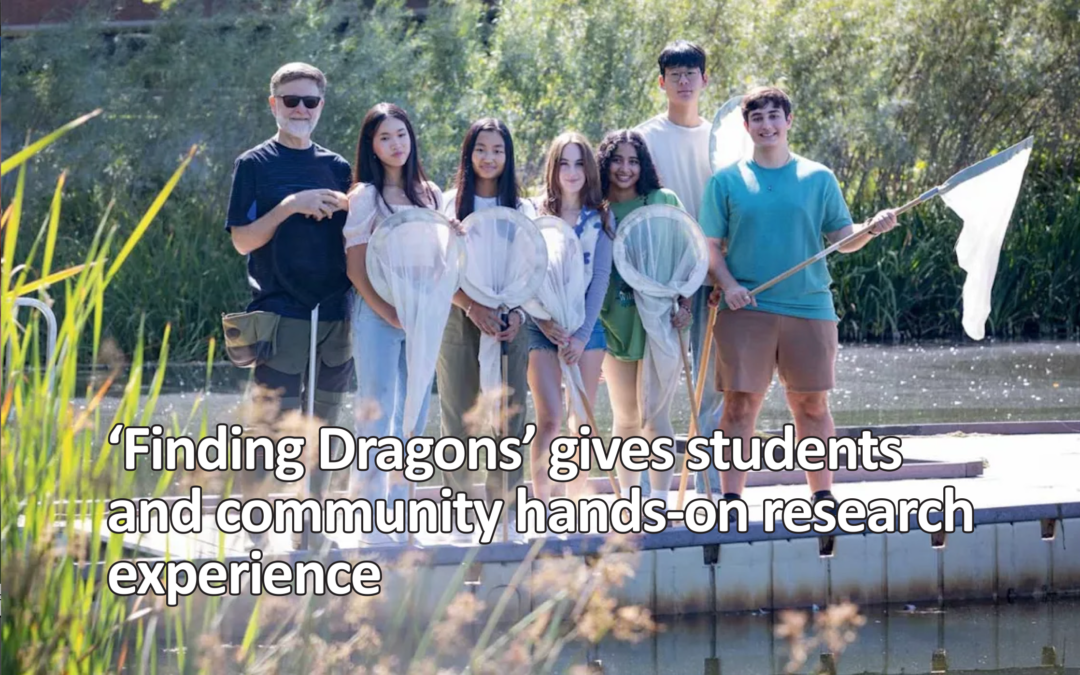
Dick Jordan, left, holds a blue dasher dragonfly as student volunteers look on. Student and adult volunteers collected blue dashers near the Parkcenter Pond in Boise in August for genome sequencing. Photo courtesy of Jisong Ryu
Time Traveling with Biological Clocks
When the DNA of a species is sequenced, it can be read as a sort of code to understand the evolutionary changes the species has undergone over time.
When Tolman approached Jordan about studying DNA sequences of dragonfly species, he likened it to a kind of time travel — a way to peer into the species’ history, Jordan said.
“When he mentioned time travel, it was just like the light came on,” Jordan said. “What an exciting way to get these kids to go back in time and think about how these species — which have been around a lot longer than us — dealt with climate change.”
In 2023, they investigated two lines of inquiry: analyzing the genomes of dragonflies that had already been sequenced, and sequencing the genome of a local species, the blue dasher (Pachydiplax longipennis).
To accomplish the latter, students and volunteers from Gnojewski’s program went to the Parkcenter Pond to catch blue dashers. The day lives on as a highlight of the program so far, with the students and city volunteers coming together to do fieldwork.
For Ella Driever, now a senior at Timberline High School, it was her first time doing field work, an exciting step for the aspiring wildlife biologist. The experience ‘sealed the deal’ on her interest in wildlife biology, she said. That day, she was also the first person to catch a blue dasher, a feat given their nimble flying capabilities.
“That was the first time I actually got to have a real creature that I was studying in my hands,” Driever said. “That was just magical.”
The specimens collected from near the pond were sent to Brigham Young University for sequencing, Jordan said.
Bringing it All Together
In August 2023, the Finding Dragons group hosted a two-day, intensive biodiversity workshop that invited everyone who participated in the project to hear presentations from Tolman and Jordan, as well as scientists from around the country about conservation research efforts.
Though the initial intent was to analyze and write the scientific manuscript about the blue dasher’s genome during the second day of the workshop, the sequencing was not yet completed. Instead, the group pivoted to analyzing the genomes of three species whose genome sequences were already available to the scientific community, seeing how they had responded to past climate change as a practice round for doing the same for the blue dasher, Tolman explained.
The group looked at the genomes of two damselflies, one from Europe and one from the western U.S., and a dragonfly from Europe. The students had the chance to do some of the computational analysis, Tolman said.
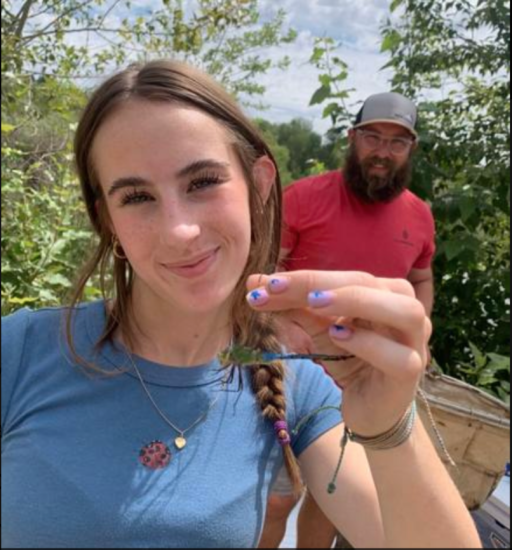
Ella Driever holds up a blue dasher dragonfly that she caught near the Parkcenter Pond as Augie Gabrielli looks on. Student and adult volunteers with the Finding Dragons project collected blue dashers near the Parkcenter Pond in Boise in August for genome sequencing. Photo courtesy of Ella Driever
The analysis revealed that none of those species appear susceptible to climate change. That is still a valuable finding as it helps scientists prioritize policy for species that are the most vulnerable, said Or Bruchim, a senior at Timberline High School that helped with the computational analysis.
“We have limited resources to alleviate the impacts of climate change,” Bruchim said. “The species that we need to protect, we should definitely allocate more resources according to how much they’re impacted. So we shouldn’t waste our resources on a species that’s not going to be too impacted by the effects of climate change.”
By the end of the day, through dividing up the different sections of manuscript, the group had a draft of about 80% of the research paper. The results were published in the International of Odonatology, with the students and city volunteers listed as co-authors.
When the blue dasher genome information came back, the students were tasked with assembling that as well, Tolman said. With the help of some additional analysis from Tolman and other scientists, they were able to write a manuscript looking at broader changes in the dragonfly order Odonata.
The manuscript is currently being reviewed by the journal Gigascience, with the students listed as authors.
Future Blue Dasher Inquiries, Future Connections
Tolman and Jordan anticipate that the information contained in the blue dasher genome can be used for an additional five or more years of scientific inquiries for students, and anyone who makes use of the publicly available data.
For example, how closely related is the Boise blue dasher to blue dashers that live elsewhere, and do they have traits that make them able to survive in cities?
Jordan says he also hopes to apply the research model to study mayflies in the McCall area, connecting with the fishing community there, he said.
The leaders and participants also highlighted the wide-ranging mental health benefits that come with scientific research efforts.
Driever said that she keeps a busy schedule with activities like playing varsity volleyball and working a part-time job.
“When I get to go do these fieldwork things, and I meet these people, I allow that nature that I’m protecting to ground me and keep myself from being burnt out,” she said.
Bruchim said his involvement shows him that others care about the same issues and are taking action toward solutions.
“It’s a really enlightening experience, and you’re able to make connections with people that share the same values and are passionate about the same things you are,” he said, “so it’s a big mental weight off, and it makes you feel more in control of the situation.”
Erin Banks Rusby covers Caldwell and Canyon County. She reports on local government, agriculture, the environment, and more. She can be reached at erusby@idahopress.com
by editor | Jan 16, 2024 | Environmental Literacy, IslandWood, Language Arts, Outdoor education and Outdoor School, Schoolyard Classroom
by Emma Belanger
As someone who comes from a low-income background and grew up in a semi-urban environment, birds were one of the first aspects of the more-than-human world that I felt truly connected to without having to obtain expensive gear, resources, or and a way to travel to a novel environment. When I looked out my window, I saw birds in the trees outside; when I walked around my neighborhood with my family, I practiced my birding by ear; at home, I would sit for hours combing through my Birds of Michigan field guide and making notes about the birds I had noticed that day. For me, birds were an access point to what would become a lifelong dedication to learning more and being inspired by the natural world.

Photo by Emma Belanger
Now, as an outdoor educator working primarily with 4th-6th grade students, I’ve been thinking a lot about how to teach about birds. If we want to study ecology, knowing more about the birds in a particular ecosystem can tell us so much about how different actors are playing a role and acting in relation to other beings. If we’re curious about how the world changes over time, we might look to birds to help tell us some of the story. When we want to know more about the beings we share space and time with, we might turn to feathered friends, hear their calls, see their colors, and learn about ways the world brings life together. With birds having relatively easy visibility and accessibility in most locations, even in urban settings, shared stories of conservation successes, and many aspects worthy of awe, birds are a perfect candidate for rich studies in environmental and science education spaces that can connect us to the more-than-human world. Thus, in educational settings, learning about birds allows learners to think about the world around them in finer detail and gives them tools to begin asking questions about stewardship, conservation, and being in right relationship with their local ecosystem.
There is also evidence to suggest that being around and noticing birds can lead to positive mental and emotional wellbeing (Hammoud et al., 2022). Further, practicing birding can invite us to engage with other ways of knowing and being that allow us to reimagine what ecology means, making room to dismantle some colonialism present in academic ecoliteracy. When teaching about birds, we can engage in critical place pedagogy and put intentions towards expanding learners’ socio-ecoliteracy, where Indigenous, Black, and peoples of color history and culture can be valued as legitimate funds of knowledge (Wicks, 2020). There is not one right way of having a relationship with birds, and connections to birds can be profoundly related to culture, family, and personal experiences. Honoring an individual’s unique relationship to place and non-human animals provides learners with relational resources to dene their experiences in their own terms, leading to learning that becomes more personal and grounded in that individual’s reality.
Any outdoor place has birds for us to meet, listen to, and learn from, making bird lessons inherently a place-based topic. When lessons give learners access to ways of knowing that enable them to make more connections to their communities, act for important causes, and find ways to care for themselves and the world around them, knowledge can become a foundation where future worlds of justice take root. Climate change continues to impact human and non-human lives and ways of being, and having access to practices that feel grounding, important, and rooted in place-based knowledge may empower learners to act radically in reciprocity and appreciation for their communities and one another. In this way, engaging in practices of birding and paying close attention to the world can equip students with mindfulness skills, deepened nature-culture relations, and inspiration for future dreaming and activism.
If you feel inspired to try out a bird lesson with your community of learners, you can find a lesson I like to do with “new” birders below. I, for one, hope to make the practice of listening and watching for birds something I do with learners no matter where I am. This practice feels intertwined with relational gratitudes and can help us to reiterate a commitment to paying attention to the natural world. As Mary Oliver says, “attention is the beginning of devotion” (Oliver, 2016). In the time that I’ve spent with others thinking about birds, I’ve seen others experience, and I have myself experienced, feelings of joy, wonder, peacefulness, and excitement. All of these emotions, to me, are essential to humanity’s survival and ability to thrive in our changing world. To change with our world, we must be willing to listen, to take the time to see and feel what our bodies feel, to be present in what the present is calling for.
 Birdsong Lesson Plan
Learning Goals: Feel familiar and comfortable being quiet outside, practicing grounding techniques through deep listening, making creative connections to the world around us.
DCI Focus: Biological Evolution; Ecosystems
NGSS Practices: Obtaining, Evaluating, and Communicating Information; Developing and Using Models
Materials: Paper, writing utensils, any accessibility equipment necessary for your group of learners, bird eld guides (optional), binoculars (optional), Merlin Bird ID App or BirdNET app and device (optional)
Target Audience: 3rd grade and up
Ask a group about birds they may have seen in their lives, recently in a shared context or by connecting students to other ways some may commonly learn about or experience birds.
Use a mix of small group, individual, and large group reflections. Then, prompt the group to think for a moment about birdsong and what they already know about how birds communicate. Introduce the activity by asking learners what it might look like to try to draw a visual representation of a sound. If guidance is needed, provide ideas about pitch, tone, sound length, loudness, etc, and different ways those could be represented.
Pass out/ask learners to get out a blank piece of paper and a writing utensil while you explain that the group will sit silently for some length of time (5-10 mins depending on group interest and motivation), and while we listen for birds, we’ll draw out visual representations of the bird noises we here.
Emphasize that there’s no way to do this wrong and lots of ways to do it right. Students can use whatever symbols, patterns, or even words and colors, as long as it makes sense to them.
Do the activity with the students during the allotted time; draw what you hear! There is an opportunity to use the Sound ID feature of the Merlin Bird ID app, or the BirdNET spectrograms, if that would feel relevant to your learners or if you have learners that are in the Deaf community. Bird eld guides could also be used during this part of the lesson.
At the end of the time, ask students reflective questions. Perhaps, how many different birds did you hear? How did you know? Then, ask students to switch with a partner to try to decode their representations. Ask students to make the sounds they think their partner drew.
At the end, I like to ask students how it felt to be sitting quietly together in nature and if it was easier to hear sounds that they don’t usually notice. At this point, I share that birdsong is one way I feel like I can always tune in to my relationship with the natural world when I need it personally–if I’m sad, overwhelmed, anxious, etc. I encourage learners to think about what it might look like to try this activity in other spaces and contexts.
References
Conradie, N. & Van Zyl, C. (2021). Investigating the Environmental and Avi-Values and Birding Behaviour of Gauteng’s Young. African Journal of Hospitality, Tourism and Leisure 10(5):1695- 1710. DOI: https://doi.org/10.46222/ajhtl.19770720-187
Hammoud, R., Tognin, S., Burgess, L., Bergou, N., Smythe, M., Gibbons, J., Davidson, N., A, A.,
Bakolis, I., & Mechelli, A. (2022). Smartphone-based ecological momentary assessment reveals mental health benefits of birdlife. Scientific Reports, 12(1), 17589. https://doi.org/10.1038/s41598-022-20207-6
Neruda, P., & Schmitt, J. (1989). Art of birds (1st ed). University of Texas Press.
Oliver, M. (2016). Upstream: selected essays. New York, Penguin Press.
White, R. L., Eberstein, K., & Scott, D. M. (2018). Birds in the playground: Evaluating the effectiveness of an urban environmental education project in enhancing school children’s awareness, knowledge and attitudes towards local wildlife. PLOS ONE, 13(3), e0193993. https://doi.org/10.1371/journal.pone.0193993
Wicks, T. (2020). Becoming Birds: Decolonizing Ecoliteracy. Portland Audubon. https://audubonportland.org/blog/becoming-birds-decolonizing-ecoliteracy/
Zych, A. (2016). Birding as a Gateway to Environmental Education. New York Audubon.
https://www.sciencefriday.com/educational-resources/birding-gateway-environmental-educati on/
Author
Emma Belanger (she/they) is a graduate student in education, interested in co-creating new worlds with learners. You can visit her website by clicking here.
by editor | Oct 17, 2023 | Critical Thinking, IslandWood, Learning Theory, Outdoor education and Outdoor School, Place-based Education, Questioning strategies
Key Considerations for Asking Questions as a
Field-Based Science Instruction
By Amos Pomp
Introduction
We do not ask [questions] in a vacuum; what we ask, how, and when are all related.
– Bang et al., 2018
How can field-based science instructors be intentional with the questions we ask students?
As a graduate student and field-based environmental science instructor for 4th-6th graders in Washington State, I ask students questions all the time. Asking questions is an integral part of learning and doing science and is one of the Next Generation Science Standards science and engineering practices. I believe that the questions I pose as an instructor have the power to either disengage or engage student groups in their learning processes. Thus, considering which questions I ask, and when, is a significant and nuanced part of my teaching practice.
Instructor-posed questions are an important, multifaceted part of effective pedagogy. Instructors should ask their students various types of questions and celebrate various types of answers. Instructors may ask questions to elicit students’ prior knowledge, check their understanding, help them figure out where there are gaps in their ideas, and help uncover ideas that would otherwise go unnoticed (Reiser et al., 2017). Instructors may also ask questions to “help students figure out and refine their own questions” (ibid.).
The way in which instructors ask questions and elicit answers is also important. If I only encourage spoken answers to my questions, I may send an implicit message that I only value verbal and vocal participation in my learning environments. If I only praise the ways in which one student’s artwork connects to my prompt, I’m implying that I prioritize some sensemaking over others’. If I only accept scientific names of plants as correct, I’m indicating what kinds of knowledge I deem acceptable.
Reflecting on this non-exhaustive list of reasons for asking questions, as well as the potential implications of how I solicit answers, has led me to be more intentional with the questions I do ask and how I ask them. I don’t just think about what I am asking my students; I also think about why I am asking it—for what purpose. I think about whom I am asking it to or for and what kind of responses I am expecting from my group. How can I engage them in their own sensemaking and synthesis, creative thinking, and science and engineering processes? To help plan for each new group of students I teach, I’ve developed a framework for how I consider the pedagogical purpose of my questions.
Reflecting on My Own Experience
At the beginning of the school year, my grad cohort and I had many discussions about what teaching and learning look like. From our conversations, we agreed on two key points. The first is that to us, successful field-based science instruction looks like guiding students in their own thinking, observing, and investigating. Rather than responding to students’ questions with an easy answer of my own, one of the routines I adapted early on was asking them, “What do you think?” Even when posed informally, asking students what they think and encouraging a genuine answer is a pedagogical move to redistribute power and agency by encouraging them to gather evidence and explain their own reasoning and learning.
 The second point we agreed on is that masterful instructors learn from and alongside their students in processes of collaborative sensemaking. At first, I found this process came naturally. Being new to field-based science education in the Pacific Northwest, it was easy for me to respond to a student’s pointing at something and asking what it was or what was happening without giving them an easy answer. “I’m not sure, have you seen something like it before?” I would say, or “tell me what you notice about it and what it’s doing. Can we come up with three possible answers to your question?” Asking these questions positioned my students as experts on their own experiences and encouraged us to work together to learn about our environment.
As the school year has progressed and I’ve became more knowledgeable about the ecosystem I’m teaching in, I’ve noticed two things happening. In moments where I am doing new activities or teaching lessons in new ways, my questions have remained open-ended and genuine, like the above examples.
In other cases, however, I have found myself struggling to maintain nuanced intentionality in my question asking. Sometimes I notice myself asking students answer-seeking, or “known-answer,” questions—questions to which I already know the answer I’m looking for—because I want the group to reach a specific understanding about a topic based on my own knowledge or some third-party definition (Bransford et al., 2000). Other times, I’ll ask the group a question about an activity we just did and receive mostly blank stares in response. In these instances, I am probably asking the wrong questions and discouraging the divergent thinking, diverse forms of engagement, and collaborative sensemaking and synthesis I’m looking for.
Upon reflection, I decided to create a tool to help me make sure I ask students pedagogical questions with the intention they deserve.
Instructor-Posed Questions: A Framework
When thinking about how to intentionally ask a question to a group of students, here are some key considerations I take into account.
Assessing the state of the group
Before asking my students a pedagogical question, I assess the state of the group. This assessment can happen during planning or in the moment. I think about where the students are or will be physically, as well as what is or will be going on, when I plan to ask the question. Perhaps they would still be riled up after an activity, or they might need a snack. Perhaps a group discussion would not add any value to what’s already happened or could possibly even detract from the experience. Perhaps the group needs to hear the question then move to another location before answering to have time to think and discuss casually on the way. If I want the group to engage in some sort of collaborative sense-making, I do my best to ensure that the group is in a place where most of the students will be able to engage in the process in some way.
Allowing for different forms of student engagement
When I plan to ask a group of students a question, I then think about how I want them to answer. I can ask them to answer in written/drawn form, whole-group share-out, in small groups or a partner, just in their own heads, or some other way. I make this decision based on patterns of what I’ve seen work best for similar groups in similar situations in the past.
Once I’ve decided how I want students to answer my question, I find it’s best to give instructions before asking the question. For example, I might say, “You’re going to answer this question in your journal, and you can write, draw, write a poem or song, or even create a dance or found-material sculpture.” Then I ask the question and repeat the ways that students can answer.
Clarifying the goal or purpose of my question
For this section I’ll use an example wherein my goal is for students to think and learn about the role of photosynthesis in a plant’s life and the role plants play in ecosystems.
With my goal in mind, I could ask, “What does photosynthesis mean?” However, I would likely hear one student’s regurgitating a definition from a textbook, which does not necessarily indicate true learning or understanding. Also, if I ask such didactic questions multiple times to the same group, I often end up calling on the same students repeatedly—missing out on quieter voices—because they are the ones comfortable with sharing in such a way.
I would also refrain from asking, “Who can tell me what photosynthesis means?” This wording implies that it’s time for someone to win favor by being the one who can. It’s a challenge to see who can show off their knowledge, and it doesn’t help a group of students explain how photosynthesis works or why it matters.
Additionally, I don’t want to ask my question if I’m looking for a specific answer. I have to be open to students’ explaining photosynthesis in new ways or talking about other ways that plants get energy and contribute to ecosystems.
Asking a question
Instead of the examples above, I could ask my students, “How do plants get energy?” or “How can we describe a plant’s relationship to the sun?” These explanatory questions engage students in more diverse scientific practices than just naming and defining a chemical reaction (Reiser et al., 2017). If I’m having trouble getting students to move toward photosynthesis, I could ask, “What do you think of when you hear the word photosynthesis?” which I still find to elicit more open-ended responses than the original example.
Something else to consider is that if, for example, I’m teaching a group of students who have never been to a harbor like the one I bring them to for a lesson, any questions I ask the group about what role plants might have in the harbor ecosystem will not carry as much meaning for them if they do not first have a shared, relational experience with plants at the harbor (Reiser et al., 2017). If I can first facilitate a time for them to explore and observe plants at the harbor, then asking them about their own thoughts and questions about plants at the harbor will have much more success. I can also ask questions in ways that allow students to bring in past experiences with other beaches or plants in other ecosystems.
I am also aware while teaching that common lines of questioning in schools are rooted in the discursive patterns of white, middle-class, European Americans. One way that I can expand my question-asking practice is encouraging learners to investigate the “likeness between things” to draw in students who engage in more metaphorical learning by exploring analogies with the question, “What is photosynthesis like?” (Bransford et al., 2000). Robin Wall Kimmerer agrees: “asking questions about relations illuminates answers that true-false questions may not” (Bang et al., 2018).
Finally, I could also ask questions that help students evaluate their own learning or the learning process, like “how did you contribute to the group in the photosynthesis investigation?” or “how did that activity go for you?” rather than ones that assess what they learned (Rogoff et al., 2018). I would ask these latter questions to prioritize my goal of exciting students about science learning over ensuring that they learn any specific “facts” or “knowledge.”
Deciding not to ask a question
Sometimes, I move through my framework and decide I don’t need to ask the group a question. Instead, I’ll tell the group some of my own thoughts on the matter, or I might just transition to something else entirely. An example of the latter is that if I’m more interested in having my students explore something other than how photosynthesis works, rather than asking them what they know about photosynthesis, I could simply say, “Photosynthesis, which, for those who might not remember, is how plants create their own energy from sunlight, carbon dioxide, and water.”
Conclusion
Asking questions in field-based science education is a nuanced practice. The way instructors ask questions reveals to students both explicitly and implicitly what forms of participation they value, whose knowledge they prioritize, and what kinds of learning they deem acceptable. With a bit of intentionality, however, instructor-posed questions are the key to engaging students in collaborative sensemaking and synthesis, divergent thinking, and science and engineering processes of their own.
References:
My mentors, Renée Comesotti and Dr. Priya Pugh
Bang, M., Marin, A., & Medin, D. (2018). If Indigenous peoples stand with the sciences, will scientists stand with us? Daedalus, 147(2), 148-159.
Bransford, J. D., Brown, A. L., & Cocking, R. R. (2000). How people learn (Vol. 11). Washington, DC: National academy press.
Reiser, B. J., Brody, L., Novak, M., Tipton, K., & Adams, L. (2017). Asking questions. Helping students make sense of the world using next generation science and engineering practices (pp. 87-108). NSTA Press, National Science Teachers Association.
Rogoff, B., Callanan, M., Gutiérrez, K. D., & Erickson, F. (2016). The organization of informal learning. Review of Research in Education, 40(1), 356-401.
by editor | Oct 17, 2023 | Environmental Literacy, Equity and Inclusion, IslandWood, Learning Theory
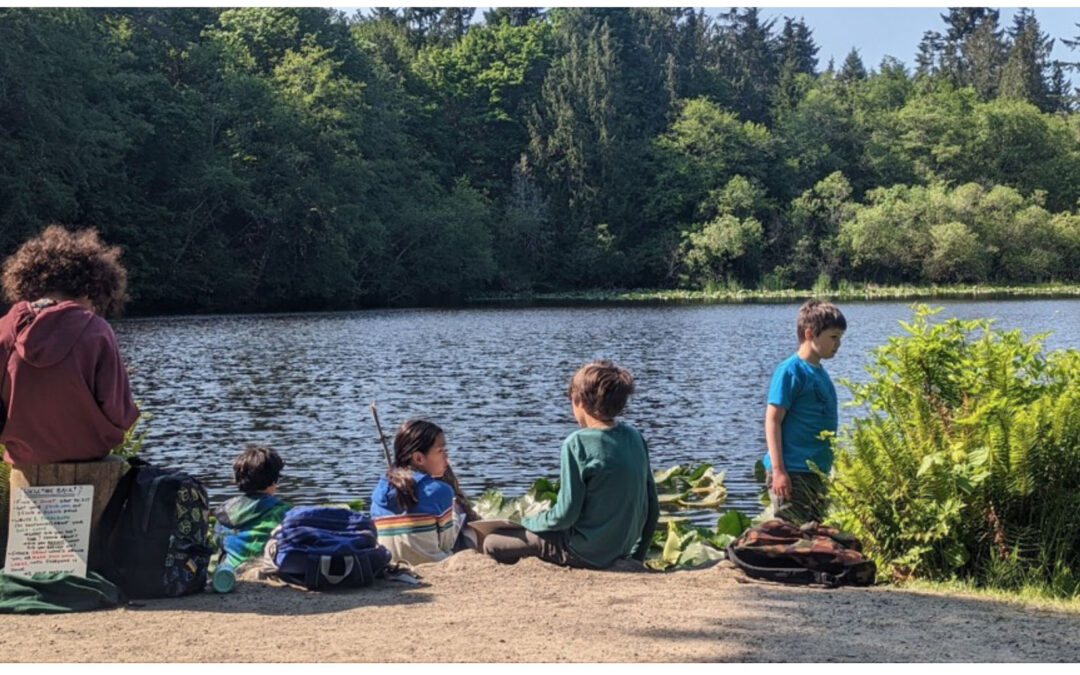
Five 5th-grade students sit or stand facing a sunny pond surrounded by lush greenery, working on a writing task or exploring quietly. Photographed by Greyson Lee
Background Music and Birdsong: ADHD in the Outdoors
by Greyson Lee
After several hours of watching my dad bounce around his home auto shop, channeling restless energy into relentless productivity, he finally pauses to look up car parts long enough for me to catch a conversation with him.
I know by this point that my brother, diagnosed with ADHD before either of us can remember, was not the only one in the family with it. My dad hadn’t said the words before then, but when I bring up my own recent diagnosis, he seems to connect the dots to his own vague learning disability diagnosis from before the language was as common as it is today.
He reflects on a story I’d heard before: he’d been failing a math class in high school, so he and his mom fought for, and won, permission to snake earbuds through his hoodie. He could listen to music in one ear while the teacher lectured, and with this background stimulation humming below the teacher’s lectures, he suddenly felt like he could focus on and understand the content of the class.
Even today, my dad always has music on when he’s doing anything: I hear it in the morning when he’s getting ready for work, it’s always on in his car, it’s on when he gets home from work until he goes to bed, and he keeps it playing over the speakers at his station during his entire work day as well. For him, the background noise seems to be an essential tool in allowing him to function day-to-day with ADHD.
The one place my dad doesn’t seem to need his music, however, is outdoors.
It seems that any time students with ADHD come up in outdoor education, there’s a common refrain: “they do much better here”, and even, “you wouldn’t know they had ADHD if nobody told you”. Struggles in the classroom melt away in the outdoors. Some even note that their students with ADHD tend to thrive in an outdoor learning environment, often finding it even easier to engage than their peers do.
What is it about the outdoors that allows people with ADHD to focus so much better? And how can educators- formal and informal- lean into this phenomena?
Tired of Paying Attention
Environmental Psychologist Stephen Kaplan has proposed the theory of “directed attention”: the kind of attention we have to pay in certain situations, like listening to a lecture, in order to consciously control our focus. Directed attention is a choice and a skill, and it might look like tuning out distracting noises, or ignoring the impulse to check social media. The implication is that this conscious effort will eventually cause “attention fatigue”, making it more and more difficult to continue controlling one’s focus. (Clay, 2001)
In a 2004 study, survey results indicated that time spent outdoors led to reduced ADHD symptoms (Kuo & Taylor, 2004). Their results suggest that green spaces are rich in fascination, the other side of Kaplan’s “attention fatigue” coin: a more natural and undirected form of attention that allows the mind to rest.
“Just-Right” Stimulation
In an article for ADDitude Magazine, Dr. Ellen Littman dives into the complex battle between too much and too little stimulation that is often taking place in ADHD brains. Littman explains that in order for brains to be “alert, receptive, and ready to attend and learn”, they need to be stimulated just the right amount; a balance that most brains tend to be able to figure out on their own. (Littman, 2022)
ADHD brains, on the other hand, lack the “reliable coordination of neurotransmitters” that would otherwise allow them to control their own focus. Too little stimulation leads to a kind of boredom often described as “painful” by people with ADHD, and an intense motivation to find some kind of stimulation- often a spike in dopamine- to compensate. Too much stimulation, on the other hand, results in “over-arousal”: feeling overwhelmed, often suddenly, and reacting with irritability, restlessness, or even aggression until able to get away from the commotion and recuperate. (Littman, 2022)
ADHD brains are left either overreacting or under-reacting to stimuli, rarely anywhere in a more “moderate” area that might allow for some control over one’s ability to focus, be receptive, or to engage in learning.

Five 5th-grade students perched on small rocks lean over to watch their classmate pick a shore crab out of the water. Photographed by Greyson Lee
“Chill Lo-Fi Beats”: Regulating Input
A few years ago, a series of YouTube playlists and livestreams by the “Lofi Girl” channel garnered widespread popularity; I remember a few professors using them to fill the silence in the classroom while we worked on some assignment or project.
The appeal is similar to that of white noise machines, water features, and the fan you might leave on in your bedroom at night, even if it’s not too hot: silence can be just as distracting as too much noise. In a casual survey conducted by ADDitude Magazine, one respondent shared that background music helps them maintain focus on a particular thing; “when my environment is quiet,” they said, “my mind wanders to various things and not on what I need to be doing.” (ADDitude Editors, 2022)
Background noise can also be a way of drowning out too much stimulation; another respondent shared that soft, familiar background music “helps [them] focus by removing any background noise (dishwasher, washing machine, people outside or around [them]).” (ADDitude Editors, 2022) Other respondents reported that their need for background noise could vary depending on their task and situation; activities that require high focus might be better paired with silence or very soft music, and “tedious” activities that require less mental focus might be easier with something that distracts the brain.
Of course, everyone’s “ideal” balance of stimulation looks different- but background noise can be a helpful tool in finding it.

A student cradles a rough skinned newt in their hand, and several others reach toward the newt in shared fascination. Photographed by Greyson Lee
Zoning In
It isn’t revolutionary to note the lack of stimulation present in classrooms; in fact, this is openly a design goal. The idea is to lower distractions so students can focus on the only source of stimulation in the room: their teacher.
As a student with ADHD, I had few ways to regulate my balance of stimulation in the classroom. If I needed more stimulation, I could fidget or draw; if I needed less, I could try to go to the bathroom for a break. Oftentimes I just found myself staring glassy-eyed at a wall, my thoughts racing in directions I had no control over, while my teacher droned on pointlessly in the background.
Students are not “cured” of their ADHD when they walk outside, and I still find that certain students need longer transition times, more breaks, more responsive planning, or something to fidget with in order to engage as much as other students can.
But I rarely see those glassy-eyed stares when teaching outdoors, and why would I? There’s so much to look at outdoors, and hardly any walls to zone out onto. Students often fidget, wander, and move their bodies in ways I wouldn’t see in a classroom, but when I finish giving instructions and turn them loose, it’s clear they heard everything they needed to. And I hardly ever see a student need a break from our setting– there are no long bathroom breaks, walking laps elsewhere, or sitting in a hallway to soak in a bit of silence.
There are so many more opportunities for self-regulation outdoors, and the impact on students with ADHD is noticeable. How would their learning experiences be different, and their “academic success” impacted, if their teachers leaned into that?
References
- ADDitude Editors. (2022, May 20). Background Noise vs. Silence: ADHD Adults on Music & Focus. ADDitude. Retrieved May 6, 2023, from https://www.additudemag.com/background-noise-sensitivity-adhd-music/
- Clay, R. A. (2001, April). Green is good for you. American Psychological Association, 32(4), 40. https://www.apa.org/monitor/apr01/greengood
- Kuo, F. E., & Taylor, A. F. (2004, September). A Potential Natural Treatment for Attention-Deficit/Hyperactivity Disorder: Evidence From a National Study. Am J Public Health, 94(9), 1580-1586. https://doi.org/10.2105%2Fajph.94.9.1580
- Littman, E. (2022, May 18). Brain Stimulation and ADHD / ADD: Cravings and Regulation. ADDitude. Retrieved May 6, 2023, from https://www.additudemag.com/brain-stimulation-and-adhd-cravings-dependency-and-regulation/
Credit
Greyson Lee is an art and outdoor educator finishing his M.Ed at the University of Washington.

by editor | May 27, 2022 | Equity and Inclusion, Indigenous Peoples & Traditional Ecological Knowledge, Tribes & Traditional Ecological Knowledge
River Newe: Creating
New Narratives On Historic Landscapes
In this article we present our work that directly addresses Justice, Equity, Diversity, and Inclusion (JEDI) for our tribal youth of the Shoshone-Bannock people. We have reimagined what JEDI means for us through environmental education activities as they relate to our efforts to reinhabit the traditional homelands where our people lived, gathered, hunted, and thrived since time immemorial.
by Jessica Matsaw, M.Ed,
Sammy Matsaw, Ph.D,
and Brant G. Miller, Ph.D
The landscapes of the Middle Fork of the Salmon River watershed and other usual and accustomed places of the Shoshone-Bannock are imbued with meaning and wisdom that we are actively seeking to connect our tribal youth with. The corridor is the heart of the largest wilderness segment in the lower 48 states with intact cultural sites and vast untouched lands with no cell service. The perfect place to disconnect youth and get them into a sense of what our ancestors knew about living without modern technologies and at the same time sharing in a true sense of unfragmented and connected riverscapes. The experience has been one where the students begin by wanting to go home to the final days of not wanting to leave and have real connection to place. We cannot stress how important this has been to our youth and tribal members.
To begin, we share a vignette that begins to capture the intentional and oftentimes dynamic approach we are taking to engage our Tribal youth deeply and meaningfully with experiences that give them grounding in the present, hope for the future, and a foundation for explorations using Traditional Ecological Knowledge and Western scientific methods to inquire about their curiosities.

Shoshone-Bannock young ladies, Abrianna (7) and River (15), gathering wild berries, and enjoying one another’s company in the homelands of their ancestors. Photo by Popp Photography 2021.
“We wake from many stressful days of preparation to get here. We arrived at Dagger Falls campground the evening before. Yesterday was so much work finalizing all the things, loading ice, food, and organizing the coolers and dry boxes by meals, days, and how to access them the best. The trailer is mostly organized to get out things we need for a short breakfast and some coffee. Not sure what we forgot but at this point we will just make do. Coming from the Rez, our lives are mostly about making do, so we’re good at it. No worries, as we enjoy coffee and visiting with new and old friends and family. The kids and some of the adults are checking out the falls, picking raspberries, journaling, taking in the scenes of a river carved valley. Taking down the tents, stuffing sleeping bags, some hair braiding, and another cup of coffee. It’s starting to feel like we should move over to the boat launch – ‘Alright, let’s load up and head on over!’
“After mounting the frames, we begin rigging the rafts with heavy coolers, dry boxes, groover and tanks, camp chairs, tables, and dry bags filled with our hygiene kits, tents, sleeping bags, and dry clothes. We leave space for future dreams and incoming memories made with new faces and ones we haven’t seen in a bit.
“As each raft gets fully rigged you can hear, ‘Hey everyone, can we get a hand over here?’ It takes a team to load our rafts onto the boat launch ramp and walking it down together.
“At the same time our youth were creating prayer bundles to mount on the front of our rafts made up of tobacco ties, sage, and lots of good thoughts and laughter.
“Before we begin our journey down the Middle Fork of the Salmon River, our women will ask the river for permission to travel with her. Once we make our offerings and give to the river a gift of our first foods and prayer, we can then open the circle. We acknowledge the land, water, rafts, and guides who will be working tirelessly to keep their hands on their oars, ears to their neighbors, and reading the water. She will tell us how to get down the river.
“The first two days will be rough as they are supposed to be. We are getting reacquainted with her again and she has lessons to teach us all. Mostly what is on our minds is the running of rapids like Sulfur Slide, and the big one for the day is Velvet Falls. We will arrive at our usual camp and enjoy a soak for the weary, just to relax, and some play for the young and old alike.”
The vignette above is a window into how we are approaching our ideas about place, homelands, and resituating Shoshone-Bannock culture into the 21st century, and reconnecting our youth with our memory traces left by our ancestors. We have a long history in the Middle Fork of the Salmon River watershed and to hear and see our young people couple Traditional Ecological knowledge with science, technology, engineering and mathematics through their own research, journaling, and artistic ways of capturing not only what they’re learning in mind, but also in heart and spirit, is to begin to see the future, and what is possible in this new, envisioned future. Each season and our planned activities can be thought of in this manner: traditional teachings, customs and protocols, tools, places across spatiotemporal distributions by elevation, weather, and climate, etc.
 Intergenerational traumas such as the boarding school era interact with living in desperate times of survival between two entirely different cultures through the onslaught of threats to our literal and cultural existence. In a contemporary setting we are still orally in our collective thought about how our knowledge already knew the recent findings in Western science, that we have unwritten theoretical frameworks. Indigenous storytelling is a rich metaphor for the bold and creative space of curious Indigenous minds, hearts, and souls for the betterment of our Sogope Bia (Mother Earth) and to support our nation-building. Our connection in thought, verb-based languages, and action is complex and adheres to the so-called messiness of ecology, and the nature of science. The broader issue affecting our communities’ reflexive abilities are daily conflicts from a racialized society upholding asymmetrical forms of reasoning and assumptions about human entitlement to, and extractions from, the natural world, that continues to separate humans from nature (i.e., the nature-culture divide, Bang & Marin, 2015). A more localized related problem begins at K-12 schools where we are losing our children to the norms of the education system, that continues into college and in the workplace where our voices are dead before arrival (Matsaw et al. 2020). As professionals, the expectation is exceptional fluency in scientific comprehension and writing, coding, statistical analysis, and Western scientific theory, principles, methodology, and methods. The social and environmental justice of our times is to rise above racist microaggressions to on-the-fly cultural competency affording cultural relevancy so that we can broker space, and time for sustainable pedagogies and methodologies to the benefit of our Indigenous Knowledge. Sadly, we are outnumbered, and our children are being left behind, the gap in between is continually ever widening, so our loss deepens and the attainability for our youth to replace us in the workforce is further out of reach.

Prayer ties created by our youth in respect of elements, directions, sky and earth, and medicines we use to keep us safe and healthy for attaching to our rafts. Photo by Popp Photography 2021.
To combat these issues, we are using traditional ecological-thinking through a Shoshone-Bannock seasonal round in our homelands doing STEM learning activities. Activities through protocols of consent asking our land and waterways permission to test the ideas of our frameworks with tools of Western science such as river trips down the Middle Fork Salmon River; hunting/gathering of our wild foods; interacting with places of the stories/knowledge/theories of our ancestors. Along the way we will collect data, observation, journaling, using tools from our digging sticks to iPads, spear poles to DNA and otolith (ear bone) collections from salmon. These activities will be used to evaluate pedagogies and methodologies rooted in Shoshone-Bannock Traditional Knowledge by building theories, study plans, experimental designs, methods, and technologies as a way of creating new/old pedagogies. Our old pedagogies have been interrupted by colonialism and now we are adapting using state standards to quantify our learning and transfer of knowledge in the form of new pedagogies so that our knowledge persists. Concurrently, working to vacate racist structures in our tribal institutions, situating our own tribal organization and leadership to support making effective and meaningful changes in policy and reframing thoughts of becoming teachers and STEM professionals that cross with traumas associated with boarding schools and objects of research.
The doorway we are intentionally and mindfully creating is one for our youth to begin to envision a renewed path through an ecosystem of opportunities that will lead to their own success. In many ways we are just beginning to reimagine how to rebuild our presence of the Shoshone-Bannock people back into the cultural riverscapes of our ancestors and how we still see the land, as our Sogope Bia. Our river trips along ancestral homelands are to facilitate observations of where we once lived, how the landscape once appeared, and how our people interacted, honored, and were sustainable co-inhabitants with our more-than human relatives.
Back to the river…we stop at cultural sites where there are pit house depressions, and/or pictographs. We exercise our imaginations of what we know today with how it must have been then. For instance, looking at the villages and how they are arranged and imagining the proximity of families amongst the larger community. We can imagine this because our community back home on the reservation still reflects a similar state, preserved by our natural, innate need to arrange as we always have. Families in family areas closer to relatives of similar clans, bands and where we were when we came to the reservation life. Each site is not a far-off imaginary. To open the imagination of our youth is to then see the STEM, the Indigenous Ecosystem builders we always have been and still are today.
We are also wanting to be respectful of those who inherited the wrongful displacement of our Tukadeka relatives over a century ago. We believe they are there in the most loving way they can be, and we want to reciprocate the relationship they have with our home. In that we are wanting to share with them how this place is not only special, but also largely intact from the way our ancestors left it when they were forcibly removed. For the most part what we have gathered is that the guides on the river are happy to see us back.
 Jessica Matsaw, M. Ed., is the Art, Civics & Tribal Government Teacher at the Shoshone-Bannock Jr/Sr High School. She combats educational systems of exclusion and cultural erasures by focusing culturally centered, equitable learning spaces of engagement to celebrate Indigenous ingenuity, intellect and inquiry.
Sammy Matsaw, Ph.D., is a grandfather, father, husband & extended family member amongst the Shoshone-Bannock and Oglala Lakota with a PhD in Water Resources. As co-founders, he and his wife are creating an intercultural STEAM pedagogy more agreeable with Indigenous peoples through a non-profit called River Newe.
Brant G. Miller, Ph.D., is an Associate Professor of Science Education at the University of Idaho. His research interests include Adventure Learning, culturally responsive approaches to STEM education, science teacher education, and technology integration within educational contexts.
For more information, check out https://rivernewe.org/
See more articles like this at https://clearingmagazine.org/fall-2021
