The Judgment of the Barnacles

The Judgment of the Barnacles

There’s a song in the sea for those who listen, and messages in the sand for those with far reaching eyes.


By Dr. Gloria Snively and Doug Wonnacott

The morning silently creeps in upon the gray, green waves. Smooth flat rocks that tumbled together for a thousand years moan and groan against the shore. The pale sea is without character of its own — it reflects the sky, follow the moon, and is driven by the wind. On the rocks high above the tide land, the gulls preen their feathers and wait for the tide to drop

Eventually the unmerciful tide ebbs, exposing soggy, wet seaweed covered rocks. The moaning cobbles crowding the beach are littered with the debris of life. Along the tide land that marks the ebbing and flowing of the tide, death walks hugely and in many forms. Among the debris are empty snail shells, torn pieces of golden sponge, tattered seaweed holdfasts, decaying crab molts, and nude hermit crabs fumbling for a new home. The tangled masses of up-rooted seaweeds: browns, greens, reds and purples lie strewn like shredded confetti. Shore crabs scramble sideways to hide under rocks, starfish hang with stretched tube feet from boulders, and barnacles withdraw into cone-shaped shell houses. An octopus with glaring yellow eyes lies stranded in a shallow pool of water with its long suction-cup covered arms thrashing in vain to return the victim to the mother sea.

The gulls that earlier sat half asleep on the rocks noisily pick and probe at crabs, worms and fish along the tide line using their long sharp bills. Opportunists, they squabble and fight and harass one another to regurgitate their finds. The hungry gulls scavenge over the wreckage of the beach to clean it of whatever they can find; the living, the dead and the dying. The vulnerable sea creatures cry soundlessly for life — and nothing screams but the gulls.

During such times, on the ebb of tide, I have observed another swarm of vulturine activity. Upon the morn’s fog-blanketed shore, electric flashlights bob along like fireflies to join the gulls. This is the sign of the clam diggers. They stumb‑le along in the fog, over-turning cobbles, digging mercilessly with long handled forks and shovels, and leaving piles of cobbles beside gaping holes in the sand. Tens of hundreds have passed by me, many leading wide-eyed children with wooden spades and plastic pails. Butter clams, horse clams and littlenecks are gathered into overflowing buckets, the smallest and the largest tossed aside. Mothers and children gather into pails brightly colored starfish. They collect bags of beautifully ornamented living shells whose occupants will be carted home and dried in the sun, boiled alive for their shells, or left to suffocate in buckets overnight. Eventually, the unsleeping tide follows the moon and drives both gulls and humans from the tide land.

On one such occasion, I carefully picked my way along a slippery boulder strewn beach. Ahead of me the humans with long wooden spades amused themselves by smashing barnacles with rocks. I hastened through the seaweed jungle, past the slippery cobble stones, to the barnacle bed above the high tide line.

“Don’t harm the barnacles,” I ventured breathlessly. “Please leave them alone.”

The humans pretended not to hear, and continued smashing the barnacle cities.

The barnacles are alive,” I pleaded.

“What?” replied the surprised humans. “Barnacles aren’t alive.”

“The barnacles are very much alive. They simply retreat into their shell houses when the tide is out.”

“You’re crazy,” laughed the humans.

“But you mustn’t kills the barnacles,” I persisted. “They follow the rise and fall of the tide and the revolutions of the moon.”

“Who cares?” came the angry rebuff. “What does it matter, there are millions of these things everywhere.”

And they continued smashing the barnacle cities, prying loose the mussel beds with those long wooden spades, and filling their pockets with beautiful living shells.

I turned and slowly began the treacherous journey back along the slippery beach. Who invented those spades of wood? Who was it that cut them from a tree? High overhead a snow-white gull circled the bay, a large blue mussel dangling from its bill. The gull let the mussel drop to smash the shell open on the hard cobbles, exposing the orange colored flesh. Instantly, the other gulls filled the air with their chorus of frenzied screams. Void of pity, I watched that snow white gull swoop down, rip the soft orange flesh from the mussel shell, and hurriedly fly away.

The tide rises, the tide falls. The mother sea follows the moon. The mob of cobbles crawled the shore; rubbing shoulders — shifting, grinding and moaning their way through centuries. I stroll along the tide line and ponder the many moods of the mother sea; wondering why she moans ever more. “We are not dumb,” whisper the cobbles. “We will be the last ones.”


Song of the Barnacles

I venture to say, though a teacher myself, that I have learned little of consequence from books or from any other extra paraphernalia that we associate with formal education. What I have learned that has meaning or significance in life comes not from books, but from an endless journey along a surf-swept shore.

If there is any truth to what I say, it began for me on the protected rocky shores of Ucluelet, a little village on the exposed western coast of Vancouver Island, British Columbia. As an elementary teacher, that memorable trip to the sea beach with a class of wide-eyed youngsters was among the first of many such adventures to unknown shores.

It was one of those magnificent sunny days in June, the kind that we on the west coast appreciate deeply after the cold grey days of a long winter. The trip to the beach was a fifteen-minute hike along a wooded trail from the local school.. On the outer shore the view was spectacular. The roaring sea rhythmically sent booming white waves crashing upon the rocky reef. But in the cove, protected by the reef and the bay, the wave action was less fierce. Sleeping haystack rocks and needle-shaped basalt boulders crowded the graceful curvature of the bay.

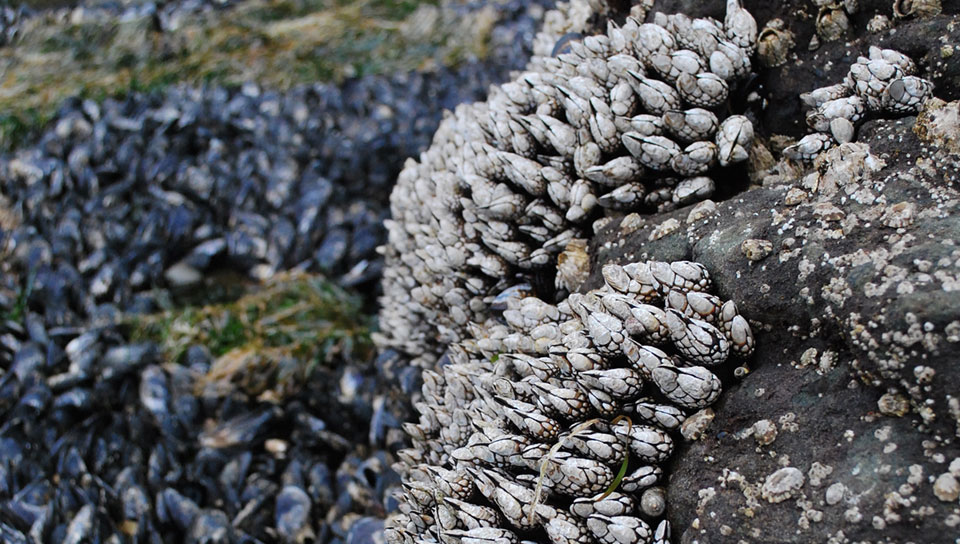
On the shore, the tide was going out, leaving glistening seaweed covered rocks and glassy blue pools of water in holes and crevices. Various belts of life appeared on the rock faces in colored layers, one above the other. Bare rock at the top, then a stained layer of black lichens, a wide band of gray-white barnacle cities, a bed of blue mussels, then bright green sea lettuce, a layer of luxuriant brown kelp, then graceful pale, pink coralline seaweed at the low tide line. Attached to rocks, among the protective curtains of seaweeds, and in the tide pools lived hoards of rocky shore animals.

Many so exquisitely colored and of such fantastic shapes they seemed unreal — orange starfish, purple urchins, giant green anemones, richly ornamented snails and variously decorated crabs.

As we explored the shore, I could hardly keep pace with the activities of the children. Nor could I answer their incessant questions: What’s inside a barnacle? How does the starfish eat the mussel? Why do crabs crawl sideways? Why is the ocean blue? What’s that called? Is that a plant or an animal? Those children, who asked me so many questions, never seemed to hear the ones I asked them. Nonetheless, I did the best I could — carted tons of field guides down to the beach, hauled out microscopes, and had them describe, measure, sort, map and sketch everything in sight.

Several days later, around mid-day, we returned to that very same beach. The intense noon-day sun cast drying rays upon every living creature along the shore. And we humans were no exception. Hot and sticky from our journey and having to wait for the noontide to drop, we sought protection in the shade of those high basalt pillars. We settled down to a bag-lunch of bologna sandwiches and apples and — being full and tired — decided to nap while waiting for the tide to go out. Like the nearby gulls lazily preening their features, we waited patiently for the sea to allow us entry into the tide lands.

It was one of those rare moments in teaching when every child was quiet, every body still. Thus, you can imagine our surprise at being awakened by the sound of gently resonating voices.

They whispered “sssssssh…” Carried by the wind, those tiny, tiny voices grew and grew into a soft, melodious symphony.

One by one, astonished children and a very unbelieving adult rose, and with eyes and ears staring out of our heads, we began searching for the source. Where did those mysterious little voices ring from? We looked all around where we stood, then searched the boulder canyons, but to our great disappointment, we could not find a single clue. All the while those tiny melodic voices continued echoing with magnificent simplicity throughout the canyon walls.

Suddenly, from behind a giant boulder, a very excited Scott shouted, “It’s the barnacles! It’s the barnacles singing!”

“Awe… come on. How could the barnacles sing?” quipped the skeptical Mark. “They don’t even move.”

“But listen!” persisted Scott. “Listen to them sing!”

So we put our ears to the barnacle cities and what do you think…?

We clearly heard the barnacles sing.

Imagine…barnacles singing! It was the most remarkable sound I believe I have ever heard.

“What makes the barnacles sing?” asked one child.

Crystal Cove Conservancy

“What do you think they’re saying?”  added anotherOur curiosities aroused, we instantly set about the find the answers. With intense concentration, we observed those barnacle cities for the rest of the day. Watched the six-cover plates move as the animal inside sealed its shell house shut. “Sssssh.” Watched the seawater evaporate over the boulders and over every living surface. Listened intently as the barnacle song swelled to a crescendo, then just as magically as the seawater vanished, listened as the music faded to silence. Later that day, when the tide returned, we watched those barnacle cities spring to life. Quick as a wink, when the stony cone-shaped barnacle cities spring to life. Quick as a wink, when the stony cone-shaped barnacles were submerged, the barnacles thrust their six long feather legs, like a fisherman’s net, in and out, in and out. We watched those industrious little barnacles sweep the water for microscopic food and kick it down into their mouths. You can be sure we were an exhausted, but jolly band that tripped back to Ucluelet late that afternoon. But we had whistled and sung to the moon and stars, and vowed to remember that lesson.

That lesson was the loveliest and the saddest I have yet learned along an unknown shore. How many times had I walked along a seashore and never noticed the barnacles, never pondered or questioned them at all? But I have drawn this true story to your attention, so that should you venture along a rocky shore and come upon the barnacle cities, do not hurry on. Wait for a time, exactly at the ebb of tide. And be very quiet and still. Then, should the sun be burning bright, you will hear the barnacles sing.


At the time of publishing, Gloria Snively was a professor emeritus at the University of Victoria in Victoria BC. Doug Wonnocott was a principal at Quadra Island Elementary School in Quadra Island BC. This article originally appeared in Current, the publication of the National Marine Educators Association

_____________________________________________________________

Activities related to this article

The purpose of the following activities is to encourage the reader to interact with the article through the language arts (reading, writing, listening and speaking); and through field trip experiences; and to use the knowledge, concepts and attitudes developed through the activities to compare the article with the real world of the barnacle. Above all else, the activities are designed to keep bringing the reader back to the article, to not only gain knowledge, concepts, and positive attitudes; but to experience the author’s style and message.

Some Thoughts About the Language Arts Activities:
1. Be selective in choosing the activities. Decide what you want the reader to gain from the literature. Don’t overdo the activities and don’t hesitate to adjust them to meet your needs.
2. Consider using cooperative learning techniques, including the use of heterogeneous groups (3-5 members). The use of these groups encourages discussion, sharing of skills, peer-to-peer tutoring and expansion of ideas.
3. If you are using the article as motivation for a science-oriented theme, don’t leave it after one reading. Bring the readers back to the text, especially after they have gained new knowledge, concepts and attitudes.

Pre-Reading Activities
1. In order to evaluate the student’s knowledge, do a pre- and post-reading cluster. Before reading the article have the students cluster (brainstorm) all they know about barnacles. Following the teaching of the unit, have the students do another cluster. Compare the pre- and post-results.
2. To encourage the sharing of prior knowledge and to encourage the making of predictions about the meaning of what is to be read, use an anticipation guide. An anticipation guide helps guide the students in acquiring the major concepts to be learned in the article. It activities background knowledge prior to reading and provides useful, diagnostic information for the teacher. Also, it provides students with a purpose for reading the text, provokes thoughtful discussion, and serves as a useful tool for refocusing on the major concepts of the article. Keep the following guidelines in mind when constructing and using an anticipation guide:

      • a. Identify the major concepts to be learned.
        b. Decide how many concepts support or challenge the student’s beliefs.
        c. Create 5-10 statements. Write them well and somewhat conentiously.
        d. Arrange the statements in an appropriate order.
        e. Present the guide to the students before introducing the article.
        f. Students fill in individually, agree or disagree, a reaction to each statement.
        g. Students defend their reactions in discussion. Teacher leads the discussion, but does not volunteer a personal opinion.
        h. After reading the article, students react to statements from the author’s point of view.
        i. Discuss differences in reaction.
        j. Writing: choose one statement and then prove the author’s point.

    e.g.,
    You                     Author
    (agree/can’t decide/disagree)
    • Barnacles are living animals.
    ª Barnacles are very delicate creatures and may be easily damaged.
    • Barnacles are important members of a seashore community.
    • Clam diggers should not be allowed to take as many clams as they want.
    • Barnacles sing.

    3. Use guided imagery to help develop the setting of the article prior to the reading. Through imagery the teacher can take the students on an “imaginary trip” to the beach. By generating discussion about colors, sounds, textures, sights, patterns, feelings, etc., the teacher can help the students connect when they “see” to what they will read.

    Reading and Writing Activities
    4. Consider orally reading the article to the students, especially Part 1. Help to set the mood and the flow of the language — then allow the students to read the rest.
    5. Encourage the students to identify their favorite passages and to orally read to each other in pairs or small group. By practicing reading passages over and over again until fluent within these groups, weaker students may improve their reading comprehension.
    6. From the article, have the students identify those factors that help the barnacles survive in its environment. Once they have their lists, allow the students to refer to additional learning resources to confirm their lists and to add to them.
    7. Again, use the guided imagery strategy to help the students write a piece from the point of view of the barnacle. The piece may focus on one aspect of the life of the barnacle — feeding, survival, the effect of human intervention, etc., and should be creative, while conveying factual information. Students may share these pieces in small group.
    8. Write a true story telling about life at the seashore: what barnacles eat, what they do at high tide and at low tide (or when covered or uncovered with seawater), how they protect themselves from predators, how they keep from drying out when the tide goes out to sea.
    9. From the article, have the students identify the author’s writing style and message. For example, in small groups discuss the statement “That lesson was the loveliest and the saddest I haveyet learned along an unknown shore.”
    10. Have students complete each of these ideas with material growing out of the article and discussion. This article made me wish that…, realize that…, describe that…, wonder about…, see that…, believe that…, feel that…, and hope that… (Good for small cooperative groups to generate discussion and expand on ideas.
    11. Design a poster which celebrates our caring for all life on this watery planet, and inspires action, leading to the healing of our planet and ourselves. For example, a poster might encourage “prevention of cruelty to barnacles.”

    Field Trip Activities
    For students to understand the concept of preservation at the seashore, they must have understanding, at least in part, of the related concepts of habitat, tidal cycle, desiccation, predator-prey, protection, interdependence and survival. The best way of attempting to sensitize children to such complex abstract concepts is through field trip experiences. For example, you can lead the students to understand why barnacles should be protected by observing how barnacles survive at the seashore.

    Have the students separate and find a comfortable sitting position as close to the “barnacle cities” as possible. Have them close their eyes and be very quiest and still. Tell them to concentrate on hearing and identifying the sounds around them.

    Then, have fun watching live acorn barnacles under water. Find a small rock covered with barnacles and drop it into a jar of seawater. What happens? What kid of food does the barnacle eat? How does the barnacle get its food? Draw a picture of a barnacle out of seawater. Draw a picture of a barnacle under seawater.
    After the field trip, compare the article to the reality of the field trip. Have students identify those aspects of the article that are true for the environment being studied. Include specific aspects that could be added to the article given the specific environment.

  • —G.S and D.W.

Ear to the Ground: Interviews with PNW Environmental Educators

Ear to the Ground: Interviews with PNW Environmental Educators


Robert Steelquist,
Coastal Explorer, Environmental Educator (2021)

Jane Tesner Kleiner (2021)
Greening the Schoolgrounds

Gary Dorr (Standing Red Bear) (2018)
Reclaiming a Culture through the Traditional Canoe

Monica Nissen (2015)
2015 Environmental Educator of the Year (CBEEN)

Ryan Monger (2016)
Sultan WA High School Science Teacher

Rus Higley (2016)
2016 Marine Education Classroom Teacher of the Year (NAME)

Sue Staniforth (2013)
Environmental Education Consultant, North Saanich, British Columbia

Ralph Harrison (2013)
Science and Math Institute


Sara Focht (2013)
Idaho Non-formal Educator of the Year

Mike Town (2011)
Passionate about Environmental Education

Ned Buckingham (2010)
Olympic Park Institute

Saul Weisberg (2010)
North Cascades Institute

Mind the Gap: How Environmental Education Can Step Forward to Address the STEM Achievement Gap

Mind the Gap: How Environmental Education Can Step Forward to Address the STEM Achievement Gap

Environmental Education is a broad field encompassing nature centers, school forests, outdoor education facilities, state and national parks among others. This diversity of organization type allows for wide engagement by the public and holds great potential for addressing achievement gaps in the formal education system.

by Robert Justin Hougham, Ph.D,
Isabelle Herde,
Tempestt Morgan,
Joey Zocher, Ph.D.,
and Sarah Olsen, Ph.D

Environmental Education organizations have more power than they realize to affect change. For example, in Wisconsin, Environmental Education organizations employ over 3,100 educators, serve 1.1 million user days of education in the field, and represent over $40 million in direct economic activity. The collective impact of this industry is significant. We advocate for other states and regions to take a similar approach to quantifying the field in order to leverage support and ultimately, affect change. Part of addressing the STEM achievement gap will lay in making the environment an integral part of the approach, while yet another part of addressing this gap will be advanced by focusing the collective impact organizations to build capacity. The work we will go on to describe here has proven valuable and eye opening- we also will lay out some of the steps to replicate this in other states. Doing so is a matter of environmental justice, a call to which many environmental organizations are responding.

Environmental Education to address STEM achievement gaps
Science, Technology, Engineering and Math (STEM) education does not have equal outcomes among different demographic groups. Racial disparity in science education is an issue nationwide. The 2015 NAEP science assessment noted statistically significant gaps in achievement for U.S. students that identified as black and Hispanic compared to those who identified as white (National Center for Education Statistics, 2015). As an example, Milwaukee, Wisconsin has the greatest STEM achievement gap in the country (Richards, 2016). Nationwide, schools that serve predominantly black and Hispanic students are less likely to offer higher-level science courses (U.S. Department of Education, Office for Civil Rights, 2016). All of these facts demonstrate an educational system that fails students of color in STEM.

The pedagogical practices of environmental education have proven to be an accessible approach to science learning for youth of different backgrounds and is thus uniquely poised to address the STEM achievement gap. The field of environmental education encourages students to observe and connect with a place in order to learn. Dominant strategies for teaching include place-based education and an inquiry approach. Place-based education allows students to forge meaningful connections between STEM content, students’ daily experiences and to observe the environment around them (Land & Zimmerman, 2015; Greenwood & Hougham, 2015). These field and inquiry-based approaches in STEM have better educational outcomes for low achieving youth (Blythe et al., 2015). Field experiences have also shown to increase confidence for underserved student populations (Hougham et al., 2018).

However, the field faces its own gaps of knowledge and historical bias. For the environmental education industry to effectively address the nation’s STEM achievement gap, environmental education organizations must understand their position and progress in addressing issues related to diversity, equity and inclusion (DEI). This includes, but is not limited to, the increase of positive representation of minorities and other underrepresented groups, as well as teaching in a more culturally conscious and responsive manner. This paper will focus on Wisconsin, which faces some of the largest STEM education gaps, and how the lessons learned from a status and needs assessment and the work currently underway to address those findings could be applied to the nation.

Methodology
In the winter of 2015-16, a digital survey was distributed to environmental education organization leaders around the state of Wisconsin. Our goal was to investigate the statewide status surrounding relevant topics within environmental education such as land management, professional development, visitation trends, budgets, diversity, equity and inclusion and identify organizational needs in these focus areas. In 2019, we updated and re-ran the survey, intending to update and improve our understanding of the status and needs of environmental education in Wisconsin. This article is focused on the enhanced component of the survey questions about diversity, equity and inclusion. Here, we present the set of questions from our 2019 DEI section of the survey to lay out our approach, and also to encourage the use of similar question sets in other states and regions.

The following questions were developed to address diversity, equity and inclusion in our field, defined in consultation with August Ball, Founder/CEO of Cream City Conservation & Consulting LLC. We understand the definition of diversity, equity, and inclusion and its meaning can take different forms. For the purpose of this survey we asked that respondents consider the following definition in their answers:

Diversity: Differences that make a difference.
Equity: A process of ensuring everyone has access to what they need to thrive.
Inclusion: Celebrating, welcoming and valuing differences.

  1. Please estimate the percentage of groups that visit your site or programs that include at least one person with a known disability.
  2. Please check all areas of training provided to your environmental education instructional/ program staff on working with persons with disabilities. How to adapt activities for participants with:
  3. Do you consider your facility to be accessible to visitors with disabilities?
  4. Do you consider your programs to be accessible to visitors with disabilities?
  5. Have you conducted a physical accessibility survey of your site?
  6. Does your curriculum or lesson plans include activity ideas for learners of varying abilities?
  7. Do your curriculum or lesson plans include activity ideas for learners from different cultures or backgrounds?
  8. What level of priority does your organization place on increasing program and facility accessibility at your site?
  9. What level of priority does your organization place on increasing diversity, equity and inclusion at your site?
  10. What is the estimated demographic distribution of your staff?
  11. Select the answer that best fits your organization.
    11a. This organization is committed to diversity.
  12. Please read the sentences and select the answer that best fits your organization. These questions were taken from the Diversity Survey (2014) by the Society for Human Resource Management.
    12a. There is cultural and racial diversity among the people a job candidate will meet/see on their first visit to the organization.
    12b. There is cultural and racial diversity among the people represented in our organization’s marketing materials
    12c. Employees from different backgrounds are encouraged to apply for higher positions.
  13. Do you have resources and content available in other languages?
  14. Does your organization provide trainings on diversity, equity, and inclusion?

Past iterations of this survey have had positive impacts for Wisconsin environmental education organizations. Solid data is needed to inform decision – making and programming. The closer the data reflect the local context of the industry, the more effectively educators, administrators and our supporters can respond to current trends. However, collecting this data is only one step towards changing the status of the work on the ground.


Results
193 EE leaders representing 173 EE organizations completed the survey. We asked these leaders to describe their organization in a number of ways. For example, whether the organization correlates school program to academic standards (75.3% – Yes), if they considered their location an outdoor tourist destination (44.0% – Yes) and if they regularly partner with other regional or statewide EE organizations (59.5% – Yes).
Of the 93.1% of respondents who considered their organization’s facilities to be accessible or somewhat accessible to visitors with disabilities, half (50.5%) have never conducted an accessibility survey of their site. The most common accessibility-related training that staff receive focus on physical disabilities (65.1%) and ways to encourage communication and interaction among all participants (50%).


Survey participants were asked which subject areas and organizational skills their staff would most benefit from additional training. Shown below are the most common responses:
Top EE Subjects Areas staff need
1. Using STEM as a context for EE (E-STEM)
2. Technology use in outdoor education
3. Understanding school initiatives, speaking school language
4. Community action/service learning
5. ‘Sustainable design/green technologies or buildings’ and ‘Community-based learning’

Top Organizational Skills staff need
1. Diversity, equity and inclusion
2. Grant writing
3. Fundraising
4. Digital presence/website/Facebook/etc.
5. Volunteer management
Analysis: Perception vs Reality: the bubble around inclusion and environmental education

Solutions
The reported commitment by environmental organizations to DEI does not match the reported actions or steps they have taken towards DEI. For example, respondents from 56% of environmental organizations in the United States reported that trainings focused on diversity should be done (Taylor, 2014). In the Wisconsin status and needs assessment, only 50% of respondents reported actually conducting trainings related to diversity, equity and inclusion (Hougham et al., 2019). Even then, “The small body of empirical research that does exist about diversity trainings suggests that current practices are largely ineffective over the long-term. Therefore, it is imperative to conduct needs assessments to determine what content should be done” (Beasley, 2017, p. 5). Spending time planning, executing and evaluating DEI trainings will be essential in moving this body of research forward and improving the professional development opportunities available to educators in the field.

At Upham Woods Outdoor Learning Center in Wisconsin, seasonal staff training includes a session on DEI. The session lasts approximately 5 hours and is spread out over 2 days. All levels of leadership were present – from the executive director to seasonal teaching naturalists – for a total of thirteen participants. Different levels of participation were encouraged; staff were given the opportunity to reflect individually and to participate in both small and large group discussions. The training used multiple forms of media including pictures, text, and videos in order to cite experts and incite discussion. Environmental justice framed the training so that our team could understand the larger picture and the role that environmental education could have on its participants. Environmental educators should empower learners to exercise their agency in creating better communities, which includes the environment in which those communities exist. More environmental organizations are embracing the focus on environmental justice in efforts to engage more diverse communities. For example, Camp ELSO (Experience Life Science Outdoors) in Portland, Oregon focuses programs on “grounding the youth experience in environmental justice while elevating the visibility and leadership opportunities for folks of color. ” (Brown, 2019, p. 8). We looked at case studies that explore how environmental justice and environmental education intersect.

The training covered multiple topics such as the elements that make a space diverse, equity versus equality and how to respond to microaggressions as a bystander and as someone who experiences them directly. We talked about agency and how promoting others to exercise their agency creates more inclusive spaces. The training went beyond providing definitions and introductions to vocabulary words. Our staff discussed privilege and the role it has in addressing equity. We spent time talking about how access only approaches to broadening participation fails to hold dominant cultures accountable for the culturally exclusionary language that may exist within the programs they are providing access to (Bevan et ak., 2018). Participants then went through Upham’s lesson plans and identified areas for improvement including how the lesson was framed and a critique of the content. This information was collected and will be used to improve our lessons.

We asked for feedback at the end of the training to help us develop additional modules and activities for staff related to DEI during their contract. While staff training is an integral step towards inclusion, it cannot be the only time an organization supports discussions and activities focused on DEI. The goal of inclusivity needs to be reflected in an organization’s policies, processes, paperwork and infrastructure. Continuous and intentional reflection of staff practices needs to become part of office culture. To create sustainable change we must confront a system that supports the oppression of certain communities and discontinue privileging privilege and focus on supporting those communities that have been historically neglected or oppressed.

For environmental educators, from a pedagogical standpoint, we must not only change what we teach, but be willing to change the ontological underpinnings in the transmission of knowledge. We must shift our role from experts sharing wisdom to members of a learning community with the Earth. This is particularly true for white educators working with marginalized populations, as the dominant culture needs to listen and empower rather than tell and control. Without doing this groundwork in DEI training, we fall into the trap of treating empowerment as giving a voice to the voiceless, rather than listening to those who haven’t been heard. We must shift the notion of DEI as a need to that of an asset, and be willing to use this knowledge to help others create the change we cannot imagine.

Freire (1970) supported the notion that we are moving regardless, and we are either moving to keep the dominant paradigm or to transform it. What better catalyst for change than our urban youth, who are already fueled by being marginalized? Emdin’s (2009) research found, “These students eagerly await opportunities to exercise this power in the creation of a foreseeable new future that is different from an oppressive present” (p. 242). The first question we must ask ourselves is whether our organizations simply want to share what we are doing with diverse audiences or are we eager to embrace this new future as well?

Citations
Beyond Diversity: A Roadmap to Building an Inclusive Organization. Green 2.0.
Bevan, B., Calabrese Barton A., & Garibay, C.. (2018). Broadening Perspectives on Broadening Participation in STEM. Washington, DC: Center for Advancement of Informal Science Education.
Blythe, J. M., Dibenedetto, C. A., & Meyers, B. E. (2015). Inquiry-based instruction: Perceptions of national agriscience teacher ambassadors. Journal of Agricultural Education, 56(2), 110-121. doi:10.5032/jae.2015.02110
Brown. S. (2019). Reclaiming Spaces. Clearing: Resources for community-based environmental literacy education, pp 8-10
Emdin, C. (2010). Affiliation and alienation: hip-hop, rap, and urban science education. Journal of Curriculum Studies, 42(1), 1-25.
Freire, P. (1970/2005). Pedagogy of the oppressed. New York, NY: Continuum
Greenwood, D. A., & Hougham, R. J. (2015). Mitigation and adaptation: Critical perspectives toward digital technologies in place-conscious environmental education. Policy Futures in Education 13(1), 1-20.
Hougham, J., Morgan, T., Olsen, S., & Herde, I. (2019). 2019 Status and Need report of Wisconsin Environmental Education related Organizations. Madison, WI: University of Wisconsin Madison Extension
Hougham, R. J., Nutter, M., & Graham, C. (2018b). Bridging natural and digital domains: Attitudes, confidence, and interest in using technology to learn outdoors. Journal of Experiential Education, 41(2), 154-169. doi:10.1177/1053825917751203
Land, S.M. & Zimmerman, H.T. (2015). Socio-technical Dimensions of an Outdoor Mobile Learning Environment: A three-phase design-based research investigation. Education Technology Research Development, 63(2), 229-255. Doi:10.1007/s11423-015-9369-6.
Richards, E. (2016). Wisconsin No. 1 for black-white science achievement gap. Milwaukee Journal Sentinel. Retrieved from: http://www.jsonline.com/story/news/education/2016/10/27/wisconsin-no-1-black-white- science-achievement-gap/92722730/
Taylor, D. (2014). The State of Diversity in Environmental Organizations. Green 2.o. Retrieved from: https://www.diversegreen.org/wp-content/uploads/2015/10/FullReport_Green2.0_FINAL.pdf
U.S. Department of Education, National Center for Education Statistics. (2015). National Assessment of Educational Progress: Results of the 2015 science assessment. Retrieved from: https://www.nationsreportcard.gov/science_2015
U.S. Department of Education, Office for Civil Rights. (2016). 2013-2014 Civil Rights Data Collection: A First Look. Retrieved from: https://www2.ed.gov/about/offices/listocr/docs/2013-14-first-look.pdf

Acknowledgement
Project funding was supported by the University of Wisconsin – Madison, Wisconsin Association for Environmental Education and the Wisconsin Center for Environmental Education.

About the Authors
Dr. R. Justin Hougham is faculty at the University of Wisconsin- Madison where he supports the delivery of a wide range of science education topics to K-12 students, volunteers, youth development professionals, graduate students, and in-service teachers. Justin’s scholarship is in the areas of youth development, place-based pedagogies, STEM education, AL, and education or sustainability.

Isabelle Herde is the Program Director at Upham Woods Outdoor Learning Center

Tempestt Morgan is the Expanding Access Program Coordinator at Upham Woods Outdoor Learning Center.

Dr. Joey Zochar is an Advisor at Escuela Verde in Milwaukee, WI.

Dr. Sarah Olsen is a curriculum and evaluation specialist for Upham Woods Outdoor Learning Center (no photo)

Justice and Equity in Environmental Education – Special Issue Winter 2022

Justice and Equity in Environmental Education – Special Issue Winter 2022


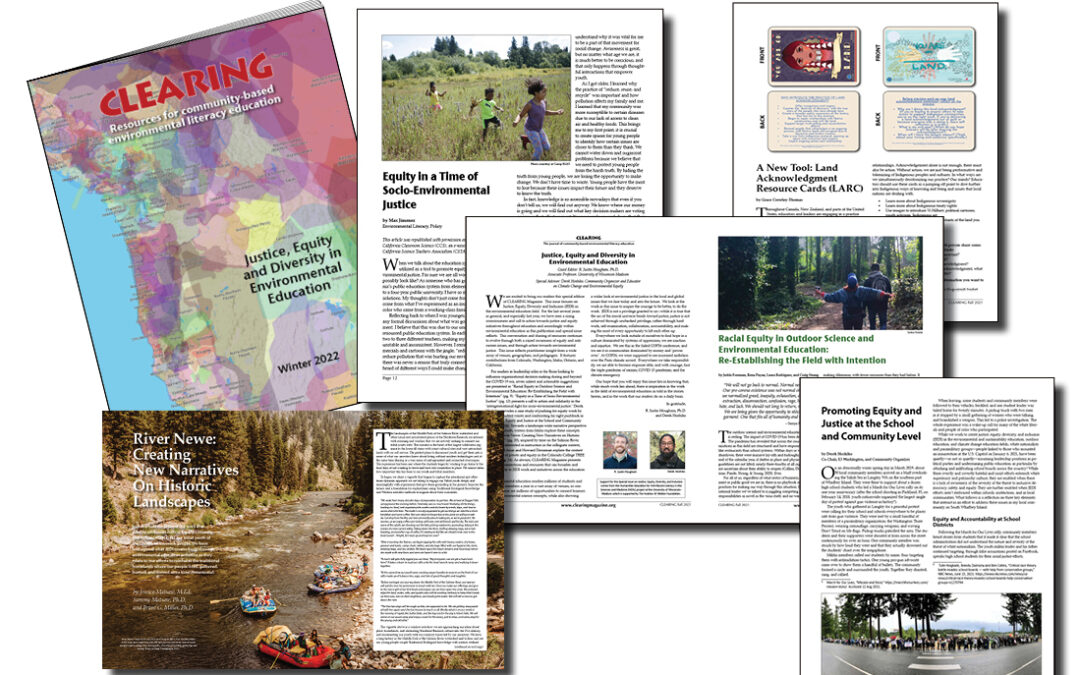
CLEARING Special Focus Issue:
Justice, Equity and Diversity in Environmental Education

Guest Editor: R. Justin Hougham, Ph.D.
Associate Professor, University of Wisconsin-Madison
Special Advisor: Derek Hoshiko, Community Organizer and Educator on Climate Change and Environmental Equity

We are excited to bring our readers this special edition of CLEARING Magazine. This issue focuses on Justice, Equity, Diversity and Inclusion (JEDI) in the environmental education field. For the last several years in general, and especially last year, we have seen a rising consciousness and call to action towards justice and equity initiatives throughout education and accordingly within environmental education as this publication and special issue reflects. This conversation and sharing of resources continues to evolve through both a raised awareness of equity and anti-racism issues, and through action towards environmental justice. This issue reflects practitioner insight from a wide array of venues, geographies, and pedagogies. It features contributions from Colorado, Washington, Idaho, Ontario, and California.

For readers in leadership roles or for those looking to influence organizational decision making during and beyond the COVID-19 era, seven salient and actionable suggestions are presented in “Racial Equity in Outdoor Science and Environmental Education: Re-Establishing the Field with Intention” (pg. 9). “Equity in a Time of Socio-Environmental Justice” (pg. 12) presents a call to action and solidarity in the ‘intergenerational fight for socio-environmental justice.’ Derek Hoshiko provides a case study of pushing for equity work by centering student voices and confronting far right pushback in “Promoting Equity and Justice at the School and Community Level” (pg. 16). Towards a landscape-wide narrative perspective with tribal youth, writers from Idaho explore these concepts through “River Newe: Creating New Narratives on Historic Landscapes” (pg. 20), inspired by time on the Salmon River. For readers interested in instruction in the collegiate context, Juan Miguel Arias and Howard Drossman explore the context and themes of power and equity in the Colorado College TREE semester (pg. 24). As always, CLEARING Magazine presents additional connections and resources that can broaden and directly apply to JEDI work and initiatives across the education community.

Environmental education reaches millions of students and community members a year in a vast array of venues, so consider that these are millions of opportunities to connect learners to core environmental science concepts, while also showing a wider look at environmental justice in the local and global issues that we face today and into the future. We look at the work in this issue to inspire the courage to be better, to do the work. JEDI is not a privilege granted to us—while it is true that the arc of the moral universe bends toward justice, justice is not achieved through unchecked privilege, rather through hard work, self-examination, collaboration, accountability, and making the most of every opportunity to lift each other up.

Everywhere we look outside of ourselves to find hope in a culture dominated by systems of oppression, we see inaction and injustice. We see this in the failed COP26 conference, and we see it in communities dominated by money and ‘power over.’ At COP26, we were supposed to see increased ambition over the Paris climate accord. Everywhere we take responsibility, we are able to become response-able, and with courage, face the triple pandemic of racism, COVID-19 pandemic, and the climate emergency.
Our hope that you will enjoy this issue lies in knowing that, while much work lies ahead, there is inspiration in the work in the field of environmental education as told in the stories herein, and in the work that our readers do on a daily basis.

In gratitude,
R. Justin Hougham, Ph.D.
and Derek Hoshiko


To see the entire issue in FLIP PAGE format, click here.
(Note: This link takes you out of the CLEARING website.)


Table of Contents 

Racial Equity in Outdoor Science and Environmental Education: Re-Establishing the Field with Intention (.PDF)
by Jedda Foreman, Rena Payan,
Laura Rodriguez, and Craig Strang

Equity in a Time of Socio-Environmental Justice (.PDF)
by Max Jimenez, University of California

Promoting Equity and Justice at the
School and Community Level (.PDF)
by Derek Hoshiko
with Anti-Racism Resources for Outdoor Families
& Environmental Educators (sidebar)

A New Tool: Land Acknowledgment Resource Cards (.PDF)
by Grace Crowley-Thomas, IslandWood
(see full article here)

River Newe: Creating New Narratives On Historic Landscapes (.PDF)
by Sammy Matsaw, Ph.D, Jessica Matsaw, M.Ed, and
Brant G. Miller, Ph.D, University of Idaho

Power and equity in undergraduate environmental education: “Loving Critique” at the Colorado College TREE Semester
by Juan Miguel Arias & Howard Drossman
Colorado College Education Department

Reclaiming the Promise of Place: An Interview with
David Greenwood by Roberta Altman
from Bankstreet Occasional Papers