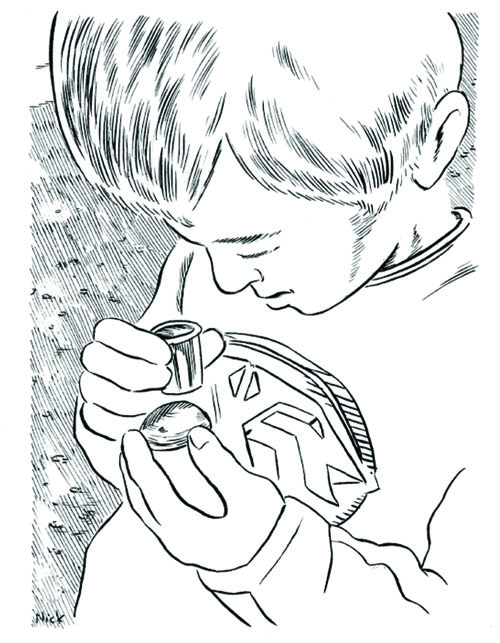
by editor | Oct 18, 2017 | Place-based Education
Everyone Ought to Have a Ditch
“What gets lost, when we focus on facts, are the initiation experiences, the moments of transcendence when the borders between the natural world and ourselves break down.”
by David Sobel
 spend a lot of time these days talking with teachers, foundation directors, environmental educators, and evaluators about how to most effectively shape environmental stewardship behavior. The $64,000 question is—what’s the most effective way to educate children who will grow up to behave in environmentally responsible ways? Or, more elaborately, what kinds of learning, or what kinds of experience will most likely shape young adults who want to protect the environment, participate on conservation commissions, think about the implications of their consumer decisions and minimize the environmental footprint of their personal lives and the organizations where they work? There’s a surprising dirth of information about exactly how this process works.
A number of researchers have studied environmentalists to try to determine if there were any similarities in their childhood experiences that contributed to their having strong ecological values and pursuing an environmental career. When Louise Chawla of Kentucky State University reviewed these studies (Chawla 1992), she found a striking pattern. Most environmentalists attributed their commitment to a combination of two sources, “many hours spent outdoors in a keenly remembered wild or semi-wild place in childhood or adolescence, and an adult who taught respect for nature.” Lots of time rambling in neighborhood woods and fields and a parent or teacher who cared about nature were frequently cited as causal forces in the development of their own environmental ethics. In his autobiography about growing up in Denver, lepidopterist Robert Michael Pyle describes the urban semi-wild place the inspired him.
“My own point of intimate contact with the land was a ditch. Growing up on the wrong side of Denver to reach the mountains easily and often, I resorted to the tattered edges of the Great Plains, on the back side of town. There I encountered a century-old irrigation channel known as the High Line Canal. Without a doubt, most of the elements of my life flowed from that canal.
From the time I was six, this weedy watercourse had been my sanctuary, playground and sulking walk. It was also my imaginary wilderness, escape hatch, and birthplace as a naturalist. Later, the canal served as lover’s lane, research site and holy ground of solace. Over the years, I studied its natural history, explored much of its length, watched its habitats shrink as the suburbs grew up around it, and tried to help save some of its best bits…Even when living in national parks, in exotic lands, in truly rural country side, I’ve hankered to get back to the old ditch whenever I could …
Even if they don’t know “my ditch,” most people I speak with seem to have a ditch somewhere—or a creek, meadow, wood lot or marsh—that they hold in similar regard. These are places of initiation, where the borders between ourselves and other creatures break down, where the earth gets under our nails and a sense of place gets under our skin…. It is through close and intimate contact with a particular patch of ground that we learn to respond to the earth, to see that it really matters… Everyone has a ditch, or ought to. For only the ditches—and the fields, the woods, the ravines—can teach us to care enough for the land.” (Pyle, 1993)
One problem, of course, is that every child doesn’t have a ditch, or even if they do, they’re not allowed access to it. As more than half of the world’s children live in urban settings, the availability of ditches, or just urban parklands, is shrinking. Even in rural and suburban settings where patches of woods and ponds are available, parents’ concerns about pollution and abduction make these places unavailable. And so the task of providing access to semi-wild places with the tutelage of caring adults often falls to environmental educators. But as environmental educators seek to professionalize their endeavors and work more closely with schools, they become assimilated into the world of standards, curriculum frameworks and high stakes tests. Learning about the environment becomes ingesting a sequence of facts and concepts that create environmental knowledge. The underlying assumption is that knowledge leads to the creation of attitudes that eventually lead to thoughtful environmental behaviors.
For instance, California’s curriculum guidelines for Understanding the Local Environment starts out with the healthy notion that, “Direct experience in the environment also helps foster the awareness and appreciation that motivate learners to further questioning, better understanding and appropriate concern and action.” This is followed by content guidelines for different grade levels. Here’s an example of a set of related guidelines through the curriculum.
Grades K-4: Identify basic types of habitats (e.g.. forests, wetlands, or lakes). Create a short list of plants and animals found in each.
Grades 5-8: Classify local ecosystems (e.g.. oak-hickory forest or sedge meadow). Create food webs to show, or describe their function in terms of, the interaction of specific plant and animal species.
Grades 9-12: Identify several plants and animals common to local ecosystems. Describe concepts such as succession, competition, predator/prey relationships and parasitism.
This is a developmentally appropriate sequence of knowledge objectives, but there’s an inherent problem. Because these curriculum guidelines are connected to state assessments, the focus often collapses into making sure the students can recite the information. They follow the old Dragnet maxim: “Just the facts, m’am.” As a result, providing the direct experience falls to the wayside. The opportunity to explore the ditch gets replaced by memorizing lists.
Go back to Pyle’s description above to see where the problem lies. From exploring the ditch, he became interested in natural history and then became an advocate for preservation. Sounds like knowledge to attitudes to behavior. My contention, however, is that the crux element in his description is, “These are places of initiation, where the borders between ourselves and other creatures break down, where the earth gets under our nails and a sense of place gets under our skin.” What gets lost, when we focus on facts, are the initiation experiences, the moments of transcendence when the borders between the natural world and ourselves break down. It’s like Dylan Thomas describing “I was aware of myself in the exact middle of a living story, and my body was my adventure and my name.” It’s these experiences that provide the essential glue, the deep motivational attitude and commitment, the sense of place. These in turn fuel the pursuit of knowledge that leads to conservation behavior. John Burroughs puts it simply when he says, “Knowledge without love will not stick. But if love comes first, knowledge is sure to follow.”
Which leads me to my controversial hypothesis. “One transcendent experience in nature is worth 1000 nature facts.” Stated in a slightly more positive form, it may be that one transcendent experience in the landscape has the potential for leading to 1000 nature facts. Maybe even to infinity and beyond. So the question becomes: How do we design family outings, school curriculum, and environmental learning opportunities with an eye towards optimizing the possibility of creating transcendent experiences? Of course, first we have to get a sense of what these transcendent experiences are and if they really make a difference before we can decide that they’re important to pursue.
Nature Mysticism
Writing at the beginning of the 19th century, William Wordsworth was the one of first poets to identify the significance of children’s nature experiences. In his Intimations of Immortality from Recollections of Early Childhood, Woodsworth recalls his boyhood wanderings saying,
There was a time when meadow, grove and stream,
The earth, and every common sight,
To me did seem
Appareled in celestial light,
The glory and the freshness of a dream.
Wordsworth contended that children perceived nature differently from adults and that this mode of perception was a gift rather than a delusion. Their experiences were transcendent in that the individual often felt connected to or merged with the natural world in some highly compelling fashion.
Following Wordsworth’s lead, anthropologist Edith Cobb reviewed the autobiographies of 300 European geniuses and found that many of them described similar kinds of experiences in childhood.
“My position is based upon the fact that the study of the child in nature, culture and society reveals that there is a special period, the little understood, pre pubertal, halcyon, middle age of childhood, approximately from five or six to eleven or twelve, between the strivings of animal infancy and the storms of adolescence—when the natural world is experienced in some highly evocative way, producing in the child a sense of some profound continuity with natural processes….”
It is principally to this middle-age range in their early life that these writers say they return in memory in order to renew the power and impulse to create at its very source, a source which they describe as the experience of emerging not only into the light of consciousness but into a living sense of a dynamic relationship with the outer world. In these memories the child appears to experience a sense of discontinuity, an awareness of his own unique separateness and identity, and also a continuity, a renewal of relationship with nature as process.
Cobb’s description, (a renewal of relationship with nature as process) is surprisingly ecological in character, especially when you recognize that she was writing in the mid 1950’s, well before any ecological theory had developed.
It turns out, however, that these experiences are not limited to geniuses. Two similar, but unconnected studies, document the widespread occurrence of spiritual experiences in nature during childhood. The Original Vision: A Study of the Religious Experience of Childhood by Edward Robinson was conducted by the Religious Experience Research Unit at Oxford University in England in 1977. Visions of Innocence: Spiritual and Inspirational Experiences of Childhood is a study completed by Edward Hoffman in 1992, a practicing psychologist and university professor who solicited descriptions of childhood experiences from adults in the United States and around the world. Hoffman does not reference Robinson’s study, so they appear to be quite independent, though their findings are absolutely resonant.
Robinson’s British study was based on adult responses to a published query in newspapers asking people if they had ever “felt that their lives had in any way been affected by some power beyond themselves.” Of 4000 responses, about 15% described childhood experiences and a significant proportion of these occurred in nature. Robinson analyzes these is a chapter entitled Nature Mysticism. Hoffman’s study similarly requested respondents, “Can you recall any experiences from your childhood—before the age of fourteen—that could be called mystical or intensely spiritual?” Again, though no mention was made of nature, a significant proportion of the experiences described are nature-based.
Both authors describe that these are accounts written by adults of childhood experiences. Many of the writers suggest that though the childhood experience was monumental in significance, they had no way of describing the experience in childhood. They were swept up in a wave of awe, but had no way to tell their parents what they had felt. Robinson and Hoffman both acknowledge the possibility of the experience being reshaped by years of memory, but the similarity of the descriptions suggests an integrity to the original experience. Let’s dip into some of the experiences.
“Through the spring, summer and autumn days from about the age of seven, I would sit alone in my little house in the tree tops observing nature around me and the sky overhead at night. I was too young to be able to think and reason in the true sense, but with the open receptive mind of a young, healthy boy I slowly became aware of vague, mysterious laws in everything around me. I must have become attuned to nature. I felt these laws of life and movement so deeply they seemed to saturate my whole mind and body, yet they always remained just beyond my grasp and understanding.”
“When I was about eleven years old, I spent part of a summer holiday in the Wye Valley. Waking up very early one bring morning, before any of the household was about, I left my bed and went to kneel on the window-seat, to look out over the curve which the river took just below the house…The morning sunlight shimmered on the leaves of the trees and on the rippling surface of the river. The scene was very beautiful, and quite suddenly I felt myself on the verge of a great revelation. It was if I had stumbled unwittingly on a place where I was not expected, and was about to be initiated into some wonderful mystery, something of indescribable significance. Then, just as suddenly, the feeling faded. But for the brief seconds while it lasted, I had known that in some strange way I, the essential ‘me’, was a part of the trees, of the sunshine, and the river, that we all belonged to some great unity. I was left filled with exhilaration and exultation of spirit. This is one of the most memorable experiences of my life, of a quite different quality and greater intensity than the sudden lift of the spirit one may often feel when confronted with beauty in Nature.”
The comments of the woman above illustrate Edith Cobb’s notion of discontinuity or unique separateness and continuity or oneness with nature. The woman sitting at the window describes “the essential me” (her unique separateness) being unified with the trees, the sunshine and the river, (continuity with nature). I contend that this sense of deep empathy, of being saturated with nature, yet unique and separate, is one of the core gifts of middle childhood. The sense of continuity provides the foundation for an empathic relationship with the natural world and the sense of separateness provides a sense of agency, of being able to take responsible action for the natural world. The deep bond creates a commitment to lifelong protection. The next question then might be: Are these experiences really specific to childhood? These next two recollections suggest the narrowness of the developmental window of opportunity.
“The only aspect in which I think my childhood experience was more vivid than in later life was in my contact with nature. I seemed to have a more direct relationship with flowers, trees and animals, and there are certain particular occasions which I can still remember in which I was overcome by a great joy as I saw the first irises opening or picked daisies in the dew-covered lawn before breakfast. There seemed to be no barrier between the flowers and myself, and this was a source of unutterable delight. As I grew older, I still had a great love of nature and like to spend holidays in solitary places, particularly in the mountains, but this direct contact seemed to fade, and I was sad about it. I was not quite able to grasp something which was precious.”
From a thirty-three year old German woman who grew up an urban setting.
“Our home was in the city, but fortunately we lived only a few minutes away from a beautiful park with many kinds of flower….On Sundays, we made trips regardless of the weather to the nearby Harz Mountains…
I can’t remember if my parents ever told me that nature is alive or has a certain spirit. But I always felt that nature had a definite soul. In our backyard an old maple tree stood, and I used to climb up it and spend many hours amid its branches. I would hug this old tree, and I always felt that it spoke to me. Its branches and leaves were like arms hugging and touching me, especially on windy days.
Not only the trees could speak to me, but also all the plants, streams and even the stones…When I would find an especially beautiful rock on the road, I would take it, feel it, observe it, smell it, taste it and then listen to its voice. Afterward, I would return happily to my parents and relate what the trees or flowers, rocks or brook had told me. They would find this amusing, and were proud of their daughter’s imagination…
Then school began, and everything changed. Because of my intense involvement with nature, I couldn’t relate well to other children who seemed silly and babyish to me. They found me strange and funny. But even harder was the change at home. Now (my parents) denied everything. ‘What nonsense! The rocks can’t talk! Don’t let anybody hear this, because they’ll think you’re crazy.’ How right my parents were. I found out one day when my classmates saw me talking to a big chestnut tree in front of the schoolyard. Not only did they ridicule me, but they told the teacher, who requested a meeting with my parents the next day…
My parents recounted the conversation to me and clearly showed how ashamed they were ‘to have such a crazy child.’ From that day onward, my magic was systemically ruined or destroyed… So it happened, that I started believing that nature was mute and couldn’t speak to me.”
The window of opportunity is both developmental and cultural. The account of the first woman parallels the account of the 14 year old in the previous chapter describing how, at adolescence, she was just no longer able to capture the sense of transcendence after a certain age. The account of the German woman suggests that even when a child has a particular disposition towards transcendent experiences, the cultural context only tolerates this kind of magical thinking up through the end of early childhood. It’s like imaginary friends—up till about seven they’re cute, after seven they become indicative of a child’s avoidance of reality.
Both Robinson’s and Hoffman’s studies are filled with similar descriptions. They become almost boring in their similarity, but that’s the interesting part. They seem to reveal a reasonably common propensity towards transcendent experiences during middle childhood. Now, no longitudinal studies have been done to assess whether these people behave in a more ecologically responsible fashion in adulthood than the general population. My speculation, however, is that once you’ve felt continuous, and at one with the natural world, it will powerfully compel you to environmental ethics and behavior. Therefore, it follows, that if we want to develop environmental values, we should try to optimize the opportunity for transcendent nature experiences in middle childhood. Tall order? That’s where the children and nature design principles come in handy.
David Sobel is a Senior Faculty in the Education Department at Antioch University New England. He also coordinates Antioch’s new Nature-based Early Childhood program. Through his writing, speaking, and teaching, Through his writing, speaking, and teaching, David plays a major role in what has become a national movement promoting place-based education, an approach that has blossomed—from studying biology in the school yard to creating mapping businesses, and other neighborhood services. Each is an exercise in changing the way students learn about the environment and their place in it. David advocates using students’ home turf to study topics and issues related to sustainability, not just ecology but also local history, culture, and the economy. David is the author of a number of books including Children’s Special Places and Beyond Ecophobia.

by editor | Aug 27, 2017 | Outstanding Programs in EE
A Biome Bonanza!
After taking a class for teachers about sustainability several years ago, my teaching partner and I were inspired to get kids out and about and connected to the natural world more. We looked at our science curriculum and with the help of Bob Carlson and his staff at our district’s CREST Center, we developed a couple of great overnight experiences for our students.
By Lisa Terrall, Bolton Elementary School
West Linn, Oregon
 iving in Oregon, we have easy access to many different biomes in which living things have adapted differently to their environments and lots of locations where evidence of volcanic activity is visible. In 4th grade, we did a lot of work around plant and animal adaptations, as well as geological changes to the Earth. We developed a 4 day “Biome Bonanza,” during which we spent a day at the coast, a day in an Oak Savannah and two days in the Columbia River Gorge.
Our day at the beach is a day trip. We stop at a spot in the coast range mountains where we can find sea floor fossils at a fairly high elevation. This allows kid to begin to see evidence of plate tectonics and how the crust that used to be the sea floor was lifted and is now part of a mountain. They love discovering and trying to identify the fossils they find and are amazed at how dynamic the Earth is.

 Our next stop is at the coast. We spend quite a bit of time exploring local tide pools and finding creatures that live there. Students get to see species they have researched up close and are able to begin to identify the structures and functions of their bodies and how they help with survival in that particular environment. Tide pools are great because they have multiple zones within them and the adaptations are different from zone to zone, as well as from tide pools to other surrounding environments like the ocean or the coastal forests. After our time in the tide pools we take a short forest hike, looking for how the environment is different, as well as how species have adapted for survival. We also get a good look at some of Oregon’s rocky cliffs and are able to see evidence of past basalt flows.
Our next day is spent in our town of West Linn, at a local Nature Conservancy preserve called Camassia. It is walking distance from our school and we are able to see more evidence of basalt flows, as the entire preserve is on top of columnar basalt with much of it exposed. The soil here is very thin and students are able to see how plants have adapted to this condition. They love being able to compare this to the coastal forest they were in just the day before. They are always amazed that the same basalt flow they are standing on stretches all the way to the coast and is contained in the cliffs they were able to see the prior day. It begins to give them a sense of connectivity and the magnitude of the volcanic events of the past. While we are there, we take the temperature of a pond and get a water sample to test for pH and turbidity when we return to school. Testing the water sample gives our students time to practice using the testing equipment and to recall 3rd grade learning around salmon and what they need (as far as water conditions) to survive.
 The next two days of our outdoor experience is spent on the road in the Columbia River Gorge. We take our 4th graders on an overnight trip to see more evidence of the basalt flows, learn about the Missoula Floods that shaped the gorge and our local valley, and to do more comparison of the plant and animal adaptations in yet a different environment. We spend time at a wildflower preserve, taking in the panoramic views of the gorge and identifying/sketching wildflowers. Students love identifying the flowers with a plant identification book and trying to figure out their adaptations. This area is quite windy and exposed to the weather being high up at the top of the gorge, so students get to see waxy leaf coatings, things growing low to the ground and even some hairy leaves. They compare that to the large, flat, shiny leaves they had seen in days prior in the coastal forest.
We also go to a local museum to hear and see a program about the Missoula Floods. This allows students to get more information from an expert about how the gorge they have just viewed came to be. We spend time at the museum exploring the Ice Age exhibit and taking a guided walk around the grounds to hear more about and see native flora and fauna.
That night we go to pizza and swim at a local pool before crashing on the floor of a grade school.
 The next day we spend time at Hood River Middle School hearing from Michael Becker and his science students about how they are continuing to strive to create a more sustainable space for learning. They have an amazing greenhouse that is ever evolving to include new and innovative things. The middle school students give our 4th graders a tour of the area, including a discussion about the geothermal energy system under the soccer field. This is a very inspiring part of the trip and spurs our students on to thinking about ways we can improve what we do at our own school.
When we leave the middle school, we head to a local falls area and go on a great hike. Students see and point out evidence of basalt flows, erosion, plant and animal adaptations and enjoy the outdoors. We also find a spot to pull out water testing equipment and run stations for students to test pH, temperature, and turbidity, as well as to collect and identify macroinvertebrate samples. This is always a highlight of the trip! At the end of our water stations, students make a determination about whether or not this stream is a healthy one for fish using their data as evidence.
Our trip is capped off by a visit to Bonneville Dam to see the fish ladders and learn how electricity of created from water flow.
 Overall, we have a great trip and students gain so much! They are able to see and touch things that they have studied in science class. They make connections, ask lots of great questions and enjoy the beauty of our natural spaces. We hear back from many students and parents that they re-visit many of the locations as a family at a later time and that the students are great tour guides with lots of information to share.
As curriculum and teaching assignments have changed, we have tweaked this trip for 5th grade. We are able to review past learning about salmon, plant and animal adaptations, and geology, as well as focus on new learning about energy. This year it is a two-night, three-day trip that will include many of the above activities, but will also include a day that has a visit to the Biglow Wind Farm in Wasco to see windmills in action, and a visit to White River Falls State Park to see a now defunct powerhouse at the base of a falls. We will also spend time at a local business in Hood River learning about their commitment to renewable energy and seeing their solar roof. Our students have been researching renewable energy in class and this will give them opportunities to enjoy the great outdoors while seeing things they have previously read about.
We feel these experiences are important for students now more than ever. In an increasingly digital world, it could be easy for students to be indoors more and pay less attention to the natural world around them. In addition to making the classroom learning feel more real, these trips get kids out, get them active, and help them connect to the wonder and beauty of our natural world.

by editor | Aug 27, 2017 | Outdoor education and Outdoor School
Outdoor Education —
Thoughts From an Elder
by Dan Kriesberg
Photo courtesy of Portland Audubon Society.
 uring college I was a waterfront director at a sleepaway camp and absolutely loved it. When my post college job search led me to residential outdoor education centers I was thrilled. It was summer camp all year round and it allowed me to follow my lifelong passion for the natural world. The perfect job. Twenty-five years later, after being a naturalist, 4th grade teacher, science teacher and environmental education consultant and having seen outdoor environmental education programs from the perspective of a parent and a teacher, I have decided this all makes me an outdoor environmental education elder.
First of all, what you are doing matters; this work matters. Don’t forget, be proud. The world needs outdoor education now more than ever. The world needs citizens with the knowledge, awareness and desire to live with the earth not against it. This is difficult when children are not spending enough time outdoors. Their lives are overscheduled with activities, they have less freedom to explore their neighborhoods and combined with fewer places to be in the “more than human world” they have become a generation indoors. You are the antidote because only by getting outdoors will children gain the appreciation, knowledge and sense of wonder needed to become stewards of the earth. We know from our own experience the rewards of being outdoors. Only by being outdoors will children reap the physical and psychological benefit the research and our own experiences has shown comes from getting out there.
There is a story to tell, so be a story sharer. Let the land, water and sky help you. Let the children help tell the story as well. Ecology is filled with fascinating characters, interrelationships, conflicts, heroes and more. Whatever it is that you are teaching, there should be a theme with the connections that will help children understand and remember. Don’t teach a bunch of random facts or activities. Share your story in the style that suits you. Back in the eighties I used an Indiana Jones adventure to connect lessons on ecology to save an endangered species. Wilderness survival classes began with a plane crash that required learning outdoor living skills to get back to safety. A lesson on forest ecology began with the story of a red eft. Geology is a journey back in time. It might a short story told in a 90 minute lesson or a longer story over 3-4 days. As the stories are shared, there are some things to keep in mind.
Teach local. There is amazing everywhere. The animals and plants living wherever it is you live, teach the same lessons as those in the jungle, desert or artic. Where you live has mind-blowing flora and fauna that inspire wonder. The best part of all, is that once children learn wonder at your nature center they will be more attentive to what is around their homes. They will be having direct experiences. The lessons from catching a frog far outweigh a website, movie or video of even the most amazing wildlife.
Connect to their home places. It helps to know something about the children with whom you are working. Learn about where they live, what animals and plants might they encounter back home. Talk to teachers about the community. Are there parks, forests, lakes or ponds you can refer to in your lessons? By reading their local newspapers you can relate what you are teaching to the environmental issues back home. Don’t prejudge the kids based on where they live as rich and spoiled or rowdy or whatever. Let them introduce themselves. Expectations lead to reality.
Teach love. Let there be no “ecophobia,” first described by David Sobel, this concept is important to those of us who work with children. Ecophobia is a “fear of environmental problems and the natural world.” Fear is not a great motivator. Love works much better. The stories you tell should be about the wonder of the “more than human world.” The stories should teach how it all works by fostering an awareness of our connection and love for the outdoors that comes from learning through play, exploration, guidance, fun and wondering.

Photo courtesy of the Gray Family Foundation.
Teach wonder. Look for teachable moments – the times when a child’s questions takes you off track but into a good place, or when a warbler lands on a branch just above your head while you are trying to explain how a sedimentary rock is formed, or when a rainstorm gives you a chance to define a watershed while standing in a puddle. These moments can become part of the story that you are telling. Be open and aware of teachable moments by learning about the place you are working. Explore by spending time walking and sitting. Learn by listening to people who know the land. Read. Gain your own sense of being by learning the natural and human history of the place. Then you can be aware of your part in the story. Be open. A sense of wonder is the greatest gift you can give children.
There are two parts to having a well-developed sense of wonder. One part is the ability to see the wonder in the world, the wow, the amazing, the how is that possible? It is also the ability to wonder, to ask questions, to know there is more to know. Let their curiosity guide the story you are sharing. Be sure the students know it is okay to wonder. Celebrate the good questions. When a child’s face lights up in the presence of wonder, you have done your job.
Teach science. Facts matter, a theory is not a guess. Knowledge is collected through experimentation and observation. Then, based on the accumulation of facts, theories are developed to explain what is going on. Decision making should be based on facts. Don’t just tell children how our knowledge was figured out. Have them figure things out for themselves through the activities and lessons you plan. The scientific method is not just for scientists. It is okay to say, “I don’t know, let’s find out.” even if you can’t find out at the moment. By figuring out a way to learn for themselves it can be an opportunity to experience how science works.
Teach hope. There are reasons to be optimistic. The wild is not all gone. There is still much beauty and wonder to be experienced. Human-caused problems have human solutions. Small actions multiplied by millions both cause and can solve problems. The Clean Air and Clean Water Acts have made a huge difference. The Montreal protocols, an international treaty banning chlorofluorocarbons has led to the closing of the hole in the ozone layer. Species that were once endangered are now safe from extinction. Yes, there is much to do, but by focusing on what is working you will inspire children more than focusing on what is not working. That just leads to doom, despair and hopelessness.
Teach action. Children need to understand their role in a democracy. This means having knowledge of environmental issues, at local, national and international levels. The knowledge will help them take action and not feel overwhelmed by the attitude there is nothing to be done. Children have the right and responsibility to let their elected officials know how they feel. They will be the ones making decisions in the future as voters and consumers.
Teach effectively. It is okay to expect good behavior, and if that means disciplining your students then do so, it doesn’t mean being mean. I have seen too many times educators talking when children are talking. I admit to having given too many chances and have to remind myself that I am not being fair to the kids that are behaving. Have expectations for their behavior and hold them to it. It’s as simple as waiting until you have their attention before speaking. If needed involve teachers to get support. Do not let one or two students prevent the whole group from having a positive experience. Kids do understand limits, just be fair and consistent, they don’t like hypocrites.
Another way to prevent discipline problems is to build relationships. This can happen by listening and talking while sharing a meal or while walking. Ask questions, make jokes, and connect with some knowledge of popular culture. Be yourself, don’t try to be too cool.
 Time is limited so avoiding distractions is key. While it is called outdoor education for a reason and it is true, there is no bad weather, there is only bad gear and lots of children have bad gear. Be aware: wet, cold and tired students are not going to learn. A shorter outdoor lesson with more focus is better than a longer lesson to the point of whining. Location, location, location, it matters where you teach. Think about the places you stop. Is there sun in their eyes? Is it noisy? Are there distractions? Is it wet? Is it safe? Is it safe for the plants and animals that live there?
Don’t be a slave to your agenda, sometimes it will be time to move on before you are ready and other times lessons slow down when children are so engrossed time stops. Whatever material you don’t get to, it will be okay. Don’t worry about not finishing, you are never going to teach everything anyway. Don’t be afraid to admit a lesson is a failure. It is better to cut your losses and move on rather than to plow through. Be aware of what they have already learned and activities they have already done. If you are at a center where more than one instructor will be working with the children be sure to know what the other naturalists are doing. There is too much to do and learn to repeat things. Outdoor education is less about the content and more about the experience. Almost always chose action over talking.
Enjoy, let the children see your passion and if you don’t have it anymore, it is time to do something else. Be the best you can be, don’t settle for mediocrity even if others are. Know why you’re doing what you are doing and do it with passion.
# # #
Dan Kriesberg is the author of A Sense of Place, Teaching Children about the Environment with Picture Books and Think Green, Books and Activities for Kids, as well as over 100 articles on environmental education and essays about his personal experiences in the outdoors. He lives on Long Island with his wife, Karen and two sons, Zack and Scott. Dan is a sixth grade science teacher at Friends Academy. Whenever possible he spends his time in wild places backpacking, hiking and hanging out.

by editor | Aug 27, 2017 | K-12 Activities
Environmental Education Activities K-12
a potpourri of teaching ideas for the classroom

GRADES
K-2
Science
Flannel Beach Life
Cut out pictures of intertidal animals from calendars or a cheap field guide. Laminate pictures and use stick-on velcro to turn them into flannel board creatures. (You can also purchase a set of flannel patterns from the Seattle Aquarium). Use the flannel board to introduce the intertidal animals. If possible, have students act out the movements of each, for example, pretend to be anemones and wave arms as tentacles during high tide, cover up tight at low tide.
Garbage Gardens
Have students bring in an egg carton and empty halved egg shells from six eggs. Pierce the bottom of the egg shells and fill them with composted soil. Place the egg shells in the egg carton to keep upright. Plant various types of seeds in the egg shells. Make sure to label each student’s egg carton with their names and the types of seeds they planted. Extend the learning by creating experiments dealing with the effects of natural environmental variations such as light and water as well as “artificial” variations including the application of household hazardous wastes found in the classroom (check out areas around your sink for these products). — TGP
Social Studies
Nautical Neighbors
If there is a marina area, take the class on a tour of it. Arrange a tour of a fishing boat, and have the skipper explain all the different equipment and the variety of jobs aboard the craft.
Seafood Survey
Many cultures depend heavily on food from the sea for their sustenance. Have students survey family members and friends about the types of seafood they like to eat. This can be graphed on the chalkboard as well. Follow up survey with a visit to a local fish market or grocery to look at varieties of fish and shell fish up close.
Mathematics
Whale Milk Math
A newborn blue whale gains 200 lbs per day (9 lbs. per hour) by drinking up to 50 gallons of milk each day. In one day, a blue whale calf would drink the amount of milk in 800 school-sized milk cartons! Have students rinse and save milk cartons each day. Count the new ones daily and add the total to the previous day’s total until you reach 800.
How Many Legs?
Post pictures of an octopus, a seastar, a crab, and a gull. Review as a class the number of legs each animal has, and discuss the ways each animal’s legs help it to survive. Next challenge students with addition problems, such as: How many legs would there be if we had added the legs of the octopus and the gull? The seastar and the crab?
Language Arts
What Do You See?
Students view several pictures of beach/ocean wildlife, then choose one to study. After examining closely, each student writes a description of his/her animal. Later, teacher reads written description and class guesses which animal picture it was based on.
World Music
You and your students can listen to, discuss, learn the lyrics and sing along with international artists of world music. Johnny Clegg and Savuka, Raffi, Peter Gabriel, Midnight Oil, Sting (song composed in the video, Spaceship Earth), Julian Lennon (“Salt Water Tear”) and Paul Simon (“Boy in the Bubble”) are only a few. Kid’s Eye View of the Environment, presented by Michael Mish, is a delightful audio cassette with clever lyrics and catchy melodies that will make everyone want to sing and dance. — TPE
Fine Arts
Be a Tree
Have students identify characteristics of trees. Visit trees in a back yard, in an orchard, in a park, or in the school year.
Have the students do tree dramatizations, using their arms as the branches and their legs as the trunk. How does the tree look during a storm? How does a fruit tree look in the spring? How does a young tree look in comparison with an old tree? What would happen to change the tree in different kinds of weather or during the different seasons?
After feeling what it might be like to be a tree, have the students paint pictures of them. — EGO
GRADES
3-5
Science
Evaluating Growth
Growing plants in crowded and uncrowded situations will show the effects of overpopulation. Fill milk cartons about three-fourths full of soil. Plant several cartons with seeds — some with two or three seeds, several cartons with a small handful and several cartons with a large handful. Varying the amounts of seed in the different cartons creates different conditions under which the plants will grow. After the seeds have become seedlings, measure and record their heights on a piece of paper and draw a line graph on graph paper to represent each group of seedlings. Evaluate the plants’ growth periods in terms of the number of plants under the different conditions. —CTE
Social Studies
Pick a Package, Any Package
Visit a supermarket and find the following products: cereal, laundry soap, milk, fruit juice, vegetables, soup, cake mixes, spices, candy, and toothpaste. In what different kinds of packages can they be bought? Are they available in the bulk food section? Why are products available in so many different packages? Which packages have the least amount of throw-away packaging? Which packages cost the least for each product? Which one does your family usually buy? Back in class, make a wall chart. Can some of the packages be reduced or avoided, reused or recycled? Circle in green all the reusable items, in yellow all the recyclable items, and in red all the disposables. -NTW
Non-Pointing the Finger
Take a walking tour of the neighborhood. List possible examples of non-point source pollution, both natural and human-caused. Back in the classroom, compile a class list to see how many sources were pin- “pointed.” Use magazine or newspaper pictures to make an informational display of possible sources of non-point water pollution. — FSS
Mathematics
Milk Carton Madness
In an attempt to determine how much potential space milk cartons take up in a landfill, students measure and calculate the volume of one milk carton. Students also determine the volume of their classroom. Using the milk carton volume figures, have the students determine how many cartons it would take to fill up their classroom. Then determine how many milk cartons are generated by the entire school in one day. Determine how long it would take to fill up their classroom. Extend these computations to a volume the size of the school. Follow this by discussing the importance of diversion of materials from the landfill and by exploring the feasibility of milk carton recycling at your school. — TGP
Language Arts
Wet Words
How important is water to our society? Just think how many different words we have to express it. Have students brainstorm words that mean water or a form of water (e.g., splash, drip, etc.) while the teacher lists them on a large sheet of butcher paper. Can your class reach one hundred? Save the list and use it later for creative writing activities.
Fine Arts
Water Drop Necklaces
Give each student a sheet of paper onto which a large water drop has already been drawn on both sides. On one side of the paper, printed inside the water drop are the words, “I’M TOXIC, DON’T FLUSH ME.” On the reverse side of the paper, inside the water drop are written the words, “WATER IS PRECIOUS, AS PRECIOUS AS…” Instruct students to draw one or several toxic items that should not be flushed down the toilet (e.g., paint, oil, chemicals) inside the water drop on the “toxic” side of the paper. On the other side instruct them to draw pictures of one or more persons or items that are precious to them (e.g., grandma, grandpa, a pet, a bicycle).
Once the drawings are completed, have the students cut out the water drop, then punch a hold near the top of the drop using a paper punch and finally thread a string of yarn through the hole to create a necklace. The necklace has a positive “precious” side and a negative “toxic” side depicted by the students’ drawings. — CON
Torn Paper Art
To help the students understand the fibrous make up of paper, tear a scrap of paper and hold one of the torn edges up to the light. Along that edge will appear a slight fuzz. Here and there tiny strands will project separately, like fine hairs. These strands are cellulose fibers.
Discuss with the children all the different materials from which fibers can be harvested to make paper. Show them fibers from a small piece of cloth to illustrate the point.
Using scraps of construction paper, tear and glue different colors to represent the forest and creatures who depend on the forest for survival. Display these pictures throughout the school to heighten awareness of the need to conserve and protect natural resources. – CON
GRADES
6-8
Science
Adopt a Part of Nature
Adopt part of a stream, creek, river, lake or ocean. Clean up the beaches or shores and spend time there as a class enjoying these special places.
Shorebird Safari
After introducing the class to common shorebirds and the field marks used to identify them, take your class to a beach. Shorebirds are visible year round, especially as the tide goes out. Students should try to identify special adaptations the birds have and predict the type of food they are seeking.
Social Studies
Nature’s Tool Box
Pass out to individuals or small groups of students an assortment of simple tools: paper clips, sewing needle, letter opener, hair brush, straight pin, comb, and so on. Have students examine the tools carefully and decide what kinds of natural objects could be used or modified to make them. After students hike through an outdoor setting and collect materials, have them use the materials to make specific tools. —EGO
Travel Log
Design a travel log to show the travelling you do for two weeks. Include the date, where you went, how you travelled, who went with you, how long it took and how many kilometres you travelled round trip. After two weeks, add up how many trips you took by car, transit, bicycle, foot, taxi or other modes. How many kilometres did you travel all together? Which transportation mode is the fastest? The cheapest? Which is you preferred transportation mode for each type of trip? Why?
Now analyze your information and make suggestions as to how you could have reduced the number of trips you made. How many times could you have used transportation other than a car? Compare your results with those of your friends. —LCA
Mathematics
Graph the Tide
Purchase a tide table wherever fishing supplies are sold. Enlarge and photocopy each month’s chart on a separate page. Make enough copies so that each student will have one month to chart on graph paper. Post the papers in a line along the wall to see the rise and fall of the tide for the year. Teacher may want to designate a place on the paper for the base point (0.0).
Language Arts
Opposites Attract
Here is a thought-provoking idea: Collect photographs, illustrations and/or paintings from magazines — some that graphically portray a healthy, balanced environment and others that depict a damaged, unhealthy Earth. Hang these on opposite walls in the classroom to stimulate discussion and inspire writing. How does each set of images make students feel? Encourage them to think about how the healthy can be changed into the damaged and how they can help to change the damaged back into the healthy. As students learn about environmental problems and the solutions, they may go to the appropriate sides of the room to record their thoughts and ideas in two separate notebooks. For example, if a student is studying about an extinct animal, that student may record his/her concerns in a notebook located next to the unhealthy Earth artwork. If he/she knows of possible solutions and actions that can be done to help, they may be recorded on the other side of the room next to the healthy Earth artwork. Eventually, your class will have two useful notebooks filled with concerns and solutions to many environmental problems. Prioritize these and use your computer to record the top ten items that can be posted in the room for reference and distributed to family members. – TPE
Fine Arts
Touch of Color
While visiting a wooded area, pass out paper to the class and have each student, using natural materials (soil, berries, flowers, leaves, moss), draw a picture of the forest setting. Give the class an opportunity to display their work and describe their feelings about the surroundings. Encourage the students to discuss what materials were used to add color. —EGO
GRADES
9-12
Science
Symbiosis
Working with a partner, students research symbiotic relationships amongst intertidal and ocean organisms and choose one to report on. One example would be the anemone and the clownfish.
Human-created Habitats
Assign one water-dwelling animal to each student or team. Students then must design (on paper) an artificial habitat which would suite the living requirements of the animal. To do so, they must investigate and establish the characteristics of the animal’s natural habitat, including food, water, shelter, space, climate, etc. This assignment could be followed by creating models of artificial habitats.
Social Studies
Environmental Careers
Plan an Environmental Careers Day. Research various careers associated with the environment and invite people in to speak about their jobs. Try to get a variety of speakers to reflect the diversity of careers and educational requirements. Prepare an outline for the speakers to they will address the questions you are most interested in.
Both Sides Now
A forest management specialist, touring a watershed area, notes that in one part of the forest many diseased trees have fallen and are covering the ground. This is a serious fire hazard for the forest. The specialist recommends logging this area and replanting with young, healthy seedlings. A concerned citizen’s group protests the logging, saying that clearcutting the area will erode the soil, which will make our drinking water unclean.
Your group has been asked to list the pros and cons of logging that area of the watershed. Consider the environmental, economic and social arguments. Can you find a compromise to the problem? How do personal opinions affect your decision? —FSS
Litter Lifelines
Students collect litter in an outdoor setting — school parking lot, playground, camp, or business district. Then each student selects a piece of trash – soda can, chewing gum wrapper, potato chip bag —and makes a life line of the litter, from the origin of its natural materials to its present state. — TGP
Mathematics
Food Chain Figuring
Use the following information to create math problems. A medium-sized whale needs four hundred billion diatoms to sustain it for a few hours! The whale eats a ton of herring, about 5,000 of them. Each herring may have about 6,500 small crustaceans in its stomach, and each crustacean may contain 130,000 diatoms…
Language Arts
Legends of the Sea
Many cultures have legends about the way the ocean and its life forms were created. Read some of these to the class, then encourage them to create their own legends about how somethings came to be. It would be helpful to have some pictures of marine life forms for the students to view. Some ideas: How the Eel Became Electric; Why Octopi Have Only Eight Arms; Before Whales could Swim; How the Hermit Crab Lost His Shell.
Fine Arts
Environmental Art
Visit a natural history museum. Or, have students look through books with photographs of paintings depicting the environment. They may analyze, discuss, compare, contrast art works and give critiques. Pupils may be inspired to write poems or stories about ideas generated from the special works and they may then create their own works of art.
Sources of Activities:
EGO- Education Goes Outdoors, Addison-Wesley 1986.
CON – Connections: Life Cycle Kinesthetic Learning. The Energy Office, Grand Junction, CO 1993.
CTE – Consider the Earth by Julie M. Gates, Teacher Ideas Press, 1989.
FSS – From Source to Sea, Greater Vancouver Regional District 1993.
GGC – Growing Greener Cities and Environmental Education Guide
American Forests, Washington DC 1992
LCA – Let’s Clean the Air, Greater Vancouver Regional District 1993.
NTW – No Time to Waste, Greater Vancouver Regional District 1993.
TPE – The Private Eye, Kerry Ruef, The Private Eye Project, Seattle, 1992.

by editor | Jul 28, 2017 | Outstanding Programs in EE, STEM
by Alison Heimowitz
Every fall students in Sharon Angal’s third-grade classroom at Quatama Elementary, a STEAM (Science, Technology, Engineering, Arts and Mathematics) school in the Hillsboro School District, wait patiently for the arrival of the “salmon lady.” “She’s here, she’s here!” is heard echoing down the hallway. Older students who have already experienced raising salmon in the classroom stop to say “hi.” Entering the classroom, sixty sparkling eyes are eager to meet the salmon eggs that will be reared in an aquarium. The students will care for the eggs until they grow into fry and are released. Water temperature will be monitored and recorded and any dead fish removed by a different student every day for approximately five weeks. As the fish grow, students actively engage in a series of classroom and field-based experiences including the creation of a large mural that celebrates the salmon’s life cycle and a field trip to Tillamook State Forest Center to observe wild spawning salmon. Release of the salmon fry into the Tualatin River, an event celebrated by students and their families at Tualatin Community Park, is a unit highlight. During the winter and spring, students put on their gloves, rain jackets and waterproof boots to restore salmon habitat in a section of Rock Creek at Orchard Park.

Quatama teachers learning how to incorporate NGSS standards into the curriculum.
A unique partnership makes this project possible. Three years ago staff from Quatama, the Oregon Zoo and the Portland Metro STEM Partnership (PMSP) teamed up to bring science to life and foster environmental literacy through relevant STEAM-related educational opportunities for Quatama students. Each partner plays an important role in project success. Quatama teachers develop/co-develop and implement activities and project units articulated from grades kindergarten through sixth that are aligned to science content standards. Zoo staff provides “salmon care” technical support to teachers, assists with curriculum development, and connects teachers to other community resources. PMSP staff provides professional development to support alignment to science content standards and use of STEM education best practices as well as utilization of student STEM identity measures. Other community partners also play a critical role. The Oregon Department of Fish and Wildlife supplies the tanks, pumps, coolers and salmon eggs; Clean Water Services and the Oregon Forest Resources Institute provides bus transportation to field trip destinations.
The partnership launched two and a half years ago and targeted third grade students and teachers with support from a Metro “Nature in Neighborhoods” grant; it now reaches every Quatama student. Two years ago, in anticipation of Oregon’s adoption of the Next Generation Science Standards (NGSS), Quatama, Zoo, and PMSP staff created a two-day professional development workshop designed to weave the salmon story through eac

A Quatama student learns about salmon fry in a classroom aquarium.
h grade while addressing relevant standards in the life science strand of NGSS. This workshop, funded by a Gray Family Foundation grant, gave teachers a better understanding of how to incorporate the new NGSS standards into their classroom curriculum and helped them begin development of the articulated K-6 curriculum. The life science units created during the workshop have continued to evolve over time. Having designated people from the Zoo and PMSP to work with each year has kept the development of new and refinement of old classroom and field experiences fresh, relevant and exciting for both teachers and students. It also has given teachers a chance to truly integrate curricular units with all components of STEM and the arts. Has the partnership made a difference in student learning? A short video (Bringing Conservation Education into Schools) developed by the Oregon Zoo Foundation provides anecdotal evidence of this project’s influence on student learning. Measurement by PMSP shows a continued growth in Student Academic Identity and Motivational Resilience (STEM Identity) (Figure 1).

Success of this partnership is based on a number of factors. First, Quatama leadership had the foresight and resources to hire a half-time TOSA (teacher on special assignment) to provide support to teachers as they carry out the school’s vision of equity to all students. Second, the basis for collaboration is one of co-creating rather than coordinating. TOSA, Zoo and Quatama staff meet together to create NGSS-aligned lessons and field experiences that are cohesive, relative, and provide meaningful learnin

Quatama students study macroinvertebrates.
g opportunities for students. A partner representative does not come in, teach, and then leave. Instead, the teacher is in charge of lessons; the partners are a resource. Teacher commitment to the process also makes a difference. Changing teaching practice is difficult and the first year is definitely hard. However, each year gets easier.
This collaboration also has proven to be a trifecta win for each of the partners. Quatama teachers have been able to learn from STEM experts how to create real world learning opportunities that inspire and motivate students to be active learners. For the Zoo, training the next generation of scientists and responsible citizens is vital to the Oregon Zoo’s mission “

Macroinvertebrate study.

Quatama students engaged in tree-planting activity during an outdoor education session.
to inspire the community to respect animals and take action on behalf of the natural world.” By partnering with Quatama, the Zoo has the opportunity to leverage its staff proficiency and deep ties within the community to provide an intensive learning opportunity. PMSP benefits by working with a school and partners dedicated to the long-term process of professional development and curriculum development/implementation.
The key to a project like this is to identify school and community partners who are looking to make long-term coordinated change to benefit students. If you would like to learn more about this partnership, feel free to contact Kristen Harrison with the Portland Metro STEM Partnership at Kristen.harrison@pdxstem.org, Alison Heimowitz with the Oregon Zoo at Alison.Heimowitz@oregonzoo.org, or Sharon Angal with Quatama Elementary School at angals@hsd.k12.or.us.
All photos courtesy of Alison Heimowitz.
