
by editor | Feb 22, 2017 | K-12 Activities
50+ Simple EE Activities Across the K-12 Curriculum
GRADES
K-2
SCIENCE
Back to the Earth
Display food items such as a boiled egg, apple, peanut butter, bread, jelly, strip of bacon, etc. Pictures can be used. Ask students to identify the food items you have on display. As the students respond, ask them to tell what their favorite food is. From answers they give, let them trace two or three through their many forms back to the soil. Example:
apple -tree-seed-soil
peanut butter-store-factory-peanuts-plant-soil
jelly-store-factory-berries-plant-soil
orange juice-store-factory-oranges-tree-seed-soil
As a follow-up, provide each student with drawing paper and crayons. Ask them to draw a series of pictures showing each step of the cycle of a product from its soil origin to the consumer. Post representative products on bulletin board.
Snail Spell
Read Snail Spell by Joanne Ryder. Have the students fantasize “shrinking” to the size of an insect and write a descriptive paragraph, of their experience.
Flannel Beach Life
Cut out pictures of intertidal animals from calendars or a cheap field guide. Laminate pictures and use stick-on velcro to turn them into flannel board creatures. (You can also purchase a set of flannel patterns from the Seattle Aquarium). Use the flannel board to introduce the intertidal animals. If possible, have students act out the movements of each, for example, pretend to be anemones and wave arms as tentacles during high tide, cover up tight at low tide.
Garbage Gardens
Have students bring in an egg carton and empty halved egg shells from six eggs. Pierce the bottom of the egg shells and fill them with composted soil. Place the egg shells in the egg carton to keep upright. Plant various types of seeds in the egg shells. Make sure to label each student’s egg carton with their names and the types of seeds they planted. Extend the learning by creating experiments dealing with the effects of natural environmental variations such as light and water as well as “artificial” variations including the application of household hazardous wastes found in the classroom (check out areas around your sink for these products). — TGP
SOCIAL STUDIES
Nautical Neighbors
If there is a marina area, take the class on a tour of it. Arrange a tour of a fishing boat, and have the skipper explain all the different equipment and the variety of jobs aboard the craft.
Seafood Survey
Many cultures depend heavily on food from the sea for their sustenance. Have students survey family members and friends about the types of seafood they like to eat. This can be graphed on the chalkboard as well. Follow up survey with a visit to a local fish market or grocery to look at varieties of fish and shell fish up close.
Getting Down to Basics
List all the items below on the chalkboard. Then ask students, one at a time, to erase something that could harm the environment.
Beds, foam cups, what, war, polio shots, oil, atom bomb, pine trees, friends, sneakers, car, hairspray, vegetables, television, plastics, hamburgers, gold, food coloring, love, lawnmower, oxygen, zippers, flowers, aspirin, rockets, ice cream, water, candy bar, computers, grass, chemical fertilizers, jets, school, mosquitoes, boom boxes.
Add to this list. Have students explain their reasoning. — KT
MATHEMATICS
Whale Milk Math
A newborn blue whale gains 200 lbs per day (9 lbs. per hour) by drinking up to 50 gallons of milk each day. In one day, a blue whale calf would drink the amount of milk in 800 school-sized milk cartons! Have students rinse and save milk cartons each day. Count the new ones daily and add the total to the previous day’s total until you reach 800.
How Many Legs?
Post pictures of an octopus, a seastar, a crab, and a gull. Review as a class the number of legs each animal has, and discuss the ways each animal’s legs help it to survive. Next challenge students with addition problems, such as: How many legs would there be if we had added the legs of the octopus and the gull? The seastar and the crab?
Geometric Shapes in Nature
Geometric shapes can be found in twigs, rocks, leaves, insects, and feathers. Look for cubes, cylinders, pyramids, cones, ovals, spheres, spirals, etc. have students put specimens in like piles. Variation: Human-made shapes. Triangles, squares, dcircles, rectangles, etc., can be found at school in sidewalks, buildings, clothing.
LANGUAGE ARTS
What Do You See?
Students view several pictures of beach/ocean wildlife, then choose one to study. After examining closely, each student writes a description of his/her animal. Later, teacher reads written description and class guesses which animal picture it was based on.
World Music
You and your students can listen to, discuss, learn the lyrics and sing along with international artists of world music. Johnny Clegg and Savuka, Raffi, Peter Gabriel, Midnight Oil, Sting (song composed in the video, Spaceship Earth), Julian Lennon (“Salt Water Tear”) and Paul Simon (“Boy in the Bubble”) are only a few. Kid’s Eye View of the Environment, presented by Michael Mish, is a delightful audio cassette with clever lyrics and catchy melodies that will make everyone want to sing and dance. — TPE
Finding Adjectives
Give each child a small piece of paper with one or more adjectives that describe something in nature (e.g., smooth, slimy, triangular, expanded, cool, soft and green, round and gooey). Have students explore a natural area to find items that meet these descriptions. Let students take turns sharing what they found. —JOD
FINE ARTS
Be a Tree
Have students identify characteristics of trees. Visit trees in a back yard, in an orchard, in a park, or in the school year.
Have the students do tree dramatizations, using their arms as the branches and their legs as the trunk. How does the tree look during a storm? How does a fruit tree look in the spring? How does a young tree look in comparison with an old tree? What would happen to change the tree in different kinds of weather or during the different seasons?
After feeling what it might be like to be a tree, have the students paint pictures of them. — EGO
Make a Refracting Telescope
Use two small convext lenses, a toilet paper tube, cardboard, rubber cember, and paper.
1. Find the focal length of one of the lenses.
2. Cut a lens-size hole in the cardboard
3. Glue the lens over the hole.
4. Trace around the toilet paper tube with a pencil over the spot in the cardboard where the lens is located.
5. Cut on this line, and glue the cardboard-mounted lens in the end of the tube.
6. Wrap a sheet of paper around the tube.
7. Tape it in place.
8. Mount the other lens in the end of the paper tube.
9. Slide the tubes back and forth.
Natural Balance
Collect natural materials, or have students collect them. Suspend them with string under a crossbar of two sticks. Driftwood, acorns, and pine cones are among materials that are effectively used. Hang these in the classroom to brighten the scenery.
GRADES
3-5
SCIENCE
Evaluating Growth
Growing plants in crowded and uncrowded situations will show the effects of overpopulation. Fill milk cartons about three-fourths full of soil. Plant several cartons with seeds — some with two or three seeds, several cartons with a small handful and several cartons with a large handful. Varying the amounts of seed in the different cartons creates different conditions under which the plants will grow. After the seeds have become seedlings, measure and record their heights on a piece of paper and draw a line graph on graph paper to represent each group of seedlings. Evaluate the plants’ growth periods in terms of the number of plants under the different conditions. —CTE
Living in the Schoolyard
Teacher begins activity by drawing an outline of the classroom on the blackboard. Develop a key to one side of the outline to be used to represent the plants, animals and special features which exist in the classroom. “Let’s see if we can make a map of all the living things in our classroom. Does anyone see a plant? Skippy, will you come up and mark the plants on our map for us?
Then provide a map of the schoolyard for groups of students (or for individual students depending on skills at map making). Take children outside and let them map all the living things that they see. Remind them that they have to look hard to see some of the things that are there.
After students have completed their maps, gather them together for discussion about the roles of the living things they found.
Forest Community
Discuss as a group the items a city has and make a list. Suggestions include people, factories, subways, cemetery, apartments, treffic, plumbing, stores, garbage collectors, streets, etc.
Divide the group into smaller ones of 3 to 4 each. Send each group out in a forest or wooded area and have them try and identify the natural item that corresponds to the ones on the list. —ECO
SOCIAL STUDIES
Pick a Package, Any Package
Visit a supermarket and find the following products: cereal, laundry soap, milk, fruit juice, vegetables, soup, cake mixes, spices, candy, and toothpaste. In what different kinds of packages can they be bought? Are they available in the bulk food section? Why are products available in so many different packages? Which packages have the least amount of throw-away packaging? Which packages cost the least for each product? Which one does your family usually buy? Back in class, make a wall chart. Can some of the packages be reduced or avoided, reused or recycled? Circle in green all the reusable items, in yellow all the recyclable items, and in red all the disposables. -NTW
Non-Pointing the Finger
Take a walking tour of the neighborhood. List possible examples of non-point source pollution, both natural and human-caused. Back in the classroom, compile a class list to see how many sources were pin- “pointed.” Use magazine or newspaper pictures to make an informational display of possible sources of non-point water pollution. — FSS
Water, Water Everywhere…NOT!
Point out that last year water was rationed in parts of California. It was shut off altogether in parts of Rhode Island when a leaking gas station tank polluted it. Our carelessness can hurt the water supply. Also, it is important not to waste water if we want to be sure of having enough for our needs. Have students name some ways each of us can help protect our water supply. (Ideas include using less water, not running water needlessly, not littering near bodies of water. Also some environmentalists suggest eating less meat to save water. A vegetarian diet requires much less water in its production than is used in the raising of cattle, for example.) —KT
MATHEMATICS
Milk Carton Madness
In an attempt to determine how much potential space milk cartons take up in a landfill, students measure and calculate the volume of one milk carton. Students also determine the volume of their classroom. Using the milk carton volume figures, have the students determine how many cartons it would take to fill up their classroom. Then determine how many milk cartons are generated by the entire school in one day. Determine how long it would take to fill up their classroom. Extend these computations to a volume the size of the school. Follow this by discussing the importance of diversion of materials from the landfill and by exploring the feasibility of milk carton recycling at your school. — TGP
Shoot the Moon
Knowing that the moon returns to a given position every 29 1/2 days, have students figure out the dates that will have full moons for the coming calendar year. From this they can make their own calendars and check up on themselves. —JOD
LANGUAGE ARTS
Get Your Story Straight!
Invent or find a story that conveys an environmental message you wish to have your students think about. Divide the story into individual events that have ideas or words that allow the student to sequence them in a particular order.
As a group, or individually, have the students read the passages. Have the students number the passages so that the story can be read in the correct order.
Read the story aloud in the correct sequential order.
Use discussion and questioning to strengthen the story’s message. —IEEIC
Wet Words
How important is water to our society? Just think how many different words we have to express it. Have students brainstorm words that mean water or a form of water (e.g., splash, drip, etc.) while the teacher lists them on a large sheet of butcher paper. Can your class reach one hundred? Save the list and use it later for creative writing activities.
FINE ARTS
Wetlands Animal Masks
Students can create paper mache masks of their favorite wetlands creatures. Creative dramatics can be developed by students using their masks to play a role in a wetlands drama.
Students will need old newspapers, wallpaper paste or liquid starch, water, tempera or acrylic paint, round balloons, and scissors.
Choose a wetlands animal. Tear the newspaper into narrow strips. Blow up the balloon. Mix the wallpaper paste. Use one part wallpaper paste and 10 parts water or straight liquid starch.
Dip the strips of newspaper into the wallpaper and water mixture. Lay the paper over the balloon. Apply two layers to what will be the front of your mask. Let it dry completely.
Repeat procedure, building up the areas that will be noses, beaks, ears, etc. Let it dry completely.
Repeat the procedure, applying one last coat of paper over the entire mask. Let it dry completely.
Put the mask over your face. Feel where your eyes are. Have a friend mark the eye gently with a crayon or marker. Remove the mask and cut eyeholes. Put the mask over your face and check the eyeholes; remove it and make any corrections.
Cut a mouth hole.
Paint the mask and let it dry.
Water Drop Necklaces
Give each student a sheet of paper onto which a large water drop has already been drawn on both sides. On one side of the paper, printed inside the water drop are the words, “I’M TOXIC, DON’T FLUSH ME.” On the reverse side of the paper, inside the water drop are written the words, “WATER IS PRECIOUS, AS PRECIOUS AS…” Instruct students to draw one or several toxic items that should not be flushed down the toilet (e.g., paint, oil, chemicals) inside the water drop on the “toxic” side of the paper. On the other side instruct them to draw pictures of one or more persons or items that are precious to them (e.g., grandma, grandpa, a pet, a bicycle).
Once the drawings are completed, have the students cut out the water drop, then punch a hold near the top of the drop using a paper punch and finally thread a string of yarn through the hole to create a necklace. The necklace has a positive “precious” side and a negative “toxic” side depicted by the students’ drawings. — CON
Torn Paper Art
To help the students understand the fibrous make up of paper, tear a scrap of paper and hold one of the torn edges up to the light. Along that edge will appear a slight fuzz. Here and there tiny strands will project separately, like fine hairs. These strands are cellulose fibers.
Discuss with the children all the different materials from which fibers can be harvested to make paper. Show them fibers from a small piece of cloth to illustrate the point.
Using scraps of construction paper, tear and glue different colors to represent the forest and creatures who depend on the forest for survival. Display these pictures throughout the school to heighten awareness of the need to conserve and protect natural resources. – CON
GRADES
6-8
SCIENCE
Rainforest Pyramid
Use artistic talents to create blocks symbolizing rainforest creatures. Build a pyramid, putting the prey species such as insects at the bottom – building up until the top predators like the jaguar and harpy eagle are at the top. Show what happens when prey species are taken away – such as if insects are killed by pesticides, or small rodents are killed as pests. The same activity can be done for temperate forests of the Northwest as well, or any other particular ecosystem. —RC
Adopt a Part of Nature
Adopt part of a stream, creek, river, lake or ocean. Clean up the beaches or shores and spend time there as a class enjoying these special places.
Shorebird Safari
After introducing the class to common shorebirds and the field marks used to identify them, take your class to a beach. Shorebirds are visible year round, especially as the tide goes out. Students should try to identify special adaptations the birds have and predict the type of food they are seeking.
SOCIAL STUDIES
How Did They Do It?
Have students investigate the lifestyles of Native Americans on the prairie or along the coasts or in your local area. How were their needs met by these different environments?
Nature’s Tool Box
Pass out to individuals or small groups of students an assortment of simple tools: paper clips, sewing needle, letter opener, hair brush, straight pin, comb, and so on. Have students examine the tools carefully and decide what kinds of natural objects could be used or modified to make them. After students hike through an outdoor setting and collect materials, have them use the materials to make specific tools. —EGO
Travel Log
Design a travel log to show the travelling you do for two weeks. Include the date, where you went, how you travelled, who went with you, how long it took and how many kilometres you travelled round trip. After two weeks, add up how many trips you took by car, transit, bicycle, foot, taxi or other modes. How many kilometres did you travel all together? Which transportation mode is the fastest? The cheapest? Which is you preferred transportation mode for each type of trip? Why?
Now analyze your information and make suggestions as to how you could have reduced the number of trips you made. How many times could you have used transportation other than a car? Compare your results with those of your friends. —LCA
MATHEMATICS
Calculating Growth Rates
In 1990 the U.S. population was 248.71 million, in 1980 it was 226.54 million. If you need to determine the annual growth rate and doubline time from this information, use the following equation:
growth rate = (100÷number of years) x In (pop. 1990 ÷ pop. 1980)
To calculate natural log (In), you will need a calculator with an “In” key, which are available for under $20. The following is the series of keystrokes required to work out this example:
KEY DISPLAY READS
ON 0
248.71 248.71
divided by 248.71
226.54 226.54
= 1.0978635
In 0.0933660
x 0.0933660
100 100
divided by 9.336603
10 10
= 0.933660
Because of the uncertainty in the data, we will round this number up to 0.934. You now know that population in the U.S. increased between 1980 and 1990 at an average annual growth rate of 0.934 percent per year. Using the equation to determine doubling times (70 divided by the rate of growth), you can also figure out that the U.S. population at that continued growth rate will double in approximately 74 years. We cannot however, assume that the rate of growth will remain constant. The Immigration Law of 1990 for example, which increased immigration rates by 40%, will proportionately raise the U.S. population growth rate and thereby decrease the time it takes for our country to double its population. -CCN
Graph the Tide
Purchase a tide table wherever fishing supplies are sold. Enlarge and photocopy each month’s chart on a separate page. Make enough copies so that each student will have one month to chart on graph paper. Post the papers in a line along the wall to see the rise and fall of the tide for the year. Teacher may want to designate a place on the paper for the base point (0.0).
LANGUAGE ARTS
Opposites Attract
Here is a thought-provoking idea: Collect photographs, illustrations and/or paintings from magazines — some that graphically portray a healthy, balanced environment and others that depict a damaged, unhealthy Earth. Hang these on opposite walls in the classroom to stimulate discussion and inspire writing. How does each set of images make students feel? Encourage them to think about how the healthy can be changed into the damaged and how they can help to change the damaged back into the healthy. As students learn about environmental problems and the solutions, they may go to the appropriate sides of the room to record their thoughts and ideas in two separate notebooks. For example, if a student is studying about an extinct animal, that student may record his/her concerns in a notebook located next to the unhealthy Earth artwork. If he/she knows of possible solutions and actions that can be done to help, they may be recorded on the other side of the room next to the healthy Earth artwork. Eventually, your class will have two useful notebooks filled with concerns and solutions to many environmental problems. Prioritize these and use your computer to record the top ten items that can be posted in the room for reference and distributed to family members. – TPE
What’s the Idea?
Encourage students to be on the lookout for environmental articles in their magazine. Once they begin coming in, select one and duplicate as many as needed.
Distribute copies to students.
Instruct the students to read the selection very carefully. On a clean sheet of paper, or index card, they are to write the following:
• the main idea
• the problem
• a solution
• their personal opinion
• a summary (approximately eight sentences)
On the back they are to compose and write three quality questions with answers regarding the selection; one true-false, one multiple choice, and one fill-in-the-blank.
Collect papers and compose a comprehension quiz to distribute the next day, or perhaps create a game with which to exercise learned facts. — IEEIC
Expectations
Students can write a paper that expresses their feelings about going to outdoor schooll. By knowing their anxieties, fears, and excitement, you may be able to better understand their individual needs. It is always fun for students to reread their own papers upon returning home. —JOD
FINE ARTS
Touch of Color
While visiting a wooded area, pass out paper to the class and have each student, using natural materials (soil, berries, flowers, leaves, moss), draw a picture of the forest setting. Give the class an opportunity to display their work and describe their feelings about the surroundings. Encourage the students to discuss what materials were used to add color. —EGO
GRADES
9-12
SCIENCE
What Eats?
For one game, divide the group into teams, with no more than 10 persons on a team. How write a column of numbers one to 10 in three widely separated places in the room. Each team has a pice of chalk or marking device.
At a signal, the first person on each team dashes to the column of numbers and writes the name of a plant or an animal opposite the number “1”. Then he dashes back and gives the marker to the second person on his team. This person goes to the column and writes the name of something that eats what is written in number “1”. The marker is then passed to the third person, and so on down the line.
If a player writest down an incorrect name, it can be erased only by the next player, who loses his turn to write a name. Winners are determined by the most correct food-chain connections identified by a group.
Once a group has developed some skill at playing, try limiting the habitat to that of the forest, a brook, a marsh, a pond, the ocean, or some biome or community.
Symbiosis
Working with a partner, students research symbiotic relationships amongst intertidal and ocean organisms and choose one to report on. One example would be the anemone and the clownfish.
Human-created Habitats
Assign one water-dwelling animal to each student or team. Students then must design (on paper) an artificial habitat which would suite the living requirements of the animal. To do so, they must investigate and establish the characteristics of the animal’s natural habitat, including food, water, shelter, space, climate, etc. This assignment could be followed by creating models of artificial habitats.
SOCIAL STUDIES
Environmental Impact
Create a large mural on butcher paper of a natural area complete with wildlife, trees, mountains, rivers, etc. but no human development. After completing the mural, brainstorm a list of things that would happen if a much needed energy source (e.g., coal, oil, uranium, water) was discovered in that area. Draw pictures of these activities and facilities and place them in appropriate places on the mural. Discuss the positive and negative impacts the “new development” will have on the environment and wildlife, and create a list of these effects. Now, re-develop the energy source and see if you can come up with ways that the development can have less impact on the environment and still get the energy needed, at an affordable cost.
Move Over!
To begin this activity, tell your class they are going to try an experiment dealing with classroom arrangements. Don’t mention the idea of overpopulation or limited resources. These concepts will surface as the outcome of the activity.
Select an area of the classroom to be used in this overpopulation experiment. an area approximately 10’x10’ should be marked with masking tape on the floor and two desks should be placed inside the area. Also provide a “Resources Box” with 4 pencils, 2 pens, 6 sheets of paper and 1 pair of scissors.
Select two volunteers to work in the square. They should take with them only the books they will need. One half hour later, select two more students to work in the square and add their desks to the other two. (Make sure to remove all “resource” from the desks first).
Continue to add students to the area in shorter intervals of time similar to the way population grows rapidly. When the area can no longer hold additional desks, add students and have them share desks. Make sure the tasks the children are involved in will require the use of resources in the “Resources Box.”
When the limited resources and overcrowded conditions lead to bedlam, bring the class together for discussion. How is this like the real world? What “resources” are in short supply? —LLC
Environmental Careers
Plan an Environmental Careers Day. Research various careers associated with the environment and invite people in to speak about their jobs. Try to get a variety of speakers to reflect the diversity of careers and educational requirements. Prepare an outline for the speakers to they will address the questions you are most interested in.
Both Sides Now
A forest management specialist, touring a watershed area, notes that in one part of the forest many diseased trees have fallen and are covering the ground. This is a serious fire hazard for the forest. The specialist recommends logging this area and replanting with young, healthy seedlings. A concerned citizen’s group protests the logging, saying that clearcutting the area will erode the soil, which will make our drinking water unclean.
Your group has been asked to list the pros and cons of logging that area of the watershed. Consider the environmental, economic and social arguments. Can you find a compromise to the problem? How do personal opinions affect your decision? —FSS
Litter Lifelines
Students collect litter in an outdoor setting — school parking lot, playground, camp, or business district. Then each student selects a piece of trash – soda can, chewing gum wrapper, potato chip bag —and makes a life line of the litter, from the origin of its natural materials to its present state. — TGP
MATHEMATICS
Differential Absorption
Types of soils differ in the amount of water they can hold. Collect a standard amount of each of five or six soil types. Place each soil sample in a sieve held above a container. Pour a measured amount of water onto the soil and measure how much is collected after 30 seconds, one minute, 10 minutes. The amount of water the soil can hold is total added, minus that which drained out at the bottom.
From the data obtained, determine which of the soils can hold the most or the least water. On what properties of the soil does this depend? Which soils would erode most easily? Which would be best for plant growth? —ECO
Food Chain Figuring
Use the following information to create math problems. A medium-sized whale needs four hundred billion diatoms to sustain it for a few hours! The whale eats a ton of herring, about 5,000 of them. Each herring may have about 6,500 small crustaceans in its stomach, and each crustacean may contain 130,000 diatoms…
LANGUAGE ARTS
Operation: Water
Invite the participants to imagine that they have landed on Earth from another planet. The planet they come from only has minerals and air. They had received word that a substance had been found on Earth that could move or hold its shape. They are here to see if the report is true and discover for themselves what this “water” is like. They are equipped with finely tuned instruments for sound, feel, sight, smell, and taste. They are to split into two search parties, one going to the pond area, one to the stream. They have 15 minute to gather sounds, smells, signs of animal and plant life, observe water clarity, etc. The groups then discuss and compare the two water sightings and make speculations about the role of water on this green planet. Have students write an essay on their exploration of this strange planet and the miracle substance “water.” —JOD
Forest Essay
Have students write an imaginary story using one of the following titles: a) The Life of a Pencil; b)An Autobiography of a Tree from Seed to Lumber.
Legends of the Sea
Many cultures have legends about the way the ocean and its life forms were created. Read some of these to the class, then encourage them to create their own legends about how somethings came to be. It would be helpful to have some pictures of marine life forms for the students to view. Some ideas: How the Eel Became Electric; Why Octopi Have Only Eight Arms; Before Whales could Swim; How the Hermit Crab Lost His Shell.
FINE ARTS
Mother Earth
Students begin by brainstorming a list of all the ways they are dependent on the Earth. From that list should come some ideas for presenting that information to others. They may decide to have teams of students work on representing different items on the list. They may want to expres their relationship to the land written in story format, in poetry, verbally on tape, through photographs, drawings, paintings, or soft sculpture. They should come up with a theme uch as Native American philosophy, or a celebration of life-giving qualities of the Earth, or getting involved with conservation, and work from there. Ask for volunteers to write letters to local organizations requesting space to set up their display for others to view.
Encourage your students to express their feelings about our responsibility to live in harmony with the land. Is it our responsibility? Can the actions of one person make a difference? What kinds of actions does living in harmony with the Earth require? —LLC
Environmental Art
Visit a natural history museum. Or, have students look through books with photographs of paintings depicting the environment. They may analyze, discuss, compare, contrast art works and give critiques. Pupils may be inspired to write poems or stories about ideas generated from the special works and they may then create their own works of art.
Sources of activities:
CCN — Carrying Capacity Network Clearinghouse Bulletin, June 1992.
KT — Kind Teacher, Natl. Association for Humane and Environmental Education
IEEIC — Inegrating Environmental Education Into the Curriculum… Painlessly. National Educational Service, 1992.
RC — Rainforest Conservation, Rainforest Awareness Info. Network, 1992.
ECO — Eco-Acts: A Manual of Ecological Activities, Phyllis Ford, ed.
JOD — Just Open the Door, by Rich Gerston, Interstate Printers and Publishers, 1983.
LLC — Living Lightly in the City, Schlitz Audubon Center, 1984.
EGO- Education Goes Outdoors, Addison-Wesley 1986.
CON – Connections: Life Cycle Kinesthetic Learning. The Energy Office, Grand Junction, CO 1993.
CTE – Consider the Earth by Julie M. Gates, Teacher Ideas Press, 1989.
FSS – From Source to Sea, Greater Vancouver Regional District 1993.
GGC – Growing Greener Cities and Environmental Education Guide
American Forests, Washington DC 1992
LCA – Let’s Clean the Air, Greater Vancouver Regional District 1993.
NTW – No Time to Waste, Greater Vancouver Regional District 1993.
TPE – The Private Eye, Kerry Ruef, The Private Eye Project, Seattle, 1992.

by editor | Feb 22, 2017 | Learning Theory
The Importance of Deep Experiences in Nature
By Joseph Cornell
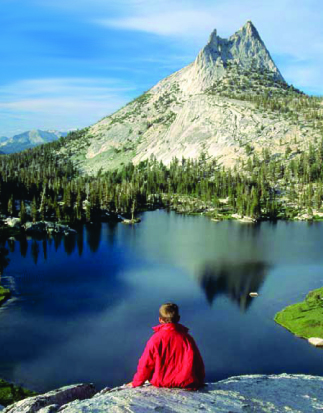
 rofound moments with nature foster a true and vital understanding of our place in the world. I remember an experience I had as a five-year-old boy that awakened in me a life-long fascination for marshes, birds, and for a life lived wild and free.
I was playing outside on a cold, foggy morning when I suddenly heard a startling chorus of “whouks” coming toward me through the air. I peered intently at the thick fog, hoping for at least a glimpse of the geese. Seconds passed; the tempo of their cries increased. They were going to fly directly overhead! I could hear their wings slapping just yards above me. All of a sudden, bursting through a gap in the fog, came a large flock of pearl-white snow geese. It seemed as if the sky had given birth to them. For five or six wonderful seconds their sleek and graceful forms were visible, then they merged once again into the fog. Seeing the snow geese thrilled me deeply, and ever since then I have wanted to immerse myself in nature.
Being Fully Present
When outdoors, many people are so engrossed in their own private concerns that they spend little time noticing their surroundings. I once demonstrated this to a group of 25 teachers in Canberra, Australia. I asked them to look at a beautiful tree as long as they were able to, and to raise their hands when their attention wandered from the tree and drifted to other thoughts. In only six seconds, every hand was raised. They were amazed to discover how restless their minds were.
Exposure to nature isn’t always enough. A friend of mine discovered this when he took his eight-year-old son hiking in the Canadian Rockies. They hiked for several hours until they came to a spectacular overlook where they could see two glaciated valleys and several alpine lakes.
He said, “That view alone made our long trip from Iowa worthwhile.” He suggested to his son that they sit and enjoy the mountain scenery. But the boy, who’d been running exuberantly back and forth along the trail, sat for five seconds, then scrambled to his feet and started running up the trail again. My friend said he felt like screaming, “Stop! Look at this incredible view!”
How can we help others experience nature deeply when their minds and bodies are so restless? The secret I’ve discovered is to focus their attention with captivating nature activities that engage their senses.
For example, in the Camera Game, which is played with two people, the “photographer” taps the shoulder of the “camera” twice, and the camera-person opens his eyes on the scene before him. Because the camera-person looks for only three seconds, his mind doesn’t have time to daydream, so the impact of his “picture” is quite powerful. Players of the Camera Game have told me that they’ve retained a vivid memory of their pictures for five, even eight years afterwards. This activity helps people of all ages experience what it is like to truly see.
Other examples of simple, absorbing activities are mapping natural sounds, writing an acrostic poem about something captivating, drawing one’s “best nature view,” and interviewing nature, where you look
for a special rock, plant, or animal that has an interesting story to tell. Then you ask it questions like, “What events have you seen in your life? What is it like to live here? Is there something you would like to tell me?”
Superlative Moments
Abraham Maslow described peak experiences as especially joyous with “feelings of intense happiness and well-being” and which often involve “an awareness of transcendental unity.” Mountaineers commonly report having these kinds of experiences. John Muir, in the following passage, explains why:
In climbing where the danger is great, all attention has to be given the ground step by step, leaving nothing for beauty by the way. But this care, so keenly and nar- rowly concentrated, is not without advantages. One is thoroughly aroused. Compared with the alertness of the senses … on such occasions, one may be said to sleep all the rest of the year.
—John of the Mountains
The intense focus required by wilderness pursuits such as climbing heightens one’s awareness, which is why so many people avidly enjoy them.
 Leaders can encourage peak experiences on less wild walks by using experiential activities that focus people’s complete attention on nature. Concentration is concentration; people benefit from increased perception wherever they are. One educator who hikes the Appalachian or Pacific Crest Trail every summer practiced the Sharing Nature organization’s reflective “I Am the Mountain” exercise for just four minutes. Afterwards, he said enthusiastically, “I was able to experience a state of heightened awareness that usually takes me a month in the wilderness to feel.”
Meeting Nature Face to Face
Science can only describe a flowering cherry tree; it cannot help us experience the cherry tree in its totality. To develop love and concern for the earth, we need deep, absorbing nature experiences; otherwise, our relationship with nature will remain distant and abstract and never touch us deeply.
Rita Mendonca, Sharing Nature Brazil’s national coordinator, recently gave a training program in the Amazon for professional ecotourism guides, some of whom had worked in the area for 40 years. Their attitude at first was that she had little to teach them. But after participating in several experiential Sharing Nature® activities, a woman approached Rita and said with deep emotion, “You are helping me find the forest inside of me! We don’t know the forest in this way!”
Absorbing experiences bring us face-to-face with nature. The observer and the observed become united—and only then is true knowing and love awakened in the observer’s heart. John Muir said that the content of the human soul contains the whole world. The deeper purpose of experiential learning is to broaden our experience of life and include other realities as our own. When one is immersed in nature, Muir said, the “body vanishes and the freed soul goes abroad.” Only by expanding our sense of identity beyond our physical body and egoic self can we commune with distant horizons, brightly colored songbirds, and countless other delights.
When people are quiet and receptive, fully immersed in nature, insights on the real purpose of life reveal themselves. David Blanchette is a teacher at the Punahou School on Oahu Island, Hawaii, where every year he leads his 13-year-old students on an inspirational nature walk along a remote and wild coastline. Below are some of his students’ thoughts about life and nature after playing reflective, experiential Sharing Nature activities like “Expanding Circles,” “Trail of Beauty,” and the “John Muir Game”:
• It made me feel like I was actually a part of the sand and ocean.
• I was a calm ocean wave gently rolling towards the shore. I was the reef, feeling the cool water roll over me.
• I felt euphoria. I felt like I was one with everything around me.
• It felt powerful, yet peaceful. Every part of me is moving and flowing in harmony.
• Watching the turtle swim carefree reminded me that I have nothing to worry about.
• You really live when you take time to notice your surroundings.
• If you find beauty within the world you can find it within yourself.
Jessica, one of David’s students, wanted to express her appreciation for the ocean, so she gratefully wrote “thank you” in the sand—and let the ocean waves embrace her sentiment and take it into itself.
Fostering in others beautiful human qualities of humility, respect, love, and joyful harmony with one’s environment outside and inside of oneself—as expressed by the Hawaiian students—is what nature education is really about.
 Becoming Good Stewards
A teacher in the Southwest once asked the children in his class to draw a picture of themselves. He recalled, “The American children completely covered the paper with a drawing of their body, but my Navajo students drew themselves differently. They made their bodies much smaller and included the nearby mountains, canyon walls, and dry desert washes. To the Navajo, the environment is as much a part of who they are as are their own arms and legs.” The understanding that we are a part of something larger than ourselves is nature’s greatest gift. With it, our sense of identity expands and, by extension, so does our compassion for all things.
In order to create a society that truly reveres the natural world, we must offer its citizens life-changing experiences in nature. Saint Teresa of Avila said, “The soul in its ecstatic state grasps in an instant more truth than can be arrived at by months, or even years, of painstaking thought and study.” One moment of deeply entering into nature can inspire in us new attitudes and priorities in life that would take years to develop.
When people feel immersed and absorbed in the natural world, they are learning the highest that nature has to offer—because nature herself is their teacher.
Joseph Cornell is the author of the highly acclaimed Sharing Nature book series and is the founder and president of Sharing Nature Worldwide. You are welcome to reprint this article with prior permission from Sharing Nature Worldwide. You can find out more about Sharing Nature activities and resources at www.sharingnature. com or 530-478-7650. Contact Joseph Cornell at info@sharingnature.com.

by editor | Jan 26, 2017 | Marine/Aquatic Education
Eelgrass as Teacher
Integrating Tradition, Science, and Learning on the British Columbia Coast
by Nikki Wright
 ith a respectful hush, students squat on the sand or sit on logs on the warm beach, listening intently to Trish speaking about the way her indigenous Coast Salish community harvested herring roe in Deep Bay, B.C., Canada when she was ten. You can hear a fir needle drop in the forest behind her as she recollects her memories of watching the shoreward migrating herring , so thick, she says, they were “like little bits of shining glass in the Bay.” The families would collect the roe from cedar boughs placed in the bay and store it in long storage bins, where she would race past and swipe some to eat before Grandmother would find her out.
These high school students were in a very special site, a Gulf Island on the British Columbia coast, learning first hand the traditional stories of Native peoples harvesting and storing the riches of the sea. During their time on this beach, they would explore eelgrass beds, which are also used for herring spawn sites, in the interface between ocean and land. They found myriad critters crawling and scurrying between the blades. This exploration of the mysteries of sea life so close to the shore would lead them further down the road of revelation and possibly to a lifetime of marine discoveries.
Shortly after I had listened to Trish on that extraordinary beach, I accompanied a grade four class on a beach within the boundaries of Victoria on Vancouver Island. With small class groups alongside me, I walked gingerly in gumboots in an eelgrass community at low tide. Once again, I had a glimpse into these wondrous undersea gardens, watching the small kelp crabs and juvenile seastars creep along the emerald green blades, and witnessed small flounder gliding under the sand. A whole world opened up before us. This is the magic of eelgrass in quiet bays and coves and estuaries.
SeaChange Marine Conservation Society, a community conservation group on Vancouver Island in British Columbia presents these kinds of opportunities in the spring, summer and fall each year to schools at all levels. Many times, eelgrass (Zostera marina –one of the two native species of eelgrass on the BC coast) is a gateway of learning during our time on the shore and in the estuary. This is the story of my experience with eelgrass as a teacher. The following are suggestions for exploring a seagrass community for Grades 1-6.
When I first started marine naturalist work in Victoria, Canada, I was a SCUBA diver diving for sea creatures and demonstrating their behaviour to elementary and middle students. Most of these young people were more familiar with facts about coral reefs and sharks across the world than with the sea cucumbers, Great Blue Herons and pipefish of their local marine world. This introduction to local sea animals was a first step, but unsatisfying to me as a marine educator. I wanted to teach ecology. I needed to find ways for young people to fall in love with the intricacies of an easily accessible natural system (Capra, 2005). I believed, and do so even more strongly today, that children learn best from the natural world when they are actively engaged in it (Krapfel, 1999). Eelgrass has afforded those opportunities through classroom, field and community activities. Students will observe ecological connections. The underwater blades offer viewing windows into complex food webs close to shore (Phillips, 1994). Students can extend their understanding of ecological relationships by investigating land use activities affecting these food webs. Teachers can help students understand the importance of citizen science in protecting shores with maps of the boundaries of eelgrass meadows made by their students.
 The Biological Diversity within Eelgrass Meadows
Eelgrass is a simple enough looking plant, but it has great importance to living systems, both human and non-human. It evolved from fresh water and migrated to the ocean in relatively recent geological time. Eelgrass shoots act like crab grass or strawberry plants in that they grow most successfully by rhizomes, or underground roots. One plant in a large meadow can be the parent of thousands of shoots, as they clone in muddy sandy substrates in shallow protected bays and estuaries in most temperate marine areas of the world. The intricate weaving of the underwater blades afford shelter for salmon from the hungry foraging of Bald Eagles, and the minute algae on the blades feed the small crustaceans called copepods that swim near the muddy bottom which in turn feed the outcoming salmon fry from freshwater streams. The plants are so popular with salmon that eelgrass meadows have been compared to salmon highways in the Pacific Northwest.
The high biological diversity available in eelgrass systems provides food for a diversity of organisms in several ways. In the Trent River delta on Vancouver Island, for example, 124 species of birds have been identified and includes over 38,000 individuals. Forty eight per cent were observed using the intertidal eelgrass (Z. japonica) of the delta for feeding, foraging or preening at some time during the year (Harrison and Dunn, 2004).
For younger grade levels, it is fun to explore eelgrass meadows for juvenile creatures – small crabs, seastars, and flounder for example. Because the weaving of the eelgrass blades provides good hiding places from predators, the beds are resplendent with new life.
The matted rhizomes help capture sediment and decreases erosion (Phillips, 1984) which is important for shoreline homeowners. All these benefits of this underwater vegetation can be demonstrated to school children in their classroom and outside on their local beach or estuary. It takes little or lots of time, depending on how far and deeply you as an educator would like to extend the lessons. This article assumes that you have the opportunity to visit your local eelgrass more than once over the school year.
I thought in 1993 I had found a simple way to teach ecological systems to children. Thirteen years later, after all the SCUBA dives, seining, kayaking, tide pooling, and mapping and restoring of eelgrass, I am still entranced with this nearshore plant that makes up underwater emerald forests.
 Classroom Activities
A network of eelgrass conservationists along the entire coast of British Columbia maps eelgrass beds and locates potential restoration sites. Many of these individuals come into their local schools to help teachers with exploring the mysteries of eelgrass. They bring resource books with plenty of photographs, maps, stories, colouring books, overhead drawings and graphs of food webs found in eelgrass habitats, and eelgrass plants found along the beach. You can provide library books, web sites, stray eelgrass plants and help students explore ideas on how they would like to investigate their local eelgrass beds.
In preparation for the first field trip, students can formulate questions they wish to answer during their field trip, and discuss their hypotheses in small groups. For example, one group of fifth graders might formulate the following: “If young crabs use eelgrass for shelter, then they will be found in areas hidden from their predators.” They then could create a data sheet with spaces to record how many and what kinds, sizes and locations of crabs they observe.
Students should be reminded that they are visiting the living rooms (or habitats, depending upon the age group) of intertidal animals and plants that are already stressed from exposure to the sun. Examples of good beach manners are:
 • Turn rocks back gently after lifting them
• Fill in any holes when digging
• Wash hands in the tub of saltwater next to the touch tanks before touching animals and plants
• Handle animals and plants gently.
• Avoid walking on plants and animals
• Do not remove attached animals or plants.
• Leave the plants and animals in their natural homes (habitats).
It is important that students be comfortable and safe and be respectful for the life they will encounter on their field trip. Sunscreen, extra socks, drinking water, towels and gumboots or shoes that can get wet or muddy. They can add their own beach etiquette rules.
Field Trip Activities
Students can become familiar with eelgrass ecology during a preliminary field trip lasting usually an hour and a half. Prior to the actual field trip, the class can be divided into three groups. We usually have three groups of ten students each.
The first beach station is the ”Habitat Aquaria.” We use two glass 33 gallon aquaria placed within a wooden frame and supported by two wooden supports. We fill the first aquarium with sand and “living rocks,” drift eelgrass and crab and chitons, sea cucumbers, small seastars, sand dollars, clams and the like collected by SCUBA divers. We place rockier substrate in the second aquarium with drift kelp and other seaweeds, urchins, living rocks with tunicates and coral algae living on them, limpets, turban snails, and crabs to demonstrate what lives beyond the shallow eelgrass meadows. Simple rubber tubs can be substituted for glass aquaria. Laminated field guides are distributed so that the students can identify and observe animals on their own before they are told what is in the aquaria. Buckets and tubs surround the aquaria are filled with seaweed and kelp to shade the animals that can be touched by the students under supervision. A hand washing tub full of saltwater ensures that sunscreen on the students’ hands will not harm the animals in the touch tubs.
The second station can be a “Detective Game.” Using the field guides students are asked to find and observe, without collecting, animals that have hard shells, or live in a community, or plants that have knobs growing on their blades. They convene after 15 minutes or so to share their findings. Detective questions could be ones such as:
Find:
• Two different kinds of edges on seaweeds.
• Evidence of an animal having eaten something.
• Three seaweed leaves with different textures (smooth, prickly, etc.)
• Four different odors/smells.
• Five different sizes of barnacle.
• Six different kinds of birds on the shore or near-by
• Seven human activities on or near the shore.
• Remember eight different sounds and repeat them to the group
• Name nine different ways people are using the shore or waters near-by.
The third station can be a “Making Art” display. On a large tarp, students at all grade levels enjoy as a group making a giant sea animal or an eelgrass or kelp underwater forest.
Beach seining in a protected bay or estuary is another way to acquaint students to the eelgrass community but it is crucial this be done in a very sensitive manner, as juvenile marine animals such as salmon fry and young flounders cannot tolerate exposure out of water or touch. When done under the careful supervision of an experienced leader, however, students are thrilled with the diversity of the collection from seining after they have helped haul the net shoreward. The specimens can be collected carefully and kept in cool seawater tubs for a short duration for observation by all.
Beach specimen presses can be done easily with moist heavy paper and cardboard between the paper. Students collect drift (unattached) eelgrass, seaweeds and flat pieces of kelp and design patterns onto the heavy moist water. The sheets are then placed between two wooden boards and tied together with a belt. The collection should be placed in an area that is well ventilated in the classroom. In just a few days, the students can open the press and discover their dried creations. Cards, posters and other art work can then be taken home or displayed.
 Extension of Field Activities
A second field trip can be designed for mapping a local eelgrass bed during the springtime on a very low tide (less than 2 metres in B.C.). The methodology for mapping can be practiced in the classroom. Before that however, it is essential that students know why this particular habitat is important to map. After they have become familiar with its ecology during their preliminary field trip, students can interview community members, including fishermen, First Nations members and old time residents on what they remember of eelgrass in the local waters. This information can then be brought back to collate into maps.
On southeast Vancouver Island, one of the eelgrass mapping coordinators consulted with First Nation Elders and old time fishermen to find out where the eelgrass “used to be” in a large estuary. She brought that information to a classroom of 5-6th graders, and asked them to map the areas on nine baseline maps. The class then combined the maps to compare where the meadows were historically sited and where they grow presently. They discovered that a large area was impacted by log storage activities, but they also discovered that local community restoration efforts were underway to bring back the meadows where the log leases were no longer used.
Mapping can be as simple as following the upper boundary of an eelgrass bed and noting on a cadastral map where the bed begins and ends. Or students may want to map the upper boundary using a GPS unit and then measure the density of the bed using a transect line and quadrats. The scientific protocol that has been accepted in British Columbia for mapping eelgrass can be found on the Seagrass Conservation Working Group web site (Seagrass Conservation Working Group web site, 2002).
To show students how to measure eelgrass shoots within a meadow, you might try using a demonstration eelgrass grid, which takes little time to make. I suggest you find mesh material (we use the plastic mesh used to protect SCUBA tanks) with small (approximately 1⁄4 inch) spaces to thread green ribbon in dense patterns. Provide a quadrat (see below) and a ruler so that students can practice measuring the width and length of the blades. Thicker ribbon can be used to represent reproductive flowering plants.
It is important that they know before they map on the beach that reproductive shoots are ephemeral. If flowering shoots are not noted while mapping, the class might return the following year and observe that the bed they measured is less dense, and conclude that it has been damaged. Zostera marina is a perennial plant (Z. japonica is most often annual), but densities can vary from year to year because of the timing of reproduction and the fact that they shed their leaves up to seven times in one year (Durance, 2002). If the class decides to monitor one bed over several growing seasons, these are important factors for accounting for different shoot densities over time.
Considering the worldwide extent of seagrasses is estimated at 44 million acres, but that much of the extent has not been mapped, (Green & Short, 2003) there is a lot of mapping of eelgrass to be done everywhere! It is not difficult for students at all levels to inventory local seagrass beds whether they be Zostera marina or Z. japonica or another species of seagrass in your area of the world.
On many shores of southern British Columbia, both eelgrass species grow close to each other. We are having fun creating useful and easily memorized limericks to help us decipher the difference between the two species, as on some shores they look remarkably similar. One example of a “limerick in process” is:
Marina, like green onions,
it’s sheaths they do tear,
While japonica, like celery,
it’s sheaths pry open, to bare. (Sanford, 2006)
Students can make up their own rhymes and songs to identify species of eelgrass that they then can pass on to the next class for the following year.
Eelgrass meadows are naturally highly dynamic systems, often changing from year to year or from season to season, reflecting changes in the environment (Den Hartog, 1971) At one school, fourth graders are monitoring both species (Z. marina and Z. japonica) growing adjacent to each other over several years, to note competition or changes between the two. They pass on the monitoring data onto the next class before the next mapping expedition during the following spring.
 What is needed
One quarter metre and one metre square quadrats can be easily made from aluminum or plastic pipe. These frames are set upon a 60 m transect line (polypropylene rope is easiest to use) at metre points randomly selected. The transect rope can have tape tied securely at one metre marks with the designated metre number marked on each tape. On the way to the site, students can call out numbers from 1-30, a recorder can write them on a data sheet (see illustration). Other equipment needed is GPS units or compass (for triangulation for site location), data sheets and pencils attached to clipboards, field trip supplies (sun screen, drinking water, first aid kit, snacks and hats), and binoculars. Make sure students are wearing gumboots or shoes or sandals that can withstand some saltwater.
Methodology
To ensure success, visit the site yourself before the field trip so that you have a clear idea how to direct the students. Since eelgrass shoots tend to grow at different lengths and widths according to where they are located in the intertidal zone, it is important to place the 60 m transect line parallel to shore well within the range of the zone you may want to select beforehand.
For example, this could be a description of the bed before you:
Zone 1 is a narrow band 8 metres wide, located in the low intertidal and shallow subtidal. The zone is characterized by a sparse population of short eelgrass (length 25 cm, density 32 shoots/m2). Zone 1 blends into Zone 2, at a slightly lower elevation. The bed in Zone 2 is 50 metres in width. The majority of the bed is located in Zone 2.
During your preliminary visit, you may have decided to have the students map only one zone with their 60 m transect. By the end of the exercise, they might feel more confident to map more of an area at a later date. The pressure of the incoming tide dictates how much time is available to map one zone. It is best to arrive with your class at the site about an hour before the tide begins to recede. During this time, the students could identify the zones of eelgrass on the beach. You may have already visited the site at low tide, so you can help direct the discussion.
For a class of 30, you may want to organize students into groups of three: In each group, one student is the recorder, one the counter of shoots, and one measures one shoot in the right hand corner of the quadrat for width and length. Each group will have one third of the 30 numbers they randomly selected before they arrived on the beach. The recorder in each group makes sure the numbers are located accurately so there are 30 sets of measurements by the end of the mapping exercise. When the tide has returned, the data sheets are collected and returned to the classroom. Over time students will notice changes in the density and width of the eelgrass bed they mapped and will have lively discussions as to why that is.
Synthesizing Classroom Studies with Field Experiences
The classroom activities and field trips can be integrated across curricula. Students can photograph their art displays on the beach tarp and combine them with the pressed plant specimens to include on a wall mural in the classroom. They can write stories about the eelgrass animals they observed on the beach and combine facts about the creatures’ biology with fiction about their lives in the meadow. They can use math to calculate Leaf Area Index (mean eelgrass leaf length and width determined from sampling one eelgrass shoot in each of 30 quadrats) for determining the productivity of an eelgrass bed, and research the history and geography while they find local stories about the locations and uses of this seagrass, including Indigenous traditions.
The table below illustrates how lessons can focus on science processes (Gough & Griffiths, 1994).

Students at all grade levels can participate in restoration of eelgrass as part of a community effort to restore damaged fish habitat. Since 2000, in Tod Inlet on southeastern Vancouver Island, community members of all ages have completed five eelgrass transplants under the guidance of a local conservation group, a scientific advisor in partnership with provincial and federal agencies. Over the past four years, community conservation groups in 22 communities on the 27,000 km coast have involved students and families on mapping and restoration projects. This level of involvement can start simply with one person committed to a plant in one place, with equipment such as gumboots, an inexpensive tub showing students eelgrass critters, rope and a square of aluminum and pencil and paper.
Maps as Community Connectors
It has been estimated that as much as 80% of the pollution load in the ocean originates from land based activities (NPA, 2007). After researching its history and constructing maps, students might conclude that their local eelgrass meadows are not as dense or as extensive as they were, even as recently as 10-20 years ago. The maps they have created can be used to influence decisions affecting the shoreline, such as the construction of cement seawalls or the creation of riparian set backs to offset the erosion effects of seasonal storm events. Students’ maps can be displayed at a local council meeting, at festivals, in brochures and in presentations to other schools or community associations.
On the BC coast, we are making eelgrass a household term, because these maps created by people of all ages have heightened awareness of the importance of this crucial underwater plant community and have been included in regional atlases, official community plans and shellfish aquaculture plans and First Nations treaty negotiations. Knowing that their data collection has far reaching influence, even fourth graders will take special care for accuracy.
Eelgrass Restoration
It has been estimated that approximately 222,000 acres of seagrasses worldwide have been lost in the last decade (1990-2000) (Green & Short, 2003) because of development, forestry and agricultural practices, dredging and hardening of shorelines (construction of cement seawalls), to name a few.
Further Explorations
As students become more familiar with their local eelgrass meadows, teachers might want to facilitate discussions with their students about why eelgrass habitats are so important on the global scale. Students could establish research teams around such issues as the role of seagrasses in global respiration (amount of carbon and oxygen released and absorbed into the atmosphere), the impact of eelgrass habitat losses with decreasing world fisheries resources, the role of seagrasses and mangroves in conserving shores during extreme weather events, and the connections between land use activities and nearshore environments and about their own responsibility in caring for eelgrass habitats.. They might conduct their research through interviews with scientists within the community as well as by using the Internet. As their understanding increases from the local to the global, they can take their information to other classes within their school, and demonstrate their findings through a multi-media event or by taking another class to the beach at low tide to demonstrate their knowledge. The beach then becomes a laboratory to learn about biology, zoology, ecological patterns and ultimately about the responsibility of humanely living in the global biotic community. We as educators can help our students face environmental challenges by encouraging them to take the time to observe, reflect, ask questions and find answers within their community. Eelgrass meadows offer one way into that window of inquiry.
References
Capra, F. (2005). Speaking nature’s language: principles for sustainability. In Stone, M.K. & Barlow, Z. (Eds.), Ecological Literacy: Educating our children for a sustainable world (pp.19-29). San Francisco: Sierra Club Books.
Den Hartog, C. (1971). The dynamic aspect in the ecology of seagrass communities. In Thallassia Jugoslavica, 7 (1), 101-112.
Durance, C. (2002). Methods for mapping and monitoring eelgrass habitat in British Columbia. Vancouver: Environment Canada.
Gough, R.L., & Griffiths, A.K. (1994). Science for Life, Toronto, Harcourt Brace & Company.
Green, E.P. & Short, F. (2003). World atlas of seagrasses. Berkeley: University of California Press.
Harrison, P.G. & Dunn, M. (2004). The Fraser Delta Seagrass Ecosystems: Importance to Migratory Birds and Changes in Distribution. Chapter 15: (pp. 3-4) In B.J. Groulx, D.C. Mosher, J.L. Lutemauer & D.E. Bilderback (Eds), Fraser River Delta, British Columbia: Issues of an Urban Estuary, Geological Survey of Canada Bulletin 567.
Krapfel, P. (1999). Deepening children’s participation through local ecological investigations. In G.A. Smith & D.R. Williams (Eds.), Ecological education in action: On weaving education, culture, and the environment (pp. 51-53). Albany, New York: State University of New York Press.
Phillips, R.C. (1984). Chapter 4: Components of the eelgrass community-structure and function. In The ecology of eelgrass meadows in the Pacific Northwest: A community profile (pp. 34-56). Seattle, Washington: Seattle Pacific University.
Phillips, Ronald. C. (1984). The ecology of eelgrass meadows in the Pacific Northwest: a community profile. U.S. Fish & Wildlife Service FWS/OBS-84/24. 85 pp.
Sanford, D. (2006). Personal communication.
The web site for more information on the educational, conservation and restoration activities of the author’s organization is: www.seachangelife.net
This article was originally written for the Asia-Pacific Network for Global Change Research, Konan University, Kyoto, Japan. It is reprinted here with permission.

by editor | Jan 26, 2017 | Arts and Humanities
 The Value of Creative Teaching
Place-based environmental education through the lens of art and creative writing
by Tess Malijenovsky
 lace-based environmental education is taking front seat inside and outside classrooms across the country in part to prepare future generations for the environmental challenges they’ll face ahead. That is, climate change, natural resource competition, ocean acidification, sea-level rise, and rampant species extinction. In the famous words of Albert Einstein, the significant problems we face today cannot be solved with the same thinking we used when we created them.
This is why we mustn’t undermine the value of creative thinking in outdoor environmental education. While our education system tends to emphasize critical thinking skills for good reason, sometimes the critic within must be silenced for the improvisation of ideas and solutions: In a study published by PLOS ONE journal, researchers Charles Limb and Allen Braud found that the parts of the prefrontal cortex associated with self-monitoring and conscious control were suppressed in jazz musicians playing improv. Despite differences in the analytical- and creative-thinking processes in the brain, however, both entail a sophisticated application of knowledge.
 Nature-themed art and writing exercises are ways for educators to elicit creative thinking in students when teaching environmental education. What’s more, nature illustration outdoors, for example, can break through learning barriers and focus the attention of students from diverse backgrounds and learning levels while delivering life science lessons, as witnessed by Straub Environmental Center’s executive director, Catherine Alexander.
Alexander recently spent a day at the Little North Fork of the Santiam River with 20 elementary-aged summer campers studying and drawing the plants, fungi, and animals surrounding their beautiful setting in an old-growth ecosystem. The students, representing a variety of learning styles and backgrounds, took their seats on mossy patches of sunlight, encapsulating science concepts in a portrayal of their immediate watershed environment.
Imagine a children drawing an osprey. As she focuses on her drawing, the child listens to her teacher talk about the length of the bird’s wingspan, the purpose of its long, sharp talons, what it eats, and where it lives. According to the brain lateralization theory that more divergent thinking occurs in the right side of the brain, listening while drawing helps distract and relax the student’s inner critic, expanding the reach and flow of new connections in her mind. Less intimidated or hypercritical in the art-making process, the child’s attention focuses on the charismatic creature she is drawing and learning about. The art lesson unravels into an engaged science lesson about the osprey’s ecological niche and life cycle.
“Art is more than a pastime,” says Alexander. “It can be an enabling portal for a number of academic subjects. The summer campers reminded me that art can have rhetorician value for students with learning disability or for whom English is not their first language. It can be a powerful equalizer and high-interest segue into all kinds of educational pursuits.”
 One free, online resource to help educators tie art and creating writing activities in life science lessons to Common Core and Next Generation Science Standards is the “Toolkit for Educators,” developed in partnership by Honoring Our Rivers: A Student Anthology, Portland Metro STEM Partnership, and Straub Environmental Center. The toolkit provides teacher-tested life science lessons plans that use Honoring Our Rivers (HOR) with the corresponding learning standards.
The HOR anthology, a program of Willamette Partnership, a Portland-based conservation nonprofit, encourages students to fall in love with rivers and express their connections to them creatively – through art, photography, poetry, stories, and foreign language – in hopes of naturally cultivating the next generation of watershed stewards for the Pacific Northwest species and communities who depend on these vital systems.
Educators who integrate river-watershed-themed art and writing activities into their lessons can not only stimulate the creative minds of their students in an engaging educational way but give them an opportunity to be published statewide by submitting their work to HOR. The program also hosts student art exhibitions and student reading events across Oregon.
Educators can also learn more about nature-themed art instruction at HOR’s upcoming workshops at the Coastal Learning Symposium this Oct. 14 at Newport’s Oregon Coast Aquarium.
Teachers have the power to encourage the creative capacities of our youth while addressing the increasing disconnect between children and the outdoors. HOR exists to help them accomplish this feat. For more information, visit www.honoringourrivers.org, or email info@honoringourrivers.org.
###
 Tess Malijenovsky is the coordinator of Honoring Our Rivers: A Student Anthology, a program of the Portland-based conservation nonprofit Willamette Partnership. Prior to moving out West, Tess was an environmental journalist and the assistant editor of Coastal Review Online in North Carolina. She studied Creative Writing and Spanish at the University of North Carolina Wilmington

by editor | Dec 19, 2016 | Learning Standards, Learning Theory
Maria’s Eye: How do we empower it to engage and understand her world?
by Jim Martin
CLEARING writer and contributor
 f I could imagine the best possible classroom in the world, it would be one in which each student is empowered to look out into the world, see something which catches her attention, then know what to do to find out about it. Students engaged, involved, invested, and empowered in their world. My mind’s eye expresses this dream as one of a salmon fry darting quickly into a thick growth of periphyton on a fist-sized cobble, as Maria’s eye turns up and the corner of her mouth sets its sails toward a smile. That, not checking off a cell in a table, is the moment of learning that we teach for. That tells us that all is going to work out; we’ll accomplish this unit, and be ready for the next; empowered to accomplish whatever comes down the road.
How do we recognize that moment, and what do we follow it up with? So far, all of the work on science standards hasn’t clarified an answer to that question. Go to the Next Generation Science Standards (NGSS) website (http://www.nextgenscience.org/) and look for teachers’ resources. And for teachers’ in-service opportunities. What do you find that is cognizant of how teaching and learning actually happen? That offers in-service training on using active learning to engage students in self-directed inquiry. Perhaps we need to work on this ourselves.
How did Maria’s eye get to the place where it turned into anticipation, and an incipient smile expressed a clear message that she was on the way to understanding? Something in her environment invited Maria to explore a concept, and her brain did the rest. Something her teacher anticipated and organized within her students’ work environment so they would engage it. Not a simple thing to do. It takes knowledge, time, confidence, and experience to do this well. And competent mentors. (For about twenty years, I did science inquiry workshops for teachers which began with a casual observation that I hoped would lead participants to notice something. Each time, to the very last I did, this is the moment I felt that this time, it wouldn’t work. Each time it did, and my experience was the thing I relied on the most to trust it would. Takes courage! And experience.)
When students engage the real world, the one outside the classroom, and discover questions embedded in what they find, that process turns on their brain, engages the prefrontal cortex (pfc), and real learning begins. When they do this in partnerships or groups, the medial pfc adds to that learning power by engaging the negotiation of meaning with its power derived from the social interactions involved in exploring, then recognizing a question. Quickly, the whole brain becomes actively involved, and new conceptual understandings are reinforced in long term memory. Can teachers learn to use this wonderful, built-in resource?
How can environmental educators help get them out here? How do we get departments of education (unwieldy bureaucracies) and legislators to recognize the need and support it. Perhaps we can pilot a project which first describes what teachers need in order to appreciate and understand how active learning works, and why. Then provides the in-service support teachers need to feel confident with the content they are teaching, and comfortable with all aspects of delivering content via active learning.
There are educators who routinely use active learning to deliver content – environmental educators. They teach in places which are interesting, and where students can initiate learnings with real-world, concrete objects. A good way to start a learning activity by engaging the brain, especially the pfc. A nice five-to-ten day summer workshop, followed by mentored field trips to nail down specific learnings. What might this pilot look like?
Some teachers are already delivering content via competent active learning. A large number of environmental educators are doing the same. What if we could gather a few of each for a few hours to discuss the idea of helping teachers become comfortable with active learning, and comfortable integrating and aligning their deliveries to their state’s content standards? There are large regional environmental education learning centers which have the infrastructure to support workshops. A collaboration between teachers, environmental educators, and environmental learning centers might have the capacity to deliver a pilot project. I like to think in terms of the long run, so add a comment that this would be a three-to-five year pilot in which initial participants would, where feasible, mentor new teachers each year, periodically review progress and tweak the project, and present their work and findings at annual teacher and environmental education conferences.
It doesn’t take many people to make positive change. I’ve learned over the decades that they simply have to start.
 This is a regular feature by CLEARING “master teacher” Jim Martin that explores how environmental educators can help classroom teachers get away from the pressure to teach to the standardized tests, and how teachers can gain the confidence to go into the world outside of their classrooms for a substantial piece of their curricula. See the other installments here, or search Categories for “Jim Martin.”

