
by editor | Dec 19, 2016 | Learning Theory
A Pedagogy for Ecology
by Ann Pelo
 s a teacher, I want to foster in children an ecological identity. I believe this identity, born in a particular place, opens children to a broader connection with the Earth; love for a specific place makes possible love for other places. An ecological identity allows us to experience the Earth as our home ground, and leaves us determined to live in honorable relationship with our planet.
We live in a culture that dismisses the significance of an ecological identity, a culture that encourages us to move around from place to place and that posits that we make home by the simple fact of habitation, rather than by intimate connection to the land, the sky, the air. Any place can become home, we’re told. Which means, really, that no place is home.
This is a dangerous view. It leads to a way of living on the Earth that is exploitative and destructive. When no place is home, we don’t mind so much when roads are bulldozed into wilderness forests to make logging easy. When no place is home, a dammed river is regrettable, but not a devastating blow to the heart. When no place is home, eating food grown thousands of miles away is normal, and it is easier to ignore the cost to the planet of processing and shipping it.
Finding a Place
Our work as teachers is to help children to braid their identities together with the place where they live by calling their attention to the air, the sky, the cracks in the sidewalk where the Earth bursts out of its cement cage. For me, teaching in a childcare program in Seattle located next to a canal that links Lake Union and Puget Sound, “place” means the smell of just-fallen cedar boughs and salty, piquant air, the sweet tartness of blackberries (and the scratch of blackberry thorns), the light gray of near-constant clouds, the rough-voiced calls of seagulls, and the rumble of boat engines. It is exhilarating to offer children this place as home ground.
Other places are less compelling as home ground. What does it mean to do this work of connecting children to place when the immediate environment numbs rather than delights the senses? What can we embrace in a school neighborhood dominated by concrete, cars, and convenience stores?
Children’s worlds are small, detailed places—the crack in the sidewalk receives their full attention, as does the earthworm flipping over and over on the pavement after rainfall. Children have access to elements of the natural world that many adults don’t acknowledge. When we, like the children, tune ourselves more finely, we find the natural world waiting for us: cycles of light and dark, the feel and scent of the air, the particularities of the sky—these are elements of the natural world that can begin to anchor us in a place.
Rather than contribute to a sense of disconnection from place by writing off the environments around our most urban schools as unsalvageable or not worth knowing, teachers can instill in children an attitude of attention to the natural world in their neighborhoods. The sense of care for and connection to place becomes the foundation for a critical examination of how that place has been degraded. Rick Bass, in The Book of Yaak, describes his experience of the interplay between love of place and willingness to see the human damage done to that place: “As it became my home, the wounds that were being inflicted upon it—the insults—became my own.”
Every child lives someplace. And that someplace begins to matter when we invite children to know where they are and to participate in the unfolding life of that place—they come to know the changes in the light and the feel of the air, and participate in a community of people who speak of such things.
Cultivating an Ecological Identity
Children know how to live intimately in place; they allow themselves to be imprinted by place. They give themselves over to the natural world, throwing endless rocks into a river, digging holes that go on forever, poking sticks into slivers of dirt in pavement, finding their way up the orneriest tree. They learn about place with their bodies and hearts. We can underscore that intuited, sensual, experiential knowledge by fostering a conscious knowledge of place.
How do we cultivate a love of place in young children’s hearts and minds, moving beyond the tenets of recycling to intimate connection with their home ground? From my experiences as a childcare teacher, I’ve distilled a handful of principles.
• Walk the land.
• Learn the names.
• Embrace sensuality.
• Explore new perspectives.
• Learn the stories.
• Tell the stories.
My primary work is as a teacher in a full-day, year-round childcare program in an urban Seattle neighborhood that serves families privileged by race, class, and education. I’ve also worked closely with teachers and children in urban Head Start programs. The principles I suggest resonate in these widely varying contexts; all children deserve home ground.
Walk the Land
Contemporary U.S. culture is about novelty and fast-moving entertainment: a million television channels to surf, and news stories that flash bright and burn out fast. This disposition to move quickly and look superficially translates to a lack of authentic engagement with the Earth: Get to as many national parks as we can in a two-week vacation, drive to a scenic view, take some photos, and drive to the next place.
As teachers, we must be mindful of this cultural disposition to superficial knowledge. It’s easy to fall into the habit of aiming for novelty, offering children many brief encounters with places, experiences that leave them familiar with the surface, but not the depths. Instead, we ought to invite children to look below the surface, to move slowly, to know a place deeply.
For many years, my emphasis in planning summer field trips was to get to as many city parks and beaches as I could. Each week, we’d head out to two or three different places, so that by the end of the summer we’d taken a grand tour of the city. I thought that by visiting a range of places in Seattle, the children would come to know their city. We had a hoot on those trips, but each place was a first encounter, and offered novelty rather than intimacy. The children came away from those summers not so much with a sense of place as with confusion about how these various places fit together to make up their home ground. We’d skimmed the surface of Seattle, but didn’t know its depths.
Now, my emphasis has shifted. I plan regular visits to the same two or three places over the course of a year. Spending time at the same park and the same beach, we see it change throughout the year. I point out landmarks on the beach to help the children track the tide’s movement up and down the beach. At the park, we choose a couple of trees that we visit regularly; we take photos and sketch them to help us notice the nuances of their seasonal cycles. From the top of a big rock at the park, the children play with their shadows on the ground below, noticing how shadow and light change over the year. The children greet the rhododendron bushes like dear old friends, and know the best places to find beetles and slugs.
My commitment to walking the land consciously with children has changed how I walk with them to the park in our neighborhood. I used to focus our walk on getting there efficiently and safely, and chose our route accordingly. Now, I’ve charted a longer route, one that takes us past a neighbor’s yard full of rosemary and lavender and tall wild grasses. We take our time walking past this plot of earth, and I coach the children to point out what they notice about this familiar place. I worried that the children would become bored, walking the same path every day, or would stop seeing the land, so I developed several rituals for our walk. We pause at the rosemary to monitor changes in its fragrance, buds, and foliage, and to watch for the arrival of spit bugs, whose foamy nests delight the children. We pause at the wild grass to compare its growth to the children’s growth, an inexact but joyfully chaotic measurement.
Learn the Names
When we talk about the natural world, we often speak in generalities, using categorical names to describe what we see: “a bird,” “a butterfly,” “a tree.” We are unpracticed observers, clumsy in our seeing, quick to lump a wide range of individuals into broad, indistinct groups. These generalities are a barrier to intimacy: a bird is a bird is any bird, not this red-winged blackbird, here on the dogwood branch, singing its unique song.
Most of us don’t have much of a repertoire of plant, insect, animal, tree, or bird names; I sure don’t. For many years, I wasn’t particularly interested in learning the names of the flora and fauna, and imagined that learning the names would be a chore, a tedious exercise in memorization. When I turned 40 and visited Utah’s red rock desert, it awakened me to a passionate love, born in my eastern Washington childhood, which I’d forgotten, or never consciously acknowledged: love for a spacious, uncluttered horizon, love for dirt, rock, and sage, for heat and dust and stars, for open sky. Being there taught me that learning the names is an exercise in love. I was in an entirely unfamiliar place, and had only the clumsiest of generic names for what I encountered: a bush, a rock, a lizard. As I began to fall in love with the red rock desert, I wanted to know everything about it, including the names it holds. I bought a field guide and began to learn the names—the identities—of the plants, the creatures, the types of rock. Each name was a step closer into relationship. The names helped me locate myself in the desert.
I carry a field guide to the Pacific Northwest with me now, when I’m out with the children in my group. We take it with us when we walk to the school playground around the corner, and when we go farther afield. We turn to it when we encounter a bug we don’t recognize or find an unfamiliar creature revealed by a low tide. And I’ve created lotto and matching games from the field guide, photocopying images of familiar trees, birds, marine creatures. We use the images for matching games and bingo games: Together, we’re learning the names of this place that is our shared home ground.
Embrace Sensuality
In a culture that values intellect more than intuition or emotion, typical environmental education too often emphasizes facts and information in lieu of experience. Plenty of plastic animals, nature games, videos, and books for children invite them to intellectualize—and commodify—the natural world. Teacher resource catalogues offer activity books and games that teach about endangered species, rain forest destruction, pollution, and recycling. These books and games keep the natural world at a distance.
To foster a love for place, we must engage our bodies and our hearts—as well as our minds—in a specific place. Intellectual and critical knowledge needs a foundation of sensual awareness, and, for very young children, sensual awareness is the starting place for other learning. How does the air feel on your skin? What birds do you hear on the playground?
A friend of mine taught in a Head Start program in a housing development that had been the scene of several shootings, and that had more graffiti than green. She wrestled with how to stir children’s numbed senses awake in that harsh landscape where playing outdoors was dangerous. She decided to bring the sensual natural world into her classroom. She added cedar twigs to the sand table, and chestnuts, and stems of lavender. She included pinecones and seashells in the collection of play dough toys. She supplemented her drama area with baskets of rocks and shells, and included tree limbs, driftwood, stumps, and big rocks in her block area. She played CDs of birds native to the Northwest. And in early fall each year, she welcomed the children to her program with feasts of ripe blackberries, making jam and cobbler with the children, telling them about her adventures picking the blackberries in a wild bramble in the alley behind her apartment building.
Explore New Perspectives
Living in a place over time can breed a sense of familiarity, and familiarity can easily slip into a belief that we’ve got the land figured out. We stop expecting to be surprised, to be jolted into new ways of seeing; we become detached from the vitality of a place.
Our challenge is to see with new eyes, to look at the familiar as though we’re seeing it for the first time. When we look closely and allow ourselves to be surprised by unexpected details and new insights, we develop an authenticity and humility in our experience of place, and wake up to its mysteries and delights.
Several years ago, one of the 4-year-old children in my group posed a simple question: Why do the leaves change color? Her question startled me awake: I saw the transformation of color through her eyes, a phenomenon consciously witnessed only once or twice in her young life, and one full of mystery and magic. Her question deserved my full attention, not a recital of the muddled information that I remembered from my science classes in school, and not a quick glance at an encyclopedia. Madeline’s question launched our group on an in-depth study of the lives of leaves that carried us through the seasons.
My co-teacher, Sandra, and I took the children on a walk through the neighborhood to study the trees. Moving from one tree to the next, we began to see a pattern, and shared our observation with the children: the leaves on the outermost branches began to change color before the leaves in the center of the tree. The children built on our observation, adding what they’d noticed: The leaves first changed color on their outermost edges, while the center of the leaves remained green. I suggested that we gather leaves to bring back to our room, where we could study them up close and record what we observed, sketching the details that we saw and adding nuances of color with watercolor paint. As we sketched the lines of the leaves, children pointed out the resemblance between the skeletal lines of leaves—the “bones” of a leaf, the children called them—and the tendons and lines on our hands: “The lines of the leaf feel like human bones.” “The lines are like the lines on our hands.” Excited by the children’s observations, I suggested that we sketch our hands, just as we’d sketched the leaves, knowing that our sketching would help us see ourselves in new ways, as cousins to leaves.
As we sketched, I asked the children to reflect on why the leaves change color in the autumn. “What is it about autumn that makes leaves change from green to red, orange, brown?” The children generated several theories: “In the fall, it’s cold. Leaves huddle together on the ground to get warm. The trees are cold because they don’t have any leaves to keep them warm.” “The color is a coat to keep the leaves warm, because it’s cold in the fall.”
From this analysis, one child made a leap that deepened our conversation: “Leaves get sad when they start to die.” From this decidedly unscientific conjecture, the children forged a potent connection to the leaves: “Like we give comfort to others when they’re sad, the plant needs comfort.” “I think a hug would help a leaf, and being with the leaf.” “Maybe you could stay with it. You just give it comfort before it dies.” “When it drops on the ground, that’s when it needs you.”
At Hilltop, we use an emergent pedagogy, developing curriculum from the children’s questions and pursuits. In our study of the lives of leaves, I experienced the value of this pedagogy, as we lingered with questions, theories, and counter-theories, and with our not knowing. Our emergent curriculum framework allowed us to explore Madeline’s question in the spirit in which it was posed: a question about the meaning of change and the identity of leaves. Through our exploration, we became intimates of leaves, anchored in our place.
Learn the Stories
To foster an intimate relationship with place, we need to know the stories and histories that are linked to that place, just as we do in our intimate relationships with people. In our work with young children, our focus in gathering these stories is as much about the children’s imaginings as it is about scientific facts. We can invite their conjectures to complement the facts, opening the door to heartfelt connections.
Visiting a Head Start program one afternoon, I watched Natalie catch ants on the asphalt slab that served as the program’s playground. She hovered over a crack in the pavement, carefully picking up each ant that crawled from the crack and dropping it into a bucket. Curious about her intention, I asked what she was planning for the ants: “They’re bugs and we hafta kill them.” I imagined contexts in her life in which this could be true: Had her family dealt with invasive insects at home? Had she experienced the pain of bee stings and itch of mosquito bites? I wanted respectfully to acknowledge these sorts of experiences, yet I didn’t want them to become her only references for understanding and relating to the natural world. I said, “Sometimes, when bugs come into our houses, we have to kill them to keep ourselves healthy. And some bugs can bite us in painful ways. But sometimes we don’t have to worry so much about the bugs we find. I’m curious about these ants. Where do you suppose they come from?”
Natalie was quick to imagine the ants’ story: “The ants are in the hole talking. If they hear loud noises, they won’t come out. We have to be very quiet! If they see us, they stay in because they’re scared. When one ant wasn’t looking, I got him! I’m faster than them—that’s how I catch them.”
“What’s in the hole that the ants come from?” I asked.
“Maybe their family,” Natalie mused. I offered her a clipboard and a pen, and invited her to draw what she imagined was in the hole. She began to sketch, talking aloud as she worked: “They’re a family. They talk to each other and bring food to their baby. In the house, there’s food and a table and a bed and a seat.”
Natalie stopped drawing to look into her bucket: “There’s 15 ants in the bucket! That’s more than one family. That’s a lot of families. They share one house in the hole. The ants come not fast because they’re talking, saying their plan to come out to see what’s outside. They want to find their family that’s in the bucket. The ants in the bucket want to get out of the bucket and go to their family.”
Natalie abruptly dumped the bucket upside down next to the crack in the pavement, and tapped it on its bottom. “Go home, ants! Go to your home. Go to your family.”
When I invited Natalie to imagine the ants’ story it helped her see her bucket from the inside as well as from above, and shifted her relationships with the ants. She moved from a defensive posture to that of being a protector. Particularly for children living in places where the natural world is degraded or dangerous, imagining the stories of a place can inspire new possibilities; it casts children into an active role as people who care about and take action on behalf of a place.
Tell the Stories
We’re often encouraged to see the Earth as landscape, which is scenery—something to look at, but not to participate in. But when we collapse the distance between the land and ourselves and allow ourselves to become part of the story of a place, we give ourselves over to intimacy. This can be our work with young children—weaving them into the story of the place where they live.
One way I’ve begun trying to link the children to the land is by using observable markers anchored in place to measure our lives. “You’ll start kindergarten in the fall, when the blackberries are ripe.” “Christmas comes in the darkest part of winter, when the sun sets while we’re still at school, and the sun doesn’t rise until we’re back at school the next morning.”
And I’ve been playing a game with the children that I learned from Richard Louv’s book, Last Child in the Woods, “The Sound of a Creature Not Stirring.” We listen for the sounds we don’t hear (a leaf changing color, an earthworm moving through the soil, blackberries ripening)—a way to focus our attention on the Earth around us and to participate in what’s happening in it.
A Foundation for Action
In The Pine Island Paradox: Making Connections in a Disconnected World, Kathleen Dean Moore writes, “Loving isn’t just a state of being, it’s a way of acting in the world. Love isn’t a sort of bliss, it’s a kind of work. . . . Obligation grows from love. It is the natural shape of caring.” She writes: “To love a person or a place is to take responsibility for its well-being.”
From love grows action. In my work with young children, I share stories of local environmental activists who have used their love of place to fuel their action. For example, I tell the story of a group of children and their families who launched a campaign to save the cedar tree at the school playground where we often play.
Children have loved the cedar tree at Coe School for a long time; children played at this tree even before you were born. One year, a mom was at a community meeting and learned that the city park department was planning to cut down the tree because it was damaging the asphalt on the playground with its big roots. She told the children in her daughter’s kindergarten class, and those children and their families decided that they had to work to protect the cedar tree and to help the park department find another way to fix the problem of broken asphalt. The children and their families wrote letters to the city workers, telling them about how much they loved the cedar tree, and sharing their ideas for taking good care of the tree and the pavement on the playground. They had a meeting with the city workers, who hadn’t known that the tree was important to the children. After the meeting, the city workers decided not to cut down the tree; they made a plan with the children and their families and the other kids at Coe School about how they could work together to fix the asphalt and take care of the tree.
I watch for opportunities for the children to add their own chapters to the story of activism on behalf of beloved places. I want them to see themselves as part of a community of people anchored by fierce and determined love of place and who take responsibility for its well-being.
The poet Mary Oliver instructs us on how to open the natural world to children: “Teach the children. Show them daisies and the pale hepatica. Teach them the taste of sassafras and wintergreen. The lives of the blue sailors, mallow, sunbursts, the moccasin flowers. And the frisky ones—inkberry, lamb’s quarters, blueberries. And the aromatic ones—rosemary, oregano. Give them peppermint to put in their pockets as they go to school. Give them the fields and the woods and the possibility of the world salvaged from the lords of profit. Stand them in the stream, head them upstream, rejoice as they learn to love this green space they live in, its sticks and leaves and then the silent, beautiful blossoms. Attention is the beginning of devotion.”
And devotion is the beginning of action.
 Ann Pelo is a teacher educator, program consultant, and author whose primary work focuses on reflective pedagogical practice, social justice and ecological teaching and learning, and the art of mentoring. She is the author of five books, including The Goodness of Rain: Developing an Ecological Identify in Young Children; Rethinking Early Childhood Education/ and The Language of Art: Inquiry-based Studio Practices in Early Childhood Settings.
This article is reprinted with permission from A People’s Curriculum for the Earth: Teaching Climate Change and the Environmental Crisis, edited by Bill Bigelow and Tim Swinehart. Available from www.rethinkingschools.org.

by editor | Dec 2, 2016 | Marine/Aquatic Education, Outstanding Programs in EE
from the Fall 2016 Issue of CLEARING
Integrating Watershed Science in High School Classrooms:
The Confluence Project Approach

by Audrey Squires, Jyoti Jennewein, and Mary Engels, with Dr. Brant Miller and Dr. Karla Eitel, University of Idaho
It’s not just because I personally love snow and skiing and snowshoeing and all that. It’s not just because I love to teach science outdoors in the field. It’s not even just because I value connecting my students with real scientists every chance I get. It’s honestly not any one of these particular things alone that has made the Snow Science field trip the absolute favorite part of my Environmental Science curriculum over the last four years. Instead, it’s the simple notion that for this generation of teenager in the Inland Northwest, the impacts of climate change on the hydrology of snow within our watershed might be the most valuable social, economic, and ecological topic to cover in the entire school year. Snow is the backbone of our way of life in North Idaho, and the sense of awareness and empowerment my students develop as a result of this Confluence Project three-lesson unit is absolutely critical for their growth and progress as young adults heading into the 21st century. – The Confluence Project Teacher, Advanced Placement Environmental Science
 lean water matters, immensely, to all of us. We desperately need education that promotes deep understanding of how water is important to students. Fortunately, water as a theme is easily incorporated into numerous scientific disciplines. From the basics of the water cycle in foundational science courses to the complexities of cellular processes in advanced biology; and from energy forecasting with anticipated snow melt in economics to the nuances of water as a solute in chemistry, water is foundational to a variety of subjects and can be incorporated into the learning objectives with a little creativity and willingness to step outside the box.
Over the past three years in high schools across Northern Idaho we have been working to develop a water based curriculum that has the flexibility to be used in many types of classroom, and that provides students with firsthand experience with water and water related issues in their local watershed. The Confluence Project (TCP) connects high school students to their local watersheds through three field investigations that take place throughout an academic year. These field investigations are designed to integrate place-based educational experiences with science and engineering practices, and focus on three themes: (1) water quality, (2) water quantity, and (3) water use in local landscapes. During these field investigations, students actively collect water, snowpack, and soil data and learn to analyze and interpret these data to the ‘big picture’ of resource quality and availability in their communities.
Before each field investigation, students are exposed to the pertinent disciplinary core ideas in class (National Research Council [NRC], 2011; NGSS Lead States, 2013), explore issues present at field sites, read relevant scientific articles, and learn field data collection techniques. Students then collect data in the field with support from resource professionals. After each field investigation, students analyze their data and use the results to discuss how to solve ecological issues they may have encountered. Adults guide students through this process at the beginning, with the goal that students will develop the necessary skillset to conduct independent, community-based, water-centric research projects by the end of the academic year (Figure 1). Students are ultimately challenged to creatively communicate their research projects, including both the scientific results and their proposed solutions to environmental issues encountered in their watershed, at a regional youth research conference (e.g. Youth Water Summit).
Figure 1: The Confluence Project continuum through an academic year. Curriculum units are listed on the left and can be taught in any order. For each unit, students participate in a: pre-lesson, field investigation, and post-lesson. Students then complete individual or group research projects using the knowledge and skills built throughout the year. The culminating event, the Youth Water Summit, invites students from across the region to present the results of their independent research projects to an audience of community stakeholders, experts, and peers.
Originally created to serve as a sustainable method to continue outreach efforts from a National Science Foundation Graduate STEM Fellows in K-12 Education (GK-12) grant (Rittenburg et al., 2015), the development of TCP coincided with the release of the Next Generation Science Standards (NGSS) (NGSS Lead States, 2013). With a strong emphasis on science and engineering practices, disciplinary core ideas, and coherent progressions (Reiser, 2013), the TCP model closely aligns with these new standards. Given that much of the curriculum developed for the older National Science Education Standards is content-focused (NRC, 1996), TCP fits the need to create curriculum that includes opportunities for students to explain how and why phenomena occur and to develop the critical thinking skills associated with scientific investigations.
 Pedagogical Framework
Sobel (1996) wrote that “authentic environmental commitment emerges out of first hand experiences with real place on a small, manageable scale” (p. 39). In TCP, authentic learning often emerges as students engage in first-hand exploration. Using the local watershed as a lens for field investigations enables students to connect with their landscapes and develop new depths of understanding of the world around them. By connecting students’ lived experiences and local landscapes with scientific information we are able to generate a unique learning setting, which in turn sparks continued interest in exploring the familiar from a new perspective. As one student from the 2015-16 program wrote:
Before the several field trips that our class went on, I had no idea how many water related issue we had on our environment (sic). After being in the field and working with experts about this topic, I now know how to inform the public, how to test if the water is clean, and how to better our ecosystem for the future. Without this hands-on experience, I would still be oblivious to the issues around me.
This localized learning approach is often referred to as place-based education (PBE), which engages students in learning that utilizes the context of the local environment (Sobel, 1996; Smith, 2002). PBE seeks to connect students to local knowledge, wisdom, and traditions while providing an authentic context to engage students in meaningful learning within their everyday lives.
TCP also uses a project-based learning (PBL) approach (Bell, 2010) to help students frame the field investigations and the subsequent analysis and interpretation of collected data as foundations for their own research projects. These practices emphasize student construction of meaningful and usable scientific concepts and, perhaps more importantly, relating these concepts to their own lived experience. For example, one student wrote the following reflection after a class water quantity field investigation:
I learned that snow is a lot more complicated than I thought. Before, I had never heard the term “snowpack.” I learned about the different layers and how they vary and can have a great affect (sic) on our watershed. This new knowledge could help me be more aware of snow and now that I understand how it works, I can watch and see how my watershed will be affected that year by the amount of snowfall.
These types of reflections demonstrate an internalization of curriculum unit topics, which in turn motivates students to continue learning.
Importantly, PBE and PBL are used as frameworks to align lessons with the NGSS. The pedagogical features of PBL match well with the eight science and engineering practices at the core of the NGSS framework, which include: (1) asking questions and defining problems; (2) developing and using models; (3) planning and carrying out investigations; (4) analyzing and interpreting data; (5) using mathematics and computational thinking; (6) constructing explanations and designing solutions; (7) engaging in argument from evidence; and (8) obtaining, evaluating and communicating information (Bybee, 2011). In TCP, these pedagogical approaches provide a meaningful context for students to engage in developing understandings of disciplinary core ideas, while the curriculum creates new, effective ways to enact the NGSS.
Empirical evaluation of student learning in the program (Squires et al., under review) indicates that after participation in TCP, students expressed greater concern for local ecological issues, recognized the efficacy of science as a tool to address environmental issues in their communities, and were more engaged in science when PBE and PBL pedagogies were used.
Project Implementation
Cross-disciplinary curriculum.
Yesterday my entomology class went to a local creek to study the bugs and life around it. It was really cool to fish a lot of bugs out of the water. We got lots of benthic macroinvertebrates such as a mayfly (dragonfly), damselflies, all in different instars (sic) [stages of growth] …. We tested the pH of the water, the transparency of the water, and the dissolved oxygen in it…This was really a fun project, it was great getting all of the bugs I’ve been learning about and it was really cool to use my knowledge about them… I suggest that anyone should go and do this, you could learn a lot about your region’s water quality. –TCP Entomology Student
TCP curriculum aligns with several Performance Expectations and Disciplinary Core Ideas from the NGSS (Table 1), and can also easily adjust to fit within multiple courses. TCP curriculum has been incorporated into less flexible, standards-driven courses like Biology and Chemistry, as well as more flexible courses like Environmental Science, Entomology, and Earth Science. While each class participates in the same three units (water quality, water quantity, and water use), teachers tailor these units to the learning objectives of their courses.
For example, environmental science teachers have been able to tie the water quantity unit to global climate change, land and resource use, and local economics. Students analyzed collected snowpack data to determine how much water would be available in their watershed for growing crops and sustaining lake and river-based tourism economies. They also compared their data to historical figures to understand how climate change has impacted water availability in their watershed over the past several decades.
By contrast, TCP biology teachers have successfully incorporated TCP units as part of their yearlong curriculum aligned with rigorous biology standards. For example, as part of the water use unit one teacher discussed sustainable water use in an agriculture setting by focusing on concepts like plant growth and cellular function. Other teachers have presented photosynthesis, primary productivity, and fisheries biology during the water quality unit, and speciation, biodiversity, and habitat as core topics during the water quantity unit.
Even in very specialized science classes there is room to engage with this curriculum. For example, one entomology teacher was able to highlight the role of macroinvertebrates as indicators of stream health when teaching the water quality unit. He taught students insect characteristics, discussed growth and metamorphism, and then showed students how to tie flies in order to solidify that knowledge in a unique, hands-on way. The class then visited a stream near their school to identify macroinvertebrates and learn their importance in evaluating water quality. Last but not least, TCP curriculum was designed for the potential of cross-course collaboration, which gives students the opportunity to apply and link concepts and skills learned in science class to their other courses while developing critical thinking skills. Several program teachers have collaborated with colleagues in their schools to integrate content across disciplines and open students’ eyes to interdisciplinary study.
Table 1: NGSS Performance Expectations targeted by lessons within TCP Curriculum and their related Disciplinary Core Ideas (National Science Teachers Association [NSTA], 2013). See Supplemental Material for detailed lesson plans.
| Performance Expectations |
Description |
Disciplinary Core Idea |
| EARTH AND SPACE SCIENCES |
HS-ESS2-2 |
Analyze geoscience data to make the claim that one change to Earth’s surface can create feedbacks that cause changes to other Earth systems. |
Earth Materials and Systems |
| HS-ESS2-5 |
Plan and conduct an investigation of the properties of water and its effects on Earth materials and surface processes. |
The Roles of Water in Earth’s Surface Processes |
| HS-ESS3-1 |
Construct an explanation based on evidence for how the availability of natural resources, occurrence of natural hazards, and changes in climate have influenced human activity. |
Natural Resources; Natural Hazards |
| HS-ESS3-4 |
Evaluate or refine a technological solution that reduces impacts of human activities on natural systems. |
Human Impacts on Earth Systems; Developing Possible Solutions |
| ENGINEERING DESIGN |
HS-ETS1-2 |
Design a solution to a complex real-world problem by breaking it down into smaller, more manageable problems that can be solved through engineering. |
Optimizing the Design Solution |
| HS-ETS1-3 |
Evaluate a solution to a complex real-world problem based on prioritized criteria and trade-offs that account for a range of constraints, including cost, safety, reliability, and aesthetics, as well as possible social, cultural, and environmental impacts. |
Developing Possible Solutions |
| LIFE SCIENCES |
HS-LS1-3 |
Plan and conduct an investigation to provide evidence that feedback mechanisms maintain homeostasis. |
Structure and Function |
| HS-LS2-6 |
Evaluate the claims, evidence, and reasoning that the complex interactions in ecosystems maintain relatively consistent numbers and types of organisms in stable conditions, but changing conditions may result in a new ecosystem. |
Ecosystem Dynamics, Functioning, and Resilience |
| HS-LS4-5 |
Evaluate the evidence supporting claims that changes in environmental conditions may result in: (1) increases in the number of individuals of some species, (2) the emergence of new species over time, and (3) the extinction of other species. |
Adaptation |
Connecting with local professionals.
The most valuable thing that we learned on our field trip to [the restoration site] was learning about the processes that were taken to restore the creek, and why they did it… We think that this field trip has shaped our understanding of these careers by actually experiencing the job and their daily tasks that can do good to the environment (sic). Following the field trip, we can say that we have a better understanding of just how time consuming and difficult the process of restoration in an area such as [the restoration site] can be. –TCP student water quality field investigation post trip reflection
Teachers often struggle to plan activities beyond the day-to-day classroom lessons, which is one reason why local professionals and leaders are an essential facet of TCP. Agency scientists, Tribal land managers, and graduate students provide scientific support to teachers and students during field investigations, in-class pre- and post-lessons, and final research projects. This gives students an opportunity to collaborate with and learn from specialists and practicing scientists in their communities, allowing the students to gain experience carrying out science and engineering practices alongside experts. In addition, students learn about career opportunities and restoration efforts in their local watersheds from TCP partners. Examples of past TCP partners include universities (extension, graduate students, and professors); Tribes (environmental agencies and Elders); state agencies (environmental quality and fish and game); federal agencies (Natural Resources Conservation Service, United States Forest Service, Bureau of Land Management, and National Avalanche Center); and local organizations (environmental nonprofits, homeowner’s associations, and ski resorts).
Since these collaborations are critical to the success of TCP program we have developed a Reaching Out to Potential Partners checklist to help teachers contact and recruit community partners. The checklist helps teachers develop a coherent narrative to use with busy professionals which highlights the mutual benefits of collaboration.
Keeping costs to a minimum.
Admittedly, implementation requires some capital investment to cover essential program costs such as busing, substitute teachers, and field equipment. However, these costs can be minimized with some creative organization. Multiple TCP schools have been able to eliminate busing costs by using streams near or on school property. Supportive administrators can creatively minimize substitute teacher costs (in one case the principal agreed to cover the class instead). Field equipment is certainly necessary to collect data (see Resources), but the equipment required may potentially be borrowed from agencies or university partners. A classroom supply budget or a small grant from the booster club or other local organization can also help cover such costs and build supplies over several academic years. While regional youth research conferences, such as the Youth Water Summit are excellent ways to motivate students, it is possible to get the research benefits without the associated costs. We suggest inviting partners and other local experts to attend research project presentations at school. This way students can still benefit from external feedback as well as gain research and presentation skills.
Conclusion
TCP has provided a valuable framework for school-wide exploration of local water-related issues. TCP provides hands-on, place-based and problem-based learning while addressing key Next Generation Science Standards and preparing students for the kind of inter-disciplinary problem solving that will be increasingly necessary to address the complex challenges being our students will face as they become the workforce and citizens of the future.
Resources
The full TCP curriculum including lessons, standard alignment, field trip planning, and other recommendations can be found at: http://bit.ly/2cNdNIm
Interested in learning more from the TCP’s leadership team? Contact us at theconfluenceproject@uidaho.edu
Acknowledgements
A program like this requires dedicated and creative teacher and program partners. Without the enthusiastic commitment of our past and present teachers and partners TCP would never have been actualized. We’d like to thank Rusti Kreider, Jamie Esler, Cindy Rust, Kat Hall, Laura Laumatia, Jim Ekins, and Marie Pengilly for their aid in program design and implementation, as well as for continued programmatic effort and support. Furthermore, thank you to Matt Pollard, Jen Pollard, and Robert Wolcott; along with graduate students Paris Edwards, Courtney Cooper, Meghan Foard, Karen Trebitz, Erik Walsh, and Sarah Olsen for your dedication to TCP implementation. In addition, we would like to acknowledge funding from the NSF GK-12 program grant #0841199 and an EPA Environmental Education grant #01J05401.
Author Biographies
Audrey Squires, Jyoti Jennewein and Mary Engels are past program managers of TCP. Squires is currently the Restoration Projects Manager for Middle Fork Willamette Watershed Council while Jennewein and Engels are PhD students at the University of Idaho (UI). Dr. Brant Miller, UI science education faculty, was the Principal Investigator of the EPA grant that funded TCP in 2015-16. Dr. Karla Eitel is a faculty member and Director of Education at the McCall Outdoor Science School, a part of the UI College of Natural Resources.
References
Bell, S. (2010). Project-based learning for the 21st century: Skills for the future. The Clearing House, 83(2), 39-43.
Bybee, R. W. (2011). Scientific and engineering practices in K–12 classrooms: Understanding a framework for K–12 science education. The Science Teacher, 78 (9), 34–40.
NGSS Lead States. (2013). Next Generation Science Standards: For states, by states. Washington, DC: The National Academies Press.
National Research Council. (1996). National Science Education Standards. Washington, DC: National Academy Press.
National Research Council. (2011). A framework for K-12 science education: Practices, crosscutting concepts, and core ideas. Washington, DC: The National Academies Press.
National Science Teachers Association (NSTA), 2013. Disciplinary Core Ideas in the Next Generation Science Standards (NGSS) Final Release. http://nstahosted.org/pdfs/ngss/20130509/matrixofdisciplinarycoreideasinngss-may2013.pdf Accessed 22 April 2016.
Reiser, B. J. (2013). What professional development strategies are needed for successful implementation of the Next Generation Science Standards? Paper presented at the Invitational Research Symposium on Science Assessment. Washington, DC.
Rittenburg, R.A., Miller, B.G., Rust, C., Kreider, R., Esler, J., Squires, A.L., Boylan, R.D. (2015). The community connection: Engaging students and community partners in project-based science. The Science Teacher, 82(1), 47-52.
Smith, G. A. (2002). Place-based education: Learning to be where we are. The Phi Delta Kappan, 83 (8), 84–594.
Sobel, D. (1996). Beyond ecophobia: Reclaiming the heart in nature education (No. 1). Orion Society.
Squires, A., Jennewein, J., Miller, B. G., Engels, M., Eitel, K. B. (under review). The Confluence Approach: Enacting Next Generation Science Standards to create scientifically literate citizens.

by editor | Nov 22, 2016 | Learning Theory
Understanding Ecosystems is a Real Need:
Will we help today’s kids learn what they ought to know about ecosystems?
by Jim Martin
CLEARING Writer and Contributor
 ids in school today, and their children, need to understand ecosystems, and their own place within them. And teachers need to possess the capacity to ensure this can be accomplished. A recent study published in Science, (Vol. 351, Issue 6274, 12 February 2016, pp. 664-665) indicates that US teachers are not adequately prepared to teach about global warming in any detail; nor, for many, with confidence that it is even happening, or is caused by human activities. And, how many know with confidence how local ecosystems will respond to global warming? This is, I submit, knowledge and understanding that our students need. As important as technical and engineering knowledge and understanding, which receives far more attention in our society than ecosystems.
 This is a poor state of affairs. Ecosystems aren’t simple; nor is global warming. How many teachers, or citizens for that matter, know that the Earth’s current orbital position and ‘wobble’ about its axis indicate that we should be in a long cooling, not a warming, period? How many know the length of these periods during Earth’s journey around the Sun? Or their effect on ecosystems; ecosystems which support all life on Earth. Not to mention the human population explosion, which is the driver of much of this warming process. How many teachers spend quality time each year on these topics? How many feel free to do so? They need help. And help is what we can offer them.
How can our teachers bring themselves up to date on the complexities and importance of global warming? What resources do they have available? If you were to check the New Generation Science Standards (NGSS) web site, you might be surprised. I just checked the Oregon Department of Education’s web site, and found nothing in the teacher resources section that could be used to support student learnings about ecosystems, global warming, or the human population explosion. The NGSS web site has the same paucity of resources for teachers, although they do note that some resources will be forthcoming. NGSS and the National Science Teachers Association web sites offer resources like worksheets and ties to the standards for the content the worksheets cover, but there is nothing I can find that offers teachers without strong backgrounds in science an opportunity for in-service training which will prepare them to teach ecosystems so that they are understandable. The same is true for the in-service support teachers need to attain the conceptual understandings which underlie competent teaching. We, the people who teach, or have taught, in our classrooms are the ones who will have to do this work. We need to start.
I submit that this state of affairs means the NGSS (and CCSS) need to become more expressive; to become useful, descriptive, aids that teachers can rely on to support their efforts in teaching a complex environmental curriculum. We can’t ask the federal or state education organizations to do this, but we can do it ourselves. Taking it one step at a time. Environmental educators know their sites and the science and math involved in understanding them. They may not currently discover and use the curricula which is embedded within their sites. This is where those teachers who, together, have this experience can help. Environmental educators and teachers, working together to exploit curricula which is embedded in natural environments. To learn about ecosystems. What if a few teachers and environmental educators got together to talk about how they could work together to use a study of ecosystems as a vehicle to drive curriculum in other content areas? A conversation in which they cover broad topics students would need to work with in order to learn about ecosystems, coupled with conversation about particulars of other content areas that could be integrated into the study of ecosystems.
 For instance, while studying a forest ecosystem, students at any grade level could count the number of each species of tree they find. Then, depending on their math capacity, they could draw a representative of each of the tree species, with the size of each kind based on its population count. They can add the numbers counted to get the total trees counted. They could subtract the number of the first species from the total; then the second, and on to the last. What is left? They can develop fractions and do the division built into a fraction’s structure, to calculate the decimal fraction which says the same thing. They could multiply each divided fraction by one hundred to calculate the percent that kind of tree is of the whole. They could use the counted numbers of trees, their total and the number of each species, in an equation to calculate species diversity. That’s just a smattering of the math curricula embedded in one activity in a natural area. And the concomitant standards embedded there along with them. How do teachers take these pieces of math to a larger mosaic which enables students to attain the conceptual understandings which prepare them to deal with global warming and ecosystems? What can you imagine for all of the other content areas taught in your schools? What we teach is in and of the real world, that place outside the classroom. Can we use it to learn?
Would you be interested in engaging a substantive conversation about how environmental educators and teachers can work together to do a better job of teaching mandated curricula while building students’ knowledge and understandings of ecosystems? If you’d like to contribute to a conversation on this theme, you might write an article for Clearing, write a comment in the space below, start a conversation where you are, or decide to try this yourself. If teachers know environmental educators, or environmental educators know teachers, you can present the concept at environmental education and teacher annual conferences. For myself, I’ll continue to write on this theme. And contact my regional environmental and teacher organizations to suggest it. We all need to do something. The kids need that.
Jim and Dryas Martin 604 E. 28th St. Vancouver, WA 98663 berrywd@teleport.com home.teleport.com/~berrywd/index.htm
 This is a regular feature by CLEARING “master teacher” Jim Martin that explores how environmental educators can help classroom teachers get away from the pressure to teach to the standardized tests, and how teachers can gain the confidence to go into the world outside of their classrooms for a substantial piece of their curricula. See the other installments here, or search Categories for “Jim Martin.”

by editor | Oct 20, 2016 | Outdoor education and Outdoor School

“Mr. D., that was the best science class I’ve ever had!”
The trials and successes of a classroom without walls
By Greg Derbyshire
 he above feedback, made by a grade 8 student, is one of many similar comments made to me by students and parents who recognize and appreciate the opportunities provided by outdoor experiential education. That’s why I took students outdoors when I was a classroom teacher. Not for the accolades or ego stroking, but for the knowledge that I reached many students in a way that can’t be done inside the walls of a classroom. Few of us need to be informed of screen-time statistics when it comes to our modern society. A growing body of research is supporting what many of us know inherently, and the long-term impacts of the loss of exposure to the natural world are mounting. We now know that connecting with the natural world benefits many aspects of our being. Physical, social, spiritual, and mental health improve when we spend more time outdoors. Bullying decreases, ADHD symptoms are reduced, and social and cultural barriers diminish. For many of us, we know that we have an obligation as teachers to expose our students to the outdoors; it may be the only opportunity many of them get.
Herding Cats
The last class of my indoor teaching career was one of the nicest groups of grade 7 and 8s I’d had the pleasure of working with. They were energetic, creative, and enthusiastic. They weren’t, however, good listeners. During the first couple of weeks of September, I tried to help them develop better listening skills.
The usual strategies didn’t work; being late for gym class bothered them, but didn’t change their attentiveness.
With some trepidation then, I prepared them for a study of our schoolyard and the adjacent vacant land. The grade 7’s would investigate biodiversity for the Interactions in the Environment science unit and the grade 8’s would review the above, plus collect plant and water specimens for investigation with microscopes for the Cells unit.
Prior to going outdoors, we reviewed the expectations. Each small group would carry a clipboard, worksheets, scrap paper, pencils, measuring tapes or metre sticks and numerous zip-lock bags for collecting samples. Members of each group were to stay together and work together, solving problems on their own if possible.
I knew this class might be a bit challenging in an outdoor setting because of the struggles we’d had with listening skills in the classroom. But it was much worse than expected. Groups split up, metre sticks were used as swords, pencils got lost, and worksheets didn’t get filled out properly. And, that was just in the schoolyard! With thirty years as a classroom teacher under my belt, and with considerable experience at outdoor education centres, leadership centres and summer camps over the previous thirty-five years, I had no idea a group could be so frustrating. Despite the schoolyard behaviour, we moved to the adjacent vacant land and continued our study. When we finished our work and lined up at the school door to go back inside, I shared with them my dismay at their blatant disrespect for their peers, for me, and for the learning opportunity, which they had just spoiled. I told them that I had never had such a challenging group in all my years teaching outdoors, and that my experience that day was much like trying to herd cats. They knew Iwas upset, so they followed my instructions to return to class, sit down,open their reading books and remain silent.
I sat down at my desk to plan my lecture on respect and listening skills. After fifteen minutes, I asked for their attention.
Instead of my lecture though, I instinctively asked them to share what was good and what wasn’t so good about their outdoor learning experience. A few students offered the correct observations about poor listening skills and a general lack of following instructions. A couple of students suggested that the hands-on learning was a lot of fun. Then, the comment I’ll never forget: “Mr. D. – that was the best science class I’ve ever had!”
I paused. It was obvious that many other students felt the same. “Why then,” I asked, “were you so out of control out there?” It took some time, but some students shared that they seldom, if ever, went outdoors for anything but recess and gym class. They just couldn’t control themselves with the perceived freedom; it was too much like recess, despite having clipboards and worksheets in hand.
Even with this frustrating outing, the learning that followed was substantial. We spent many quality hours preparing plants for pressing, identifying species, mapping study plots with species variety, comparing schoolyard plots with vacant land plots, preparing slides for looking at samples through microscopes, identifying microscopic invertebrates, and preparing reports for presentation. Just one afternoon of outdoor learning provided plenty of extended learning opportunities in the classroom, and set up anticipation for future forays into outdoor experiential education.
In fact, the outdoors became our classroom without walls. Students began to ask if we could go outside to learn. We did. Over the course of the year, we left the classroom for language, math, history, geography, science, physical and health education, and the arts. The outdoors became a natural place to learn. And they became better learners as a result.
Benefits, Barriers, Basics and Beyond
As suggested above, there are dozens of benefits to outdoor experiential education. Students get more exercise, they socialize more, co-operate more and learn more.
They are exposed to new venues for learning where staff can share their expertise. Some students, who might find desk learning a bit of a struggle, shine in the outdoors; they often take leadership roles in groups – something they would not normally do inside. In my experience, students become motivated to work well together so that they don’t lose their outdoor learning opportunities.
The different venues open up different ways of learning. Most will know of Howard Gardner’s theory of multiple intelligences, (Frames of Mind: The Theory of Multiple Intelligences,1993).
There are now nine recognized intelligences: logical-mathematical, spatial, linguistic, bodily-kinaesthetic, musical, interpersonal, intrapersonal, naturalistic and existential. I am convinced that outdoor experiential education can support and enhance all nine intelligences.
Recently in education, differentiated instructionhas been touted as the way to reach more of our students. Take them outside, then! Some will thrive. Some will be challenged. All should benefit in their own ways.
There are, however, a few barriers to taking classes out regularly. A single permission form for a year of local outdoor excursions may not be allowed at some schools. On the other hand, many schools and boards are moving toward being “paperless,” so trip-specific permission forms could easily be completed electronically. Depending on administration, specific school and classroom compositions, the availability of volunteers may be a barrier. None are typically needed if you are staying on school property, and possibly if you are going “next door.” Other outdoor resources within walking distances would require volunteers. Individual schools and boards will have their specific requirements.
As is suggested by my “herding cats”experience, individual class dynamics will impact on the quantity and quality of outdoor experiences. Teachers must recognize the uniqueness of each class and the individuals within it, and plan accordingly. The reality is, some classes may not be able to get out as often as others. Regardless, the benefits of outdoor excursions will be palpable.Whether you’re a novice outdoor educator who needs support, or the experienced teacher who can provide that support, there are a few basics to keep in mind. The list below is a starting point. Adjust it as you see fit for each activity to suit your specific needs. The more experience you get at this, the easier it is.
- Get to know your local resources, (schoolyard, woodlots, vacant land, urban studies opportunities, talented parents or other adults in the community who might be able to help you with specific aspects of outdoor learning).
- Get to know your board and school policies and procedures for outdoor excursions; complete any required paperwork. Perhaps a generic permission form for occasional excursions close to school would suffice for those outdoor teaching opportunities that present themselves throughout the year.
- Arrange for volunteers, if needed.
- Know your students; what are their strengths and limitations?
- Plan the activity for your chosen curriculum area and topic, and gather materials and supplies.
- Carry out that plan; take those kids outside!
- Debrief the students to find out what they liked and didn’t like, and what they understood and didn’t understand. This feedback will prove very useful for future outings.
- Do follow-up activities to solidify learning.
Beyond the basics, here are some ideas for developing a network of outdoor educators within your school and district.
- Consult with colleagues to learn the basics.
- Share your ideas and experiences at regular meetings.
- Create outdoor activity resource documents specific to your schoolyard and local resources, (saved on your school’s server, of course). All teachers can contribute to it.
- Combine classes for some of your excursions. This is one way to team up experienced and inexperienced teachers, and more appropriate student groupings may be easier to arrange.
- Be an advocate for outdoor experiential education whenever you can.
So, why bother?
From my years of experience in the outdoor education and recreation sectors, I’ve seen what a difference going outdoors can make. Beyond all the wonderful benefits stated in research, there’s something that happens to children when they spend time outdoors. Their eyes soften. They begin to see the world in a different way. They’re more centred and at peace. They discover a part of themselves they didn’t previously know. What more could you want for your students?The bottom line is, if you don’t make the small effort to take your kids outside, who will?
Greg Derbyshire is a recently retired classroom teacher with the Grand Erie District School Board in Ontario, Canada. His many and varied outdoor interests and pursuits continue to occupy much of his time. More recently, his interest in promoting the benefits of outdoor experiential education has inspired the creation of a new venture, It All Comes Naturally.
This article first appeared in Stepping Into Nature, a publication of The Back to Nature Network, a multisectoral coalition oforganizations and agencies working to connect children and families with nature. The Network was established with the support of the Ontario Trillium Foundation through a collaborative partnership between Royal Botanical Gardens, Parks and Recreation Ontario and Ontario Nature.

by editor | Oct 19, 2016 | Marine/Aquatic Education
An Interview with Rus Higley
2016 Marine Education Classroom Educator of the Year
Rus Higley has worked as Manager at the Marine Science and Technology Center at Highline College since its opening in 2003. He was born in Alaska, but grew up in Des Moines and graduated from Western Washington University with a B.S. in Marine Biology. He then went on to get his M.S. in Curriculum & Instruction from Old Dominion, and Master of Marine Affairs from the University of Washington. Besides managing the MaST Center, Rus teaches classes at Highline College in Marine Biology, Environmental Sciences and Oceanography, and teaches Environmental Sciences at the University of Washington, Tacoma.
Rus Higley was recently named the 2016 Marine Educator of the Year by the Northwest Aquatic and Marine Educators (NAME).
Congratulations on being named the 2016 Outstanding Classroom Educator by NAME. So what led you to becoming an environmental educator in the first place?
After college, I joined Peace Corps where I taught science to high school students and worked at a catfish hatchery. While doing that I learned that I enjoyed teaching and so have continued to develop opportunities. When I returned to the Northwest, I had a non-teaching position with Highline College. Shortly, after I started, I got a call from the VP for instruction who knew my background and had an oceanography class without an instructor…the catch was it started in 3 days. 17 years later I’m still teaching!
Did you have a specific experience as a child that connected you to the natural world?
I’m originally from Sitka, Alaska and spent most of my childhood summers up there. My friends and I always played on the beach looking for animals, getting stuck in the mud, and fishing. It always seemed like the only choice.
What are you working on right now?
In addition to everything else, I’m working with Washington SCUBA Alliance on the creation of an artificial reef for divers here in Redondo, WA. A recent meeting with Senator Karen Kaiser gave us a lot of hope for this to move forward. Part of the motivation for this is that the state is removing toxic materials, such as pilings and tires, from the Puget Sound. Although a long term gain for the health of the Puget Sound, it is a short term loss of some beautiful habitat and dive sites. This reef would use natural materials to build appropriate structures for local marine life. One big aspect we are working on is the research that is needed to show that this in truly a “good” idea, so we are working to develop a suitable research program to look at the diversity of life both before and after it is built.
 What is your favorite part of your job?
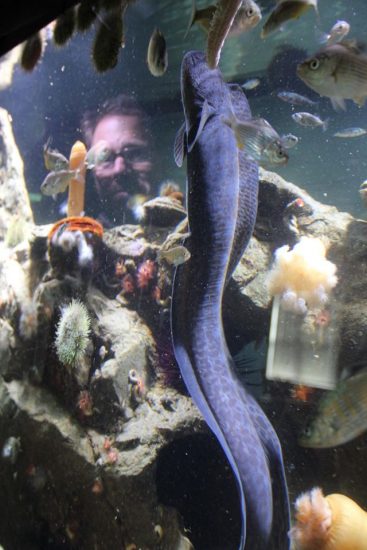
If you’d asked me 10-15 years ago to describe my perfect job, except for the warm and tropical part, I’ve got it. Not only do I get to teach oceanography and marine biology to college students, I get to run an amazing community sized marine aquarium. The MaST Center is a 3,000 gallon aquarium facility for Highline College that not only has college classes but brings in thousands of school kids and thousands of visitors every year. Our small crew of staff and volunteers have done so many amazing things and continue to push the limits.
Can you share a story about a project that worked really well, or a particular student you remember?
Over this fall quarter, as the technical advisor, I am working with the Foss Waterway Seaport and Tacoma Public Schools to articulate a 23 foot gray whale skeleton. We started this project last Christmas, when it was found dead on the beach. Since then, we’ve conducted a necropsy, flensed the meat off, composted the bones, and are now articulating the skeleton. The work is being done by 15 Stadium High School students who during the quarter have talked to an engineer about the structural limitations including a proposed “pose” for the animals, an ethical conversation on whether it should or should not be named, a naturopathic doctor to compare human and whale bones, the lead scientist for the necropsy to help determine why it died. While all of that has been going on, the students are literally putting the whale together.
[Note: Check out The Tacoma News Tribune article on this project]
What are your biggest concerns about the state of marine/aquatic education today?
Most kids have a passion for the ocean but it is limited to whales, sea turtles, and Nemo. My biggest concern and goal is taking that passion and using it to grow them into educated citizens and maybe even a scientist.
You’re a strong advocate for environmental justice. How do you incorporate that into the work you’re currently doing?
Highline College is one of the most diverse colleges in America and serves in South King County one of the most diverse populations. Helping people realize that they are a part of the environment and need to take ownership for their choices is really important. Much of our outreach is focusing on the non-traditional “student”. As a teacher, working with students to explore ideas like internal and external cost. For example last year, one of my classes dug really deeply into a proposed methanol plant in Tacoma which was eventually cancelled before being built.
Do you have any advice for someone starting out in this field?
Build your résumé. My daughter is a sophomore in college where it is easy to get lost especially at the larger schools. Being in the top 10% of a class of 500 students does not stand out. What else have you done? Referring back to the whale, imagine the resume of the Stadium High School students who took all these great classes AND BUILT A WHALE! Get connected with your teachers and professionals as they often know of opportunities that you may not have heard of. Also, find your dream job(s). If you don’t know where you want to be in 10 years, it’s hard to work for that. Even though I’m not looking for a new job and in fact love my job, I have literally over a hundred job descriptions of possible jobs for me in the future. Every time I see a job description that sounds interesting, I save it in my file. Also get on professional organizations and look for their job boards. For example, if you want to work in an aquarium, the Association of Zoos and Aquarium job/internship board has opportunities from all over.
Where do you find inspiration for the work you do?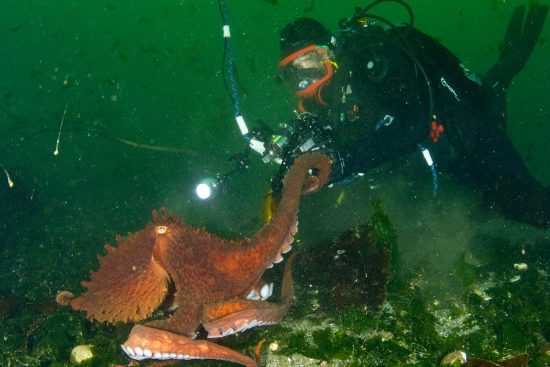
The students are an obvious answer and are some of my biggest inspiration. Seeing them make the connections, seeing them open their eyes to a new thing or way of thinking, is amazing. Also, I try to keep current in the field to help motivate me to continue to push myself.
What is your favorite resource or tool for teaching marine science?
The web has so many real time, global sized resources. One of my new favorite visualizations for the planet is earth.nullschool.net which has a nearly real time model of wind, temperature, ocean currents, etc.
What’s your favorite marine creature?
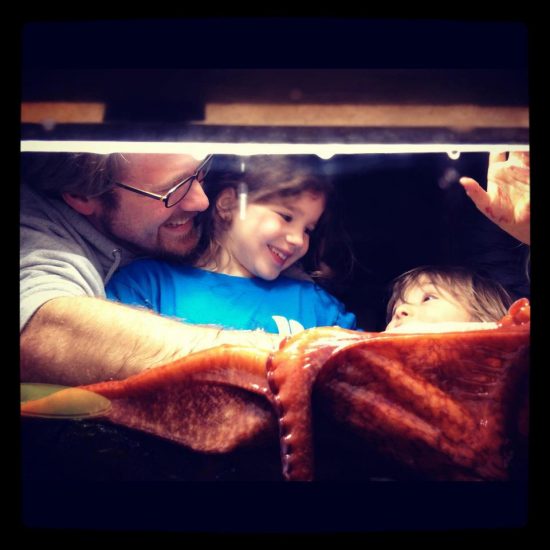
Like a lot of divers in the Pacific Northwest, I love the octopuses. Any dive that finds an octopus is a good dive. At my marine center, we have the opportunity to work with several animals for long periods of time. Watching them grow, learn how to recognize people, and play is amazing. Last year, I even took an octopus to prison for a talk on octopus intelligence. I also generally dive with our octopus during our Octopus Graduation event where we release them back into the Puget Sound and follow them with a streaming camera so the audience can watch real time on the surface. Google “octopus graduation” and you can find some of the old videos.
Where do you go when you want to recharge your batteries?
I’m a river rafter and have been guiding for over 20 years. Getting on the river feeds me. This past August, my wife and I, along with a group of friends, spent 18 days rafting the Grand Canyon. Although a challenging experience, living on “river time” changes the way I look at things.
Do you have a favorite place to visit in the Pacific Northwest?
We love to go camping and two of my favorites are Cape Disappointment which is down by the mouth of the Columbia River and Salt Creek Recreation Area up by Port Angeles. Both feature the ocean but are significantly different environments.
 Are you reading any great books at the moment?
I’m currently working on Energy for Future Presidents by Muller. Although I don’t agree with everything he says, he really works to try to make honest comparisons and has me reevaluating some of my opinions. For example, how does solar power compare to nuclear to natural gas. I’d really love to have a follow up conversation with him because I think he glosses over some of those external costs.
Another favorite is Shell Games by Craig Welch who explores the illegal trade of geoducks here in the Puget Sound area. It’s a factual book that reads like a crime fiction novel.
And finally, who do you consider your environmental heroes?
Rachel Carson whose work Silent Spring played a role in the start of the modern environmental movement. Her science was amazing and her strength to stand up to all the people who thought women can’t be scientists continues to inspire me.
Nowadays, Elon Musk and his push for game changing improvements in alternative energies. We need people to think big.
Thank you for taking the time to talk with us.
Thanks for including me in your great publication. Being recognized for doing the stuff I love is a true honor.
# # #
Open every Saturday from 10 a.m. to 2 p.m. to the public, the MaST Center, mast.highline.edu, is located at 28203 Redondo Beach Drive S.—halfway between Seattle and Tacoma and about 5 minutes south of the main Highline Campus.
Ear to the Ground is a regular feature of CLEARING. Check the website for previous interviews.

