by editor | Dec 18, 2014 | Place-based Education
Phenology Wheels: Earth Observation Where You Live
 By Anne Forbes, Partners in Place, LLC
This article originally appeared in Earthzine – http://earthzine.org/
.
.
 aking a habit of Earth observation where you live is a fun and fundamental way to practice Earth stewardship. It is often our own observations close to home that keep us inspired to learn more and allow us to remain steady advocates for solutions to today’s daunting problems. Earth observation done whole-heartedly becomes skilled Earth awareness that leads to profound relationships with the plants, animals, and seasonal cycles surrounding us in real time, whether we live in the city, suburbs, or countryside.

Courtesy Anne Forbes.
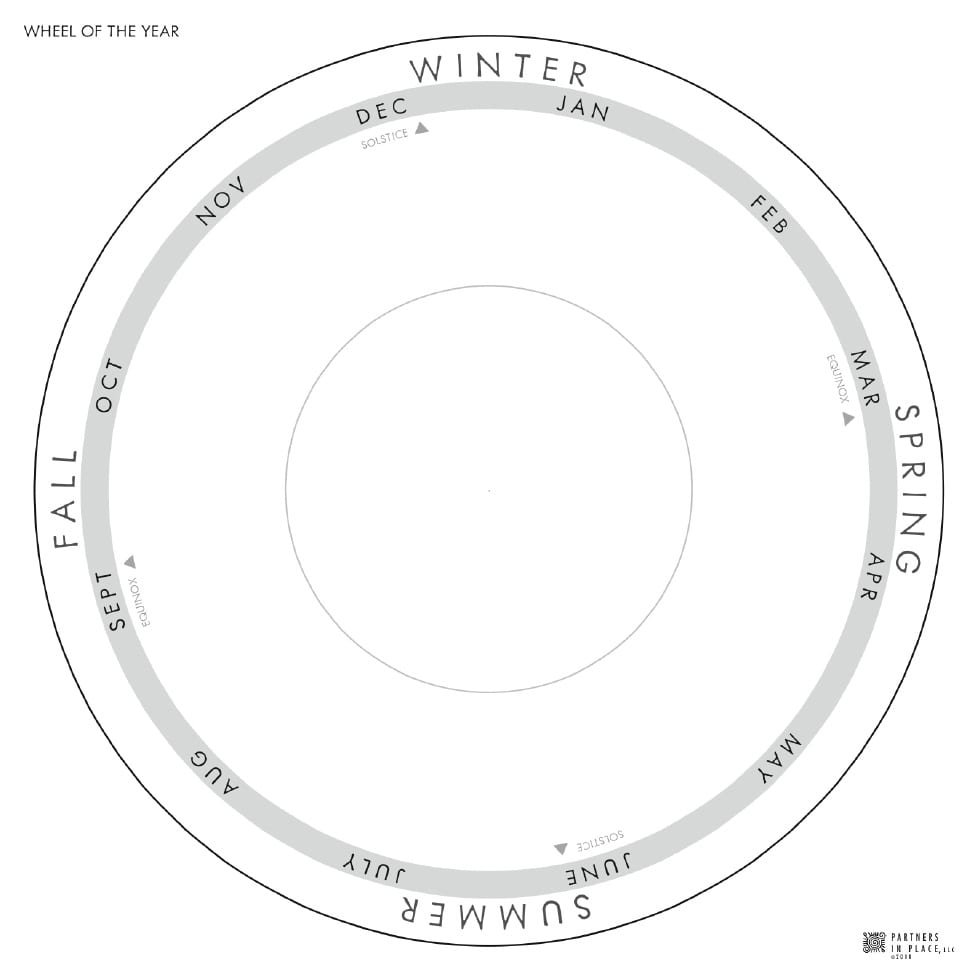
One way to track Earth observations is an activity called Phenology Wheels, suitable for individuals, families, classrooms, youth programs, and workshops for people of all ages. Phenology is a term that refers to the observation of the life cycles and habits of plants and animals as they respond to the seasons, weather, and climate. A Phenology Wheel is a circular journal or calendar that encourages a routine of Earth observation where you live. Single observations of what is happening in the lives of plants and animals made over time begin to tell a compelling story – your story – about the place on our living planet that you call home.
Why a circle? We usually think of the passing of time as linear, with one event following another in sequence by day, by month, by year. Placing the same events in a circular journal, or wheel shape, helps us discover new patterns (or rediscover known ones). We can use the Phenology Wheel to communicate about what is really important or interesting to us.
Here’s the General Idea
A Phenology Wheel is made up of three rings in a circle, like a target. To become a Wheel-keeper, you select a home place, such as a garden, a “sit spot,” schoolyard, watershed, or landscape that will be represented by a map or image in the center ring, the bull’s eye. Next, you mark units of time – such as the months and seasons of a year, hours of a day, or phases of a lunar month – around the outside ring, like the numbers on the face of a clock. Then, as you make specific observations of what is going on in the lives of plants and animals and the flow of seasons, you record them within the middle ring using words, phrases, images, or a combination.
Here’s How To Get Started
Because the wheel is round, you can begin a Phenology Wheel for Earth observation at any time of year.
Although you can pick among different time scales for the outer ring, let’s begin here with a year of seasons and months.

Courtesy Anne Forbes.
1. Draw a set of nested circles on a large piece of paper. You can do this by tracing around large plates or pizza pans, by using an artist’s compass or by making your own compass out of a pencil, pin, and string. You may also purchase a kit of print Wheels or a set of digital PDF Wheels online.
2. If you are making your own Wheel, write the names of the seasons and months on the outer rings.
3. Select an image for the center to represent the place or theme you have selected and to anchor your practice of observation in time and space.
Maps for the Center: If you choose a map, will it be geographically accurate or symbolic? Will it be traced or cut and pasted from an existing map, or will it be a map of your own creation?
Tip: Use a web-based mapping system such as Google Maps to print a map and use it to trace selected features as a base map for your Wheel.
A Centering Image: If you choose an image other than a map, will you create your own image or use one that you find already in print material? Will you use a photo, make a collage, or choose a found object, like a leaf or feather?
Tip: Children often enjoy a picture of themselves at their “sit spot” or other place they have chosen to track their observations.
4. Establish a Routine: Observe → Investigate and Reflect → Record
OBSERVE: What do I notice in this moment? What is extraordinary about seemingly ordinary things? What surprises me as unexpected or dramatic?
then
INVESTIGATE: What more do I want to know about what I observe? What questions will I seek to answer through my own continued observation? What information will I search for in books or from mentors or websites?
and
REFLECT: What does my observation mean to me? How is it changing me? How does it help me explore my values and beliefs?
then
RECORD: A routine of frequent observation provides the raw material to transform your blank Wheel into a circular journal as you record images, symbols, or words as you observe the passing of the seasons in your home place.
Tip: An interactive diagram of this process can be found under the Observe & Record tab here.
5. Share and Celebrate: Use your Wheel to report or tell stories about what you learn from and value about Earth observation in your home place.
Like a wheel on a cart, time turns around the hub of your home place;
the metaphor is a journey taken through a day, a month, a year,
or a lifetime of curiosity and appreciation.
Of course, you don’t have to keep a journal to explore and appreciate your home place on earth and the home place in your heart. What are the dimensions of your home place in this moment? What marks of time’s passing do you observe? The more playful you are with these questions, the more you may feel a part of your home place and committed to co-creating its well-being with others in your community.

Courtesy The Yahara Watershed Journal.
Welcome home.
Example #1: The Yahara Watershed Wheel
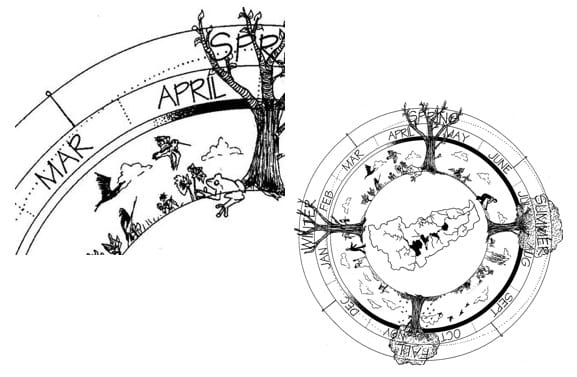
About twelve years ago, a group of like-minded friends gathered by my fireside to reflect upon what it means to live in this place we call home in Dane County, Wisconsin, USA. We chose to think of the Yahara Watershed as our common home place, and the series of seasonal events that occur in a typical year as the time scale to track. We put a map of the watershed in the center of a large Wheel of the Year, with units of time going around the outside rim, much like a clock, but using seasons and months instead of hours. We then went around our own circle, each speaking of the defining moments in the natural world and in the lives of people enjoying it throughout the months of a typical year. The artist among us sketched the images onto the Yahara Watershed Wheel that you see here. The detail in the enlarged image represents the unique happenings in March and April: pasque flowers in bloom, the return of redwing blackbirds and sandhill cranes, woodcock mating dances, first dandelions, and spring peepers in chorus.

Courtesy Anne Forbes.
Example #2: Poems of Place
In reporting on this Wheel filled with seasonal poems by 4th and 5th graders about the large school woods, just outside an elementary school “backdoor” in Cambridge, Wisconsin, teacher Georgia Gomez-Ibanez writes, “Because the woods is so accessible, the children spend quite a lot of time there developing a deep sense of place, including keen observational skills and a heightened imagination, all enhanced by the affection they have gained by years of exploring, learning and stewardship.” This selection of student poems illustrates how Phenology Wheels can be used to enhance language arts as well as science curriculum.
Example #3: Local Biodiversity
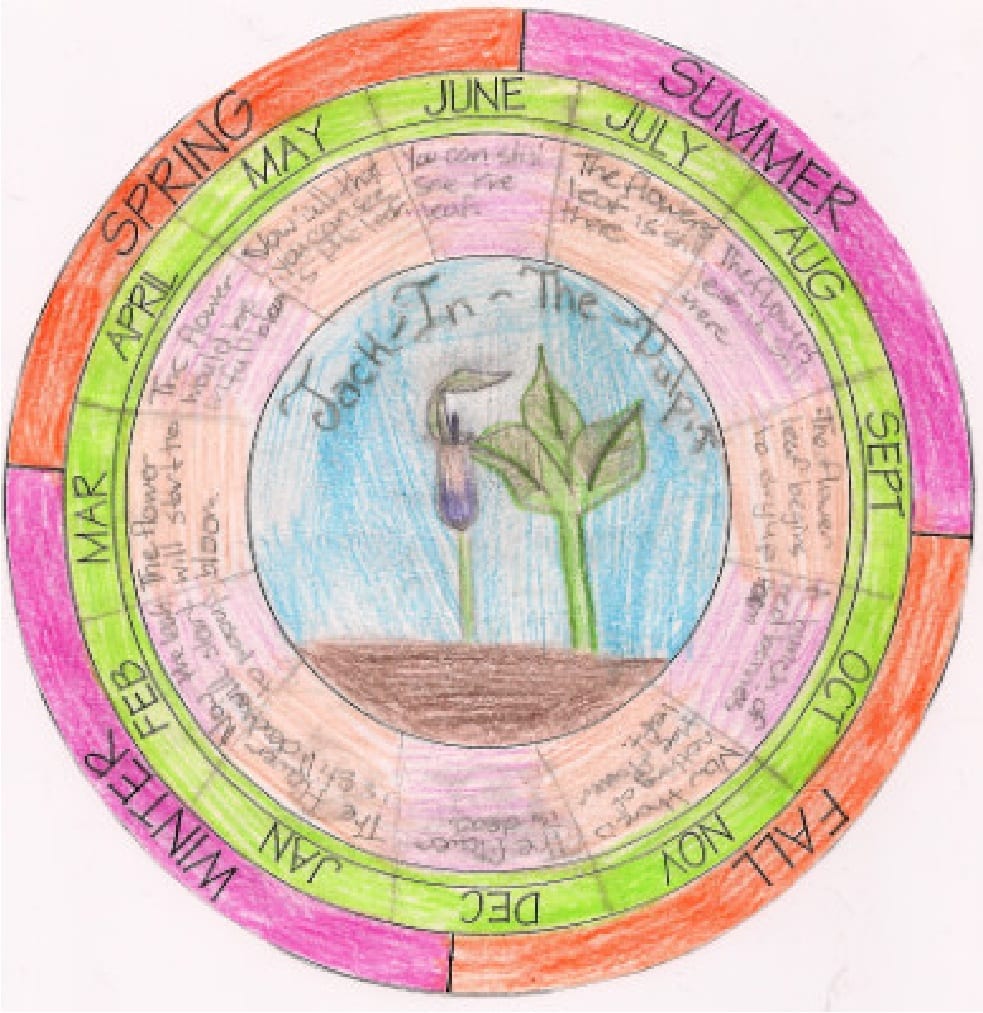
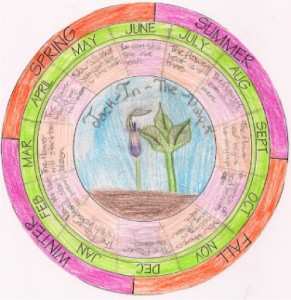
In another example from Cambridge Elementary School in Wisconsin, teacher Georgia Gomez-Ibanez reports that a classroom studied the biodiversity of the area where they live. Each student picked a different animal or plant from their adjacent woods or prairie for the center of an 11-inch Wheel and then did research to tell the full story of the life cycle in words. The example here shows the work of one student who studied the Jack-in-the-Pulpit wildflower.
The next step would be for the students to combine their information for single species onto one large 32-inch Wheel and use it to explore the dynamics of the ecosystem that appear through food webs, habitat use, seed dispersal mechanisms, and so on.
Frequently Asked Questions
Courtesy Anne Forbes.
1. Where do I get more information?
If you are ready to start a Phenology Wheel for yourself, family, classroom or youth program, or any other interest group:
• Visit the Wheels of Time and Place website for instructions, resources, and a gallery of examples.
• Download a curriculum for youth developed in partnership with Georgia Gomez-Ibanez, an elementary school teacher, and Cheryl Bauer-Armstrong, Earth Partnership for Schools, UW-Madison Arboretum.
2. Where do I order pre-made Wheels?
Order the blank Wheel templates as a digital download of PDF files or as a complete toolkit, Wheels of Time and Place: Journals for the Cycles and Seasons of Life. The latter includes a set of print Wheels in 11-inch and 24-inch sizes, a code to download the PDF files, and an instruction booklet – all in a recycled chipboard carrying case.
3. What size should my Wheels be?
Some people prefer 11-inch Wheels because they are compact, portable, and can be easily duplicated in a copy machine on 11 x 17-inch paper. You can trim them down to 11-inch square if you would like.
When people share the 24-inch Wheels, their faces often light up with excitement. This size, or larger, works well if you have a large clip board or a place to keep it posted for frequent use or when people are working on one Wheel in a group.
Of course, if you make your Wheels by hand, you can make them any size you like. If you purchase the PDF files, you can enlarge them up to 32-36 inches at a copy or blueprint shop.
4. What if I’m already a journal-keeper?
Some people who already keep a written journal use the Wheels to review their journals periodically and pull out observations to further explore and put on a Wheel. It’s amazing what patterns and stories can emerge.
5. Can the Wheels be created from databases?
Frank Nelson of the Missouri Department of Conservation has used wheels called Ring Maps, A Useful Way to Visualize Temporal Data to show trends and reveal patterns in a complex set of data.
________________________________
Anne Forbes of Partners in Place, LLC is an ecologist who seeks to integrate her scientific and spiritual ways of knowing. For over 35 years, she worked on biodiversity policy as a natural resource manager and supported environmental and community collaborations as a facilitator and consultant. Her years of spiritual practice in varied traditions, most recently the Bon Buddhist tradition of Tibet, inspire her commitment to engaged action on behalf of present and future generations. She failed her first attempt at retirement and instead created the Wheels of Time and Place: Journals for the Cycles and Seasons of Life.
Contact: anne@partnersinplace.com.
by editor | Dec 18, 2014 | Critical Thinking, Learning Theory, Teaching Science

How Big is Science? Can I Discover its Dimensions?
There is great beauty in thoughts well conceived and clearly expressed.
This is science, when it is skillfully done.
by Jim Martin
CLEARING Associate Editor
(Photo by Jim Martin also!)
When I first taught high school science, I assumed that published curricula would provide reliable instruction for my students. Midway through my first year, it began to dawn on me that this might not be so. The curricula the school used was organized so students studying it would learn about science. This, besides being rather boring, would not do what I expected. I believe students come into my classroom to DO science, to become scientists. A much different process than learning about.
By this time in my career, I had learned that students’ brains could think; all by themselves. Sort of an ‘Oh, duh’ thought, but new to me. What first put me onto this was observing students move from serial to parallel processing as they developed conceptual understandings. That, and reflecting on student frustrations and failures in lab when I assumed that their lab manuals had been written by authorities who “knew.” Thinking about these frustrations and failures revealed to me that students, and many of their teachers, hadn’t acquired the knowledge to comprehend the content as it was laid out in our texts and manuals.
My flag, the whirring that my antennae have learned to make when I’m not being careful about where I’m headed, was the perception expressed by students that, “this is harsh.” I can’t think of a better way to describe it; texts and manuals that were filled with directions and expectations insensitive to where students were at this stage of their educations. And me, expecting them to learn from them as written. The labs, in particular, were replete with concept load, where more than one concept lies embedded in words meant to clarify. What we do to enable our students to learn should never evoke the comments I heard. If we care for our students, and expect them to discover the beauty of our discipline, we should teach effectively. So, I ask, Is empowering students in science something that we can learn to do for practically every student who enters our door?
Science is a product of human endeavor, and can be learned. Look at the good teachers whose students learn to express themselves in competent poetry and art. We can do it in science if we become competent and humane practicioners. This tells me that all of the pedagogical classifications our profession employs – Maslow’s pyramid, hierarchy of cognitive function, inductive/deductive, etc. – reflect expressions of central nervous system function, expressions emergent from our brain at work, and that these underlying neurological processes aren’t as complex as the concepts and classifications we use to describe, understand, and manipulate them.
It takes confidence for a teacher to move from the recitation of facts to the manipulation of concepts in the solution of problems. In fact, examination of this transition provides some useful successive approximations which can be used as signposts to move ourselves from one end to the other on the spectrum. Science engages concepts and processes along with the brain’s mechanisms for generating critical thinking and learning for understanding. While complex to address individually, they all come into play when you do science. Just as similarly complex combinations of concept and process come into play together in painting an image, writing a poem, swishing a three-pointer, or playing a long, slow, syncopated sax line.
How do you prepare your students to engage in self-directed inquiries in the environment, while also preparing them to take standardized tests on the content they are expected to cover? A good first step is to prepare yourself. We can start by looking at what teaching inquiry looks like along a developmental continuum from fully teacher-centered to fully student-centered; a line with particular dimensions. The names of the stages along the continuum describe its dimensions, and the time to learn to express each dimension is the length of a particular piece of the continuum. Let’s picture different ways you might execute a streambank restoration project, and develop our continuum along that process.
There is a creek about four blocks from your school, and you have learned that the city wants to restore a section of its bank for a wildlife observation park. When you inquire, you find that part of the project involves planting native riparian trees. How might you exploit this as an opportunity? Let’s say you begin this work at what I’ll call the Fully Teacher-Centered level, in which you instruct the class on the project, show them how to plant the cottonwood cuttings you will be using, and have them set up pots and plant their cuttings in them. You will show them how to measure the cuttings’ growth, and graph their data. Typical teacher tells, students do, classroom learning. During all of this work, you have been attempting work in which you have little or no experience, especially in involving students in work outside the classroom.
You can begin to move toward the next phase, the Introducing Student-Centered level, by finding ways to make the activity, while it is not student generated, become relevant to them and enables your students to feel that this new learning is important to them. You can do this by engaging them in selecting learnings they would like to attempt. Let’s say one student, when planting her cutting, asks which end goes into the ground. A tough question if you’re not a botanist, which I am not. So, you suck it in and respond, “I don’t know. How can we find out?” (The most beautiful words a teacher can utter!) What happens next is up to your students. They’ll answer their question, and you’ll have grown at least another inch and a half in stature.
In this stage, you and your students will become aware of your need to learn more about the community outside the classroom. You might have already involved them in work outside your classroom organized by a local environmental education organization. You make sure your students have practiced the work they will do before going out in the field. And you might find yourself looking for other teachers who take their classes out into the field, and helped them become active members of effective work groups. In this stage, you still rely on other knowledgeable people, especially environmental educators, to facilitate your work.
Another thing to look for, and in future expect, is students who begin to see their role in making field work eminently doable. Students who are involved and invested in the work, and empowered as persons. They will become partners with you in planning and doing the work; and, in doing the learning and research to comprehend what they have discovered.
If you continue this work, you will find yourself at the next level, the Teacher:Student-Centered Level, where you and your students collaborate on the project from its initial conception to the final product. You initiate projects, and then include your students in designing and doing the project. You are experienced now in involving students in work outside the classroom and exploiting the curricula embedded there. Student work groups know what to do and how, and practice tasks before going into the field. You know how to design, organize, and implement the work, and to integrate the field work with curriculum. The results of their field work are brought back to the classroom by the class for discussion and follow-up work.
As you continue in this work, you will find yourself working at the Fully Student-Centered Level. You have a set of partners in the community whom you work with to design, develop, and execute projects in the community, and to tie them to your classroom curricula. You work closely with your students to plan field work and classroom followup. Students are organized into effective work groups who, working together, have developed the skills to carry out their field work, are involved and invested in their work, reach out to help others in their groups, communicate effectively, and can be counted on to make sure their equipment and materials are ready to go. You facilitate this by maintaining effective contact with your partners and agencies. You have eyes out for opportunities to expand your network, while ensuring you don’t overextend yourself.
It is surprising how little it takes to move a teacher from the textual delivery of facts and information to the contextual delivery of understanding. Experience in initiating, doing, and communciating self-directed inquiry is a key piece of the puzzle. In spite of this effort, and most school science is taught from texts, standardized labs, and worksheets. In time, teachers will be the decision-makers in their schools, and schools will become dynamic centers of learning. In the meanwhile, we have to do the best we can to teach well and let others know what we’re doing.
Science has many dimensions. We’ve begun to enter a discussion of the amount of structure we impose upon our students’ efforts, and the amount of structure we build into our approach to meeting students’ needs. As with any kind of learning, we expect the learners to move from dependence on instruction to independent activity. Do we, in our classrooms, allow that? Do we allow this for ourselves?
 This is a regular feature by CLEARING “master teacher” Jim Martin that explores how environmental educators can help classroom teachers get away from the pressure to teach to the standardized tests,and how teachers can gain the confidence to go into the world outside of their classrooms for a substantial piece of their curricula. See the other installments here, or search Categories for “Jim Martin.”
by editor | Dec 9, 2014 | Indigenous Peoples & Traditional Ecological Knowledge
 Ecological Métissage: Exploring the Third Space in Outdoor and Environmental Education
By Greg Lowan
An increasing number of scholars, both Indigenousi and non-Indigenous, are asking, “Is it possible to blend Western and Indigenous North American ecological philosophies and knowledge?” Indeed, many scholars and educators, such as the late Nakoda Chief John Snow (1977–2005), suggest that the future success of our society will require the combined wisdom of Aboriginal and non-Aboriginal cultures.
Eminent Tewa scholar and educator Gregory Cajete (2001) relates the story of one of his family members who has a “split head”. This family member is of mixed Euro-American and Indigenous Tewa ancestry and often feels split between the two cultures. Cajete suggests that many people in our predominantly Western society built on the Indigenous territories of Turtle Island (North America) also have a split head; our sociocultural and geographical identities are often disjointed. John Ralston Saul (2008) provides a related view when he suggests that Canadians have forgotten (or been led to forget) the foundational Aboriginal aspects of our culture and languages, resulting in an incomplete national sense of self. Cajete proposes that the ultimate task at hand is to recognize this and find ways to heal the split head of our collective society, blending the best of Western (and other) and Indigenous cultures to create a unified whole.

Figure 1. The Third Space. The Third Space makes some people uncomfortable because “hybridity problematizes boundaries” (Pieterse, 2001, p. 220)
In response to these kinds of concerns, Métis scholar Catherine Richardson (2004, p. 16) introduces the concept of the “Third Space” as the existentially blended territory of a Métis mentality. She compares this to the “First Space” of the dominant Euro-Canadian society and the “Second Space” of colonially subjugated Aboriginal peoples. However, during a recent conference presentation, one audience member astutely pointed out to me that the First Space here on Turtle Island was, in fact, Aboriginal, followed by the European Second Space, which resulted in the Third Space of the Métis (see Figure 1, below). The Third Space is a place where Western, Aboriginal and other cultural beliefs, philosophies, values and knowledge intersect, cohabit and intermingle (Richardson, 2004).
. Zembylas and Avraamidou (2008) propose that challenging this further opens up the Third Space. Pieterse suggests that hybridity involves recognizing the “in-betweens” and “interstices” (p. 238) and pushes us beyond false dualistic conceptions of culture and race. According to Pieterse, the Third Space requires “collective liminality, collective awareness” (p. 239) similar to the Trickster knowledge celebrated in many Indigenous cultures. Finding the Third Space involves collectively embracing a hybrid or Trickster consciousness.
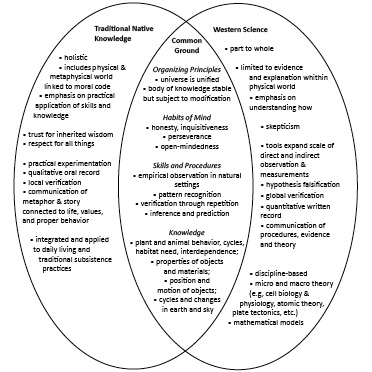
Figure 2 . Finding common ground betweenWestern science and Indigenous knowledge (Barnhardt and Kawagley, 2005).
Alaskan scholars Ray Barnhardt and Oscar Kawagley (2005) provide the illuminating Venn diagram below to compare and contrast Western and Indigenous approaches in search of common ground. From their diagram we can see that there are indeed many similarities between Western science and Indigenous knowledge of nature. Concepts such as a unified universe; personal qualities such as perseverance, curiosity and honesty; empirical observation of nature; and a desire to understand the behaviour and patterns of plants, animals and other natural phenomena are common to both traditions.
Aikenhead (2008) uses the Ancient Greek terms “episteme” and “phronesis” respectively to describe Western science and Indigenous knowledge. He defines episteme as thinking focused on how the world works and phronesis as practical wisdom- in- action. Baumard (1994) defines phronesis as a blend between “techne”, which is practical knowledge, and episteme. However, he also suggests that the Greeks actually recognized four dominant forms of knowledge: episteme (theoretical or philosophical knowledge), techne (practical knowledge), phronesis (theoretically informed practice) and “metis”ii (oblique or intuitive knowledge), a term etymologically related to the Latin “mixtus”, meaning mixed, which is the root of modern terms such as “métissage” (Dolmage, 2009). Baumard suggests that while episteme, techne and phronesis have been widely recognized and preserved in Western history, metis (pronounced “meh-tiss”) was suppressed and ignored until Détienne and Vernant’s (1974, 1991) seminal efforts in its recovery. As a Métis person, I find the etymological, epistemological and ontological implications of metis as a way of understanding and being in the world deeply intriguing.
Metis as a form of knowledge was suppressed in Western history for various reasons. Dolmage (2009) suggests that metis wasn’t widely recognized for the past two thousand years because of its associations with femininity embodied in the form of the goddess Metis, one of Zeus’s wives and the mother of Athena. Détienne and Vernant (1974, 1991) also propose that metis has been suppressed throughout Western history because of its association with animals and nature. Examples of metis in Greek mythology and philosophy often involve the dolos (tricks or ruses) of animals like the fox, the octopus or the squid, which is able to turn itself inside out. In their concluding chapter, Détienne and Vernant (1974, 1991) suggest that:
In studies of the Greeks pursued by scholars who claim to be their heirs, there has been a prolonged silence on the subject of the intelligence of cunning [metis]. The fundamental reasons for this have been two-fold. The first is perhaps that, from a Christian point of view, it was inevitable that the gulf separating men from animals should be increasingly emphasized and that human reason should appear even more clearly separated from animal behaviour than it was for the ancient Greeks. The second and even more powerful reason is surely that the concept of Platonic Truth, which has overshadowed a whole area of intelligence with its own kinds of understanding, has never really ceased to haunt Western metaphysical thought. (pp. 318–319)
The oblique, intuitive and subtle boundary-crossing characteristics of metis as a way of knowing and being in the world could be considered as a more flexible alternative to the absolutist legacy of Platonic thought that is reflected in the single-culture nationalism of, for example, many European nations and the United States (Saul, 2008). This idea might prove illuminating in our search for the Third Space between Western and Indigenous knowledge and wisdom.
Two-Eyed Seeing—viewing the world simultaneously through both Western scientific and Aboriginal lenses to form a focused and unified vision—is another theory developed by Mi’kmaq Elder Albert Marshall (Lefort and Marshall, 2009).
Concepts such as the Third Space, healing the split head, Two-Eyed Seeing and metis provide a compelling theoretical basis for exploring intercultural environmental ethics and education. I use the term “ecological métissage” to collectively describe these concepts. The concept of ecological métissage arises from Thomashow’s (1996) description of “ecological identity” as the way that we understand ourselves in relation to the natural world and an understanding of “métissage” as a mixing or blending often associated with culture or ethnicity (Pieterse, 2001). Therefore, ecological métissage denotes a blending of two or more ecological world views in personal identity, philosophy and practice. The following explores examples of ecological métissage in practice.
Intercultural outdoor and environmental education is a growing field of practice with a limited but growing body of literature. Many organizations across Canada and around the world are currently delivering programs designed to bridge cultures. While some programs aim to share Indigenous knowledge with Indigenous students only, others are open to both Indigenous and non-Indigenous students. Other programs also attempt to blend Indigenous knowledge with modern scientific approaches, seeking the previously discussed Third Space. The following is a brief review of a selection of programs and key scholars in these areas. One study that I first encountered during my master’s research (Lowan, 2008, 2009) was Takano’s (2005) description of a community-developed land -based cultural education program based in Igloolik, Nunavut. Takano, a researcher of Japanese descent, participated in Paariaqtuqtut, a 400 kilometre journey through the community’s ancestral territory in May 2002. Paariaqtuqtut means “meeting on the trail” in Inuktitut and was developed by a group of community members and Elders. Paariaqtuqtut aims to connect young people with cultural skills and teachings in a land-based context. Takano (2005) found that community members in Igloolik were concerned that many youth were losing connections with their land and culture. Those interviewed observed that this leads to youth feeling lost between two worlds, disconnected from their community and culture, yet unprepared to live in the Western world. Takano also recorded the experiences of several participants who felt that Paariaqutuqtut had helped them to reconnect with their land and culture.
David Lertzman (2002) and Thom Henley (1989) provide descriptions of the Rediscovery program. Rediscovery programs have been founded across North America and around the world in various forms. Some are very small and focused on one particular Aboriginal community while others, such as Ghost River Rediscovery (Lertzman, 2002) in Calgary, are large, year-round programs. Ghost River Rediscovery is based on local Indigenous traditions and welcomes students of all ages from all cultural backgrounds. I have had the wonderful opportunity to volunteer with them on several occasions. Henley (1989), one the program’s original founders, states, “Rediscovery brings together people from many different racial backgrounds . . . . When people from different races have the opportunity to talk to one another, to work and play together, then inevitably they begin to learn about each other’s lives and cultures” (p. 35).
As previously mentioned, a recent issue of Green Teacher (Fall, 2009) focused on Mik’maq Elder Albert Marshall’s concept of Two-Eyed Seeing. Several programs embodying Two-Eyed Seeing were profiled. For example, Hatcher and Bartlett from Cape Breton University’s Integrative Science program (2009a, 2009b; Bartlett, 2009) describe units that they developed on various subjects, such as birds, traditional medicine and astronomy, for high school students. In their units they attempt to integrate Western science with Mi’kmaq knowledge and philosophies of nature. They recognize that truly blending Western and Indigenous approaches is a challenging task for educators.
Further examples of inspiring Two-Eyed Seeing programs are provided in the same issue of Green Teacher. Métis educators Deanna Kazina and Natalie Swayze (2009) relate their experiences with “Bridging the Gap”, an inner-city program in Winnipeg that works with both Aboriginal and non-Aboriginal youth. Bridging the Gap strives to integrate Western and Aboriginal approaches to learning about the natural world. Based on their description and another article by Swayze (2009) in the Canadian Journal of Environmental Education, it appears thatthey are experiencing success. Kazina and Swayze instill genuine cultural awareness in their students through lessons such as how to offer tobacco and how to respectfully approach the Elders who are a strong part of their program.
Gloria Snively (2009) also relates her experiences as a long-time teacher-educator at the University of Victoria interested in what she calls “cross-cultural science”. She uses a lesson on dentalium, a shell traditionally used as money by Indigenous people across North America, as a vehicle for discussing Two-Eyed Seeing. Snively observes:
Cross-cultural science education is not merely throwing in an Aboriginal story, putting together a diorama of Aboriginal fishing methods, or even acknowledging the contributions Aboriginal peoples have made to medicine. Most importantly, cross-cultural science education is not anti -Western science. Its purpose is not to silence voices, but to give voice to cultures not usually heard and to recognize and celebrate all ideas and contributions. It is as concerned with how we teach as with what we teach. (p. 38)
While there is a growing body of literature on intercultural outdoor and environmental education in Canada, no comprehensive studies to date have focused on the experiences and competencies of intercultural outdoor and environmental educators and the deeper societal implications of their work. Who are these “border crossers” (Hones, 1999; Nguyen, 2005; Pieterse, 2001)? What led them to their chosen vocation? What makes them effective? And how might they be reshaping Canadian ecological identity? Why is this important? These are the kinds of questions that I am currently addressing in interviews with contemporary intercultural outdoor and environmental educators as part of my doctoral research.
i Cultural terms, such as Indigenous, Aboriginal, Western, and Elder, have been intentionally capitalized as a sign of respect. ii In this article “Métis” refers to Métis people, while “Metis” will be understood as a figure from Greek mythology, with “metis” denoting a recognized form of knowledge in ancient Greek society.
References
Barnhardt, R., & Kawagley, A. O. (2005). Indigenous knowledge systems and Alaska Native ways of knowing. Anthropology and Education Quarterly,36(1), 8–23.
Bartlett, C. (2009). Mother Earth, Grandfather Sun. Green Teacher, 86, 29–32.
Cajete, G. (2001). Indigenous education and ecology: Perspectives of an American Indian educator. In J. A. Grim (Ed.), Indigenous traditions and ecology: The interbeing of cosmology and community. Cambridge, MT: Harvard University Press.
Detienne, M., & Vernant, J. P. (1974). Les ruses de l’intelligence: La mêtis des Grecs.Paris: Flammarion. Detienne, M., & Vernant, J. P. (1991). Cunning intelligence in Greek culture and society. Trans. Janet Lloyd. Chicago: U of Chicago Press.
Dolmage, J. (2009). Metis, mêtis, mestiza, Medusa: Rhetorical bodies across rhetorical traditions. Rhetoric Review, 28(1), 1–28.
Hatcher, A., & Bartlett, C. (2009a). MSIT: Transdisciplinary, cross-cultural science. Green Teacher, 86, 7–10. Hatcher, A., & Bartlett, C. (2009b). Traditional medicines: How much is enough. Green Teacher, 86, 11–13.
Henley, T. (1989). Rediscovery: Ancient pathways, new directions, outdoor activities based on native traditions. Edmonton: Lone Pine Publishing.
Hones, D. F. (1999). Making peace: A narrative study of a bilingual liaison, a school, and a community. Teachers College Record, 101(1), 106–134.
Kazina, D., & Swayze, N. (2009). Bridging the gap: Integrating Indigenous knowledge and science in a non-formal environmental learning program. Green Teacher, 86, 25–28.
Lefort, N., & Marshall, A. (2009, May). Learning with the world around us: Practicing two-eyed seeing. Paper presented at the 5th World Environmental Education Congress, Montreal, PQ.
Lertzman, D. (2002). Rediscovering rites of passage: Education, transformation, and the transition to sustainability. Ecology and Society, 5(2): Article 30.Retrieved February 27th, 2007 from http://www.ecologyandsociety.org/ vol5/iss2/art30/ Lowan, G. (2008). Paddling tandem: A collaborative exploration of Outward Bound Canada’s Giwaykiwin Program for Aboriginal youth. Pathways: The Ontario Journal of Outdoor Education, 20(1), 24–28.
Lowan, G. (2009). Exploring place from an Aboriginal perspective: Considerations for outdoor and environmental education. Canadian Journal of Environmental Education, 14,42–58.
Nguyen, N. H. C. (2005). Eurasian/Amerasian perspectives: Kim Lefevre’s Métisse Blanche and Kien Nguyen’s The Unwanted. Asian Studies Review, 29,107–122.
Pieterse, J. N. (2001). Hybridity, so what?: The anti-hybridity backlash and the riddles of recognition. Theory, Culture & Society, 18(2–3), 219–245.
Richardson, C. L. (2004). Becoming Metis: Therelationship between the sense of Metis self and cultural stories. Unpublished doctoral dissertation, University of Victoria, Victoria, BC.
Saul, J. R. (2008). A fair country: Telling truths about Canada. Toronto, ON: Penguin Group.
Snively, G. (2009). Money from the sea: A cross-cultural Indigenous science activity. Green Teacher, 86, 33–38. Snow, J. (2005). These mountains are our sacred places. Calgary, AB: Fifth House.(Original work published 1977).
Swayze, N. (2009). Engaging Indigenous urban youth in environmental learning: The importance of place revisited. Canadian Journal of Environmental Education, 14, 59–72.
Takano, T (2005). Connections with the land: Land-skills courses in Igloolik, Nunavut. Ethnography, 6(4), 463–486. Thomashow, M. (1996). Ecological identity. Cambridge, MA: MIT Press.
Zembylas, M., & Avraamidou, L. (2008). Postcolonial findings of space and identity in science education: Limits, transformations, prospects. Cultural Studies in Science Education, 3, 977–998.
Greg Lowan is a proud member of the Métis Nation of Canada. He is currently a contract lecturer of Aboriginal Education at Lakehead University and a PhD candidate in Educational Contexts at the University of Calgary. This research is supported by the Social Sciences and Humanities Research Council of Canada (SSHRC), the Killam Trust and the University of Calgary. This article originally appeared in Pathways: The Ontario Journal of Outdoor Education 2010, 23(2).

by editor | Nov 20, 2014 | Outdoor education and Outdoor School
In Support of Outdoor School
By Merrill Watrous
“I not only learned about ghost shrimp and how to catch them, I did catch them. I not only learned what a chitin was and where it lived, I went out to where it was and petted it. Almost everything (at Outdoor School) was one step ahead of regular school. With the songs around the campfire there were just as many emotional parts as there were educational parts. I feel like I left a better person, more aware of the environment.” (Nick, age 11)
Petting an animal, singing around a campfire, and learning how to care for the environment — the value of these activities is not easily assessed according to current standards and benchmarks. I can provide no statistical evidence with this article to prove that the students who spent a week with me at Outdoor School scored higher on later standardized tests the next year than their peers did. However, research does indicate that integrating the curriculum around topics in environmental education is a powerful way to teach. The arguments I will present here in support of continuing to fund outdoor education are largely anecdotal, based in part on the words of children like Nick who were themselves changed by the experience.
How did Nick become a better person through Outdoor School? It is important to determine this for he was not alone in feeling transformed by it. To prepare for Outdoor School, we first read and wrote about the natural world. In public French immersion schools in both Canada and the United States, teachers often share students but not curriculum. Outdoor School brought me closer to my teaching partner because we became engaged with the same curriculum as well as with the same students. It brought my students closer to one another because they ate, slept, worked, and played in close proximity twenty-four hours a day. It brought teachers and parents closer to one another because we met often to organize transportation and materials before leaving. It transformed us all because, through the Outdoor School experience, we came together as a more cohesive community.
Loving the Science
Like Nick, Matthew loved Outdoor School and when he wrote to me about it later, he couldn’t help but enumerate all that he had learned.
“I learned about biodiversity, the amount of compressed oxygen in salt and fresh water, the inhabitants of the tide pools, the secrets of the estuary, the names of plants like salal and fruiticas lichen, and about mixed, diurnal, and semidiurnal tides.”
Matthew enjoyed the company of his classmates and the beauty of his surroundings but what made the week work for Matt was the science. Classroom science kits may have helped him to understand some of the basic principles of science back at “regular school,” but no lab could compare with the estuary as a learning environment.
Character Education
One child who was less sure than Matt that he liked Outdoor School wrote about his character growing in spite of himself. Children, like adults, realize that sometimes we learn the most from experiences that challenge us. We spend a substantial amount of money in schools today in the United States on programs devoted to preventing violence through “character education.” If Outdoor School for my students was a place where they felt themselves becoming better people, a place where they felt themselves growing as human beings, perhaps this is one place we need to invest time and money.
We all took with us to Outdoor School for the week only what we needed to stay warm and relatively clean. Each child wrapped his or her belongings in black plastic garbage bags to keep it all dry as we took the barge across the estuary to the camp site. As simple as these bags were to pack, they were heavy to carry, and right away the strongest children began to help the weaker ones as we hiked up and down the dunes on our way from the landing dock to the cabins. After awhile, we got to know our cabin-mates from different schools and a few of our neighbors shared with us the fact that a store in their small rural Oregon community had chosen to make a gift to the class of garbage bags to take to Outdoor School. “Free garbage bags- what kind of gift is that?” I watched my students thinking, students who had never before in their lives had to consider where the money comes from to purchase such necessities as garbage bags. I was humbled myself when later on that first night another teacher shared with me how hard she’d worked to find enough warm and water-resistant coats for her students to wear to Outdoor School. (Every one of my children arrived at school regularly with a warm coat on a cold day.) At various times during that Outdoor School week, the children and I were humbled and inspired not only by the beauty and majesty of the wilderness around us but by the courage and determination of our bunkmates.
Learning to Conserve
Without television or video games to distract us, we shared time, materials, and our food with one another. Child after child wrote about the “great food!” at Camp Westwind. (The menu featured such gourmet kid fare as chicken nuggets, mac and cheese, and PB and J sandwiches.) At mealtimes, we passed bowls of food and pitchers of milk from child to child, bowls and pitchers that could be refilled as needed. What was left at the end of the meal on the plates of the children and their teachers, however, had to be thrown on the compost pile after it was weighed, measured, and recorded: every day and at every meal. As the week went on and campers began to realize how much they’d been wasting, food waste was reduced by 90%. I watched children serve themselves applesauce an eighth of a cup at a time, gauging their hunger carefully before putting anything extra on their plates. Students not only learned to conserve food, they also learned to be responsible for their own possessions. At the end of each meal, we sang together, and staff members who had combed the beach and the woods for “lost” personal items earlier offered these items in song for reclamation. It was all done with a sense of humor, but it helped us to learn to be more responsible stewards of our possessions.
Funding Outdoor Education
When deciding whether to fund Outdoor School experiences in the future, we need to think about what we value as teachers and parents. Do we value teaching science in an integrated fashion so that we can maximize the number of students we engage? Do we value teaching students to be environmentally conscious in a way that will stick with them? Do we value teacher-to-student and student-to-student relationship building? If as teachers these are among our core values, then we need to see Outdoor School as something worth fighting for in the face of budget cuts.
Tokens and Rewards
I found Outdoor School to be a nourishing experience personally; I took away from it at least as much as it took from me. I remember buying quickly and thoughtlessly the day before we left a little packet of camping-themed stickers. I handed them over to the Outdoor School Principal at Camp Westwind on our first night so that all of the children participating in camp could “enjoy” them equally as journal decorations. She received them graciously from me and returned them just as graciously, unused, to me at the conclusion of camp. The anti-consumerist message of the camp staff was both consistent and heartening; there was no place within it for something as useless as stickers.
Individual efforts and team efforts were recognized from time to time at camp — not with stickers but with a song or with a “gift-loan” of a feather or a rock of unusual beauty to admire. The children learned to replace these feathers and rocks in the spots where they had first been found after admiring them. We spent hours creating sand sculptures in teams and then reduced them all to “sand rubble” in order to leave the beach as we had found it in its pristine condition before leaving camp. Returning the beach to its natural state was fun and it was exercise. We were moving all the time at Camp Westwind, and most of the children reveled in well-earned feelings of physical fatigue at the end of the day. They even complained pridefully about the hardships of camp.
Alex wrote,
“The cold hard beds, the early hours, and the long, tiring hikes. These are the reasons I liked Outdoor School. The early hours let you hear the birds chirping in the morning. At the end of the long hikes there was always a beautiful view. And the beds . . . well, there was nothing so great about the beds.”
There’s nothing so great about fundraising for activities like Outdoor School when public funds dry up, either, but it would not be easy to set a price on what my students learned at Camp Westwind. As Alex put it, the view at the end of the day IS spectacular. I’ll never forget it, or the children who shared its beauty with me.
Merrill Watrous taught Foundations of Education seminars and supervised teaching practicum students through the Cooperative Education Department at Lane Community College. Prior to that, she taught graduate level courses in writing for Pacific University and fifth grade at a language immersion school. She has also taught grades K, 1, 3, and 4 and middle school writers. She is the author of one book on the teaching of writing and art and numerous articles for such magazines as Learning, Instructor, Mailbox, California and Oregon English, Writing Teacher, Techniques, The Magazine of American History and others. She can be reached at Watrousm@lanecc.edu.

by editor | Nov 20, 2014 | Gardening, Farming, Food, & Permaculture
Can School Gardening Help Save Civilization?
(An Essay in Four Parts)
by Carter D. Latendresse
The Catlin Gabel School
Abstract
This paper is an argument for gardening in schools, focusing on two months of integrated English-history sixth grade curriculum that explores the relationships between a number of current environmental problems—notably hunger, water scarcity, topsoil loss, and global warming—and the land-use practices that led to the downfall of ancient Mesopotamia. This paper suggests that world leaders today are repeating some of the same mistakes that caused desertification to topple the Sumerian empire. It then explains how our sixth grade class explores solutions to the existing emergencies by studying Mesopotamia, ancient myth, gardening, and contemporary dystopian fiction. Finally, this paper posits a new cosmology that might help to remake western civilization, saving it from the threat of present-day ecological crises.
Why Garden in School?
Part I: Four Enduring Understandings
During the fall months in my 6th grade English class, I teach gardening, ancient flood stories, contemporary dystopian literature, and ancient Mesopotamia. My colleagues and I ask our students to look backward to identify essential characteristics of the first human civilizations, so that they might look forward and imagine remaking Western civilization in the 21st century. During these lessons, my history teacher partner focuses on the development of agriculture in the Neolithic Age (8000 BCE to 3000 BCE), the rise of Sumerian city-states, the four empires of Mesopotamia, and the characteristics of ancient civilizations. In my English class, my curriculum parallels and interweaves with these topics at crucial points, especially around issues of soil, water, food, climate, environmental justice, and the stories we tell ourselves as humans to orient ourselves to Earth, to one another, to the other animals, and to the cosmos. Sixth grade students and teachers at our school can often be found outside during September and October, harvesting apples, grinding wheat, learning about bee keeping, planting overwintering lettuce, or baking pita bread in the garden cob oven. Several people have asked, “What does the garden have to do with English or history class?” or “Why do you garden in school?” This essay is an attempt to answer these questions.
The sixth grade teaching team begins its unit from the principles enunciated in the seminal curriculum design text, Understanding by Design, by Grant McTighue and Wiggins (2005). The authors show that the best teaching is, paradoxically, in preparation for college while it is also, at the same time, as John Dewey (1897) says, part of an informed “process of living and not a preparation for future living” (Article Two: What the School Is section, para. 2). We strive to present riveting, relevant, future-thinking curriculum that is rooted in solving the problems and celebrating the wisdom that exist today. The problem-based teaching with a backward design process outlined in Understanding by Design offers us a good model on how to remain, simultaneously, college preparatory and focused on today’s most pressing issues. The garden is our place of intersection for the teaching of ancient history, the novel, writing, economics, politics, anthropology, religion, myth, and science. Pedagogically, we have nine reasons for teaching the Sumerian empire in our organic garden behind the middle school building. These nine reasons grow up out of the four enduring understandings we want our students to chew on for the rest of their lives.
The first enduring idea or understanding is that the aims and desires of most people on Earth have been fundamentally similar since hunter gatherers first domesticated crops and animals in Iraq 10,000 years ago, and we can empathize with those people because we too desire, at bottom, the same things, which are connection and belonging. As humanities teachers, we do not present what some might term a traditional history curriculum to our students that focuses on names, dates, generals on battlefields, or famous men elected president. Such a presentation presupposes that the victors of confrontations make history, and that conflict, violence, and the will to power are the unconscious driving impulses scaffolding the metanarrative of the human species. Instead, influenced by new scholarship focusing on empathy, mirror neurons, the lives of women, the colonized, and ordinary people throughout history, we begin by asking, Whose stories get left out of history, and why? We unearth representative stories that could stand for the great silent majority of human history, and we presuppose, along with Jeremy Rifkin (2009, p. 9-26), that the deepest unconscious desires of Homo sapiens include companionship in towns that provide nutritious food, clean water, and safe homes for our children. By studying Mesopotamia, we get a snapshot of people putting these desires into action when they created the world’s first cities.
Our second enduring idea that we want our students to return to throughout their lives is that there exists today a phalanx of interwoven problems facing the human species—global warming, hunger, biodiversity loss, deforestation, poverty, water scarcity, topsoil depletion, each of which is exacerbated by overpopulation. While these global issues may feel both overwhelming and unapproachable, during the autumn of the sixth grade year, we teach that several of these problems are causal, one giving way to the other, and all have their roots in practices one can find in Mesopotamia. Such practices included clearing the land of trees, erecting massive irrigation systems, then farming monocultures, which led to erosion, then desertification, and then later empire collapse.
Ten years ago, Time magazine, in its August 26, 2002 edition, released a Special Report entitled How to Save the Earth. “Up to a third of the world,” the authors noted, “is in danger of starving. Two billion people lack reliable access to safe, nutritious food, and 800 million of them—including 300 million children—are chronically malnourished” (Dorfman & Kluger, 2002, p. A9). The authors also presented startling statistics on water scarcity: “At present 1.1 billion people lack access to clean drinking water and more than 2.4 billion lack adequate sanitation. ‘Unless we take swift and decisive action,’ says [then] U.N. Secretary-General Kofi Annan, ‘by 2025, two-thirds of the world’s population may be living in countries that face serious water shortages” (Dorfman & Kluger, 2002, p. A10). Whereas Time magazine did not then connect the dots on the ecological problems it investigated, other writers since that time have.
J.R. Rischard’s (2002) High Noon was similarly foreboding but more thorough. The former vice-president of the World Bank gave us twenty years to address twenty pressing and mutually destructive environmental concerns such as global warming, deforestation, biodiversity loss, fisheries depletion, and water shortages. One wonders how far we’ve come in half our twenty years. Joining the chorus, the eminent historian Jared Diamond (2005) likewise proposed, in his book Collapse, his own list of eleven similar and overlapping ecological problems that require immediate attention: problems such as—pardon the repetition—deforestation, coral reef destruction, fisheries depletion, erosion and topsoil loss, the end of peak oil, lack of potable water, toxic chemical pollution, global warming, and overpopulation (Diamond, 2005, p. 487-496). Similarly, Clive Ponting (1991) argued that each empire, whether Sumerian, Egyptian, Roman, or Mayan, follows the same paradigm, already alluded to, during its downfall: deforestation, erosion, monocropping, overwatering, desertification, and eventual collapse.
What we want our students to investigate, as part of this second enduring understanding, is that these problems are interconnected. Global warming, peak oil, the global food crisis, poverty, the loss of healthy local economies, and biodiversity loss are mutually-supporting spokes of a wheel that continues to roll over the backs of billions, especially in the southern hemisphere. “It is wrong to grow temperate-zone vegetables [as monocrops for export, such as bananas] in the tropics and fly them back to rich consumers,” Vandana Shiva (2008) writes, articulating some of the sometimes hidden interplay between injustice and ecology. “This uproots local peasants, creates hunger and poverty, and destroys local agro-biodiversity. . . . Since vegetables and fruits are perishable, transporting them long distances is highly energy-intensive, contributing to climate change” (p. 128). Throughout the years, Shiva has continued to elucidate the point that the global food industry perpetuates economic and environmental injustice for local, most southern hemisphere economies that export monocultured cash crops such as sugar, bananas, coffee, cotton, chocolate, and tea to more wealthy countries overseas. Healthy local economies and ecosystems overseas are compromised, even ruined, by the industrialized global food system.
Carolyn Merchant (1989, p. 52) and Shiva (2008, p. 105) likewise note the tendrils connecting seemingly disparate issues: when lands are cleared for monocrop exports, pesticides and inorganic nitrate fertilizers are typically poured into the diminishing soil, which then invites pests and disease—as monocultures have easier genetic codes to crack than biodiverse fields—which in turn increases the need to clear and deforest more land for cultivation. So-called free trade agreements and exporter-friendly loaning institutions—such as the World Bank and the World Trade Organization—conspire to wrest land from local subsistence farmers so that the multination agribusiness corporations can buy out smaller farmers and expand.
Noting the preceding, concerned parents might worry that their children will look around the world—at India, Mexico, Ecuador, Indonesia—and assume that we in the U.S. are foisting our relative strong economy on other nations and therefore insisting that the errors of Mesopotamia be repeated in other modern countries today. We teachers share this concern, but we lean toward the notion that people, in their deepest recesses, seek belonging and connection rather than power and exploitation. In addition, we resist the hard-hearted theory of British economist Thomas Malthus (1999), who in 1798 proposed that population growth would outrun the ability of the world to produce food. Overpopulation, he said, would lead to war, famine, disease, and other calamities that would curtail human reproduction in a kind of macabre, unsentimental balance. Instead of simply cataloguing wrongdoing across the world and assigning blame, shrugging our shoulders in an unfeeling social Darwinism—which is counterproductive, in the end, to the creation of the empathic civilization that we hope to create—we sixth grade teachers like to move quickly to our third enduring understanding, which seeks to empower the students with problem-solving strategies.
The third enduring understanding we unpack for our students is that just as the current aforementioned global problems are interwoven and therefore seemingly intractable, multiple solutions will be employed this century on an international scale, and we, paradoxically, might most easily help on campus by studying local, organic food, responsible water use, and enlightened community engagement. If we grow organic vegetables at school, for example, in raised beds using low-evaporation drip irrigation, using seed we’ve collected from the previous year, and then we later harvest and eat that produce at lunch in our salad bar, we show the students how to support healthy, local, biodiverse economies—and overseas farming economies, by extension, who might convert their fields back to feeding their own peoples—while also reducing the use of inorganic fertilizers and pesticides, as well as diminishing global warming that follows energy-intensive global packaging, refrigeration, and shipping.
Paul Hawken (2007) states that the movement to establish a more sustainable world “has three basic roots: environmental activism, social justice initiatives, and indigenous cultures’ resistance to globalization, all of which have become intertwined” (p. 12). We in the sixth grade teach all of these topics during our fall Mesopotamia unit so that our students begin to see that environmental movements are really about social justice and health, at bottom, just as biodiversity is about local sustainability.
Various historians and social theorists suggest ways to live in post-oil economies. Indeed, the genre has become a nonfiction subgenre, claiming whole sections in bookstores. In addition, leading intellectuals, such as Richard Tarnas (2012), are pointing to ecovillages, intentional communities, and small, independent schools such as Catlin Gabel as ways to address a coming crisis of living in the world with more people and dwindling fossil fuel reserves, since smaller nontraditional living and educational sites can more deliberately incorporate the use of alternative energy sources and the new paradigms that are needed to sustain them.
What becomes clear after reviewing the three enduring understandings—human desire creates multilayered problems requiring multilayered solutions—is that the vision of human history we are presenting is paradoxical. Surely, the overall quality of life for most people on the planet today is more comfortable, safe, and enjoyable than it was for people living in the city of Ur in 2500 BCE. Smallpox vaccinations, electricity, indoor plumbing, telephones, computers, automobiles, and a thousand other technological innovations have bettered the quality of human life since the great cities of Mesopotamia fell and were reclaimed by the desert. However, we also live in an age of contradiction, during a time of converging ecological emergencies, and climate scientists might easily join Hamlet in his enigmatic assessment:
“What a piece of work is a man! how noble in reason!
how infinite in faculty! in form and moving how
express and admirable! in action how like an angel!
in apprehension how like a god! the beauty of the
world! the paragon of animals! And yet, to me,
what is this quintessence of dust?” (Shakespeare, 2.2.295-300)
How should we synopsize these seeming contradictions? The students live on a beautiful, amazing planet, but one that is engulfed in growing environmental calamities. It’s our job as educators to resist dichotomous, simplistic thinking; rather, we strive to admit the complex truths and to problem solve collaboratively across coalitions and issues. It is also our job to resist cynicism, hopelessness, and paralyzing guilt as we explore these topics with our students. When we look to the past with our students, we can see the choices our ancestors made when they settled around reliable food sources in the Middle East at the end of the last ice age, building the world’s first cities, and we can imagine remaking our future cities this century with smaller carbon footprints.
Our curriculum design around Mesopotamia and the garden is to explicitly connect issues while resisting reductionist mono-issue, silver-bullet thinking. We do not proceed with the idea that a hydrogen economy will replace the topsoil, the fish in the ocean, or the trees being clear-cut in the Amazon. At the same time, we don’t deny it won’t help. We agree, in short, with Paul Hawken’s (2007) premise, in his book Blessed Unrest, that there is a massive social justice and environmental conservation movement afoot without one monolithic mission statement or central leadership. This movement is systemic, global, and broad, focusing on many issues and comprised of thousands of groups—for clean air, better public education, water conservation, and bans on GMO in food, for example. Despite the fact that there does not exist some central agency dispensing strategy and dogma, their aims intersect around two main principles: social justice and environmental conservation, which both lead to our last pedagogical goal.
Our fourth enduring understanding is that the stories a culture tells itself about its origins, its purpose, and its future will determine to a large extent that culture’s ability to survive the tests of time. Another way of saying this is that the stories we tell ourselves will help us to imagine the solutions we will need to fix the problems we have created. We teachers find that we are able to present both the intersecting problems and the possible solutions by retelling the oldest stories humanity has told itself about its creation, its place in the cosmos, its meaning and purpose. I therefore teach Gilgamesh (McCaughrean, 2003), the first of all written stories, from Mesopotamia. I also teach Genesis (Holy Bible, 2003), perhaps the world’s most influential narrative, plus a host of Greek myths, from the beginnings with Gaea and Uranus, through Cronos to Zeus, Prometheus, and Pandora, finally culminating with Deucalion and Pyrrha (Baker & Rosenberg, 1992). Similarities jump out when the three narrative strands are laid side-by-side: Gods create the world, including humanity; humans either lose or try to gain eternal life and fail; Gods become displeased with humans and send a flood, killing all except for a favored few, who survive in a boat and then go on to repopulate the world with the Gods’ blessings. The fact that the oldest stories all focus on an ecological catastrophe that is not dissimilar to the one featured on our nightly news today is not lost on our students. They see, for example, that global warming is melting the polar ice caps today, threatening coastal civilizations with flooding. This isn’t a grim news story “out there” somewhere or a tall tale easily relegated to a bookshelf labeled “myth and legend.” NOAA reports that half of Americans live within fifty miles of the coast (2011). If the ice caps melt, hundreds of millions worldwide will become ecological refugees. Studying the ancient stories in the contexts of both the founding of human civilization and our current ecological predicaments makes sense, then, as we want the students to analyze the old stories in order to eventually imagine new narratives for the coming century that will include heroic deeds of collaboration in order to create a just global village.
In addition to studying the world’s oldest stories, I also teach contemporary dystopian literature to explore a number of possible reactions to potential environmental troubles of the future. The science fiction and fantasy novelists have been at the vanguard of imagining solutions to life’s problems for over a century. The students are directed to probe the reasons for civilization collapse in their novels and to imagine resurrections based upon sustainable principles involving soil, water, food, housing, and energy production. I also pair the dystopian novels and civilization creation projects with nonfiction reading of four National Geographic articles on the first civilizations, food insecurity, topsoil loss, and water scarcity. Students are asked to image themselves creating their own civilizations in the next century, given certain definitions for advanced civilization and all of the ecological challenges we are facing right now.
Taken together, these four enduring understandings undergird our nine reasons for teaching in the garden. We want to provide students with the backstory for how we got to 2012 as a human species, emphasizing that the study of human history should elicit our empathy rather than condemnation. We also want to provide our students with interpretive lenses with which they can analyze both our current human impact and utter reliance upon Earth. Last, we want to offer students the schemata to remake a more sustainable, just, and enjoyable civilization for the world’s citizens in the 21st century.
Click here for Part 2