by editor | Nov 20, 2014 | Critical Thinking, Environmental Literacy, Learning Theory
 Helping Teachers Gain Competencies in a Technological Age
Is Active Learning, Learning?
by Jim Martin
Because active learning requires practice and feedback on thinking like an expert (a scientist), it demands considerably greater subject expertise by the teacher. . . . [A problem that] will remain until college science teaching improves to the point that all students, including future K-12 teachers, graduate with a solid understanding of science and a better model for good science teaching and learning. . . . Most people, including university faculty and administrators, believe learning happens by a person simply listening to a teach¬er. That is true if one is learning something very simple, like “Eat the red fruit, not the green one,” but complex learning, including scientific thinking, requires the practice and interaction described earlier to literally rewire the brain to take on new capabilities.
– Carl Wieman
Wieman is describing what I view as the historical residuals that impede effective teaching in today’s schools: We are leaving the educational needs of the Industrial Revolution, and embarking on the needs of our Technical age, and evolved social and cultural structures. Rote learning limits human empowerment, yet we still, in large part, rely on it.
The two issues Wieman describes both limit the education our students receive, and perpetuate the problem because under-prepared graduates make under-prepared teachers. Teachers are the only people who can correct this. Teachers can’t give effective feedback to learning students if they haven’t the requisite extensive experience and knowledge of what they are teaching to do so. A teacher who has done the science, and comprehends the concepts and processes involved in what is being learned, will have a much better perspective to process a student’s efforts, place them within a meaningful context that the student can respond to, and observe for first, critical, steps toward learning for understanding. For a teacher without the background to comprehend and do the science, a student’s efforts which seem to be going in the wrong direction might be interpreted as being altogether wrong, the appropriate material in the text or instructions pointed to, and the student moved on; perhaps even to learn what was to be learned, but not empowered as an autonomous learner. And less likely to become a competent student. Ultimately, what was to be learned will not be learned well enough to remain in memory after the test.
If teachers are to engage their students in active learning, which has the capacity to produce effective long-term conceptual memory, we all need to help build an environment where teachers are assisted to become competent in the concepts and processes they teach. Since I started tracking teacher preparation for the content they are asked to teach, about half are reported to have had the coursework and/or experience to teach it. Wieman finds a similar pattern. Even those who teach teachers aren’t immune. A chemist, who mentored science teachers for a federal education support agency, didn’t know that cold creek water which was overhung by vegetation and aerated by an upstream riffle might have what appears to be an elevated dissolved oxygen content. This is a real deficit, and we all need to do something to resolve it.
Environmental educators have generated an enlightened public which has produced a State, Oregon, that is an epicenter for streambank restoration in the world. We’re now faced with a nation which is near the bottom in science education among the highly developed nations. Environmental educators can help inexperienced science teachers gain the confidence and expertise they need to improve science education in our classrooms. Everything we need to do that is on our sites and in our heads. We only need the bootstrapping will to take the first step – sit down with someone of a like mind, talk about what needs to be done, then, together, sit with someone else and do the same.
Here’s one I experienced years ago at a constructed pond within a large industrial area. The pond was connected by a canal to a large natural lake. There was a parking lot on one side of the rectangular pond; a large drain pipe removed water from the parking lot and surrounding area and dropped it about ten feet from its open end into the pond. We visited one Spring as part of a science inquiry workshop. Teacher participants were practicing water quality observations, and asked to decide in each of their groups where to make their observations.
As we gathered to review their findings, most groups’ dissolved oxygen (DO) measurements were within the range we’d expect for pond water at the temperatures they’d recorded. Two groups, however, recorded very high DO values. One group had made their observations in the center of a large algal bloom at one end of the pond, and they decided that, since these were algae producing the high DO levels, the levels observed there represented excellent water quality. The other group had measured water quality at the place in the pond where water flowing out of the drain pipe splashed into the pond. Their DO measurements were higher than those in the algal bloom. This group decided that, since the water leaving the drain pipe must be polluted, the high DO values represented very poor water quality.
What would you have interpreted from the DO data and places where the observations were made? Those teachers were using the science they knew, and taught, but in a place outside the classroom or lab. What might they have thought and said if it were their students who made the observations, and their interpretations of the results were different? Perhaps even the opposite of those they had made themselves?
We’ve all been faced with dilemmas like this. How do we respond? How might a teacher respond who has never made a scientific observation outside the classroom? Perhaps never made one at all? (Or the chemist who didn’t understand dissolved oxygen dynamics in a natural environment?) How might an environmental educator respond to this issue? By that last, I don’t mean give the correct answer; I mean relieve the deficits in experience and understandings that brought the problem into existence.
Most issues in education become issues because we don’t lay the practical and conceptual foundation our careers require. To fix it, we need to jack up our structures, rebuild their foundations, lower the structure back on a solid foundation, then let the creaks, groans, and cracks in the structure tell us how to reorganize it. This is something our top-down educational organization is unable to do. We have to do it ourselves. I say that teachers who are comfortable teaching inquiry science, and environmental educators who are comfortable reaching out to teachers, need to get together to bring science back to young people in ways which restore its inherent interest, excitement, and empowerment.
Working together, environmental educators and teachers who routinely engage their students in inquiry, are a practical hope for building a stronger science edifice in our schools. Current efforts from the top of education’s administrative structure to embed a common core curriculum and new science standards in the schools haven’t, to date, funded the basic professional development support that a large number of teachers will need to bring these initiatives to life, and make them a basic part of all education in the nation. A good way to make this happen, in an effective, non-punitive, way is for the work to start in the classroom, supported by teacher mentors and environmental educators.
Why do I include environmental educators in words about science inquiry education in classrooms. Because inquiry education relies on active learning, which is an effective way to build conceptual learnings into long-term memory. Active learning is the teaching modality that most environmental educators use. The familiar concrete referents students and their teachers will use at an environmental site make learning to do and understand science inquiry much more effective. And because school curricula, even though it may be so disguised that it seems appropriate only to school, is actually about the world we live in. You can find it embedded in nearly every place you see, from a busy neighborhood business area to a riparian forest or a mountain stream.
It’s been my experience that teachers respond well to developing the capacity to take charge of their science curricula by beginning with inquiries in a natural environment, zoo, or school neighborhood. Inquiry workshops which introduce groups of teachers to science inquiry in places with familiar concrete referents, then use these experiences to transition participants into science inquiry with the materials they have in the classrooms, are a good first step in improving science education. If it could be arranged, environmental educators and teacher mentors would ensure that a large number of these teachers would complete the journey to become those who, along with their students, routinely learn for understanding. And are willing to help empower other teachers.
Here are two sets of five assessment statements which have been used with effect, and which would emerge from the classrooms of teachers who have been freed to teach science as it should be taught. Freed because they have overcome the obstacles their teacher preparation and current punitive emphasis on standardized test results place on them. Freed to give effective feedback to their learning students. A teacher who has done the science, and comprehends the concepts and processes involved in what is being learned, will have a much better perspective to process a student’s efforts, place them within a meaningful context that the student can respond to, and observe for first, critical, steps toward learning for understanding.
National Board for Professional Teaching Standards teacher certification program effective professional teaching propositions:
1. Teachers are committed to students and their learning;
2. Teachers know the subjects they teach and how to teach those subjects to students;
3. Teachers are responsible for managing and monitoring student learning;
4. Teachers think systematically about their practice and learn from experience; and,
5. Teachers are members of learning communities.
I believe that #2 above is not effectively addressed by current reforms. The five propositions listed above lead to what comes next:
Bill and Melinda Gates Foundation Measures of Effective Teaching and Cambridge Education Project teacher assessment assessors developed by students, themselves:
1. Students in this class treat the teacher with respect,
2. My classmates behave the way my teacher wants them to,
3. Our class stays busy and doesn’t waste time,
4. In this class, we learn a lot almost every day, and
5. In this class, we learn to correct our mistakes.
Becoming comfortable and experienced in teaching inquiry-based science is a fundamental step in meeting these propositions because it engages a paradigm shift which provides you with a more realistic perspective about science and students becoming scientists.
 This is a regular feature by CLEARING “master teacher” Jim Martin that explores how environmental educators can help classroom teachers get away from the pressure to teach to the standardized tests,and how teachers can gain the confidence to go into the world outside of their classrooms for a substantial piece of their curricula. See the other installments here, or search Categories for “Jim Martin.”
by editor | Oct 23, 2014 | Language Arts
The Power of Storytelling:
Earth Tales and Activities
Show the Way for Living in Balance
by Michael J. Caduto
©2014 All Rights Reserved
From Siberia to the tip of South America, and from Africa to Polynesia, stories have grown from the very Earth upon which they were first told. Through these tales, the natural world speaks to the people who walk upon it and who use it to stay alive. But stories have wings, too, which loft them upon the winds of our imaginations.
Traditional tales contain the wisdom that countless generations have harvested by living close to the land, growing their own food and making the things they needed with their own hands. In order to live, they had to take care of the soil, the water, the plants and the animals. As the stories show, people eventually learned that the harm they caused the world around them would one day come knocking on their own door. The care they showed would be returned in kind with food, clean air and water, and materials with which to fashion tools and other necessities. In this way, stories are a kind of medicine, a way of healing the wounds of life.
In many stories it is clear that traditional cultures believe that all of nature is alive: those things that move, and those that do not. There is a breath of life in a tree, a hawk and the long wind that blows across open places and gently bends blades of grass. A spirit lives in the shadow that grows between the hills as the sun sets, in the rocks of the hills themselves, in the moon that rises into a starry sky, in the sweet smell of a flower and in the joy of a newborn fawn. Over and over in the old tales we read of the common faith in a benevolent, unseen Creator of the wonders that surround us. Like the natural world, stories are sacred and are treated with respect and reverence.
We All Have Native Roots
No matter what culture, or cultures, our ancestors come from, traditional stories can help us trace our roots back to their source. We all have ancestral ties to Native peoples who lived close to Earth. Their wisdom lies deep in our memories. One common thread that runs through the stories is the belief that we are a part of nature, and that the community of people and the natural world depends upon a mutual, respectful relationship. Although we cannot help but change our environment as we live in it and use its resources to keep us alive, we can do everything possible to have a positive impact and nurture the natural world.
Besides entertaining and helping to teach moral lessons, stories help to explain the natural world; they carry on our spiritual beliefs, our artistic traditions and the particular ways we use language. The wisdom of Earth stories is both a link to our past, and a lifeline to the beautiful, healthy Earth we want to leave as a legacy for future generations.
Earth Tales and Activities
In this section I present “The Wisdom of Nature,” an original retelling of a traditional Swahili story from Kenya, Tanzania and Zanzibar in eastern Africa. The story is adapted from my book Earth Tales from Around the World and it appears on my storytelling CD, The Wisdom of Nature and Other Earth Tales. The accompanying activities are designed for children of ages 5 to 12. As with all stories in Earth Tales, the activities suggested in the back of the book can be created and adapted to suit the home environment of the intended audience. These particular activities are oriented to the plants and animals of North America and are adapted from the book Keepers of the Animals: Native American Stories and Wildlife Activities for Children.

This introduction and story, “The Wisdom of Nature,” are used with permission from Earth Tales from Around the World, ©1997 by Michael J. Caduto (Golden Colorado: Fulcrum Publishing). The story also appears with permission from the storytelling CD: The Wisdom of Nature and Other Earth Tales, ©2014 by Michael J. Caduto (Luna Blu®). The activities, ©1991 by Michael J. Caduto, are adapted with permission from Keepers of the Animals: Native American Stories and Wildlife Activities for Children, by Michael J. Caduto and Joseph Bruchac (Fulcrum Publishing). The illustration by Adelaide Murphy Tyrol is used with permission. Activities may be used only as needed for normal classroom use. Written permission is required from the author to copy this story and introduction in any form from: Michael Caduto, P.O. Box 1052, Norwich, VT 05055, USA. Phone: (802) 649-1815. Copies of these books and information on related books, music and programs can be obtained at the P.E.A.C.E.® website: www.p-e-a-c-e.net
The Wisdom of Nature
Swahili (Tanzania)
©2014 by Michael J. Caduto
All Rights Reserved
 In the thick brush at the edge of the hill country lived a magnificent snake. Its eyes blazed and the scales that covered its skin were as hard and strong as any shield. Venom flowed from its long, curved fangs. In the moment of its hunger, this huge, powerful snake devoured any wild animal it desired.
One day, the snake sat sunning itself in a small clearing. Being close to the ground, the snake sensed a roar in the distance. Its tongue picked up a strong scent. Upwind, some young hunters were burning the brush to drive the game animals into the open. Crackling flames rushed toward the snake
As it searched for refuge, the snake slithered out of the low brush and into the open along the border of a farmer’s fields.
“Please help me hide,” asked the snake. “The hunters are coming. They will kill me.”
When he saw the snake, the farmer was afraid.
“Do not fear me,” the snake called out to the farmer. “I will not harm you.”
The kindhearted farmer took pity on the snake, as he did on all animals that were in need of help.
“Quickly,” said the farmer as he opened the mouth of a large, empty grain bag, “crawl into this sack. The hunters will never think to look for you here.”
As soon as the tip of the snake’s tail disappeared into the mouth of the bag, some hunters approached. They were following the faint trail left by the snake’s belly as it slid along the ground.
“Have you seen a large snake come this way?” they asked the farmer.
“No,” he replied. “I have been working here all morning and have seen no sign of a snake. You must be reading an old trail.”
“Thank you,” said the hunters, and they walked on. When they were a safe distance away, the farmer opened the grain bag and whispered, “Come out, the danger has passed.”
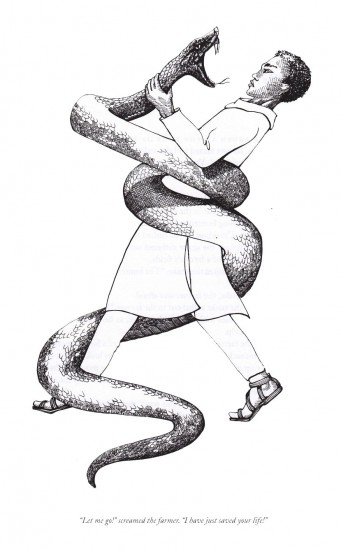
The snake crept out of the sack, threw its coils around the farmer and held him fast.
“Let me go!” screamed the farmer. “I have just saved your life!”
“That is true,” replied the snake. “But I have not eaten for many days. You will make a good meal.”
“Then you will not let me go?” asked the farmer.
“No, I am starving.”
“Before you eat me,” said the farmer, “you could at least repay me for saving your life.”
“That is only fair,” said the snake. “I agree. Now what do you desire?”
“Let us have others decide whether you should eat me.”
“If that is your wish, so be it,” agreed the snake.
The snake followed the farmer to the edge of the field where a coconut palm tree had been planted. The tree listened carefully as each of them told his side of the story.
“Well,” replied the coconut palm, “I know the nature of human beings. They eat my nuts and drink the sweet milk inside. Some even use my leaves to thatch their roofs. Why should I save a human being? I say the snake should have its meal.”
“Let us ask the bee,” said the farmer.
“As you wish,” replied the snake.
“You must be joking!” replied the bee. “Human beings smoke us out of our homes and steal our honey. They never give us thanks. I have no compassion for the farmer.”
“Perhaps the mango tree down by the road will understand my plight,” thought the farmer. “Snake, let us go ask the mango to give us its judgment.”
“Lead on,” replied the snake.
Once it had listened to their stories, the mango tree spoke. “Year after year I stand here as generations of human beings pass by. They cool themselves in the shade of my branches and eat my fruit when they are hungry. Some break off my branches for firewood or to use as the shafts of spears for hunting the wild animals. Not once has a human being thanked me. Farmer, I see no reason why the snake should not eat you.”
“How could this be?” exclaimed the farmer. “Why should my life be such a trifle in the eyes of nature?”
At that moment, the farmer spotted a gazelle grazing along the riverbank. To the gazelle the farmer now pleaded his case.
In response to his story, the gazelle told a tale of its own. “I am often the difference between life and death for the human beings. Without my meat, they would starve and perish. Because I am so generous, people take me for granted. Your life, farmer, belongs to the snake.”
A baboon was listening from where it sat on the branch of a nearby tree.
“Every creature does what it must in order to survive,” said the baboon. That is the way of nature.”
“But what of the snake?” asked the farmer.
“One cannot blame the snake for its hunger,” replied the baboon. “Like you, the snake is part of the balance that exists in the world.”
A snake is meant to eat its prey,
it catches as it can.
Its food will try to get away,
escape’s the way of man.
“What, then, do you have to say about whether or not I should eat the farmer?” asked the snake.
“First, you must show me exactly how it happened,” said the baboon. “That sack does not look big enough to hold a snake as magnificent as yourself.”
The farmer then opened the bag and the snake crawled in.
“Are you able to close bag with the snake inside?” asked the baboon.
“Yes,” replied the farmer as he drew the cord tight and tied it securely.
“Now, farmer, we will see what you have learned,” said the baboon. “Once again, the fate of the snake is in your hands. Now what are you going to do about it, hmmm?”
Activities
Prey, Tell Me
“Every creature does what it must in order to survive,” said the baboon in this story. “That is the way of nature.” Indeed, each plant and animal has specific adaptations, physical (genetic) traits and behaviors that better enable it to survive and reproduce in its particular environment. Among animals, many survival adaptations relate to eating or being eaten.
Activity: Solve some riddles that describe the survival adaptations of some prey animals by guessing the animal’s identity.
Goals: Understand what a survival adaptation is and learn some defenses of certain prey animals.
Level: Ages 5 to 12
Materials: Riddles and kids.
Procedure: Discuss the meaning of interrelationships and give examples of different kinds of animal relationships. Be sure to include examples of animals that have both positive and negative effects on each other. Ask the children to think of their own examples.
Define and discuss the concept of survival adaptation with the children. Have them call out some examples of offensive adaptation of predators and defensive adaptations of prey animals.
Now tell them they are going to hear some riddles which describe some adaptations of animals that are often hunted as prey. With older children, have them come up and take turns reading the riddles. You will need to do the reading for young children. The riddles vary from easy to challenging.
PREY, TELLME (RIDDLES)
- My home is a burrow in the ground. I only come out at night when it is cool and damp and when I am not likely to be seen. Lots of animals, especially early birds, love to eat me, but I can scoot down my burrow quickly if someone tries to grab me, and I am very sensitive to vibrations in the ground. Don’t fish around too long for the answers?
I am a (worm).
- I am a great swimmer from the minute I am born, I float almost as well as a cork. If something comes after me I use my webbed feet and tiny wings to skate quickly away over the water. The predators who spot me and try to attack from below see down when they look up. You may see me eating plants or fish.
I am a (duckling).
- My long ears, keen hearing and sensitive nose help me to detect danger from far off. I can make a fast getaway if spotted. Still, I come out from sunset to sunrise with darkness as my cover. I have a habit of twitching my nose. My tail is short and my feet are lucky.
I am a (rabbit).
- I sing my song when summertime is aging and autumn is on the way. I don’t sing with my voice though. Some people know I wing it. My long antennae help me to sense when danger is around. Still, my kind often become lunch for birds, shrews and even tiny snakes. I might live under a rock or spend my time in a clump of grass.
I am a (cricket).
- You know me well around your garden. My skin is bumpy and bad to taste. I eat ants and flies with a long, sticky tongue. When you pick me up I release the contents of my bladder to startle you into putting me down.
I am a (toad)?
- My skin of scales is a good hint. I am small and quick with a colorful tail. When a predator comes and grabs at the tip, I snap it off like the flick of a whip.
I am a (skink).
Adapt and Survive
Adapting is not simply a matter of following a pre-determined program of adaptations like a robot. Many times, like the human being in this story, the animal that survives is one that can learn from its environment and make choices based on individual situations. For animals, threats can come from both the natural world and from the actions of human beings.
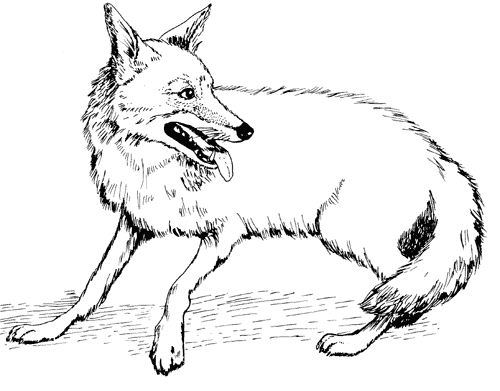
Activity: Play a game of choices to see if you are as adaptable as the coyote—to see if you can adapt to survive in a changing world.
Goals: Understand that change—both natural and human-made—is a normal part of an animal’s existence, and that adapting to change is necessary to survive.
Level: Ages 9 to 12
Materials: Copy or copies of “Coyote’s Choice: Adapt and Survive,” other materials as needed depending upon the format you use for this activity, such as a game for each child to play individually (one copy for each child), or a course that children will walk through while making the decisions (index cards, each with one of the numbered situations set up as separate stations and any props you may want to add to create a more life-like course for the children to experience).
Procedure: Discuss the adaptability of coyotes, how they have expanded their range in recent years and the many changes which are constantly occurring around them to threaten their existence. These changes can be natural, such as floods, fire created by lightning, drought or a food shortage. Change can also be caused by people, for example, clear cutting a forest, damming a river or setting out traps or poisoned bait to kill animals. Coyotes are experts at adapting to change, moving to a new habitat when they need to or sensing danger when it is near and avoiding it, even if it means turning away from food that looks suspicious when they are hungry. They do not always make the right choice, however, and cannot always adapt successfully. Sometimes they survive, sometimes they do not.
Have each child read the following story, making choices along the way as they think a coyote might make. Even if a child makes the wrong survival choice at a certain point in the story, he or she is to continue on to the next station, and so on, until reaching the end of the story. When all of the children are through, have them share their choices, adaptations and experiences. How many of them honestly made all of the right choices and were able to make the necessary changes to survive each time? Which choices made it most difficult to make the right survival decisions? Which choices were the easiest?
Note: This activity can also be set up as a fun series of stations in which the initial situation is described and illustrated and children must choose one course or another by turning over a card or lifting up a flap to reveal the consequences of their decision. Then they can move on to the next station to test their wits there.
 COYOTE’S CHOICE: ADAPT AND SURVIVE
- You are a tiny coyote pup and your mother has gone off to hunt for food. While you wait in the burrow a strange piece of thin wire on the end of a stick is pushed toward you from the door of your den. You see it coming and are afraid of it so you:
a. cower back against the wall of the burrow to escape.
b. attack the wire by biting it.
Answers:
• If you chose (a) you survived.
• If you chose (b) you were snared and taken away by a hunter.
- You are now old enough to do some hunting on your own. There, up ahead, you see a dead animal that looks like it is more than big enough for a whole meal. When you get closer you see some strange tracks in the soil and smell an animal you have never smelled before. You are very hungry, but afraid to go closer to the dead animal. After watching a while and looking for signs of danger you decide to:
a. eat the meat of the animal.
b. turn away and search for another meal.
Answers:
• If you chose (a) the meat was a poisoned trap set by a farmer and you are a goner.
• If you chose (b) you survived.
- It has not rained for a long time, the plants are dying and animals are becoming scarce. You are very weak, yet you feel an urge to travel to look for food. You begin to walk away from your burrow but you find it hard to walk. You decide to
a. push ahead and look for water and food elsewhere even though it means risking using up your last energy.
b. return to the burrow and wait for the rain and food to return.
Answers:
• If you chose (a) you survived.
• If you chose (b) starvation set in and you became too weak to leave your burrow. You did not survive.
- You come to a place where people are living because you know there is usually some food nearby. There is a place up ahead where the smell of food is strong, yet danger is very near and threatening. As night slowly advances with the setting sun, you decide to
a. sneak in and eat as much of the food as you can under the cover of darkness.
b. turn around and seek food elsewhere.
Answers:
• If you chose (a) you were able to eat safely while protected by the darkness. You survived.
• If you chose (b) your last strength was used when searching for food in another spot. You did not survive.
- With your strength restored you travel a short distance seeking shelter—a place to sleep and digest your meal. There is a strange burrow above ground up ahead. It is large and the morning sun shines off the strange smooth skin into your eyes. You climb up into it and try walking through the place that looks like the entrance, but you bump into something you cannot see. Finally you find an opening in the skin on the side and walk in, only to find many strange smells meet your nostrils. You sniff a few times and suddenly feel very tired. You decide to:
a. lie down and sleep here.
b. move on to look for a safer place.
Answers:
• If you chose (a) you slept in an old abandoned car and made it your temporary shelter. You survived.
• If you chose (b) you found a large hollow tree to rest in and slept safely all day. You survived.
- When you wake up the sun is setting and you are hungry again, but not starving like before. You leave your burrow and walk until you come to the edge of the woods. You see a field with some furry animals in it eating the plants, but you are not sure it is safe to enter the field or whether those animals are food or not. As you move closer you notice a freshly-killed rabbit in front of you. There are those strange tracks around it, like the ones you saw near that dead animal with the strange smell some time ago. But this meat smells good as you approach it and your hunger deepens. Then, as you move even closer, you notice something sticking out of the ground near the rabbit. It looks like it has large teeth and is made of the strange skin of that burrow with the smooth shiny skin. You look all around one more time to make sure that none of the dangerous animals who walk on two feet are around, then you
a. pounce on the rabbit.
b. run off into the underbrush, sensing danger.
Answers:
- If you chose (a) you felt a sharp, cold pain climb up your leg from one of your feet. Your foot is in a steel trap and there is no way out.
You did not survive.
- If you chose (b) you survived.
- If you have successfully survived by making all of the right choices so far, you will now raise a new coyote family. On the way back to your burrow you meet a coyote and decide to take her or him as a mate. Soon, the next generation of coyotes is born and you have pups of your own to feed.
Living In Balance: The Circle of Giving and Receiving
In “The Wisdom of Nature” the bee and the mango tree complain that the human beings take what they need but never give thanks. The gazelle says that its meat keeps the human beings alive, but that the human beings take it for granted. Many Native peoples see reciprocity—the Circle of Giving and Receiving—as essential to living in balance with nature.
Activity:(A) Make a list of all the gifts we receive from plants and animals. Practice
using only what is needed and giving thanks when receiving each of these gifts. (B) Create a special gift to return the generosity of the plants and animals.
Goals: Understand how numerous and varied are the gifts we receive from plants and animals. Realize that living in balance involves using only what is needed, not being wasteful and giving thanks to complete the circle of giving and receiving.
Level: Ages 5 to 12
Materials: (A) chalkboard and chalk or felt-tipped markers and newsprint, masking tape. (B) same materials as in (A) plus: pencils, paper, crayons, construction paper, scissors, glue, tape, very large sheet of paper such as brown postal wrapping paper, pictures or photographs of plants and animals as models for the children’s drawings, other materials as needed to complete children’s own, original projects.
Procedure A: Opening the Circle—Receiving. Use the children’s ideas and your own thoughts to make a list of the gifts we receive from plants and animals. Brainstorm a list of plants and animals that help to bring the gifts to us. Have the children go through an entire day by saying “thank you” to a plant or animal, or plants and animals in general, each time one of these gifts is used, eaten, worn, etc. An example is “Thank you honeybee” for honey and beeswax (a common ingredient in lip balm).
Encourage the children to be especially careful to use these gifts wisely—to take only what they need and not be wasteful.
Procedure B: Completing the Circle—Giving Back. Now tell the children how this story of “The Wisdom of Nature” reminds us that the plants and animals give us many wonderful gifts, and that living in balance means, in part, to return the gifts we receive by giving something of ourselves back. Ask the children to call out ways they may do this and write them down for all to see. Save them for use later.
Have each of the children write, in his or her own words, a poem or other form of saying “thank you” to the plants and animals. Children may draw a picture to depict a feeling of gratitude. Very young children may need pictures or photographs of the plants and animals to help them visualize the images for their drawings.
Create, on a large sheet of paper, an outline of a coconut palm, mango or other chosen tree, such as an apple tree. Have each child write or place her or his form of
“thank you” inside this outline. Pictures may be cut out and glued or taped on. The tree could even be entirely filled with pictures or illustrations to form a collage.
Follow through by having the children add other ways of giving thanks to the plants and animals as they think of them.
Michael J. Caduto is the creator and co-author (with Joseph Bruchac) of the best-selling Keepers of the Earth® series of books and resources. He recently released two new storytelling CD’s of stories from around the world: The Rainbow Garden—Tales of Wisdom (ages 5-10) and The Wisdom of Nature and other Earth Tales (ages 11 and up). Michael travels widely as an award-winning author, master storyteller, ecologist, educator, poet and musician. His work draws from the global well of Earth wisdom and he has worked closely with many Native peoples. His most recent books, Catch the Wind, Harness the Sun: 22 Super-Charged Science Projects for Kids and Riparia’s River received the Teacher’s Choice Award and Green Earth Honor Book Award.
by editor | Oct 21, 2014 | Gardening, Farming, Food, & Permaculture, STEM
Integrating STEM and Sustainability Education through Learning Gardens:
A Place-Based Approach to the Next Generation Science Standards
by Sybil S. Kelley and Dilafruz R. Williams; Portland State University
 ur ecological and social problems are deeply interconnected. Climate change, habitat destruction, loss of biodiversity, food insecurity, air and water pollution, along with innumerable other environmental problems, are increasingly related to issues of equity and social justice. Addressing these problems requires a citizenry that is both scientifically and ecologically literate, ensuring that all people are empowered with the understandings, dispositions, and skills to address the challenges of this modern world.
CLEARING readers are likely familiar with another crisis of our times, the idea of “Nature Deficit Disorder” that Richard Louv (2005) so poignantly described in his landmark book, Last Child in the Woods: Saving our Children from Nature Deficit Disorder. Louv and numerous other leaders of the No Child Left Inside initiative have done a remarkable job pointing out the parallel phenomena of increasing numbers of children with ADHD and loss of time spent in nature, particularly unstructured time to explore, engage in imaginative play, and utilize all the senses. Nonetheless, time that children spend in school has become more rigid, siloed by discipline (e.g. 90+ minute literacy blocks), and disconnected from students’ daily lives and lived experiences.
As a society, we place unrealistic demands on educators. Classroom teachers are continually expected to do more with less—less money, less support, less time—with increasing mandates and pressures of accountability, whether from No Child Left Behind or Race to the Top. Informal educators provide a remarkable array of learning experiences, yet many teachers do not have the time or capacity to make use of these opportunities, particularly since in most cases, field trips have to be rigorously defended and justified in context of the school-day curriculum. However, since the early 1990s, the school garden movement has been working to mitigate traditional schooling taking place within the four walls of the classroom by bringing students outdoors on school grounds right where the schools are housed.
The adoption of the Next Generation Science Standards (NGSS) by 26 states has the potential to transform teaching and learning in and out of schools. The focus of the NGSS is on 12 “big ideas” in science (the Disciplinary Core and Component Ideas, NRC, 2012), bringing these together into process oriented learning goals (learning performances) that bridge scientific content with the practices of science and engineering, and crosscutting concepts that span all the disciplines of science (e.g. patterns, cause and effect, and systems and system models). The NGSS raises the bar for science in schools, and will require that much more attention be paid to science starting in elementary school. To help in this process, the NGSS are integrated by design. First, science education has been integrated into STEM education (Science, Technology, Engineering, and Math), elevating the practices and content of engineering design to the level of scientific inquiry. Further, the NGSS provide connections and links to the Common Core State Standards (CCSS), making them much more useful for developing integrated, project-based units of instruction. We believe that school gardens provide a rich milieu to put the NGSS into practice, making science relevant to the lives of students as they engage with their own place in meaningful ways across disciplines.
STEM and Sustainability Education: Sense of Place
As an individually and socially constructed phenomenon, relationship to place is complex and so is the creation and development of meaning, attachment, and identity based on this relationship. To know one’s place is prerequisite to knowing one’s self. According to several scholars, sense of place is recognized as a key component of sustainability and sustainability education. Wendell Berry (1990) tells us that if we do not know where we are, we cannot know who we are. David Orr (1992) explains that people with a sense of place become “inhabitants” who dwell deeply, steeped in connections. Similarly, David Sobel (2004) asserts that people tend to protect what they love and know; therefore the actual places where we live, work, and play, become an explicit part of sustainability initiatives.
Sustainability education takes a holistic, systemic view of the world, is place-based, experiential, and transformative. Effective, high-quality STEM teaching, which should include learning experiences that are relevant and meaningful to students’ lives, are active and interactive, and make use of observation and evidence to develop meaning and understanding (knowledge claims). STEM and sustainability education are complementary and should be brought together in mainstream education.
Not only do we need to weave STEM and sustainability education together, we need to elevate both more prominently in schools. Recent studies have illuminated statistically significant reductions in science instructional time in elementary classrooms (Blank, 2013). These findings are quite troubling considering the need for scientifically and ecologically literate graduates. If we wait until middle and high school to emphasize science, we have already lost a tremendous number of students, most typically students who are already marginalized in mainstream educational (and other) systems. Making use of learning gardens can provide a solution. Teaching and learning in gardens is a way to increase student engagement in learning, and also to support different learning styles, integrate various disciplines, and revitalize schools and neighborhoods.
Using “living soil” as a metaphor for re-envisioning education, Williams and Brown (2012) state,
Gardens present an appropriate life-enriching ecological practice that guides curriculum, teaching, and learning. In an era characterized by educational malaise and apathy and amidst a repetitive discourse of racing to the top, gardens offer an alternative and regenerative model for bringing schools to life that differs significantly from mechanistic techno-scientific reform efforts oriented toward economic globalization. (p. 22)
In other words, school gardens and the living soil within them can provide a place-based context for teachers and students to learn together, alongside other community members, including the non-human members, developing a sense of interconnectedness and understanding of our place in ecological systems.
Williams and Brown (2012) outline seven pedagogical principles that are foundational to garden-based education, and that shift learning from a dry, disconnected model to one that is active and alive. Learning gardens cultivate a sense of place, awaken the senses, and foster wonder and curiosity; further, through practical experience, learners observe rhythm and scale, develop understandings of interconnectedness, and value biocultural diversity. Much of schooling focuses on visual and auditory learning modalities. Learning gardens on the other hand provide multisensory, kinesthetic learning experiences for children (and adults). They provide accessible places to build connections to nature—allowing learners to see, feel, hear, smell, and taste the wonders of nature. In our own teaching and working with teachers in low-income schools in particular, we have found the desperate need for this connection among adults and children alike.
As districts, schools, and individual classroom teachers work to implement the NGSS, innumerable, place-based opportunities exist to address national, state, and local goals within the context of learning gardens. Nonetheless, it will require leadership at many levels to reach the vision of the NGSS and the school garden movement. Principals need to see the value of garden-based education and embrace this type of teaching and learning by supporting and protecting their teachers. As professionals and leaders working directly with students, teachers will need support in developing relevant, place-based lessons that address the NGSS. Teachers must be integral players, bringing their expertise and experiences to the process.
In our summer professional development course entitled, Integrating STEM and Sustainability Education through Learning Gardens, classroom teachers, garden-based educators, and graduate students in the Leadership for Sustainability program work together to implement a place-based curriculum with elementary students in a summer garden program through SUN Schools (Schools Uniting Neighborhoods). In the afternoons, this diverse group of educators has the opportunity to grapple with the content and design of the NGSS, and to work collaboratively to develop integrated, standards-based instructional units that are contextualized in school learning gardens. For the NGSS to become a reality, teachers will need more professional learning experiences that empower them to put their expertise and knowledge of their students (their place) into the design and implementation of well-planned instructional units. NGSS and the Framework for K-12 Science Education (NRC, 2012) from which they were developed provide the structure and scaffolding for building curriculum, but efforts led by teachers and partners from higher education and the local community will provide the flesh and details for implementation.
In the following paragraphs, we will highlight some examples of what the NGSS in learning gardens can look like in practice. The first scenario provides an example of an engaging encounter that could open the door to numerous explorations, while the second is an actual lesson we have used in the summer garden program. Both highlight the rich learning opportunities that emerge and are literally just outside the classroom door.

Figure 1: An unexpected discovery of a Goldenrod Crab Spider feasting on an unsuspecting honey bee yielded immediate fascination and interest among students and teachers alike.
In science, teachers are often encouraged to use the “5E” instructional model (Bybee et al, 2006) that includes “Engage, Explore, Explain, Extend, and Evaluate.” In the garden, all five E’s can be woven together, but “engage” and “explore” are particularly ripe. Last summer, a group of teacher candidates and youth ranging in age from four to twelve years old were thoroughly engaged and excited by this predator-prey discovery. For teachers, such wonders provide an anchor for numerous learning experiences.
For example, a Kindergarten teacher could help her students investigate the needs of different plants and animals in the garden. By gathering age-appropriate data (perhaps a simple table with a name and/or drawing of the organism and what the students observe each organism eating), students can develop an explanation of how different animals eat different (and in some cases the same) things. This would directly address the Kindergarten NGSS related to structures and processes in organisms, specifically the component concept about matter and energy flow in organisms (from NGSS (2013), K-LS1-1. Use observations to describe patterns of what plants and animals (including humans) need to survive). First grade teachers and students could build on foundations laid in kindergarten by focusing on the structure and function of plants and animals, and how an organism’s structures help it survive and grow (1-LS1-1. Use materials to design a solution to a human problem by mimicking how plants and/or animals use their external parts to help them survive, grow, and meet their needs).
As another possible direction, this initial discovery could serve as the platform for introducing the 3rd grade standards related to heredity and biological evolution. By combining hands-on data collection in the garden with internet research, or perhaps inviting a local scientist/arachnologist to visit the class, students could compare the variations among this particular species of spider (e.g. some have red strips, others do not), as well as traits of other spider species. Using their data, they could construct an argument about why some species are more likely to survive in particular habitats over others (3-LS3-2. Use evidence to support the explanation that traits can be influenced by the environment; 3-LS4-2. Use evidence to construct an explanation for how the variations in characteristics among individuals of the same species may provide advantages in surviving, finding mates, and reproducing (NGSS, 2013)).

Figure 2: Students collaborate to gather data about the number and diversity of species they can observe and record in their habitat sampling area.
In each of these possible scenarios, there are also numerous interdisciplinary connections to reading and math expectations in the Common Core State Standards (CCCS) and to real world issues. For example, as third graders learned about the relationships between species and their specific habitats, they could also read a variety of texts describing the flora and fauna, as well as abiotic components, of different ecosystems. They could read and discuss the role of pollinators in ecosystems, and how pollinators are so crucial to our own food sources, particularly those in a specific location—i.e. for this place. As a culminating product, students could create a short video or poster that argues why sustainable agriculture practices are vital to food security and the planet as a whole.
The second example is one that we have experienced first-hand in the summer garden program connected with the Integrating STEM and Sustainability Education through Learning Gardens course—Is Soil Alive?—the driving question behind two days of soil explorations. The first day was spent collecting samples to test for soil composition. As students waited for the layers of sand, silt, and clay from various locations around the school yard to settle in their jars, they explored decomposers in the compost and worm bins, and those found in the garden. As a culminating activity (that could also serve as an assessment), students were given a worksheet that asked them to draw what they had observed above and below ground in the garden. The overarching question, “Is soil alive? Explain your thinking” guided students.
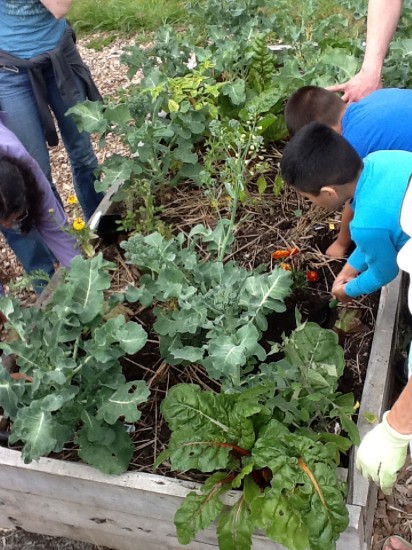
Figure 3: Students and teachers search for critters (aka, decomposers) in the raised garden beds at their school.
This cluster of lessons provides several clear connections to the NGSS, particularly related to “Interdependent Relationships in Ecosystems,” “Cycles of Matter and Energy Transfer in Ecosystems,” and “Biogeology” of Earth’s systems. But equally important, an open-ended question such as “Is the Soil Alive?” helps students and teachers grapple with the nature of science. In this particular example of viewing soil as an ecosystem, students were provided with a concrete example of some relatively abstract, complex ideas. It let them think and learn about systems, interconnections, cycles, and flows, laying a strong foundation for further exploration and learning in upper grades. Students had the opportunity to engage in logical reasoning and discourse, using empirical observations to support their claims. Some of the more complicated explanations of why the mineral portions of soil are non-living while the system as a whole can be considered alive, at the most basic level, were understandable to the elementary-age students. If teachers had given “the right answer” as is traditionally related to properties of living and non-living elements of soil, they would have discouraged students from thinking, imagining, inferring, and looking for evidence. Furthermore, a response that declared soil as not being alive because it is made up of sand, silt, and clay could have denied students a deeper exploration into the microbial ecology of soil and compost.

Figure 4: While observing and recording the decomposers found in the compost bin, a student observed this black soldier fly emerge from its pupa. It is hard to imagine doing a better job of explaining life cycles than an experience such as this can provide
Recommendations/call to action:
School and community learning gardens provide rich, easily-accessible contexts for integrating STEM and sustainability education. Learning experiences that are multisensory, place-based, and interconnected come to life in the garden, making teaching and learning relevant and meaningful to students and teachers alike. The recent adoption of the Next Generation Science Standards, which emphasize application of knowledge, higher-order thinking skills, and demonstration of proficiency through performance, present the educational community with a unique opportunity to make better use of such spaces for teaching and learning. To help move our community closer to this vision, we offer a few suggestions to help in this process:
- Think big, start small—meaningful change takes time. It is important to spend time envisioning and planning in the early stages so that your garden-based aspirations can be turned into reality.
- Whether you are new to outdoor, garden-based education or an experienced practitioner, it is important to set shared expectations and norms with your students. Too many children have not spent a lot of time outside in nature. Furthermore, when they have been outside during school hours, it is often recess, not learning time. It is important to be clear that even though students are outside the classroom, it is still time for learning.
- Related to number two, get outside regularly. As students become more familiar with the garden routines, they will be more comfortable and “on-task.” Consider learning outdoors to be equally essential as learning with technology. Nature time is as important as screen time.
- Share your successes (and challenges)—with colleagues, your principal, parents, and your students.
- Connect with other educators and resources. For instance, the following websites can provide even more links to others interested in learning gardens: Oregon School Garden Summit (http://www.ode.state.or.us/search/page/?id=4202), OSU Extension’s gardening program (http://extension.oregonstate.edu/gardening/), Learning Gardens Laboratory (http://www.pdx.edu/elp/learning-gardens-laboratory) and many other local, regional, and statewide organizations.
- Most of all, have fun! Learning should be a fulfilling lifelong endeavor. That will only happen if it is fun, engaging, and meaningful. Learning gardens are the perfect mileau!
Photo Inspiration:

Figure 5: Learning gardens also provide numerous opportunities for arts integration.
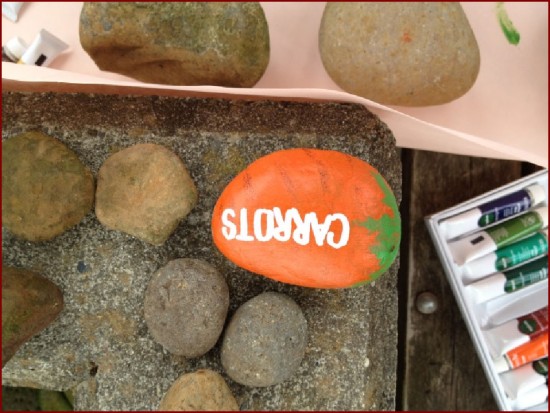
Figure 6: Arts integration and bilingual language development—gardens can provide a cultural entry point for many students from diverse backgrounds.

Figure 7: Collecting daily measurements of temperature and weather conditions helps students develop understandings of hard-to-grasp, abstract concepts. Additionally, they can observe change over time, make predictions, and record and analyze data.

Figure 8: A one-on-one exploration of roots and soil.

Figure 9: Early literacy skills can be developed and enhanced through journaling and data collection. Even the youngest learners can feel successful.
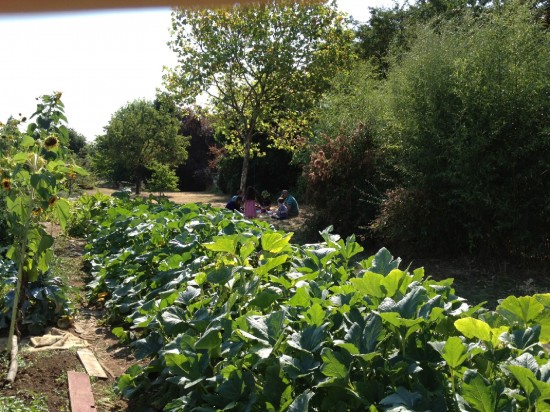
Figure 10: Teacher candidates discuss and reflect on the day’s activities with a small group of students.
References:
Berry, W. (1990). What are People For? Berkeley, CA: Counterpoint.
Blank, R. K. (2013). Science instructional time is declining in elementary schools: What are the implications for student achievement and closing the gap?. Science Education, 97(6), 830-847. DOI:10.1002/sce.21078.
Bybee, R., Taylor, J. A., Gardner, A., Van Scotter, P., Carlson, J., Westbrook, A., Landes, N. (2006). The BSCS 5E instructional model: Origins and effectiveness. Colorado Springs, CO: BSCS.
Louv, R. (2005). Last child in the woods: Saving our children from nature-deficit disorder. North Carolina: Algonquin Book of Chapel Hill.
National Research Council [NRC]. (2012). A framework for K–12 science education: Practices, crosscutting concepts, and core ideas. Washington, DC: National Academies Press.
NGSS Lead States. (2013). Next generation science standards: For states, by states. Washington, DC: The National Academies Press.
Orr, D. W. (1992). Ecological literacy: Education and the transition to a postmodern world. Albany: State University of New York Press.
Sobel, D. (2004). Place-based education: Connecting classrooms & communities. Great Barrington, MA: The Orion Society.
Williams, D. R. & Brown, J. D. (2012). Learning gardens and sustainability education: Bringing life to schools and schools to life. New York, NY: Routledge.
About the authors:
 Sybil S. Kelley, PhD,is Assistant Professor of Science Education and Sustainable Systems at Portland State University in the Leadership for Sustainability Education program. In addition, she teaches the Elementary Science Methods courses in the Graduate Teacher Education Program. Sybil has spent nearly 15 years working in formal and informal educational contexts. Her programming and research focuses on connecting K-12 students and educators in underserved schools and neighborhoods to authentic, project-based learning experiences that contribute to community problem solving. Taking a collaborative approach, Sybil supports teachers and community-based educators in aligning out-of-school learning experiences with state and local academic requirements. Her research focuses on investigating the impacts of these experiences on student engagement, thinking, and learning; and teacher self-efficacy, pedagogical content knowledge, and instructional practices. Prior to her work in education, Sybil worked as an environmental scientist and aquatic toxicologist. Correspondence can be sent to sybilkel@pdx.edu.
 Dilafruz R. Williams is Professor, Leadership for Sustainability Education program, in the Department of Educational Leadership and Policy at Portland State University in Portland, Oregon. She is co-author of Learning Gardens and Sustainability Education: Bringing Life to Schools and Schools to Life (Routledge, 2012), and has published extensively on garden-based learning, service-learning, urban education, and ecological issues. She was elected to the Portland Public Schools Board, 2003-2011. She is co-founder of Learning Gardens Laboratory and Sunnyside Environmental School in Portland. Additional information about her can be obtained at www.dilafruzwilliams.com
by editor | Oct 13, 2014 | Place-based Education, Service learning
To view this article in .pdf format, click here: MyMcKenzie
An environmental education professional development program using
place-based service-learning
by Kathryn Lynch
University of Oregon Environmental Leadership Program

 here does your drinking water come from? It is a simple question, and given that humans can survive only a few days without water, a critical one. Yet, too many people cannot answer this most basic question. In Eugene, this lack of connection is often compounded by the transient nature of a large sector of the population (university students) who are often just passing through on their way to careers elsewhere.
To respond to this serious disconnect with nature, the Environmental Leadership Program (ELP) launched a set of new EE projects in 2012 focused on helping students develop a connection to the sole source of their drinking water, the McKenzie River. This stunning 90-mile long river provides many gifts: clean drinking water, fish and wildlife habitat, recreation, hydropower, and inspiration. The watershed offers fascinating and complex geology and geomorphology, multi-faceted and controversial land use issues, and a strong sense of community and history tied to place. Many organizations are doing work in the watershed, which provides opportunities for students to directly engage in conservation issues. In sum, the watershed provides a great laboratory for interdisciplinary, place-based education and service learning.
 The two main goals of the new EE effort were to: 1) create a year-long program for UO students interested in EE careers (that would provide them with the knowledge, skills and confidence to develop and implement place-based, experiential programs) and 2) develop age-appropriate, engaging MyMcKenzie curricula for local youth, grades 1-8, that promotes the stewardship of the McKenzie River.
To prepare the undergraduates for their service projects, we offered a new fall course called Understanding Place: the McKenzie Watershed. The goal was to provide the necessary foundation for them to become effective place-based educators. During the 10-week course, we examined the geological, ecological, historical, social, and political influences that shape the McKenzie watershed. Six field trips took us from the headwaters to the confluence, where we explored lava flows, springs, hiking trails, dams, hatcheries, restoration projects, historical sites and more. Guest speakers provided diverse perspectives on Kalapuya culture, salmon restoration, water quality and management, and sustainable agriculture, among other topics. We wanted students to hear directly from the farmers, anglers, residents, scientists, policymakers and regulatory agencies that shape the watershed’s past, present, and future. Through diverse hands-on, student-led activities, the class gained a spatial and temporal understanding of the McKenzie, and contemplated the meaning of “place,” what contributes to a sense of place, and how it influences people’s worldviews and choices.
In the subsequent winter course, Environmental Education in Theory & Practice, UO students learned how to transform their new knowledge of the McKenzie River into engaging place-based educational programs. Participants gained a working knowledge of best practices in EE through readings, guest lectures, field trips, and most importantly, their service-learning project in which they developed educational materials for their community partners. The “Critters and Currents” team worked in partnership with Adams Elementary School to develop two classroom lessons and one field trip for each grade level. The “Canopy Connections” team developed and facilitated field trips for middle-schoolers that included a canopy climb, building watershed models, and mapping, among other activities. All the activities used the McKenzie River as the integrating context, and placed particular emphasis on systems thinking, and how the health of the river directly affects us, as the river provides our drinking water.
While the specifics of the curricula were left up to the teams to determine, all teams were required to: 1) incorporate an interdisciplinary approach, 2) include multicultural perspectives, 3) use experiential, inquiry-based methods, 4) promote civic engagement, and 5) articulate assessment strategies. Their materials were pilot-tested at the end of winter term, and then the teams worked with their community partners to implement their EE programs throughout spring term. Each UO student completed approximately 120 hours of service, which entailed facilitating field trips, classroom visits and developing supplemental educational materials (e.g. websites, presentations). What follows next are descriptions of the two 2013-2014 projects, written by the team members themselves.
 Case Study 1:
Critters and Currents
By Leilani Aldana, Leah Greenspan, Courtney Jarvis, Claire Mallen, Anna Morgan, Trevor Norman, Makenzie Shepherd, Tony Spiroski, Britney VanCitters, Cheyenne Whisenhunt, Alicia Kirsten (graduate project manager).
 iking along the McKenzie River trail is unlike anything else in its breathtaking beauty and awe. The trees tower above, the firs paint the horizon green, and the moss blankets the forest floor. Squirrels dart back and forth, winged insects buzz through the misty air, and regal ospreys circle above the river, spying on possible prey below. All these organisms work together in the carefully orchestrated equilibrium that is a Pacific Northwest forest. And although the forest can be serene, delicate, and quiet, it also tells a bold and enduring story to those who are willing to listen and fortunate enough to hear.
The forest’s tale is told by the many plants, fungi, animals, and humans that call it home. At one point, the entire McKenzie watershed told this story; the indigenous Kalapuya and Molalla people lived closely with their varied and unique plant and animal neighbors, constructing a narrative out of the reciprocity that encouraged a long-lasting relationship. Eventually the plot of this story was thrust in another direction, as the influx of newcomers would alter the face of this territory through extensive land management techniques and exploitation of natural resources. Today, the story of the McKenzie River watershed illustrates the growing disconnection between forests and our society brought by global urbanization. But the story is not yet over, and we have the unique opportunity to transform it.
The prominence of technology and urbanization in the 21st century has established an obvious distinction between the urban and natural worlds. Younger generations, increasingly disengaged and separated from their local natural environments, exhibit symptoms of what is colloquially called “nature-deficit disorder” (Louv 2008). Marked by rising levels of ADD/ADHD, obesity, depression, and muted creativity, nature-deficit disorder will accelerate if not immediately and holistically addressed.
Nature has the ability to inspire us, teach us, and transform our lives. By giving children the chance to explore the natural world, we allow them to experience the story nature has to tell. Utilizing place-based lessons and hands-on activities, environmental education helps students gain an ecological awareness and an understanding of natural processes. Infusing curricula with environmental themes and concepts has proven to foster stewardship and improve support for conservation (Jacobson 2006).Communities need to work collaboratively to ensure that children are provided with the awareness, knowledge, attitudes, and skills necessary to tackle future environmental problems. As environmental educators, we have enthusiastically decided to face this task; we are working to encourage deep and meaningful connections between students and nature, with the goal of nurturing responsible and active citizens.
The 2014 Critters and Currents team worked to help students connect to and build kinship with the McKenzie watershed.Our team of ten undergraduate students and project manager collaborated for six months with Adams Elementary School to bring children to visit the Delta Old-Growth Forest, the H.J. Andrews Experimental Forest, and Green Island which is managed by the McKenzie River Trust. We created curricula that promotes environmental awareness, inspires respect and compassion for the natural world, and encourages positive environmental action now and in the future.
Building connections and gaining understanding is crucial to implementing environmental education. David Sobel, whose work focuses on place-based education, states, “If we want children to flourish, to feel truly empowered, let us allow them to love the earth before we ask them to save it.” (Sobel 1996:39). By encouraging children to experience and explore the McKenzie River, students will become empathetic and compassionate toward their local ecosystems.
Throughout the spring, students at Adams Elementary School in Eugene, Oregon were able to participate directly in the narrative of the McKenzie River watershed. By constructing and decorating fabric bird wings that they can wear, our students were able to become the birds that live in the McKenzie River watershed; by developing proper habitats for real life decomposers such as pill bugs, sow bugs, and earthworms, our students were directly responsible for the lives of those who prolong McKenzie River ecosystems; by intimately learning about a particular McKenzie River critter through storytelling and haiku writing, our students became empowered to protect and defend that critter and its home. Providing our students with activities that nourish empathy for the McKenzie River watershed and its inhabitants inspires a sense of love and awe that lasts, like the narrative itself, a lifetime.
 As adults, we often overlook the joys of simply being in the natural world. A childlike sense of wonder allows us to tap into long-forgotten natural connections that help foster a symbiotic relationship with nature once again, one that not only takes our breath away but also fills us with life. We stand in awe of the towering pines and vibrant mosses that carpet the old-growth forest floor; we are struck with silence as the wings of the great osprey beat the air above us and the tiny patterns of a water skimmer are drawn across a serene pond. These subtle, yet profound, experiences allow us to narrate our own story about the environment that surrounds us and how we as a community will care for it.
Let us persist with our place-based environmental education movement, where classrooms shift from hard desks and chalkboards to engaging the senses and producing first-hand experiences; where students can form intimate relationships with the story told by an old-growth forest or the wetlands of a floodplain forest, rather than reading about it in a textbook. Let us begin the shift to the great outdoors, where we can learn from the greatest storyteller of all: nature itself.
Case Study 2:
Canopy Connections
By Justin Arios, Brandon Aye, Jen Beard, Cassie Hahn, Megan Hanson, Tanner Laiche, Hannah Mitchel, Christine Potter, Meghan Quinn, Christy Stumbo, Jenny Crayne (graduate project manager).
 he 90-foot tall Douglas-fir swayed gently in the wind. Multiple ropes hung from the top, waiting to be climbed. The students buzzed with excitement and nervousness as Rob and Jason from the Pacific Tree Climbing Institute prepared them to climb. On their own effort, most students ascended to the top of the tree, swaying with the tree and seeing the forest with a bird’s-eye view.
 Canopy Connections 2014 was developed and facilitated by 10 undergraduate students and included a 50-minute pre-trip classroom lesson and an all-day field trip to HJ Andrews Experimental Forest. Through our field trip, we sought to immerse students in nature, foster a connection to place, and teach students about the processes and biology of an old growth forest. Connecting to nature at an early age combats Richard Louv’s theory of “nature-deficit disorder” and instills a culture of respect and awe for the natural world and hopefully, the long-term protection of natural places.
We built our field trip around the theme of “Students as Scientists,” integrating both science and the humanities. In addition to ascending into the canopy of a Douglas-fir, participating students collected scientific data, sketched native plant species, creatively expressed their observations through journaling, and built a debris shelter. Each lesson incorporated activities of various disciplines and catered to different learning styles. This rationale is supported by Howard Gardner’s multiple intelligences theory which argues that students learn and process information many different ways. We used this reasoning to construct activities that engaged students’ learning habits via kinesthetic, linguistic, visual, inter- and intrapersonal, naturalist, and logical learning methods.
Our first interaction with the students was during the pre-trip lesson. We built upon their knowledge of geography to construct a map of Oregon, highlighting cities, mountain ranges, and rivers connected with the McKenzie River. At Fern Ridge Middle School, the students were eager to add other features to the map as well, including the Long Tom, the small river flowing behind their school. Once complete, half the class was given a term relevant to the field trip such as “geomorphic” and “species richness” while the other half was given definitions. The students mingled in the class, helping each other to match the terms with the definitions.
On the morning of their field trip, the students arrived at HJ Andrews, armed with the knowledge gained from the pre-trip lesson. As they filed off the bus, we were there to greet and guide them to the staging area. After an introduction to HJ Andrews, the community partners, and the field trip agenda, each group journeyed into the forest to the first of their four stations.
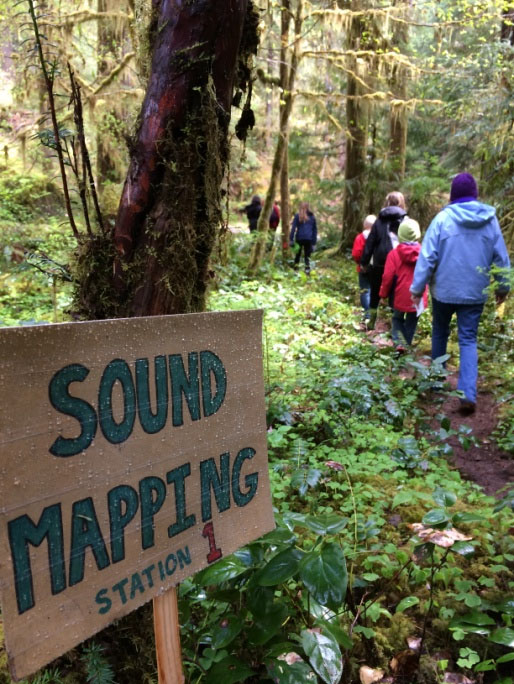
 Nestled at the end of the Discovery Trail was the River Reflections station. Here students learned about the complex interactions and disturbances that occur in a riparian zone through scientific observation and personal reflection. This station reflected the essence of the ongoing work at HJ Andrews by focusing on the Long Term Ecological Research and Long Term Ecological Reflections programs, highlighting the value of using both scientific and artistic lenses to understand the natural world. As scientists, the students compared the temperature, humidity, canopy cover, and species composition between two plots, one adjacent to the river and another 10-15 meters from the river. From our position on the creek bed, students saw a gravel bar in the middle of the river that provided a perfect example of the species found in newly disturbed areas. The students then journaled quietly by the river. To our surprise, students were so engaged in the journaling activity, they did not want to leave the station! Every student filled his or her own page in journals dedicated to collecting Canopy Connection’s Ecological Reflections.
At another station, students discovered the diversity found in old-growth forests, both in terms of composition and structure. They did this by identifying plants as tall as a western redcedar and as small as stairstep moss. Each student sketched and learned about a different plant and reported back to their group. After getting a close up view of forest biodiversity, the students embarked on a riddle quest to discover what makes an old-growth forest different from other forests. Every hidden riddle led them to a location on the trail identifying snags, woody debris, old trees, and canopy layers, which are the 4 main features of an old-growth forest. The students gathered in a circle to discuss how to mitigate threats to biodiversity through conservation measures.
 At the “Stewardship in Action” station, the students reflected on the importance of taking care of nature by learning about and applying the Leave No Trace principles. Each student described their favorite place in the outdoors and how they felt there. This led to a discussion about the Leave No Trace principles. Students creatively expressed the principles through a short rap, poem or skit. The highlight of this station was applying the Leave No Trace principles by constructing and deconstructing a survival shelter using only debris found in the forest. The students were excited to get their hands on the branches and debris to build a shelter and crawl in for a picture!
The most profound experience was the tree climbe at the “To Affinity with Nature and Beyond” station. Each student had the opportunity to climb into the canopy of a 90-foot tall Douglas-fir tree using a system of ropes. Ascending the tree was a unique experience because students had to overcome any fears they might have had to get to the top of the tree. While climbing, students observed the change in temperature in the canopy layers and were surprised to discover that (on sunny days) it was 10 degrees F warmer at the top. While this station incorporates scientific observation, what most students will remember for the rest of their lives is the sheer wonder of viewing the old-growth forest from the canopy.
Between each station, the students found a compass bearingwritten on a slip of paper and hanging on a tree. This bearing led them to a riddle hidden 20-30 feet down the trail. The riddle related to the previous station the students had left not long before. This activity was a fun way to keep students engaged during the transition time between stations, while helping them reflect on what they learned at each station. The students learned how to read and use a compass, a valuable skill, while we were able to quickly assess if we met our learning objectives.
All in all, the Canopy Connections team spent over 1,800 hours to create and facilitate field trips for 6 middle schools and 230 students. While each field trip held the same content, every student left with his or her own distinct experience.
 One student from Roosevelt Middle School said, “I learned a lot about old growth forests that I did not know before, and I think I am more likely to participate in activities taking place there.”
Throughout this program, our team and our students gained a great deal of knowledge, while fostering a connection to place and respect of old-growth forests. We have inspired our students to be curious, and want to learn more, about old-growth forests and the natural world. Ultimately, we hope these students will be more environmentally aware and will continue to care about the forest and natural environments as much as we do. As much as we hope to have touched their lives, the overall experience of working with these students has motivated us to continue pursuing careers in environmental education and work to nurture a healthier environment in the future.
Acknowledgements
We would like to thank the Luvaas Family Foundation of the Oregon Community Foundation and Steve Ellis for their generous contributions that made these projects possible. Special thanks also to our community partners: the children, teachers and staff at Adams Elementary School, the McKenzie River Trust, Kathy Keable and Mark Schulze from HJ Andrews Experimental Forest, who hosted the field trip, and Rob Miron and Jason Seppa from the Pacific Tree Climbing Institute (PTCI), who facilitated the tree climb.
Works Cited
Jacobson, Susan Kay, Mallory D. McDuff, and Martha C. Monroe. Conservation Education and Outreach Techniques. Oxford: Oxford UP, 2006. Print
Louv, Richard. Last Child in the Woods: Saving Our Children from Nature-deficit Disorder. Chapel Hill, NC: Algonquin of Chapel Hill, 2008. Print
Sobel, David. Beyond Ecophobia: Reclaiming the Heart in Nature Education. Great Barrington, MA: Orion Society, 1996. Print
 Kathryn Lynch is Co-Director of the Environmental Leadership Program. Katie is an environmental anthropologist who has a strong commitment to participatory, collaborative and interdisciplinary approaches in both her research and teaching. She has worked in Peru, Ecuador, Indonesia and the United States examining issues of community-based natural resource management. This has included examining the role of medicinal plants in Amazonian conservation efforts and the potential for engaged environmental education to promote conservation. Before joining UO she was a researcher at the Institute for Culture and Ecology, where her research focused on the relationships between forest policy and management, conservation of biodiversity, and nontimber forest products. She has also facilitated various courses and workshops that examine the nexus between environmental and cultural issues.

by editor | Sep 12, 2014 | Indigenous Peoples & Traditional Ecological Knowledge
Students on the Road for Science
For two weeks in July, seven Heritage University students and 11 high school students from White Swan and Yakima traveled more than 2,000 miles for a class that was one part field experience and one part cultural exchange. The course, People of the Big River, took the students on an academic adventure that crossed eastern Washington and Oregon.
from Heritage University website
“This was a really unique experience that connected these students with science, history and culture in a way you just can’t do in a classroom,” said Dr. Jessica Black, assistant professor of Environmental Science. “They really got a sense for how modern-day science is intertwined with traditional practices for the preservation and management of natural resources.”
The long journey included visits to the tribal lands of peoples who once lived on the Columbia River or one of its tributaries. Students met with tribal elders who described their traditional lands, ecosystems and cultures to help bridge the gap between Western science and traditional ecological knowledge. The students took this broader traditional perspective and—with guidance from Heritage professors, White Swan High School science teachers, and scientists from local tribes and the US Forest Service—used it to understand common goals surrounding natural resource management and sustainability.
Read the entire article on the Heritage University website here

 Helping Teachers Gain Competencies in a Technological Age