
by editor | Jul 17, 2014 | Place-based Education
Place-based Education:
Listening to the Language of the Land and the People
By Clifford E. Knapp,
Professor Emeritus, Northern Illinois University
 Introduction
The intersection of place and education has occupied much of my teaching even though this field has not always been called place-based education. I began my career in 1961 as a high school science teacher. When I took my students outside to plant and identify trees, build nature trails, and predict weather, I described what we did as outdoor education. In 1972 when I taught seventh grade science we took field trips to the local water and sewage treatment plant, a geology museum, and a forest to study tree management practices. I described this as environmental education. Before I retired from teaching in 2001 as a professor in the Teaching and Learning Department of Northern Illinois University, I took my graduate students to a local bookstore to learn about its role in the community, on a walk in the business district to study architectural styles, and to an arboretum to observe tree damage from pollution. Only then, did I describe this way of teaching as place-based education.
In all three of these examples, I used the place and people in the community as living textbooks to teach parts of the curriculum that were best learned in context through direct experiences. I did this because I believed in experiential education and knew these people and places were the best teachers. The places in these communities were strong factors in my choices of what and how to teach. I viewed the curriculum through a lens that magnified opportunities to involve my students in authentic and engaging interactions with a more expansive classroom. Place-based education is an old idea and at the same time it is a new term and movement that evolved from its predecessors. This modern approach to teaching incorporates the best of the best practices, as educators understand them today.
David Sobel (2004) a pioneer in the field, described the term as “the pedagogy of community, the reintegration of the individual into her homeground and the restoration of the essential links between a person and her place” (p. ii). The first time the term was used in the United States was in his book and on a cover designed by The Orion Society (1998). Over time, place/education approaches have sported different names. This idea of teaching about the local environment has been called nature study (Wilson, 1916), bioregional education (Traina & Darley-Hill, 1995), ecological education (Smith & Williams, 1999), environment as an integrating context for learning (EIC) (Lieberman & Hoody, 1998), a pedagogy of place (Hutchison, 2004), and community-based education (Smith & Sobel, 2010). More recent names include contextual teaching and learning (Sears, 2002), watershed education (Michael, 2003) and life-place education (Berg, 2004). Another emerging synonym is environment-based learning.
All of these terms describe programs demonstrating how local places contribute to curriculum and instruction in schools and other educational institutions. Sometimes other descriptors are used to explain why extending education into the community is simply a good teaching technique. For example, in an article appearing in the Harvard Educational Review in 1967 the authors labeled their plan for school reform “a proposal for education in community” (Newmann and Oliver, 1967, pp. 95-101). The school building was where teachers planned, set objectives, and taught basic literacy skills to students. They went into the community to visit factories, art studios, hospitals, libraries and other laboratories to generate learning. The third part of their proposal was the in-school seminar where local “experts” helped students reflect on and apply what they learned in the community laboratories. In that same year the National Council for the Social Studies (Collings, 1967) issued a publication titled, How To Utilize Community Resources. It was designed to help teachers learn from their communities. In 1970 the National Science Foundation funded a curriculum project titled, Environmental Studies for Urban Youth (ES). “The student determines and investigates whatever is of interest to him within the available learning environment, both inside and outside the classroom” (Romey, 1972, p. 322).
Naming or labeling a teaching method or philosophy may make the idea easier to communicate to others, although it sometimes creates confusion about what that term really means. Jonathan Sime cautions: “The concept of place is reaching the early stages of academic maturity. Undoubtedly, there are confusions in the way the concept is used at present” (In Hutchinson, 2004, p. 12). This article defines place-based education, pedagogy of place, and sense of place. It gives examples of different types of educational programs having common characteristics at their core and explains why place-based education is an important educational reform. To provide historical perspective, I describe the Progressive Education reform movement in the United States, Great Britain, and other countries about 100 years ago. Finally, I compare that movement with the place-based education movement of today. My hope is to provide useful information, but mostly I want to stimulate your curiosity by raising questions. Niels Bohr, atomic physicist, told his students, “Every sentence that I utter should be regarded by you not as an assertion but as a question” (In Klose, 2009, p. 768). My hope is that my words will help you connect to places through a greater understanding of their educational potential.
Looking Back at Place-based Learning
Long ago, before schools were invented to educate the young, children learned from their families and from others in their communities. If they wanted to learn a trade, they apprenticed and were taught by a skilled master. If they wanted to cook, sew, and clean, they gained these skills from their parents. Comenius (1592-1670), an educational reformer, wrote: “We should learn as much as possible, not from books, but from the great book of Nature, from heaven and earth, from oaks and beeches” (In Quick, 1890, p. 77). Rousseau (1712-1778), a Swiss/French philosopher, believed: “His [the ideal boy’s] ideas are confined, but clear; he knows nothing by rote, but a great deal by experience. If he reads less well than another child in our books, he reads better in the book of nature” (In Quick, 1890, p. 118). Pestalozzi (1746-1827), a teacher from Zurich Switzerland stated, “nature offers the succession of impressions to the child’s senses without any regular order” (In Quick, 1890, p. 184). Throughout the history of schooling many educational reformers advocated for direct experiences in the community as a way to improve how students learned important knowledge. Later, when schools were established, instruction became more separated from the community and less experiential and practical educators today continue to offer school reform proposals in hopes of finding better ways to teach and learn.
The Progressive Education Movement
Public education has long been a contested arena in societies around the world. People continue to hold different views about how to educate students and what is important for them to know. When people become discontented with how schooling is conducted, they suggest educational reform. In the United States, beginning as early as the 1870s (Pinar, Reynolds, Slattery, & Taubman, 1995), a new progressive movement challenged the way students were educated. Critics did not like the way meaningless routines, rote memory, long recitations, regimentation, and passive learning characterized traditional education. There is no agreement on the exact dates of the progressive reform movement in the United States, but most historians agree that it flourished from the 1890s to the 1930s (Hines, in Squire, 1972). The Progressive Education Association was founded in 1919 and disbanded in 1955. Progressive Education was not a unified movement. At least three types were identified: 1) “child-centered, or children’s interest and needs approach”, 2) “the creative values approach”, and 3) “the social-reconstructionist approach” (Hines in Squire, 1972, p. 118).
John Dewey was one of the leading proponents of the child-centered approach in the United States. He also was known outside the country through his books, articles, and lectures. He promoted experiential education: “Experience [outside the school] has its geographical aspect, its artistic and its literary, its scientific and its historical sides. All studies arise from aspects of the one earth and the one life lived upon it” (1915, p. 91). He also wrote, “The teacher should become intimately acquainted with the conditions of the local community, physical, historical, economic, occupational, etc., in order to utilize them as educational resources” (1938, p. 40). Dewey outlined some common principles found in progressive schools: 1) promoting expression and cultivation of individuality (as opposed to imposition from above), 2) nurturing freedom of activity (as opposed to external discipline), 3) learning mainly through experience (as opposed to texts and teachers), 4) acquiring meaningful skills (as opposed to drill), 5) using the learning opportunities of present life (as opposed to preparation for a remote future), and 6) adapting to a changing world (as opposed to static aims and materials) (Macdonald, in Squire, 1972, p. 2). Progressive educators viewed the curriculum as ecological and linked to the broader community. Therefore it included what happened there as well as in the school building.
Whenever theoretical principles of a movement are briefly outlined like this, opportunities for misinterpretations are likely. This was true in the case of Dewey’s message and in much of the Progressive Education movement. Advocates for this movement point out how Dewey and other progressive educators were misunderstood (Squire, 1972; Wang, 2007; Tanner, 1997; Lauderdale, 1981). Because many educators interpreted Progressive Education differently and they discovered that implementing the theory and practice took hard work, the movement eventually lost power in the mainstream and was replaced by more traditional and abstract ways – mostly by transmitting knowledge through lectures and the written word. Progressivism never died out completely; it moved outside in the form of outdoor and experiential education (Knapp, 1994). In some cases, it re-emerged in schools (especially some private and charter schools) and nature centers. Some educators continue to implement progressive educational methods because they recognize that their students respond well to them. Do you know teachers and schools that could be called progressive today?
A Crisis of Place?
Why is a pedagogy of place important for educators to understand and implement? Some believe that today’s youth, especially in Western societies, are missing important connections to their surroundings. Phillip Sheldrake (2001) refers to this problem as a crisis of place characterized by “a sense of rootlessness, dislocation or displacement” (p. 2). Bill McKibben (1993) called this alienation from nature, rapid globalization, and loss of skills needed for self-sufficiency “a moment of deep ignorance, when vital knowledge that humans have always possessed about who we are and where we live seems beyond our reach. An Unenlightenment. An age of missing information” (p. 9). Laurie Lane-Zucker (as cited in Sobel, 2004) calls for a “fundamental reimagining of the ethical, economic, political, and spiritual foundations upon which society is based, and . . . this process needs to occur within the context of a deep local knowledge of place” (pp. i-ii). In a study of primary school children’s knowledge of natural and non-natural objects in the United Kingdom, the researchers found that after age 8, children could recognize more Pokemon characters than common local wildlife (Senauer, p. 7). “Few American schoolchildren can name more than a few of the plants or birds in their own neighborhoods, yet studies have shown the average American child can identify over one thousand corporate logos” (Michael, 2003, p. xii). Another indicator of “missing information” from today’s student knowledge base is that a recent edition of the Oxford Junior dictionary omitted many words related to nature. The following words have disappeared from the pages: dandelion, stork, otter, magpie, beaver, doe, minnow, wren and porcupine. They have been removed to make room for new words such as blog, broadband, and chatroom (River of Words personal e-mail communication, 2009). If you believe that today’s youth are in crisis by lacking connections to their local community, you may want to implement a pedagogy of place in your schools. One response to this crisis of place was the formation of the Children & Nature Network in 2006. Co-founders Richard Louv, author of Last Child in the Woods, (2008) and Cheryl Charles, former director of two leading environmental curriculum supplements (Project Learning Tree and Project WILD), led the way. Now the network is a strong force in promoting nature activities to combat “nature-deficit disorder” in the United States and Canada. I have attended the group’s national gatherings and find great energy and enthusiasm there.
A Pedagogy of Place
David Orr (1992) gives four reasons to integrate place into the educational curriculum. First, the study of a place requires teaching through “direct observation, investigation, experimentation, and application of knowledge” (p. 128). Experiential learning capitalizes on the rich content found in specific places. Problem-based learning in the context of place investigations has been shown to engage students actively and increase their understanding of required concepts. “Second, the study of place is relevant to the problems of overspecialization, which has been called a terminal disease of contemporary civilization” (Orr, 1992, p. 129). In other words, place involves the study of many interrelated disciplines. Place-based education demonstrates how knowledge from various content areas is needed to understand place at an ecological level. This is how learning originally occurred before educators divided up knowledge into separate and often unrelated compartments. Third, the study of place gives rise to many significant projects that serves to improve policy and practice in communities. These activities leading to more sustainable community practices can promote policy change related to “food, energy, architecture, and waste” (Orr, 1992, p. 129). Fourth, some view the destruction of local community life as a “source of the instability, disintegration and restlessness which characterize the present epoch” (Orr, 1992, p. 130). The study of place can serve to reeducate people in the art of living well where they are. To be an inhabitant there means a person who dwells “in an intimate, organic, and mutually nurturing relationship with a place” (Orr, 1992, p. 130). Do you know students who have a close relationship to where they live? Implementing a pedagogy of place enables educators to plan the instructional programs that spring from within the contexts of local areas.
A Sense of Place
My earliest contact with the concept of a sense of place came in the early 1970s from the artist Alan Gussow speaking at a conference. He described a place as a piece of the whole environment that was claimed by feelings (1974). This made sense because I learned best when I felt attracted to the content and saw it as meaningful to my life. I can remember special places from my childhood – the sandy beaches at the Atlantic Ocean, school athletic fields, a children’s camp, and the lakes and streams where I fished. I had feelings of excitement, joy, satisfaction, and security there. These places shaped my sense of self and eventually led to my career as a place-based educator. I agree with Hug’s (1998) definition that a “sense of place is the meaning, attachment, and affinity (conscious or unconscious) that individuals or groups create for a particular geographic space through their lived experiences associated with that space” (p. 79). Albert Camus described it this way: “Sense of place is not just something that people know and feel, it is something people do” (In Basso, 1996, p. 143). In order to have a strong sense of place a person has to been actively engaged in those places doing something important. This “doing” needs to raise a person’s level of awareness to a point that changes a person’s view of the place. How has your personal identity been influenced by the places you’ve been?
The idea of a sense of place is difficult to quantify, just like a sense of joy, sense of community, or sense of wonder are. However, this does not mean that the concept is not important. My sense of place is strong if I experience many positive feelings somewhere and it is weak if I feel disconnected to that place. However, there is a downside to being closely attuned to a place. If you move away or that place is harmed or destroyed you might feel sad or angry. When I was a child, I walked to school on a familiar path through a vacant lot of trees. I came to love some of the plants growing there, especially a plant called skunk cabbage. When that land was sold and a house built there, I felt a deep sense of loss and sadness. My special plant and path were gone. Losing a special place happened to me again as an adult. I live along a tree-lined river in my town. For years, I walked there to find peace and relaxation. I even built a trail and invited the community to share nature with me. I had fallen in love with that place because of the good feelings I found there. When the park district bulldozed the trees, leveled the land, and placed stone riprap on the shore, I felt another sense of loss of landscape. Whenever I go there I know my sense of place is violated. Have you ever lost a special place that had claimed your feelings?
Place and the Disciplines of Study
Disciplinary content in the study of place extends beyond art and education. According to Philip Sheldrake (2001) “place has become a significant theme in a wide range of writing including philosophy, cultural history, anthropology, human geography, architectural theory and contemporary literature” (p. 2). To this list Hutchinson (2004) added psychology and urban planning. Because place-based education includes many disciplines, it is well suited to being incorporated into much of the school curriculum. Gregory Smith (2002) described five different thematic patterns or models of place-based education in American schools. The first model, Cultural Studies, focuses on collecting information about the people living in an area. Students can interview these people and then write about their lives. The Foxfire program, begun in Georgia in 1966 by a high school English teacher, is one example of this model (Hatton, 2005). Many of these interviews and photographs became part of the Foxfire book series published by a major New York publishing company.
The second model, Nature Studies, emphasizes investigations of local natural phenomena. These studies lead to conservation and restoration projects to improve the local environment. Whenever one or more teachers in a school plan to teach students about their ecological addresses as well as their home addresses, they create a more knowledgeable citizenry. One example of this model is River of Words in Moraga, California (Michael, 2003). One project of this non-profit organization is promoting an international poetry and art contest for youth each year.
The third model, Real-world Problem Solving, involves the identification of community problems and issues. These problems and issues result from the clash between culture and nature. The student projects include learning about biology, physics, psychology, mathematics, economics, politics, and other subjects. One example of this model is promoted by Harold Hungerford and his colleagues at Southern Illinois University (Hungerford, Litherland, Peyton, Ramsey, & Volk 1996). Designed for middle school students (ages 10-14), this program helps students learn the steps for dealing with controversial place-based topics in the region.
The fourth model, Internships and Entrepreneurial Opportunities, explores the economic options available to students. Students examine various vocational possibilities by shadowing employees in local businesses or by taking on service learning assignments. The fifth model, Induction into Community Processes, allows students to become more involved in the life of the community’s decision-making processes by learning how local government works. By partnering with those agencies responsible for the day-to-day operations of a community, students become more engaged and responsible citizens. Smith’s five models show that place-based curricular reform takes several different forms. He identified some common elements in all models: 1) surrounding phenomena are the foundation for developing the curriculum; 2) students become creators of knowledge more than consumers of knowledge created by others; 3) students’ questions and concerns play a central role in what is studied; 4) teachers act primarily as “brokers” for connecting students to learning possibilities in the community; 5) separation between the community and school is minimized; and 6) assessment is based on how student work contributes to the well-being and sustainability of the community.
Implementing Place-based Education
It may be useful to envision what might happen if teachers or entire school staffs decide to implement place-based education. What might that look like in the lives of students, teachers, and administrators? All of these projections are based on some empirical studies, anecdotal evidence and my experience, but clearly more research is needed. For more information about the benefits of place-based education, I recommend reading Andrew Kemp’s (2006) chapter, “Engaging the environment: A case for a place-based curriculum” (pp. 125-142). Another reference is fact sheet #2 available from the University of Colorado at Denver (www.cudenver.edu/cye). Smith and Sobel’s book, Place- and Community-based Education in Schools (2010) gives a powerful rational for implementing this approach in schools.
The most obvious outcome of a well-taught place-based curriculum is that students develop a strong sense of place for where they live. They feel rooted and connected there. They know the history of their place and discover where to find beauty as well as blight. They have a better sense of their personal identities because there is a positive relationship between knowing your place and knowing yourself. Students grasp how the community officials make decisions affecting their daily lives. They also know more about the critical issues facing the local government and may get involved in some of them. Students become aware of their own ecological ethic and want to take steps to maintain the community’s sustainability into the future. They demonstrate a reverence for life and a love of nature and are motivated to care for local ecosystems. They want to learn more about their place because they experience the joy and satisfaction of learning relevant concepts, skills, and values. They find many opportunities to apply the concepts, skills and values learned at school. Students improve as team members as more and more community projects are completed cooperatively. They are able to move between the school building and the rest of the community with greater ease and confidence.
Because of the students’ enthusiastic responses to learning, teachers look forward to going to school each day. Teachers notice that their classroom climate has improved as a result of a curriculum that engages students. Teachers realize that the students are retaining information learned in meaningful contexts and scores on certain tests and other indicators are slowly rising. Teachers look better in the eyes of their administrators and receive more acknowledgements. They realize that students are learning about their place through a variety of disciplines, including mathematics, science, history, government, language, art, music, and physical education. Teachers are able to teach their students about higher order executive functions (habits of mind) such as asking better questions, critically analyzing, problem solving, and evaluating their own thinking processes through lessons about place. They set textbooks aside in favor of learning through direct experiences and new information found in the community. They lecture less and let the places and the residents do more of the teaching. Their main role is to facilitate learning more than transmit knowledge. Teachers gain confidence in their ability to build challenging curriculum from the rich contexts in their community and surrounding region. They feel like creative and innovative educators and not mere technicians of a scripted curriculum.
If all of these transformations became visible in students and teachers, school administrators will be deeply satisfied. They will receive frequent praise from parents and other members of the community for running a successful school. They will boast to their fellow administrators about a school reform that works. The positive school climate will reflect a healthy place to be. Place-based education will have contributed to helping the school fulfill its critical role in the community.
Theologian and geologian, Thomas Berry (2006) wrote: “Two things are needed to guide our judgment and sustain our psychic energies for the challenges ahead: a certain alarm at what is happening at present and a fascination with the future available to us if only we respond creatively to the urgencies of the present” (p. 17). I hope that you share some of the alarm I feel about today’s youth becoming alienated from their local natural and cultural worlds and will respond to the urgencies of the present with plans to teach more about your local places.
References
Basso, K. H. (1996). Wisdom sits in places: Landscape and language among the Western Apache. Albuquerque, NM: University of New Mexico Press.
Berg, P. (2004). Learning to partner with a life-place. (Reprint first appearing in Ecuador Dispatch #1, June 12, 2004).
Berry, T. (2006) Evening thoughts: Reflecting on earth as sacred community. San Francisco, CA: Sierra Club Books.
Collings, M. R. (1967). How to utilize community resources. Washington, D.C.: National Council for the Social Studies. (How To Do It Series—No.13).
Dewey, J. (1915). The school and society (Rev. ed.). Chicago, IL: The University of Chicago Press.
Dewey, J. (1938). Experience & education. New York: Collier Books.
Gussow, A. (1974). A sense of place. New York: Seabury Press.
Hatton, S. D. (2005). Teaching by heart: The Foxfire interviews. New York: Teachers College Press.
Hines, V. A. (1972). Progressivism in practice. (Pp. 118-164). In J. R. Squire, (Ed.). A new look at progressive education. (Pp. 1-13). Washington, D.C.: Association for Supervision and Curriculum Development.
Hug, J. W. (1998). Learning and teaching for an ecological sense of place: Toward environmental/science education praxis. Unpublished doctoral dissertation, Pennsylvania State University, State College.
Hungerford, H. R., Litherland, R. A., Peyton, R. B., Ramsey, J. M., & Volk, T. (1996). Investigating and evaluating environmental issues and actions: Skill development program. Champaign, IL: Stipes Publishing.
Hutchison, D. (2004). A natural history of place in education. New York: Teachers College Press.
Kemp, A. T. (2006). Engaging the environment: A case for a place-based curriculum. In B. S. Stern (Ed.), Curriculum and teaching dialogue: Volume 8. (pp. 125-142). Charlotte, NC: Information Age Publishing.
Klose, R. (2009). Atoms vs. a three-legged woman. Phi Delta Kappan 90(10). Pp. 767-769.
Knapp, C. E. (1994). Progressivism never died—it just moved outside: What can experiential education learn from the past? The Journal of Experiential Education, 17(2), 8-12.
Lauderdale, W. B. (1981). Progressive education: Lessons from three schools. Bloomington, IN: Phi Delta Kappa Educational Foundation.
Lieberman, G. A., & Hoody, L. L. (1998). Closing the achievement gap: Using the environment as an integrating context for learning. San Diego, CA: State Education and Environmental Roundtable.
Louv, R. (2008). Last child in the woods: Saving our children from nature-deficit disorder. Chapel Hill, NC: Algonquin Books of Chapel Hill.
Mary Baldwin College. (n.d.). Taking natural teaching to a higher level. (Flier available at twillis@mbc.edu)
Macdonald, J. B. (1972) Introduction. In J. R. Squire, (Ed.). A new look at progressive education. Washington, D.C.: Association for Supervision and Curriculum Development.
McKibben, B. (1993). The age of missing information. New York: A Plume Book.
Michael, P. (Ed.). (2003). River of words: Images and poetry in praise of water. Berkeley, CA: Heyday Books.
Newmann, F. M., & Oliver, D. W. (1967). Education and community. Harvard Educational Review, 37(1), 61-106.
Orr, D. W. (1992). Ecological literacy: Education and the transition to a postmodern world. Albany, NY: State University of New York Press.
Pinar, W. F., Reynolds, W. M., Slattery, P., & Taubman, P. M. (1995). Understanding curriculum: An introduction to the study of historical and contemporary curriculum discourses. New York: Peter Lang.
Quick, R. H. (1890). Essays on educational reformers. New York: E. L. Kellogg & Company.
River of Words e-mail. info@riverofwords.org retrieved July 17, 2009.
Romey, W. D. (1972). Environmental studies (ES) Project Brings Openness to Biology Classrooms. The American Biology Teacher, 34(6): 322-328.
Sears, S. (2002). Contextual teaching and learning: A primer for effective instruction. Bloomington, IN: Phi Delta Kappa Educational Foundation.
Senauer, A. (2007). Children & Nature Network Research and Studies, Volume Two. Santa Fe, NM: Children & Nature Network. Retrieved September 6, 2009, from http://www.childrenandnature.org/research/volumes/C42/42
Sheldrake, P. (2001). Spaces for the sacred: Place, memory, and identity. Baltimore, MD: The Johns Hopkins University Press.
Smith, G. A., & Williams, D. R. (Eds.), (1999). Ecological education in action: On weaving education, culture, and the environment. Albany, NY: State University of New York Press.
Smith, G. A. & Sobel, D. (2010). Place- and community-based education in schools. New York: Routledge, Taylor & Francis Group.
Smith, G. A. (2002). Place-Based education: Learning to be where we are. Phi Delta Kappan, 83(8), 584-594.
Sobel, D. (2004). Place-based education: Connecting classrooms & communities. Great Barrington, MA: The Orion Society.
Squire, J. R. (Ed.). (1972). A new look at progressive education. Washington, D.C.: Association for Supervision and Curriculum Development.
Tanner, L. N. (1997). Dewey’s laboratory school: Lessons for today. New York: Teachers College Press.
The Orion Society (Eds.), 1998. Stories in the Land: A Place-Based Environmental Education Anthology. Great Barrington, MA: The Orion Society.
Traina, F., & Darley-Hill, S. (Eds.), (1995). Perspectives in bioregional education. Troy, OH: North American Association for Environmental Education.
Wang, J. C. (2007). John Dewey in China: To teach and to learn. Albany, NY: State University of New York Press.
Wilson, L. L. W. (1916). Nature study in elementary schools: A manual for teachers. New York: The Macmillan Company.
Cliff Knapp is a professor emeritus from Northern Illinois University. This means that he has time to attend conferences, teach workshops, carve wood, read books, travel and become a better husband, father, grandfather and great grandfather to his family. He can be contacted at cknapp@niu.edu
This article appeared in Pathways: The Ontario Journal of Outdoor Education. (Fall, 2012). Vol. 25, No. 1. Pp. 4-12

by editor | Jul 10, 2014 | Learning Theory
Are Economies the Only Things that Expand and Contract?
Do we need to inject more time for contemplation into our curricula?
by Jim Martin
CLEARING Associate Editor
Photo by Jim Martin
Concentration and contemplation. Expand and contract. Walk drive. Makes life varied, interesting, doable. In school, the intensity of work in the field or lab can make the follow-up work seem interminable. Slowing down to contemplate and write may seem, not a waste of time, but using time that needs to be spent preparing for the next test or lab or field trip. Some of us assume it can be done quickly, just make a table, graph the data in the table, and write a one-paragraph conclusion, then move on. But it’s contemplation that drives home the learnings. And makes life purposeful and meaningful. Even at the cellular level, it takes neurons time, hours to days to weeks or more, to lay down an effective memory. Even though the transmissions that set up the neuronal networks involved in that memory moved at velocities well over 100 meters per second. Contractions and expansions, working together to make the world meaningful.
Years ago, Dryas and I met a man who loved to restore old homes. Something he enjoyed working with, and which was a pleasant surprise for me, was the concept of expansion and contraction of space. For instance, two large spaces, two rooms, in our house were linked by a short, low, narrow passage. Moving from one room to another meant leaving a large space, contracting as you traversed a low, narrow space, and then expanding again into a large space. Traversing them was a small adventure. How do we recognize and use these large and small elements of our lives? Do we even allow them?
Even when life becomes unbearable – a bitter divorce, the death of one we’re close to – the emotional contraction is concentrated, intense, then opens to an expansion into a world we’re beginning to know and explore. The period before the event, if it was a life involved and invested in, was an expansion, the time we enter into understanding. It’s this concentrated period of exposing ourselves to new information, then moving to an extended period of contemplation that has the capacity to consolidate new learnings so they become elements we can easily bring to mind and to bear on new experiences. Even divorce and death.
Life today seems to emphasize contractions – tweets, texts, two people with lattes sit together talking to others on their cell phones – does it allow expansion, contemplation? As I write this, I look around my favorite coffee and crepe house and see people, many 20- and 30-somethings, talking and laughing, talking and thinking, reading; or eyes past the window, lost in thought. From time to time, a hand caresses a cell phone to life, an eye glances to see what’s there, then hand returns to thought, book, or friends. As people, we haven’t lost contemplation. Those who seem to be distracted are probably the same who have always found contemplation difficult. Of the hundred-plus people I’ve friended on Facebook, only a few send constant updates, and most of those, I know, spend quality time in contemplation.
And so it should be in school, but, paralleling school’s inability to adequately help us prepare for life in the real world, contractions tend to be the norm. Checking off standards seems to be our frenetic response to the need for doing a better job of teaching. Even though teaching less, but in more depth – expansion and contemplation – results in a better education. Test scores around the world tell us that our capacity to pass similar tests is well below that of the rest of the highly developed world. So we try to catch up by emphasizing test preparation in schools, and track our progress on tests of academic standards. We even invest heavily in preparing to take these tests. What we don’t emphasize is learning for understanding.
We don’t really understand something unless we’ve done it, thought about it, and done it again. And talked about it, and thought about it. Learning and memorizing facts in order to pass tests is effective when we are learning how to stop and go through a series of traffic lights, or to use a drill press effectively without injuring a finger. It doesn’t work as well for learning or modifying concepts for understanding. The networks of neurons for this kind of learning, learning for understanding, are much larger, and provide a broader base of information for understanding when we encounter something new. Students whose teachers engage this larger approach to teaching actually score better on standards tests than those where teachers focus significant amounts of time on preparing their students for these very tests. Let’s look at this.
Concentration and contemplation; what does this look like as an organizer for delivering curriculum? Let’s move from one large room to another via a narrow, arched passageway – contemplation, concentration, contemplation. One step further: Let’s follow the last contemplation with a sharp contraction.
Walking through the first room, observing and thinking about what’s there, we find people reading, discussing, working computers, writing. They’ve been presented with a question, “What about its local habitat influences where macroinvertebrates decide to spend their time?” The question is a short cut, devised by the students’ teacher to save time. The class has three days to develop a list of possibilities, discuss them, and find out how to observe them. They’ll do this in their work groups.
Even while they’re in this large room dedicated to contemplating the problem, some moments are busier than others, such as when they are deciding whether to add water temperature to the list, since the creek near the school has a generally predictable temperature. So, I might modify my metaphor to include large and small areas within the room; a room, nevertheless, where students know they have time to do the work.
What the teacher has done by phrasing the question in its particular way is to induce her students to employ higher level cognitive skills as a vehicle for learning. (And defining the limits of the playing field. An effectively devious method of setting boundaries.) Instead of starting by finding and memorizing facts, students begin by assessing and discriminating the macroinvertebrate habitat, which induces them to seek, acquire, and understand information, and apply what they find to answering the teacher’s prompt. This work takes time, involves research and what I call ‘negotiation of meaning’, where discourse begins to clarify meaning. While busy, students have time to think and digest information they have sought and found. Time to make sense of what they are learning. And to assure ownership of the learning.
They are starting by delineating and assessing a habitat with a mind toward developing a concept which includes macroinvertebrates and aspects of their habitat. Instead of being taught specifics about macroinvertebrates and stream habitats, then moving up the line, they start at a higher conceptual level, and the impetus for working at the lower levels comes from the students themselves by following up on the needs-to-know that emerge from their work. And they will spend their time learning the basics more effectively than if we teach to them from the front of the classroom. Not only that, but they will remember what they discover. That is what we’re after if we’re teachers.
Now, to a contraction. So they decide on temperature, water depth and velocity, characteristics of the bottom, and algae, as aspects of the local habitat which might influence where macroinvertebrates live. Now, they need intense concentration on how to observe and measure these. Then they put this into a design to answer the over-arching question, go out to the creek, and do the work. This is a straight-forward operation, much like what they usually experience in school. Except that it was derived almost entirely from their own minds. The things we’re charged with developing.
Next in the contraction is to do the work, followed by an expansion to process and interpret results. They’ll need to tabulate and analyze their results, then synthesize and interpret what emerges. After this, they will prepare to communicate their results. These processes will engage discussion and contemplation as they begin to comprehend what they have learned. By this time, they will be the owners of their learnings, and you will be tweaking things here and there to tie down the learnings which are your main curricular goals.
The final contraction? Go back to the site to follow up on questions that arose in reporting. Rarely done, but nails down the learnings. Products of their own minds.
 This is a regular feature by CLEARING “master teacher” Jim Martin that explores how environmental educators can help classroom teachers get away from the pressure to teach to the standardized tests,and how teachers can gain the confidence to go into the world outside of their classrooms for a substantial piece of their curricula. See the other installments here, or search Categories for “Jim Martin.”

by editor | Jun 13, 2014 | Indigenous Peoples & Traditional Ecological Knowledge
The Power of One
by Michael J. Caduto
You must be the change you wish to see in the world.
— Mahatma Gandhi
 bout five years ago I started to plan for a new book for children, parents and teachers about global climate change. I soon found that there was no shortage of materials that addressed how humankind is generating greenhouse gases, and explained the myriad ways in which this pollution is changing the weather and impacting people’s lives and environmental health worldwide.
Climate Change on a Kid’s Scale
When I began presenting a related program called Kids’ Power, I encountered a deep-seated concern among many young people who were struggling with this overarching environmental issue. Children’s natural instincts lead them to want to do something about the issues that affect people and the natural world, especially plants and animals, but climate change doesn’t lend itself to clear cut projects like Pennies for Peace or setting up a school-wide recycling program. Some students were vexed by the complexity of climate change; some felt that the issue was so grand they couldn’t take meaningful personal action to help solve the problem; still others saw it as a challenge to meet head-on. One thing was clear: In order for children to know what can be done to solve the problem of climate change, they must have a solid understanding of how our actions affect the environment, as well as what kinds of natural and physical forces can be used to solve the related problems.
The book that was finally published, Catch the Wind, Harness the Sun, explores climate change and includes activities for helping to solve the problem. It then takes a critical step beyond—helping youth to understand the principles behind the forces of nature so that they can harness the power of the sun and wind to generate renewable energy for use in everyday life. To those ends, it covers essential concepts in physics, such as the electromagnetic energy engaged in wind turbines and when pedaling a bicycle generator.
 The Power of One
I also discovered a phenomenon that I call The Power of One: every single positive action taken by each individual adds up to create a huge impact. For example: whenever fortyfive kids convince their parents to replace just one incandescent lightbulb at home with an energy-efficient compact fluorescent light (CFL) or light-emitting diode (LED) bulb, they save more than enough energy to supply all of the lighting for one entire household. If every home in the United States replaced just one incandescent lightbulb with an energy-efficient bulb, it would have the same effect as taking 800,000 cars off the road— reducing greenhouse gas emissions by 9 billion pounds each year. And if each and every household in the United States simply started drying clothes online, instead of using a clothes dryer, we would immediately cut down on the use of enough electricity to shut down thirty average-sized coal-fired power plants. Every action we take to cut down on energy use and generate renewable energy combines with the actions of others to produce a positive synergistic effect.
Green Giants
Still, something else was needed in the book; inspirational stories about young people who have responded to current environmental challenges with projects and programs that are creating a brighter future. These young people come from throughout North America and from such far-flung countries as the United Arab Emirates. Their projects range from the “Cool Coventry Club” (Connecticut) that encourages commitments to reduce energy consumption, generate renewable energy and cut back on greenhouse gases; to anti engine-idling campaigns in Utah and Manitoba; and to generating local hydroelectric power for rural villages in the mountains of Indonesia.
The common element among all of these successful projects is that the children use local resources, harnessed by virtue of their own ingenuity, to make a real contribution toward fighting climate change and other environmental problems. They demonstrate how the solutions are all around us—blowing in the wind, shining down upon us from our home star and flowing through remote mountain streams. These “Green Giants” show that it is possible to (literally) set and run our clocks by using the forces of nature; to create a new world of renewable energy in which fossil fuels (coal, oil and natural gas) will become obsolete.
We adults have left today’s children with a legacy of environmental problems on a global scale. The least we can do is provide them with the knowledge and skills they need, as well as a sense of their own personal power, so that they can understand how to live in balance with the environment today in order to create a sustainable future. Saving our home planet us an exciting, empowering and fun way to connect with other youth in a common cause. Following is an example of how twelve-year-old Adeline Tiffanie Suwana started an environmental movement in Indonesia that has become a powerful force for improving the lives of many people and caring for the natural world.
Friend of Nature
Adeline Tiffanie Suwana
Kelapa Gading Permai, Indonesia
Excerpted from: Catch the Wind, Harness the Sun: 22 Super-Charged Science Projects for Kids. ©2011 by Michael J. Caduto. Used with permission from Storey Publishing.
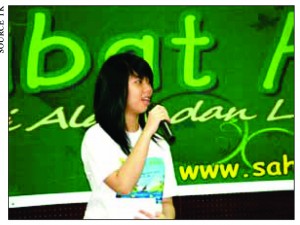
 Adeline was eleven years old and had just graduated from Primary Six in Indonesia when she first got involved with protecting the environment. “I think the most important environmental issue that we face in Indonesia and the world today is Climate Change, which has already disrupted our environment and communities,” she says, “Disasters such as floods, drought, and sinking islands could become more frequent and more severe. Those concerns encouraged me to start asking children to understand, commit and act to save our Earth.”
Many of Indonesia’s low-lying coastal farms would flood if sea levels continue to rise due to global warming. Two thousand of the nation’s smaller islands could be underwater by 2030. Rising temperatures may shorten the rainy season and make storms more severe. These changes would affect Indonesia’s rice yield—the staple food for more than 230 million people.
“Nature is declining in quality at an alarming rate,” Adeline says, “starting from where we live and stretching to the sea—the river, the forest and the air that we breathe. The effects can be felt in the form of floods, air pollution and beach erosion due to climate change and global warming.”
But Adeline is hopeful. Speaking with wisdom beyond her years, she says that, starting at an early age, children need to be encouraged to grow a sense of love and caring toward nature and the environment.
 Planting Trees in a Fragile Land
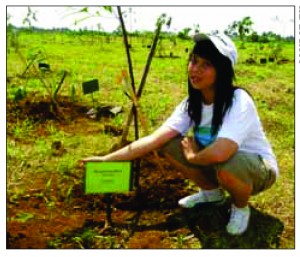
How does an eleven-year-old start to save the world? In July 2008, after graduating from primary school, Adeline spent her holiday teaching friends about the importance of mangrove trees. Soon they were planting mangroves at Taman Wisata Alam Angke Kapuk, the Jakarta Mangrove Rehabilitation Center.
She says that in order for the project to succeed, it was important “to make children include their parents so that they start realizing that it is time that we contribute to the world to save our mother nature from destruction.”
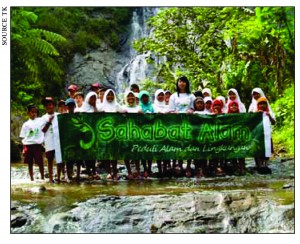
Adeline’s enthusiasm is contagious. She and her colleagues soon formed a group called Sahabat Alam, or “Friends of Nature.” The number of children who joined Sahabat Alam and the environmental projects they took on grew quickly. The group’s activities included ecotourism, planting coral reefs, freeing Penyu Sisik (hawksbill turtles) and cleaning marine debris from beaches.
Several national and international Environmental Organizations have now recognized the work of Sahabat Alam. In May of 2009 Friends of Nature received the Biodiversity Foundation’s (Yayasan Kehati’s) Highest Award and Appreciation in honor of the group’s commitment toward developing awareness among children and youth as the next generation of stewards of Indonesia’s biodiversity.
 Adeline says she feels honored that she was awarded first place in the 2009 International Young Eco-Hero Awards (for ages eight to thirteen) by the San Francisco-based Action for Nature, a non-profit organization that aims to inspire young people to take action for the environment and protect the natural world in their own neighborhood and around the globe. She was also selected as an Indonesian Delegate by UNEP (United Nation Environment Programme) to participate in the 2009 TUNZA International Children’s Conference in Daejon, Korea in August 2009.
Adeline doesn’t see herself as being much different from any other twelve-year-old. “I am not the only Eco-Hero,” she says. “Children, youths and adults all over the world can do the same thing as long as they have the willingness and commitment. This comes first from the heart, then from sharing with friends and starting to take action.”
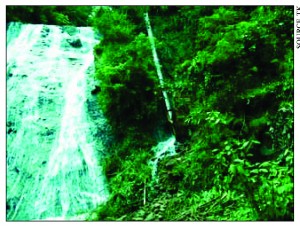 Helping Rural Families
Adeline also sees the connection between the needs of people and the natural world. “I would like to help our remote brothers and sisters to fulfill their dream [of] flowing electricity into their houses for children to study, watch television, cook and all other activities, especially at night.” She is now involved with a program that is bringing electricity into remote areas that have never before had power. She points out that, “Nearly half of Indonesia’s 235 million people live in areas without electricity.”
The solution? An Electric Generator Water Reel, a small hydroelectric generator that uses the natural power of a waterfall to produce what Adeline describes as “clean, environmentally friendly, Green, renewable and sustainable energy that does not increase the amount of carbon dioxide in the atmosphere or worsen the greenhouse effect.” The water reel simply turns in the falling water and doesn’t affect the waterfall or the flow of the stream. (See the box called “Reel Math”.)
Sahabat Alam is getting lots of help from parents and sisters, as well as the Indonesian Ministry of Environment. For the first installation, the group traveled to the region of South Cianjur, West Java, which is a four-hour drive from Jakarta. After walking up into the mountains for another two hours, the team finally reached the village of Kampung Cilulumpang. By the time they left, the villagers had electricity for the first time in their lives. The group is now building Electric Generator Water Reels for two other villages, and it plans to bring this project to villagers throughout Indonesia.
“Previously, children’s voices were not heard,” says Adeline, “but now, we are coming together to voice our commitment to our national leaders and world leaders, to make peace and start having one voice to save the Earth.”
“I share and affirm with all of them that, even with our small hands, children can initiate, contribute and implement environmental projects starting from their small community to nation-wide projects to contributing to the world by helping hinder climate change and global warming and save the earth from further destruction.”
“We are the next and future generations of the world. In our hands, the world and its contents are at stake.”

Resources
Adeline Tiffanie Suwana’s Friends of Nature website
Action for Nature
Change the World Kids
Young Voices on Climate Change
YouTube video for Catch the Wind, Harness the Sun
Sources That Explain Global Climate Change:
Tiki the Penguin
Global Warming Question and Answer Web Site, National Oceanic and Atmospheric Administration/
National Environmental Satellite, Data, and Information Service (NESDIS) Asheville, North Carolina
Renewable Energy for Kids:
EcoKids Canada, Earth Day Canada, Toronto, Ontario
Energy Kids, U.S. Energy Information Agency, Washington, D.C.
Curriculum Connections:
The Pembina Institute: Lessons & Activities, Curriculum Links
Natural Resources Canada’s Climate Change Teacher Resources: Grade 5
Michael J. Caduto, author, environmental educator, storyteller and ecologist, is well known as the creator and co-author of the landmark Keepers of the Earth® series and Native American Gardening. He also wrote Pond and Brook and Earth Tales from Around the World. His latest books are Catch the Wind, Harness the Sun: 22 Supercharged Projects for Kids (Storey Publishing) and Riparia’s River (Tilbury House). His many awards include the Aesop Prize, NAPPA Gold Award and the Brimstone Award (National Storytelling Network). Michael’s programs and publications are described on his website: www.p-e-a-c-e.net


by editor | Jun 13, 2014 | Schoolyard Classroom
Starting a Community-based Natural Resource Education Program

Strategies for Authentic Community Engagement
Authors Patrick Willis Oregon State University Extension 4-H Portland, Oregon
Susan Cross Environmental Educator Tucson, Arizona
lmost every school has a natural area very nearby. It could be that marshy place behind the school, the little stream or “ditch”, the unmowed field, or the patch of woods beside the parking lot. These natural areas are often overlooked as learning sites, or if they are recognized, they are not acted upon because we do not know exactly how to start using them. The intent of this article is to provide educators with a platform to begin natural resource programming at sites near their school. Philosophical as well as pragmatic information is shared to provide both intrinsic and conceptual connections for educators to engage youth in authentic community involvement in the natural resources. This information is intended to offer support, ideas, encouragement and new ways to think about what we do as educators. It is meant to inspire you and move you to action.
It is our hope that through programs that link schools with natural resource areas, citizen awareness and community involvement will increase. The vision is for schools to become vital resources for their communities and that students, through real world projects, become active participants in their society.
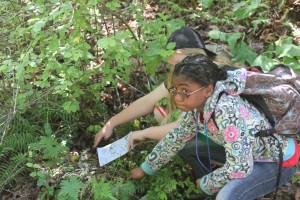 Why connecting students with natural resource areas have educational benefits.
A strong connection to the larger world community starts with an intimate local understanding. Children can apply knowledge of systems and concepts learned in a personal experiential world to global problems. Once they grasp the value and function of the forest, wetland, grassland or watershed in their school backyard, it is a short step to awareness about other watersheds or wetlands that they see in their own community, or to a concern about global environmental issues they hear about in the media. A personal stake in the lives of their wood ducks, red-tailed hawks or metamorphosing moths becomes an intrinsic understanding of the richness present in all ecosystems. A program such as this taps the innate desire of children to care for their world and allows them to do just that: to help, to clean up, to make better homes for wildlife, to gather information to guide decision making. It empowers them at the local level and gives us all a much needed assurance that active informed citizens can and DO make a difference.
Students involved in active hands on programs also feel better about the way they are learning. The students report that they have more fun and feel like they are learning things that they didn’t know before. Teachers say that their students really retain more of what they learn and can apply the learning in other situations.
In these times of being overwhelmed by environmental problems on every front, it is easy for people to lose their sense of hope and to feel defeated in the face of such looming concerns. This can be especially hard on young people, who have been inundated since early childhood with the magnitude of our planet’s problems. Working with young people in settings where they can impact an area in a positive way is a powerful tool to help them realize the healing potential they have as caring human animals.
Getting Started
Many educators find the idea of starting a program such as this to be intimidating…And it can be!! Teachers already have heavy workloads. It often feels as though there isn’t enough time in the day to prepare for classes, grade the day’s papers and still get to eat lunch! The extra work required to implement an on-going, in the field/community program can indeed loom large in the picture and cause many people to give up before they even begin.
 Sites and Site Selection
The initial step is to find a site around which to center your program. The site is an integral part of the program because it becomes the focal point for community involvement. Because of time limitations in our schools, the closer the site is to the school door the better. The site doesn’t need to be huge or elaborate. It can be the little ditch on the school grounds, it could be the marsh on private land across the street, it could be the little patch of forest left in an urban development, it could even be something that you restore or develop on your own school grounds. The ability to visit the site frequently outweighs any lack of “wildness.” In the reality of today’s shrinking school budgets, transportation money is drying up. A site within walking distance solves this problem, and makes all logistics easier.
After you determine what site or sites you may be able to use for your program you will need to find out as much as possible about the site. In an ideal situation, this entire process can be done by your students. You will want to find out who owns the property. Who is in charge of managing it? Can you use the site as a study center? Are there special things about the site? Is it a protected area? How will you minimize the impact of your student’s presence at the site? Get maps of the local area. Talk to homeowners associations and neighborhood businesses. Can you do enhancement work there? How could the site be improved for wildlife or educational uses? What kind of information would it be useful to have about the site? Who might best use that information? What is the history of the site? Are there any cultural values?
When you find out who is involved with your site you may be surprised to learn that those people need your student staff to collect information as much as you need them for their expertise. Some sites may be in private ownership and you may have to seek permission to use the land as a study site. This process in itself can be quite a learning experience for your students. Many schools are lucky enough to have natural areas on their own grounds, but you may still need permits to make changes. Each place has its own unique combination of political circumstances just as each place has its own unique natural character. Let the problems you encounter become learning challenges. Help your students learn about how the world outside the classroom operates. The problems you face will lead to the development of valuable life-long learning skills.
Willingness to Change Attitudes and Structures
Often the success of innovative programs depends on our ability to think in new ways. Change is never easy and is especially hard to create in institutional settings. It is difficult to envision new roles for ourselves and new shapes for our old models. With the momentum for educational change coming from the state level, the atmosphere for programs of this type is good, and you could be on the leading edge of this change. The watchword of the hour is flexibility.
 Changing Teacher Roles
In this kind of program the teachers may have to recreate the way they interact not only with their students but also with their peers and administrators. You may find yourself much more of a coordinator and learning manager than a deliverer of set curriculum. You may find that the most important function you can serve is finding access for your students to partnership opportunities with other adult instructors. You may spend your time locating project ideas, equipment and funds rather than directly teaching lessons. You may need to spend time on the phone coordinating an event or writing proposals to fund your program’s newsletter. It is not the role you are probably most familiar with and it can seem like a leap into the unknown. It can also lead to personal growth and a great deal of fulfillment as your program blossoms.
Changing Educational Models
Everyone involved in education agrees that our current model doesn’t seem to be working. Students are not entering the adult world prepared to meet the challenges of a rapidly changing and complex world. Demand for people who can work cooperatively, be self motivated learners and understand complex systems is growing in every field of endeavor. Schools somehow need to provide their students with opportunities to learn the skills of citizen action, exposing them to processes and systems both natural and social. Students need to have real world experiences with real world consequences. Programs such as this can offer those opportunities. Schools could be in the business of finding community needs that aren’t being met. Schools could become a resource for the community instead of being viewed as a drain on resources. The school, through a program, could provide opportunities for students to interact with their community and society using meaningful projects that need to be accomplished. A great deal of excitement and motivation builds around an idea when students are producing work for a real world audience with a real world purpose. Think of the schools as a pool of highly educated leaders with a large motivated work force that just needs to be focused and applied to the needs of the community!
The Time Issue
Time, or the feeling of never having enough time, is a stumbling block in the initiation of Community-based programs. How much time should be allocated for activities related to the project? How will the teachers involved find time to organize materials, field work and special events? Is one day each month enough field contact? Perhaps one day each week may be needed. How will this program fit in with music, social studies or math? Is a 45 minute period enough time to get out into the field, do a study, and then get back? All these time questions are quite valid and need to be explored. But our attitudes, those hidden assumptions behind our time feelings also need to be explored. How did our school day come to be fragmented into 40-45 minute blocks? Does it have to be that way? Can our scheduling be more flexible without a loss of quality?
Using a thematic or project based approach to interweave your Community-based program into several subject areas can increase the amount of time spent in the field or community. Math can serve to interpret collected field data. Art could be the designing of logos or signs for the site. Music could involve songs written about the area and performed at a school wide celebration. Pursuing permission to have use of a site, or to make changes at a site, could serve as lessons in political science. Keeping journals or producing an informative newsletter is a natural for writing and language.
You Don’t Need to be an Expert
A general fear many educators experience is that they will be asked about something they don’t know. When beginning a program that involves a natural resource area there will be tons of things you don’t know, and that will be part of the excitement. As teachers we have the feeling that we should always be able to answer every question like an expert; but we may want to consider that the “teacher-as-learner” may be a more powerful model than the “teacher-as-dispenser-of-all-knowledge”. Being able (and willing) to say, “I don’t know, but let’s see if we can find out,” is a virtue in an educator, not a sin. Think of the program as an opportunity for you and your students to learn about an ecosystem together. Curiosity, enthusiasm and access to good reference materials are far more important than teachers having all the specific information on a particular environment locked away in their brain.
Program Planning for Administration Support
Having the support of your administrator may allow you to arrange for time to do planning for and coordination of your program. With good administrative support and communication, substitute time may be possible for planning, attending development classes or for special field programming for your students. It is almost impossible for teachers to teach a regular load and to just add on another program. Realistically the teacher who takes on a project of this sort will need time and support from their school. Your formal proposal may give your administrator a powerful tool for acquiring a commitment from your school board or district for that extra time you will need.
Project Plan Outline
Another important part of beginning a program is the time spent early on in the planning phase. If you take the time to examine your hopes and limitations, to determine what your goals are and to commit those to paper, you will have come a very long way toward establishing something concrete to build the program on.
The proposal form (Figure 1) will help you create a document you can use to approach school administrators, fellow staff members, and potential partners. It will help you clarify your group’s goals and priorities. Your proposal form, or “white paper” describes the vision and who should participate, the benefits of participation, and the benefits to the community. In addition, the project plan often contains language very useful in future grant proposals. Whether your project is simple or complex, you and your group will benefit from taking the time to ask yourselves the questions contained in the form.

Community-based Program Strategies
You have a program proposal, you have administration support, there is building enthusiasm for the project…what do you do next? The following are tested and well established examples about how to generate and sustain interest in the program as it develops.
Create an Identity
Your students and others involved in the project will have much more ownership if the site you have chosen has a name or an identity. It is probably more powerful to have the students highly involved in the process of creating an image for the site rather than having an image imposed on them. You will want to guide them in coming up with an attractive logo that can be used on your future newsletters, correspondences, signs and t-shirts. You may want to consider letting people know what your purpose is in the construction of the name. Are you a resource center, a study center, a technology center, or something else? Is there some special plant, animal or geographic feature at your site that would make a good symbol or icon?
 Increase Community Contact
Support for your program will grow if people know about what you are doing. Cultivate a relationship with your local media. Let them know when your students will be out in the field, when you are putting up a sign to identify your site or have special activities planned. Your students can write and publish a website or a simple, informative newsletter about their involvement and successes. Invite partners and potential donors or other influential people in your community to observe what your students are doing. People often like to jump on the bandwagon of an interesting project and partnerships can develop from public knowledge of the program.
Create a Student Leadership Component in Planning
You can plan yourself silly, but if the project doesn’t have student ownership and support your plans will soon sink with apathy or resistance. Students need to feel like it is their program. They need to be active citizens in the process right from the beginning. Having student representation at the planning level will lend legitimacy to tasks proposed for students to accomplish. It can be a powerful growth experience for the students involved.
Spend Some Time on Aesthetics
If you think back to your own interest in the natural world it is usually linked very closely with a sense of place. Allow your students time in their special environment to observe the natural world in a holistic way. Love of the natural world doesn’t come from performing pH tests. It comes from watching spiders build their webs or resting in the sun in tall grasses and listening to a killdeer sing. Set up intentional aesthetic activities for your students early on in the program. You’ll end up with strong advocates for the site. Emotional responses to the environment are not irrational responses; and emotional ties to place are often the best motivations to action!
Approaching Resource People
Depending on your circumstances you may want to use resource people as special advisors or you may want to form partnerships with one or more of them that includes actually working on projects that they are involved with. Resource people as guest speakers in the classroom probably has limited value. If you can arrange for your students and staff members to work directly with resource people it can lead to much larger rewards for everyone. Because most resource people have many duties in their job descriptions, they are busy people. If you can approach them with detailed specific needs and directions about how they might help you with their expertise, their time will be used much more effectively.
Funding Ideas
Money always seems to be a limiting factor in program development, but don’t let a lack of funds discourage you. Many activities can be done without much money. Exploring and getting to know the site, doing plant and animal inventories, making maps, observations of seasonal changes or planning an awareness celebration for the school or community can all be accomplished with a minimum of funds.
Keeping the community and the media aware of your plans and goals can lead to opportunities for donations from businesses such as volunteers, money, equipment or supplies. Parent/Teacher organizations can be a source of funding as well as a source of volunteer helpers. Motivated students can also be excellent fund raisers using all those time proven school fund raising techniques. You and your students may also be able to come up with a product associated with your site such as t-shirts with a logo, wildlife art or photography from the site, or some other product or service. Cities or counties may be able to donate time or materials. Agencies sometimes have funding for plantings or restoration work. Cities and agencies may be able to provide tools and advice from staff people.
There is always the potential for grant writing as a source for funds. This approach to raising money is often available but comes with the fears of how to get started, who to ask, what to say and, of course, finding the time to write the grant. Another factor to consider is the fear of getting the grant. Most granting organizations require you to do what you promised in the grant! This is where your program plan becomes a valuable resource. A good plan is the first step in approaching a funding source. As for who to ask for funding, the list of possibilities can be overwhelming. Start with a few inquiries with local agencies and ask others who have written grants. Most people are very supportive and helpful. If you stay with a reasonable plan, your program will blossom with the assistance of a grant and not degrade into unfulfilled dreams.
 Field Techniques
Many teachers feel uncomfortable taking their students outdoors. It is a much less structured setting and chaos can quickly ensue. A bad field experience can leave a leader longing for those wonderful rows of desks back in the building. Field study does require some special skills and planning, but the harvest you and your students reap is rich!
There are some risks being in the natural world, from twisted ankles to bee stings; but the possible rewards far outweigh the risks. Safety is an important concern in the field. Make sure you have a first aid kit with you and know what to do in an emergency. You may want to check on your school’s insurance policies for field settings. Many risk factors can be greatly reduced by explaining clearly to your students what your expectations are for behaviors in the field.
Setting the same kind of clear behavior expectations for the field as you have in your regular classroom is essential. Let students know that you have boundaries that they must respect, being sure to be clear about what areas are off limits and why. Have set work areas for each group. It is often easier to explain tasks and rules inside the normal classroom setting before you set off into the outdoors to do your field work.
Spending a bit of time on field ethics is a valuable thing. Students don’t automatically know that they need to be quiet, to not disturb plants and animals unnecessarily, or that horseplay is not acceptable. Most of the time when we allow students to be in the out of the classroom is for unstructured play. It takes some training to get the message across that outdoors doesn’t always mean recess.
Group size is another important factor in the success of field work. Small groups function much better than large groups. Have a job for everyone. Having tasks that keep the students focused brings the potential for misbehavior down. If you are the only leader, use a “hub” approach. Have a central location from which you disperse and gather your student work groups. It is also important to realize that not all students need to do everything. Often it is better to have students become the “experts” at a certain job or subject area and to share their findings and knowledge with the others.
Minimize Your Impact/Earth Ethics and Etiquette
One of your most important roles in the program is as a role model for student behavior. Your actions speak much louder than your words and children will treat the environment much the same way that you do. This can be an enormous opportunity to teach outdoor ethics without ever saying a word. Your decisions about collecting, the way you treat plants and animals in the environment, and what your expectations are for your student’s interaction with the site are all powerful messages about how to treat the planet. Children should be engaged in decisions about when, why and how to collect samples. Is it appropriate? Is it necessary? What valuable thing will we learn from the experience? Examine ways in which your visits impact the natural world. Are there ways that we can reduce those impacts and still learn the things we want to? How long lasting are our disturbances? Bringing these kinds of questions into the consciousness of your students will help them to form and examine their own beliefs on these issues.
Conclusion
Change will only come to our systems through the efforts of individuals. Though change is difficult and frightening, it is also empowering and growth producing. It is up to you to try things out, to experiment with ideas and to not be afraid of failure or of success. BE ALERT! This approach to student/citizen involvement can become a self-perpetuating system…a machine that may be difficult to stop once engaged!! Don’t be surprised when you become the center of excited interest emanating from your students, their parents, your colleagues and administrators! We owe it to our students and community to try!
Pat Willis is a distinguished environmental educator currently with Oregon State University Extension 4-H.
Susan Cross is a former EEAO member and Oregonian now living in Arizona.
by editor | Jun 13, 2014 | Forest Education
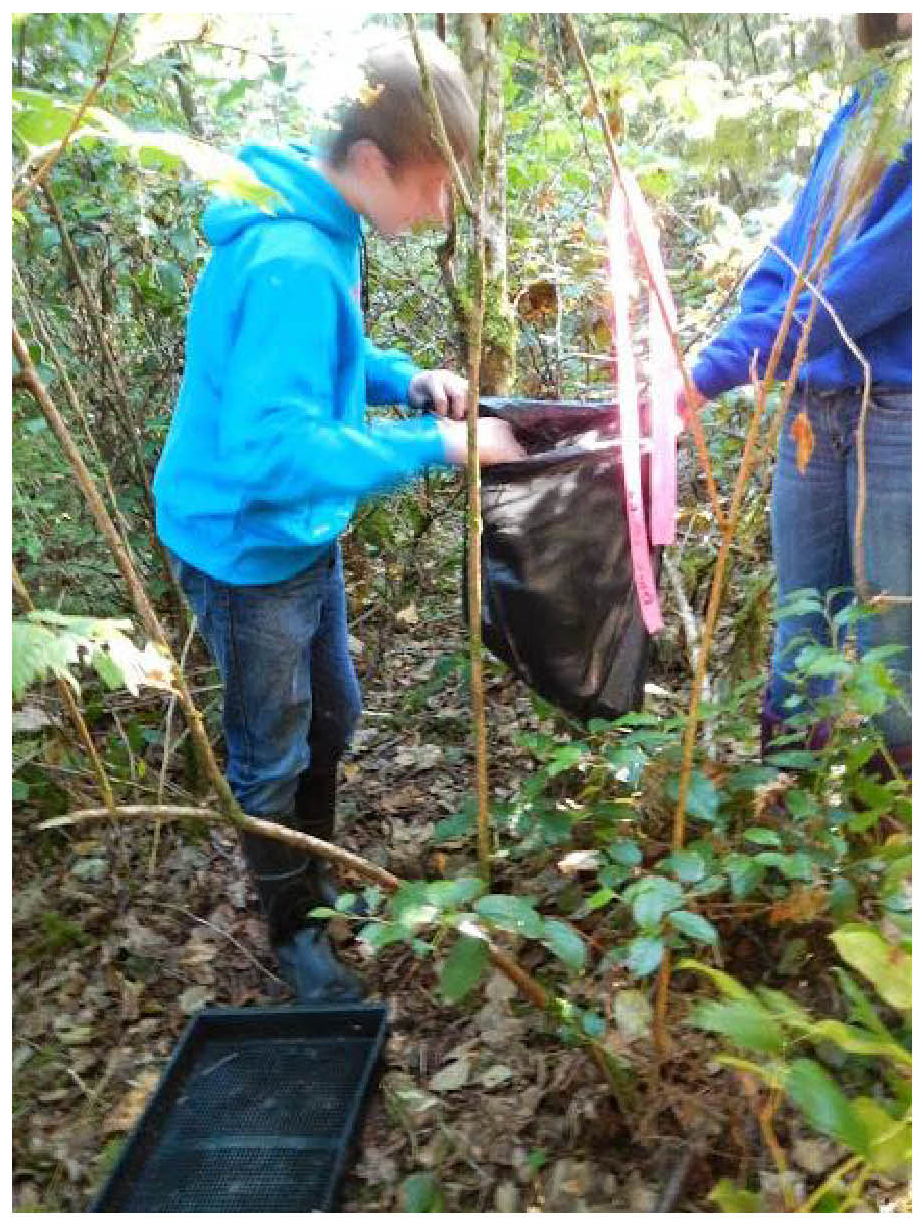
The LitTER Project: A field method for using litter-fall to study carbon cycling
by Lee Cain & Nick Baisley
Astoria High School Science Department
ABSTRACT
During a NASA funded Teacher-Researcher Partnership program focused on bringing Global Warming and Climate Change into the classroom, a long-term ecological study was created to get students into the field to research leaf litter fall as it relates to the carbon cycle.
Through photosynthesis, carbon in the atmosphere is converted into plant matter, which then will fall to the ground as it continues to be recycled in the carbon cycle. Our investigation is designed to answer the following question: “What is the rate at which carbon as leaf litter moves from a coniferous forest canopy to the forest floor (C-flux as Mg/ha/yr)?” A secondary question we are hoping to answer with this study is: “How does the rate of C-flux relate to coniferous age and management techniques?”
For comparison we selected one 60+ yr. old stand, a 30-50 yr. old recently thinned stand, and a young closed-canopy regenerating clearcut (15-20 yrs. old). In each stand we laid out two parallel transects, each with nine litter traps (plots) spaced 10 meters apart. Along each transect we also placed a HOBO temperature and light data logger.
We are collecting, drying, sorting, and finding the mass of leaf litter, and other sources of carbon, that have fallen into the traps. With only one fully completed set of data, we have yet to begin to answer the key questions of this study. We foresee a period of at least five years before we gather a significant data base. The purpose of this preliminary year was to choose our sites, establish transects, and work through any logistical or methodological challenges that present themselves. In the fall, students will begin taking regular field trips to the sites in order to collect and analyze the data.
 ig forests, big trees. Steep slopes, moss, and mycorrhizal strands of hyphae exposed under sliding boots. Climb up the slope, scramble down the log, lay the tape out, and spread the calipers. Then back up the slope again over the crisscrossed giant pick-up sticks to get the next measurement.
Later, taking a break for lunch, smashing microscopic biting midges against our sweaty arms, we have the chance to gaze upwards at the giant columns and wonder about what each tree has witnessed in its four or five centuries of existence. Then lunch is over, and it’s time to lay the tape out again.
This goes on day after day. Two science teachers from Astoria High School, we were in the H. J. Andrews Experimental Forest in the Cascade Mountains. This forest is part of the Long Term Ecological Research (LTER) Network, created by the National Science Foundation (NSF) in 1980 to conduct research on ecological issues that can last decades and span huge geographical areas. We were working with Dr. Mark Harmon of Oregon State University’s College of Forestry to take follow-up carbon storage measurements on forest research stands that had not been measured since the ‘70s and ‘80s.
In the following week in the computer lab, we take apart the measurements and put them back together again. On graphs, the data slowly begins to crystallize in our minds. We begin to realize that the carbon cycle is not working in the same time-frame as our short lives. It takes time for change to happen. Perhaps much more time than we have to repair the damage that we have done in a relative blink of an eye.
We now notice forests differently. We see logs in a way we did not before. Or rather, we see their absence. Replanted and managed forests appear to be empty – something is just missing. It is not just a sense of something missing – one can visibly notice the absence. No giant pick-up sticks lying crisscross on the forest floor. Such a void of stored carbon.
Back in the classroom, our challenge was to get students to see the actual carbon cycle as we have, and not just as an abstract diagram in a textbook. Then they might just be able to understand their own role in the cycle. We knew that time would be the enemy, because we never seem to have enough of it. But if we can get them to see the carbon falling, even one leaf at a time, then we will have begun the process. So we came up with the “LitTER Project,” a long-term ecological study (9th grade Integrated Science) of the movement of carbon from the forest canopy to the forest floor as falling leaves (litterfall). We realized it might take 5 years or more before we acquire any really significant database, but hoped that the process of getting kids to actually handle the litterfall would set into motion a greater awareness of the carbon cycle.
Our key investigative question was, “What is the rate at which carbon as leaf litter moves from a coniferous forest canopy to the forest floor (C-flux as Mg/ha/yr)?”
A secondary investigative question was, _“How does the rate of C-flux relate to coniferous age and management techniques?”
METHODS
Litterfall Traps — Three sites were selected within the Astoria area to give a wide range of forest ages and management approaches, yet also to be close enough to the high school to be practically accessible. For comparison we selected one 60+ yr. old stand, a 30-50 yr. old recently thinned stand, and a young closed-canopy regenerating clearcut (15-20 yrs. old).

At each site, two transects were laid out parallel, 20 m apart. All transects were set to have a 360 N orientation to be consistent in terms of solar angle of incidence. Nine litterfall traps (plots) were spaced along each transect at 10 meter plot intervals.
Each litterfall trap consisted of a black plastic rectangular floral tray (43 cm by 43 cm ~0.2 m2) lined with window screen to keep all litterfall from passing through the grid of the floral tray. Two wire surveyor flags were used to anchor through the trap into the forest floor and hold the mesh in place. The fluorescent flags helped to aid finding the traps on later visits. In addition, a surveyor’s ribbon with plot identification was tied to a nearby branch. Each plot was cleared of branches for 1 meter above the center of the trap.

A canopy cover photograph was taken by standing directly over the trap and shooting straight up. A HOBO temperature and light data logger was also placed next to each transect. This photograph can be digitized for percent cover using Photoshop or a similar software. Percent cover can then be used to draw relationships with carbon flux rates.
Student Visits — Students were bussed to the study sites and allowed about 1.5 hours to collect the first samples from the traps. Each team of 2-3 students was responsible for collecting the samples from one plot, and re-setting the trap to level and clearing the forest floor to level, flagging the branch above the plot and taking the canopy cover photograph.
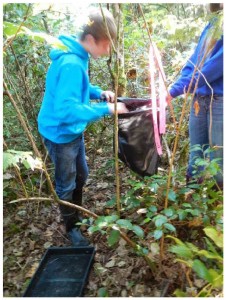
Processing Samples — Litter from the traps was placed into black plastic bags labeled with masking tape and trap information. The empty trap was returned to exactly the same position until the next collection date. The bags were tied shut and taken back to the lab, where they were then spread out to dry for two weeks at an average temperature of 25 C. In teams, students then sorted and weighed the litter samples to the nearest 0.1 grams (Table 1) in the following categories: needles, broadleaves, total leaf, woody matter, reproductive (seeds, flowers, etc.), total plant, mineral matter, and animal (bug parts).
GRAPHS AND FIGURES
Table 1 – Teams of students were given single data tables to initially record the sorted raw weights:

Table 2 – Excel was used to summarize the raw data:

Figure 1 – Graph of summarized results of the first month of data collection:
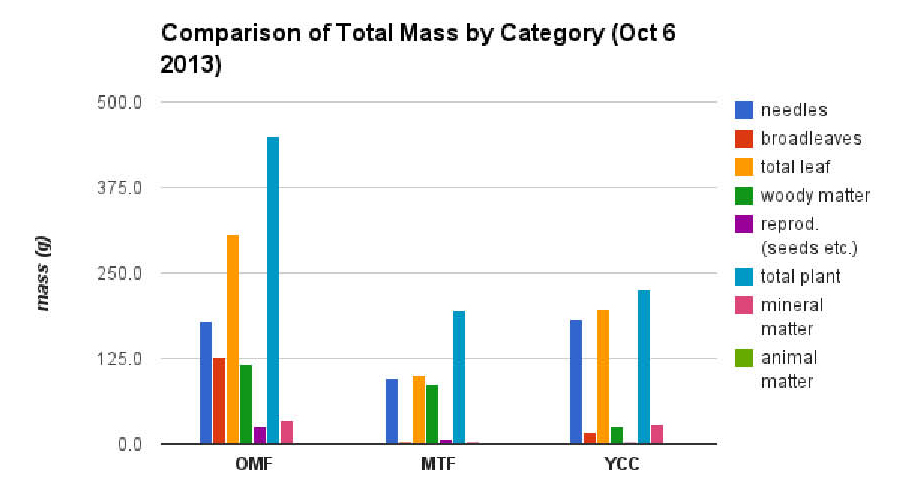
DISCUSSION
While only one data collection had been completed at the time of publishing, the tables and figures in the previous section should give an idea of how we have arranged the data.
The most obvious result in the data, though it is early yet, is that there are apparently significant differences between study sites in terms of total leaf mass compared to woody matter. Over time, these differences should develop into differences in the rate of carbon flux in the three different systems. This should not be surprising, yet is exactly these sorts of differences that students will likely not be able to see prior to participating in a LitTER project. Because there is only one sample event so far, we have not yet constructed picture of the carbon flux as litterfall over time. What is not known at this time if these differences maintain their relative distances or if it equalizes over time.
 While we are looking forward to pulling out these and other relationships from the data, we are mostly excited by the potential of this project as a tool to get students involved in science inquiry. Students become highly engaged during the data collection and processing. There are also many directions that we can go with the student learning about climate change with this project as a base.
There are still a few areas in the project protocol that we need to revise. Originally, the data collection was planned as a monthly activity that rotated between six Integrated Science classes throughout the school year. But it immediately became apparent that this didn’t work with the busy pace of school and the unforeseen effect of weather (windstorms, rain, snow days).
It is also a major organizational effort to get even one class of student scientists out to the nearest of the sites, let alone bussing six different classes to all of them. To adjust to this, we are now planning on making the data collection quarterly. Three times throughout the year, we teachers will team to collect the data (about 2 hours per site). This approach may eventually fall into the form of a senior project, to be carried out by a capable science-minded individual or group of individuals. Our 9th grade students will now experience the field data collection just once per year, on a fall day devoted to the project. While this is not as ideal as more frequent field trips, we feel that this is a balance we have to make to accommodate the public school setting of our project. At least this way the students have that field experience to help them to better relate when participating in the multiple data analysis events in the laboratory.
REFERENCES
Muller-Landau, H.C. and S.J. Wright. (2010) Litterfall Monitoring Protocol, March 2010 version.
F.S. Peterson, J. Sexton, K. Lajtha. (2013) Scaling litter fall in complex terrain: A study from the western Cascades Range, Oregon. Forest Ecology and Management 306, 118-127 Online publication date: 1-Oct-2013.
This article was submitted for ED 901 – Researcher Teacher Partnerships: Making global climate change relevant in the classroom Spring 2014 ; Oregon State University & Oregon Natural Resources Education Program (ONREP)


