by editor | Sep 16, 2025 | Environmental Literacy, Gardening, Farming, Food, & Permaculture
Living Soil and Composting: Life’s Lessons in Learning Gardens
by Dilafruz Williams and Jonathan Brown, Portland State University
After we spread the chicken poop, we covered it with hay… the poop was the fertilizer and the hay was the stuff that kept the plants warm. After school I checked the garden. Empty. Nobody. I climbed the fence to check the radishes [I had planted.] I dug around the radishes. They seemed dead. I grabbed a magnifying glass and looked closely at the leaves. Aphids were chewing on the leaves, like ants or other bugs. I went home worried.
Next day [I went to check the garden.] Something red flashed in my eye. I panicked. “Yhaaaa!” I screamed with terror. I looked down expecting to see some poisonous bug. It was a pair of ladybugs, maybe mating. The answer to the radish problem right in front of my face!
-3rd grade student journal (from Clarke, 2010)
This journal entry conveys an eight year old student’s understanding of the web of life: how to use natural fertilizer, ways to warm the soil to create favorable conditions for plant growth, and the role of beneficial insects in a school garden.
Beyond distant field trips, learning gardens provide a locally relevant context for such multi-faceted environmental discovery right on the school grounds where learning is housed; they bring children into contact with a vast biological and cultural web of relations embodied in the living soil of compost.
We celebrate learning gardens as sites for integrated learning that can help students develop an intimate connection with land, insects, plants, and soil through awakening their curiosity, wonder, and critical thinking skills. Life is about more than head and gut; our fingernails, skins, palates, nostrils, and tongues are also important in nurturing deep and long lasting bonds of environmental kinship. In this essay we highlight compost-making as a practical school garden activity that builds living soil and serves as a metaphorical guide for learning about life.
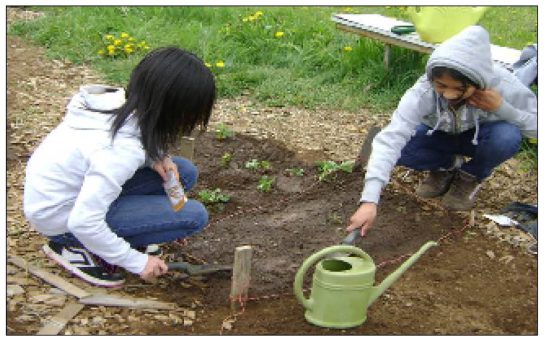 Where is the Learning in Learning Gardens?
On March 20, 2009, First Lady Michelle Obama joined children from a local public school to break ground on the South Lawn of the White House, establishing an organic vegetable garden with special attention to health and nutrition. In doing so, she has validated the recent surge in the school gardening movement.
Simultaneously, garden-based learning is being supported by state and local curricular efforts to align standards and to provide design support.1
An avenue of environmental education, school gardens are unique as they are located directly on school grounds. This makes for dynamic learning as “the environment” can less easily be separated from daily human activity. Walking through gardens on the way to and from school encourages students to develop a sense of ownership, to connect with the natural world, and to observe subtle seasonal changes, as the opening journal excerpt demonstrates.
Both of us have been involved in the design and development of gardens on school sites and have partnered with teachers, and students of varying ages, to support their learning. Garden-based learning is considered an instructional strategy that utilizes a garden as an instructional resource, a teaching tool that encompasses programs, activities and projects in which the garden is the foundation for integrated learning, in and across disciplines, through active, engaging real-world experiences. In some settings it is the educational curriculum and in others it supports or enriches the curriculum (Desmond et al., 2002, p.7).
The resurgence of school gardens and garden-based learning across the country in school districts large and small appears to have multiple purposes and outcomes: aesthetics, growing food, developing healthy eating habits, rain-water harvesting, interdisciplinary learning, social development, multisensory learning, play, academic learning (particularly science), instilling morals, intergenerational learning, healthy habits, and physical activity (Williams & Dixon, forthcoming). Multicultural gardens have been successfully used as context for teaching about regional cultural history (Kiefer & Kemple, 1998) as well as English as a second language (Cutter-Mackenzie, 2009). Potential application of gardens in education is seemingly endless. This interest in integrated real-world learning has made the school garden an instructional resource and tool as viable as a classroom. As a result, school gardens are often viewed as “outdoor classrooms” (Dyment, 2005). For Parajuli and Williams (2005), the following four-fold framework highlights the role of interconnectedness in learning gardens pedagogy:
- To promote multicultural learning representing multiple agricultural and culinary traditions of the parent community.
- To foster multidisciplinary learning, connecting math, science, social sciences, languages, arts and aesthetics.
- To cultivate intergenerational learning between young adults and their parents, grandparents and other relatives.
- To nurture multisensory learning by involving not only our heads but hands, hearts, skins, tongues, intestines, and palates.
Thus, school grounds can become community hubs that integrate learning across disciplines, generations, and cultures, and get students to think in terms of patterns and connections (Williams, 2008). From our experiences, we offer an illustration of compost-making where students learn about life’s lessons in the learning gardens.
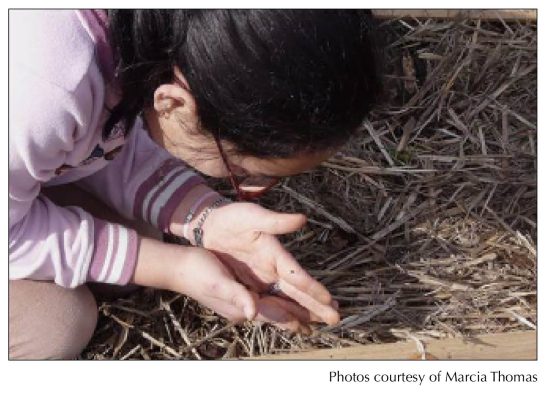 Composting for Living Soil
While food is the most palatable product of gardens, compost is the most desirable. Since long neglected soil on school grounds is often nutrient deficient or polluted, active composting makes a contribution to living soil which sustains related human and biotic communities.
Unfortunately, the gardening season is out of sync with the academic school calendar; just as students are arriving for classes, the rich abundance of the summer fades to withering stalks and muddy fields. While this can be an obstacle for educators seeking to integrate gardens into their practice, it presents an opportunity for compost-making, which sets in motion a long-term investment in living soil.
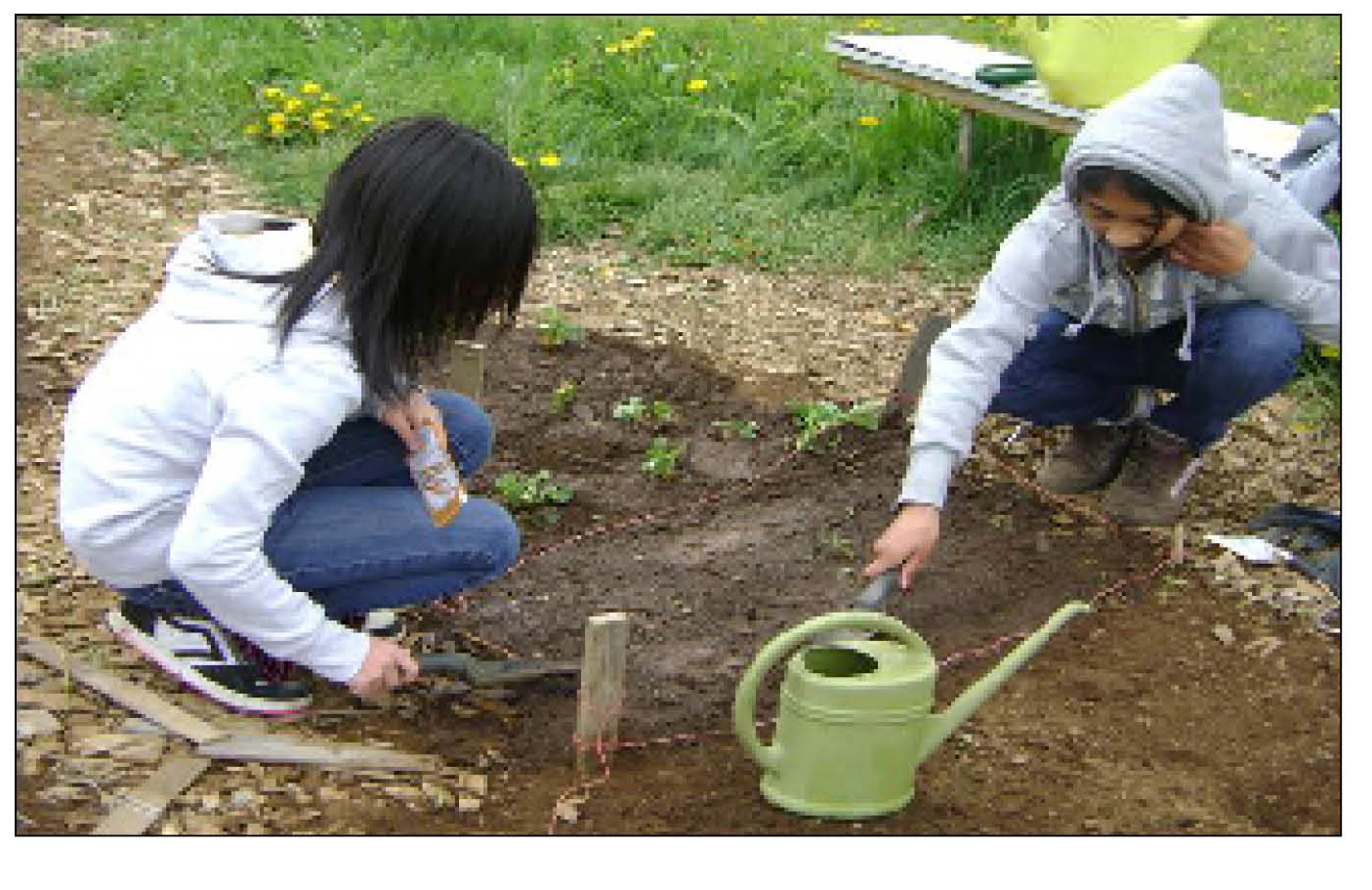
Imagine a fall day in the garden, where 20 6th grade students are busily harvesting ripe produce in small groups led by teachers and community volunteers. There are a number of work stations, including picking pumpkins, mulching fruit trees, and building a fall compost heap. Not many students are drawn to the compost heap, perhaps because it is “dirty”, but eventually two students—Santiago and Katie—agree reluctantly to help Rick, a community volunteer, gather different types of biomass for the pile. The trio retrieves a wheelbarrow and begins to gather fall leaves from the small orchard.
Katie notices that underneath the moist leaves there are many organisms such as millipedes and sow bugs. At first, she is nervous to touch them, but soon overcomes her fear. Rick explains that moist leaves are a natural habitat for decomposers, and that the compost heap that they are building is an ideal home for these organisms to flourish. Santiago gets excited managing to steady the wheelbarrow when it is filled with donated rabbit manure. Though he is first disgusted by the mixture of straw and manure, he soon finds pride in being strong enough in body and spirit to fill and pilot the wheelbarrow.
Back at the compost heap, Katie and Santiago work together to cautiously combine their gathered biomass in a careful formula presented by Rick. Other students notice their project and inquire about what they are doing. Katie explains that the decomposers are just like humans, they need food, water, and air to live. Santiago shows his friends how to add layers of leaves covered with layers of manure. Soon many students are gathered around the growing compost heap, helping to water it and keep it within the bounds of the wooden bin.
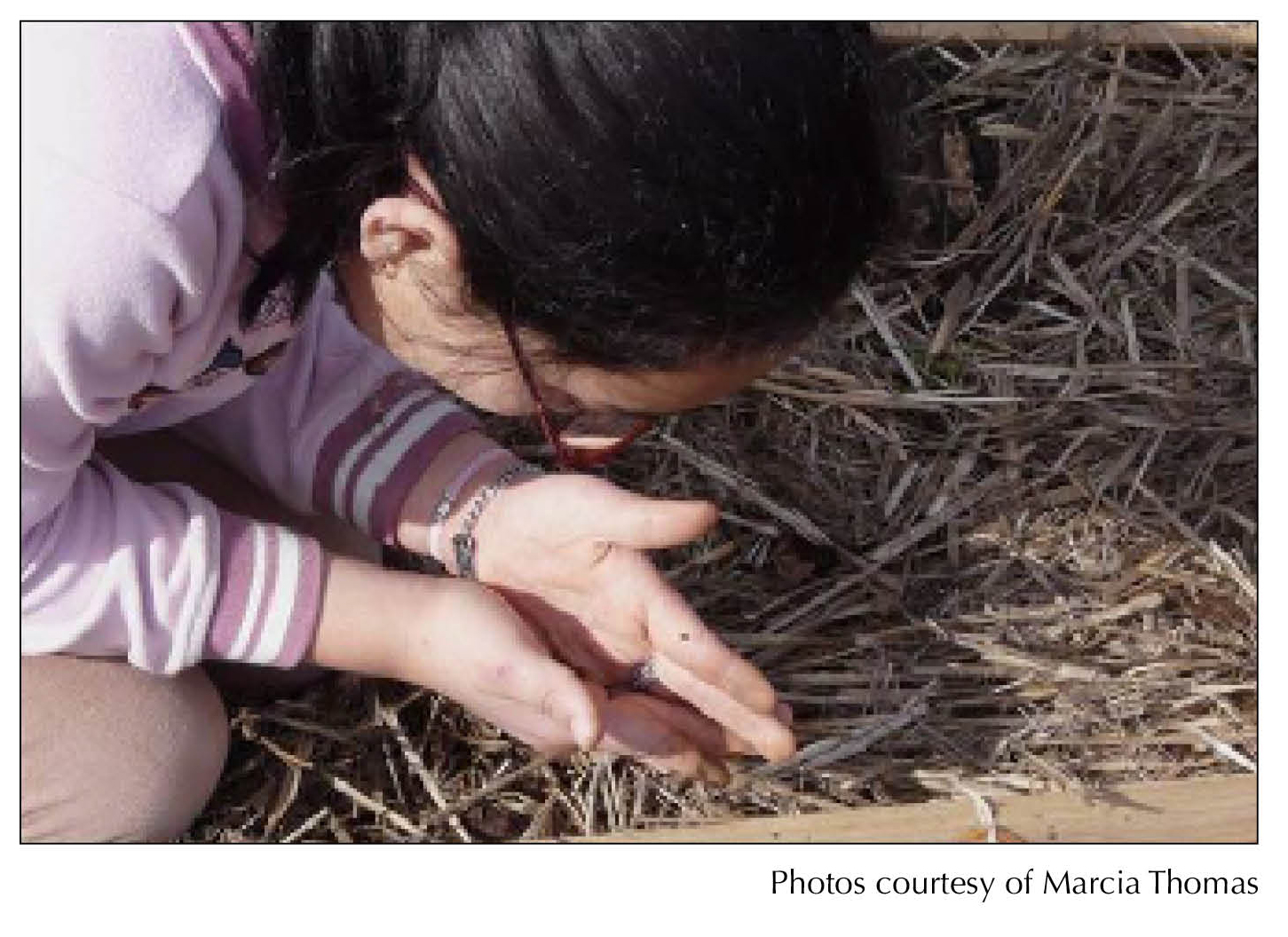
Some students are brave enough to reach a gloved hand into a nearby compost heap that is more established; they notice it is hot. Removing their gloves, they remark with surprise that the compost does not smell and that they cannot recognize any leaves or straw in the maturing heap. They wonder aloud how long it would take to transform the rough pile of leaves, sticks, and straw into one that looks, feels, and smells “just like dirt.” The garden period ends and the students and their teacher return to the school building for the rest of their day. But the lesson does not end there. At snack time, Carlos, a particularly observant student, announces to the class that their apple cores can be added to the compost heap; the class community finds a way to collect the cores. Compost now enters classroom walls as students and teacher reconnect with the core of life: living soil. Decomposition becomes as relevant as Composition.
The preceding story is no fantasy, but an account of our actual experience with children building compost in school learning gardens. There is a wide array of curricular material describing teaching various forms of composting in greater detail.2 Below, we present a lesson sketch (adapted from Parajuli et al, 2008):
Lesson: “Living Compost: What is it and how do we make more?”
Description: This lesson introduces students to compost and the biological processes behind it. Students make a simple compost pile and watch as it changes over the next few months. They also closely examine the critters that make compost their home.
Lesson Outline:
10 min. – Introduction
90 min. – Small groups work in three 30-minute rotating stations:
Station One: Critters in the Compost
Station Two: Making a Compost Pile
Station Three: Early Winter Harvesting and Bed Preparation
10 min. – Reflection & Clean Up
Educational Goals /Skills:
1. Learn what compost is and its role in the garden
2. Learn how to identify common compost and soil organisms to appreciate them
Activity Station: Making a Compost Pile:
1. Introduce the cycle of life and the concept of decomposition. Explain that by building a compost pile, we build a home for decomposers.
2. Ask if anyone can describe what a decomposer is or what it does.
3. Introduce the “FBI”: fungus, bacteria, and insects. These are decomposers that will break down the compost pile.
4. Have participants give examples of biodegradable materials that they might throw away at home or at school (banana peel, dried leaves).
5. Ask participants to describe possible reasons to compost.
6. Introduce the “BIG FOUR”: browns (e.g. leaves, straw), greens (e.g. grass clippings, food waste), air, and water.
7. Explain procedures: (1) chop materials to 6 inches or less; (2) mix browns and greens; (3) maintain moisture equal to a wrung-out sponge.
8. Have the group collect brown and green materials in separate piles.
9. Assign students various tasks such as chopping, layering browns and greens, mixing, and watering the pile.
10. Once the pile is built, review basics of composting and why it is important.
Compost-making teaches many lessons such as: change over time, cycles, decomposition, life from death, the role of microorganisms in sustaining life, and food webs. The traditional meaning of the term “harvest” is turned on its head as students first harvest food waste and garden debris with which to build a compost pile, then months later harvest rich soil and earthworms from the bottom of the compost bin. This puzzles students and draws them into the cycles of life: “bugs” become invertebrate partners in helping to break down biomass into a form usable by plants; and compost serves as an intergenerational gift to future students and the school grounds themselves. Plus, they grow seeds in this compost-turned-soil: the miracle of life presents further bounties. Students learn one positive model of environmental regeneration. Via composting, life’s lessons simultaneously surface and find roots in the learning gardens.
As food producing sites often marginal in relation to school buildings and other concrete educational infrastructure, school gardens are islands of biological activity within a sanitized and homogenized school environment. This contrast itself can stimulate critical questioning about the broader community context of learning in relation to life, as a 7th grade student reflects:
It is strange that people can take pride in large lawns and waste their land with simply growing and cutting grass. If we plant gardens instead, and can also grow food, we can bring wildlife and at the same time eat healthy fresh food. I am worried that bees are dying in our region; how will our flowers get pollinated? How will we have fruits? (from Williams 2008)
Thoughtful and critical questions are a key component of the cognitive process: when students are questioning, they are making meaning and seeking to connect new stimuli to familiar concepts. The living soil of school gardens awakens endless learning.
Conclusion
The current educational environment is driven by fact-based curriculum, standardization, and multiple-choice test-taking, all of which stifle children’s curiosity and imagination. Learning gardens provide ample opportunities for students to encounter the unfamiliar; questions, not answers, become the driving motivators for learning. Struck by peculiarity in the gardens, a wondering “beginner’s” mind stimulates an experience of awe and sets in motion a search for answers, as curiosity, wonder, and critical thinking come naturally to children. The living soil of school gardens engages the learning of life’s lessons.
Dilafruz R. Williams is Professor, Leadership for Sustainability Education at Portland State University. She is co-founder of the Sunnyside Environmental School and the Learning Gardens Laboratory in Portland. See www.dilafruzwilliams.com
Jonathan D. Brown is Adjunct Faculty, Leadership for Sustainability Education at Portland State University. He served as instructor at the Learning Gardens Laboratory and co-founded a campus community garden at Simon’s Rock College of Bard, Massachusetts. Contact: Jon Brown at jumpinjonbrown@gmail.com.
PHOTOS: Courtesy Marcia Thomas
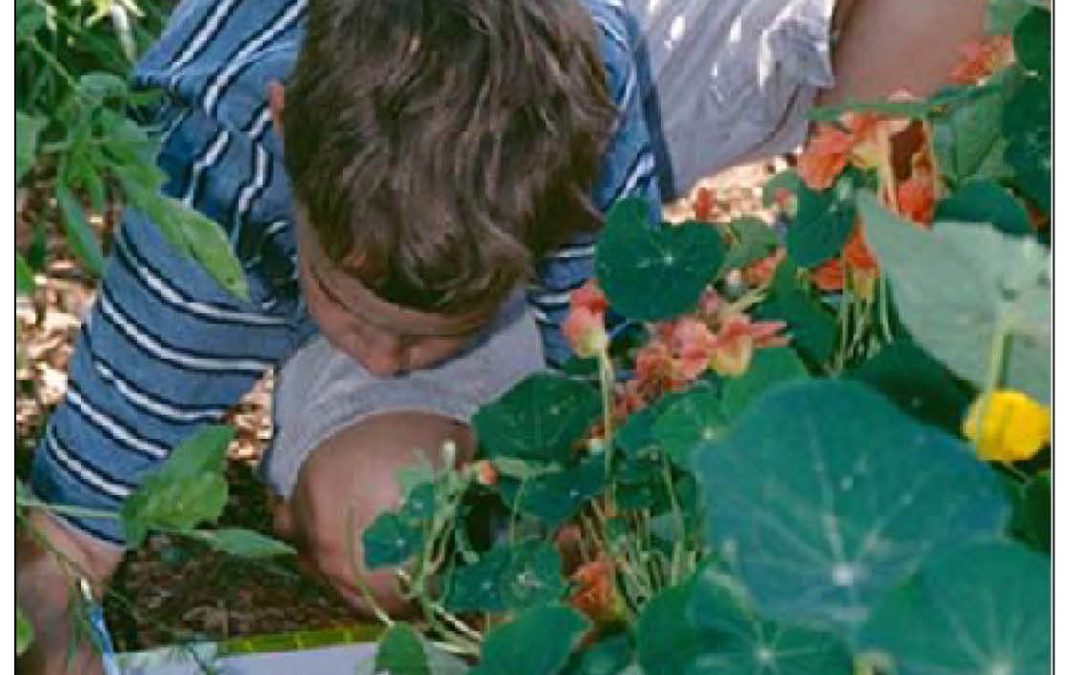
Title: The touch of life
References
Clarke, D. C. (2010). Ethnobotany: A year of schoolyard learning: curriculum review. Unpublished master’s research project. Portland State University, Oregon.
Cutter-Mackenzie, A. (2009). Multicultural school gardens: creating engaging garden spaces in learning about language, culture, and environment. Canadian Journal of Environmental Education, 14, 122-135.
Desmond, et al. (2002). Revisiting garden-based education in basic education. International Institute for Educational Planning, UNESCO, Paris, France.
Dyment, J. (2005). Green school grounds as sites for outdoor learning: barriers and opportunities. International Research in Geographical and Environmental Education, 14 (1), 28-45.
Kiefer, J., & Kemple, M. (1998). Digging deeper: integrating youth gardens into schools & communities. Vermont: Food Works.
Parajuli, P., Dardis, G., Williams, D. R. & Hahn, T. . (2008). Curriculum Development and Teacher Preparation in and for the Learning Gardens. A Report to Oregon Community Foundation, Oregon.
Williams, D. R. (2008). Sustainability Education’s gift: learning patterns and relationships. International Journal of Education for Sustainable Development, 2(1), 45-50.
Williams, D. R. & Dixon, S. P. (forthcoming). Garden-based learning: synthesis of research. A report to the Spencer Foundation.
Notes
(Endnotes)
1 For garden-based learning, see Collective Roots: http://www.collectiveroots.org/garden_based_learning; For development and design of garden curriculum, see Gardens for Learning: http://www.csgn.org/page.php?id=36
2 For comprehensive introduction to school composting, see: School Composting: http://www.ct.gov/dep/lib/dep/compost/compost_pdf/schmanual.pdf
11. 12. 13. 14. 15. 16. 17. 18. 19. 20.
by editor | Sep 15, 2025 | Adventure Learning, Conservation & Sustainability, Critical Thinking, Data Collection, Environmental Literacy, Experiential Learning, Forest Education, Homeschool, Inquiry, Outdoor education and Outdoor School, Place-based Education, Questioning strategies, STEM, Teaching Science
A Natural Fit: Homeschooling and the Establishment of a Research Forest
by Jess Lambright
For those open to an alternative educational path, a classroom with no walls or desks but instead trees, meadows, and streams, offers abundant opportunities for scientific exploration. My journey in outdoor education started by home-educating my own children, but soon expanded to include other students and families. Although making everyday a field day comes with certain challenges—such as very wet, cold winter days—it has also shown me how adaptable young people are, and how many spontaneous and fascinating learning opportunities present themselves when you commit to regular immersion in the natural world.
I have come to appreciate the vast range of possibilities in which students can acquire knowledge. While some homeschooling families follow packaged curriculum closely and monitor carefully to make sure their children meet state standards each year, others chose a less structured approach called unschooling, rooted in a deep trust for kids’ natural tendency and ability to learn. This philosophy can free a motivated young person to dive deeply into an ocean of learning powered by autonomy, inspiration, and infinite possibilities.
Connecting to place and stewardship of land
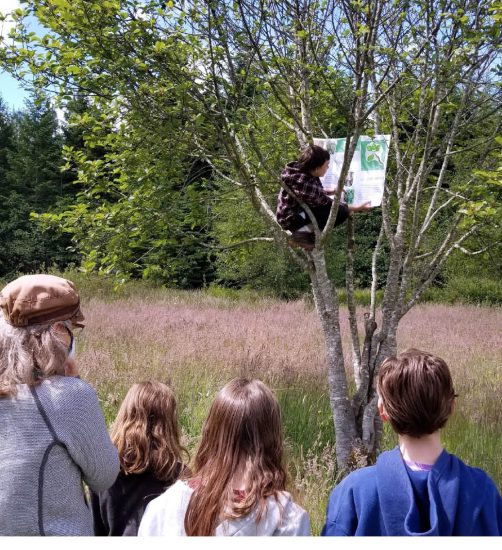
A multi-disciplinary unit study called My Tree and Me, where each student was connected with a specific tree which they measured (diameter, height, age) conducted secondary research about the species, wrote poetry, and created art with materials from the tree. One student decided to give his final poster presentation from the branches of the Cascara tree he had spent so many hours with.
The first outdoor program I hosted involved an established group of kids spending an entire day outdoors, once per week, for over four years. Week after week and year after year we returned to the same 40-acre woods from the first days of fall through the start of summer. It was common for our group to wander through the forest, without a destination or agenda, letting our innate curiosity lead the way. Wandering freely, with open eyes, allowed us to get in touch with what excited us and created opportunities for true discovery (Young et al., 2010, 56).
It filled me with satisfaction to watch the deep connection to place that developed over time in each of us. Monuments and landmarks, like a circle of giant old moss-covered stumps towards the southwest corner of the forest, acquired names and memories and provided comfort and familiarity when they were encountered. We would experience the wet meadow as a place that requires rubber boots to traverse in the wet months, a beautiful explosion of white flowers and soft grasses that dance in the wind in the summer, and a sea of delicate purple camas flowers in the spring. One year we returned to the same sit spots week after week, recording changes in our journals as spring brought all the growing things to life.
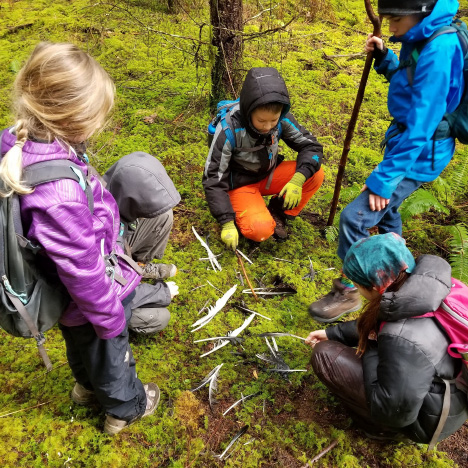
Students pause to examine a pile of feathers they discovered while exploring the woods on a rainy day. The group came up with a series of questions about what happened and brainstormed ideas about how they could investigate further to potentially find answers.
Spending time on a particular piece of land, through the seasons and years, inevitably leads to a sense of kinship and creates an urge to protect and enhance the natural environment. It’s been rewarding to teach students about which plants are non-native and potentially harmful to the local ecosystem, then see them step up as guardians of the land. When we wander through the woods, sometimes they spot a pocket of invasives and if we’re lucky enough to be carrying long-handled loppers, the team of weed warriors can quickly level a patch of Himalayan blackberry. In addition to studying and exploring, offering students an opportunity to actively participate in land management elevates their sense of purpose and deepens their connection to the natural world.
Full Family Learning
Homeschooling naturally leads to multiple ages and families all learning together. In the early days of our homeschool outdoor program the adults often observed activities and supported logistics. But over time it became clear that we truly were a mixed-age group of learners and explorers. Treating everyone as learners equally can have the effect of empowering young people. Sometimes kids master skills quickly. teaching what they’ve learned to adults. And sometimes the best exchange comes not from experts, who have a deep and longstanding understanding of a concept- but those who have recently experienced the gift of insight.
Mixed age learning is a mutually beneficial relationship fostering growth in multiple ways. Adults sometimes shelter in the security of topics they already understand and avoid venturing into areas less familiar. Conducting scientific inquiry in nature is ideal for having a high ceiling and a low floor: everyone knows something, and no one knows everything! Cultivating a growth mindset, by creating an atmosphere where mistakes are celebrated as learning opportunities, and where having a question is as valuable as having an answer (Boaler, 2015, 11), pairs beautifully with immersive study in nature.
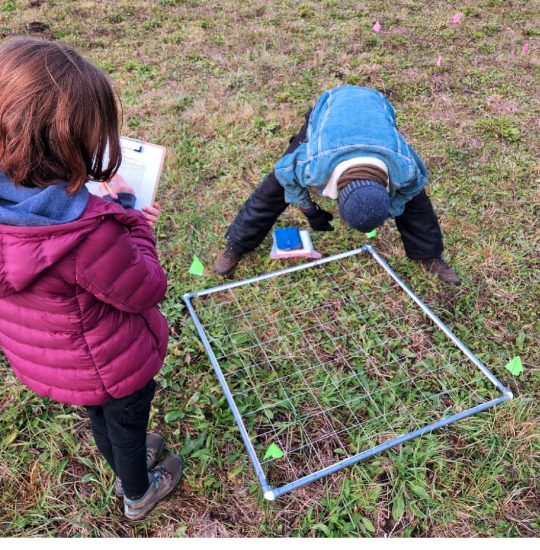
A team of researchers determine the percent meadow knapweed present in a one-meter plot square by examining each of 100 smaller squares for the plant of interest.
Authentic Curriculum
Each day that I meet a group of students in the natural world, I come prepared with a plan for that day. Sometimes my plans are elaborate and detailed, and sometimes they are less specific and open to input from my fellow adventurers. But without exception I am mentally prepared and openly delighted to be upstaged by the unexpected. Whether it is locating a dead porcupine after noticing an unusual smell, being suddenly pelted by large hail, being startled by the arrival of the cacophonous noise of a murder of crows, or being circled by two deer so distracted in their mating dance that they fail to notice us; being fully present for nature’s dramas is my top priority.
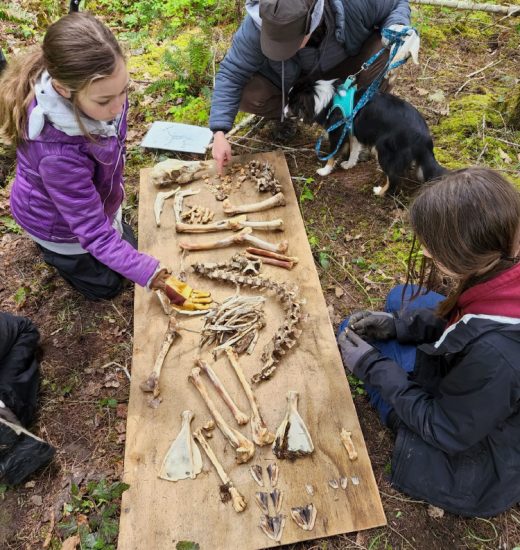
After waiting over a year for the soft tissue to decompose, students collect and sort bones from a deer that died of natural causes near the Bear Creek Wilderness.
One day, just as the families were arriving at the Bear Creek Wilderness, a truck with two wildlife professionals pulled up to examine a deer laying in the horse pasture adjacent to our meadow. Curious, we gathered to ask questions about what might have happened. When they offered to let us keep the recently deceased animal, we gladly accepted- and spent the day dragging it across the meadow into the woods, securing it with paracord, and setting up our two trail cameras to watch what would happen.
Each week we checked on the deer, and everyone brave enough to venture near got to experience first-hand what decomposition looks and smells like. The camera footage revealed a series of fascinating dramas involving a bobcat, opossums, neighborhood dogs, and finally turkey vultures. A year and half later we carefully collected the bones and spent hours sorting and reconstructing a full deer skeleton. Finally, we tried our hands at making bone tools. In my experience, the best learning opportunities are not planned or expected. But when we build regular rhythms and practices, it is possible to “lay the groundwork for the outbreak of authentic curriculum” (Sobel, 2008, 81).
Cultivating scientific inquiry

Students work to match specific leaves to nature journal pages. Each student found a leaf while wandering through the woods, then recorded details of that leaf in their nature journals using words, pictures and numbers. The leaves were collected, then each student selected a new leaf and found the corresponding journal page.
Getting to know a place, including its seasonal changes, provides a useful perspective when it comes to asking research questions. An invaluable tool to record and remember discoveries, questions and observations is the field notebook, or nature journal. Developing the habit of collecting data with pencil and paper while exploring the natural world takes ongoing dedication, is deeply personal, and will certainly evolve through the years if one continues the practice (Canfield, 2011, 187-200). Nature journaling techniques that involve close examination of specimens in order to draw them, often reveal details that would have been overlooked with a quick glace or photograph. Indeed, to truly get to know a specific plant species it is hard to imagine an activity more educational than carefully drawing each of its parts.
Foundational to scientific inquiry is the research question, or asking questions within the realm of science. There are plenty of valid and interesting questions that one might ask while pondering the wonders of nature, and it’s important not to shut down inquiry when a question like, “Does it make this tree happy when I climb it?” arise. If limited to knowledge bound by science, one may miss rich worlds of philosophy, spirituality, intuition, and other ways of knowing. Still, once we are ready plot our scientific course it’s useful to remind students that questions should be measurable (Laws & Lygren, 2020, 90-93).

At the start of a student-led wildlife study, one researcher, who had taken time to carefully read the manual and test out the equipment, teaches the other students how to label their memory cards and set up their trail cameras. This project was made possible by a generous grant from the Diack Ecology Education Program.
Research Methods
When guiding young people into the world of field research it is helpful to start with basic techniques and big picture, cross-cutting concepts. Keeping track of important details in a field notebook and not forgetting to record obvious but key information like the date and location takes practice before it becomes routine. Collecting data can be time consuming, but sometimes trying to interpret sloppily recorded field notes can lead to tedious and frustrating hours at home. Finding a doable and interesting research question, taking into account confounding factors, and dealing with the disappointment if all the hard work to apply different treatments on an invasive plant all result in similar outcomes, requires a certain level of maturity and commitment.
Digging into a full-fledged research project requires determination, perseverance, and time, but it is possible to introduce students to the exciting and fun parts without getting bogged down by details. I recently taught a research methods class to elementary and middle school students with the goal of having hands-on experience with sophisticated research equipment without requiring data analysis or report writing.
We practiced collecting samples, and at first, we recorded in our field notebooks all the important metadata. Inspired by collection and observation, but limited in time, we then simplified the process to maintain interest and focus. For the rest of our forest walk we collected whatever samples caught our eyes- and mentioned what we would record if we were doing a research project- but kept it fun and quick so we still had time to investigate them at the end with magnification. Keeping data collection fun and exciting for younger students makes for a useful introduction to scientific inquiry and sets them up for conducting their own research in the future.
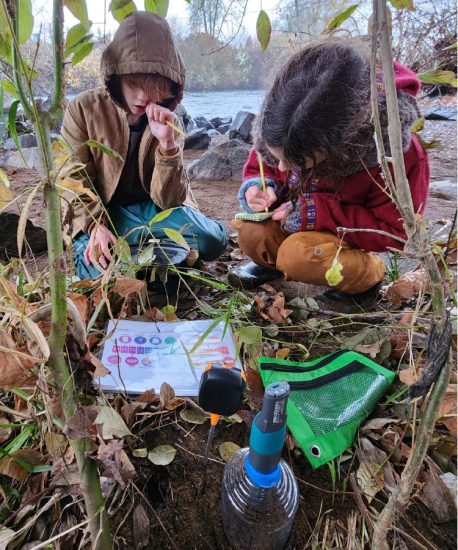
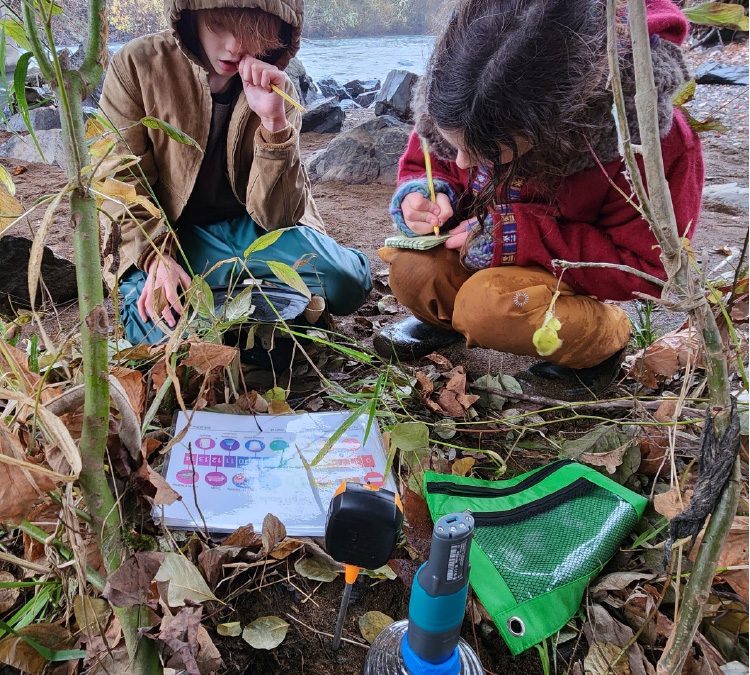
Students collect carbon dioxide and pH data from a patch of earth using equipment funded by the Diack Ecology Education Program during a research methods class with Wild Alive Outside.
Student-Led Research
In my experience, homeschoolers have a low tolerance for contrived activities, busywork and doing things for a grade. Any activity, assignment or project needs to be authentically meaningful. While it may be hard to force them to fill out a worksheet recording what we just discussed, they often thrive with open-ended activities and projects they can direct. It’s important to provide the appropriate scaffolding, and offer examples, but I have been impressed by how quickly and enthusiastically students construct their own research projects. As a mentor, I sometimes struggle with finding balance between requiring them to do something ‘right’ and encouraging critical thinking along with a safe place to fail, each of which are valuable learning experiences. Allowing students to take ownership in the learning process enhances the development of scientific thinking.
Once, a student created an elaborate plan to attract birds for his trail camera research project involving dead trees, peanut butter, and bird seed. There was tangible disappointment when the resulting images revealed many more rodents than birds, but it led to a new series of questions as well as an understanding about wildlife activity in that area. Field science is almost always iterative in nature, with new questions emerging from initial data and, ideally, the opportunity to inquire further and collect more data. With guidance and partnership students integrate information while maintaining natural curiosity.
Expanded Educational Support
Last year our outdoor program, Wild Alive Outside, received its first infusion of grant-funded scientific equipment. The Diack Ecology Education Program financed a set a trail cameras for our students to study wildlife activity at the Bear Creek Wilderness. Access to high-quality equipment has been a game changer for our little research group. Students felt empowered to design their own experiments by having full control over one of the trail cameras and two high-capacity memory cards. In addition to learning what wildlife passed through the area of the forest or meadow they selected, they gained experience with organizing and analyzing digital data. For some, it was their first exposure to spreadsheets, and others had to push their edges to patiently examine each of hundreds of photos. After months of data collection and conducting secondary research on one of the many wildlife species they discovered, they created posters to present their findings.
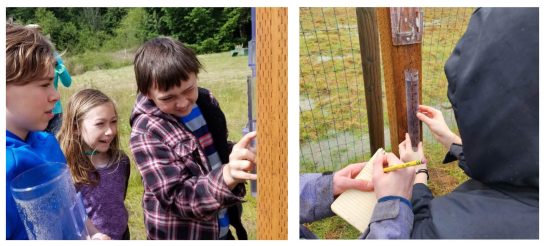
Students carefully measure the water in the rain gauge to determine rainfall over the previous week. Data is later reported to the CoCoRaHS website as part of a nationwide citizen science initiative.
For several years now, each day on the land begins with checking the rain gauge. Because we only visit once per week, we often have several inches of rain to carefully measure and record in the notebook. This simple ritual wakes up scientific thinking: “remember to look straight on before taking a reading,” connects us to what’s been happening while we were away: “no wonder there’s standing water in the meadow,” and gives us access to site-specific long-term data. At the end of the water year, shortly after the start of autumn, we can look back at the data we’ve collected, compare it to previous years, and make predictions for when the rains might come that fall. Additionally, we report our data through a sophisticated citizen science program called CoCoRaHS – Community Collaborative Rain, Hail & Snow Network with thousands of other citizen scientists across the country. I have found students take data collection quite seriously when they know they are part of a larger community of scientists, all doing their best to produce accurate results.
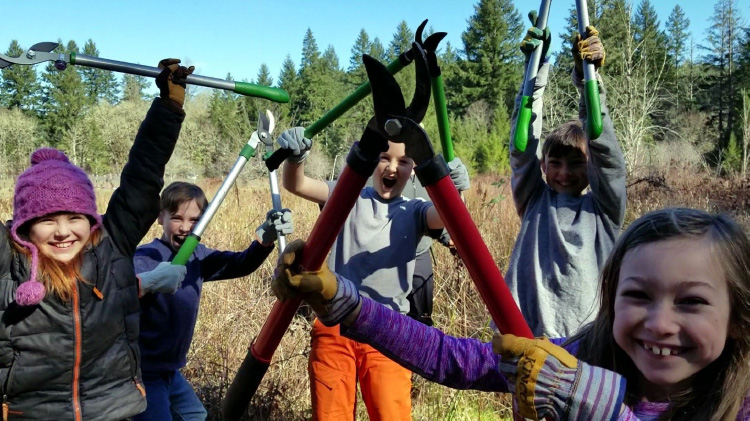
After tackling a large patch of invasive blackberry bushes, the Weed Warriors celebrate their contribution to protecting the wet meadow in the Bear Creek Wilderness.
The Bear Creek Wilderness and Student Research Forest
My program design is to plant the seeds for creating a student research forest where young people will have ongoing opportunities to learn scientific methods of field research and contribute to an ever-increasing body of knowledge through their own efforts. Just as the H.J. Andrews Experimental Forest welcomes graduate students and long-term ecological researchers and has amassed a wealth of knowledge and data about that site, we aim to support young emerging scientists with open minds and creative ideas to connect with place, nature, and make meaningful contributions to science within a community of knowledge seekers. Participants gain foundational skills together as they engage with the land, utilize scientific tools, grow as learners, and share knowledge with each other.
References
Boaler, J. (2015). Mathematical Mindsets: Unleashing Students’ Potential Through Creative Math, Inspiring Messages and Innovative Teaching. Wiley.
Canfield, M. R. (Ed.). (2011). Field Notes on Science and Nature. Harvard University Press.
CoCoRaHS – Community Collaborative Rain, Hail & Snow Network. Retrieved January 18, 2024, from https://www.cocorahs.org/
Diack Ecology Retrieved January 26, 2024, from https://www.diackecology.org/
H.J. Andrews Experimental Forest. Retrieved January 26, 2024, from https://andrewsforest.oregonstate.edu/
Laws, J. M., & Lygren, E. (2020). How to Teach Nature Journaling: Curiosity, Wonder, Attention. Heyday.
Sobel, D. (2008). Childhood and Nature: Design Principles for Educators. Stenhouse Publishers.

In 2019, Jess Lambright started a nature school for homeschool families where once per week kids and parents spend all day outside learning wilderness skills, exploring, developing naturalist knowledge, conducting field studies, and connecting with nature, themselves, and each other. She founded Wild Alive Outside in the summer of 2023 with the goal of getting more youth outdoors to discover wonder and inspiration in the natural world through science, outdoor skills, and wilderness connection.

by editor | Sep 15, 2025 | Conservation & Sustainability, Data Collection, Experiential Learning, Inquiry, Integrating EE in the Curriculum, Schoolyard Classroom, Student research, Teaching Science
Scotch Broom Saga:
Restoring a School Habitat as Project-Based Learning and Inquiry
by Edward Nichols and Christina Geierman
Since the advent of No Child Left Behind, many schools have turned their focus inward. Students rarely leave the classroom. Teachers often deliver purchased curricula that attempt to make meaningful connections for students. Lessons may contain examples from the real world, but these exist only on paper and are not explored within a real-world context. This article describes how an elementary school (K-5) on the southern Oregon coast addressed a real-world problem– the presence of the invasive Scotch broom (Cytisus scoparius) plant on the school campus. It began as a plan to improve an outdated writing work sample but became a school-wide project that allowed ample opportunities for students to authentically practice research skills while developing a sense of value for the world around them.
North Bay Elementary School is located in the temperate rainforest of rural Oregon, just a few miles from the Pacific Ocean. It serves about 430 students, over 95% of whom qualify for free and reduced lunch. The property was purchased many decades ago when the lumber mills were booming and so was the population. It was built as a second middle school, and the grounds had plenty of room to build a second high school. But the anticipated boom never came, and the property eventually became an elementary school surrounded by a small field and a 50-acre forest. At some time in the past, an enterprising teacher had cut trails through the forest for student access. When that teacher retired, the trails largely fell into disuse.
The Seed of an Idea
In Oregon third-grade students must perform a writing work sample each year. The topic in North Bend, which had been handed down from previous teachers, was invasive species. The class would work together to write a paper on an invasive species found in Florida, then apply their writing process knowledge to produce a sample on an Oregon invasive. They were given three curated sources created by using a lexile adjuster on the Oregon Department of Fish and Wildlife website. This project existed in a relative vacuum– invasive species were not mentioned before or after the work sample. Its only connection to the rest of the curriculum was the writing style. The students were interested in the topic and produced decent work, but Edward Nichols thought they could do better. He had long noticed multiple patches of Scotch broom growing just off the school playground. This invasive plant out-competes native ones and does not provide food or useful habitat for other native species. He wondered if they could do something with this to enhance the writing work sample and turn it from a stand-alone project to something more meaningful.
Fertile Ground
That summer, Edward attended a Diack Training held at Silver Falls State Park. In addition to providing excellent professional development on how to perform field-based inquiry with your students, it is also a place where you get to meet other educators with similar mindsets.
A chance conversation with Julia Johanos, who was then serving as Siuslaw National Forest’s Community Engagement and Education Coordinator, led to the idea of having an assembly on invasive plants for all students at North Bay Elementary. Edward was also a member of the Rural STEAM Leadership Network, and he met Jim Grano in their monthly Zoom sessions. Jim is a retired English teacher who is now focused on getting students outside. He has helped several schools in the Mapleton area start Stream Teams, which got students outside restoring stream habitat and collecting data on salmon. He routinely led student groups into the field to remove English ivy and Scotch broom. Edward invited him to help lead a similar event at North Bay.
 The Big Event
After weeks of planning, North Bay held a service learning day on March 17, 2023. The kickoff happened the day before when Julia Johanos led an engaging school-wide assembly on why invasive species are bad for our environment. The next day, the entire school participated in removing Scotch broom from the forest. The students came out one grade band at a time in 45-minute shifts. Each grade had a different task. Kindergarten students pulled the seedling Scotch broom by hand. Slightly larger stalks required “buddy pulls”, where two students worked together. Fourth and Fifth grades used weed wrenches to remove bigger plants. Alice Yeats from the South Slough NERR briefed each group on safety. And dozens of parent volunteers kept everybody safe. The Coos Watershed Association donated native plants, and the second grade came out at the end of the day to plant coyote bushes and red flowering currant, native strawberries, Oregon grape, and a variety of evergreen trees in the spaces the broom used to occupy. After school, Christina Geierman, a science teacher at North Bend High School, brought high school volunteers from the Science National Honor Society to help pull the biggest broom of all and clean up after the event.
Sustaining the Excitement
It is a tradition at North Bay to have a variety of fun activities for the last day of school. This year, in addition to the stalwarts of bubble soap, bicycles, and bounce houses, the event also contained a Scotch broom pull led by Jim Grano. Students could do whatever activity they chose, and many students chose to remove the broom from the edge of the playground. A representative from OSU Extension was also there, showing the kids how to make bird feeders, and folks from the South Slough NERR returned to lead nature hikes. The Confederated Tribes of Coos, Lower Umpqua, and Siuslaw Indians (CTCLUSI) also ran a booth and taught students about conservation and had them play a native game called nauhina’nowas (shinny), which involved using tall, carved sticks to pass and catch two balls connected by twine.
A second, school-wide Scotch broom pull occurred this past fall. Edward also started a Forestry Club at North Bay, which featured guest speakers from the Bureau of Land Management and had the students planting more native species. Plans are underway to have a school-wide pull each spring and a forestry club each fall to plant native species just before the rainy season hits.
 Applying Their Knowledge
Students participating in the Scotch broom pull apply their classroom knowledge in various ways. In mathematics, they record and tally the number of plants removed, practicing authentic math skills. They observe and document the plant’s lifecycle during the pull, connecting classroom biology lessons to real-world applications. North Bay uses the Character Strong curriculum to address social-emotional learning, and the broom pull allows students to apply traits like perseverance, cooperation, and service. Students can immediately and directly see the results of their efforts when they go outside for recess. This gives them a sense of pride in their accomplishments. There have been many reports of students educating their parents about why Scotch broom should be removed from the environment and even a few tales of students removing invasive plants from their own properties.
While participating in the Scotch broom pull, the students met a variety of scientists and conservationists. They were able to make a connection between this sort of work and future job opportunities. Jim Grano showed them that, if you feel passionately about something, you can make a difference as a volunteer. Alice Yeats, Julia Johanos, and Alexa Carleton from the Coos Watershed Association showed them that women can be scientists and do messy work in the field just as well as men can. Although it will take many years to tell, we hope that a few students will be inspired by this work to pursue careers in natural resources management.
Into the Future
This past fall, North Bay was named a NOAA Ocean Guardian School. This means that NOAA will provide the funds necessary to carry this project forward and expand it. The grant is renewable for up to five years. This spring, a group of students from North Bay will host a booth at Coos Watershed’s annual Mayfly Festival. There, students will present their project to members of the public and urge them to remove Scotch broom and other invasives from their own properties.
This spring, the North Bend High School Science National Honor Society (SNHS) will partner with North Bay students for a Science Buddies Club that will take place after school. Thanks to a Diack Grant awarded to Christina Geierman and Jennifer Hampel, the SNHS has a variety of Vernier probes and other devices that can be used to collect data in the forest. In the first meeting, the North Bay students will guide the high schoolers down the forest trails and describe their Scotch broom project. The SNHS members will show them how the probes work and what data we can gather. The guiding question will be, “Why do Scotch broom live in some areas of the forest, but not others?” The students will come up with hypotheses, focusing on one variable like temperature, light availability, etc. and then work together to gather and analyze the data. Students will present their data in a poster at the Mayfly Festival and possibly the State of the Coast Conference.
Members of the North Bend High School Science National Honor Society and family volunteers have reopened the trails through the forest. Plans are underway to expand these trails and partner with the CTCLUSI to create signage. The forest is being used by the school once again. Classrooms that earn enough positive behavior points can choose nature walks through the forest as potential rewards. Dysregulated students are taken down the path to calm them. Increasing student and community use of the forest is one of our future goals.
 Edward Merrill Nichols is a 3rd-grade Teacher at North Bay Elementary in North Bend, Oregon. Growing up on the southern coast of Oregon instilled in him a love of and respect for his natural surroundings. With over six years of experience, he fosters student growth through engagement and respect. Edward actively engages in STEM education, leading Professional Development sessions and extracurricular clubs. He holds a Bachelor of Science in Education and a Master of Science in K-8 STEM Education from Western Oregon University.
 Christina Geierman has taught physics, biology, and dual-credit biology at North Bend High School for eleven years. She is a published scientist, a proud union member, a decent trombone player, and a world traveler. She enjoys spending time outside with her husband, Edward Nichols, and dog, Aine.

by editor | Sep 12, 2025 | Environmental Literacy, Inquiry, Language Arts, Learning Theory, Teaching Science
The wild turkeys on my street don’t wear booties in the winter and the mouse in my house doesn’t wear bonnets from a closet! Should environmental education start with realism in the early years?
by Suzanne Major Ph.D.
Anthropology of Early Childhood Education
Books and movies have made animals, insects and plants so charming and sympathetic, and at times so frightfully magnificent and impressive. Can young children do without these entertaining animations and anthropomorphism, that is, making animals, insects and plants look and behave like humans? Do we dress them up, make them talk and have them drink tea from porcelain cups because we don’t know anything about them? Or do we think that young children can’t appreciate them for what they are? Young children across the world easily demonstrate that they are capable of perceiving, observing and remembering the descriptive elements belonging to an animal, a plant or insect. They can collect information and draw knowledge from it. My friend Omar in Cairo, three years old, knows not to treat the wild dogs as pets if only, because they are infested with fleas. My neighbour Maddy learned at two-years-old not to bother the bees in the hive hanging from the apple tree. Jenny, in Moncton New Brunswick, four years old, can identify the leaves of poison ivy in the forest and knows to wear long pants to protect her legs when she goes for walks with her family. Children learn very early on what is dangerous or not, comestible or not, pleasant or disagreeable. They are also capable of attaching symbolic value to things. Children everywhere offer flowers to their mothers and grandmothers to express their feelings or to create a nice event! As you know, they learn using observation, imitation, repetition or as Piaget wrote “perception, assimilation and accommodation”. They also identify with the knowledge of others or the information offered by nature. They encode it just because others use it, or they happened to observe it. They sometimes need information quickly, so they identify with the information others have, to fill the gap until they can adapt or replace it with more personal information. Through a very individualistic process of thought creation they retain or ignore elements of information and knowledge. They set the ones they favour in memory and replay others in thought, all sorts of ways assessing what works or not.
Finding animals, insects, plants or things cute, vulnerable or charming stems from the capability of empathy which is more difficult to use for what is ugly, threatening or disgusting. This notion of finding things cute is a cultural one that is cultivated and exploited by stories, books, animations and movies. Empathy is used to ensure survival among our own and can be transferred to animals, insects and plants. But it also allows sentiments to emerge that can be directed, intentions that can be instructed and behaviours that can be modelled. It is often used because of marketing interests but it can also serve pedagogically to create empathy. “Charlotte, the spider” is a good example!
The question here is do we need to create stories to nurture environmental education with children? Are we trying to sell them nature? Do we need to manipulate them towards environmental education or can we let them acquire a more significant first-hand experience? Should we not have a more functional approach about how everything has a place and time and is part of a balance of all and everything in the universe? Should we not let nature imprint itself on children, so they can sense by themselves their place on earth? Is that not fascinating enough? Let’s take the booties and the bonnets off the turkeys and the mice on these pages to see where this can go! Pink and white mice are mammals of the order of Rodentia and the genus MUS.[1] Wikipedia tells us that they are climbers, jumpers and swimmers and have lots of energy. They use their tail for tripoding so they can observe, listen and feel their environment. They can sense surface and air movements with their whiskers and use pheromones for communication. It is difficult for them to survive away from human settlements and in our houses, they actually become domesticated! They eat plant matter or anything else they can get their paws on. They will even eat their own feces for nutrients produced by intestinal bacteria. They are great at reproducing. They have a 19 to 21 days gestation, have 3 to 14 pups and 5 to 10 litters a year and females are sexually mature at 6 weeks. Do the math! We like them outside in the fields and not in our houses. Where I live, coyotes can hear and smell them and eagerly feast on them. Small falcons and owls can see them easily and pick them up in a flash. Last summer was very warm and wet. The vegetation exploded as well as the mice population. As I walked in my garden, they would jump up right and left to move away from me.
What can we infer from this information for environmental education? Young children spontaneously sit on their legs, hold up their bent hands and wiggle their noses to imitate mice. By observing mice and comparing their bodies with them, young children can engage in an array of locomotive and motor activities. Experimenting with sensing surfaces and air movements with their skin and their hair they can discover how this gives them information and knowledge. They can explore and sense space with the whole body like the security of a small shelter and the unsettling feeling of wide-open spaces. Discovering smells and odours for two and three-year- olds can be a lot of fun and for older children, linking those to chemical reactions can awake them to science. Seeking the mice out in the fields can be very interesting as they make little tunnels that go everywhere under the snow and through the dried grass. Reflecting with young children over three years old on the mice population in relation to the weather and the consequences this brings is interesting because the phenomenon attracts coyotes near houses which creates a real threat to house pets and small farm animals.

Let’s consider wild turkeys or Meleagris Gallopavo. Wikipedia informs us that the females are called hens and the males are known as toms. The males have huge tails they fan out to attract the females and impress the other males. They have up to 6,000 feathers and they can fly for 400 metres. To protect themselves from storms, they can roost up to 16 metres above ground in tall conifers. They gobble and emit a low-pitched drumming sound. If cornered, they can be aggressive towards humans. They are omnivores but prefer nuts, seeds and berries. They will eat amphibians, snakes and reptiles. Their babies are called poults. The hens lay 10 to 14 eggs and incubate for 28 days and the little ones are ready to go 12 to 24 hours after hatching. They can fall prey to coyotes, grey wolfs, lynxes and foxes.
The adults are around four feet tall and the big males can weigh some 37 pounds. I observe them regularly around my house. Hens flock together with the young ones, 12 or 14 together as they walk around the fields and woods. When they cross the road, one leads on and at least one or two stay behind to gather everyone. They are very attentive, looking right and left and right again. One might even stand guard in the middle of the street to make sure everyone has crossed. I am told they made a comeback in recent years as they had disappeared because of over hunting. At night in the summer, when there is a storm, we can hear them gobble after each clap of thunder.
What can we infer from this information for environmental education? It’s a magnificent bird when it struts around displaying its beautiful black tail, but I reckon a young child would be impressed even afraid if it came face to face with a tom or a hen on the street or in the back yard. It certainly offers the opportunity to acquire new vocabulary with the wattle or snood hanging from its beak, the caruncles pending from its neck, its hairless head crown and beard or beards on a single bird, the spurs on the back of its legs and the three long toes on its feet. Two and three- year-olds would delight in knowing by heart the body parts of the wild turkey and comparing it with the ones of a chicken. Young children would also be impressed to measure themselves against the life-size drawing of a male turkey. Three and four-year-olds could explore what low-pitch drumming sounds are and could discuss why the turkeys gobble after the clap of thunder and even do a little research. As an educator, I would not miss the chance to make a parallel between the turkeys looking right and left and right again before crossing the street and children attempting to do the same but unable to fly away from danger! Finally, with older children it would be interesting to place the mice, the turkeys and the coyotes in their environment and talk about the relation between them.
Nature provides real and fascinating animations all by herself and children can appreciate the reality of animals, insects and plants. All sorts of elements can create the desire for observation and exploration. Exploration calls on focus which brings attention to details which creates in turn the need for manipulation. Manipulation and/or representation will lead to curiosity for functions which is knowledge. Knowledge for young children establishes the feeling of competence. Competence cultivates initiatives and permits the experience of trials and successes. In turn, the need and the pleasure for demonstration can take place, then patience to practice, to persist and develop skills becomes a reality. Later, mastering will open the cognitive door to metaknowledge.
Observation, exploration, focus, manipulation, representation, curiosity, knowledge, competence, initiative, demonstration, patience, mastering, metaknowledge, is a pedagogical sequence that young children can start experiencing when they are just a few months old.
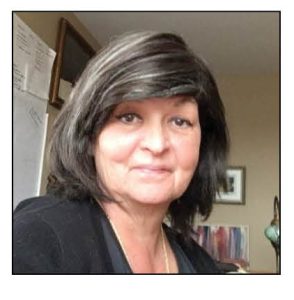 Suzanne Major is an anthropologist and early childhood educator. She received her Ph. D. in 2015, with mention of excellence, in Anthropology of Early Childhood Education from the University of Montreal, Quebec, Canada. She also has a master’s degree in Child Studies which was obtained in 2004 at Concordia University, in Montreal, Canada. She has worked 12 years as Director for the Early Childhood Studies Program of the University of Montreal’s Faculty of Permanent Education.

by editor | Sep 8, 2025 | Marine/Aquatic Education, Questioning strategies
Empowering Their Voices: Students Sound Off on the Puget Sound
by Nancy Skerritt and Kristin Edlund
What makes work truly meaningful? Creating curriculum that harnesses and nurtures the student’s voice is challenging work. We believe that engaging students in real world problems that affect their lives is central to engagement. Grade Nine students in Maple Valley, Washington participate in a unit of study entitled “Sounding Off on the Puget Sound.” The unit provides rich opportunities for our students to learn critical and creative thinking skills, Habits of Mind, and to practice real world problem solving.
The work in the unit is authentic, rigorous, and project based. Students participate in an online digital learning community. All six hundred experience a trip on a Washington State ferry, and they create projects of their own choosing where they “Sound Off” to a self-selected audience. The unit culminates in a call to action where the students research a community service organization for their own involvement, learning what it means to practice civic responsibility.
 At the heart of this unit is a shift in voice: Whose voice is heard? In the past, the teacher’s voice has dominated the conversation. Our new model values the student’s voice – not in random or isolated ways, but by carefully orchestrating curricular opportunities. We achieve our curriculum goals by structuring experiences that allow students to find their own voice and build the skills to make their voices heard. How do we accomplish this? We focus on the processes of learning and connect students to their own local community.
One year ago, we made a decision to abandon outdated content in our Grade Nine social studies course and to invite our students to explore the critical issues challenging the health of our Puget Sound. Our unit is designed to teach students how to investigate any issue by considering baseline data, examining this data over time, and making inferences from the data about how our environment is changing.
Students consider the ways in which marine life populations are affected by water quality, the impact on local seafood industries, and projections for how our lifestyle will change if the Sound is allowed to degenerate through pollution and other human interactions. The message is clear: Students can have impact by making their voices heard, taking simple actions like cleaning up after pets, and by getting involved in local com-munity organizations that are designed to improve the quality of our environment for our students today and into the future.
Strategies for Investigating an Issue
Within the structure of the unit, students gather information, interpret this information and then take action. Students investigate stakeholder groups to understand competing wants and needs. They use thinking skills like Point of View and Analysis to explore how human actions and interactions affect the health of the Sound. Drawing on case studies from other  parts of the country, they learn about the complexity of environmental issues by exploring a parallel issue in the Florida Everglades. The students study the wants and needs of the various stakeholders and search for a solution that takes into account the competing interests.
Students build on this background knowledge to research our local stakeholders: the timber industry, the commercial fishing industry, tourism, recreation, Native American interests, and wildlife. The students are acquiring the thinking skills and Habits of Mind to investigate issues and to draw their own conclusions. A key goal with this unit is to foster critical and creative thinkers who have skills that transfer to any issue, problem, or concern. We believe that these thinking skills lead to empowerment and honor individual points of view.
Problem Solving
The students then use a problem solving model to form their own opinions and ultimately to create an action plan where they can become personally involved in cleaning up the Sound. The model begins by summarizing the situation and crafting a question to focus thinking: “Evidence shows that the Puget Sound is polluted. There are various stakeholders who have vested interests in the future of the Sound. Considering the com-peting interests of preserving our environment, supporting our economic growth, and honoring our culture and traditions, how can the health of the Sound be preserved for a sustainable future? “
After analyzing the interests of the multiple stakeholders, the students develop their own point of view with evidence. Students have applied the thinking skills of Problem Solving, Point of View and Analysis. They have learned and practiced habits of mind such as thinking flexibly and applying past knowledge to new situations. Rather than passively studying a local issue, the students are actively engaged in developing their own point of view so that they can be part of the solution to a complex problem directly affecting the quality of their lives. The learning is relevant and rigorous. Students are respected as young adults with good ideas for improving our world.
Technology for Collaboration
Technology can be a powerful motivator for students when it provides a social context for their learning. In addition to utilizing a variety of technology tools for research and production, students in the Sounding Off unit collaborate creatively in an online learning community.
Web-based tools allow this virtual space to mirror elements of students’ social networks while scaffolding their collaborative skills: students learn to respond professionally and respectfully to one another’s ideas, and to incorporate others’ ideas into their own work responsibly.
Student posts begin as structured responses to prompts and evolve into more spontaneous expressions as the unit progresses. The online venue also provides a record of the class’ learning over time; the history of students’ posts allows the class to reflect on their evolving understanding of complex issues. Students’ individual voices gradually form a chorus in which their distinct tones can still be heard.
For instance, at the beginning of the Sounding Off unit, pairs of students choose one word to express their impression of Puget Sound. They post their word on the class site. As students explore the economic, cultural, and environmental issues facing Puget Sound, they are periodically asked to post additional one-word or one-phrase summaries of their understanding. Students comment and elaborate on each other’s posts, and the growing list of words and phrases generated, along with the support for those summaries, represents an increasingly sophisticated interaction with those issues.
The students are asked midway through the unit to use a web-based video generating tool to create a short video that incorporates images, words and music to express how their perceptions of Puget Sound issues have changed. With technology tools, students apply principles they have learned about how artists use those elements to provoke an emotional response in the public. The videos, in addition to synthesizing the class’ learning up to that point, serve as another opportunity to scaffold student skills, in preparation for the culminating Sounding Off Project.
The online learning community also provides the opportunity to expand the classroom beyond its walls. As students learn about Puget Sound stakeholders, those stakeholders and other experts can join the virtual community and contribute to the students’ learning. Students are empowered by interacting with adults as equal participants in exploring the real issues that affect their lives.
Certainly, technology provides powerful tools for generating creative products. However, in this unit, technology’s true power is found in its ability to foster community – to break down walls between individuals both within the classroom and beyond it. The structure of the online learning community provides a safe place for students to try out their voice, while the widening circle of that community allows them to amplify it.
Field Experiences
While the online learning community provides an engaging virtual experience for students, we find that there is no substitute for engaging students in the real world outside the classroom – for getting up close and personal with the issues. In Sounding Off, this means getting the students down to the waterfront and out on the Sound itself. In an era where field experiences are often the first casualties of budget cuts, we remain committed to these opportunities for all students.
We are equally committed to ensuring that the field experience is one of the most meaningful learning experiences the students will have throughout their educational career. This requires careful planning and orchestration of activities that are integral to the learning goals of the unit.
 During the Puget Sound field experience, students engage in activities at two sites: the Seattle Aquarium and on board a Washington State Ferry. At the aquarium, students explore the marine habitat and the wildlife that calls the Sound home. They use their field journals to make observations, compare and contrast, generate questions, and pose problems.
On board the ferry, students hear from stakeholders representing different interests related to the health of Puget Sound. The stakeholder’s interest might be economic, environmental, or cultural/historical. Students have the opportunity to interact with stakeholders who might represent state fisheries, non-profit habitat restoration organizations, Native American tribes, large shellfish corporations, or others.
To prepare for the field experience, students research the stakeholders and their points of view in advance, generating questions in their field journals. On the ferry, students use their field journals to organize information around key thinking skills. Both at the aquarium and on the water, students use their field journals and cameras to capture evidence regarding the economic, environmental, and cultural/historical aspects of Puget Sound.
While our community sits right in the Puget Sound’s watershed, this field experience represents the first time many of our students have ever actually been out on the water. The powerful impact of this opportunity is evident in students’ reflective letters to stakeholders and in the way the field experience continues to influence student thinking well after it has ended. Interacting personally with the Sound’s stakeholders while out on the Sound itself is an experience that can’t be replicated in the school building.
Sounding Off! Project
The Sounding Off! Project provides a framework for students to make their voices heard. Using the structure for projects provided by Ted McCain in his book Teaching for Tomorrow, students work as a member of a team. They design projects for the purpose of raising awareness about the health of the Puget Sound. The projects educate and call their audiences to action. Students choose their message and their target audience. Then they select a medium that will best communicate their message. They manage their team and project in the online learning community.
The projects vary widely based on the audience, medium and message. For example, one project team might create a picture book for kindergartners showing strategies for home water conservation while another team might create a video podcast to highlight the importance of habitat conservation to share with our legislators. Students are encouraged to use their individual talents to make a statement. They present their project to their chosen audience, “sounding off” on the state of the Puget Sound and sharing how people’s actions can make a difference.
Choice is at the heart of this project, and students exercise their creativity and their passions as they communicate with an authentic audience about the state of the Sound. Projects have included a website for learning about the danger of bulkheads, paintings that depict the past, present and future of the Sound, movies to promote stewardship, poetry, and children’s games.
Community Service
The unit culminates with the students investigating community service organizations, exploring answers to these questions: What is community service? Why is it important? How is service a component of citizenship? Students research community organizations that are involved in cleaning up the Puget Sound. They study the mission of the different organizations, and using a decision making model, they select an organization in which to become involved. Students contact the organization of their choice, learn about the organization’s service projects, and then commit to involvement in one of these projects. Students reflect on their participation by considering how they are making a difference in promoting the sustainability of the Puget Sound . They are doing real work that has value beyond the classroom and can take pride in making contributions to their community.
Engagement leads to empowerment. We want to graduate students who know that they can make a difference and have the tools to act. Learning must be relevant and real. Our students discover how they can take action to have impact. This life lesson will last long beyond the accumulation of content. Students learn problem solving, decision making, persistence, and interdependence. They practice civic involvement through a call to action. Our democracy relies on involved citizens, and our students learn that they have empowered voices through their study of the Puget Sound. They develop the awareness that what we do today does indeed make a difference for the future.
How do we know that these kinds of learning opportunities are more meaningful for our students than traditional approaches?
We’re listening to their voices.
For more information about the Sounding Off on the Puget Sound unit, please contact Nancy Skerritt in the Tahoma School District at nskerrit@tahomasd.us
References:
Costa, A. and Kallick, B. (2009) Learning and Leading with Habits of Mind. Alexandria: ASCD
McCain, T. (2005) Teaching For Tomorrow: Teaching Content and Problem Solving Skills. Thousand Oaks: Corwin Press
Nancy Skerritt, the Director of the Teaching and Learning Department, has been with the Tahoma District for 9 years. She previously worked in the Snoqualmie and Auburn School Districts. One of her most interesting assignments has been the development of the Elementary Core Curriculum in the Tahoma district. She has expertise in thinking skills instruction and she works with the Washington State Commission on Student Learning to assist with the design and implementation of the Washington State assessment system.
Kristin Edlund is a curriculum specialist in the Tahoma School District in Washington State and author of the middle school Habits of Mind curriculum. She has written social studies units that integrate the Habits of Mind and thinking skills, and she supports teachers in implementing this curriculum in the classroom. Edlund teaches classes in integrated curriculum, thinking skills, and Habits of Mind throughout western Washington and has presented at numerous state and national conferences. She worked as a teacher-librarian for 12 years before entering administration. She can be reached at the Tahoma School District office at kedlund@tahomasd.us.