
by editor | Mar 29, 2013 | Environmental Literacy

- Photo credit: Sarah Sullivan, Abernethy School, Portland
by Jim Martin
Clearing Associate Editor
 he last time we met, students had planted seeds in parts of a garden plot they chose. So, where do they go now? They’ve made their decisions about where to plant each of their seeds. As the seeds sprout and grow, are there opportunities for them to engage in self-directed inquiries? Can they ask questions, like, “What would happen if ___?” followed by a perturbation they choose to introduce. Some possibilities that come to mind are things like sun flecks (the moving patches of sunlight in forested areas), watering schedules, companion plants, fertilizers and vitamins, pruning, hours of sunlight (photoperiod). What effect do these perturbations have on plants’ optimal growth? Kids have great imaginations, and I’m sure some of their perturbations would be more interesting than those I’ve mentioned. Doing this kind of work suggests that we are seriously entering the Experimental dimension of science inquiry. This is where you lose a little control over what students think and do, but not over how they go about their work. (more…)

by editor | Mar 4, 2013 | Environmental Literacy
When you make the finding yourself – even if you’re the last person on Earth to see the light – you’ll never forget it.
-Carl Sagan
by Jim Martin
Science Educator and
CLEARING guest writer
 oing out into the world beyond the classroom for science and other curricula can be confusing. I clearly remember the first time I took students out to make observations. In the classroom, we had lined up all the conifers together, deciduous species together, and animals in neat little boxes. It all made sense to me. Little did I know! When we went into the real world, there was no sense of order my students could perceive. I saw that my first job was to help organize what seemed to be disorder. We did a transect, and the observations they made along its length brought the underlying order in any ecosystem within reach. And the difference between the ecology in the publishers’ materials and in an actual ecosystem opened my eyes to why we need to begin our science studies with actual hands-on inquiry, both as a pragmatic necessity, and as being a closer fit to how our brain learns for understanding, than the lessons and activities in the published materials I was using. It’s also the way scientists work; inquire of nature to answer a question, communicate findings, and inquire some more.
Let’s look at a project in a schoolyard. A teacher began one with a garden plot, and had her students plant seeds in a plot on the school grounds. During the year, they would make observations on changes they observed. She had a friend who works for the county environmental services agency, talked with her, and they jointly decided to complement the garden plot with a study of a restoration site where the teacher and her students would determine where to plant, plant, monitor, and compare.
(more…)
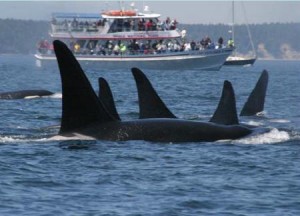
by editor | Jan 29, 2013 | Environmental Literacy, Marine/Aquatic Education
by Sally Hodson, Ed.D.
author of Granny’s Clan, published by Dawn Publications
See Part 1 and Part 2 of this series.
 Part 3: Tell a Story
How do we prepare young people for the 21st century challenge of caring for our planet so that it can sustain future generations of plants, animals and humans? In short, how do we educate our kids to be eco-literate?
To be literate in the language of our planet, we need to understand how life on Earth functions and how we interact with it. And we need tools to help our heads to think, our hearts to feel, and our hands to act.
This month, we’ll add Tell a Story to our Eco-Literacy Toolkit

.
Tell a Story
”Tell me a fact and I’ll learn. Tell me the truth and I’ll believe. But tell me a story and it will live in my heart forever.” Native American Proverb
We are all storytellers. Stories are part of every human culture. Stories connect us with others across time, place, culture and species. History tells us stories about our past. Science brings us stories about our natural world and the plants and animals who share it with us. Movies, books and TV fill our lives with stories
Think of your own life as a story. How do you tell your story to others? When we share and listen to stories, we integrate our left brain’s language with our right brain’s emotions and imagination. A great story helps us understand the world and gives meaning to our lives.
Where can we find powerful stories for our Eco-Literacy Toolkit?
1. Explore natural places where you live. What plants and animals share these places with you? What are their stories?
2. Read stories about plants (maple tree), animals (prairie dog town), ecosystems (kelp forest), ecological processes (salmon life cycle) and ecological changes (re-introduction of wolves to Yellowstone Park).
3. Look for stories that inspire hope for the future (saving an endangered species).
4. Find stories of people who help us learn about the natural world (Jane Goodall, Jacques Cousteau, Wangari Maathai, Rachel Carson).
5. Watch nature and wildlife documentaries that tell visual stories
How can we use these stories to develop ecological literacy?
1. Write Stories
– Write and illustrate a Picture Book that tells a story about nature, a plant or an animal.
– Write the Autobiography of an animal or plant. Imagine their life story and tell it from their point of view.
2. Tell Stories
– Story Circle – Choose a nature topic. With a circle of students, the first student starts the story with a sentence. Each student adds another sentence to the story. Continue until everyone has a turn and the story is completed.
– Magic Story Box – Fill a shoebox with natural objects (stone, leaf, feather, seashell). Each student picks a different object from the box. Students spend several minutes getting to know their object and then each tells a story about their object.
– Describe Me – Select a natural object (stone, leaf, feather, etc.) and place in the center of circle of students. Each student offers a different word to describe the object.
– Story Treasure Hunt – Select a picture book story about an animal or nature. Divide students into two groups. Group 1 writes out each sentence of the story on a different index card, hides the cards out of sequence and draws a treasure map to show where to find the cards. Group 2 uses the treasure map to locate the cards and then assembles them in the correct sequence to tell the story.
3. Create Visual Stories
– Design a shoebox Diorama to show plants and animals that live in a natural place.
– Paint a Mural that tells a story about a natural place.
– Make a classroom Story Quilt. Select a nature topic and ask each student to design their own story square. Assemble to create story quilt.
– Create a Comic Strip graphic story about nature.
4. Dramatize Stories
– Produce a Puppet Show about an animal’s life or a nature story.
– Create a Reader’s Theatre Script or Play about your favorite animal or nature story.
Many free downloadable activities are available at this website relating to Dawn books (go to the Teacher’s/Librarians tab on the website and select Downloadable Activities from the drop-down menu). Activities related to Granny’s Clan: A Tale of Wild Orcas that show how to use story include: .
– All in the Family (see Family Totem Pole and Family Story Quilt)
– Salmon Journey (see Salmon Life Story)
– Great Grannies (see Granny’s Life Story) and
– Tell Me a Story (Orca Rangers Comic Strip, Story Treasure Hunt and Story Circle).
Dr. Hodson is a K-12 teacher and a trainer of teachers, and was executive director of The Whale Museum in Friday Harbor, WA.
by editor | Jan 19, 2013 | Environmental Literacy, Place-based Education
The Urban-Rural Exchange Bridges Oregon’s Greatest Divide
By Judy Scott
From Oregon’s Agricultural Progress
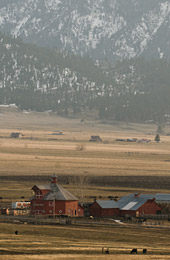
Wallowa County in northeast Oregon was the destination for one of this year’s four exchanges. The young guests from the city arrived in the thick of calving season, a dynamic leap into ranch life. Photo by Lynn Ketchum.
 ix lanes of Portland traffic filled the rear-view mirror as the van headed east on I-84. On the left, the Columbia flowed through its gorge below giant windmills scattered like toys, turning with the breezes. After a few hours, sagebrush took the place of Douglas-fir and fern.
The riders from Portland’s Sunnyside Environmental School had reason to be nervous as they watched the familiar give way to the unknown. And it wasn’t just the landscape that would change.
The 15 middle-school students were already immersed in a life-broadening experience: the 4-H Urban-Rural Exchange program, sponsored by Oregon State University Extension Service. For five years, host families from Grant, Klamath, and Wallowa counties have opened their homes and lives (sometimes nervously) to city kids. In turn, Multnomah County families introduce rural students to life in Portland.
Wallowa County in northeast Oregon was the destination for one of this year’s four exchanges. The young guests from the city arrived in the thick of calving season, a dynamic leap into ranch life.

The Portland students (above) weren’t sure what to expect when they arrived in Wallowa County to stay with rancher Charley Phillips and his wife Ramona. Soon, the students were pitching in to help with all the chores, including branding calves at the Birkmaier ranch (below). Photos by Lynn Ketchum.
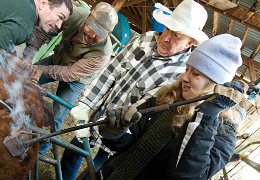
Deep in the Wallowa Mountains, hosts Tom and Kelly Birkmaier and a crew of friends rounded up 65 calves for branding. While unhappy mother cows bawled in the distance, the job was to brand, inoculate, and ear-tag the calves as quickly as possible while muscling them securely into a metal chute.
This was no spectator sport for Portland middle-schoolers Zoe O’Toole and Birch Clark. Although reticent at first (“I’m not really sure how I feel about branding,” Zoe had confided earlier), the girls gamely took turns with both the branding iron and the syringe.
Down in the valley at another host home, a cow notched up her tail, and three other city students learned what that meant: the cow was ready to give birth. Lanie Novick and her middle-school colleagues watched in awe as the calf dropped from its mother’s womb while Lanie documented the event on her cell phone. Ramona and Charley Phillips, who hosted the girls at their ranch near Joseph, were impressed with the students’ enthusiasm and unending questions as they collected eggs each morning and tossed baled hay from the back of a truck to a “sea of cows.”
Calving season knows no time clock. After midnight, the girls bumped along with the Phillipses in their pickup truck, scanning the range with spotlights in search of cows with newborns. The girls learned that if they spotted cows bawling and bunched up around their calves, there might be predators such as cougars or wolves stalking nearby.
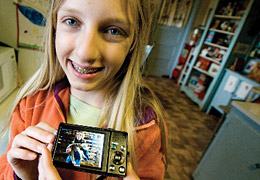
Seventh grader Lanie Novick (above) displays a memorable snapshot of her Sunnyside classmate Julia Glancy holding a newborn lamb. The learning experience includes classroom time at the Imnaha School (below), where five local students make up the total K-8 enrollment. Photos by Lynn Ketchum.
Part of each exchange includes spending a day at the host school. Portland students Morgaen Schall and Joseph Unfred swelled enrollment of the one-room schoolhouse in Imnaha by 40 percent on the day they went to class with the school’s five local students.
Morgaen and Joseph both love working with horses in Portland but prefer being “in the middle of nowhere.” Their stay was not romantic—mending fences seldom is—but they enjoyed the outdoor work, and to show their appreciation, the two boys made a special Sunday breakfast for their hosts, Cynthia and Dan Warnock and their three sons.
More than half of the urban-rural exchange students have kept in touch with their host families. Sometimes during the summer they cross back over the cultural divide to reunite with their hosts and to share the experience with their parents. The exchange expands when parents get involved. Thirty families in Portland now buy beef directly from a host rancher as part of a new beef cooperative, an idea that grew from the young people’s exchange.

Back on the ranch (above), feeding time is fun for students and cows. In Portland, students used mass transit to navigate the city (below). Photos by Lynn Ketchum.

“The basic mission of 4-H is education for youth,” said Jed Smith, a 4-H faculty member at the Extension office in Klamath Falls. “But 4-H also involves parents in Extension education. When you get young people in the conversation, you’ve got a good start towards better understanding between remote rural Oregon and the rest of the state.” Smith wants his urban visitors to experience first-hand the life of rural ranchers and farmers. “They see that ranch families are good with animal husbandry, they’re responsible stewards of the land, but they face different challenges than urban families,” he said.
One of those challenges is the reintroduction of wolves, which sparked the creation of the urban-rural exchange. In 2005, after Sunnyside students completed a class project on how westward U.S. settlement affected wildlife, the students gave testimony at a state Fish and Wildlife Commission hearing in favor of reintroducing wolves. The urban students didn’t expect that their opinions would spark controversy in rural Oregon, where ranchers bemoaned that city dwellers didn’t understand rural life. To foster better understanding across the state, OSU 4-H and Sunnyside joined forces to create the first Urban-Rural Exchange in 2006.
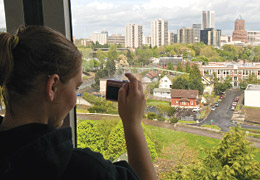
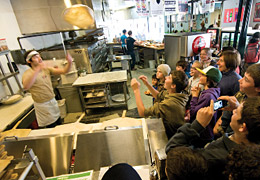
Students from Klamath County get a tram’s-eye-view of Portland (above) while Hot Lips pizza shows off their spin cycle (below). Photos by Lynn Ketchum.
Everyone involved that first year, from both sides of the Cascades, ventured into unfamiliar territory. At least one rancher would have pulled out at the last minute if the city kids were not already on their way. However, at the end of five days of sharing chores and meals together, both students and families described the exchange as one of the best experiences of their lives.
Each year, some of the city students come home thinking that farming and ranching would be professions they’d like to pursue. “We want them to learn about the care of natural resources from a rural perspective,” said Maureen Hosty, the OSU 4-H Extension faculty member who coordinates the exchange. “Sometimes they take it to a personal level. They want to live there.”
Fewer rural students visiting Portland express a strong desire to relocate to the city. Perhaps city living is an acquired taste. Dylan Denton and Trevor Wentz, both from Wallowa County, enjoyed their day exploring mass transit and gliding over the skyline by tram. But considering that a square mile in Portland is home to 3,939 people, and in Wallowa County, it’s home to 2, they had to conclude, “There are too many people!” Nevertheless, according to their host family mom, Dylan and Trevor readily took to “a crash course” in riding bicycles in city traffic, even while pedaling in cowboy boots.
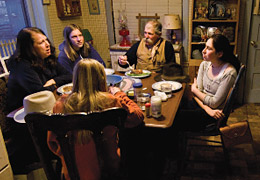
The bustle of city life contrasts with the quiet of dinner time after a long day’s work on the ranch. Photo by Lynn Ketchum.
Portland hosts helped their rural visitors understand sustainable urban living. They climbed to the top of city buildings to see rooftop landscapes that temper winter stormwater and summer heat. They visited the city’s massive recycling system. And they walked through one of Portland’s 20 farmers markets, where they ran into a potato vendor from faraway Wallowa County.
More city kids have made the exchange than their rural counterparts, and Hosty encourages more students from rural Oregon to visit Portland. “We want to build a strong bridge of understanding that goes both ways,” she said. The bustle of city life contrasts with the quiet of dinner time after a long day’s work on the ranch.
“We have a lot more in common than we realize,” Hosty said. “But if we don’t spend some time walking in each other’s shoes, then misunderstandings will continue to divide our state.” The 4-H Urban-Rural Exchange can make a difference. “Kids are leading the way and are willing to spend some time to learn. And the real learning happens in family homes at the dinner table.”
by editor | Jan 16, 2013 | Environmental Literacy, Marine/Aquatic Education
Teachers discover authentic lessons in crayfish and caddis flies
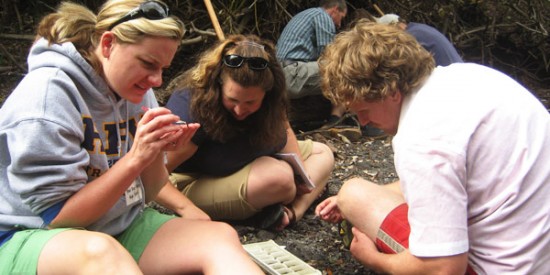
- What is that bug? Teachers Kathryn Davis from Hood River High School, Molly Charnes from the Academy of International Studies in Woodburn and Thomas McGregor from The Phoenix School in Roseburg work at identifying aquatic insects during a workshop in Philomath. (Photo: Lee Sherman)
By Lee Sherman
In Brief
The Issue
To provide environmental field experiences for their students, teachers need hands-on instruction in field research methods. Kari O’Connell and Susan Sahnow of Forestry Extension’s Oregon Natural Resource Education Program train high school teachers through Teachers as Researchers.
OSU Leadership
OSU trains science teachers through the Dept. of Science and Mathematics Education and provides opportunities for K-12 students through SMILE, 4-H, the Environmental Health Sciences Center and pre-college programs.
The dense grove of willow, ash, maple and alder looks like 100 percent nature’s doing. But in fact, the 3,000 towering trees shading the east bank of Marys River in Philomath grew from the vision and dedication of a science teacher and his students.
The riparian restoration that Jeff Mitchell and his biology students accomplished 10 years ago stands as a testament to the power of natural resources education and community collaboration.
“A whole generation has lost their connection to the land,” observes Mitchell, a longtime practitioner of environmental field studies at Philomath High School. “My generation were farmers and foresters. But with urbanization and electronics, people have lost track of the land and how it works. We need to restore that literacy in forestry, wetland biology and watershed dynamics.”
Now an OSU initiative is helping to re-forge those links. Oregon science teachers are getting hands-on lessons in environmental research through a two-year-old Extension program called Teachers as Researchers. This partnership between the university’s Oregon Natural Resource Education Program and the Andrews Forest Long-Term Ecological Research Program is helping educators guide their own students toward authentic, meaningful discoveries – and activism – within their local communities.
Watery Food Web
One late-September afternoon in the shade of Philomath’s student-planted trees, 15 high school teachers from Astoria to Roseburg scoop samples from the slippery riverbed with long-handled nets. Then, peering closely through handheld magnifiers, they compare their samples against photos and scientific illustrations on laminated field guides, trying to distinguish “shredders,” “collectors,” “grazers” and “scrapers” – aquatic invertebrates like caddis flies, crayfish, damselflies, pond snails – that live and feed in healthy Northwest streams. As each creature is identified with the expert input of research ecologist Sherri Johnson of the Pacific Northwest Research Station, it is sorted with its brethren into a white plastic ice-cube tray. The proportions of, say, aquatic worms to pouch snails to blackfly larvae are indicators of the river’s ecological balance.
Ultimately, Mitchell points out with a wry smile, the study of stream ecology is all about “who’s eating whom. The presence or absence of certain species of aquatic invertebrates can tell you a lot about past and present water quality of the stream.”
During the two-day workshop, the teachers also get skills instruction in classroom-based activities like graphing water-quality variables from chemicals and invasive species to organic pollutants and temperatures.
Inspired to Learn
The project’s ultimate goal, says OSU’s Kari O’Connell, is to get high school students out into the field to conduct their own investigations. Aquatic sampling at Marys River is one of three workshops teachers take during their year-long participation. They also learn about decomposition and carbon cycles at the H.J. Andrews Experimental Forest near Blue River and about fry and fingerlings at the Oregon Hatchery Research Center near Alsea.
“This project helps teachers engage their students in outdoor settings,” says O’Connell, who leads Teachers as Researchers. “Studies show that kids do better on achievement tests, behave better in class, get more excited about learning and feel more pride in their accomplishments when their lessons are tied to real-world environmental issues.”
The project is already having an impact in Oregon schools. During 2008, the project’s first year, nine of 13 workshop participants made quick use of their newfound skills by engaging their students in local watershed studies.
Oregon the Magnificent
Oregon’s storied landscapes — its mountains, rivers, oceans and rangelands — are prime, readymade environmental learning labs, notes Silicon Valley transplant Pete Tuana, superintendent of the Philomath School District.
“Oregon has a unique reputation as an outdoor state,” Tuana reminds the teachers before they head to the river with their sampling nets. “This environment is so magnificent. Yet today’s children get so busy playing videogames on the sofa, they don’t go outside and get dirty. Those kids are tomorrow’s stewards of the land. We’re not connecting the dots. We need a coherent, K-12 curriculum on natural resources.”
Oregon took a big step earlier this year when it became the first state to pass a “No Child Left Inside” act (House Bill 2544). Co-sponsored by Corvallis representative Sara Gelser, the legislation, part of a national movement to reconnect kids with the outdoors, created a state task force to develop guidelines, aligned with state science standards, for environmental literacy.
With its growing cadre of teacher researchers, OSU is in the vanguard of this urgent push toward authentic lessons in local landscapes.
“These inspiring teachers are preparing the future students of OSU,” says O’Connell, “and the future citizens of Oregon.”
