
by editor | Jun 29, 2013 | Learning Theory
Details, details, details…
The degree to which you can elaborate detail determines the level of confidence you’ll have in teaching curricula which begins in the real world
 by Jim Martin
CLEARING Associate Editor
 ust as the degree with which they elaborate the ecological details of the compost communities students study delineates the levels at which they are working, the degree to which you can elaborate detail determines the level of confidence you’ll have in teaching curricula which begins in the real world. A metaphor to illustrate this: Let’s say you live in a neighborhood like mine, in which every block has some homes with large trees in their yard or in the planting strip next to the street. A strong wind comes through and knocks a large tree limb onto a neighbor’s roof, damaging it. The neighbor immediately has the tree cut down, and every home owner in the neighborhood feels some degree of panic or anxiety about the trees near their own homes. What will they do? (more…)

by editor | Jun 7, 2013 | Place-based Education, Schoolyard Classroom
Stepping into the Real World – What happens when you open the door
by Jim Martin,
CLEARING Associate Editor
Let’s explore what science and environmental education could look like if we were to use the real world as if it were an authentic source of curriculum, and a place to start our work. The place we’ll explore is a suburban school yard. There is a small creek at the edge of the school property. Its west side has a tall fence at its edge; beyond is an apartment complex. On the school side, the bank faces a playing field. There are trees and shrubs along both sides of the bank. Closer inspection reveals that the stream has two riffles along its length, a glide or run above the first riffle, between the two riffles, and beyond a pool at the end of the second riffle. Riffles are places in a stream where the water splashes and turns white. Glides or runs are places where the water moves quickly, but doesn’t splash. Pools are places where the water moves slowly, and has a relatively smooth surface. (more…)
by editor | May 4, 2013 | Learning Theory
Teaching how to involve and invest students in their education and empower them as persons isn’t a passive set of knowledge, skills, and understandings. Rather, it is an active, dynamic process, not as easy to teach, at least within the current education paradigm.
by Jim Martin
CLEARING Associate Editor
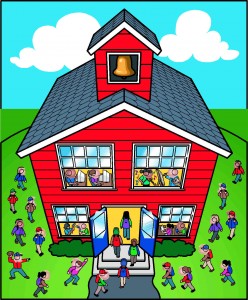
 hat is school? Everyone has a picture of what it is, and the majority will probably include kids sitting in desks, learning, taking tests, and doing homework. The things I just expect students to do – listen to the teacher, take good notes, ask questions, complete homework, memorize material for tests, pass tests with good scores – are part of teaching and learning, but not all of it; not the most important part. The most important part is our students’ involvement and investment in their education, and empowerment in their lives; these are what school actually is. This part of school isn’t taught in pre-service courses, even though it’s the source of developing their responsibility for learning, and determines the quality of what graduates at the end of high school. Students’ responsibility for directing their education is the part we don’t learn about because, I believe, the publishers’ pre-packaged products make it too easy to skip this vital part of learning for understanding. Teaching how to involve and invest students in their education and empower them as persons isn’t a passive set of knowledge, skills, and understandings. Rather, it is an active, dynamic process, not as easy to teach, at least within the current education paradigm. (more…)
by editor | Apr 11, 2013 | Environmental Literacy, Forest Education, Learning Theory, Outdoor education and Outdoor School

…at Starker Forests
Helping students climb the ladder to responsible citizenship
by Dick Powell
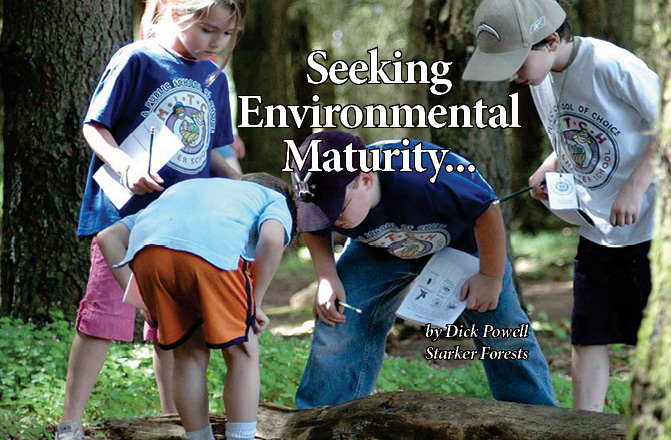
This past summer I attended the World Forestry Center’s International Educator’s Institute (IEI). As an environmental educator without any formal pedagogical or interpretive training, I found this week-long workshop enlightening and very worthwhile.
The part of IEI that I found most useful was called the “Pedagogic Steps in Environmental Maturity.” It validated what we’ve been doing.
Read the article here. (From the 2012 CLEARING Compendium).

by editor | Apr 4, 2013 | Service learning, STEM

By Lee Sherman
In Brief
Whether identifying fish or monitoring water quality, students combine education with service through OSU’s Oregon Natural Resources Education Program. Through partnerships with local watershed councils and other agencies, students are making a difference.
Lifelong stewardship can begin as simply as a school project at a local stream.
That’s what happened when Philomath High School student Colby Davidson conducted a fish study for his senior thesis. An average student who wasn’t accustomed to accolades, he was as surprised as his teachers when he discovered six native species previously unknown in Newton Creek – and then won a national conservation award from the National Wildlife Federation. Now, three years later, he remains vigilant and active in local watershed issues.
Stories like this drive and inspire OSU’s Oregon Natural Resources Education Program (ONREP). Based in the College of Forestry, the Extension program’s mission statement – “to prepare educators to inspire natural resources learning and experiences so that students make informed decisions, exhibit responsible behavior, and take constructive action for Oregon’s natural resources” – captures its community-service thrust.
Building Skills
Through ONREP’s Teachers as Researchers project, kids get initiated to service learning with a foundation in rigorous classroom instruction. “Authentic field investigations start with skill-building, such as graphing pollution data or identifying Northwest invertebrates,” notes ONREP Director Susan Sahnow.
It then spills across local landscapes as teachers lead students into woodlands and riparian zones to study the natural resources that define the places they call home.
Finally, by forging partnerships with local watershed councils and other agencies, teachers and students embark on research-based projects that enhance their neighborhoods, forests and watersheds in tangible ways.
The key message for students is, “If we don’t take care of our stream, who’s going to do it?” says teacher and ONREP participant Jeff Mitchell. “They learn to care about their own community by doing meaningful community service.”
Lee Sherman is a writer for the Oregon State University Extension Service. This article was reprinted from the OSU website at http://oregonstate.edu/leadership/presidentsreport/2009/fall/discovery-leads-service
