
by editor | Oct 14, 2012 | Environmental Literacy, Place-based Education
 urious about place-based education? Check out this free place-based education (PBE) video series, produced by University Outreach at the University of Michigan-Flint. The series was made possible through a $20,000 grant by the Saginaw Bay Watershed Initiative Network and support from the Great Lakes Stewardship Initiative. Several of the videos feature Oregon’s own Jon Yoder, past-president of the Environmental Education Association of Oregon (EEAO), one of the founders of the Straub Environmental Learning Center in Salem, and science program coordinator for the Salem-Keizer School District.
See the entire series at http://www.umflint.edu/outreach/programs/pbe-videos.page?

by editor | Oct 5, 2012 | Schoolyard Classroom
 by Bobbie Snead
Straub Environmental Learning Center
 he male osprey swoops down to join his mate on the enormous stick nest in Minto Brown Park. Sixty yards away, the third graders from a local elementary school gasp and clap in delight. I’ve taught them about ospreys in their classroom and now they’re getting to see the real thing. They are more excited than if they’d been on an African safari. This moment is my passion. (more…)

by editor | Jul 9, 2012 | Learning Theory
“Lessons for Teaching in the Environment and Community” is a regular series that explores how teachers can gain the confidence to go into the world outside of their classrooms for a substantial piece of their curricula.
Part 23: Notice is a Powerful Verb:
Noticing something in your environment entrains your creative powers
by Jim Martin, CLEARING guest writer
 You’ve decided to have your class study two water bodies near your school, one a vernal pond which is dry during part of the year, and the other a permanent pond which has water all year round. During the three years you’ve taught at this school, you’ve noticed the ponds, and wondered what lived in them. You feel committed to this school, and have been thinking of using the ponds as a source of some of your language arts, art, science, and mathematics curricula in your seventh-grade, mostly self-contained classroom.
So, you visit the ponds during spring break to see what’s actually living there. One thing you notice is a healthy frog population in the permanent pond. After wandering through the area, you recognize that the ponds and their environs present lots of possibilities for language arts and art, as well as for science and mathematics; you decide to do it.
You feel a need for a partner, at least to act as a sounding board, so tell your incipient plan to a colleague, who teaches the other seventh-grade classroom, about what you want to do. She is interested in the idea, but is uncomfortable about taking her students out of the classroom. You both agree she will act as a sounding board for you. (more…)
by editor | Jun 25, 2012 | Questioning strategies
“Lessons for Teaching in the Environment and Community” is a regular series that explores how teachers can gain the confidence to go into the world outside of their classrooms for a substantial piece of their curricula.
Part 22: Use It All
Why settle for simple recall of facts?
by Jim Martin, CLEARING guest writer
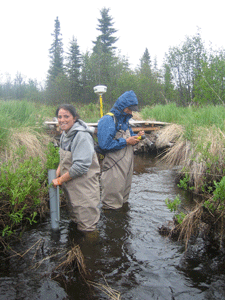
 We were observing a young woman sampling the temperature of the water in a stream. As she did her work, she would see the stream and its bank and look into the stream itself, see the plants, the animals, other students, the sampling equipment they used, and she would build an integrated perception of the entirety of this situation. She also talked with her partner, negotiated places to sample, told her observations, wrote them down, tabulated readings, interpreted her observations, etc. As she was doing these things, she would be using her temporal lobes for the language and some of the memory parts, the parietal lobes for the orientation and sensory parts, and occipital lobes for direct vision. (more…)


