
by editor | May 29, 2012 | Learning Theory, Questioning strategies, Schoolyard Classroom
“Lessons for Teaching in the Environment and Community” is a regular series that explores how teachers can gain the confidence to go into the world outside of their classrooms for a substantial piece of their curricula.
Part 21: Where Brains Learn
Some cognitive particulars about learning in the real world
 by Jim Martin, CLEARING guest writer
 he crack, a river, flows from the upper left corner of the wall, spreads into branching riverlets as it nears the window. That sentence was written in metaphor. The next sentence has no metaphor, but carries the same information: There was a crack in the wall which branched as it neared the window. Which will you remember? Which brings recallable pictures to your mind? This is like engaging in science inquiry in the real world. Compared to reading about the results of science inquiry in the real world. Each gives a visual clue, but which will come most easily to mind?
This is like science made vs. science in the making. The place of Assimilation is learning for understanding. When you engage your students in the real world, it acts like a metaphor, clarifies concepts and rectifies them with experience.
When you use the conceptual structures which underlie learning, they act as metaphors to clarify what you and your students are doing and learning. These structures are like the mirrors in a kaleidoscope which always generate the underlying structure of the image you see, and the pieces, ordered by that structure, are what you respond to. Can I add a little more to this?
We’ve been examining the conceptual structures that underlie learning, and how concrete experience in the real world encourages our brains to engage those structures. They reside in the architecture and processes of the brain. A picture of how they work to build understanding began to clarify itself to me during my teaching years. The brain is the organ of learning, and its structure and function does facilitate learning, especially when the delivery of the learnings recognizes how the brain works. Just as knowing the structure of color facilitates painting with water colors. When you dip the brush and apply it to paper, you know and anticipate what will happen. The underlying structure determines, to a large extent, what emerges.
Many of us carry an image of the human mind as an entity disembodied from our brain, an ethereal thing that goes where we go, and does our thinking for us. And no wonder. We can’t see the brain work, even in our classrooms. It doesn’t move the way muscles do, and it makes no sound. The best we can do is to know what the work of the parts of the brain are, and look for evidence of what they do in the things our students do and think.
Take Assimilation. The concept of Assimilation has varied descriptions, depending on who’s doing the describing. They generally carry this piece: What the learner personally experiences in the world about is incorporated into the world within our mind or brain. Its strength lies in the interaction between our brain and objects in the world outside ourselves. These are concrete interactions, and they work perfectly with the way our brain is organized to learn. Our brain learned to learn in the real world, where engaging concrete objects led to the kinds of abstractions that emerged as spear throwers and paintings on rocks, sticks, and cave walls. That is what makes metaphor such a powerful writing and rhetorical vehicle. It clarifies a subject with visual, tactile, olfactory, aural, and taste details that engage our senses, and make complexities open to understanding. A brain which developed in a concrete world is able to soar. Marvelous!
I often mention concrete vs. abstract referents. You can do the following as an experiment if you teach the same thing to two classes. When we are presented with new material in an abstract form, like a paragraph of information, we can put it into long term memory by using the information several times. Think of the end-of-section questions, where students answer questions by reviewing what they have read about particulars. Like Procedural Memory, which helps us carry out actions, it may stay with us, but different but related pieces won’t be stored as one concept. When we actually engage concrete referents, a thermometer in a stream, we engage Declarative or Distributed Memory, episodes and facts that can be brought to mind consciously, where new learnings are incorporated into concepts already residing in the brain. Let’s look at some of the parts of the brain involved in these processes.
When a student holds a thermometer in her hand and immerses it into the cold waters of a glacier-fed stream, her eyes send visual information about this to the visual processing areas in the Occipital Lobe of her brain, at the very back of her head. The Parietal Lobe, between the Occipital Lobe and the middle of her head, processes the feeling and temperature of the water on her hand. It also keeps track of where her person ends and the rest of the world begins, then gathers the visual, tactile, and coolness information, and passes it to other parts of the brain which carry memories of all these things.
You can get a sense for how this functions when you sit down to enjoy your favorite beverage, say a latte. (Now, you have to tell yourself that you’re here to learn. That sets things up in your brain.) As your fingers move toward the cup’s handle, you become very aware of the shape of the handle just outside your skin, and the round shape of the cup. You may have brief perceptions of other cups, perhaps a favorite that is still in the dishwasher. You can see the foamy latte part of the beverage near the top of the cup, and anticipate its flavor. Certainly you’ll be aware of its texture, fine bubbles, color, pieces that your tongue loves to discover. And the coffee itself. You’ll know what kind it is, where it was grown, color, anticipated taste, texture, and the bouquet it always leaves in your mouth after you’ve sipped it. You may even be aware of the brands of the latte and coffee, and other facts of these ingredients of the beverage. You may have brief recollections of other places you’ve had this particular blend, who was there, and what you were doing.
These things happen very quickly, but they are perceptions perceived. Each piece of information came from specific parts of your brain, and these were processed together in your prefrontal cortex, at the front of you head, as what is currently called Working Memory. The prefrontal cortex is also the place where you engage critical thinking. Nice.
So, by doing something when you’ve told yourself that you’re doing it to learn, you suddenly have all of the things you’ll need to help you learn brought together in the part of the brain that can do the learning. Why shouldn’t we use the structure and function of the brain to enhance the delivery of our curricula? Let’s take this idea back to the young woman immersing her thermometer into the waters of a stream.
As she picks up the thermometer, positions it in her hand so she can see its graduations, she becomes very aware of its shape, its use, her expectations for what it will tell her, the particular reason she is picking it up, the memories she already has about streams, and thermometers, and, because she’s here to learn about salmon, some thoughts about how salmon like the temperature of their water.
She is on the first hour of a one week unit on watersheds, so doesn’t know a great deal about water temperature, salmon, and watersheds. None the less, what memories she does have of these things come together with all the rest in working memory, ready to learn.
So, she measures the temperature of the water, and it’s twelve degrees celcius. Her working memory doesn’t know where to fit this in, what I call a Need to Know. So she looks for the reference book that is part of the contents of the box she helped carry down to the streambank. Finding it, she looks for information about salmon and temperature, and finds they prefer waters with a range of temperatures between 4.4 and 14.0C. Then her prefrontal cortex, the site of critical thinking, begins to use the information she has gleaned and memories stored, to engage the prefrontal cortex’s functions of perseverance, self-monitoring and supervision, problem solving, orchestration of thoughts and actions in accordance with internal goals, compare and contrast, working toward a defined goal, expectation based on actions, extract and reconstruct sequences of meaning from ongoing experience.
That’s a long list, a partial one, of the functions of this site of human learning that current US curricula generally overlooks. Contrast this with the teacher telling students about salmon and water temperature, the student reading in the text about it then answering questions in the back of the chapter about these things. Compare and contrast (using your prefrontal cortex!) this with the rich texture of meaning in the young woman with the thermometer.
Next time we’ll look some more at this underlying structure of learning.
 This is the twentyfirst installment of “Teaching in the Environment,” a regular feature by CLEARING “master teacher” Jim Martin that explores how environmental educators can help classroom teachers get away from the pressure to teach to the standardized tests, and how teachers can gain the confidence to go into the world outside of their classrooms for a substantial piece of their curricula. See the other installments here, or search Categories for “Jim Martin.”
by editor | May 27, 2012 | Marine/Aquatic Education
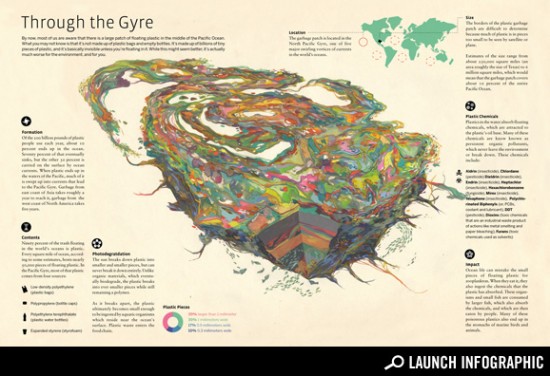
By now, most of us are aware that there is a large patch of floating plastic in the middle of the Pacific Ocean. What you may not know is that it’s not made up of plastic bags and empty bottles. It’s made up of billions of tiny pieces of plastic, and it’s basically invisible unless you’re floating in it. While this might seem better, it’s actually much worse for the environment—and for you. Take a look at the Pacific Gyre and the plastic floating in it.
.
Gyre illustration by Jacob Magraw-Mickelson
– from good.is

by editor | May 15, 2012 | Outdoor education and Outdoor School, Schoolyard Classroom
“Lessons for Teaching in the Environment and Community” is a regular series that explores how teachers can gain the confidence to go into the world outside of their classrooms for a substantial piece of their curricula.
Part 20: Beginning at the Beginning
.
 by Jim Martin, CLEARING guest writer
 n the last blog, we looked at planning an inquiry unit from the perspective of a student display, isolating the parts of the display and tracing them backwards. Now, let’s start at the beginning, and look at the inquiry unit as a scope and sequence. Until you’re comfortable taking your students out into the real world, it’s easy to forget some of the details in this kind of work until you’re on site, or waiting by the school for a bus you haven’t ordered. It happens!
It’s difficult, in the blog’s format, to construct a scope and sequence using a long timeline, so we’ll do it as a narrative. You might practice laying the parts out on a timeline, at least mentally, as the visual feedback often suggests things to do that you won’t notice as you read a narrative.
Our reed distribution inquiry began with the Casual Observation. At least, as written. However, just getting to the site means you’ve ordered a bus and substitute, have talked with your students about safety, given specific directions about clothing and lunches, sent permission slips home for parents to sign and return, looked for equipment students might need, prepared student logs so they can record their experiences, done a preliminary site visit yourself, and prepared the substitute’s lessons.
On a time line, these would line up on the left under a heading, “Casual Observation.” They would be on the left side of this column. On the right of that column, you would list the things students will do. For instance, they will need to know something about the site they will visit, and, in general, what they will be doing there. You’ll need to organize reference materials the class will need when they return, and decide which references you will carry to the site. All before you board the bus. So your timeline would begin at least a month before you’re on that bus, headed toward your site.
The actual observation won’t take up much space on the timeline. You ought to give your students a tour of the site. Then have them follow prompts you give them, or just follow their own noses. At first, this will depend on your comfort level. Eventually, it will depend on your recognition of the potential embedded in a student’s ownership of the work and learnings.
Where we go from here depends upon your schedule. If you’re here for the day, then your students can move through all the pieces of the unit. If you are planning for two briefer field trips, then the timeline will look different, but most of the components should be the same. Because this is a linear unit, with each piece completed before moving to the next, the parts of the scope and sequence will be similar, but the days won’t.
When students have completed their casual observation, you might have them share what they noticed. As students work, some may go to the references for information, others may not have thought of this, or are waiting. As you move around the site, some may ask for advice. Be careful not to tell them what they can find out themselves. A sentence that almost always works for me is, “Good question; how can you find out?” The number and kinds of questions students raise are mostly a function of their locus of control. Okay, let’s move to the Develop an Inquiry Question phase.
Before starting this phase, you should have samples of good and not so good inquiry questions for students to critique. Do you have them do this before, or after they have written two or three tentative questions? Again, this depends on your comfort level and teaching style. Because Assimilation is one of the main conceptual structures that underlie the organization and delivery of my curriculum, I like to have students write first, so they have concrete referents to use when we discuss the characteristics of good inquiry questions.
The process is simple, but takes time. Basically, students write and critique inquiry questions using the examples you provide until they have one or two they are comfortable with. Then, they assess these questions and develop a final inquiry question. You might introduce the concept of operational definitions if appropriate, and naming protocols, which are sort of operational definitions. (Use naming protocols for plants or animals whose names they are unsure of. Mine was, “Give it a name and use it until you have good reason to change it.” This seemed to work; relieves anxiety and reduces confusion.)
If you’re doing two field trips, you’ll want to check permission slips, equipment, bus, and sub. So, under Develop an Inquiry Question, you would just have something like Develop an Inquiry Question on the right, and Prepare Sample Questions and Assessment Criteria on the left, and if you’re doing two trips, check permission slips, etc., on the left. (You might have noticed that all of the items we’ve been adding fall into two groups, logistics and pedagogy. This could be a way to further clarify your scope and sequence.)
After students have developed their inquiry question, they need to Design an Investigation. This is always pretty straightforward; their question tells them what to do to answer it. The other items in this column might be safety reminders, prep the analytical math they’ll need to process their collected data, practice using tables to organize observations, and practice on any equipment they plan to take into the field. They are important, not so much to the design of their investigation as to the next item, Collect Data. However, this is the time, before they leave the school, to do this. Of course, you can move it to Collect Data. I like the idea of prepping these things as students are designing their investigations because they have an opportunity to integrate these concepts into their planning at a time when it makes sense to them.
The Collect Data column is short, unless you include the logistical pieces in it, like take the bus, arrive at site, go to stations, collect data, pull the work together, return to bus. Students ought to iterate safety rules before you release them into the site. After that, students do the work and return to school. By this time, they ought to be the well-oiled machine.
Back at school, they Analyze and Interpret their data. Now that they have concrete referents about data, this is a good time to review what they learned about tables and analytical math. Since student groups will move through this phase at different paces, show them what you want to include (but not be limited to) in their reports and displays, if they are making them. As questions arise, this is where you do targeted mini-lectures. Most classes will welcome a demonstration of the analysis of a hypothetical set of data, both the mathematical and graphical analyses and interpretations. If you’re weak in this area, and lots of us are, this can be a good learning experience for you.
After students have analyzed and interpreted their data, they prepare to Communicate it, the last heading in the scope and sequence. They should at least make a presentation to the class, complete with a poster. You’ve already briefed them on what to include in their display, and this is a good time to reiterate it. After all reporting is done, you ought to consider having the class summarize the meaning of all of the findings. You’ll find, over the years, that you’ll learn as much about teaching as they learn about environments.
This description of attempting to use a scope and sequence has generated a great deal of detail. More detail than you’d want on a simple timeline. You can take lumps of these details, give each lump a name that makes sense to you, and just name the lump. It will help build a better scope and sequence. Somewhere below these briefer descriptors you can jot down the details. (I’ve used spreadsheets to do this, since you can go as far to the right, and down, as you want.)
It may be time, while we’re engaging underlying structures, to examine their significance. Next time, we’ll do this, and discuss some of the reasons structure is significant.
 This is the twentieth installment of “Teaching in the Environment,” a new, regular feature by CLEARING “master teacher” Jim Martin that explores how environmental educators can help classroom teachers get away from the pressure to teach to the standardized tests, and how teachers can gain the confidence to go into the world outside of their classrooms for a substantial piece of their curricula. See the other installments here, or search Categories for “Jim Martin.”

by editor | May 5, 2012 | Questioning strategies

“Lessons for Teaching in the Environment and Community” is a regular series that explores how teachers can gain the confidence to go into the world outside of their classrooms for a substantial piece of their curricula.
Part 19: Walking Backwards May Get You There
Working backwards is a good way to nail down understandings. It’s also a good way to test your students’ understanding of science inquiry.
by Jim Martin, CLEARING guest writer
We’ve been looking at inquiries as they go from beginning to middle to end. What might they look like if we start our inspection at the end of an inquiry, and trace it to its inception? Will it sound the same? Are there some insights lurking along the backward path? Retracing a path you’ve walked or driven often contains some surprises.
Let’s start with an end product, a two-panel cardboard display board sitting on a counter in the classroom. On its surfaces, students have written and illustrated their question and how they arrived at it, the design they built to answer the question, the data they collected, their analysis and interpretation of the data, and their conclusion about whether the interpretation answers the question. (That last piece is an easy one to overlook. Studies can take on a life of their own, and students sometimes forget why they started on their journey!)
Think of that display as a benchmark; the evidence that a student has mastered the learning it, the benchmark, encompasses. If you’ve ever used benchmarks to design the scope and sequence of a unit, you’ll know they do have good, practical, pragmatic uses. They tell you what you want to accomplish, and your scope and sequence tells you how they will get there. If you keep the benchmark in mind, you’ll find it easier to keep your scope and sequence focused, targeted on the benchmark. This is different from looking up a required benchmark and seeing if your lessons have addressed it, a common, ineffective, current pedagogical practice.
So, let’s take the last activity we described, a study of temperature and dissolved oxygen in the main and lateral channels of a stream. What do the writing and illustrations on the panels of the display tell you that students have to learn? Well, an obvious one is that they have to know how to organize a complex report. So you make Report Writing one of the topics to cover. To get to the final product, they have to be able to work in Effective Work Groups. This means you need to be working on building these well-oiled machines early on.
Moving back, they have to know how to Construct and Read a Graph for the information it contains, and Explain this Clearly in Writing. They have to know how to Refer their Interpretations back to their Question. And they have to have the capacity to engage in Critical Thinking in order to do this. This is one of the weak spots in education in the US. Getting the right answer on a multiple choice question isn’t critical thinking. My own questions of students and a number of studies show quite clearly that, no matter how well critical thinking would help make the right choice, students just look for the best answer, or choose between two likely answers. They don’t think unless you ask them to write their thinking on the test itself.
During their work, they will have to know how to Analyze Data. This means you’ll have to assess their competence in the math they’ll use for the analysis, and they’ll have to practice figuring out what the results of the math mean. Often, this means that we, the teachers, need to brush up on this. Not to mention the Outliers in the Data that they’ll have to make decisions about. Students are working with two measurements, temperature and dissolved oxygen. How do they analyze them? Deal with outliers?
Collecting Data is just a term, but it’s a big part of the work. Students will have to know how to Measure Temperature and Dissolved Oxygen. This means time in the lab, and the conceptual background to Understand the Relationship of one to the other, and to the lives of juvenile salmon. (Analogy to doing my budgets to find out what I’m really doing.) As they encounter problems, they’ll need to know how to Negotiate Meaning in a group. They’ll need to know how to Organize their Sampling; do they sample at the edge of each channel? Within the channel? How many measurements at each place they sample? Actual sites are very different from the lab. In the lab, everything is organized, and sitting just where it is needed, in its proper order. The real world is messy; until you’ve sampled in it a while, it can be a very confusing, disorderly place. Safety on the site: What Safety Rules do you have to discuss with the class and write down? The work: How do they divide the jobs?
Designing the Investigation; how do students go about this? If they’ve asked a succinct inquiry question, it will tell them what to do. They just list the steps the question calls for. This is usually the easiest part of the work to do. You simply need to get them started, then walk around and review what they’re talking about and writing down. You’ll find that their locus of control has moved within them, they exhibit all the characteristics of ownership of the learning. Plan for enabling your students’ locus of control and ownership of the learning, or it won’t happen in the clutch.
Asking a good Inquiry Question is probably the most difficult part of the work. After developing a question, students assess it. There are lots of assessment rubrics around. Here’s one I use, thanks to Norie Dimeo-Ediger and Berk Moss, who passed them on to me while we were doing institutes at the Oregon Zoo. A good inquiry question is: interesting to you, simply stated, observable, and doable. And one other, thanks to Mike Weddell – Ethical. (That last may not seem applicable to you until your students are disturbing plants, animals, and soils in ecosystems.)
The questions themselves are very difficult to arrive at until we’ve asked a relatively large number of them. This is partly because we haven’t lived our learning lives out in the world we evolved in. So we are a bit overwhelmed by the complexity we observe there, and subsequently ask very large questions. These large questions often begin with “Why.” Why do birds fly south in winter; how do aquatic organisms reduce pollution; why do leaves break up and decompose on the bottom of a pond; why did these trees grow the way they did here? These are what I call ‘umbrella’ questions. They don’t lead to one succinct inquiry which will answer them. Rather, they beg several to many smaller inquiry questions.
For instance, I might ask an umbrella question like, “Why do reeds grow in narrow bands along this river’s edge?” Think of answering ‘Why’ questions in this facetious way: Do I design a questionnaire, then go out and ask the reeds its questions? That’s a very common way to get an answer to a Why question. Or, I might take a different tack and ask the Why question what smaller questions might provide an answer to it.
Why questions and How questions are almost always umbrella questions, which can only be answered by sets of succinct inquiry questions. One inquiry question that might begin to answer my Why question about reeds might be, “Where, on a line from the water’s edge to a spot 100 meters up the streambank, do reeds live?” An answer to that should tell me what particular part of the reeds’ environment to question for an answer to my umbrella question.
A follow-up question might be, “What are the properties of the soil at the streambank’s waterline, the streamside edge of the reeds’ distribution, the streambank side of the reeds’ distribution, and soils at 10-meter intervals thereafter?” Not a succinct question, though. Not simply stated. That’s my cue to think about what I’ve just said. Thinking about it, I suddenly see that it’s more like a piece of a design to answer my inquiry investigation. I could make my inquiry question more succinct by simply asking about soil properties at 10-meter intervals from the waterline, or soil properties in the band of reeds, and on either side of the band. If I suspected soil moisture might contribute to the reeds’ distribution, I might ask, “What are soil moisture properties between the band of reeds and the stream, in the band of reeds, and 10 meters up the stream bank from the reeds?” I’ll continue with this one, but am still uneasy about the long predicate.
The time it takes to do this well is worth the expense. It’s key to doing inquiry. Work out your own way to do it; just be sure to do a quality job. And don’t forget, it takes lots of practice to get to the place where you routinely see something and ask a simple inquiry question about it.
Let’s assess this last question. First, is the question interesting to me? If I’d never seen reeds, the answer might be, ‘No.’ However, I have done a casual observation, and their tight distribution along the streambank came to my immediate attention. So, I’d say the question is interesting to me. Too often, students are given their question. Not a good way to make a question interesting.
Second, is the question simply stated? I say yes and no. It’s a long sentence, and I might spend some time thinking about how to shorten the description of where the soils are that I’m interested in. Perhaps I could change my question to, “How does soil moisture compare between the band of reeds and the rest of the streambank?” That way, my investigative design can do the work of describing just which soils I’m interested in. I like that; it is what I will do.
Third, is the question’s subject observable? Oh, yes. I find the soil, I dig, I test for moisture, I write down a number. Easy. Fourth, is answering the question doable? Well, that depends on how much time I have to do the sampling and testing, if I have the equipment, and if I can get transportation to the site. If those needs are met, then it’s doable, and I can get to work. If not, I’ll have to rethink my ideas.
It looks like my question has survived, and I can get to work. Earlier, I mentioned a casual observation. Let’s look at that now. You can’t ask an inquiry question without knowing something about the subject of your inquiry. It’s the weakest part of most publishers’ lab and field exercises. Many have the student write an hypothesis in the absence of experience, something scientists don’t do until they’ve thoroughly studied a phenomenon with many individual inquiries. The casual observation gives students an opportunity to get to know the subject well enough to ask an informed question of it. We owe them that much
When you send students out for their casual observation, and it’s their first such experience, you might think of giving them brief prompts like, Look for plants, Look where the water meets the land, or Look where plants live. Another thing to consider – students will be negotiating meaning while they’re doing their casual observation, and that tends to be best when they work in dyads, pairs. A third student will probably let the others do the work. At this point, it’s very important for each student to be closely involved in the work, and to be sharing thoughts with a partner. This is where the process of assimilation for understanding begins. If you can’t arrange the casual observation without one triad, then make sure each member is a good communicator.
Don’t tell your students specifics about what they are about to do, just what the next step is. Their brain has to do the learning. This is a toughie. We always want to help them, but this is learning they have to do themselves. And can.
We’ve walked through an inquiry from very end to beginning. Next time, we’ll bring this together to scope and sequence how the unit would work. See how it looks from beginning to end. This is a skill we all need to develop and use.
 This is the nineteenth installment of “Teaching in the Environment,” a new, regular feature by CLEARING “master teacher” Jim Martin that explores how environmental educators can help classroom teachers get away from the pressure to teach to the standardized tests, and how teachers can gain the confidence to go into the world outside of their classrooms for a substantial piece of their curricula. See the other installments here, or search Categories for “Jim Martin.”
by editor | Apr 16, 2012 | Questioning strategies
“Lessons for Teaching in the Environment and Community” is a regular series that explores how teachers can gain the confidence to go into the world outside of their classrooms for a substantial piece of their curricula.
Part 18: Starting at the Top
Stand the hierarchy of cognitive functions on its head
by Jim Martin, CLEARING guest writer
 Learning to exploit the community and environment for your curriculum can be a confusing process. It can be less confusing if you apply the Learning Curve to the structural concepts we’ve been discussing – dimensions of inquiry, student-centered inquiry, effective work groups, etc. – because learning is a process, a developmental process. For instance, when you first start to develop effective work groups, both you and your students are learning them. Once learned, you’ll find that you have to keep in mind that you’ve got it down so well that it is easy to assume a new batch of students has too. To you, because you assimilated the concept, it seems more like common sense than learned content. The word, developmental, is an important one to remember. Lots of us don’t. We teach as if they already knew.
‘Structural concepts’ is a term that is useful to keep in mind. They help you stay on track in your teaching. I’m sure that, like me, you’ve found yourself in a favorite unit, straying away from the plan because where you’re going is such fun. If we keep those structural pieces in mind, we can attach the curricula we’re delivering to them. Some sheetrock here, a window there, and the deck in just this place.
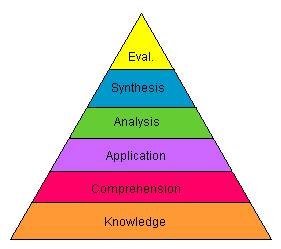
One structural concept is Bloom’s hierarchy of cognitive function, which contains several levels, named and then described: Knowledge – observation and recall of information; Comprehension – understanding information; Application – use information, use methods, concepts, theories in new situations; Analysis – seeing patterns, organization of parts, recognition of hidden meanings, identification of components; Synthesis – use old ideas to create new ones, generalize from given facts, relate knowledge from several areas, predict, draw conclusions; and Evaluation – compare and discriminate between ideas, assess value of theories, presentations, make choices based on reasoned argument, verify value of evidence, recognize subjectivity.
You might have noticed as you move through the hierarchy, there are more and more descriptors. A clear indicator that more and more of the learner’s brain is involved at each successive level. And, the learnings are more meaningful. Many published materials contain words in question stems like, ‘What,’ ‘How,’ and ‘Why,’ in an apparent attempt to stimulate thinking at the various levels in the hierarchy. In fact, I once attended a workshop where the presentor suggested starting multiple choice question stems with words like these to induce critical thinking. Words in question stems don’t do the work of thinking at the various levels; what students do, does. Starting at higher cognitive levels and inquiry dimensions is doable, and a way to stimulate involvement and investment in new learnings. It’s worth learning how to do.
Much of what education does in the US attempts to move students up the hierarchy, perhaps with the idea that when students have all the facts memorized, they’ll be able to evaluate what they’ve learned. But, most curricula ends at the Application level, or if it does reach true Analysis and Synthesis, it is delivered in a didactic modality. We know the words, but don’t incorporate them into our lives because we haven’t done them.
Here’s an interesting way to engage your own learning curve: start, once you’re comfortable with the concept of dimensions of inquiry, at the top right of the cube (See the diagram in Effective Work Groups: When you know them, they will change your world), reserving the lower left corner for training on instruments, etc. This top-down learning is effective, as students begin in a context, and work their way down the cognitive function hierarchy as they develop needs to know.
For instance, you can use temperature and dissolved oxygen in a stream and a lateral channel to start in the upper right, at least to the Correlational segment of the Experimental dimension. Lead students to the stream and ask them to see where water is. They’ll notice the main channel of the stream, but may take a while to notice a lateral channel. Then ask them where they think temperature and dissolved oxygen are more suitable for juvenile salmon. You move to the lower left corner of the diagram by showing them how to measure temperature and dissolved oxygen. Then they will move themselves almost immediately toward the upper right corner as they explore your question. This is how humans learn.
In the activity described above, you have moved from Application to Evaluation. Instead of starting with Knowledge, moving to Comprehension, then to Application, students start at the Evaluation level of the cognitive hierarchy, then migrate through its levels as they pursue their inquiry. Should you observe them carefully, you’d find they were using pieces of each level as they solve the problem they started out with. They don’t have to move in lock step, in one direction, up the hierarchy. They simply integrate the functions of the hierarchy into their repertoire.
Let’s explore a template that may help you reverse the sequence contained in the hierarchy, and so doing, leads to learning for understanding. The template is called the Learning Cycle, another structural concept, and it starts somewhere near the Unstructured and Inquiry dimensions of Inquiry. Instead of learning all about something before they go into the lab, community, or environment to explore it, students explore first, experiencing the content at a higher cognitive level. Let’s use the temperature and dissolved oxygen activity to demonstrate this.
The concept of the learning cycle has evolved over several decades, has generated a large body of data to support its efficacy, and is generally described as having 3-5 phases. I’ll paraphrase five phases here, and describe what students would do in each. The cycle can be used in any discipline; in our case let’s relate it to the stream and lateral channels activity described above. What the students and teacher did fall into the five phases in the order they were done.
- Engage: in which a student engaging in an activity becomes interested in a topic. Students exploring stream channels, main and lateral, become engaged with the content.
- Explore: in which the student to constructs incipient knowledge in the topic through questioning and observation facilitated, but not directed, by the teacher. When students, facilitated by the teacher, pull experiences together to formulate an inquiry question, they begin to construct knowledge and incipient concepts about the content. (This takes time.)
- Explain: in which students explain what they have discovered, and engage in a discussion of the topic to consolidate their understandings. When students assess their questions and design their investigation, they negotiate the meaning of their new understandings, testing their understanding of them as their plan evolves.
- Extend: in which students apply what they have learned and elaborate these new skills and understandings. As they collect data and analyze it, students are applying what they have learned about measuring temperature and dissolved oxygen in parts of the main and lateral channels they have chosen. As they work, they are elaborating their incipient understandings about temperature and dissolved oxygen in response to readings from the two microenvironments, and are observing and categorizing more details of the two channels. Doing this, they begin to develop incipient conceptual schemata about main and lateral channels They also encounter problems in knowing just where to sample, and are learning new information about how temperature and dissolved oxygen change in the two microenvironments.
- Evaluate (may now be evolving to ‘Create’): in which the teacher and students assess their knowledge, skills, and understandings. Students present their findings to the class. This forces them to assess the coherence and validity of their new learnings. When students interpret their data and ask if it answers their question, they are ground-truthing and clarifying their understandings. As they communicate their findings to the rest of the class, they are observing and correcting themselves, as is the teacher, within a collegial context. (If you’ve never done this, you’ve missed a very powerful experience. Find a teacher who does this and visit when students are communicating findings.
During the trajectory of the stream and lateral channel study, the ownership of the work migrated from the teacher to the student. The teacher must get them into contact with the content, then follow up on their initial findings to assist them to develop a clear inquiry question. After this, they carry most of the load, and you can scope and zoom to learn more about how this kind of learning works. Remind yourself if you forget, a brain is an autonomous learning machine. It starts in the real world, where it evolved, then moves to the abstract, to conceptual learnings. Back at school, those brains will peruse the books to fill in information they need to know. They learn.
Next time, we’ll take a trip from the end of an inquiry to its inception. Working backwards is a good way to nail down understandings.
 This is the eighteenth installment of “Teaching in the Environment,” a new, regular feature by CLEARING “master teacher” Jim Martin that explores how environmental educators can help classroom teachers get away from the pressure to teach to the standardized tests, and how teachers can gain the confidence to go into the world outside of their classrooms for a substantial piece of their curricula. See the other installments here, or search Categories for “Jim Martin.”
