by editor | Apr 10, 2012 | Questioning strategies, Schoolyard Classroom
“Lessons for Teaching in the Environment and Community” is a regular series that explores how teachers can gain the confidence to go into the world outside of their classrooms for a substantial piece of their curricula.
Part 17: Discovery of Students as Persons
Students, engaged, empower teachers; a first step toward Community and Environment Based Learning
by Jim Martin, CLEARING guest writer
 The discovery and appreciation of effective student work groups often emerges from involving students in community-based learning. Probably because the work, based in and on the real world, is authentic, and entrains central nervous system processes which are already in place. This is an important developmental learning milestone, and can be exploited to move yourself toward community-based learning as an integrated view of how to teach.
As teachers make this discovery about work groups, they may exhibit a growing desire to nurture and exploit this new view of school and students. This is one of the paradigm shifts which leads to effective use of the curriculum embedded in the community. The student, as empowered person or citizen, affects the nature of a teacher’s view of his or her role in the classroom, school, field, and community.
Teachers who build their curricula around the community and environment often directly alter their students’ attitudes toward their educations. The perceptive observer will notice this in the way students become involved and invested in their educations, and empowered as persons. From time to time, I’ve heard teachers notice particular students working in the lab make an observation like, “Is that Bethany organizing her group? She doesn’t do that in my class.”
This change in students’ attitudes and work is noticeable, and most teachers who observe it are impressed, and with support, eventually changed by what they see. Students’ empowerment influences and empowers their teachers. Certainly, I was one of those teachers. I’d like to describe three teachers’ involvement in community and environment based learning, and the effect their students had on them. Each teacher is a composite of more than one teacher, but the teachers in each description approached the work of teaching in similar ways, and had about the same experience.
The first is a veteran middle school math teacher who used his authority to maintain control in the classroom, sent misbehaving students into the empty hallway, delivered his curriculum via lecture and practice, and was marginally successful in delivering content. One day he decided to try a regional watershed program where students and their teachers made observations on environmental parameters in watersheds. During the first field trip, he mainly walked around as a spectator, which many teachers do in these situations. Later, we talked about possible follow-up activities, and I suggested making three-dimensional topographic models of their station from thick poster board. This would give him an opportunity to observe work groups; hopefully one or more would be effective.
The next day, he asked me to start the project, and said he would butt in whenever he felt comfortable. Once the students started working, he expressed surprise at the work, communication, and management skills various students exhibited. He had never noticed his students were all different! He took over right away, used his own personal knowledge, skills, and understandings to run the class, and over the next two years moved from being a top-down, didactic, authoritarian teller of content to a comfortable, student-centered facilitator of effective work groups. That was a gift from his students, whose personal empowerment so impressed him. And one of his gifts to them was a dramatic increase in the scores of the bottom 25th percentile.
(In many of my blogs, I refer to the ‘bottom 25th percentile.’ I do this because, if you can raise the achievement of that particular group in a classroom of students, then the achievement of all students in the class will improve along with them.)
The second is a middle school language arts teacher who was relatively new to teaching, and who involved her students in the community and environment. One day, she decided she’d like to have her class develop a watershed model in a courtyard at the school. She organized the class into groups who learned how the fountain in the courtyard worked, and modified its flow so it resembled a stream. Others learned about rocks in streams, native plants in streams and on stream banks, etc. These students were already empowered by their teacher’s competence as a motivator and facilitator, so they continued to be involved and invested in their educations, and their success in this new project reinforced the teacher to continue to be involved in community and environment based learning.
(My last project with her was a tutor-assisted reading program in which college students volunteered to tutor groups of 4-5 students, and significantly improved the reading levels of her bottom 25th percentile. Authentic education involving effective work groups pays off in any discipline and academic level.)
The third is a veteran middle school social studies teacher who did little planning for her classes, didn’t maintain a structure in her classroom that was conducive to learning, and didn’t develop effective work groups. As part of our project we would come to her school to mentor her on field work. One time we took her class out to learn to find and map elements of watersheds. Once we were on the school grounds with the students, she left to rest in the faculty room. Over a period of two years, she never became involved in activities the students engaged in the school. But she did stay with them when they manned information booths about their projects at informational open houses at study sites in the community. She became comfortable on field trips, participated in some of the work her students were doing, and encouraged some of them to do good work. The students who grew in the projects she started did so mainly on their own; the opportunity was all they required. Her bottom 25th percentile didn’t improve.
This teacher had, over several years by the time our project finished, entered and traveled along the acquisition phase of the learning curve. In some areas, she moved into transition to the proficiency phase. Should she ever move some distance up that phase, the work might involve and invest her in her teaching. She is bright, but not empowered by her work or by her students. The fact that she did move some way into the learning curve tells me she represents a first approximation of a fully empowered teacher. If I were her mentor, I’d use that information to set the next approximation and move her toward it.
There’s a good lesson here. If we are to get our students to the point where they empower us, we have to be intimately involved in what we do. Seems obvious, but not to everyone. The third teacher was interested in the community and environment, but never became intimately involved with the work. Because the work is almost always authentic, that alone helps us to become very involved in it. That, plus our commitment to our profession, teaching.
 This is the seventeenth installment of “Teaching in the Environment,” a new, regular feature by CLEARING “master teacher” Jim Martin that explores how environmental educators can help classroom teachers get away from the pressure to teach to the standardized tests, and how teachers can gain the confidence to go into the world outside of their classrooms for a substantial piece of their curricula. See the other installments here, or search Categories for “Jim Martin.”

by editor | Apr 4, 2012 | Questioning strategies
“Lessons for Teaching in the Environment and Community” is a regular series that explores how teachers can gain the confidence to go into the world outside of their classrooms for a substantial piece of their curricula.
Part 16: Effective Work Groups
When you know them, they will change your world
by Jim Martin, CLEARING guest writer
 e left the last blog with a note about effective work groups. I asserted a continuum of work groups from one in which each student is answering questions without talking with other students in the group, to one in which students carried on a continuous negotiation of meaning and organization of work assignments until the job was finished.
Let’s return for a moment to the Dimensions of Inquiry to visualize scenarios in which the quality of student interactions experiences a developmental change from isolated work to effective cooperative work. Look at Figure 1, which is a depiction of the three Inquiry dimensions arrayed in a three-dimensional graph whose axes are connected to form a cube. The dimensions range from Verification to Inquiry on the X-axis, Structured to Unstructured on the Y, and Description to Experiment on the Z. Each black dot inside the cube represents an activity performed by a student or group of students. Taken together as pictured, they represent a trajectory from rote didactic to interactive constructivist learning, a plan for where a course or unit should begin and end.
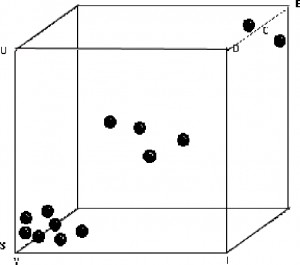
Figure 1. Three-Dimensional array of the Dimensions of Inquiry. Starting at the upper left, and moving around to the right, U = Unstructured, S = Structured; V = Verification, I = Inquiry; and D = Descriptive, C = Correlation, and E = Experiment.
You can see that some activities are structured, and clustered around the Verification and Description sides of the X and Z axes. These would be teacher-centered, and didactic, and hopefully activities in which students were learning to use equipment, read technical manuals, or work like that. But, try to imagine an activity in that lower left cluster in which students were trying to determine where juvenile salmon might congregate based on measured water quality parameters. It is possible to imagine this scenario, but the picture I see is one of a very neurotic teacher controlling every aspect of the students’ thoughts and actions. Certainly not conducive to critical thinking, one of the products which should emerge from science education. Unfortunately, it usually doesn’t emerge, and we all need to learn to rectify this situation.
The most effective way I know to do it is to move my students through that cube so, instead of doing lots of ineffective small activities, such as those publishers seem to favor, they spend most of their time on a few complex activities that entrain and encourage critical thinking, involvement and investment in their education, and empowerment as persons. These outcomes are as important, at the very least, as is touching ever so briefly, mandated science benchmarks. (I had a very small part in developing science benchmarks. So, I should talk. I don’t wish to belittle benchmarks; they make wonderful organizers, but have morphed into swords, held over teachers’ heads. Unfortunate.)
Effective work groups facilitate this movement toward students who routinely use critical thinking to navigate the curricula they are assimilating. Developing effective work groups is an ongoing process in which you move from Teller of Facts to Facilitator of Minds. Students working together in groups is a dynamic phenomenon, one which can be frustrating or invigorating, depending on how you approach the process. Like raising children, you have to learn to live with a balance between freedom of decision and action, and respect for boundaries. And, like parents, you accomplish this by creating structures within which your students move.
One thing that helps is to start the school year off with students working on an interesting problem in dyads. The problem should be one in which students make some things interact, and the interaction produces interesting results. (Our primate heritage: We’re easily drawn to novelties! Piaget called them discrepant events.) For instance, they can add an indicator dye to several liquids you’ve collected, and observe for a color change. (If you’ve practiced beforehand, you’ll almost always find one thing which doesn’t produce the color change you expected. Fun. And, discrepant.)
As they work, you can make suggestions that help them work well together, but don’t tell them any answers. Their brains have to do that. Having them report their results to the class helps them to learn some valuable lessons about working together. (If you include things in this activity which will act as openers to segue into your first unit, you’ll be able to see right away the power of assimilation to involve students in their learnings.)
I start with dyads because they minimize problems of acting out, refusing to help, etc. Once students are working well in dyads, then you can merge dyads to form tetrads, groups of four, to work on larger problems. Occasionally move the memberships around. (I learned a nice trick at a workshop; Make up a blank ‘day timer’ page, with the hours from 9:00 to, say 6:00, and an underline after each hour. Have students move around, signing up students they know and don’t know. Then, when you change group memberships, ask them to get together, say, with their 4 O’clocks to form dyads. This keeps the ownership ball in their court, and also gets students to know one another the first or second day of class.)
We’re going down this road toward effective work groups for a reason. There’s a dynamic that is generated within groups of students who have experiences in working together effectively which will raise the capacity of all of your students to become very effective learners. You’ll see this emerge as you work. The person who first described this dynamic was Lev Vygotsky, a Russian psychologist, who developed the concept of a Zone of Proximal Development, which he hypothesized as a place where all students could learn a particular concept, but don’t because most students haven’t developed the capacity to identify key elements of the concept that bring everything together. Practically all students understand the components of the concept, but haven’t developed the skills to identify the key elements and bring them to bear on solving the problem.
When they work in groups, students, in a real sense, share their minds, their brains. And they are very good at recognizing and exploiting cues from the environment. As either a bright student in their group, or you, the teacher, elucidates a key integrating component, most of the students will see it. Eventually, continuing to work in this mental negotiating environment, all, or nearly all of your students will have assimilated the skill of identifying key elements, and will be working at a higher level of cognitive function. This is how you raise the performance of your bottom 25th percentile. The secret is to begin with groups who learn to negotiate meaning together, and who work well in small or large groups. That sets the stage. The hardest part for you, once you begin to notice student dynamics in groups, is having the patience to move at a pace which allows your students to develop these capacities. I always felt frustrated when I would consider that I had to wait three or four months until we did the activity which I knew would bring everything together.
If you’ve already developed effective work groups, this is probably old hat. If not, try a small piece with dyads, and observe their interactions very carefully. What are they doing and saying that moves them forward? What inhibits them? Later, work with them by starting with strengths you observed. We don’t always recognize our strengths, and begin to favor them when they’re recognized. And, we resist change when our weak areas are brought up. So, build on strengths, then ask yourself and your students how to use these strengths to shore up the weak areas. You’ll all learn valuable lessons about group dynamics from this. You know by now that you are modeling adult behavior and attitudes in your classroom. You don’t have to tell them much. What you do is like planting seeds. You may not see the plant that eventually grows, but you can rest assured that you will enhance students’ lives by modeling how to be an effective member of a group.
 This is the sixteenth installment of “Teaching in the Environment,” a new, regular feature by CLEARING “master teacher” Jim Martin that explores how environmental educators can help classroom teachers get away from the pressure to teach to the standardized tests, and how teachers can gain the confidence to go into the world outside of their classrooms for a substantial piece of their curricula. See the other installments here, or search Categories for “Jim Martin.”

by editor | Mar 21, 2012 | Environmental Literacy, Place-based Education

Along the Oregon coast, community partners are teaming up with the school district to encourage use of the ocean as a context for learning
.
by Rachel Bayor, School Liaison Partnership Coordinator
 hy do kids need to know about the ocean? It may take a moment to reflect on why the ocean is important to every person on this earth whether you live on the beach or in Nebraska. For one, the ocean’s influence on weather and climate is an integral part of understanding global climate change. In addition, the ocean makes earth habitable as most of the oxygen in the atmosphere comes from photosynthetic organisms in the ocean. These and other details about the ocean are important to understanding our global system and how the system is changing.
Why do kids that live on the Oregon Coast need to know about the ocean? This one may not be as much a puzzler. Residents of the coast must prepare for coastal hazards such as tsunamis, sea level rise and storm surges. In order to make informed decisions, they must also understand the natural resources of fish, shellfish, timber and even waves that directly impact local economy and jobs. (more…)

by editor | Feb 28, 2012 | Environmental Literacy
A Classroom Without Walls
Deepening Children’s Connection with Nature
by Seth Webb
Free Horizon Montessori School

 e each have an incredible gift: the ability to engage children with the world – indeed, the universe – that surrounds them and, of which, they are an integral part.
Working with children, our job is one of setting the kindling for the wonderful sparks of curiosity and deep interest to spring forth. While there may be a linear progression of lesson delivery in our albums, we don’t always teach that way, nor do we make overt and obvious the connections between the seemingly disparate ideas and materials across the curriculum that we share.
We wait for the “ah-has.” It is up to the students, alone or collectively, to do the work of the synapses – to make those links, to leap the gaps between ideas towards a holistic understanding of everything around and within them.
There is a way of knowing that comes from being genuinely part of what you are attempting to understand. That is, an authentic knowledge rooted in sensorial experiences that tickle and surprise. Through slowing down and taking our time, looking at the familiar from different perspectives, we can deeply explore the wild spaces around us. So it can be with the natural world outside the classroom. (more…)
by editor | Feb 25, 2012 | Environmental Literacy
“Lessons for Teaching in the Environment and Community” is a regular series that explores how teachers can gain the confidence to go into the world outside of their classrooms for a substantial piece of their curricula.
Part 12: Flirting with Danger
What happens when things seem to go wrong
 by Jim Martin, CLEARING guest writer
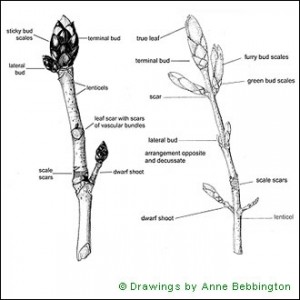
 n the last blog, I – and hopefully you – went out to snap off a twig from a cherry tree. I did that, except that the closest I have to a cherry tree is a prune tree, then began to examine it. Since I don’t have a lab now, I did the dissection with my tiny swiss army knife. The blade is a little over an inch long, and reasonably sharp after nearly 14 years of use. Here’s what I found.
The twig was dry and hard. When I cut it from the tree, I first cut off a piece about a foot long, then made another cut to create a six inch section of twig. I used the knife to slice a line around the circumference of the section about half an inch from one end. Then I cut lines perpendicular to the circumference line, about a quarter inch apart, around the section. After that, I used the edge of the blade to peel up sections of bark, one at a time.
Danger #1: When you look at illustrations of twigs and their parts, each section is shown intact, colored to set it apart from others, and often thicker than you find in the real thing. So, being mentally forewarned, I wasn’t discouraged when what I saw wasn’t what bark and cambium look like in the drawings in the book. The outside of the bark was easy to discern, but any cambium adhering to the inside was a little harder to decipher. After a section of bark was lifted, there was a relatively dark, thin layer which looked like it had been buttered on with a table knife. It wasn’t soft, but when I scraped it off, it was definitely different from the wood beneath. (more…)

 The discovery and appreciation of effective student work groups often emerges from involving students in community-based learning. Probably because the work, based in and on the real world, is authentic, and entrains central nervous system processes which are already in place. This is an important developmental learning milestone, and can be exploited to move yourself toward community-based learning as an integrated view of how to teach.
 This is the seventeenth installment of “Teaching in the Environment,” a new, regular feature by CLEARING “master teacher” Jim Martin that explores how environmental educators can help classroom teachers get away from the pressure to teach to the standardized tests, and how teachers can gain the confidence to go into the world outside of their classrooms for a substantial piece of their curricula. See the other installments here, or search Categories for “Jim Martin.”


