
by editor | Dec 31, 2011 | Environmental Literacy, Questioning strategies
“Lessons for Teaching in the Environment and Community” is a regular series that explores how teachers can gain the confidence to go into the world outside of their classrooms for a substantial piece of their curricula.
Part 7: From Hand to Mind
Concrete experiences generate learning for understanding
by Jim Martin, CLEARING guest writer
 ver the past few blogs, we’ve walked through a science inquiry done in a natural area. First, we noticed something there, then asked a question about it, and used the question to develop an investigation. We did the investigation, collecting data that we hoped would answer our question.
We’ve analyzed and interpreted our data, and now we need to communicate it. Most science standards and benchmarks overlook this piece of science inquiry, but scientists don’t. This is the place where you really nail down what you’ve learned. Something we often don’t do in American education
Communicating findings is an important piece of science inquiry. Preparing for this phase gives you a chance to look back on what you’ve done; where you started, what you did, how that affected your thinking, what new questions emerged from your work. A check to see if you understand, and, hopefully, appreciate what you’ve done. You know what one part of the world is, and what it does. I’m sure you’ll never pass that place, or one like it, and not think about what’s there and what it’s doing.
A good way to start the communication process is to make a poster with four sections. The first section states your question and provides background information about it, and why you want to find out. The second section lists the steps you took to answer your question. It should be clear enough that another person could follow your directions. (I used to have my students swap directions, try to follow them, and make recommendations for edits, point out pieces that were particularly well done, etc. What emerged was interesting for all of us.) The third section contains the record and analysis of your observations. The fourth section is a statement of your findings (your interpretation based on analysis of the data) and any next steps you would like to take.
When you’ve done this, and if you’re feeling particularly brave, post it where your students and/or colleagues can see it. Get them interested. You’ll find that they are curious about what you’ve done. Some of them may wish to do an inquiry themselves. How would you respond to that? You might find yourself working with a colleague to do a similar inquiry, or integrate yours into an interdisciplinary project.
If you’ve been following this inquiry, you know that it isn’t easy to find time and determination to actually go out yourself and attempt to do this work. We all have important things to do, are pressed for time, and don’t have a clear idea how to incorporate new work into an already full schedule. These are all understandable reasons for not trying this way of doing science inquiry. But they’re not effective reasons. One of the causes of the current dilemmas in education is that we rely on publishers’ curricula and mandates from the bureaucracy of education to organize our teaching, our delivery of one of the most important developmental pieces of each of our students’ lives, their education.
When you engage a science inquiry on your own, something most teachers have never done, you gain a perspective you can only achieve in this way. You can’t learn about it; you have to learn it by doing it. You put something into your head that no one can take away; that changes your view of science as something that is cluttered with disparate facts and processes that you have to somehow teach, and your students have to try to memorize long enough to pass the test on. You begin to see clearly that science isn’t just an extremely large compendium of facts and concepts, science made, but also an invigorating, exciting way to learn, science in the making. If you actually do an inquiry, you’ll know first-hand that it drives you into the books to find information – the seemingly disparate facts that we try, and largely fail to teach our students. You control whether you take the steps to gain this view of teaching. There is very little in your environment compelling you to do it.
So, what has this long exercise been about? Using the world outside your classroom to involve and invest your students in their educations, to develop their capacity for assimilating new learnings into conceptual schemata which are already there in their brains.
The important piece in the inquiry we’re working on is first going into the community to do work, then returning to the classroom after the outdoor work to follow up. It’s easy to let the second piece go, especially if you’ve never done work in the community with your students. Your students use these real-world experiences to establish concrete referents in the community; following up in the classroom allows them to use these referents to develop coherent symbolic concepts, that are part of the curriculum you deliver. There is a continuum from the community to the classroom, just like a road connects the country with the city, making a continuum of travel, and experience, from one to the other and back again.
Many teachers who venture out into the real world miss that opportunity. They allow the environmental educators they work with do the work, then return to the classroom and pick up on section 18.b.3 in their textbook. You can always tell environmental educators what your students are doing, and what you would like to do, and they’ll nearly always be able to work with you. The idea behind environmental education is to instill knowledge about environments into people’s world views. Doing inquiry in environments guarantees that new learnings will be assimilated, become part of the person, along with her concomitant views. As long as you follow up on them in the classroom.
This is a win-win situation. Most environmental educators rely on people (read school buses) to come to their sites, and most teachers rely on effective student learners to bolster their records for the number of students passing standards tests. Here’s the connection: If you turn your field trips into student-driven inquiry activities, then their brains, which are built to learn best in the real world, will begin the job of preparing them to pass tests.
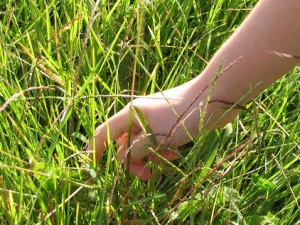
When human beings use their hands, their brains become very active. Especially when they use their hands to learn something new. The parietal lobes keep track of where we end and the rest of the world begins. This place is our skin. When we see and touch things in the real world, outside our skin, and know we’re there to learn, the parietal notifies other parts of the brain that are involved in this new learning. Concepts and knowledge already in memory are opened up, storage is set up for the new learnings, and these activities generate ‘needs to know.’ The needs to know drive them into the books and internet. That’s power.
Reflect on your experience if you did the casual observation in a natural area; do you recall your mind opening up? Recognizing what living things were there? What their names were? What information you already knew about them? Did you want to find out more? This is all set up for you when you start learnings in the real world. Then you use your teacherly skills to use this auspicious beginning to engage your students in real learning that will stay with them for a long, long time. Because it will become assimilated into concepts and understandings which are already there, in their brains. You can’t ask for better.
When students engage in self-directed inquiry in natural places, they become involved and invested in the work. Especially those students who aren’t seen as being ‘academic.’ Becoming invested in the work – a natural function of the brain in the real world – students want to know about what they are experiencing. This leads them to search for clarifying and amplifying information on their own. In the end, they learn for understanding, not just so they can pass tests. And they do pass the tests, especially those in the bottom 25th percentile.
Teachers whose students do this know it’s true. For the rest of us, it takes courage to free ourselves enough to give it a try, to start something like this, but we can do it. Start in your own school yard. Who lives there? Simple question; it can be answered at many levels. You’ll find that the main difference in grade-level approaches to answering this question are just in the vocabulary, complexity of sentences and paragraphs used, and the nature of details contained within the concepts. The main facts elicited will be very similar. Take ten minutes to ask this question in your school yard. Hard to squeeze in ten extra minutes, but worth the effort.
[/password]
 This is the seventh installment of “Teaching in the Environment,” a new, regular feature by CLEARING “master teacher” Jim Martin that explores how environmental educators can help classroom teachers get away from the pressure to teach to the standardized tests, and how teachers can gain the confidence to go into the world outside of their classrooms for a substantial piece of their curricula. See the other installments here.
by editor | Dec 30, 2011 | Schoolyard Classroom
by Harmony Roll, Taiga Teacher
 ou don’t need to be an environmental educator, you don’t have to stray from traditional norms, or be on the cutting edge to incorporate place-based education into your daily practice as a teacher. The goal is to create connections, connections to what the learners already know about the world around them. Activate their prior knowledge. (more…)

by editor | Dec 21, 2011 | Place-based Education, Questioning strategies, Schoolyard Classroom
“Lessons for Teaching in the Environment and Community” is a regular series that explores how teachers can gain the confidence to go into the world outside of their classrooms for a substantial piece of their curricula.
Part 6: The Easy Part
by Jim Martin, CLEARING guest writer

 e’ve been exploring science inquiry, starting with doing a casual observation in a natural area. In the last blog, I found an inquiry question. What did it tell me to do? I discovered how straightforward the Investigative Design is when it is built upon a clean inquiry question. The inquiry question I finally chose was, Where in trees do Fox Sparrows spend most time? That tells me what to do. Here are the steps it will take me to answer it.
1. Go to the place where I will do my study.
2. Observe for Fox Sparrows. I might do a continuous observation, or break it into 15-minute intervals. I opt for intervals so that, in case the data are inconsistent in their aggregate, they may be influenced by external events that I might notice on site. This provides more information than simple overall totals. (At this point, I may decide to add a section in my data sheets for comments.)
3. Write down the numbers of Fox Sparrows in the trees, and my estimate of how far above ground they are.
4. When the observations are completed, analyze and interpret the collected data.
5. Then, refer the interpretation back to the question. Did I answer it?
Let’s look at your question. If you wrote a clear one, it will tell you what to do. Think of what it’s telling you, and write it out in steps. Make sure that the plan, as written, is practical and details procedures which can be followed by another person. Be sure that the information gathered by your procedures will provide an answer to your question.
Tell yourself how your plan answers the question. Tie parts of the plan to particular parts of your question. Then think of other classroom things this work might be tied to: What information do the main parts of your plan bring to the answer? How would you use this piece to develop critical thinking? Technical writing? Formulating operational definitions? How might you use this as a writing assignment? To address the misconception that scientists’ endeavors are clean and straightforward from the get-go? (Your students need to learn how scientists really do their work. They should be able to look at a set of canned directions and tell you why they’re written as they are. While scientists may master most of the pieces of investigative designs, there is always some level at which they continue to struggle. That’s one of the things that keeps them in the game.)
Now for the easy part. Collect a good set of data by following the plan that you described. Record any glitches you encounter, and any modifications to the plan that you had to make. Keep clear records. Note anything that was not anticipated by your plan. This may become useful later.
Here’s what I found. I had to add ‘the ground’ to the list of places in trees where I might find Fox Sparrows. In fact, they spent all of the time I observed them foraging on the ground. This raised lots of questions in my mind. If I was teaching, and this was my class making the observations and raising the questions, I’d have to decide if it was possible, given my schedule, to let them follow up on some of the questions they generated. I have no standard answer to this dilemma other than to do what seems best for the students’ development at the time. I think I’ll take this topic up in a later blog. It has lots of repercussions on how you teach, and how students learn and become empowered.
Once you’ve collected the data, you can begin to organize it so that it makes sense to you. Use this experience to mentally organize the ways you will record your data in the future. For instance, did the way you organized your data record beforehand have to be modified? How? Why? Did your protocols anticipate what you would experience on site? This is an important learning experience that helps you develop the concepts and skills which underlie science inquiry. Pass these learnings on to your students.
Then illustrate the data in a way which clarifies it. This can be a graph, a diagram, an illustration. As you do this, you may experience some twinges of uncertainty: Am I using the correct method of illustration and analysis; does the data clearly demonstrate what I thought it would; is my data significant? This is a topic we’ll return to from time to time. We all pass lots of math classes, but rarely have to use mathematical analysis in real world situations. The more comfortable you are with it, the more comfortable your students will be.
The data generated by my Fox Sparrow observations pose a few problems. For one thing, they all fit into one category – birds on the ground. I suppose I could make a bar graph, with ‘ground,’ ‘lower branches,’ and ‘upper branches’ on the X-axis, and ‘Number of Birds’ on the Y. It would certainly drive home the point, so I might do it.
However, doing this forces me to think about how I responded to the fact that no birds were in the trees. I realize now that they didn’t stray far from the trees and shrubs where I was working. None strayed into a meadow nearby, or toward the lake shore. I know now that I should have divided the ground habitat in some sort of representative sections, and counted birds in them. I’d probably have found something interesting. This is a piece of science inquiry we need to look at again later – what is the place of negative results in science inquiry? They are important, so we’ll come back to them in a later blog.
Now to interpret our data. What does it mean in terms of your question? This is the place in the inquiry where you decide if your investigation has provided an answer to your question. Work and think carefully. Include a visual representation of the data. If your data doesn’t answer your question, what does it say? If what it says isn’t clear, then does it raise other questions? Can you use inquiry to answer them? I certainly can do that with my results.
Summarize in a few words what the data says to you in terms of your question. Make this a clear statement with an opening sentence, and two or three supporting sentences. Then state any further questions that your inquiry raised and posit any next steps. Do this as if you would follow up on your findings and investigation, even though you may not have time. The thought processes engaged are worth it.
Good inquiry questions tend to raise other good questions as they are answered. This is like a bank account with interest. My own summary is, ‘Fox Sparrows spent all of their time foraging on the ground. They stayed within several yards of the shrubs and trees at the edge of a meadow adjacent to the shore of a lake. Their apparent foraging habit means I need to make observations over the period dawn-to-dusk to determine whether and where they perch in trees.
We’ve finished the active inquiry part of the work. This also completes the more or less didactic nature of the blog thus far. We’ll become more conversational, and perhaps more thoughtful. I’d like to hear from you, your thoughts on the things I’m writing about, on the place of environments and classroom science, or other topics you’d like to address.
Next time, we’ll communicate our findings, something most science standards and benchmarks leave out, but without which science would stagnate. In the meanwhile, work with your data and summarize it. I’ve noticed that the process of inquiry involves both convergent and divergent thinking. If you don’t know about these categories of thought, google them. They are important conceptual organizers you can use to organize and deliver your curricula.
This is the sixth installment of “Teaching in the Environment,” a new, regular feature by CLEARING “master teacher” Jim Martin that explores how environmental educators can help classroom teachers get away from the pressure to teach to the standardized tests, and how teachers can gain the confidence to go into the world outside of their classrooms for a substantial piece of their curricula. See the other installments here.
by editor | Dec 13, 2011 | Environmental Literacy, Schoolyard Classroom
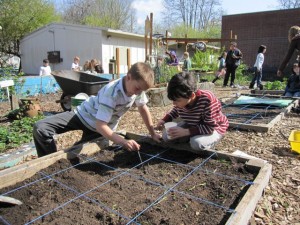
 On a quiet, residential, inner southeast Portland, Oregon street, a little elementary school is breaking new ground for the farm-to-school and school garden movement.
At Abernethy Elementary, students enjoy freshly cooked breakfasts and lunches prepared on site by a trained chef. The meals are often prepared with local and seasonal ingredients, some of which are harvested from the school’s Garden of Wonders. The garden itself is entirely planted, tended and harvested by the students, who use it throughout their school day as a “learning laboratory. “ (more…)
by editor | Dec 6, 2011 | Place-based Education, Questioning strategies, Schoolyard Classroom
“Lessons for Teaching in the Environment and Community” is a regular series that explores how teachers can gain the confidence to go into the world outside of their classrooms for a substantial piece of their curricula.
Part 5: Questions are Compasses
by Jim Martin, CLEARING guest writer
 The more things are spoken about,
The less of their truth remains . . . .
– Nanrei Kobori
 ur words, leaves falling from trees, in their numbers can obscure the realities they describe. Writing a clear, succinct inquiry question is not an easy thing to do, but can become relatively easy with practice. We can only think as clearly as how well we use the language we think with, can only travel as far as our thoughts will carry us. Clean inquiry questions facilitate investigative designs; cluttered questions do not. Our job now is to use our recent outdoor experiences and our facility with language to write a clean, clear, succinct, inquiry question. That done, we can assess it.
If you took me up on my suggestion, this week you wrote at least four inquiry questions around what you observed during your casual observation, and attempted to assess them. We’re going to work with those and the two questions I asked and use what we know about them to query your questions. Then we’ll use one of them to design an investigation.
Hopefully, we’ll turn yours into questions that you could ask your students, and which would lead them to make the observations necessary to answer them. To do that, you simply need to make your questions clear enough that they tell you what to do to find an answer to them. Good questions are interesting to the asker, simple and straightforward, answerable and practical, and quantifiable (measurable).
(You may have noticed that I am using various criteria to describe and assess inquiry questions. If you ask around, you’ll find many ways to assess them, each reflecting a different aspect of inquiry. These assessments aren’t graven in stone. Get to know as many as you can, and you’ll find a handful will make great sense to you. Use them. In time, you’ll add others as they begin to make better sense. We’re all on a journey, traveling at our own pace, but moving toward the same destination.)
Pull out your inquiry questions. Choose one you’d most like to answer. This is the inquiry question we’ll start with. Let’s assess it. Your question should be interesting to you, simply stated, answerable by making observations, and doable. Notice that I’ve substituted doable for quantifiable. I’ve decided to mentally include quantifiable in observations. The main point is that questions have to have a sharp focus that creates a picture in your mind, that tells you what to do, and that you can actually do what it tells you. In your own mind, sort out three or four descriptors to use to assess your questions. I’ll use the four I stated earlier for the moment. Let’s use them one at a time to assess my two questions, then yours.
Interesting to you. You’re not likely to learn much from seeking an answer to a question which is uninteresting. Nor are you likely to invest enough in it to bring the necessary care and attention to detail that the work demands. If you’re a student, investigating the question may not drive you into your textbooks for needed information. Assign your question’s interest to you on a scale of 1-3, and write down, or at least think about your reason for this assessment.
(Something to think about: “How” and “why” questions – some questions are too large for a single inquiry. They may tell you what you want to know, but are too general to focus a single investigation upon. They usually have other questions ‘embedded’ within them. For instance, if you ask, “How do leaves on the bottom of a pond affect dissolved oxygen in the water,” you need to know where leaves are and are not, what the concentration of dissolved oxygen is where there are and aren’t leaves, what processes are entrained by leaves when they fall into the water, which of these processes use or produce oxygen, and so forth. Any one of these ‘embedded’ questions can be made the subject of an inquiry. Taken together, their answers may begin to answer the larger question.).
Simply Stated. If your question is complex, it may represent more than one question. Other questions are embedded within it, much like bricks in a sidewalk. ‘Why’ questions fall into this category. Asking why cottonwoods grow on stream banks does not suggest observations to make. Or, the question may contain so many components that it will be cumbersome to design an investigation around. For example, What determines how far from the water’s edge cottonwood trees grow, depth of the water, depth of the water table, growth rate of cottonwoods, soil types at various distances from the water’s edge, or the height of adult trees? The best questions are simple sentences like, “Where do birds perch,” or, “What kinds of macroinvertebrates inhabit rocky bottoms?” Again, assess your question on a scale of 1-3 and know your reason.
Answerable by Making Observations. You should be able to answer your question by observing its subject, and measuring or counting something about it. If your question is about what type of bottom macroinvertebrates ‘like,’ then you would have to ask them how they like rocks, mud, decaying leaves, and so forth. Would you be able to tally and count their responses? (You could ask about how many are present in each kind of bottom, and make an inference about preference.) Score your question and know why.
Doable. If your question involves the subject in the future, then you won’t be able to make an observation today. For instance, “How many of these salmon eggs will hatch in the spring?” is an inquiry question that you couldn’t make an observation upon today. If you need a room full of equipment to make the observation, or need to observe over a period of weeks, but only have one day, answering the question may not be doable. Assess your question and know why.
Add your scores and divide by 4. This number, your overall score, should be very close to 3. Now what? What does your assessment tell you about your inquiry question? Is it a good question for you to ask, or should you make some changes to it? If your Overall Score is less than 3, then go back to the question and modify it based on the assessment criterion that you scored lowest on. Or, you may have to abandon it for now.
Rework/rethink. If you edited your question, then re-write it. Make notes so that you won’t forget what you were thinking as you rewrote it. (This is a good thing to remember when your students are experiencing the same thing. These thoughts are important, and are generally lost if not preserved in writing.) If this question won’t work, go to one of the others you wrote, find one you think might work, and assess it. This may take time, but the learnings are invaluable.
Congratulations! You’ve just completed the most difficult part of the inquiry process. While it may not seem so, this is the piece that engages you (and your students) in active critical thinking. Pay attention to your students when they are framing inquiry questions. The difficulty they encounter and frustration they feel is what we all experience when we do more than simply memorize more facts. Like anything else we ask our brains to do, the process becomes easier with practice.
Here’s my assessment of my two questions.
Do Fox Sparrows spend more time in the upper or lower branches of trees?
• Interesting to me: 3. I’m intrigued by the idea of birds partitioning trees, so this is right down my alley.
• Simply stated: 2. A better sentence might be, Where in trees do Fox Sparrows spend most time? I’m ambivalent, though, because the question, as stated, tells me precisely where to look.
• Answerable by making observations: 3. I listen and look and write down where they are. Done deal.
• Doable: 3. I have an hour. I’ll do it.
So, I tweak my question and I’m ready. A nice outcome of this is that my question tells me what to do; how to design my investigation.
What causes Fox Sparrows to fly south in winter?
• Interesting to me: 3. I’ve always wondered why birds fly south.
• Simply stated: 2. I think it’s almost a succinct sentence. I might try tweaking it.
• Answerable by making observations: 1. I can’t think of all the things that cause birds to fly south in winter. I could probably come up with a short list, but I don’t know if I have the capacity to investigate them.
• Doable: 1. I don’t have the lab I’d need to do the behavioral and physiological studies, nor the time to make detailed field observations here and enroute south. I give up!
So, I have a question, but its assessment score is low. What does it tell me to do. Simple. I either drop it, or find one of the inquiry questions embedded in it to answer. I think I’m beginning to appreciate succinct questions.
I’ve got a question, the first one I wrote, and now I need to design an investigation to answer it. My question tells me what to do, so I’ll list the steps it will take in the order that I’ll do them. Pretty straightforward. From here on out, the job is relatively easy, I just complete the work, one step at a time. The next time we meet, we’ll write the investigation’s design, talk a little about collecting data, and what we do with the data once we’ve collected it. In the meanwhile, choose your best question and assess it. Sounds a little hoaky, but if you’ve never done this work, it will be time well spent.
This is the fifth installment of “Teaching in the Environment,” a new, regular feature by CLEARING “master teacher” Jim Martin that explores how environmental educators can help classroom teachers get away from the pressure to teach to the standardized tests, and how teachers can gain the confidence to go into the world outside of their classrooms for a substantial piece of their curricula. See the other installments here.


 This is the seventh installment of “Teaching in the Environment,” a new, regular feature by CLEARING “master teacher” Jim Martin that explores how environmental educators can help classroom teachers get away from the pressure to teach to the standardized tests, and how teachers can gain the confidence to go into the world outside of their classrooms for a substantial piece of their curricula. See the other installments here.
