by editor | Jan 15, 2011 | Outdoor education and Outdoor School, Place-based Education
by Lindsay Letitia Huettman
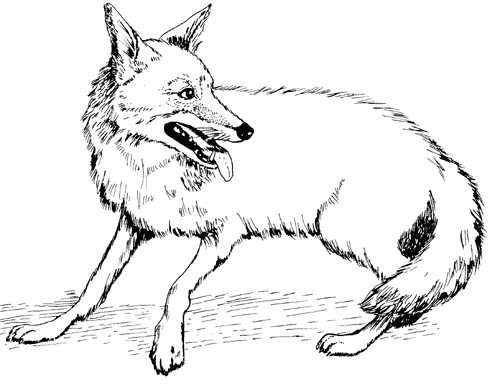
I am out in the foggy, wet Pacific Northwest winter with my 10-12 year-old homeschoolers’ program, heading to an amazing place we call Elk Meadows. As we cross the meadow, we stop for a word of thanksgiving about the day and send the kids to their Sit Spots. The instructors also head out into the landscape, finding a place to rest and watch the morning wake under the goliath presence of Mount Si. Life is revealed to all our senses in this temporary silence. As a mentor, it helps to model to my genuine excitement at the small birds in the willow thicket while enduring the cold, damp earth that I rest upon. This is a great time for instructors; a sacred time to breathe and connect to the elements, earth and its creatures. It is also the time I invite Coyote to come out and do his secret, stealthy duty as the ultimate mentor. During this peaceful space, Coyote brings me glimpses of the internal workings of my beloved students.
If any of the students were looking my way, they would see my attention on the meadow; my head turning to interpret bird calls. Perhaps they see my chest moving up and down, taking large gulps of the mist rolling off the Snoqualmie River, and observe my eyes scanning the horizon, searching for elk on the forest edges. What they wouldn’t see is a part of my awareness is also listening to Coyote. (more…)

by editor | Dec 31, 2010 | Place-based Education
by Becs Boyd
On 16 November I made a return visit to Sunnyside Environmental School in Portland, Oregon, the K-8 (kindergarten to age 14) which I first visited back in May. This time my conversations with the principal, Sarah Taylor, and with teachers and pupils, focused on what makes the school special, and on how best to help other schools keen to start along the path of Place Based Education. (more…)

by editor | Dec 27, 2010 | Learning Theory

The Arboretum Trust
Do you know Meet a Tree? The exercise where you blindfold one kid and their buddy leads them to a tree. Then, after the blindfolded is removed, the child goes and finds their tree. Yawn.
Don’t get me wrong, I’ve seen kids enjoy this. I believe they do get some value out of it. I also believe that many outdoor educators abuse this like they do all other stock and file-card activities. It’s something for kids to do. It’s in the nearly official Environmental Educator’s Game Guide.
I’m an animal tracker. I teach it to both kids and adults. I use all my facilities and gut instincts to follow bears, cougars and bobcats across epic landscapes. I deftly understand the reasoning behind sensory based curriculum. It’s great that these kinesthetic activities begin to receive more and more credibility in a world of water quality testing and DBH. Unfortunately any game or activity can also be a crutch for educators. (more…)

by editor | Dec 24, 2010 | Conservation & Sustainability, Environmental Literacy
Big Ideas from the field of Environmental Education and their Relationship to Sustainability Education
— or —
What’s love got to do with it?
.
.
 By Donald J. Burgess and Tracy Johannessen
Introduction
 common raven suddenly begins to call from Cornwall Park. I rush to the front porch trying to see what the commotion is all about. Two adult ravens are flapping high over the green canopy, croaking vigorously. Like vigilant Block Watch captains protecting the integrity of a neighborhood, ravens exhibit exceptional observational prowess coupled with intense fidelity to family and place. I scan the forest with binoculars and notice three raven fledglings perched in a scraggly birch tree at the edge of the forest. Scanning higher, I finally detect a distant bald eagle circling over the urban park where the ravens have nested for a decade. Ravens recognize an opportunistic predator like a bald eagle as a “threat to the neighborhood” and they act decisively to protect their home. The raven’s objection is clearly articulated through their vocalizations and aerial antics and the bald eagle soon circles out of sight.
Why is it that when human observers experience an ecological threat and speak out in alarm (warning against drilling oil 5000 feet below the ocean surface or climate change) that our most heartfelt appeals remain ineffective? Is it an inability to understand the true threat to our children? If we truly perceived the ability of humanity to survive as linked to the ecological integrity of our surroundings, would the human response to these cries of alarm be different? What roles do love and caring play? (more…)

by editor | Dec 9, 2010 | Climate Change & Energy, Conservation & Sustainability, Outstanding Programs in EE
The Cool School Challenge engages schools from all across the country in strategies to reduce CO2 emissions
 by Katie Fleming, Rhonda Hunter & Kimberly Cline
Extreme weather events, rising sea levels, melting glaciers – oh my! While climate change is an overwhelming issue, there is certainly hope, especially in the collective power of individual actions to reduce greenhouse gas emissions. That’s the underlying principle of the Cool School Challenge, an innovative climate education program that motivates students, teachers and school districts to reduce carbon dioxide (CO2) emissions school-wide. At the heart of the program is the philosophy that big changes start with small steps – and taken together, simple individual actions create a world of difference. Cumulatively, we CAN reduce our carbon footprint and it’s already happening! (more…)


