Exploring Place-based Education Programs in the Pacific Northwest
by Becs Boyd
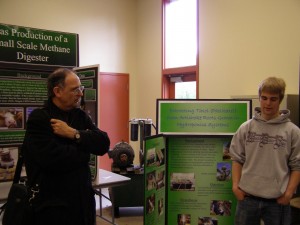
On 8th May I meet Ed Armstrong, grant writer for Tillamook School District, outside Tillamook High School in north-west Oregon. I’m here to find out about the amazing work Ed and others have been doing in connecting the six schools in the Tillamook School District with their community and with School Districts State-wide.
Ed’s background is as a biology teacher at Tillamook HS from 1995-2000 when the school was one of 25 national Annenburg Schools for science. He returned after a break in 2004 to become grant writer for the entire School District, and, using this wider influence and the $6m of grants he has secured, has been at the centre of a small revolution in science teaching in Tillamook which has been internationally recognised. (more…)
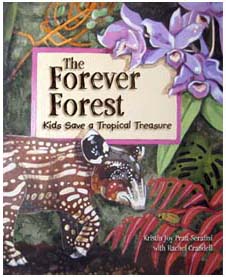
By Kristin Joy Pratt-Serafini with Rachel Crandell
Published by Dawn Publications
Reviewed by Emily Baker LeRoux
As a home schooling mother of two, I have to admit I like books. I mean REALLY like books. They seem to multiply in our house and I like to think of it as literary decoration. It works for us though; I find both kids sprawled in various rooms throughout the day with a pile of books next to them.
I first stumbled across The Forever Forest while browsing at the library on the never-ending search for books for my six-year-old animal-loving kid. Upon first glance, I thought this was just another book on the animals that live in the rainforest but I knew he’d love it so I checked it out. It turned out to be so much more. (more…)
In her celebrated The Classic Italian Cookbook, Marcella Hazan wrote: “What people do with food is an act that reveals how they construe the world.” At the time — 30 years ago — it was a sentiment that needed a word of explanation; the Japanese meal respects aesthetics, the French cuisine respects subtlety, Italian food respects its ingredients.
We now take what we eat much more seriously, and it is timely to ask: What does a school lunch of reheated burger and chips have to say about how we construe the world? For that matter, what does it say about how we construe the nature and purpose of education?
Pausing to ponder the nature and consequences of a burger bar in the center of Rome was how a major eating revolution began. Carlo Petrini, a prominent Italian journalist, was walking past a newly-opened McDonald’s franchise when he stopped and said: If this is fast food, why not have slow food? In much the same way, I was thinking about the standards-based school curriculum, with its emphasis on regurgitated gobbets of knowledge, when I recognized the analogy with fast food. What we have created, with our tests and targets, is the fast school, driven by standardized products. So why not devise a slow school, driven by an emphasis on how ideas are conceptualized, just as slow food is driven by how the innate qualities of ingredients can be realized? (more…)
We need new strategies to preserve the habitability of the planet.
by David Orr
TRADING STORIES one day about smart animals, I heard from an old farmer who described a wily fox that appeared at the edge of a clearing in which his dog was tethered to a pole in the yard. Inferring from the pattern of tracks, the empty dog dish, and the fact that the dog was bound up to the pole, he deduced that the fox had run in circles just outside the radius of the dog’s tether until he had tied the dog up, at which point he strutted in to devour the dog’s food while the helpless mutt looked on.
Something like that has happened to all of us who believe nature and ecosystems to be worth preserving and that this is a matter of obligation, spirit, true economy, and common sense. Someone or something has run us in circles, tied us up, and is eating our lunch. It is time to ask who, why, and how we might respond. (more…)
Recently Gregory Smith, Professor in the Lewis and Clark College Graduate School of Education and Counseling, received a $19,380 grant from the Gray Family Fund of the Oregon Community Foundation to train teachers in the West Linn (OR) School District on environmental issues. The Environmental Education Program seeks to encourage a strong local land ethic, sustainable communities, and stewardship of the natural environment by citizens throughout Oregon. The Fund is committed long term to institutionalizing a series of age-appropriate experiences that build a sense of place and responsibility towards Oregon and the region.
The Sustainability Education Initiative is a program of professional development coursework and activities for K-12 teachers in the West Linn-Wilsonville School District. During three courses offered in 2009, Smith prepared 50-60 teachers to incorporate sustainability issues into their classrooms and help them implement school or community projects that will enhance local natural and social environments. Participants will be eligible for small seed grants to fund start-up projects. The grant aims to increase the number of teachers implementing sustainability projects in schools, and increase student and educator awareness of local natural systems, ecologies, and social needs.