by editor | Jul 27, 2010 | Marine/Aquatic Education
by Gene Williamson
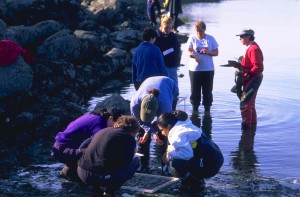
Forty years ago, when I first decided that I wanted to teach about the oceans in my 8th grade classroom in Corvallis, I was faced with a daunting task. Not only were there only the sketchiest of materials available, the prevailing wisdom was that students were not capable of dealing with sea floor geology, tides, and similar topics. There was no course of study or a common understanding of what we wanted to teach and how. Several other Oregon teachers were having similar problems. We met to discuss our mutual conundrum and, as a result, NAME was born. (more…)
by editor | Jul 27, 2010 | Marine/Aquatic Education
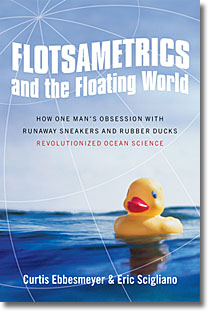
 How One Man’s Obsession with Runaway Sneakers and Rubber Ducks Revolutionized Ocean Science
Authors: Dr. Curtis Ebbesmeyer and Eric Scigliano
Publisher: Smithsonian Books/Harper Collins
ISBN 13:9780061558412
Reviewed by Orlay Johnson
If you would enjoy learning about the life and times of Dr. Curtis Ebbesmeyer, a UW graduate and Seattle oceanographer best known for tracking ocean currents using sneakers and bath toys lost, then sit back and enjoy. Flotsametrics, is co-written by Dr. Ebbesmeyer and Eric Scigliano, a local science writer.
It is a fun read, with plenty of oceanographic insights, some very personal experiences and a glimpse into the very “way out” thinking that allowed Ebbesmeyer to champion some bizarre ideas, like using Nike sneakers and bathtub toys lost off of freighters to study massive oceanic gyres. (more…)
by editor | Jul 7, 2010 | Outdoor education and Outdoor School, Questioning strategies
by Jude Curtain
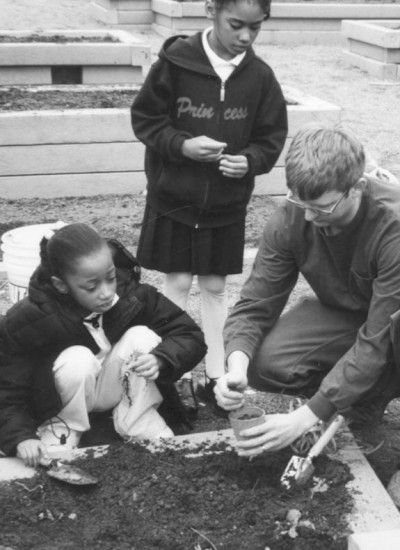
The sun was shining. There was just a hint of fall in the September air. Twenty three fourth graders were hunched over their white dishpans, excitedly sorting through their samples of forest litter. So began a series of lessons designed to guide students in generating questions, creating investigations, and ultimately finding answers.
Lesson #1: Noticing Details
My experience has been that children need training to be good observers. My first lesson engaged students in examining a container of forest litter, sorting all the things they discovered in their samples, and recording each item in their science journals.
Lesson #2: Open vs. Closed Questions
We defined closed questions as those that had a simple “yes” or “no” answer. Open questions were those that required an explanatory answer. Examples of both types of questions were generated first by me, then by the students in a class discussion. (more…)
by editor | Jul 6, 2010 | Environmental Education News
By Gregory Smith, Associate Professor of Education
Lewis and Clark College, Portland OR
June 10, 2010
As conditions globally and in the Pacific Northwest worsen, it seems increasingly imperative that individuals and organizations concerned about environmental and social health find ways to achieve a higher level of collaboration than they have so far been able to demonstrate. The difficulties faced by British Petroleum and the federal government as they attempt to deal with the Gulf oil spill foreshadow the inability of large, centralized institutions to deal with the crises of climate change and the peaking of oil production. In addition, the long period of economic growth humankind has enjoyed for the previous century could well be coming to an end—in fact may need to come to an end if we hope to lay the foundation for more sustainable societies. (more…)
by editor | Jul 6, 2010 | Outdoor education and Outdoor School
by Rob Sandelin
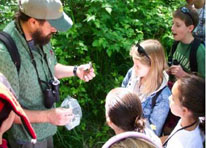
 My primary goal as an educator at the Environmental Science School is to create connections between students and nature. I do this because I believe once students have a deep connection to nature, they become advocates, often for the rest of their life. We have lots of time and experiences with nature as part of our program.
An example. We spent several trips a few years ago along a certain creek watching, counting and learning about salmon. We watched a female dig a redd (her nest) and the whole cycle. Every time we went back the kids looked for red girl, as they had named her. During one rainy day the kids noticed a pipe dumping gunky water into OUR stream onto OUR fish. They were outraged. We followed the pipe back and discovered it was a street drain, full of crud and oil from cars off the road. I did not tell them how to feel or act, they did that on their own, based on their connection to that place. After school they ALL met and cleaned up that whole street, then, unknown to me, a bunch of them went to an evening political debate between a couple of candidates for mayor. They stood up in a room full of adults, and demanded to know what the candidates were going to do about the street drains in our town which dump oil and gunk onto OUR salmon stream. They were articulate, bright and passionate advocates.
As far as I am concerned, this is why I teach.
Rob Sandelin is a naturalist and environmental educator who has since childhood spent much of his life observing and studying nature in the mountains of the Northwest. He has served as a park naturalist at Yosemite National Park, Olympic National Park, and Denali National Park. Currently he teaches field skills to student naturalists at the Environmental Education School of the Sky Valley Education Center in Monroe, Washington. He is the author of This Week in the Woods, a series of natural history essays; the Cohousing Resource Guide; and the Intentional Communities Resource Pages website. He lives with family and friends in the Sharingwood Cohousing Community in Snohomish County.


